The Healing of Heisei Anime

EvangelionIt’s difficult to succinctly describe or summarize anime and manga in the Heisei era. After all, that’s a lot of time to cover, from 1989 to 2019. But when I think about the works that have come out over the past thirty years, one word keeps coming to mind: therapy.

The Heisei era is defined by many things, but one of the biggest is the bursting of the 80s bubble economy, leading Japan into a recession it’s never fully recovered from. It has affected everyone young and old, flipping norms and assumptions on their heads as the idea of a stable future weakened and crumbled. I find that many of the trends in Heisei anime reflect this uncertainty. Heisei covers the birth of healing anime. It marks the emergence of concepts in Japan like NEETs, hikikomori, and fear of declining birth rates, which then make their way into anime. Deep introspection and escape from reality alike were in full force, asking viewers whether they needed to manually get away or to find solutions.

In that struggle between therapy as problem-solving and therapy as respite, in my opinion there’s no show as emblematic as Neon Genesis Evangelion. While it takes from works past, what Evangelion does so well, and part of why its legacy has endured for so long, is that it pushes the psychological fears and doubts of its characters to the forefront, enveloping viewers in their inner worlds. Their struggle to understand themselves and navigate youth, violence, love, and lust is still powerful today. However, another significant part of Evangelion‘s legacy is the commodification of its characters, their wispy yet mature bodies the subjects of figures, posters, ad campaigns, and more. Their idealized forms themselves provide a form of fantasy that consequently flattens and simplifies their presences.

And yet, that doesn’t necessarily mean the two sides of Evangelion never mingled, and their dual influence is reflected in 21st century anime culture in major ways. Whether it’s Rei as the progenitor of the “emotionless” blue-haired girl trope or Shinji and Kaworu as an evergreen fujoshi pairing (despite, or perhaps because it only lasts one episode), the clash of consumption, creation, reflection, and escape all continue to swirl around today. It’s fitting that the Rebuild of Evangelion movies, which show the characters trying much harder to communicate with one another and overcome the cycle of doubt and despair, is set to conclude in the Reiwa era after a ten-year delay.

The anime of the past three decades hasn’t been all doom and gloom, nor has it solely been a psychological bomb shelter shielding its viewers from the world. Heisei birthed the Yuusha/Brave franchise, with its positive messages (albeit with the occasional sprinkling in of anti-toy-company cynicism). It covered Sailor Moon and Ojamajo Doremi and Precure in terms of magical girl works that give viewers a sense of hope and optimism. Perhaps the function of these shows, however, is that they also provided positive messages to young kids in a society that didn’t necessarily provide it through other means.

While anime as therapy was born out of Japan’s own recent history, I think the global success of anime in the Heisei era shows that there were people all around the world who needed it as well, myself included. As is probably the case for many reading this, my entire otaku history has been in the Heisei era, and in retrospect I have to be amazed at how much it’s shaped my life even from the perspective of “therapy.” I learned to embrace unconventional views of masculinity and femininity through Cardcaptor Sakura. I found peace and comfort (but also artistic inspiration) from Hidamari Sketch. I discovered what means to live with confidence by reading Genshiken. I made introspection a part of my life thanks to Evangelion. This won’t necessarily change just because there’s a new emperor on the throne of Japan, but I hope I can look back again in thirty years with a similar fondness.

This post was made possible thanks to Johnny Trovato. If you’d like to request a topic or support Ogiue Maniax in general, check out the Patreon.

Spoilers Matter

Between Avengers: Endgame, Game of Thrones Season 8, and the upcoming Star Wars Episode IX: The Rise of Skywalker—all concluding parts for their respective stories—pop culture has been in prime “spoiler warning” territory. If you’re plugged into any sort of social media, and you don’t have the opportunity to watch things as they’re released, it can be a struggle to avoid any and all information. This also means it’s incredibly easy for a few trolls to ruin other people’s days, but what I’m even more concerned about is a recurring notion I’ve been seeing, about how people’s anger and frustration over being spoiled is some kind of sign that these works are less about art and storytelling and more about shock value and surprise. They might even say something like, “Truly good works are good even when spoiled.”

Perhaps they’re right. Perhaps they’re not. Either way, it still doesn’t mean that a desire to go in relatively “blind” is somehow valueless. In fact, I find it to be quite rude and even a little elitist to value a work over people’s own desires to such an extent that negatively impacting their experience is somehow “okay” because it shows how “limited” both the people and their “shocking” entertainment can be. While it’s true that some things stand the test of time better than others, and that a piece of media that can be enjoyed over repeat viewings is strong in many ways, you still only get one chance to see something for the first time regardless. Just because something is even better the second or third time around doesn’t mean that the initial exposure should be diminished.

Granted, even without spoilers, “going in blind” means different things to different people. Some might have ideas as to what they think will happen, and will be bracing for the moment that their pet theories are confirmed or denied. Others might be looking at character interactions and trying to see if their chosen characters have any romantic developments. Personally, I purposely try to avoid pushing my expectations onto a work as much as possible. But whatever one’s approach, and even if a work holds up after spoilers, being aware of what happens changes the way a work is experienced. You go from trying to navigate the work on your own terms to being aware in the back (or front) of your mind that an Important Thing is going to happen. That’s not necessarily bad, but if you view a work once without spoilers and then a second time with spoilers, it means you get to have both experiences.

Note that there are a few caveats. The choice of spoilers vs. no spoilers is anything but binary, and that something as simple as a movie trailer can be “too much” for some and “not count as spoilers” for others. There’s also a difference between “being okay with spoilers” and, say, people who want advance warning on anything that might trigger them and cause deep psychological pain. And for instances where a work might come from a very unfamiliar time and culture, and not knowing the proper context can mean not catching many of the meanings and signals that are assumed to be “obvious” or “common sense” to anyone from that original time or place. Foreknowledge can be significant, but having it isn’t inherently better than not having it. First impressions can potentially be based in ignorance, but that ignorance can be corrected afterwards. You can’t take back a spoiler.

If all a film, TV show, book, or whatever has is shock value, so be it. If it has more to offer, all the better. That still doesn’t make those who wish to be surprised or who wish to focus on the unexpected somehow symptoms of an ailing entertainment industry, or make their experiences trivial. They can always come back, and if the problem is that people don’t want to revisit after the first go-around, that’s not an issue with anti-spoiler culture—that’s an issue with time and its usage. But ultimately, if people only have enough time to see something once, they should be able to do it on their terms, and not ones set by some externally imposed values rooted in notions of how “true quality” is defined.

Hip Hop Manga: “Change!” and “Wondance”

Whether by chance or perhaps some broad editorial intent, it’s a curious thing that hip hop culture would be a prominent theme in two currently serialized Kodansha manga in Japan. Change!, running in Monthly Shounen Magazine, is the story of a Japanese poetry-loving girl named Shiori who ends up being drawn into the world of rap battling. Wondance, from Monthly Afternoon, focuses on an athletic boy with a stutter who discovers hip hop dance as a way to express himself. Each series, almost by necessity, takes a very different approach to their respective subjects, and juxtaposing the two highlights the power each work possesses.

Change! naturally places great emphasis on verbal dexterity as a series about Japanese rapping, and there are certain aspects to the language that make it differ from English rapping. Japanese has fewer vowel sounds, which means that many more things in the language can technically rhyme, which in turn means that the rhymes that do occur can be even more varied yet precise aurally. The heavy emphasis on syllables also gives Japanese a certain sense of rhythm, especially because extending those sounds can change the meaning of a word entirely.

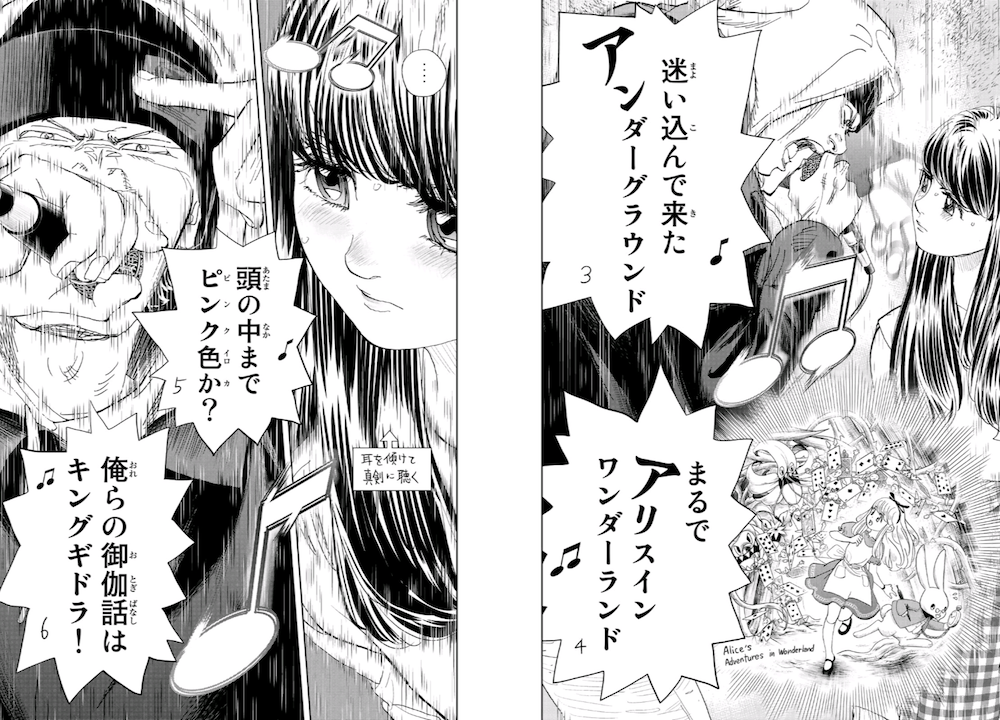
All of this needs to be effectively conveyed in the manga, and the approach Change! takes is to place more emphasis on word balloons than most manga. Words and syllables can appear larger or more erratic in order to highlight what key words in one line are being correlated with in the next line. The classic staple of many manga, furigana to aid in the reading of difficult kanji, take on added importance due to both the sheer number of homonyms that exist in Japanese and to make sure the reader keeps track of what’s being said syllable by syllable.

In the images above, the male rapper connects the word “underground” with “Alice in Wonderland,” working off the fact that andaaguraundo and Arisu in Wandaaraando both start with an “a” and have the similar raundo vs. rando. He then follows up on the next page with Atama no naka made pinku iroka? / Orera no otogibanashi wa Kingu Gidora!, or, “Is even the inside of your head the color pink? / Our fairytale is King Ghidorah!” Pinku iroka lines up perfectly vowel-wise with Kingu Gidora, and the talk of fairy tales follows up to his comparison of Shiori as being as out of her depth as Alice is in her story. While the passionate expressions and the metaphorical imagery shown contribute to the atmosphere and to hammer home the meanings behind the words, the actual word balloons do a great deal of heavy lifting.

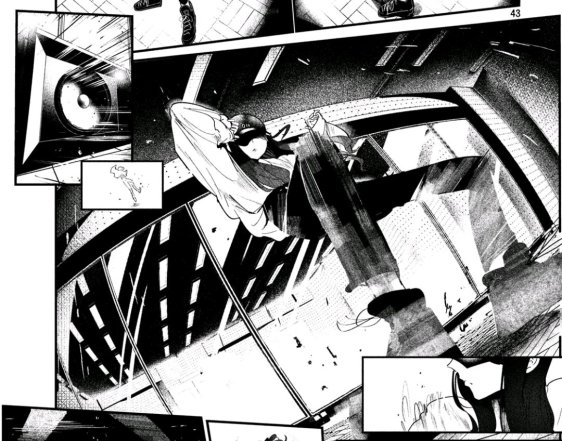
In contrast, although Wondance can be fairly wordy at times, when it comes to dancing, the manga is very much in the “show, don’t tell” category. Characters move with grace and intensity, and panels highlighting their steps litter the pages, turning them into virtual collages that practically crackle with energy. Text is sparse, and primarily brief glimpses into how the characters are thinking in the heat of the moment.

In the pages above, the main character and Hikaru—the girl who brings him into the world of dancing—are dancing together in a class. The paneling supports the character artwork, emphasizing a sense of the two as a duo in sync with each other on some deeper level. This visual approach calls to mind the elaborate paneling of 1970s shoujo manga such as Swan, where panels cascade and climax in beautiful ways. The drawings capture not just the dance but the emotions of the dancers as well, making their moves the central vehicle for storytelling. In a sense, one doesn’t even need to know Japanese (or have a translation handy) to get the essence of Wondance.

Thus, on the one hand, you have a series where the words are of the utmost importance and another where images hold the power. However, they both draw upon the visual language of comics and especially manga in fundamental ways through their particular emphases. Change! and Wondance capture some of the magic of hip hop culture itself as a multi-medium, multi-angle fusion of various ingredients.

The Confession: “The World God Only Knows” Five-Year Retrospective

April 12, 2019 marks the five-year anniversary of a momentous occasion: the day of the final and most important love confession in the manga The World God Only Knows. There’s a lot that’s special about this particular ending, not least of which was the internet’s powerful reaction to it, best encapsulated in the image below, which collects before and after reactions toward the reveal. For those who want to avoid spoilers about this series, or those who would feel offended by typical 4chan speech, it would be best to turn back now. For those who want to stay, I hope you like hearing me wax nostalgic about what makes this conclusion so great.

Continue reading

Changing of the Guard in Fandom

ComicsGate, or what remains of it, has been a thinly veiled campaign to bully women out of comics, and the “movement” itself is hardly worth talking about as anything more than unjustified harassment. However, I find that it pulls its energy from a profound change occurring in readers of the superhero genre: the ever-increasing presence of women as both readers and creators, and with it, a change in how the comics-reading community determines what is worthy of praise. I’ve seen it on a personal level, as I went from understanding comics fandom as a boys’ club filled with casual sexism and jokes about Hal Jordan’s punches to one where a mutual understanding and acceptance of such things can no longer be assumed.

I previously wrote a blog post exploring the interaction between canon, fanon, and headcanon, and in it I used those terms the way one would when talking about narrative continuity. However, I think the contrast between those concepts still exists if we use the other definition of “canon”: the commonly accepted masterpieces of a given medium. The challenging of “canons” and “fanons” in that sense is what I’ve seen as a result of the changing demographics of superhero and comics fandom. Over the course of many years, women and girls have come in with their own ideas about which artists to respect and what ideas should be taken away from a given comics, and those deeply entrenched in the older ways feel the ground shifting beneath them. Guys like that can be vulnerable to a smooth-talking neckbeard snake whispering to them, “They’re changing the rules. They’re outsiders. What happened to the things that matter?” Losing the place they belong can be more important to some than trying to address political issues in communities.

Fandom is built in partly on passion, partly on accruing knowledge and experiences. This combination lets fans both embrace that which they love—be it a book, musician, film, or anything else—and perhaps even take it to places that the work by itself would never travel. Fandom creates communities and communication, and it encourages fans to pool their resources together and establish some common ground. But when that common ground is challenged, or finds its foundation shaken by newer generations eager with different preconceived notions of what’s good or acceptable in both people and works, it can create schisms between fans.

In a way, it reflects the world’s politics at large, as previously established majorities have seen their numbers slowly dwindle in ways where numbers alone will not let them hold onto power, and a loss of influence can be downright frightening for those accustomed to always being on top in their own universes. Even if there’s an intellectual understanding that the actions of today are meant to address certain past injustices, it can be a bitter pill for those who assumed a stable foundation in their comics fandom.

You (Meaning I) Don’t Need to Know Everything

The original intention of this blog post was to review Ikeda Riyoko’s Claudine, a scandalous and emotionally intense look at a man born in a woman’s body and the complications it brings. It provides an interesting contrast to Ikeda’s most famous work, The Rose of Versailles, whose protagonist, Oscar, is raised as a man but is ultimately a woman inside.

However, as I tried to shape my thoughts on Claudine, I began to worry about whether or not I was the right person to be writing about a transgender-focused manga, never mind that Ikeda herself, as far as I know, isn’t transgender either. It’s not as if I haven’t written about similar topics before, but I’ve been increasingly self-conscious about it. My concern with writing about Claudine was that I do not know how actual transgender people might experience its narrative. Is the dominant tragic aspect of the manga considered a step backwards?

Then something dawned on me. While I consider my constant desire for knowledge a strength, this pursuit of expertise has its downsides, one of which is an inner need to say things from a place of authenticity that isn’t necessarily in reach. I expect myself to be able to understand everything eventually on a deeper level, but in some situations, as with the transgender experience, there’s only so far I can go. While there are many ways I don’t match up to the ideal male image society upholds, I don’t know what it’s like to feel uncomfortable in my own skin to that degree—to feel like who I appear to be on the surface isn’t who I am.

What I’m realizing is that it’s okay that my knowledge will forever be limited to a certain degree. I don’t need to try and be an expert in everything; I can listen to the voices of those with direct experience and those who dedicate their lives to the pursuit of equality. Support when I can, guide when I can, and learn when I can: that’s the way to approach life, especially as I grow older.

PS: I’m well aware of the irony of me taking what should have been a review of a manga about a member of a trans man and making it all about me realizing the limits of my emotional knowledge when it comes to trans people. I hope you’ll forgive me.

Privilege is a Super Meter: A Fighting Game Analogy

The concept of “privilege” is a tricky one, because it’s extremely apparent to those who lack it, and yet often unnoticeable to those who possessed it. And given the dominance of the white male in gamer culture, others have attempted to make video game-based analogies to help the unaware comprehend “privilege.” But the most prominent comparison, the idea that being privileged is like playing a game on easy mode, is ineffective for multiple reasons. While its simplicity gets the point across easily, it’s also pretty antagonistic and liable to make people defensive. “How dare you say my life is easy, just because I’m a man?”

So I propose a different analogy: being privileged is like starting each round of a fighting game with a full super meter.

Not everyone is familiar with fighting games, so this bears some explanation. Typically, when you start a match, both characters have full health, maybe somewhere between zero to 50% super meter, and placed at a neutral distance where neither has an automatic leg up on the other. Super meter is a gauge that, when sufficiently full, gives access to powerful moves that can aid players in various situations.

A full super meter at the start of a round does not guarantee a win. It does not replace or remove the need for skill, hard work, or experience. It can be squandered to the point of being useless. Some players might end up perpetually unable to truly take advantage of it. However, even if it never gets explicitly utilized, the presence of that full super meter at the start of each round influences player and character interactions from top to bottom. Just by its existence, that meter affects how your opponent perceives you.

If all you ever do is fight other people who also start with a full meter, you might never notice that there’s an issue. But as soon as you fight someone who doesn’t have this perk, the dynamics change. Imagine two players with the exact same talent and skill, playing the same character, but only one of them has that meter. The two should be able to do the same things, but one starting with more resources makes it so that what should be even exchanges are always potentially lopsided. The player with the super meter has access to additional options. That means not only does it let that player get out of tight spots they wouldn’t otherwise, and press advantages that they already have, but when only one person has that starting meter, a “neutral start” isn’t actually neutral.

That’s the thing about privilege: it subtly affects how you are perceived in the world and what you are thought to be able to get away with. It doesn’t automatically mean those who are privileged have a leg up in every situation compared to those who aren’t, but its influence permeates aspects of life big and small without anyone even having to try. It’s why assuming that everyone is on a level playing field is the classic sign of someone who is privileged and unaware of it, but also why it can be so hard to grasp for those ignorant of its existence.

Best Anime Characters of 2018

BEST MALE CHARACTER

White Blood Cell 1146 (Cells at Work!)

I have been fascinated by the immune system ever since I could read. That’s why Cells at Work!, a manga and anime that anthropomorphizes the cells of the human body, feels like a dream come true. Among the many highly amusing characters, White Blood Cell 1146 is one of the centers of the series, and his actions and personality as the main representative of immune response is an endless source of education and comedy.

White Blood Cell is an absurd entity disguised as a straight-man. His sense of duty and his deep, serious voice present a no-nonsense character. However, when you see him literally biting into a virus as he stabs it repeatedly and then turns to cordially greet his good friend Red Blood Cell, it speaks to an individual who is me than meets the eye. In a way, White Blood Cell being the best is the result of his relationship with Red Blood Cell.

BEST FEMALE CHARACTER

Aisaki Emiru (Hugtto! Precure)

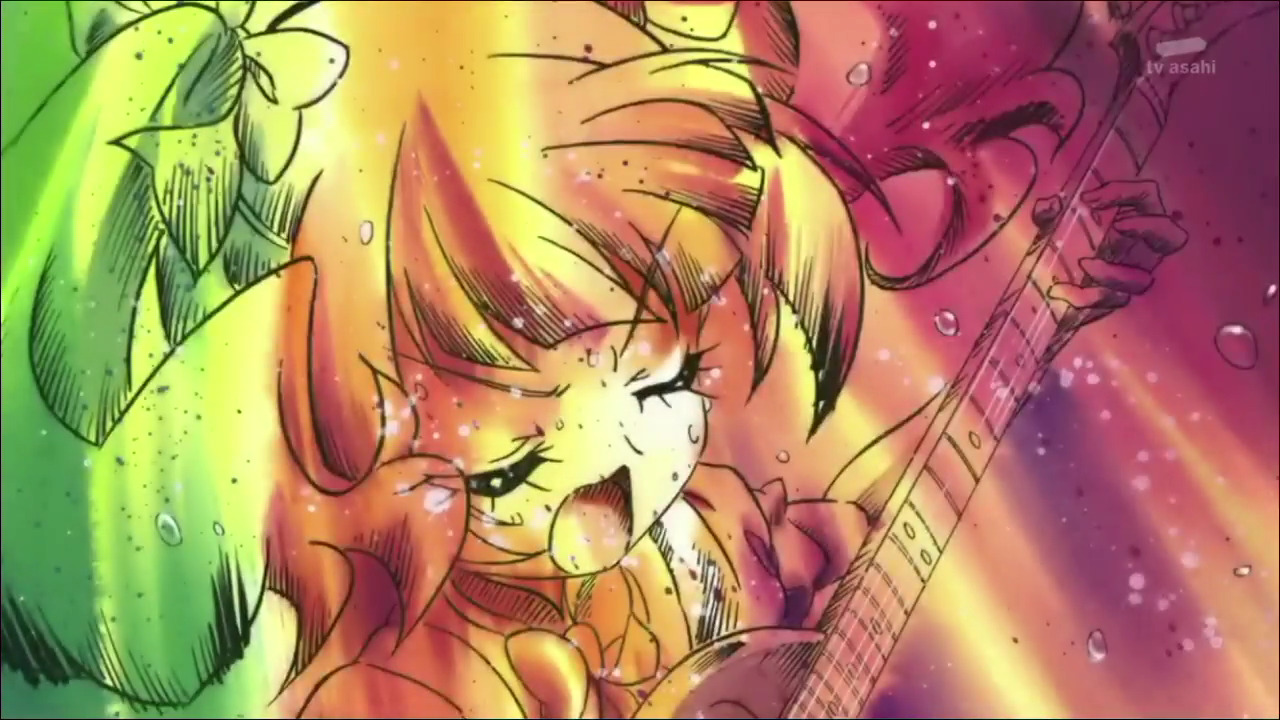
I love Precure in general, and many of its characters among my favorites, but I’ve never seen myself in a Precure character as much as I have Aisaki Emiru. Her initial appearance as an overly cautious girl who over-prepares for the worst spoke directly to who I am, and my similar anxieties on a daily basis. I can’t exactly relate to the enormous wealth and secret electric guitar, but you can’t expect everything.

But it’s not just my similarities to Emiru that make me fond of her. Like all of the girls (and guys!) in Hugtto! Precure, there’s a strong sense of growth and maturation, even for someone as young as Emiru. She learns that friendship can take all forms, that holding back one’s emotions can be harmful, and that a heart which believes in change can make the world a better place. I’ll never forget Emiru’s words as she played guitar that first time: “The ‘nyeowr’ is the shout of your soul.”

THE DAIDOUJI TOMOYO AWARD FOR BEING DAIDOUJI TOMOYO

Daidouji Tomoyo (Cardcaptor Sakura: Clear Card)

This year brought back to anime one of the best magical girl series ever—Cardcaptor Sakura—and with it the very greatest best friend in anime history. A now-teenaged Daidouji Tomoyo continues to support her beloved Kinomoto Sakura, but now with the power of a personal drone.

What makes Tomoyo great is that she wants the best for everyone she cares for. Wise beyond her years and always willing to dispense advice for her lovely oblivious friends, she’s the one you want in your corner every time.

Basically, I am extremely, extremely biased towards Tomoyo to the point that she unfairly destroys the field of best characters of the year, male or female or anything else. Thus, I’ve spun her off into her own category to make this year’s picks more fair in general.

Hail Tomoyo.

Final Thoughts

There’s one simple word that ties all of my 2018 winners together, including the titanic Tomoyo: friendship. Whether they’re discovering friendship for the first time or long-time believers in its power, all three truly embody the joys and strengths of being a true friend. It’s not just about selflessness, and it’s not just about companionship. There’s a real sense of trust and rapport that come from knowing that you have each other’s best interests at heart, and it lets them overcome just about anything.

Save

Save

Save

Save

Save

Save

Save

Save

The Identity Crisis of Twitter

To a great many, social media is just a part of life now. Whether it’s Instagram, Facebook, Snapchat, or Twitter, these websites and apps are practically glued to us due to the ever-increasing ubiquity of smartphones. But each form of social media in certain ways replicates the online communication tools of old, and I find that with Twitter in particular, its strengths and weaknesses come from being essentially a highly modular chatroom. The problem is that, while the scope of this “chatroom” can be large or small, individual users only have so much control once it gets beyond a certain size, which leads to Twitter and its users running into an identity crisis of sorts.

It’s true that if you want an absolutely private experience on Twitter, you can more or less make it happen. Set your account to private, only follow a handful of people, and maybe even communicate primarily through direct messages. You can actually just make it about you and your friends. However, there are a few aspects that limit the Twitter experience once you move past that point and want to utilize the site as most others do, which is to operate in this massive space where you can instantly search for what people are saying about any given topic.

Traditionally, chatrooms were less people-focused and more concept-focused. Even in the earliest days of AOL, you scrolled through a potential list of chats, picked one that matched your interests or desires, and then joined. Even if it was just to ask A/S/L to everyone, there was a sense that you were stepping into a shared, localized space. Web 1.0 had this feeling in general. With Twitter, you are essentially your own chatroom moderator, and it’s up to you to constantly manage who you want to listen to and who you want to interact with. This kind of customization certainly has its merits, as it lets you really control your experience on Twitter to a certain degree, but having to potentially police your own twitter feed constantly is practically a recipe for decision fatigue. A user doesn’t have to care that much, but that can lead to the next problem: if you choose to take a relatively hands-off approach, that means you can’t control the people who are peering inside.

A common story of many a Twitter faux pas is that a user (often a fairly prominent one) treats their very public and well-known account like it’s still a small, localized experience when things have in fact changed. This person might be using in-jokes that appear crass or downright offensive to outsiders, but is considered to be innocuous teasing by their more immediate circle. They might even get called out by their followers for those words and asked to apologize, and those followers might even have a point. Even so, it can feel like there’s a disconnect between what this particular user thinks is their Twitter experience (shooting the breeze with friends) and what the users at large think is the Twitter experience (a public forum where any and every statement hangs in the air for all to see).

Consider two scenarios of a person in real life who says something racist, not expecting it to be an issue, only to be reprimanded by someone listening. In scenario #1, it’s a private setting where a friend is warning this person that what they’re saying is messed up, and they need to watch how they think and use words. In scenario #2, it’s an open space where everybody’s listening and a stranger shouts down the speaker for being so damn racist. Both cases involve someone rightly pointing out racist speech and that it needs correcting, but there’s a fundamentally different experience between someone who says something around those with whom they’re familiar and while surrounded mostly by strangers. The issue with Twitter is that it can seem like the former on the surface, only for a user to discover that it’s been a public square all along. The perception of extremely public vs. relatively private space explodes and collapses in a way that doesn’t happen when you actively search for servers and chatrooms on IRC or the more modern Discord.

I believe that this folding of public and private on Twitter is also what makes harassment on the platform especially insidious. It’s no secret that certain groups (especially the alt-right) have learned to almost weaponize Twitter’s idiosyncratic behavior. They can make a statement, “innocently” @ another user, and sit back and let their followers dog-pile that user. They can search out people who are discussing a topic, and attack total strangers in their replies. Users might want to interact through Twitter as if they’re just talking to their friends and acquainances, but the search function makes it possible to seek out holders of different opinions and try to verbally abuse them. It’s all too easy to find someone you disagree with on Twitter, and to see them as the enemy.

Chatrooms aren’t and weren’t ever peaches and rainbows. They come with their own hosts of problems, from power-abusing moderators to the active nurturing of toxic spaces by users if they should so choose. I used to be part of a chatroom or two where there were some people with gigantic chips on their shoulders—folks who seemed a little too trigger-happy with their hostilities. I remember a time where I talked about my surprise that a couple of anime voice actors were married to each other, only to get shouted at about how I must be one of those shallow folks obsessed with following the frivolous minutiae of celebrities (but of course said in a much less polite way). I thought the guy was being an asshole, but I also went into that chat knowing that this was a possibility, and that I was ready to fight back and call him out on being unnecessarily angry. Not everyone is willing or should be willing to have to fend off trolls and angry mobs, but Twitter’s public/private collapse makes that fight all the more inevitable for anyone discussing a controversial topic.

I’ve been on Twitter for over ten years now, but I’ve come to realize that I’ve reduced my utilization of its chatroom-esque qualities a long time ago. I still do communicate with friends and mutuals to an extent, but a lot of it is me shouting into the wind and seeing what sticks. Much like this blog here, I use it as a place to experiment with an express thoughts and ideas. Analyzing this shift in Twitter behavior, I think it’s largely because a certain degree of distance is necessary. Those who jump onto Twitter with bleeding hearts inevitably attract sharks. But while there were always sharks, even among the islands of Web 1.0 and 2.0, the social media age means being surrounded by potential predators on all sides.

SSSS.Gridman and the Question of Genre

At a Studio Trigger panel at Anime NYC 2018, an interesting exchange occurred. During the Q&A session, the topic of Trigger’s preferred genres came up, and producer Wakabayashi Hiromi asked the audience what genre they thought the studio’s latest anime, SSSS.Gridman was about. They received various answers, but a common one was “action,” to which they responded, “Action? Really?” What this says is that, on some level, many viewers see SSSS.Gridman very differently compared to its creators.

The point here isn’t to figure out what genre SSSS.Gridman (Twin Peaks-esque paranormal mystery?). Rather, it’s to dwell on that incongruity between so many of those con attendees and Trigger itself. There are certain caveats to account for—like how this was only a handful of fans in the grand scheme of things or the way the series holds its cards close to its chest—but something has to be creating that difference in judgement.

Perhaps those viewers simply have a broader, more lenient idea of what denotes an “action series,” especially compared to creators who inevitably go in with their own values beforehand. If you asked Tomino Yoshiyuki what genre Mobile Suit Gundam is, he might not necessarily say “mecha” or “science fiction” or, indeed, “action.” Moreover, while fans might take the tokusatsu feel of the show (which it captures down to the rubber suit-like movements of the monsters) as more evidence of its “action” qualities, Studio Trigger could be seeing it as an aesthetic quality in service to a greater structure.

Adding thrilling violence to a story could just inevitably change how fans perceive it. The spectacle, on some level, can be overpowering. While I can’t say with full confidence that SSSS.Gridman is a Twin Peaks, there is an anime that takes a lot of inspiration from David Lynch and Mark Frost’s influential TV series: JoJo’s Bizarre Adventure Part 4: Diamond is Unbreakable. While that series revolves around its small-town mysteries as well, the legacy of JoJo as a shounen fight series is still present in its DNA. For some fans, that battle tendency might dominate their view of Part 4.

Whatever the case may be, it’s clear that in the eyes of the creators, there’s more to SSSS.Gridman than just action. At this point, as the show moves towards its conclusion, that might very well be “obvious,” but I do wonder how many fans it pulled in under the vague pretense of strong fight scenes.