Spirit vs. Letter in Social Media Harassment Policies

Social media platforms have been under fire by critics recently due to the way they’ve let radical groups take advantage of their platforms to attack and discredit others. People on Twitter are harassed, receiving death threats and worse, yet their harassers remain unbanned. Facebook has suffered from the inundation of fake news created by Russian propagandists, as well as racist advertising using their own ad system. A recent article by Sarah Wachter-Boettcher, titled “Facebook treats its ethical failures like software bugs, and that’s why they keep happening,” argues that Facebooks’s approach lacks a true human dimension, and fails to account for the subtle and nuanced ways that people end up using social media. In other words, using a wack-a-mole method to deal with this ignores, unintentionally or otherwise, the underlying issue of people being attacked online.

I concur with this sentiment, but would like to add something. It’s not just that treating problems like racist ad targeting as bugs or glitches is the wrong way to go, but that trying to govern social media platforms with hard and fast rules creates a rigid system that inevitably lends itself to loopholes that can be exploited.

I recently had a few discussions with friends and acquaintances, all programmers and software engineers. In one discussion, I had a small debate with a friend, who argued that laws should not be open to interpretation—what says, goes, ideally. Having “wiggle room” makes things messy. In another, the subject of self-driving cars came up. Among many of the programmers (but not all, mind), there was a shared stance that giving humans more control than self-driving cars would be to open up the efficient and organized traffic of the future to the unpredictable and poor decision-making of the average driver. Additionally, any problems that occur due to the incompleteness of the self-driving AI could be solved after they arise.

I don’t mean to stereotype programmers as all having a certain way of thinking or a certain set of beliefs (you’ll find them on all sides of the political spectrum, for example), but there’s a certain desire for the human-created mechanics of the world to make consistent, logical sense that I find common to programmers—i.e. the main people driving social media platforms such as Facebook and Twitter behind the scenes. A faith (or perhaps desire) in these systems, and the idea that they can just increase the granularity of their rules, instead of trying to take a more humanistic direction, leads to holes that can be exploited.

No matter what parameters Twitter puts in for defining harassment, people will always find ways to attack others without “technically” breaking the rules. This, I believe, is the reason so many people appear to be unjustly banned while other accounts that spew hate and encourage online attacks can manage to stay active. One side is likely ignorant of rules X, Y, and Z, while the other deftly skirts them. Intent, something that requires a closer analysis, is left by the wayside.

Krang T. Nelson, a Twitter user named after a certain cartoon warlord from Dimension X, recently tested these limits. In a Vice article, Nelson describes how he decided to troll white supremacists by crafting the most intentionally absurd tweet possible, about “antifa supersoldiers” planning on beheading white parents and small business owners. Not only was it a clearly tongue-in-cheek call-out of alt-right talking points, it was also loaded with buzzwords that white nationalists actively look for. Nelson then discusses how the white nationalist movement understands the ways to take advantage of Twitter’s policies, and that they used this knowledge to get him (temporarily) banned over a facetious remark. Here, we see clear evidence that the groups known for Twitter harassment also know how to exploit its technicalities and parameters for their own ends.

Adhering to the letter and not the spirit of policies and laws is what fuels the abuse of online social platforms. Having actual people at all levels checking to see how Twitter, Facebook, etc. are being used, and relying not on hard and fast rules, is where things need to change. Granted, having “wiggle room” in rules means they can be exploited in a different way, but overly strict interpretations are also clearly not working.


“Lagrange: The Flower of Rin-ne” and the Transformation of Lies into Truth

One of my favorite moments in the anime Lagrange: The Flower of Rin-ne is when we find out the truth about the Jersey Club, the seemingly do-anything, help-anyone group that the main character Kyouno Madoka leads. What we find out is that, whether or not Madoka realizes it, the club was created from a lie. In a time when a young Madoka was suffering from a traumatic event in her life, a local high schooler who happened to be jogging at the time created the idea of the Jersey Club on the spot, facetiously claiming that her exercise sweats were some kind of uniform in order to cheer Madoka up. The story of the Jersey Club, then, is one about how lies became truth, as Madoka took the kindness and altruism shown to her, and actually transformed it into a life philosophy. By the end of the series, it’s become almost literally a universal philosophy.

This idea of lies transforming into the truth through honesty and determination feels to me like a recurring theme in Japanese visual media. Fate/Stay Night‘s “Unlimited Blade Works” arc famously makes the claim that there’s no reason a copy has to be inferior to the original. Even knowing the origins of something, even when aware that something is a sham, it’s as if sincerity is the key ingredient to bend reality and perception.

It reminds me also of something I heard recently, which is that a sequel to Harper Lee’s To Kill a Mockingbird was published, which reveals Atticus Finch, the noble lawyer who defends a black man in a racist town, is actually revealed to be quite racist himself. The main character of the original book, Scout, turns out to have been looking at her father from the perspective of a child, only to realize his limitation as she grows into adulthood. It’s a controversial sequel, which was actually the prototype for To Kill a Mockingbird, but here we see too a “lie” becoming beneficial. Scout takes the ideals she sees from Atticus’s message and way of life, and transforms it into something even greater than the person himself.

Granted, this “bending” of reality is not necessarily without its problems. This is evidenced by the manipulation created by “fake news,” and the skewing of television news audiences, where viewers will gravitate towards the channels that cater to their beliefs almost regardless of the veracity of their reporting. The vital factor in determining whether an action is “good” or “bad” comes from what we’re seeing as “reality.” Is reality a construction of assumed cultural standards that resist change because of inertia? Or is it the foundation of truth that risks being chipped away by inaccuracies meant to exploit biases? The transformation of lies into truth can be heartfelt or diabolical, a risky double-edged sword that needs conscious tempering by both audiences and creators alike.

Ten! Ten! Ten!: Ogiue Maniax Status Update for November 2017

This month is the tenth anniversary of Ogiue Maniax. I’ll have a special post for that occasion. In the meantime, I’d like to thank my Patreon sponsors, especially the following:

General:

Johnny Trovato

Ko Ransom

Alex

Diogo Prado

Viga

Sue Hopkins fans:

Serxeid

Yoshitake Rika fans:

Elliot Page

Hato Kenjirou fans:

Elizabeth

Yajima Mirei fans:

Machi-Kurada

My favorite posts from last month:

The Precarious Balance of Tradition and Progress: Sakura Quest

A review of the unique P.A. Works anime

Love Live! Sunshine!! and the Complexities of Anime Tourism

A follow-up post of sorts to the Sakura Quest review, this one looks at the relationship between anime and influencing the movement of populations

Gattai Girls 7: Shinkon Gattai Godannar and Aoi Anna

The latest Gattai Girls is actually one of my favorite anime ever. (It was also a somewhat subtle hint towards me getting married.)

Patreon-Sponsored


Halloween Means Precure!

I was asked to write about my favorite Halloween anime, only to realize that most of them are Precure episodes. Go figure.

Closing

I’d like to end this month on a more serious note.

This past Halloween, there was a terrorist attack in lower Manhattan. While I did not know any of the people who were hurt or injured, my condolences go out to their friends and families. I went to school in the same area back in 2001, when 9/11 occurred, and hearing about the attack brought me back to what I felt then: the confusion, the need to evacuate, the unsettling feeling that the world will never be the same. Circumstances were different this time around, but I know the fear and unease that can linger over New York City in the face of such a crime. At the same time, just as then, I’m always surprised by the resilience of New Yorkers to just get back up and go about their day. On some level, it’s a product of being accustomed to the hustle and bustle of such a crazy metropolis, but I also think that it’s a semi-conscious effort to not let fear cower us into submission, or make us doubt each other as human beings.

Hate does not defeat hate. Trust, education, and openness to new ideas are the key ingredients to a better tomorrow.

Save

Save

Save

Love Live! Sunshine!! and the Complexities of Anime Tourism

Love Live! Sunshine!! Real Escape Game in Numazu

Love Live! Sunshine!! is a media-mix property whose purpose, apart from pushing its stars and profiting from a match of anime fandom and idol fandom, is to promote tourism to the region around the city of Numazu in Japan. What I find fascinating about its approach, however, is that it not only encourages people to visit Numazu, but also reflects and tries to address many of the problems facing Japan in terms of the link between sustaining population, community, and business.

There are three main issues brought up in terms of population in Japan in recent years. First, and the one that gets the most attention, is declining birth rates. Whether it’s “herbivore males” or the difficult choice many women have to make between starting a family and having a career, theories abound as to why fewer Japanese people are having children. Second is the post-3.11 decline in tourism; a nuclear meltdown scares off not just international visitors, but those from within Japan as well. Third, and perhaps the most familiar to people around the world, is people moving out of rural areas into urban ones, leaving the old towns a shadow of their former selves with little new blood coming in.

Flying Witch

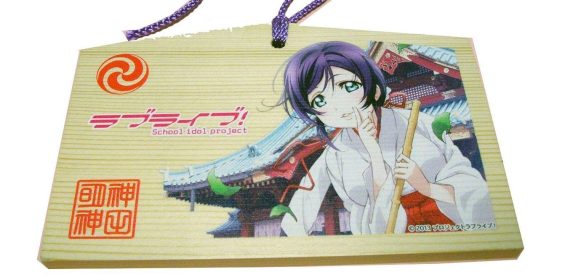
The ways in which anime have been used in response to these problems are myriad. Famously, the popularity of the anime Lucky Star led to people visiting the very shrine featured in the show, Washinomiya Shrine. The first Love Live! School Idol Project anime had a similar effect on Kanda Myoujin Shrine in Akihabara, where the character Nozomi works. But there are also anime which try to show the splendor of Japan whether directly or not. I don’t think it’s a coincidence that Flying Witch was made into an anime a few years after 3.11 when Japan was trying to revive tourism to the affected Tohoku region. Taking place in Aomori (a prefecture in Tokyo), Flying Witch features lovingly crafted shots of picturesque landscapes as if to say, “This area is lush with life.” The studio P.A. Works used the series Hanasaku Iroha to create the fictional “Bonbori Festival” and then bring it into the real world. Their more recent work, Sakura Quest, is an anime explicitly about trying to deal with a declining population in a small town through tourism and promotion.

Official Love Live! Wish Board from Kanda Myoujin Shrine

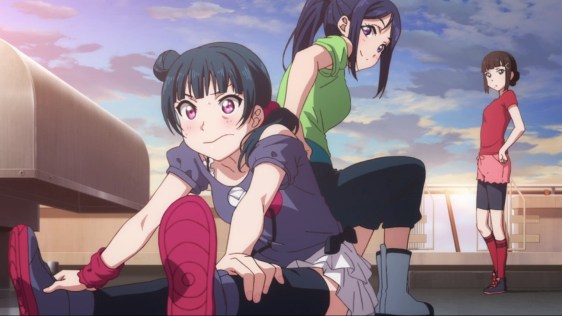
Love Live! Sunshine!! takes place in the small town of Uchiura, near Numazu. Much like the first franchise, the main characters’ school is threatened with closure due to declining attendance rates. The girls, inspired by the group known as μ’s (from the original Love Live!) attempt to replicate the latter group’s success in saving their own school, and form their own idol group called “Aqours.” Already, it’s clear how Love Live! Sunshine!! touches upon issues of population movement and tourism, but it’s especially notable when comparing the series to its predecessor.

Consider where the two properties take place. The μ’s girls of the original Love Live! are centered around Akihabara, which is both the spiritual center of otaku in Japan and, as a result, already a popular tourist destination. The Aqours girls of Love Live! Sunshine!!, on the other hand, are situated near Numazu, which has a population of under 200,000 as well as a recent history of absorbing nearby towns—a major plot point in Sakura Quest and a potential future for Uchiura. Unlike Akihabara, Numazu is hardly world-famous. And yet, if Love Live! had started differently—if it had decided to go with Numazu from the start—then I don’t think it would’ve reached its original success. Much like AKB48, it relied on the notoriety of Akihabara to build itself up, and is now paying it forward, in a certain sense. Love Live! used tourism, and now tourism is using Love Live!

Love Live! Sunshine!! can be seen as another arm of the “Cool Japan” concept, which uses Japan’s fame as a symbol of cultures both traditional and popular to promote itself at home and abroad. It appears to be succeeding, at least in the short term. In fact, over at Apartment 507 where I also write, one of the most popular posts is a guide to visiting Numazu. But as Gundam director and Anime Tourism Association chairperson Tomino Yoshiyuki has warned, short term success is not enough; permanent change is necessary, even if it’s to come from anime. The fact that Love Live! went from being supported by pop culture to being a pop cultural influence that can potentially make a change is a big deal, and I’m curious to see if this experiment has any long-term impact that goes beyond the cute idols of Aqours.

Save

Save

The World is My Canvas, and Competition is my Art: Splatoon 2 Thoughts

The video game that has most occupied my attention lately is Splatoon 2. This comes as no personal surprise, seeing as I loved the hell out of the first one. The gameplay is mostly similar to its predecessor. The changes are mostly about quality of life. But even though both games are so similar, for some reason I find myself experimenting with the different weapons more in Splatoon 2.

My preferred weapon hasn’t changed since the first game: the N-Zap, modeled after the classic Zapper light gun from the NES. For me, t’s gone from a tool for Hunting Ducks to a jack-of-all trades tool whose relative lack of power can be made up for with smart movement and positioning. It’s also just accurate enough for me to effectively focus my fire, while still being forgiving enough to compensate for the fact that my aim is not that great. In Splatoon 2, the ability for it to quickly ink the ground synergizes well with the Ink Armor special, which temporarily lets the entire team take a few extra hits and survive. The N-Zap lets me support allies up close and from afar, and it fits like a glove. Finding the right weapon is just plain satisfying.

But much like characters in a good fighting game, the variety of weapons available, many quite different from each other, is part of the allure of Splatoon 2. Even if some weapons feel counterintuitive, there’s a certain thrill to trying to get into the right mindset for any given tool. When you’re using the Sloshing Machine, a bucket that launches spiraling volleys of ink, the focus is on using its overwhelming power and arching property to quickly kill, er, “splat” your opponent in unexpected places. Dualies are relatively short-range John Woo pistols that allow for unique evasive maneuvers. The Splat Brella is like a shotgun with as defensive shield, allowing players to pick off opponents while guarding allies.

Even weapons of the same class can be wildly different. The Dynamo Roller is the equivalent of trying to Falcon Punch everyone all the time, while the Carbon Roller focuses on mobility and turf coverage at the expense of battle strength. Sometimes using a different weapon means almost playing a different game, and every time I turn My Splatoon 2 on, I think, “Do I stick with the familiar, or try to transform my mind with another item?” Both ways are fun, doubly so when patches try to make everything worth using.

One of the major changes between Splatoon and Splatoon 2 is that the new special weapons–super moves, in other words–are significantly weaker. Where once they could flip a game upside down due to their sheer power, now they influence games in subtler, less pronounced ways. I think this might end up putting more emphasis on the main and sub weapons themselves, which contributes to weapon experimentation also being more fun.

In the end, gameplay is great, and all the modes are worth playing. My only complaints are shoddy Wi-Fi on the Switch (a common problem for the console), and the lack of the Squid Girl promotional outfit from the first Splatoon shirt.

No, really, give me my Ika Musume threads.

Why the Term “Toxic Masculinity” is a Double-Edged Sword

“Toxic masculinity” is an extremely useful term. It describes a recurring problem with men and boys, which is that the societal pressure to appear and act “manly” can often harm not just others, but the guys themselves. Even the most naturally hyper-masculine individuals can benefit from awareness of this concept because they can at least know that crying, or not being confrontational all the time isn’t a sign that they’re not men. It’s also good for pointing out when media, be it films, video games, anime, etc., reinforce harmful notions of what being a “man” is. Unfortunately, the men who suffer most greatly from toxic masculinity, are likely least receptive to it. I believe the reason for this is that, ironically, the term “toxic masculinity” doesn’t sound masculine enough.

Many phrases that have come out of feminism, or have been embraced by feminists, take on a certain tinge that brings feminists to mind. This isn’t inherently a problem, but whether it’s due to association of just the word choice, it can come across as something concocted in a feminist lab (whatever that might be); perhaps it’s a little too clinical and, well, “feminine.” Part of coming  across as a “man’s  man” is one’s vocabulary, and I believe that the perceived feminist quality in “toxic masculinity” as a phrase prevents more men from using it.

On some level, I want to say, “Get over it and just embrace what the term is trying to say,” but I also understand that it’s not always so easy. Masculinity, toxic or otherwise, is tied to one’s identity. That being said, I think there already exists a phrase that embodies much of what “toxic masculinity” implies that is, for better or worse, more palatable to men concerned about maintaining their image of manliness: “When keeping it real goes wrong.”

Coming from an old Chappelle‘s Show skit, “When keeping it real goes wrong” is used to describe people who refuse to back down in even the most trivial or disadvantageous scenarios, which then leads to dire (and hilarious) consequences. Essentially, it communicates the idea that trying to be “real” 24/7 is a recipe for disaster because the need to have the world see oneself as a proper man who won’t take guff is going to, at some point, end in tragedy.

Do I think “When keeping it real goes wrong” should supplant “toxic masculinity” as the dominant phrase to describe the harmful aspects of male performance? Not really, as it’s kind of unwieldy and doesn’t match 1:1, but I think it has its place. The irony would be that using it could help more men understand the notion of toxic masculinity while also subtly reinforcing it.

Changin’ My Life: Ogiue Maniax Status Update for October 2017

October is going to be a special month for me from this point forward.

That’s because something big has happened, something I once thought impossible: I got married.

Seriously.

I won’t go into too many details, but I’ll just say that my wife is a very special person to me, who’s stuck with me through thick and thin. This even includes my time abroad in the Netherlands. I actually met her thanks to Ogiue Maniax, though I wouldn’t recommend writing anime blogs as a way to find relationships.

So I want to give a very, very special thanks to my Patreon members this month, because your continued support lets me pursue this blog as a passion project.

General:

Johnny Trovato

Ko Ransom

Alex

Diogo Prado

Viga

Sue Hopkins fans:

Serxeid

Yoshitake Rika fans:

Elliot Page

Hato Kenjirou fans:

Elizabeth

Yajima Mirei fans:

Machi-Kurada


In other, non-matrimonial news, I recently did a series of manga recommendations on Twitter. Check out the thread!

Also, here are my favorite posts from last month:

Tomino Yoshiyuki’s “Big Picture”: WHy the Gundam Creator Can Be So Hit or Miss

Recently, I got to thinking about Tomino and all his eccentricities. Here’s my hypothesis on the “Tomino style.”

Fighting Evil By Moonlight – Heartcatch Precure!: The Novel

I reviewed the Heartcatch Precure! novel, which ostensibly focuses more on Cure Moonlight than the anime.

Beyond the Brokeback Pose: Don’t Meddle with My Daughter

A look at the idea of superheroine sexualization and fetishism as a kind of cultural export, through the lense of the manga Don’t Meddle with My Daughter. It actually got retweeted by the author!

Return to Genshiken

Return to Genshiken: Volume 5 – Pride and Fujo Justice

Part 5 of my Genshiken re-read. Ogiue starts her journey here, but it’s Sasahara who really grows.


Patreon-Sponsored

My Favorite Light Novel Anime

Self-explanatory, but a fun topic all the same.

Closing

Here’s to an exciting new life!

Save

Save

Save

Return to Genshiken: Volume 5 – Pride and Fujo Justice

Volume 5 holds a very special place in my heart—it was my first ever manga purchase when I studied in Japan, and my first real exposure to the character of Ogiue. As such, it’s one of the volumes of Genshiken I know best, but in re-reading it I’ve still managed to pick up on some things I hadn’t before!

What is Return to Genshiken?

Genshiken is an influential manga about otaku, as well as my favorite manga ever and the inspiration for this blog, but it’s been many years since I’ve read the series. I intend to re-read Genshiken with the benefit of hindsight and see how much, if at all, my thoughts on the manga have changed.

Note that, unlike my chapter reviews for the second series, Genshiken Nidaime, I’m going to be looking at this volume by volume. I’ll be using both English and Japanese versions of Genshiken! Also, I will be spoiling the entirety of Genshiken, both the first series and the sequel, so be warned.

Volume 5 Summary

Ogiue’s is one of the club’s newest members. After some spirited discussions/arguments” with Saki and Ohno about yaoi, she inadvertently reveals her true fujoshi nature. Her kink: BL inspired by shounen manga.

Madarame attempts to take on his greatest foe: premium clothing shopping. Although it nearly drains him of all will, he ultimately succeeds. Ogiue, following similar advice, does not.

Sasahara’s Comic Festival application is accepted, and Genshiken must fight through a meddling pest (Haraguchi), editor and artist tensions between Sasahara and Kugayama, and a fast-encroaching deadline on the way to their first vendor experience at a doujin event. In the end, they manage to make it in time. They even sell out of their Kujibiki Unbalance-themed doujinshi onsite, thanks in part to the cosplay/crossplay powers of Ohno and Kohsaka.

Ogiue Exposed

There’s a lot we learn about Ogiue in Volume 5. She’s indeed a fujoshi, in spite of her vocal disdain for them. She comes from the Tohoku region (and, as we learn in Nidaime, Yamagata specifically) when she panics and slips into her native accent. She’s also an artist, though we’ve yet to learn the significance of art to Ogiue (and how it ties into the trauma of her past). But there’s another major development in this volume that has major implications for the rest of the series.

Before I get into that, however, I do want to point something else out. Ogiue’s initial excuse when Kuchiki mentions that he caught her at a Scram Dunk event is that it was “for her little brother.” I never got around to it in my Nidaime reviews, but it turns out that she actually does have a little brother. The reveal happens in Volume 16, in a 4-panel comic where Ogiue and Sue visit Ogiue’s family home. A simple “Sis?” followed by “He’s my brother” is all it takes to finally know that the brother, at least, was not a lie.

The True Origins of Sasa x Mada

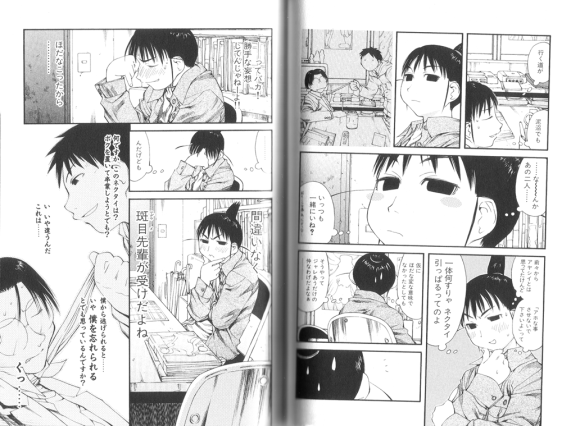
As an Ogiue fan, one of my favorite aspects of Genshiken is naturally her gradual acceptance of her fujoshi side, and her quiet obsession with Sasahara x Madarame yaoi is a part of this. While that particular thread comes to the fore in the next volume, I realized during my re-read that the seeds were planted in Ogiue’s head in Volume 5.

In one of the doujinshi planning scenes, Haraguchi reveals that he’s already made plans for Genshiken’s book (he wants to turn it into a big seller by bringing on a ton of high-profile guest artists). Sasahara keeps trying to politely refuse Haraguchi’s “kindness,” as his tendency as a non-confrontational person. However, as Haraguchi keeps pushing and pushing, eventually Sasahara’s expression grows stern (similar to how he reacts to his own sister). He puts his proverbial foot down, saying, “I will personally call all the guest artists you brought on board (without my consent) and turn them down.”

It’s potentially easy to miss, but immediately afterwards there’s a small panel with an Ogiue closeup, and she has the ever-so-slightest blush on her face. Without later context, it can just seem like she’s surprised or shocked at Sasahara’s change of behavior, but now it’s clear to me that this was the catalyst for her perception of Sasahara as a a “seme” character, and also her eventual attraction to him. When Sasahara is later arguing with Kugayama about getting the doujinshi done, and he refuses Ogiue’s help because he doesn’t want her picking up Kugayama’s slack, this also contributes to her fantasy image of Sasahara. It might also have “helped” that he made her cry, showing his gruff, masculine side, however limited.

As for Madarame as “uke,” right after Sasahara tells Haraguchi that emphatic “no,” Haraguchi turns to Madarame to ask if it’s really okay. Madarame then mentions that Sasahara is president now and it’s up to him to make the final decisions. I think this moment of deference towards Sasahara by Madarame is what plants the seed of “bottom-ness” in Ogiue’s mind, along with Madarame’s general behavior around Kasukabe.

Doujinshi Creation: From Passive to Active

Sasahara’s decision to participate in Comic Festival in the first place is a major pivot for Genshiken. Up to this point, they were an extremely passive club, where things sort of happened to them. Now, they’ve stepped into the field of creators; they’re making an active contribution to otaku culture, so to speak. This experience is also clearly what eventually leads Sasahara to becoming a manga editor. All of the back-and-forth with Haraguchi, having to know when too far is too far, and basically managing disparate elements of production to create a single complete product in a limited time span is portrayed as a tiring yet invigorating experience for Sasahara—and one that he’s pretty good at too. His personality is somehow a good fit for editorial work, especially in the manga sense of also having to manage artists.

Speaking of passivity, the argument between Kugayama and Sasahara is too real. Sasahara basically accuses Kugayama of discounting his own ability to become a professional manga artist to protect his “flimsy pride.” In other words, Sasahara is saying that Kugayama is choosing to give up because it would feel even worse to try his hardest and fail. While the opposite mentality is encouraged in life and in movies, fearing failure is something that virtually anyone can relate to.

Saki in Transition

Saki, as much as she’s spending time with the Genshiken crew, is still in a period of transition between being absolutely new to the world of otaku and being fully accustomed to it, as she is in Nidaime. While she’s always the “normie” outsider in the series, there are a number of choice moments in Volume 5 that speak to her status being in flux.

When Saki is talking with Ogiue next to the gigantic pile of homoerotic doujinshi, she looks at one of them, gets suspicious, and then opens it up and has her supicions confirmed. If she were an otaku, or at least much more familiar with the stuff, she probably would’ve realized it immediately. Still, the fact that she noticed something was “off” speaks to the time she’s been in Genshiken.

At Comic Festival, Saki sees Kousaka in drag and is clearly taken aback. Back when I first read it, it seemed like she was about to say something sad, but knowing Saki better now, I get the impression that she was going to respond with something kinder, albeit still embarrassing. In Nidaime, she reveals that she has plenty of gay friends and friends who crossdress, which makes me wonder if Saki’s response was actually going to be more “If you’re into that sort of thing, I guess I can accept that,” before she’s interrupted by Kuchiki.

But she’s also learning, whether she likes it or not. In one of the post-ComiFes 4-panel comics, Saki mentions that having the Kujibiki Unbalance vice-president (Ohno’s cosplayed character) selling pornographic doujinshi of the president must be pretty strange. Ohno gets a look of surprise on her face that Saki has shown a small example of otaku-esque perception.

However, just as we think she’s adjusting, the otaku world smacks her right in the face. At the very end of the volume, she’s shown reading the doujinshi Genshiken put out and reacting with awkward disgust. It’s clear why: the doujinshi is lolicon (and the volume has a heavily censored version of it), featuring a young Chihiro and Ritsuko from Kujibiki Unbalance having an early sexual encounter. Ultimately, while the rest of the club is treating it like nothing big (and it’s likely powered by Sasahara’s general obsession with Ritsuko, as opposed to any specific age range), Kasukabe’s reaction is all too expected, and is likely the sort of thing that keeps her from ever fully embracing otaku subculture.

She never really interacts with Nidaime‘s resident shotacon, Yoshitake Risa, either. I wonder how that conversation might go…

Mebaetame

This time around, Genshiken’s small club doujinshi looks at the Kujibiki Unbalance anime, which, in case you didn’t know or forgot, was actually made. A lot of the screenshots are actually taken directly from the anime, but a few of them are actually drawn by Kio Shimoku to resemble a TV anime screenshot. I find that kinda funny.

Final Random Thoughts

Madarame and Ogiue’s fashion trips might have seemed like one-off adventures originally, but looking back it’s clear that their voyages made an impact. Madarame starts to dress at least a little better, especially after he starts to work professionally, but it still sticks even when he quits his job in Nidaime. As for Ogiue, she starts to wear better-fitting clothing, and after she starts dating Sasahara she becomes even more fashionable. By the time Nidaime rolls around, Yajima is actually kind of intimidated by how good-looking Ogiue is. That’s quite some progress for a girl who used to actively shun fashion.

Save

Save

Save

Save

Save

Save

Save

Save

Save

Save

Save

Save

Save

Save

Save

Save

Save

Save

[APT507] School Idols vs. Pro Idols: The Hints of Sobering Reality in Love Live!

Something that’s stuck with me for a long time is the distinction that Love Live! makes between idols and school idols. I find that it hints at the harshness of the idol industry, though in a very, very indirect way. I wrote a short article on it over at Apartment 507, if you’re curious.

Save

Anno, Evangelion, and the Fleeting Intersection of Creators and Trends

The story of Neon Genesis Evangelion is partly one of a creator who tapped into the zeitgeist of his viewers, who then began to travel along a path divergent from the very people that called themselves his fans. Anno Hideaki is not an isolated incident. Any time a creator makes a sequel and it’s considered to do more harm to the series than good by some (J.K. Rowling and Harry Potter, Tomino Yoshiyuki and Gundam), there’s a sense that ideas and sensibilities did not align as well as they could have.

Of course, fans are individuals too. What one might call the general fan reaction to something is akin to an aggregate or a median of all of the different values that exist, and one might even argue that there’s no such thing as a singular “audience” or “fandom.” However, I think that’s a significant contributing factor to why it’s so hard for so many characters to achieve great success more than once, why there are so many flashes in the pan. Even when they’re attempting to chase their audience and please them, it doesn’t necessarily work out as they might hope. How likely is it for one person to tap into the collective feelings of a group, and do so consistently over a period of years?

Love ’em or hate ’em, this I think this situation is why production by committee/audience testing exists. If you want lightning to strike twice, why not try to find out as much information as possible? Why not try to approach the group mindset with a smaller group of your own? It’s safer and arguably more reliable.

The issue with this approach is that it’s more likely to discourage risk and experimentation. This doesn’t mean it can’t ever result in strong works, but the Mr. Plinkett review of the current state of the Star Wars franchise explains it well. Disney knows exactly what the fans love about their beloved far, far away galaxy, and will keep tapping that well for as long as they find if feasible. These can be favorite characters, changing trends in how people perceive media (gender and racial diversity), or something else, but rarely would a work like this try to challenge or anger its audience.

This, I believe, is the danger zone that Anno saw all those years ago as fan response to Evangelion became one that encouraged an objectification and consumption of its characters. That conversation is more complex than this post is going to get into (and keep in mind that I’m not necessarily against either side), but it keeps me thinking about the divergence of creators and fans.