The Past and Future of Anime Blogging

In many ways, anime blogging is a living relic. Born in the age when “Web 2.0” was a newly coined term and blogging in general was a young and exciting differentiation from the era of fan shrines and webrings, the anime blog was a way for writer-fans to establish an identity outside of enclaves such as forums and livejournal groups. Like the anime websites of old (and even the IRL anime clubs before that time), they filled a desire for information, appreciation, and criticism of anime and manga.

I think there’s a charm to the written word that allows it to endure and keeps it falling out of true relevance, and this applies to anime blogging. Certain ideas are better conveyed through writing (especially extremely complex ones that require a lot of small detail to fully explain), and certain people (myself included) are more comfortable with text than speech or visual performance. Writing will never truly go away because it’s just capable of so much with so little. Nevertheless, it is true that the amount of anime blogs have declined over the years.

I don’t have a falsely inflated idea as to the supposed “importance” of anime blogs in year past—it’s always been a niche. But where once an “Aniblog Tourney” existed not just as a popularity contest but as a sign of a loose “aniblogosphere,” the increasing prominence of social media platforms like Twitter, Tumblr, Facebook, and even something like Anime Amino have moved discussion back into more isolated communities. I think, on some level, “aniblogging” feels less like a distinct position than it used to. Perhaps it’s because so many anime fans these days are omnivorous consumers of pop culture that the “fan” is more important than the “anime,” but I think the rise and dominance of social media networks and alternative formats like YouTube also makes it less enticing for younger, enterprising fans to enter the field. In a “field” with a high turnover rate due to burnout and just the passage of time, not having new warriors to pick up the mantle means a gradual decline.

The anime blogs of today, whether they’re young and fresh or old and crusty, are contending with new ways to get one’s thoughts and opinions out to the world—alternatives that can be more attractive to would-be bloggers. In particular, the minor stardom that can come with YouTube can also mean potential income, perhaps even enough to earn a living. Anime fandom isn’t the only realm affected by this, but because anime is more niche than, say, gaming, it also means a smaller pie to share overall. Only a select few vloggers can get six-digit views, but it’s a lot likelier than accruing those numbers through blogging. For even the best and most charismatic writers, blogs are at best a partial or supplementary income. In other words, it’s never been easy to sustain a living just from anime blogging, for better or worse. At the same time, it’s also never been easier to actually make money from blogging thanks to platforms like Patreon. While I’m not exactly filling my coffers to the brim, my own Patreon has been a great boon.

All it really takes to write an anime blog is a genuine passion for anime and manga, as well as a desire to write one’s thoughts. It’s profoundly simple, which is why, even as anime blogging as a “thing” has waned, I think you still see the occasional challenger take on the endeavor. Writing is timeless. I don’t carry any illusions that it’s the path to fame and fortune, but it’s a space that remains open and welcome. If we want to rebuild the aniblogosphere, however, it’ll take a restored sense of “community,” no matter how nebulous and disparate it might be.

Once upon a time, anime bloggers debated the merits of “episode blogging” vs. “editorial blogging.” In hindsight, it seems so quaint.

This post was sponsored by Johnny Trovato. If you’re interested in submitting topics for the blog, or just like my writing and want to support Ogiue Maniax, check out my Patreon.

Dominatrix Gameplay: The S&M Fighting Style of Smash 4 Bayonetta

Bayonetta is generally considered the best character in Smash 4. While her strengths are many, her key trait is the ability to instantly turn the tables on her opponent’s assault and transform a disadvantageous situation into a chance for victory. As with many #1 characters in games, there have even been calls to ban her from competitive play, more than any other character in the game. But I don’t believe the outcry is simply because she’s “too good.” Rather, it’s about why she’s good. Her character strategies are akin to those of a dominatrix, and her denial of pleasure in Smash 4 is what frustrates many to the point of crying foul.

Heroic stories are often built on giving antagonists their just desserts. Whenever Stone Cold Steve Austin managed to corner Vince McMahon, fans cheered as Austin drowned his evil boss in beer. When Kenshiro in Fist of the North Star confronts Jagi, the satisfaction of having Kenshiro beat Jagi to death for all his injustice is a moment meant to scratch that revenge itch. The villain, by virtue of being a villain, must pay.

Looking at fighting games, it’s possible to label the top tier characters as the villains in the story of competition. They’re the fastest, the strongest, and the most dominant. So what happens when the “hero,” i.e. whoever’s fighting the top tier, finally catches up to this scoundrel? Well, it depends.

Take Fox, from Super Smash Bros. Melee. Widely considered the strongest character in that game by a margin wider than Bayonetta’s grip over Smash 4. But while Fox is basically a master of all trades, he’s also a glass cannon who, if hit, can be combo’d hard by many of the best and worst characters in the game. Stringing a series of attacks together and watching Fox’s damage percentage rapidly rise is satisfying. So is spiking him offstage and seeing him plummet like a rock to his doom. Making Fox pay goes a long way in providing pleasure to the player or viewer opposing him.

This results in a kind of “combo catharsis.” Even if the opponent loses to Fox, seeing a Marth or a Mewtwo chain grab him for a couple of stocks can still make it seem like the dastardly space animal was on the ropes, if only for a few moments. The villain barely got away! Even in loss, it’s possible to feel powerful—a quality that I believe is important in attracting and keeping players.

Bayonetta, in contrast, is intentionally designed to deny easy combos and follow-ups on her. Multiple jumps and ways to recover mean edgeguarding her is difficult. Afterburner Kick acts as an escape button for those trying to juggle her. Witch Twist deflects and draws in the opponent into a potentially high-damage or even fatal string of attacks. Witch Time actively punishes overly aggressive and predictable players. While it’s possible to land multiple blows on her, each hit requires about as much work as the last. Bayonetta stymies combo catharsis, making the release that comes with it incredibly difficult to achieve. Even in gameplay, she’s truly a dominatrix.

A unifying point between Bayonetta and Fox is another character notorious for denying combo catharsis: Melee Jigglypuff. A proverbial flyweight who makes up for its lack of diverse tools by stonewalling opponents through strong aerial attacks and deft aerial movement, Jigglypuff is so light that the opponent can usually only land one or two hits before it goes flying out of reach. And yet, when it comes to Fox’s reputation vs. Jigglypuff’s, the latter receives more scorn from players and spectators despite the fact that the former excels at nearly everything and boasts a much larger player base at the lowest and highest levels of competition. Catch Fox, and you can pound him for an extended period. Catch Jigglypuff or Bayonetta, and you might get just a single lick before you have to start all over again.

In spite all of the above innuendo, this is only an analogy, and I don’t think anyone actually derives sexual pleasure from playing Smash Bros.—though I could see it being just as satisfying. But at the same time, it’s clear that Bayonetta is, by design, hard to combo, and that one of the most popular and enduring elements of Smash Bros. and fighting games in general is the combos (or chains or strings). I don’t know if it’s intentional, but Bayonetta in essence works from an almost BDSM-like playbook. This doesn’t necessarily mean Smash 4 players are masochists, but those who still choose to fight Bayonetta are at least those who can manage to hold back their desire to just let loose.

Kino’s Journey: The Ubiquity of the Light Novels vs. the Scarcity of the Anime

How do you end a series about observing humanity’s foibles with an action sequence involving a flock of angry sheep?

The answer is, “Who says it’s an ending?”

The 2017 anime of the light novel Kino’s Journey: The Beautiful World is garnering mixed reviews. This is partly because the series seems to be less focused on atmosphere and consistent theme compared to the 2003 version, despite them taking from more or less the same source material. One major point of contention with the newer series is its choice of final episode, adapting the story “Field of Sheep”—a story that borders on Schwarzenegger-in-Commando-esque antics featuring a ring of fire, driving through sheep in a jeep, and a dramatic lone gunman standoff with the woolly foes.

Because the anime clearly skips around chronologically from episode to episode, I decided to take a look at which episodes come from which chapters. Out of a currently 21-volume light novel series, most are taken from around volumes 7 through 9. “Field of Sheep” is by far the newest story, coming in as the final chapter of Volume 20. It’s likely even the latest chapter at the time the 2017 anime went into production.

It seems unusual to end a series on such an odd note, but that’s only within the context of the anime. Kino’s Journey rarely gets new adaptations. There’s the 2003 series, the 2017 one, and two films in 2005 and 2007 in between. It’s been 14 years between TV series and 10 years between animated versions. It’s possible that it’ll take another 10-15 years to get another one, perhaps leaving fans scratching their heads.

But for light novel readers, it can’t really be considered an end by any stretch of the imagination. Even though it’s the last part of Volume 20, the sheep story is yet another entry into the world of Kino’s Journey, which shows no signs of stopping. A new volume has come out pretty consistently (about once or twice a year) for the past 17 years. Volume 21 just came out in October of 2017. In other words, to the anime viewer, “Field of Sheep” is an unusual curtain call. To the light novel fan, it’s just another stop in Kino’s travels.

I have to wonder if the point of adapting that sheep episode last is just a way to say, “Read the light novel!” Except, it only works in Japan (or if you can read Japanese). For those abroad who rely on anime to get their Kino’s Journey, they’re left in an arguably baaaad situation.

Like what you read? Consider sponsoring my Patreon!


The New Year Isn’t Just For Show!: Ogiue Maniax Status Update for January 2018

Happy new year to all! Amidst a topsy-turvy year, what have been your favorite shows? 2017 might go down as a surprisingly robust year for anime, and I hope to see an industry that allows creativity to rise to the top. After all, the better anime is, the more there is for this blog to talk about.

Going into 2018, I’d like to thank my Patreon sponsors, especially the following.

General:

Johnny Trovato

Ko Ransom

Alex

Diogo Prado

Viga

Sue Hopkins fans:

Serxeid

Hato Kenjirou fans:

Elizabeth

Yajima Mirei fans:

Machi-Kurada

New Year’s is of course the time for resolutions, and while I tend not to make them, I want to hold myself accountable this year.

As I’m interested in improving my language skills, most of my resolutions are focused in that area. I want to have true Japanese literacy. I’m fairly fluent overall, but I’m still not technically “reading newspapers without help” proficient—which is how Japanese literacy is officially defined.

I also want to improve my Cantonese, learn Mandarin Chinese, and/or reach a greater level of Dutch. I’ve been practicing the last one in the Duolingo app for a while now, to try and make up for my lack of true fluency when I lived in the Netherlands. My goal is to be able to read Dutch comics. Ik wil lezen Nederlandse strips.

I know they say not to try and learn more than one language at a time, but I just want to do everything, I guess.

My favorite posts from December:

Gattai Girls 7: “Shingu: Secret of the Stellar Wars” and Moriyama Nayuta [Anime Secret Santa]

A combination Gattai Girls entry and Secret Santa review! Shingu is really good; you should watch it.

Spotted Flower and the Role of the “What-If”

This story about an alternate Genshiken took on some crazy twists recently. But how does its proximity to Genshiken affect our perception of it?

Japanese vs. English Yu-Gi-Oh!: How the Two End Up Being Almost Different Shows

Inspired by the recent Yu-Gi-Oh! marathon on Twitch.

Patreon-Sponsored

Aikatsu Stars! Christmas 2017 Thoughts


“We wiiish you a merry Christmaaas…”

Closing

2017 was a tumultuous year for many. I hope you stay strong. I look forward to a world where reason and compassion defeat hatred and bigotry.

Save

Save

Save

Kaze ni Nare: Why “Irony” Doesn’t Explain Suzuku Minoru’s Entrance

I’ve been hooked on a certain song lately, called “Kaze ni Nare” by Nakamura Ayumi. The song describes the endless path of someone who fights to achieve their dream, who aims to fly into the storm like a bird and become the wind (kaze ni nare). It’s both inspiring and moving, conveying the idea that the path of a fighter is a lonely one.

It’s also the entrance theme of Suzuki Minoru, a legitimately tough-as-nails pro wrestler who’s been described to me as the Akuma of New Japan Pro Wrestling. Fans of Japanese wrestling love his theme, but on occasion you’ll find people confused as to why such a hardened fighter would come out to such a sorrowful tune. One article, while praising the song overall, even writes that the song is meant to be “ironic,” its incongruity a tactic to disorient opponents.

But irony is the last thing “Kaze ni Nare” is meant to convey, and that’s because the idea of a badass warrior being accompanied by forlorn, emotionally wraught theme music is familiar territory in Japan. Beyond pro wrestling, one need only look at anime for examples.

On a list of greatest action series ever, Fist of the North Star is always in the running. Its hero, Kenshiro, defends the innocent by pummeling ruthless thugs to death by using a legendary martial art. Kenshiro also cries at the plight of victims, and it’s in fact his ability to feel true sadness that allows him to unlock his school’s ultimate technique. Theme songs for Fist of the North Star include “Ai o Torimodose” (about the power of love) and “Heart of Darkness” (about a melancholy journey of no return). In a similar vein, the final battle in the Street Fighter II anime between Ken, Ryu, and M. Bison (or Vega, if you prefer) is set to “Itoshisa to Setsunasa to Kokorotsuyosa to,” a soulful ballad that’s also the best selling anime-related song ever.

Granted, there is a major difference between Kenshiro and Suzuki: the former is a hero among heroes, while the latter is often considered the ultimate villain in his world. He’s a strong fighter, but also willing to cheat. In Fist of the North Star terms, Suzuki is like a cross between Raoh and Jagi, with a bit of Souther thrown in. But “Kaze ni Nare” doesn’t really talk about honor or respect; it’s about ambition and dreams, and even scoundrels can have those. In it, you have the power to fight, but also the sense of powerlessness that comes with an aspiration which stretches beyond human grasp. It fits Suzuki Minoru, not in spite of his ruthlessness, but because of it.

Like what you read? Consider sponsoring my Patreon!

Best Anime Characters of 2017

BEST MALE CHARACTER

Kevin Anderson (Tiger Mask W)

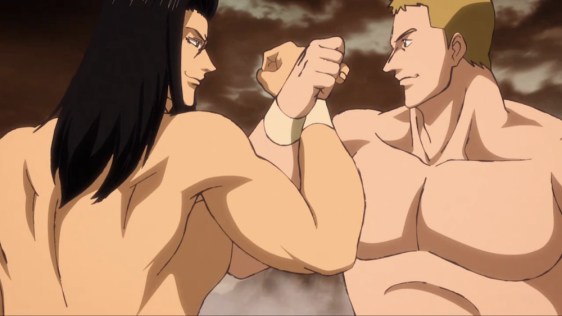
Whether in anime or pro wrestling, when you look like Generic Background Figure #45, there usually isn’t much hope for someone to make an impression. Kevin Anderson (pictured right) defies the odds, even despite the most incredibly generic name. A member of the dastardly Global Wrestling Monopoly, he’s a frequent teammate of the mysterious and nasty Tiger the Dark. But while Kevin is indeed party to some of the nastier elements of GWM, he’s also a loyal friend in an environment where backstabs and grabs for power are par for the course. When Tiger the Dark is at his lowest point, Kevin stands by him. Even when Tiger the Dark abandons GWM, Kevin takes it more as a betrayal of their friendship and fights to bring him back over. Poor Kevin.

BEST FEMALE CHARACTER

Mauve (ACCA 13-Territory Inspection Dept.)

ACCA is the kind of series where you can never tell who’s on what side—sometimes not even the protagonist himself. In a cast full of intriguing characters, Mauve stands out for her striking presence. The director-general of ACCA, an independent watchdog group for the Dowa Kingdom’s government, she holds a lot of power and has to match wits with figures even more influential than her. Mauve embodies brains, beauty, and the idea that brains are beauty, and it’s telling that even our stoic hero, Jean Otus, finds himself a bit flustered around her.

Final Thoughts

I think the qualities that have stood out to me most about the anime characters of 2017 are exceed their trappings and their archetypes, and just a greater sense of cleverness overall. Sucy from Little Witch Academia seems nasty, but she cherishes friendship in her own bizarre way. Both Sakurai and Morioka from Recovery of an MMO Junkie recast the image of the MMO player without delving into wish fulfillment fantasy or rejecting previous characters outright. Cure Macaron from Kira Kira Precure a la Mode is a highly perceptive and aloof teenage heroine—an uncommon combination in that franchise. Kevin is a nobody jobber, but his sincerity is real. Mauve casts a huge shadow on the rest of the story, but it’s more in the sense of Legend of the Galactic Heroes-esque political maneuvering over “innocent honesty.” As more and more characters challenge expectations, I look forward to what 2018 has to offer.

Save

Save

Save

Save

Save

Save

Save

Save

Recovery of an MMO Junkie’s “Alternate NEET” and the Question of Responsibility

Recovery of an MMO Junkie is a charming anime about a romance that develops between two MMORPG players, only without the need to trap them in the game. It’s a refreshing series in many ways, with one notable reason being its portrayal of its NEET main heroine.

NEET (“Not in Education, Employment, or Training”) is originally an English term that migrated over to Japan and is one of the many terms used to describe Japanese youths as a way to admonish their lack of drive. In response to this negative image, many anime, manga, and light novels have NEET protagonists rise to the occasion, get the girl, and save the day. However, even when they’re portrayed as lovable losers who become winners in a new world, they still have that aura of initial failure about them.

However, Recovery of an MMO Junkie‘s main character, Morioka Moriko, is not portrayed as being a sad sack who never went anywhere. Prior to her becoming a NEET, she actually had a lucrative office career. While they never explicitly say why she quit, it’s implied that something about the job wore her down over time, and that she left it for her own sanity. Where other series’ NEETS are often presented as people who never even try to enter adult society, Moriko is someone who could have walked down that path but didn’t.

The reason Moriko being a former working adult is important is that NEETs, hikikomori, freeters, etc., are viewed as irresponsible and lazy, as if their lack of employment and romantic success falls squarely on their shoulders. MMO Junkie suggests that maybe there’s something wrong with the corporate and societal culture that grinds people down. It’s similar to the arguments we see about millennials, except it’s been going on in Japan for even longer.

The English title, Recovery of an MMO Junkie, can sound misleading. It’s not about an MMO player getting over her online addiction, it’s about an MMO player using an MMO for self-therapy to help her recover her life. When she worked, it was her nightly reprieve. When the job became too much for her, she needed more extensive healing. Even adults need time to recuperate mentally and emotionally.

It’s Time to Yule: Ogiue Maniax Status Update for December 2017

EDITPatreon has decided NOT to go through with the changes described below.

This month’s Patreon sponsor update is, funny enough, going to be about Patreon.

Before I go into detail, I’d like to give thanks to my Patreon sponsors.

General:

Johnny Trovato

Ko Ransom

Alex

Diogo Prado

Viga

Sue Hopkins fans:

Serxeid

Yoshitake Rika fans:

Elliot Page

Hato Kenjirou fans:

Elizabeth

Yajima Mirei fans:

Machi-Kurada

Recently, Patreon has changed the way it handles patron subscriptions and creator payouts. There’s some controversy over the exact intent behind this change too–Patreon claims it’s to increase consistency of payments, critics argue it’s a greedy move to extract more money. Either way, what it means is that many users might end up paying more. Where a $1 pledge once meant you pay $1, it now means $1.36 per creator you support.

If you want to keep supporting Ogiue Maniax at your current pledge level, feel free to do so. But if the extra financial burden from this Patreon change is too much, feel free to lower your pledge amounts as much as necessary–even to $0.

One thing I’m considering is lowering my rewards to compensate for this change, so patrons can get the same perks for the same amount. Tell me in the comments or on Patreon.

My favorite posts from last month:

Teikoku State of Mind: Anime NYC 2017

It’s been a while since New York City’s had a dedicated anime con. Check out my thoughts on Anime NYC (spoilers: it was fantastic).

10 Years After: Ogiue Maniax 10th Anniversary

Wherein I reflect on a decade of anime blogging.

Raspatat at Koshien: An Iconic Dutch Snack at Japan’s Most Famous Stadium!

A snack from my time in the Netherlands!

Genshiken Re-Read

Return to Genshiken: Volume 6 – Eyes as Black as the Abyss

My favorite volume of Genshiken, period.

Patreon-Sponsored

Aikatsu Stars! and Nikaido Yuzu, the Ultimate Kouhai/Senpai

I was asked to write about my favorite Halloween anime, only to realize that most of them are Precure episodes. Go figure.

Closing

Kio Shimoku announced a new manga. Am I going to review it on Ogiue Maniax? The answer is “very yes.”

Save

Save

Save

Japanese vs. English Yu-Gi-Oh!: How the Two End Up Being Almost Different Shows

Yu-Gi-Oh! is one of those prolific anime that needs little introduction to the world at large. Its cultural penetration is tremendous, and its characters and monsters are iconic. The Yu-Gi-Oh! anime is also a series from a bygone era of heavy localization for Japanese cartoons, and one consequence is that, in many ways, the show America received and then exported to the world is significantly different from the original. It’s a song and dance as old as anime in America, but the result is that audiences potentially come to enjoy each version for differing reasons as well.

The Japanese and English versions of Yu-Gi-Oh! (Yu-Gi-Oh! Duel Monsters in Japanese, to distinguish it from a previous anime by Toei) are not wholly dissimilar. They both feature over-the-top personalities fighting for their lives and dreams through a trading card game. But when looking at the presentation of characters, music, and duels, the two diverge significantly—perhaps to the extent that they could be regarded as two different shows—even when factoring out what would be called censorship, e.g. removing references to death or religion.

Characters

Characters between versions of Yu-Gi-Oh! are generally the same archetypes, but there are instances where they vary greatly. Anzu Mazaki is nowhere near as friendship-obsessed as Tea Gardner. Katsuya Jounouchi doesn’t have the Brooklyn accent, but he’s still kind of a delinquent with a heart of gold. The biggest example of character disparity is undoubtedly Seto Kaiba.

Viewers familiar with Kaiba’s English incarnation know him as an extremely arrogant bully who almost can’t help but simultaneously self-aggrandize and belittle others every time he opens his mouth. He also has an extreme skepticism towards the occult to the extent that even when transported to an ancient, illusory world, he maintains that it’s all holograms.

Japanese Seto Kaiba, while still arrogant, is nowhere near as condescending. Instead, he’s more curt in his speech, and comes across as a no-nonsense individual who has little time or concern for goals outside his own. He’s also extremely intense about the things he cares about, puts himself into every duel, and is more willing to believe in the unknown than his English counterpart. What’s more, while both have fierce rivalries against Yugi, the Japanese version is more willing to give respect where it’s due, even if grudgingly.

Neither is necessarily a better character, but the way they approach scenes with their different personalities shapes and transforms the overall feel of the anime. Scenes of Kaiba in Japanese that are about emphasizing his passion become scenery-chewing exercises in English. Characters in the English Yu-Gi-Oh! can come across as practically parodies of their Japanese versions (which, as an aside, makes Yu-Gi-Oh! Abridged all the more interesting).

Music

To a generation of Yu-Gi-Oh! fans, “It’s time to d-d-d-d-d-d-d-d-d-duel!” is a downright iconic refrain. The music in the English version is made to sound tough and cool, like whoever or whatever it accompanies is a ridiculous badass. Though the Japanese music can also be described with similar adjectives, it comes with another dimension—a sense of personal emotional weight.

Take for example the second opening, “Shuffle,” by Okui Masami (Revolutionary Girl Utena, Scrapped Princess). There’s energy and excitement, but also dread tinged with sorrow. When the chorus hits, there’s a swath of emotions telling the audience that the stakes are high. Those feelings come across, likely even if the listener doesn’t understand Japanese.

English Yu-Gi-Oh! has one opening theme, whereas Japanese Yu-Gi-Oh! has five distinct opening themes, so it’s possibly unfair to compare them when the latter has so many opportunities to change. But one element common to all the Japanese themes is a sense of melancholy mixed with power. While that is arguably just a product of the tendency for anime songs to add some sadness, it still means the Japanese series front loads the expectation that the story is an emotional trial.

Duels

Because of the character and music differences, the duels themselves take on distinct feels, despite the fact that they play out largely the same way in both languages. In English, the duels act as wild displays of the characters’ ridiculous personalities. When Kaiba or Yugi pull off some combo and win the game, it’s like the cherry on top of a cake of absurdity. When a character then explains the logic behind their actions (keep in mind that they pretty much make things up as they go along), the response I have is, “Sure. Whatever you say.”

In Japanese, however, because all of the characters carry a greater sense of personal conviction, and the music is filled with greater variations in emotion, the duels reflect those self-serious attitudes. Even though the actual moves and explanations are more or less similar to the English version, the Japanese characters deliver every word like it’s the most important thing in the world. When hearing them explain their actions, it’s easy to feel as if everything they say makes complete sense, even when it doesn’t.

Both versions create tension and end up in the same positions in terms of story, but what draws viewers in to keep watching the duels feels like the difference between an action game and an adventure game—similar in many ways, but different upon closer inspection.

So What?

Nostalgia plays a tremendous role in how Yu-Gi-Oh! is remembered. Those who grew up with one version or another might very well be as attached to them on a deep and personal level. The desire for the “original” can also fuel disagreement over which version is better. The fact that the Japanese version came first arguably positions it as the “true” story, even though it is adapted from a manga and has its fair share of filler arcs. But even when factoring out nostalgia and reverence for the original and/or “Japanese-ness,” the two versions are different enough that, if you were to re-dub the entire series with the same English voice actors but with a script and music closer to the Japanese version, the experience would be quite different. The English Yu-Gi-Oh! makes the series feel more like an exercise in excess and bombast. The Japanese Yu-Gi-Oh! leans more towards melodrama and intensity.

At a far enough distance, the distinctions made above between English and Japanese Yu-Gi-Oh! can seem trivial. Being built from the same core, they capture a lot of the same important points in terms of story and character. But it’s because the disparities appear mainly when taking a closer look that feelings about which iteration is better can be so strong. Viewers were treated to different sets of emotions and different images of the characters. One version does not wholly deliver the desired effect of the other, leaving those unfamiliar with the “other” either unsatisfied or intrigued.

A Food Analogy to Explain the Resistance Against Diversity in Comics (and Why Diversity is a Good Thing)

Marvel placing blame for its declining sales on its push for characters outside of the white, male archeype has provided the latest arena for critics and fans to come out for and against diversity in entertainment. Looking at the online discourse, however, I find that there are many championing diversity who have difficulty seeing why anyone would resist. A major part of the problem, I believe, is that there’s a failure to understand that the two sides are coming from unique points of view built on very different foundations.

The Story of Trans Fats

Here’s a food analogy (because I love food analogies).

For years in restaurants across the US, frying oil was reused over and over by default. Then it was discovered that this process produced what came to be called trans fats, and that these fats were more harmful to health than just frying in general. Because of this, every place began changing their practices and eliminating or minimizing the presence of trans fats.

In addition to the added expense of having to rethink how food is prepared, this transition came at arguably another cost: flavor. Fried food just tastes different when old oil isn’t being reused. If the reason for eating at, say, your favorite fried chicken joint was because of what that reused oil imparts to the meat and skin, it could have felt like an unnecessary sacrifice for “health.” Even though having food be healthier is unarguably a good thing (if people could eat versions of the food they do now that tasted the same but was better for the body, they would), health benefits are not necessarily what any given person will prioritize.

The Establishment of Critical Values Among Fans

This is where I think some of the contention over diversity in comics and media lies. While the notion of “I don’t mind diversity in my entertainment, I just won’t want it to turn into some SJW hugfest,” is an argument borne out of certain biases and blindness towards privilege, it’s also on some level based in the standards established in a given circle of media consumers. In this environment, there are criteria by which a comic or television show is judged as “good” or “bad,” e.g. narrative consistency. To a different audience, narrative consistency could be important too yet still take a backseat to something accepted as a “higher priority,” such as a visceral feel to romantic interactions. Personally speaking, different groups of fans I’ve interacted with can have wildly different elements they value, to the point that it can seem as if two groups are watching completely different things despite it being actually the same product.

In other words, the push-back against diversity isn’t only about right and wrong, but about what people are accustomed to—what they’ve accepted as truisms of the medium. When a given community is built and reinforced over time, certain values become stronger in turn. If the specific reason you ate fried foods was for the savoriness that trans fats provide, then no amount of “it can increase the risk of heart attack!” will placate you.

Old vs. New Criticism

To move this away from deep frying and towards actual examples from comics and entertainment, I present two examples. The first is the changing reception over British comics writers such as Alan Moore and Grant Morrison. The second is the increasing prominence of character-over-story manga series from around the early to mid 2000s.

In years past, Alan Moore and Grant Morrison were praised by comics fans as writing incredibly intelligent and mature comics. Works such as Watchmen (Moore) and Seven Soldiers (Morrison) are genre-defying/defining creations that present complex and cerebral arguments that challenge comics readers. However, a lot of their works involve anywhere from minor to heavy doses of misogyny, so if your priority is the positive portrayal of women above all else, then it might not matter how “smart” Moore and Morrison’s comics are. On the other side, if you’re from a community space that believes the intellectual elements of their comics are what define good comics, then misogyny might be viewed as a lesser complaint or a non-issue.

Somewhat similarly, manga scholar Ito Go has written that manga criticism was historically biased against manga that emphasize character over story. When manga began coming out in the late 90s/early 2000s that focused on the stylization of its characters above all else, these were considered “bad manga” by established critics. Ito, on the other hand, argues that this because of the values that have been built and reinforced around the cult of Tezuka Osamu (the most celebrated manga artist ever), and that the visual “realness” of characters (kyara, as Ito calls it) has been just as much a part of manga all along. Essentially, the idea is that the only reason why kyara-heavy manga is considered inferior is because of the ossification of the criteria for “good” manga. Yet, for those who still want strong story above all else, Ito’s point of view holds little weight.

Whether the contention is based specifically in diversity or not, the general tendency for a group of like-minded individuals is to assume certain truths and then build around them. Disagreement can happen within these parameters, and sometimes those boundaries can even be stretched or broken, but in time certain truisms develop. Attacking that structure or praxis from the outside can appear to an insider as if you’re saying “1 + 1 = 3,” even if what you’re expressing merits consideration.

Noticing the Problem

On a certain level, I believe that the resistance against diversity in comics and other forms of entertainment is because we’re in the middle of a paradigm shift. Where once comics fandom and criticism was built on a long established marketing focus on white, male, and straight readers, other groups are making their voices heard in ways that the entrenched fanbase can’t help but take notice. The reason that they didn’t notice in the past is because they were unaffected by it, plain and simple. Many likely didn’t even know there was a problem, and this is because the values emphasized and prioritized in that community left little room for diversity to be brought up except in very broad strokes. The sand is shifting underneath them, and it’s not surprising that some would double down on what they’ve learned to be true.