OGIUE MANIAX

Anime & Manga Blog | 50% Anime Analysis, 50% Ogi

The Intertwined Histories of Magical Girls, Idols, and Science Fiction Anime

Magical Angel Creamy Mami

I recently learned (thanks to Japanese popular culture scholar Patrick Galbraith’s new book The Moe Manifesto) that Magical Angel Creamy Mami is not only an influential magical girl anime but the very first anime about an idol. In other words, idols and magical girls have been conceptually tied to each for decades now. You can see this not only in the the fact that you’ll get the occasional idol + magical girl still (Cure Lemonade and Cure Sword in the Precure franchise, for example), but the fact that the latest competitors to magical girl anime have been idol-themed shows, such as Aikatsu! and Pretty Rhythm, both of which feature magical girl-like transformation sequences. I think Creamy Mami is especially significant here because the majority of magical girls prior to it were more “witch girls,” characters who already have magical powers without the need for transformation and use them for mischief.

Of course, the common trait of magical girls and idols is that they both feature cute girls, and with idols especially they’ve always occupied a position where they are innocent yet sexual, and I don’t mean that necessarily in an “idols are creep magnets” way. Both men and women respond to idols for a variety of reasons, and a lot of it is tied to the image they present. They can be somewhat literal idols for girls and targets of affection and desire for men, and this can be seen in how idols are used in anime. While Creamy Mami built an unexpected older male audience, for example, Superdimensional Fortress Macross reveled in it by combining the idol with the extremely prominent aspects of science fiction and giant robots. The 1970s brought forth a lot of giant robot anime, and the 1980s saw the time when those who became fans of robots and SF began creating their own works, as seen with Kawamori Shouji and Macross and later Studio Gainax and their Daicon III and IV animations. Many of these creators said, “I like SF, and I like cute girls,” and created a defining combination of anime where mecha and other forms of fantastic technology are mixed with cute girls.

Daicon IV

It can also be argued that the girl in the Daicon animations is herself a magical girl, but the connection between magical girls and science fiction is especially evident in the 1990s and the advent of the fighting magical girl, most notably with Takeuchi Naoko’s Pretty Guardian Sailor Moon. While Sailor Moon does not feature giant robots, it’s undoubtedly influenced by the Super Sentai (i.e. Power Rangers) franchise with its own transformation sequences, color-coded costumes, and monster of the week fights. Super Sentai is not only traditionally marketed at boys (though this too changes as they eventually start trying to appeal to the “moms” market), but it’s also more broadly tied to tokusatsu, the costumed fighters and rubber monsters genre that more or less literally means “special effects.” What I find significant here is that when it comes to categorization of genres in Japanese, you often see “SF/tokusatsu,” tying things back, at least somewhat, to science fiction.

Pretty Guardian Sailor Moon

Moreover, the manga group CLAMP have been fans of titles like JoJo’s Bizarre Adventure, Saint Seiya, and Galaxy Cyclone Braiger, and have produced titles such as Magic Knight Rayearth, which features magical girls in a swords-and-sorcery world who also gain the power to summon giant robots. “Rayearth” itself is the name of a giant robot, thus making the title itself reminiscent of the naming scheme of many mecha anime such as Mobile Suit Gundam or Super Electromagnetic Machine Voltes V. It’s as if these female creators have taken the works that were made “masculine” by Kawamori, Gainax, and others, and in a sense re-feminized them in a process that created something new and exciting.

If we’re talking influences though, Sailor Moon and CLAMP works such as Cardcaptor Sakura are huge in and of themselves, and their shadows can be seen in a number of anime from the 2000s on. Sailor Moon basically transformed magical girls to such an extent that many assume that fighting magical girls have always been the norm, and Precure has come up as a spiritual successor that has lasted even longer than Sailor Moon. The protagonist in Sunday without God practically is Cardcaptor Sakura protagonist Kinomoto Sakura, and Magical Girl Lyrical Nanoha, which has as its primary audience older men, clearly takes a lot from Cardcaptor Sakura as well. In the case of Nanoha, it also incorporates an increasing level of science fiction from one series to the next, as the franchise goes from technology-based magic staffs that shoot lasers in battles reminiscent of Mobile Suit Gundam to spaceships and interdimensional travel. Once again, the magical girl as cute girl is tied to SF. As for idols, they not only haven’t been forgotten, either in real life or in anime (as seen with series such as Love Live! and the aforementioned Aikatsu!), but Kawamori makes his return in the form of AKB0048, a series that not only features idols as magical girls of sorts both piloting and fighting giant robots in a story that spans a galaxy, but is directly based on one of the biggest real-world idol acts in Japan today.

AKB0048

It’s as if magical girls, idols, and SF have been doing a song and dance for years and years, changing partners along the way but always being drawn to each other. They’re seemingly tied together by the fact that just a few tweaks to either appeal to a male or female audience more, while the fact that people will not necessarily stay within the genres or types of entertainment that they’re “supposed” to remain with. Cuteness is a versatile tool that at times reinforces societal and gender norms while other times becoming a tool to defy them, and this continues to influence anime to this day.

If you liked this post, consider becoming a sponsor of Ogiue Maniax through Patreon. You can get rewards for higher pledges, including a chance to request topics for the blog.

The Melancholy of Anime Openings

As I imagine is the case with many fans of anime, one of the first things about anime that caught my attention, one of the things that helped make me into a fan, was the quality of openings. Whether it was the music itself or the animation that accompanied it, anime openings felt like they blew the cartoon intros I was accustomed to out of the water, not to mention the dubbed anime openings which populated American TV. This is not to say that anime music is the best music ever, but once upon a time I often felt that way.

Recently I began to reflect on this feeling. What was the appeal? What was different about them? The more I think about it, the more I believe that it has to do with the sense of melancholy, angst, and forlornness that often appears briefly in anime openings.

A lot of anime openings make the viewer feel as if they are privy to the characters’ inner turmoil. In some cases, this is almost the entire point of the opening: see, for example, the “Tsubasa Cat” arc from Bakemonogatari (warning, it’s kind of not work-safe). The Galaxy Express 999 opening above doesn’t even have characters in it. In others, this feeling will be concentrated into a single, perhaps introspective moment. Think of the first Gundam W opening and Relena in the snow, or the Slayers NEXT opening when Lina reaches for Gourry. This melancholy is even mildly present in the opening to Fist of the North Star until it roars into overdrive during the chorus, accompanied by images of Lin, Bat, and the other destitute wanderers.

However, its ubiquity doesn’t end there, as it will appear in shows you might not expect to care about that sense of melancholy in the first place, such as Bistro Recipe (aka Fighting Foodons) and Medarot (aka Medabots). The openings for these anime both feature brief scenes where the main characters appear to be lost on an emotional level, despite the fact that they’re largely absurd comedies vaguely built around the concept of competition. It even shows up in one of the openings to the Japanese dub of the 1990s X-Men cartoon!

On some level, I wonder if openings might be a make-or-break moment for some as to whether or not they become anime fans. It’s the kind of thing that can easily cause someone to exclaim from the rooftops that anime is the best, or to dismiss it for not being as aggressively powerful as, say, the 1990s X-Men opening!

This is not to say that having this quality automatically makes an opening better, even if it is what likely caught my attention every time. Rather, just the fact that so many openings in a whole slew of genres utilize it at least to some extent feels like it speaks to something more deeply ingrained into, if not Japanese society, then how anime is viewed by society. Anime has gone from having openings designed specifically for the show itself to becoming vehicles to promote musical groups and back again, and consists of both shows designed for large audiences and hardcore fans, and yet somehow these melancholic moments have persisted over the years through all of these changes. I can only believe that there is a tacit assumption that anime openings, more often than not, should on some level evoke a strong sense of sympathy in the viewer, and this influences their structure.

The Mystery of Stocking’s Virginity (or Lack Thereof)

The idea that otaku over-value virginity is prevalent. This sexism is not limited to otaku or even just Japan of course, and there are equivalents around the world in different forms, but whether it’s people getting mad over their favorite anime characters having had past relationships, or scandals over Japanese idols secretly dating, it’s become a valid point of criticism for otaku subculture. At the same time, I wonder if that mindset isn’t so cut and dry. Just as girls do not fall under a simple virgin/slut dichotomy, I think it may be faulty to view otaku as liking only one or the other.

The main title that has me looking over the otaku preference thing is actually Panty & Stocking with Garterbelt. It’s well-established, based on sales of merchandise both official and unofficial, that the sweets-loving goth Stocking is much more popular among Japanese fans than the sex-crazed Panty. This seems to fall in line with the general rhetoric that otaku hate non-virgins, as Panty as a character is defined by the sheer amount of sex she has. She has extremely shallow standards for men, possibly spends more time having sex than not, and will even have important conversations in the middle of sex with people other than the guy(s) she’s with. The image of otaku’s preferences would work out perfectly, if not for the fact that the show states that Stocking is also sexually active.

Stocking mentions during the series that she also has a love life. It’s not even that she’s only had long-term relationships, or is merely a non-virgin still hesitant about sex even after having it. Though she’s more selective than Panty in terms of men, she establishes that she’s been with multiple guys, and will candidly discuss with Panty that some were great in bed and others weren’t. In light of this, why do the fans prefer Stocking to the point that her figures will go out of stock while Panty’s will get discounted heavily due to lack of sales?

One possibility I’m considering is pretty much a matter of relativity. Within the context of individual shows, it becomes easy to categorize characters in comparison to each other. In a show where everyone is small and cute, the character with any sort of bust becomes the “big-breasted” one, whereas in a show where all the character designs are leggy supermodels there may be a different standard among fans. Because Panty’s head is filled with sex (as the opening shows us), and Stocking is not so preoccupied with the same subject, it becomes a matter of Stocking being preferable by contrast even though she probably has more sex than your typical female anime character?

Another possibility is that it just comes down to character design, that Stocking’s gothic lolita look and Panty’s blonde hair and cocktail dress are the main ways in which they’re judged regardless of what happens in the show. Or maybe it’s that, at a cursory glance, Panty’s sexual activeness is extremely visible (the first thing we see of her in Episode 1 is her crawling out of bed with a guy), whereas Stocking’s love life is not so prominent? Only by watching the show do you learn that Stocking is no stranger to the opposite sex either, but it’s possible to understand this about Panty from the anciliary material.

If you have any thoughts or opinions on this, feel free to leave a comment, as I don’t feel like I quite have the answers. I’m not really sure myself, but I get the impression that Stocking’s relative popularity shows that things aren’t as simple as otaku liking either only the “pure” or the “promiscuous.” There are other examples as well, like how Akihabara idol Momoi Halko married and had a child but is still beloved. I have to wonder then if there’s another factor at work, like an inside/outside-group dynamic (and I don’t mean strictly in the Japanese culture sense) which dictates that allows some girls, fictional or otherwise, to be okay no matter what while others are judged more harshly.

Shoujo Face, Bishoujo Body

I’ve been reading one of Crunchyroll’s latest manga, Watashi ga Motete Dousunda (aka Kiss Him, Not Me) by Junko, which is premised around a fujoshi who loses a ton of weight after her favorite anime character dies and so inadvertently gives herself a makeover that attracts all the guys. Given the idea that the main character Serinuma Kae is supposed to be absolutely gorgeous, I find it interesting how this is expressed, because it’s somewhat unconventional for shoujo manga.

When looking at characters in manga, one can generally get a sense of who the artwork is trying to attract based on how characters’ sexual features are drawn. In manga for girls, even when a character is supposed to have large breasts, they tend not to really stand out compared to how they’re portrayed in boys’ manga. This is quite noticeable, for example, when looking at the difference between how the character Maya looks in the Survival Game Club anime vs. the manga. Another example is when a work depicts its female characters wearing unrealistic shirts that look practically painted on. You rarely if ever see this in a shoujo series.

Kae has what I would call a face that is fairly typical for beauty standards in shoujo manga, but her body is closer to what you would find in a bishoujo series, that is to say a manga for guys all about attractive ladies such as Love Hina, making her a hybrid of sorts between the two styles. Moreover, while the clothing isn’t so unrealistic so as to basically be super spandex, there are times when Kae’s figure is accentuated and her clothing clings to her chest. Again, this would not be so surprising to me if it were in a series that ran in, say, Dengeki Daioh, but Watashi ga Motete Dousunda is definitely a shoujo series, as evidenced by the fact that so much effort is made to portray the guys themselves as various degrees of angst, handsomeness, and dream-boatitude.

Watashi ga Motete Dousunda is not the only series to do this, though maybe there’s something to be said (about me or manga more generally) about the fact that the first example that immediately came to mind was another fujoshi-themed manga, Mousou Shoujo Otakukei (aka Fujoshi Rumi) by Konjoh Natsumi. Like Watashi ga Motete Dousunda, Konjoh’s series portrays its guys as tall, attractive fellows in that way you’d more typically see out of shoujo manga, but the girls, especially the character Matsui Youko, are given a kind of physical attractiveness that is more in line with guy-oriented stuff.

In his introduction to his book The Moe Manifesto (a collection of industry, scholar, and fan interviews about the subject), Patrick Galbraith makes mention of how Azuma Hideo, the “father of lolicon,” created his cute girl characters by combining the expressiveness of shoujo characters with the bodies more in the style of manga pioneer Tezuka Osamu. It could be said that Watashi ga Motete Dousunda is going for a similar effect, though of course calling it lolicon wouldn’t quite be accurate, even if one were to take into account how the definition of that term has changed over time, as it seems to be less about the intersection between youth and adulthood, and more about expressing a new type of ideal.

Week to Week, Weak to Strong: Thoughts on My “Anime Power Rankings”

This past season I’ve begun participating in the revived “Anime Power Rankings,” which polls anime bloggers for their top 5 shows each week. It’s not super serious or anything, and people can choose whatever criteria they want for their favorite anime of the week, but doing it myself has made me aware of how much judging something on a per episode basis can differ from one’s assessment of the show as a whole.

I’ve noticed that within the weekly parameters I’ll often find that the shows I enjoy and look forward to the most don’t necessarily take the #1 or #2 slots every time. For example, I’m really into Tribe Cool Crew and Gundam Build Fighters Try, but when judging the merits of individual episodes, in terms of their story, excitement, ability to captivate, interesting ideas, animation, etc., often something like Rage of Bahamut Genesis will win out instead. And yet, I can’t say it’s my favorite show of the season.

Probably the show that suffers the most in my rankings in Selector Spread Wixoss, the sequel to Selector Infected Wixoss. I’m enjoying it a great deal, probably more than Bahamut even, but it almost never makes my weekly Top 5.

This isn’t to fault the Anime Power Rankings system itself; it works for what it’s supposed to reflect. However, it does reinforce in my mind the idea that some series are more than the sum of their parts.

Gundam: Reconguista in G and the Ghost of Lalah Sune

Raraiya_mondayGundam: Reconguista in G continues to be the kind of whirlwind experience that I love in a Tomino anime. Part of that feeling comes from the show’s tendency to throw around a lot of terms without explanation that everyone but the viewer understands, only to gradually peel back the layers over time. Among these many terms are clear references to the Universal Century timeline of the original Mobile Suit Gundam that Tomino directed back in 1979, and I’ve noticed that there are a couple that relate strongly to the character Lalah Sun from that first series.
The first and most prominent reference is the G-Reco character Raraiya Monday. Not only does she have dark skin like Lalah and appear to exhibit some connection to the G-Self, the “Gundam in everything but name” of the series, but characters will sometimes even refer to her as “Rara,” which sounds mostly similar to Lalah in Japanese (ララ vs.  ララァ). When looking at their last names as well, a connection forms: Lalah Sune -> Lalah Sunday -> Rara Monday -> Raraiya Monday.

The second reference comes from one of the terms being tossed around by characters that has yet to be seen: The blueprint of the “Rose of Hermes.” In Japanese, Hermes is pronounced “Erumesu” (エルメス), which is the exact same pronunciation as Lalah Sune’s Mobile Armor, the “Elmeth.”

(By the way, I learned about the pronunciation thing from watching Densha Otoko, which has as an important object in its story, Hermes-brand tea cups.)

What does this all mean? While I don’t know if these are thematic references or actual plot points, if I were to assume the latter it would mean a few things. First, Raraiya is probably a Newtype (maybe even a Cyber Newtype given her personality?), and the reason nobody is aware of this possibility is because the concept of Newtypes has been buried with time (we also see the protagonist Bellri have occasional Newtype-like flashes). Second, the blueprint of the “Rose of Hermes” might actually refer to design documents for the Elmeth’s bits. If that were the case, whoever joins Raraiya with the Rose of Hermes would gain a powerful weapon, which would also connect to the criticism of militarization that is a central plot point in Reconguista in G.

Smash Bros. and Games as Physical vs. Mental Competitions

Note: As is evidenced by some of my recent posts, I’ve been quite into the new Super Smash Bros. as of late, and have been participating in online discussions more because of it. Rather than keeping those posts in forums or on other sites, however, I’ve decided to also include them here as “supplemental” blog posts.

Taken from Smashboards:

I’m not competitive on the level of anyone in this discussion thread, but I wanted to post in here just because the direction of this conversation is one that I’ve seen fought a million times over in multiple competitive gaming communities. I’m not a game designer so I can’t say firsthand what works and what doesn’t, but what I mainly want to say is that it’s very easy to take a firm position on how competitive games “should be” but it risks inadvertently accusing others of making or even playing games “incorrectly.”

Sirlin usually comes up in these arguments because of his emphasis on yomi and how polarizing it can be. To simplify Sirlin for a bit, he believes that execution barriers are the devil and if we could all play with purely our thoughts and intentions games would be much better. Essentially, Sirlin wants games to answer the question, who is the superior thinker? It makes sense, but mainly if you see games as “brains over brawn.”A number of years back Sirlin took a class on Starcraft Brood War that was being given at a university, and from his perspective one of the issues with Brood War is how tedious the game is in terms of things you have to click to even play the game at a remotely decent level. I can’t remember the exact words, but he basically suggested something like a maximum cap to APM so that who presses buttons faster wouldn’t be a measure of skill. Instead, it would be about using your actions wisely instead of simply some people getting more opportunities than others. Naturally, the Brood War community disagreed. It loved the idea of APM as an execution barrier, or more specifically the combination of speed and precision needed to use it effectively. It separated chumps from champs, and when a great player is able to build his army so perfectly because he never misses a beat in his production cycles, it’s viewed as a thing of beauty.

We’ve heard it over and over again that fun is subjective. It’s the rebuttal that competitive Smash players use against the argument that they’re playing the game wrong because they don’t embrace the free for all chaos that Smash advertises itself as. It applies here too: different people get satisfaction out of games differently, and this includes competitive gaming as well. In other words, while Sirlin views games as a domain of the mind, some people like the idea of being able to defeat brains with brawn even in games. They like the idea that they can train up their “muscles”, and that, by being bigger, faster, and stronger too, even the most brilliant tactical mind in the world wouldn’t be able to keep up.

For some, mastering a frame-perfect 50-hit combo in an anime fighter sounds like the most tedious thing ever. You sit around, committing things to muscle memory, hardly a showing of your mental skill. However, for others, improving your ability to read the player and to think more critically in a match is too abstract a reward. Others still might believe that the true test of skill comes from managing luck and taking advantage of uncertainty, as in games like mahjong or Texas Hold ’em. Depending on where you fall between those two extremes, different games appeal to different people because of what they believe “competition” means. Bobby Fischer famously promoted a version of chess where starting positions were randomized because he believed that chess was becoming too reliant on memorizing openings, but it didn’t stick because, most likely, people on some level liked being able to improve by having superior memorization compared to their opponents (inertia from years and years of tradition was probably a factor as well).

I think the implicit disagreement as to how games should be competitive is what creates such tension within Smash Bros. itself. You have this massive clash of philosophies within a single franchise, and even within a single game. Putting aside the fact that Melee is more mechanically difficult than Smash 4 (as far as we know), and that this has created some dissatisfaction for players who believe the Melee way is the best, even Smash 4 itself has different philosophies behind its characters which can cater to different people’s idea of “competitive fun.” We’ve seen the argument that Sonic’s gameplay is degenerative because it forces the opponent to have to guess where he’s going to be and throw out moves in the hopes of catching Sonic, but there are people who love the idea of games as gambles, of having to shoot into the darkness because there’s a thrill in being able to more effectively navigate uncertainty. This isn’t to deny the frustration fighting Sonic can create, nor is it an argument that Sonic or any other character is balanced or imbalanced. Rather, it’s about the fact that different characters in Smash end up embodying different concepts of competitive play, and when they clash there’s always the chance that arguments of a character being bad for gameplay for being too simple or complex or whatever. It’s important to think beyond our own conception of competitive fun and to be able to see from the perspective of others.

Smash Bros. and the Desire to Learn Bad Characters

I’ve been playing quite a bit of the new Super Smash Bros., first for Nintendo 3DS and soon for Wii U. In both cases I waited in line along with millions of other folks with the intention of playing the game until the cows come home. In celebration of the true beginning of the 4th generation of Smash Bros., I’d like to talk about the idea of using “inferior” characters.

Whenever I see a comment that X or Y character is garbage, something compels me to try that character out. I don’t consider myself an exceptionally talented player, nor am I going to win any tournaments any time soon. Even if i were, I also definitely don’t think I will be responsible for revolutionizing any character’s style or for defying tier lists in a major way, like Taj did for Mewtwo or aMSa has done for Yoshi in Melee. Instead, I think what prompts me to start delving into seemingly weaker characters is that when I see others so strongly deny a character’s ability to compete, it makes me genuinely curious.

Is this character really as bad as they say? Is there perhaps some aspect to the character that may have been overlooked? While in the end they might very well be right and a certain character could end up being the bottom of the barrel, often times I feel as if there is some incompatibility between a player’s preferred style and a character’s attributes that could lead to a bit of wasted potential (even if that potential might not be particularly high). For example, I often see “this character has no combos!” on a character not built for combos, or using a very aggressively oriented character defensively or vice versa.

It’s like there’s something peculiar at work in the minds of players, at times unspoken philosophies which dictate how an individual approaches their game. Case in point, when players/commentators Scar and Toph discuss why Melee player Hax is not a Captain Falcon at heart due to his preference for perfect, impenetrable technical skill over relying on reading the opponent. I want to try and adapt myself to different frames of mind for different characters.

My current project is Meta Knight. He’s had something of a fall from grace since Brawl where he was the undisputed best character, but there are all these little aspects of the character that make me feel as if those who regard Meta Knight as terrible are perhaps missing something vital to the character. Of course, now there’s a patch and Meta Knight has gained some extra tools, but even before that I felt that while I wasn’t going to wow the world with my Meta Knight, as I practiced and saw more of his ins and outs, I honestly felt that it was possible to put all the pieces together and create a formidable opponent, or at least one who would put up a decent fight against all opponents. Now that he’s been augmented in certain areas (notably killing power), things will probably be easier.

This is less a point of pride for me and more a learning process. If you read this blog and are familiar with my anime and manga content, I think you might see this approach applied there as well. Of course, unlike anime and manga in Smash Bros. there’s really only one criteria for how strong something is (how often it wins), but I think that difference is sort of inevitable.

I’ll see you online!

Random Thoughts Upon Revisiting Madoka Magica

Although I watched the original TV series of Puella Magi Madoka Magica, only recently did I finally see the movie trilogy. I’ve already laid out quite a few of my thoughts about the series including its status as a magical girl show  and how I felt about its ending, but revisiting Madoka has prompted me to contemplate certain aspects of the series some more.

Back when the Madoka Magica TV series first concluded, I remember kransom mentioning to me that one of the reactions from the Japanese fandom was this idea that Madoka was essentially the bookend for the era of anime that began with Neon Genesis Evangelion. That sounds pretty lofty and exaggerated, but when I was watching the movie I was reminded of the amount of indecision that goes into Madoka’s character. One of the questions throughout the anime is whether or not Madoka will indeed become a magical girl, but when she doubts and hesitates it’s shown to actually be to her advantage, while for Shinji it’s considered a clear sign of his weak, pathetic nature. The notion that lacking resolve can in some sense be a good thing because it means you think more carefully about the consequences and those around you is something that can be easily swallowed up by a society that tends to prioritize “getting things done no matter what.”

Another thing that struck me watching Madoka again was the presence of the abstract, mosaic-like qualities of the Witch realms by Gekidan Inu Curry. I was already familiar with his work from the Goku Sayonara Zetsubou Sensei intros, but when I thought about the fact that this bizarre yet beautiful work has been utilized in shows like Madoka, it made me wonder how many people have been exposed to this more unorthodox artistic style that would not have given it the time of day otherwise. I think it’s often easy to criticize SHAFT as a studio for taking on shows that frantically emphasize otaku tastes, but that very quality of “moe” (or “captivation” if you will) has also been the door into a higher level of artistic expression that isn’t quite as bound by the conventions of anime, if only temporarily.

Anyway, I might do a review of the movies, especially the third one, but no guarantees on that.

Making Lemons Out of Lemonade: Empty God Core at the B²OA Gallery

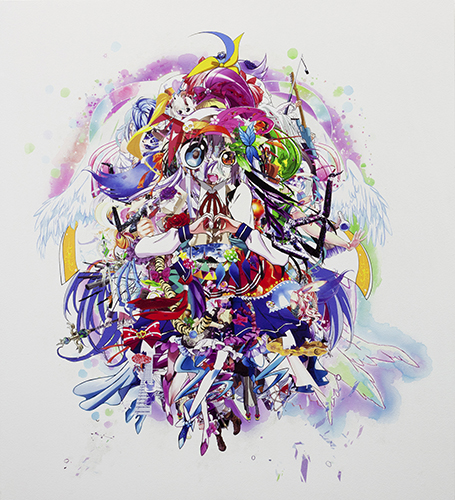
02_diablos

As an anime and manga blog largely focused largely on commercial output, it is rare that I will report on and review an Art Show in all of its capitalized glory. However, I feel it important to discuss the “Empty God Core” show at the B²OA Gallery, featuring the works of Japanese artist Umezawa Kazuki.

I am well aware of the fact that anime and manga have been subjects of exploration, self-discovery, and exploitation since at least Murakami Takashi and his “superflat” movement. Often times challenging and presenting the exoticism of Japan’s visual culture, artists like Murakami tend to feel as if they come not from the otaku subculture itself, but are reacting to it as it has grown over times. While I would not go so far as to say that this is some unforgivable flaw in his work, that he may not be a “true” otaku, it does make me notice when a piece of art conveys the perspective of someone who has embraced the lights and sounds of anime and manga as almost existential hazes.

That is the impression I received from Umezawa’s work, though even before I saw the actual show itself I had an opportunity to meet him for the first time thanks to our mutual friend, Ko Ransom. If there is anything that stood out to me most about him at first glance, it would have been his A Certain Scientific Railgun pins adorning his clothing. The one most prominent could be seen on his chest, a chibi version of Nunotaba Shinobu, my favorite character in the Index universe. A teenage scientist with a propensity for interlacing her speech with English, Nunotaba comes nowhere near the default choices for popular characters in her series, so I knew that Umezawa was serious business.

That being said, while I was aware that Umezawa was an otaku before I saw “Empty God Core,” I would have jumped to that conclusion almost immediately if I had come in without knowing a thing. Umezawa’s works consist largely of collages of anime characters, scrambled to the point of almost losing all recognizable qualities, and then rearranged to create futuristic, apocalyptic landscapes and large, god-like figures. I say “almost,” because the first thing I spotted in one of his digital paintings was the characteristic blonde poof of Cure Peace from Smile Precure! Soon after, I spotted bits of other characters as well, but it made me realize how distinct Precure hair is designed to be, so that, even divorced from the very bodies on which they sit, one can see that, yes that over there is a piece of Cure Blossom, and down by the side is Cure Beauty. The iconic nature of anime and manga characters jumps to the forefront, and their fragments are used to construct worlds.

There is a general idea when it comes to anime fandom that a lot of its qualities arose from the perception of 1980s Japan as a kind science fictional space. Like Blade Runner, which envisioned a future city amalgamated from Tokyo and various Chinatowns, the common discourse positions otaku as products of their time, and their subculture a result of changes to the world, the economy, and the degree to which societal values crumble or ossify in response. In this environment, otaku have historically been viewed in a negative light, people who cannot confront reality, loners who can only consume their media in ways which reinforce their divorce from society, while anime and manga become increasingly shallow and lacking in any real substance. What Umezawa’s work does is flip that script on its head, and show how this otaku subculture and its inhabitants can utilize the “vapid” qualities of anime and manga and its devotion to signs and icons of cuteness, beauty, and sexuality as building blocks, as atoms to form universes. Rather than a dystopian cityscape creating the otaku, the otaku creates the dystopian cityscape. He turns lemonade into lemons.

This post is regrettably a little late, but if you’re in or around New York City, the show is running until November 15th. The B²OA Gallery is at 515 west 26th street in Manhattan, and is open Tuesday through Saturday from 10am-6pm.