The Potentially Positive Influence of Public Relationships in the Starcraft 2 Pro Scene

The release of Starcraft 2 last year has caused something of a boom in competitive video gaming, referred to in the community as “ESPORTS.” More and more, professional gamers around the world are becoming stars, and along the way the fact (or impression) that they’re “nerds” is celebrated; to be a nerd is to be smart and talented and even handsome. Made prominent is the idea that nerds can be attractive to the opposite sex, that these (mostly male) keyboard athletes have an appeal attached to their passion and drive for victory.  This is not a new concept, as is evident in the gigantic Korean Brood War scene and the fact that based on the screams of the audience you might assume that it’s John Lennon playing from that soundproof booth. However, a major difference is that while Brood War shows its players as owners of large female fanbases, competitive Starcraft 2 is showcasing couples far more prominently, both inside and outside of Korea.

Whereas Brood War pros will avoid answering the question of significant others (or will mention girls they once dated), Starcraft 2 pros seem much more willing to admit that they are seeing someone. Moreover, Starcraft 2‘s has what can be described as “power couples,” well-publicized relationships where both individuals are a part of the scene. Evil Geniuses captain Geoff “iNcontroL” Robinson and Miss Oregon 2011 Anna Prosser, Startale captain Kim “RainBOw” Sung Je and his fellow teammate Kim “aphrodite” Ga Young, player/caster Trevor “TorcH” Housten and WCG Ultimate Gamer Rachel “SeltzerPlease” Quirico, Terran Emperor Lim “SlayerSBoxeR” Yo Hwan and actress Kim “Jessica” Ga Yeon, all are major examples of the public relationships that populate the Starcraft 2 community.

Part of this may simply have to do with the higher average age of Starcraft 2 pros vs. their Brood War counterparts. Where 20 might be considered an aged veteran in Brood War, some of the most talented and well-known Starcraft 2 players are approaching or even past their 30s, and with that comes possibly a sense of maturity and stability. It is also well-known that dating is frowned upon for Brood War pros for fear that it might distract them too much from the game, and no such taboo exists for Starcraft 2. While there are prominent married figures in Brood War such as Choi “iloveoov” Yun Sung, BoxeR’s former teammate and one of the most dominant players of all time, and Kim “January” Ga Eul, manager of the team Samsung KHAN, neither of them were active players when their significant others were made public. The “sex appeal” of the young Brood War player seems to be more along the lines of a K-Pop star whose relationship status is intentionally ambiguous to draw in more fans.

The reason that I am pointing all of this out is not to foster gossip about who’s dating who or to draw attention away from the games themselves, but to posit the idea that perhaps that seeing these relationships can potentially promote a different kind of lifestyle image for the nerds of the world. Rather than being a hit with the ladies, the professional nerd can be a hit with the woman of his life. You, yes you, can find a woman who will not only condone your geek lifestyle but will understand and actively support it. More than just an aspiration, the power couples of Starcraft 2 provide concrete examples that this is an attainable goal.  What is also clear, especially from the examples given above, is that these couples are not together solely because of an individual’s skill when it comes to their game of choice, but because of their character. In this way, progamers may act as role models in more ways than one.

Year 4 of the Blogging Experiment

Today marks the 4-year anniversary of Ogiue Maniax, and I thought I’d use this opportunity to reflect on a topic that’s been on the back of my mind for a while.

As those of you who keep up with this blog probably know, I began an academic career focusing on manga last year, and part of the reason I was able to do so is that I’ve honed my ability to talk about anime and manga through my blogging. Now though, the question I have for myself is, has my time in academia affected my blog posts in a way that shows an academic influence?

Seeing as I’ve never tried to write a full-on scholarly essay on Ogiue Maniax with footnotes and elaborations on methodology and the like, I don’t think I’ve changed my fundamental posting style in that regard, but I have to wonder if there are any more subtle changes that have to do directly with academia. The fact that I post much less than I used to and make longer posts in general is probably more attributable to my desire to avoid mental fatigue, but I don’t think it really bleeds into the writing itself. I can’t really think of anything major. At the same time, I’ve found myself less willing to make posts with incomplete thoughts like I used to, which may be a sign.

From my own admittedly biased self-examination (as if there is any other kind), I wonder if I don’t let my academic influences enter into my blogging enough. Sometimes I argue things primarily out of passion, and I find myself making assumptions every so often that would probably get hit with a flurry of criticisms in a more rigid setting, which makes me ask if I shouldn’t be reining it in a little bit, researching more vigorously for my blog posts. That’s not to say that every post should be that way (the Fujoshi Files for instance wouldn’t work in that regard), but maybe I should be holding myself to a higher standard.

So I want to ask my readers who’ve been with me for a while, do you find my writing has changed in a manner which reveals my increased academic leanings? If so, do you think it’s something to watch out for, or perhaps something worth encouraging? Is there something about the blog that you like more now, or perhaps something you miss and would like to see more of?

In any case, thank you for these four years. It’s been great walking with you.

Thoughts On the Pervasiveness of 4chanspeak

Since its inception, 4chan has generated a peculiar set of vocabulary. The term “weeaboo,” now synonymous with “japanophile” and “wapanese,” was born out of a word filter designed to mitigate usage of the term “wapanese.” Often times extreme and intentionally insulting, 4chan is also known for appending the suffix “-fag” to almost every word possible, to the point that its origin as a homosexual slur almost becomes a generalized slur. How else would you explain the usage of the term “straightfag” to denote someone who is annoyingly heterosexual?

Though it is convenient and perhaps comforting to think of terms such as “weeaboo” and “moralfag” as isolated elements of the 4chan userbase, 4chan-isms have permeated the internet to the extent that people who have never even loaded a 4chan page are using these phrases. I saw one such thread on a reddit video games thread, where after throwing around a bunch of classic 4chan terms, proceeded to ask what /v/ is  (the video games board on 4chan).

Personally, when it comes to my writing and even my online chatting, I prefer to keep the usage of 4chan-isms to a minimum, because I feel that they 1) have too much baggage that requires unpacking and 2) are overly broad when I tend to prefer a bit of precision in my sentences. I also prefer that other people do the same, though I don’t mind seeing it pop up every so often, especially for flavor. On the other hand, overuse of 4chan-isms to the extent that thoughts are conveyed using almost nothing but them can not only be difficult to read but causes my mind to kind of gloss over what they have to say.

However, given the sheer amount of 4chanspeak users out there, I find it increasingly difficult to write off what people have to say solely because of their excessive 4chan-sisms.  After all, if it has become so ubiquitous, if there is an entire generation of internet users who think this to be the normal way to speak online, then it is more than likely that very smart and insightful individuals who communicate primarily through such terms exist. While I can criticize them for using terms which probably have better alternatives, I cannot deny the possibility that smart things can be said in a “inarticulate” fashion. Not only that, but if someone feels most comfortable describing their feelings using 4chanspeak, who am I to judge? If someone says, “I got NTR’d and might become a suicidefag,” and actually means it, then maybe I have to just understand that sentence as being their way of expressing a hurtful situation and to take that seriously.

Burning Out On Quality

A while back I wrote a post about mitigating burn-out when it comes to consuming anime and manga, advice that had the caveat of me never having actually burned out, which means that I’m either very qualified to talk about it or not qualified at all. Recently though, I was in a situation where I had trouble watching anime, and I feel like I learned a lot from it.

I’ve been watching a lot of science fiction-themed anime, series full of ideas about how the future can/will/should be, not necessarily heady stuff but enough to make a person think a fair amount. However, even though I like everything I’m watching, one day I just suddenly had this strong desire to not continue, like my brain and eyes were telling me that they would refuse to process that information meaningfully if I tried to watch more. I wasn’t sure what to make of it, until I could hear my own thoughts more clearly.

I need to watch something ultra dumb.

And so I did, not knowing how long it would be until I could restore my capacity to watch so much science fiction. In the end, it only took a day away from those shows for me to feel the urge to keep watching, but it taught me a valuable lesson that seems so obvious in hindsight: You can have too much of a good thing.

Often the picture of anime burn-out seems to be that someone who just watched too many bad shows and can no longer handle the bottom-feeding tropes which populate low-tier anime, but I think that a more fundamental aspect of such burn-out is just monotony. Much like eating the same food day in and day out with no variety, even the most delicious of meals can lose their flavor, especially if you’re not naturally predisposed to liking them. Also like food, the level of variation needed to keep things interesting varies from person to person. With anime, I find there are shows that I can become quite fond of with little effort, shows that I can watch just about any time, but for other shows, I find I need to put a bit of myself into the show. As a result, sometimes I find myself unwilling to watch another episode because I can sense that my mind is “exhausted” and will not give me an accurate impression, and just pushing and hoping to power through that mental blockade can end up doing more harm than good.

And so, I have much gratitude for ultra dumb shows. Sometimes they’re just what I need.

The Evangelion Pilots, Represented in Combat

I’ve been revisiting Neon Genesis Evangelion lately and have come to appreciate it in ways that I hadn’t before. While I always found the show to be especially good at showing the deep-seated fears and emotions within the characters to the point that they feel almost tangible, I’ve begun to take note of how well the characters’ words and actions exemplify their personalities.

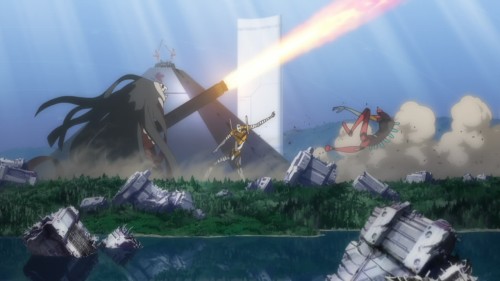
One example that stands out in my mind comes from Episode 19, the famous episode where EVA-01 goes berserk and eats the enemy angel, Zeruel. When Zeruel descends upon Tokyo-3, it is first met by a barrage of artillery fire from Asuka and her EVA-02, just weapon after weapon after weapon, with Asuka getting progressively angrier until she is defeated. Rei then appears, her EVA-00 missing an arm, and charges at Zeruel with a powerful bomb with the plans to detonate it at point blank range. Later, right before Zeruel can attack the staff of NERV, Shinji bursts through and engages in melee combat, then loses power, then goes berserk. What I’ve come to realize is that the way each character fights in that scene represents them incredibly well, acting as more than just a visual spectacle.

Asuka is always looking to prove her self-worth, particularly as a pilot and as compensation for her traumatic childhood, and her desperation mounts increasingly as more and more weapons are deployed by the EVA-02. This loud, brash display of firepower is Asuka.

From the way everyone else reacts to seeing Rei carry the N² Mine, it is clear that no one knew of this beforehand, which means that the idea is entirely her own. Rei, who constantly questions whether or not she is human at all, has very little regard for her own life.

Shinji fights with a form of desperation different from Asuka’s, and as one of his core traits is a vague sense of self-identity, Shinji’s close combat perhaps shows his desire to gain an identity through the piloting of EVA-01. This also differs from Asuka because Shinji is not looking to prove himself, but rather to find himself. It might also be possible to say that the berserk scene itself shows Shinji’s tendency to be pulled along, though I’m not sure about that one.

I think the best indicator for how much this particular moment in Evangelion represents the inner feelings of its characters comes from a comparison to the redone scene in the second Rebuild of Evangelion movie. In it, Mari replaces Asuka in EVA-02 for the film’s iteration, and the fight begins in a similar fashion, with EVA-02 surrounded by firearms which Mari initially uses one after the other. However, the scene itself feels remarkably different. Mari uses each weapon more slowly and deliberately, never really reaching the intensity that Asuka did in the TV series, and after only a few decides to run in up close with a melee weapon. The method Asuka used is something only Asuka can do; it would not reflect Mari’s character.

As for Rei and Shinji, their changes highlight more of a subtle shift in character, a fundamental part of the new films. Rei, just like the original, attempts to defeat Zeruel by detonating a bomb at point-blank, but in this version Rei takes the time to push Mari and the EVA-02 out of the blast radius while thanking her, showing that her actions do not simply stem from doubting her own humanity but from also affirming the humanity of others. Shinji’s fight is initially similar, but as I once mentioned in my review of the film, Shinji never loses control, the “berserk” EVA-01’s actions conscious and deliberate on the part of Shinji. While he still seeks his own identity, he is able to set that aside to save Rei, establishing a stronger identity in the process.

I’d like to actually end by talking about Mari once more, because as I was making this comparison I realized the role she plays relative to the others in terms of their relationship to the Evangelions. Asuka pursues self-worth, Shinji self-identity, and Rei a connection to humanity, but Mari seeks pleasure in the act itself. She revels in being an EVA pilot in and of itself, with no seeming underlying motivation except perhaps some strange desire to experience life to its fullest. Her “bestial” fighting style, even before she activates the actual “THE BEAST” mode, is indicative of this. That Evangelion is able to cut to the core of its characters in even its action scenes makes it truly impressive.

The Boku wa Tomodachi ga Sukunai Anime Could Be Better

Earlier this year, I started to read the Boku wa Tomodachi ga Sukunai manga.

I became an instant fan.

I really enjoyed the manga because of how it showed the difficulties of making friends when inexperience and considerably flawed personalities are thrown into the mix. It’s a decidedly otaku-oriented series that hits kind of close to home in a pleasant way. So when I heard that it was getting an anime adaptation I was pretty thrilled about it. I had my fingers crossed that it would be the anime of Fall 2011. Now, a few episodes into the TV series, I find it safe to say that I am fairly disappointed with the anime adaptation of Boku wa Tomodachi ga Sukunai.

On a basic level, the anime and manga are not that different from each other. They have the same premise, a group of people who are very bad at making friends trying to help each other to humorous effect. They have the same characters with the same personalities. They both have fanservice and their fair share of otaku references. But where I find the manga to pass with high marks using this mix of ingredients, the anime by comparison falls short of the manga’s success.

I think the best place for me to begin is the art, because the character designs for the manga and anime are drawn in markedly different styles. Whereas the anime has more of what I’d call a typical light novel/visual novel-esque style to it, the manga’s artwork seems more loose and fun. The manga doesn’t feel the need to stick to its template too closely, and perhaps because it doesn’t have to devote frames of animation to consistency, it makes the comic feel comparatively more energetic. Putting aside more abstract aspects of manga such as page and panel layout, decompression, etc. (things which I think the manga does quite well and do contribute to the quality of the series), even the smiles from the characters in the manga show a lot more emotion behind them. I feel like I can understand the inner workings of the characters and I’m pleased by that. The anime on the other hand, while its designs aren’t abysmal or anything, don’t seem capable of as much expressiveness, and in general the show feels a little stiff and wooden by comparison. I understand that the anime’s designs are closer to the original light novel’s but I still like them less. On that note, I have not read the light novels, so I cannot say if either is a faithful enough adaptation to the original, but the problem isn’t faithfulness so much as it is the particulars of execution.

Another major factor is the fanservice. By that, I don’t mean that the manga is devoid of fanservice which makes it somehow automatically better. In both cases, the girls are still cute, Sena’s chest is equally impressive, and they all have a tendency to wear attractive outfits. There’s nothing particularly objectionable about this. However, the anime has significantly more fanservice, to the point that I find myself saying, “The girls are already cute enough! You don’t have to do anything more with them!” The fujoshi character Rika has scenes showing her fantasizing in both versions, but the anime’s depictions tend more towards a climax in an eroge while the manga emphasizes the extent to which it leaves her flustered. The show also has a tendency to repeatedly linger on the female characters below the belt to a degree which exceeds the yuri mahjong anime Saki. The opening video itself seems particularly dedicated to showing off the girls’ bodies and ignoring the friend-making aspect of the show, and I find myself wishing it had been done differently, perhaps something akin to the Toradora! OP. To put it simply, there’s a difference between the girls wearing a sexy bikini that shows off her figure and a shot that draws specific attention to the underboob.

Now, I understand that the series has something of a harem vibe to it. It’s an unavoidable aspect of it, for better or worse, and it’s not like I have anything against a harem series which is designed to show off its girls. I once compared Infinite Stratos to Kore wa Zombie Desuka? and while I found the latter series better and more engaging overall I thought the girls of Infinite Stratos were more attractive with better designs. That approach is fine, if a little limited in its appeal. With that said, I find the key difference to be that, based on how the two adaptations approach the categories mentioned above, the expressiveness of the characters/aesthetics in general and the approach to showing off the attractiveness of the girls, the manga does a much better job of making me think of the female characters as people first and cute girls second. While I certainly don’t mind that the girls are nice to look at, what made me love the series in the first place was that it encourages a deeper understanding of the characters, particularly their awareness of their own personal flaws. With the manga, I feel that it gives a much stronger sense that these characters really do wish they could make friends in a way that outshines the fanservice, which I think gives it far greater ability to reach otaku and other readers with that bit of warmth. With the anime however, although that aspect is still there, I think it makes it more difficult to see past that simple harem exterior and into the meat of it (no pun intended for Sena fans).

I’m not going to accuse people who really like the show of having poor taste or think they’re simply unenlightened fools. I much prefer the manga and its style, but people may choose the anime’s designs over them for whatever reason. The girls are cute and it’s okay to think that they’re cute, to be attracted to them or even obsessed with them. Perhaps most importantly, while I find the level of fanservice in the manga to be more or less acceptable, I know there are people out there who would find that the cheesecake ruins the character portrayals in the manga. Even so, I just can’t shake the feeling that the anime’s approach to Boku wa Tomodachi ga Sukunai obscures its greatest strengths too much.

Smooth Criminal: Genshiken II, Chapter 69

Last time we met what can be best described as the Luigi to Yoshitake’s Mario, Yoshitake Risa. No, seriously, think about it. She’s younger, taller, and jumps higher.

Anyway, unlike the previous little sister in Genshiken who didn’t really get a dedicated spotlight until many volumes later, we get to learn a lot more about Risa just one chapter after her introduction. She’s quite an intriguing character, so I’m all for it.

(Did you know Yoshitake has the power to snore in English?)

As the freshman drinking party concludes at Yoshitake’s place with everyone crashing for the night, we get to learn quite a bit about young Risa. She awakened to her nature as a shotacon because of a particular child star, though she prefers the timelessness of 2-D over the aging process which inevitably affects the inhabitants of the real world. Also, though she loves playing basketball (enough to attend games instead of going to doujin events), she is tired of everyone assuming that she’s going to pick a college based on her hoops prowess. Yoshitake Rika, always the loving older sister, not only buys all of Risa’s doujinshi for her, but brought her to Shiiou University to help her think things through.

When all’s said and done, Risa has one last request. Knowing that Hato began crossdressing so that he could make friends with fujoshi, Risa is curious as to just how “challenging” that process is, how far Hato has gone for the sake of meeting like-minded people. Yoshitake, who can also be a “helpful” older sister, manages to twist the situation such that it ends with a visit to Hato’s place.

There, Yoshitake wants to use the time Hato spends showering to find out all of his secrets, but Yajima stands in her way. Despite assistance from the younger sibling , Yajima manages to stop Yoshitake, though in the process they inadvertently open the door to the bathroom and both Yajima and Risa get to see that Hato is indeed a man, albeit an incredibly smooth one. Risa, with Hato’s image possibly burned into her brain, now finds a reason to take the exam for Shiiou University, much like the other Genshiken little sister.

Before I get into my thoughts on the chapter itself, I want everyone to look at this image of Risa’s body.

Risa’s figure can be described as that of a tall, slender but athletic woman with small curves. It makes sense, given the amount of time she puts into sports. It is also an incredibly uncommon body type for a female character in a manga with men as its primary audience. Sure, there are girls with small chests in shounen/seinen, and there are also plenty of athletes, but rarely are they like Risa’s. Even in most comics targeted towards girls of all ages, a body type like this is not drawn with as much focus on anatomy.

Ohno, Kasukabe, and Ogiue’s bodies were already quite different, and Yajima is of course overweight, but Yoshitake Risa’s realistically athletic figure, which doesn’t really try to adhere to typical notions of feminine appeal nor masculine portrayals of heavy musculature, makes me fully aware of just how varied the body types of the female characters are in Genshiken. It’s actually quite impressive, and I think shows that Kio Shimoku, more than ever, is trying to draw female characters for men in a way that fosters understanding of women as people.

The way this chapter is, it actually feels like a hang-out between girls (plus Hato). It’s kind of like that scene at the retreat back in Volume 7, only without the painful recollection of traumatic events from the past. Instead, they were able to create new traumatic events (again, Hato). Again, it’s not out of the blue, and when I look back on Genshiken it’s clear that it’s always been different in portraying female characters, but Chapter 69 somehow feels like a particularly strong example of this approach.

I continue to enjoy the sibling relationship between Rika and Risa for reasons touched upon in the chapter summary above. Yoshitake comes across as a person who genuinely loves and looks out for her younger sister, and it’s clear that her happy-going personality has had a positive effect on Risa’s development through the years. That Risa is comfortable with calling her older sister for advice is in itself a strong sign of their bond, as is the fact that Risa feels compelled to go along with her sister’s hair-brained schemes (crossdressing, bearhugging Yajima). Again, I have to contrast it with the Sasaharas, who eventually reached something along those lines, but only through a long and arduous process.

As for Yajima, I find that she is in this strange position where Hato’s crossdressing has taken on the opposite effect of what it used to be for Yajima. Initially, Hato’s female guise made Yajima rather uncomfortable, as it challenged certain deep-rooted feelings and beliefs in her. As they have become friendlier however, the crossdressing almost acts like a barrier preventing Yajima from thinking of him as a man, which Yajima consistently views as a kind of “other,” like so many nerds out there. This is why you see Yajima try to prevent Risa from convincing Hato to change into his male version. Poor Yajima.

Speaking of Hato, the chapter also provided some insight into his life. For one thing, we learn that the reason Hato lives so far away is that he had to find an apartment with a walk-in closet to store both his dresses and his massive amount of doujinshi. Now that’s the kind of dedication that Risa can understand.

Next chapter is the school festival, and while not quite as exciting as a ComiFest chapter, it’s still something I look forward to from Genshiken. We’ll also get to see Ogiue again. And if that’s not enough, Volume 11 is on its way in February December with a special edition and an exclusive Hato figure. I’ll probably end up owning one myself, if only because I try to get every single special edition of Genshiken that I can.

I do not intend to ever break that streak.

Reading into the Negative Responses Against Phoenix Wright in Ultimate Marvel vs. Capcom 3

Phoenix Wright was recently announced as a character for Ultimate Marvel vs. Capcom 3, and his reception from fans of MvC3 has been an interesting mix of unbridled enthusiasm and indignant anger. I find the latter to be particularly interesting because of how the criticisms from fans are being formed verbally and what it says about how a game like Ultimate Marvel vs. Capcom 3 is perceived by its audience on an aesthetic level.

Before we start though, I have to say that I do not know what percentage of fans actually dislike Phoenix Wright’s participation in this game. Whether they are a “vocal minority” or not matters little, as it is more about the reaction of that group in particular.

First off, let’s take a look at some of the comments critical of Wright as a Capcom representative:

“Im not hating at all, the game looks legit I just can’t believe that non-sense was allowed in and not a more traditional fighting game character”

“Phoenix Wright is the most awkward fighting game character I’ve ever seen. Fuck that guy. I hope he’s top tier and everyone ends up using him ’cause he’s so stupid, LMAO.

Nova on the other hand, now that’s a real character. Dude is a beast! He’s like a better Phoenix (non-Dark).”

“I agree, Phoenix Wright feels out of place here, and makes me feel like I want to throat up or something. What a crappy pick, should of been Captain Commando. We already have a Capcom joke character, his name is Frank West and he’s better than Phoenix Wrong lol.”

[In reference to a an attack Phoenix Wright uses in the trailer and the argument that Tron is a joke character too ] “Tron hits ppl, not sneezes on them”

etc.

All of them say essentially the same thing. A) character who is not a fighter an does absolutely nothing resembling combat in his own game should not be in Marvel vs. Capcom 3. B) The humor-based interpretation of his “fighting” style for UMvC3 is a slight against the game itself.

At this point, it would be easy to dismiss these statements with a couple of arguments, but those arguments have problems in and of themselves. The first is the idea that “gameplay is the only thing that really matters, so it’s not relevant if Phoenix Wright fits with the rest of the cast or not as long as he’s a strong character who can create interesting gameplay.” For Marvel vs. Capcom 3, how the game controls and whether or not it’s competitively viable are, while important to its success as a game, are obviously not the only factors in presenting it to the world and its audience. If gameplay were the only relevant component, then it wouldn’t be a crossover of a comic book company and a video game company using iconic characters from their respective libraries. Although it is easy to disagree with people who think Phoenix Wright is too ridiculous for the game (and I do disagree with them), it is besides the point to argue from a primarily theoretical game mechanics perspective.

The second is the idea that “the game is already ridiculous putting up some kung fu guys against ancient gods and beings with the power to rip the Earth in half, so why draw the line at a goofy lawyer?” But while Marvel vs. Capcom 3 (and the entire rest of the Vs. game series) does bring together a cast of characters whose powers and abilities can be horribly mismatched, it does not negate the fact that Phoenix Wright is indeed not a martial artist or in possession of superhuman abilities. A punch is a punch and can be made as strong as necessary, whereas Wright has to use something else entirely.

I think the idea that a fighting game should have “characters that fight” is an interesting one in that MvC3 becomes a sort of haven for a particular type of masculinity, a place where a (presumably male) player can feel comfortable in knowing that the setting and its character will not betray them aesthetically. This is not a coincidence, as the look of Marvel vs. Capcom 3 is masculine and powerful in a way that is particularly appealing to American audiences. This is easily seen when comparing it to its sibling, Tatsunoko vs. Capcom, whose anime influence gives a somewhat softer look to even the most square-jawed and chiseled of warriors. But Phoenix Wright apparently violates that security; to the people critical of his inclusion for the reasons outlined above, he demeans the game he’s being included in because he ends up mocking the aggressive portrayal of competition. Wright risks emasculating part of the game’s audience, somewhat like the entire Arcana Heart series minus the overt sexuality aspect that is near-unavoidable with that franchise.

Again, I do not know what percentage of people playing games feels this way, but I do have to wonder how much this affects a certain portion of gamers’ decisions in which games to pursue. Are games like Call of Duty and Halo even more indicative of this mindset? If so, it may bear taking a look at how and why men look to games to affirm their masculinity.

Thoughts on Singapore Mahjong

Ever since I wrote about the idea for a mahjong manga where the protagonist travels the world and plays various forms of the game, I’ve been eager to try out other types. Unfortunately, the best I could do was read about them and engage solely in theoryjong, which while potentially useful and certainly fun in its own way could not match the act of actually playing a game. Fortunately, I was able to find a website with not only rules for a Singapore-style of mahjong, but also an online game implemented for the enjoyment of visitors. Apparently it’s been around for a while, and I just wasn’t looking hard enough.

Before I go into my impressions of Singapore mahjong, there are two caveats I have to make. First, the online game provided by the above site is 1-player only. None of my words reflect someone who has played other human beings, and so I cannot talk much about the mental aspect of it beyond a certain solitaire-esque mindset. That said, I think a lot can be discerned just from playing the computer. Second, as I am mainly familiar with the Japanese-style riichi mahjong, I will be using that form of the game to relate my experiences. Also vital to note for those who are stumbling on this post from perhaps other mahjong sites is that I’m not even that good at Japanese mahjong, so the particulars of my “tactics” are mediocre at best.

Like all of the other forms of mahjong, the Singapore style is about creating a complete hand consisting of a number of 3-tile combinations and a pair to finish it off. 3-tile combinations consist of either three-of-a-kinds or straights. Players draw and discard tiles looking for a winning hand, with the last vital tile coming only after the rest of the hand is in a position to actually win. Like Japanese mahjong, you need at least 1 yaku/fan in order to win. However, there are three main differences (and a bunch of minor ones, but I won’t go into those too much).

1) Animal Tiles

While many forms of mahjong have “flowers,” tiles which are collected and set aside during the round that can potentially give bonuses to the player who collected them, the first and most glaring difference between Singapore Mahjong and all other forms is the additional presence of “animal tiles.” Four exist in a set: Chicken, Centipede, Cat, and Mouse, and they behave similarly to flower tiles, except that getting both the “predator” and its “prey” will net you additional points. The chicken eats the centipede, the cat eats the mouse, and should either of these happen you don’t even need to win in order to reap those benefits; you gain the points immediately. This also applies to appropriate flower tile combinations, and it means that even if you end up losing, you still kind of won.

2) Little Variation in Winning Hands

The path to winning of course lies in “fan,” or “yaku,” the predetermined combinations that are considered part of a winning hand. However, unlike Japanese mahjong, the number of fan that exist in Singapore mahjong are remarkably few in number. Whereas in riichi you get credit for hands like san shoku (either straights or triplets), chanta, junchan, chii toitsu, tanyao, ii pei kou, and san an kou, none of those I just mentioned are considered noteworthy hands in Singapore mahjong. Even Yakuman such as suu an kou, ryuu ii sou, and chuuren pooto do not get honored in this mahjong variation. Essentially, the only realistic paths are getting triplets of honor tiles, hands consisting entirely of straights (the “chicken hand” in Chinese forms of mahjong), toi toi, and either chinitsu or honitsu. If you didn’t understand any of what I just said, let me summarize by saying that Singapore mahjong has significantly fewer ways to win a game compared to Japanese mahjong, and that has a clear effect on how it plays out.

3) Everybody Pays

Another major difference with riichi mahjong is the point exchange that occurs when someone wins. In riichi, if someone draws the winning tile themselves, they get a few points from everyone else. If someone discards the winning tile, the victor takes their earnings entirely from the player who threw that tile away, with the other two players remaining untouched. Not so in Singapore mahjong, where everyone pays if a win happens on discard, and everyone pays even more when a win is achieved by self-draw. Combined with an utter lack of furiten, that lynchpin rule of Japanese mahjong that prevents a player’s discards from outright lying to the other players, it means that playing defensively as one normally would with the Japanese style does not hold anywhere near the same benefits in Singapore mahjong.

Overall

Taken all together, Singapore mahjong’s profile is that of a game where aggression is valued and tough decisions have to be made from the very start. The absence of even tanyao as a viable hand means that if your hand is half triplets and half straights, you have to make the decision to go one or the other, or to hope for some honors, flowers, or animals to give your hand the necessary minimum fan to even try to win.

The sheer lack of options can feel stifling for someone like me who is used to having many more options. Hands do not grow into one another easily; a potential san shoku cannot slowly arise from a pinfu attempt, because the gaps between hands are too stark, outside of possibly a honitsu turning into a chinitsu or vice versa. While one could argue that Japanese mahjong has too many options that make the game seem ridiculously arbitrary and tough to learn, the dearth of yaku in Singapore mahjong makes it feel less like a “flow” of tiles and more like a “hail.” That simplicity is not without its merits, but it’s something I’d have to get used to, especially coming from the defense-heavy style of riichi mahjong.

Funnily enough, a pinfu hand actually nets a whopping 4 fan (with 5 fan being the absolute limit allowed typically), but on one condition: no bonus tiles (animals, flowers) can be collected. With 12 of those suckers in a given set, it becomes a matter of avoiding “good luck” just long enough for one’s own “bad luck” to implode on itself and transform into something even more powerful.

Given that my interest in it has something to do with imagining how it would work in a comic, I have to then ask, what interesting story elements could be derived from playing Singapore mahjong? I think that for at least part of a Singapore arc, animal tiles would have to play a significant role. They’re one of the more distinct parts of this particular flavor of mahjong, and if it were something like a Fukumoto manga, the whole predator-prey thing could make for some amazing metaphors, and the immediate point exchanges upon getting a proper combination could subtly shift games.

It would also work as somewhat of a setup for a Malaysia arc, as I’ve read that 3-Player Malaysian mahjong is quite similar. I’ve yet to try that, though if someone can figure out a way for me to do so, I would very much like to hear it.

Vistas: Learning Taiwan

After a long time away from it, I’ve got a new post up on the Vistas blog, where I (sort of) talk about my recent trip to Taiwan. It has less to do with the sightseeing and more to do with realizing my own ignorance about its history. I might write up a more extensive trip post at some point for Ogiue Maniax.