Battle, Fever: Genshiken II, Chapter 64

When last we left the chaotic otaku gathering that is Comic Festival, Ogiue’s past and present were set to collide as Yabusaki and Sue came face to face with Nakajima, Ogiue’s old junior high classmate and the one in some sense responsible for Ogiue’s difficult life since then. While we don’t get the Ogiue-Nakajima confrontation that I expected, Chapter 64 still has a lot to chew on, and it does a lot for all of the characters involved, including Nakajima.

Nakajima (first name Yuuko) introduces herself to Yabusaki and Sue as an old friend of Ogiue’s, made all the more obvious by her Tohoku dialect. Not knowing what to make of each other, they decide to feel each other out, with Nakajima words subtly disparaging Ogiue or expressing mock-wonder at how Ogiue currently is, and Yabusaki not trying to overstep her bounds and say any crass remarks back (Sue is cryptic as always). During the conversation, Nakajima confirms that Ogiue is currently dating someone (Sasahara), and feigns concern in order to tell Yabusaki and Sue about Ogiue’s attempted suicide and how it stemmed from her interest in the boy Makita.

Before Sue can bite Nakajima’s head off, Yabusaki explains to Nakajima that this new information isn’t going to change her opinion of Ogiue at all, and that it’s not surprising that a girl who had a perpetual chip on her shoulder towards her fellow fujoshi and would try to win arguments by leaping out of windows would have some serious problems in the past. She still likes Ogiue as she is. Sue backs her up, giving probably her first heartfelt speech in Genshiken history, though she Sues it up by mentioning the Sasahara x Madarame material that Ogiue had drawn, and that Sasahara had accepted it. Even then, this actually has the effect of making it clear that Ogiue is no longer tied down by her past. At this point, Nakajima chooses to leave, and she barely misses the arrival of Ogiue, or rather, chooses to ignore it. Apparently Nakajima wanted to tell Ogiue about something concerning Makita that would put her at ease, but seems a little bitter that Ogiue managed to carve such a good life out for herself.

Ogiue meanwhile has a 39 degree C (102 F) fever, and is so out of it that she can’t even consciously hide her Tohoku accent. Being in no condition to be outside, Yabusaki dispatches Sue to take her home, where they watch after her until Sasahara can take over. When Yabusaki and Sue (with Nyaako) leave, Ogiue bursts into tears, overwhelmed by the fact that her friends have been so good to her. Sasahara provides gentle support, but also informs her that she can’t attend the rest of ComiFest because of her current condition.

While Chapter 63 was just filled with all sorts of goings-on, this chapter which concentrated mainly on Yabusaki and Sue vs. Nakajima was no less dense, with information both overt and somewhat subtle and examples of really fascinating character psychology from all sides. I think that Ogiue to some extent is still afraid of her past catching up to her, and it warms my heart to see her friends defend her so vigorously and from the heart. It’s actually unclear just how much if anything Ogiue overheard, or if she was even aware in her fever-induced haze that Nakajima was standing there, but either way Ogiue’s tears showed just how much she (correctly) values her friends. It’s not quite the close on Ogiue’s chapter that I had predicted would happen, but it’s still a resolution of sorts, and I’m happy with that.

Sue makes an Excel Saga reference this chapter (“Hail Ilpalazzo!”) While she’s sometimes hard to believe as an American anime fan, this is probably the closest she’s gotten to feeling like the real deal outside of her initial “Anta Baka?” She also seems to be a very good judge of character, as she immediately notices some bad vibes coming off of Nakajima, kind of like Shizuo from Durarara!.

This chapter is also the first time we got to see Ogiue’s original debut scene in the manga from the perspective of Yabusaki and the other girls in the Manga Society. If it wasn’t obvious that the glimmer in Ogiue’s eyes was the result of her coming to terms with her inner demons and beginning her relationship with Sasahara (and not, for example, a stylistic change), this makes it crystal clear by showing Ogiue from Volume 4 with her eyes colored the flat black that used to characterize her.

Things start to get interesting when we read the lack of glimmer as signs of some kind of long-standing inner turmoil, as Nakajima’s eyes resemble Ogiue’s in that manner at certain key moments, particularly when mentioning anything troubling from Ogiue’s past, after which they revert back to normal. We actually don’t know much of anything about Nakajima, and this makes me wonder about her life since her years in junior high with Ogiue. Being a fujoshi (you don’t attend the first day of ComiFest just to torment an old friend), Nakajima may have had to hide that aspect of her life as well, and has been jealous of Ogiue all along, whether it was Ogiue’s ability to get a boyfriend back in junior high, or now with her life as a professional manga artist, where she has a strong group of friends and a supportive boyfriend. Suffice it to say, I think there may be some kind of trauma in Nakajima’s own life that she has yet to resolve for herself. She doesn’t seem like an entirely bad person, as shown by her interaction with her friend Shigeta (first name Mina), who was with her last year when she spotted Ogiue at ComiFest. Shigeta seems more level-headed, but there’s not much to go on, so I’ll reserve any judgment on her.

Trauma is just one possibility. Nakajima’s eyes during those moments could also be a reference to that creepy stare she and her posse laid on Ogiue back then.
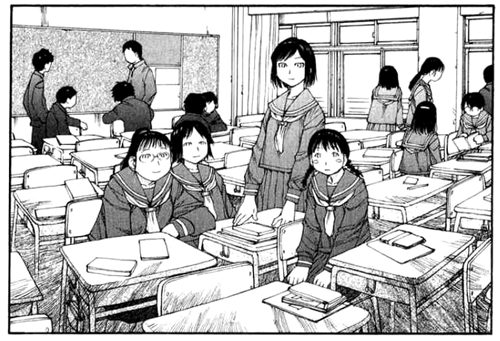
What did Nakajima want to tell Ogiue about concerning Makita? It can’t be anything bad, as the reason Nakajima decides not to tell her is that she doesn’t want to make Ogiue’s life any better than it already is. If I had to fathom a guess, I would say that Makita actually did not transfer away because he found himself reading a comic where he was getting it from behind by his best friend, but for some unrelated reason. Does this mean that Makita actually will make an appearance again at some point in the comic? I’m not sure how I feel about that, but I am open to the possibility.

The chapter ends on Madarame, who is feeling not as excited about ComiFest as he thinks he should be. Is it a possible sign that he’s growing old, the beginning of the end for Madarame as otaku? That might be the case in a certain sense, as Angela seems to have him in her sights.

How do you feel about Americans, Madarame, particularly one who like both girls and boys?

Kaiji Season 2 Truly is MAX

You Tell Them, Announcer!

Go to Akihabara, Get Genshiken Post Cards

Monday, May 23rd is the release date for Volume 10 of the Genshiken manga, also known as Genshiken II, Volume 1. To celebrate, various anime goods and bookstores in Akihabara are including exclusive post cards with drawings and a thank you from the author Kio Shimoku. The card you get with your purchase of Genshiken Volume 10 will depend on which store you give your patronage to.

Just in case this needs a warning, there’s a lot of Hato in provocative outfits, and some swimsuits and such as well.

Continue reading

And Then He Bunker Rushed Shabranigdo

(Don’t worry, this is from last season so it isn’t a spoiler.)

Sonya Blade is an Awful Character

With the recent release of Mortal Kombat 9, a lot of beloved figures in the Mortal Kombat franchise have been re-designed to look both modern and reminiscent of their very 90s character designs in an effort to bring the series back to its old school roots. Remembering that Sonya Blade’s design was absolutely awful in the previous game, Mortal Kombat vs. DC Universe, sporting the most ridiculous shirt ever, I wondered how they would portray her in this iteration. While the new design is an improvement, it makes me realize that Sonya is actually just a terribly-designed character.

Here is Sonya throughout her 3-D fighting game history, away from the live actor portrayals that characterized Mortal Kombats 1 through 3. If you did not tell me that they were all supposed to be the same character, I simply would not be able to tell. Nothing is consistent about her, short of the fact that she’s blonde, has big tits, and shows an exposed midriff. Sonya Blade is a terrible design because she is a non-design.

While she could be criticized for having an over-sized, unrealistic chest and ridiculously skimpy outfits, that’s not really the point here, as the scantily clad and jiggling girls of Dead or Alive share those properties in spades and yet are still distinctive even when they’re wearing 1 cm-thick bikinis and taken out of a relative comparison with each other. Nor is the problem that her design is too generic, as the Virtua Fighter series is all about cookie-cutter characters, and yet whether it’s the blocky and outdated graphics of Virtua Fighter 1 or the more recent Virtua Fighter 5, Sarah Bryant, a fellow fighting blonde, is still recognizable. Chun-Li can appear in Street Fighter Alpha younger and sporting a different outfit and still look like Chun-Li, and she also successfully made the transition to 3-D with her very iconic look and style.

On a broader scale, video game characters rely on a certain degree of iconic visualization, and though this is more easily done with a mascot like Mario or Sonic, it’s still possible with a more realistic figure. Sub-Zero and Scorpion show this, despite the fact that they both started out literally as the same character design with different colors. it’s clear that Sonya simply never had anything beyond her rack and her belly button to distinguish her. Back in Mortal Kombat 1, when she was the only female character, this arguably could have been sufficient, but as more and more girls have appeared in the franchise over time, also with large breasts and bare midsections, it really makes it obvious that she wasn’t thought through thoroughly.

For a further comparison, take a look at this image Sophitia Alexandra from the Soul Calibur series which I conveniently obtained from elsewhere. Although her design has gone off the deep-end in recent games, it’s very clear that all of the above figures are supposed to be the same person, even when drawn by different artists. If I were to make an educated guess as to what makes Sophitia work but not Sonya, I’d say that it has to do with the fact that Sophitia was designed in the first place with certain key visual elements like her sword and shield, skirt, and gentle demeanor, and even when next to her somewhat similar sister Cassandra, you can still tell the two apart by how their designs convey their personalities. It can be as simple as that, so that when they’re given makeovers in later games, a person can take one look without being told specifically who it is and say, “Aha, that’s her! …She looks terrible!”

Anime 2011: Armored Hotel Almelo

This past Saturday I found myself on the train heading towards the eastern part of the Netherlands, stopping just a few miles away from the German border. It was my actually my first time that far out east, but I wasn’t there to sight-see, I was there to attend an anime con. And not just any anime con, but Anime!

Living in a new and unfamiliar country, I had decided months ago that I would use my current situation as an opportunity to get an idea of anime fandom outside of the United States and Japan. I had previously attended Tsunacon, a relatively small one-day event held in Sliedrecht (but moving to Rotterdam starting next year), but Anime 2011 was my first time at a full-out 3-day Dutch anime convention. Though I was only able to attend Saturday, I still felt a strong sense of love for anime, manga, and video games.

Arriving in Almelo after a nearly three-hour trip, it was a short and pleasant walk through an open-air market to Theaterhotel Almelo, called so because it actually features a theater room capable of seating hundreds, something which makes Theaterhotel Almelo a good fit for an anime convention. Benefitting tremendously from gorgeous, 80-degree weather (that’s about 27 degrees Celsius), the spacious front area of the hotel acted as a nice spot for attendees to relax, pose for photos, and take a smoke break.

At three stories tall, and a restricted maximum attendance of 2500, Anime 2011 at Theaterhotel Almelo was not quite as large as the American conventions I’m used to, with Otakon boasting over 30,000 attendees last year, the fact that it was held in a hotel made it comfortably familiar to me, as it reminded me of my early convention experiences. Though, the fact that Anime con is actually only one of three anime conventions total in the Netherlands, and considered large for a Dutch con, should give readers an of the sheer difference in scale. In fact, in the Dealers’ Room, I had struck up a brief conversation with a Dutch attendee about precisely this topic. In a way, it made Otakon and Anime Expo sound downright legendary.

Speaking of the Dealer’s Room, I heard a familiar sound there, that of the loud exclamation of “Yaoi” and how it is probably fresh and hot and available here. Was that something which this con shared with the American ones? Was it actually universal?

Not quite, it was actually doujinshi seller Hendane’s Netherlands debut. He had heard about Anime 2011 from his time in a Dealer’s Room in Denmark. Asking him what sold well here, he said it’s pretty much the same everywhere, though what varies is the amount of disposable income that the young fans have. In Denmark, they’re apparently loaded. In the Netherlands, that is significantly less the case. The guy was doing his best to push Touhou, though I get the feeling that it hasn’t quite made its mark on the fandom here, even if I did photograph a Cirno cosplayer at Tsunacon.

Going around the rest of the dealer’s room, I also asked a few of the vendor what sold best for them. The most consistent answer was Lucky Star, which I find interesting for a number of reasons, most of them having to do with the age of that show. While certainly not old, in terms of anime fan memory it’s quite a few years in, and to see it maintain some kind of longevity was a pleasant surprise. One vendor also said that One Piece sold very well for them, which was also somewhat unexpected. Was there something about Oda’s title that gave it relatively more otaku clout here than in the US?

Just like Tsunacon, the Artist’s Alley and Dealer’s Room were one and the same, and so before I left I decided to pick up a fan-made magazine. And as I said last time, the artists at the con seem to showcase their output primarily in comics form, as opposed to individual illustrations (though those were still available). In a way, it reminded me of Japanese doujin events, and it’s actually something I kind of prefer over the US Artist’s Alleys.

Having missed out on the AMV competition last time, I made an effort to go check it out here, though by the time I got to the aforementioned large theater where it was being held, it was already full and I could not stay long. The AMV competition was sponsored by Archonia, the largest distributor of anime goods in Europe, which makes them a very familiar name to those living in Europe but probably unknown outside of it. They were actually in the Dealer’s Room. Before I left, I got a glimpse of an AMV featuring Naga the White Serpent from Slayers to the tune of Lady Gaga’s “Poker Face.” Makes sense to me.

Around this time, I was feeling the need to take a break, and noticed that Anime 2011 had its very own maid cafe. Normally, I’m not big on maid cafes, but I saw one thing and I had to go: the maids were actually taking orders or serving food. Now that might not sound like a big deal, but let’s put it into perspective a little. New York Anime Festival has touted their own “maid cafe” for a few years now, except that the Jacob Javits Center in which the NYAF takes place has its own unique rules, namely that non-union workers cannot handle food. In other words, the only thing the “maids” are good for at NYAF is posing for photos, which is not to detract from their efforts in entertaining con-goers, but it’s just not quite the same. Seeing that these girls at Anime 2011 had no odd rules to deal with, and also seeing that their menu consisted of a combination of Japanese snacks and Dutch treats, I decided to sit down to some waffle and bitter lemon soft drink. As I looked around, I noticed that the customers were pretty even in terms of gender diversity.

Given the size limitations of the hotel, the convention could not have very many panels and workshops, though there were still a decent number. Of the activities at Anime 2011 though, only one of them resembled the kind of fan panel you would typically see at an American convention. Titled simply “Your Anime Sucks,” it was a guy at the front of the room doing his best to lightheartedly rag on any title you gave him. To keep it easy on everyone, primarily mainstream titles were preferred (and silly me, I thought Akagi was a mainstream title. Whoops!). Interestingly, the guy made an explicit point of using English instead of Dutch, because of the fact that he found Dutch as a language ill-equipped for the task at hand, whether it meant a lack of sufficient wordplay or just not enough derogatory phrases in the language. The guy put in a good effort, and if I had any suggestion to make to him, it is that he doesn’t dive deeply enough into the fabric of the shows to tear them apart. That, and his criticism of the Fate/Stay Night anime didn’t involve mentioning the CG dragon inside Saber’s vagina at all.

Possibly the most impressive part of this convention was its Game Room. Filled with Japanese-style sit-down arcade machines, obscure items like Evangelion pachinko and a Vectrex, all of the newest titles and consoles, and of course Dance Dance Revolution, Anime 2011’s Game Room was good enough for a con ten times its size. Wandering around, I heard an oddly familiar song, which turned out to be the Futari wa Precure opening coming out of a Taiko no Tatsujin game, and it took me back to when I was in Japan, playing that very same song on a machine in Akihabara. It made me reflect a little on how lucky I’ve been to live in so many different places in the world.

Another good feature of this game room was the fact that it was right next to the outdoors, which meant that fresh air was coming into it the whole time. If there is a cure for Game Room funk at conventions, it is actual air circulation.

I tried my hand at a little Super Smash Bros. Brawl where I was clearly rusty, moving on to an unusual Sega wrestling game, and then a couple of fighting games, where I got frustrated by the fact that I was unable to defeat the CPU Sol Badguy in Guilty Gear X. It also reminded me that I simply never got used to arcade sticks.

The last event of the evening was the concert with the convention’s guests of honor, the electronic band Aural Vampire. Sadly, I had a train to catch so I couldn’t stay for the whole concert but I actually enjoyed their music more than I thought I would. Comprised of gothic vocalist Exo-Chika and masked DJ Raveman (who I hear from good sources plays the blazin’ beat), their performance was fun and engaging, and I’d like to see them again, either here in the Netherlands or perhaps even in the United States. Photography was not allowed though, so you’ll have to settle for this picture of Clara the cow, one of two convention mascots. Its owner, not pictured here (but pictured on the official site), is a magical farm-girl named Marieke.

Overall, Anime 2011 was a different experience from both Tsunacon and the American conventions I’m used to, but still familiar enough that I could really feel that anime con atmosphere. If I have any regrets from the convention, they have to do with some necessary concessions on my part. As mentioned in the beginning, it’s a hotel con but I could only stay for one day, and I know from experience that having a convention involve commuting gives it a different impression. In that sense, I probably did not experience the true Anime 2011, especially because I could not be around for one of their signature events, the “Ecchimated Music Video” competition, i.e. an 18+ AMVs contest, which is something totally non-existent in the US as far as I know. I also could not convince anyone I knew to go to the convention with me, so it ended up being a solitary affair. Again, while still fun, conventions are made better by friends. Maybe next time I’ll go, I’ll be able to trick someone into attending as well.

Hanasaku Iroha and Its “Conflict of Interest”

Hanasaku Iroha, one of the new shows of the current season, is unusually divisive in an equally unusual way. Whereas most shows will divide people according to whether they love or hate it as a whole, Hanasaku Iroha has its fans disagreeing as to which specific episodes are the good ones and which are the wastes of time. I think the reason that this is happening is not just because different fans have different tastes and preferences, but because Hanasaku Iroha is a generically (as in genre) transitional show with a contradictory feel to its purpose and the purpose given to it by fans.

The basic premise of the show is that a teenage girl, Ohana, has to move in with her grandmother, who runs an inn. Ohana, leaving behind a boy and the rest of her old hometown, has to adjust to working at the inn and figuring out how to get along with all the personalities at the inn. It’s a big change in her life, but she enjoys it day by day. In other words, Hanasaku Iroha has both elements of a coming-of-age story and slice of life, and this is where the conflict lies, as the two are mutually incompatible in certain ways (though I think they can work well together, and Hanasaku Iroha is one such example).

Coming-of-age stories are primarily about the transition from childhood to adulthood. They are about growth. Gurren-Lagann is absolutely full of this. Slice of life stories on the other hand are about the every-day. Even if time moves forwards, the characters do not have to. The girls of Hidamari Sketch don’t ever have to change. Those are very different values, and Hanasaku Iroha has some of both, so I think it’s easy to see why someone can look at episode 1, which has a good deal of the coming-of-age element, and find it to be one of the weaker episodes of the series, and then look at episode 3, which was more every-day hijinks, and regard that as one of the better. On the flip side, it’s just as easy to see why someone would argue the opposite, and say that episode 1 is particularly strong. Overall, it results in a very character-based show where the story moves ahead primarily through subdued character development, and it is something that might not be terribly apparent because of how Hanasaku Iroha sits at the cross-section of two disparate genres.

I believe Hanasaku Iroha to be part of a larger transitional trend in anime, even if other shows aren’t quite doing the same thing as Hanasaku Iroha. Many anime since, let’s say, Evangelion for a convenient starting point, have been about expressing a certain sense of melancholic loneliness which manifests itself into several forms, from oft-mentioned topics such as hikikomori, to simply depression. If not, they have been about soothing those feelings, being a remedy for unease and internal strife, and I think the interaction between these two routes can even roughly approximate the development of moe over the past decade and a half. Both have been very good for anime and its viewers I think, but now we’re starting to see shows not just address those negative feelings but try to encourage people to find solutions for them, or at least try to show people moving forward and growing. Ano Hana, which is also running this season, shows a group of kids trying to mend their friendship and personal problems after drifting apart. Madoka Magica, for all of its gloom, leaves hope on the table. Fractale takes a look at a society of isolation. Even K-On!, which follows the “time passing with no real change” formula almost to a tee has the younger character Azusa feeling the impact of the four main girls upon her life, particularly their corrupting (but unconsciously welcome) influence upon her work ethic.

For Hanasaku Iroha, the divisiveness that springs forth from the contradiction between coming-of-age and slice-of-life is how this period of change manifests itself.

Gurren-Lagann 5th Opening

LAZENGANN, OVERLORD!!!

Can She Manage? Listen, Bud

The Time of Retribution, Battle 2: Genshiken II, Chapter 63

Chapter 63 of Genshiken II is day 1 of Comic Festival, and some of the very best Genshiken chapters have been in that venue. This time around is no exception, and in fact it’s one of the most densely packed chapters ever in the manga. There’s a lot to go through, so let’s do a quick run-down first.

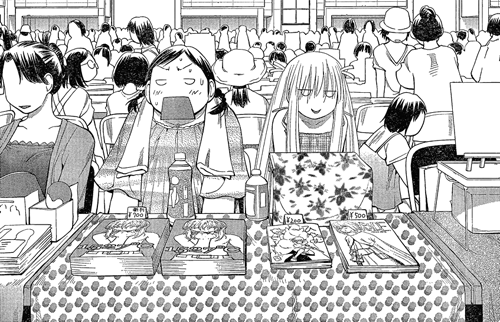
After finishing the second half of her debut professional work, Ogiue pulls an all-nighter to crank out an additional cheaper-quality doujinshi to complement her collaborative effort with Yabusaki. Unable to make it to Comic Festival before the afternoon, she sends Sue in her place, who naturally torments Yabusaki and gets along well with Asada the cat-faced girl, whose first name we discover is “Naoko” (We also get verification on pronunciation of at least the first half of Ogiue’s pen name: Ogino). As Comic Festival begins, a line begins to form at their table due to the popularity of Ogiue’s published manga, which leaves Yabusaki flustered.

I’m not sure if this is Yabusaki’s ComiFest debut or not, but it is Hato’s first time attending. This being Day 1 (the girl-oriented day), he crossplays as Yamada from Kujibiki Unbalance in order to make it less awkward for him to purchase his desired yaoi doujinshi, and in doing so continues the club tradition of Kujian cosplay. Managing to fool men and women alike, Hato ends up facing a dilemma when he’s confronted with having to hold up a large sign for the men’s bathroom, a situation he tries to avoid but is naturally inevitable. While Sue attacks from a fortified position through her signature obscure references (Kyuukyoku Choujin R), Angela brings the gaijin assault head on; when she’s not teaming up for a startlingly apt Panty & Stocking cosplay with Ohno, she’s grabbing Hato’s chest to verify his gender.

Ogiue meanwhile finally leaves her apartment, but at the same time over at Tokyo Big Sight, Nakajima, Ogiue’s old “friend” from her traumatic junior high days, visits Yabusaki’s table expecting Ogiue to be there, wherein the chapter ends on this cliffhanger.

Phew! And again, there’s still two more days of ComiFest left.

The last time Nakajima visited, it conjured up bad memories for Ogiue, who was already dealing with the inner turmoil of shame over her attraction to Sasahara and her fear of hurting him as she did her old boyfriend Makita back in junior high. Since then, Ogiue has learned to accept herself, start dating again, and has even turned her passion for drawing into a career, but when you think about it, she has still never directly confronted Nakajima. Prior to Genshiken II, we could only speculate as to whether or not this would ever happen. Now, short of meeting Makita again, this might very well be the true bookend to Ogiue’s growth over the course of the series, a way to decide her destiny, if you will. All of this has me giddy with anticipation, because while Genshiken II has been delivering so far, all of the fun and games make it easy to forget that this series also handles the dramatic incredibly well.

That’s not to say that the comedy of Genshiken needs to take a hike, as the chapter was hilarious and informative all-around. Hato’s plight is not one I can say I’ve experienced, but I can really feel for the poor guy. It’s interesting to remember that Hato drew a distinction in his mind between cosplay and crossdressing, and also to kind of compare it with Ohno’s own views on cosplaying, particularly that it’s wholly different from dressing sexily. There’s quite a bit of commonality between the two in this respect. And speaking of cosplay, I can’t help but to compare Ohno’s taste in older men to Stocking’s overall poor taste in men, as some would argue that the former is a case of the latter. I’ve also always seen Angela as being more sexually active than the other characters in Genshiken, though obviously not to the extent that Panty does. And if that weren’t enough, Ohno once remarked that her chest is bigger than Angela’s, a situation mirrored somewhat with the Anarchy sisters they’re cosplaying.

The chapter also reveals quite a bit about Sue’s development, specifically in regards to her growing language skills. When Sue first appears, she speaks purely in anime and manga quotes. When she makes her second visit to Japan, she shows that her listening comprehension has grown dramatically. By the time she began studying abroad at Shiiou University, her vocabulary had expanded to the point that she could communicate without the use of otaku references. Now, Sue takes the next step.

It’s not evident in English versions of the Genshiken manga (or at all in any of the anime), but one of the features of Sue’s Japanese is that it’s written primarily in katakana to represent her foreign accent. In this chapter though, some of that katakana has begun turning into hiragana, the script used primarily for non-loan words, indicating that her Japanese is reaching an even greater point of fluency. Personally speaking, I made my greatest strides in my Japanese language skills while studying in Japan, and to see the same happening with Sue brings a smile to my face.

And you wouldn’t believe how glad I am that Kio’s finally told us how to pronounce at least some of Ogiue’s pen name. I’ve even made the appropriate correction to her Fujoshi File.

In any case, I’m probably more stoked for the next chapter of Genshiken II than I’ve ever been. Comic Festival, it always delivers.