Otakon 2022 Interview: Voice Actor Ise Mariya

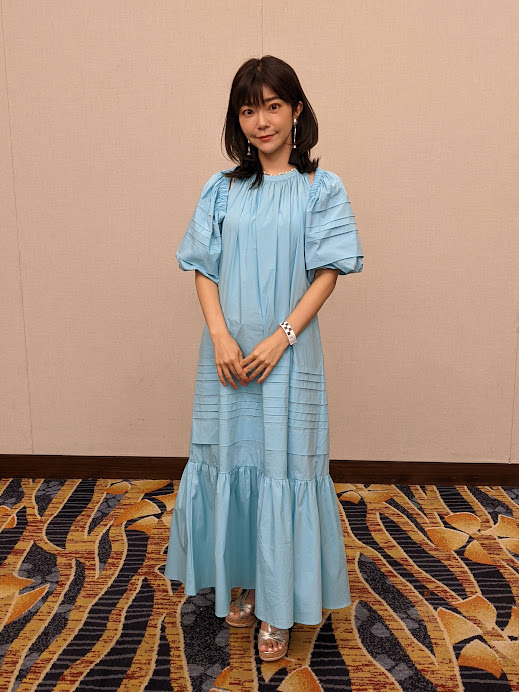
This interview was conducted at Otakon 2022 in Washington, DC.

My first question is about a role you had in the Precure series, Cure Lemonade. Precure is a very big and popular franchise in Japan, but at the time you played the character, it was still a young series. Was it like to play the character back then, and how does it feel to return to the character for crossover movies and other material?

Ise: I was in the third generation from the start of the series, and right around the time I was voicing the character, it was starting to pick up popularity in Japan.

So as you know, it’s about to approach its 20th anniversary, and I had no idea back when I first started that it would be this popular. Part of that is due to the fact that, yes, this is a children’s anime, but it also gives dreams and hopes to adults as well, and that’s probably what has led to it being so popular.

My next question has to do with the series Panty & Stocking. It’s quite popular with American fans—even more than I’d expected—and a lot of people are happy to see the series come back after 10 years. What was it like voicing Stocking, such an unusual and foulmouthed character?

Ise: I still don’t know if I’m in it, but if they reach out to me to play the character of Stocking again, I’d look forward to it.

I thought it was an interesting series. Panty and Stocking are angels in training, and they take off their panties and stocking and turn them into weapons to defeat demons.The vocabulary they use is rather…tricky?

Ise’s Manager (via webcam): Crazy!

Another character you’ve returned to in recent times is Dragon Kid in Tiger & Bunny, after a decade. Has your approach to playing her changed from how you first played her?

Ise: Tiger & Bunny 2 is 10 years after the original, but it actually hasn’t been 10 years since I’ve played Dragon Kid. Within that period, I’ve done drama CDs and movies, so it doesn’t feel like there was a 10-year gap. But even though Dragon Kid hasn’t aged after a decade, I have, and my voice has deepened and become more adult, so it adds another dimension to the role.

Watching Tiger & Bunny 2, she comes across as more of a senpai—which she is. I think the deeper voice lends itself to that role.

What was it like to play such a bizarrely inhuman character as Foo Fighters in JoJo’s Bizarre Adventure? How do you perform when the character is in no way, shape, or form a human?

Ise: Let’s see. When Jolyne and the others first meet her, Foo Fighters is a plankton-like lifeform. At the time, she’s like “Uju! Uju, uju!” in a low voice when she’s just a stand. She isn’t quite human, but she’s intelligent and clever, so I didn’t feel that much difficulty playing the character. After she borrows Atroe’s body, Foo Fighters has a childishness about her and a sense of growth she shows alongside Jolyne and Hermes, so I was conscious of conveying that innocence. 

I really enjoy your role as Ray in The Promised Neverland. It’s maybe a somewhat different character from what you normally play, as well as a heavy work. What was it like to voice Ray, especially because he does age over the course of the series?

Ise: In the first season, Ray is willing to sacrifice everything in order to save Emma and Norman—to help them escape. He lives for that, but there’s a darkness about him, and he hides his true thoughts and feelings. He planned things with all this in mind, but when he’s able to confide his secret to the other two and speak those true feelings, it lifts a weight off his shoulders. In the first season, he’s full of heavy and dark feelings. But his position changes in the second season, and he becomes more cheerful.

A less prominent character you’ve played is Akagi Sena the fujoshi from OreImo. Were you familiar with fujoshi and BL culture before the role?

Ise: In Japan, when girls who love anime and manga reach middle school, they’ll—well, I wouldn’t say it’s guaranteed—they’ll start to develop some interest in BL. So I can really understand the feelings of those we call fujoshi, and I myself read BL in middle school. It didn’t feel difficult to relate to Sena.

From what I’ve heard, you put a lot of thought into your roles—it’s very clear from your answers. My last question is, what are some lessons you’ve learned that you think would help new or aspiring voice actors?

Ise: In America or in Japan?

It’s a pretty open question.

Ise: Tough question. Being a voice actor involves using your unique voice, but it’s actually not a job that’s only about your voice. Just like a live-action actor, one of the best ways to inform your acting is to gain a lot of lived experience as the foundation for your performance, and it’s good to want as many experiences as possible. When you’re in your teens, you should do the things you can only do at that age—school, friends, falling in love, doing everything someone in their teens does. This will help to inform whatever it is you’re performing as a voice actor.

Thank you! This was a great interview.

Ise: Thank you very much!
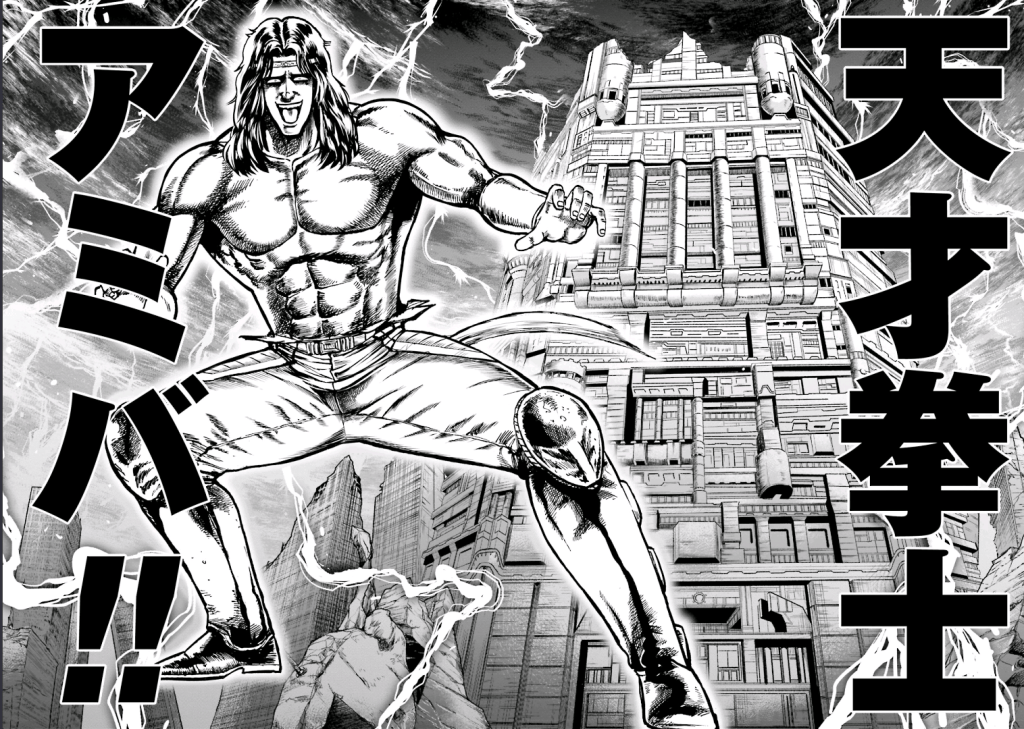
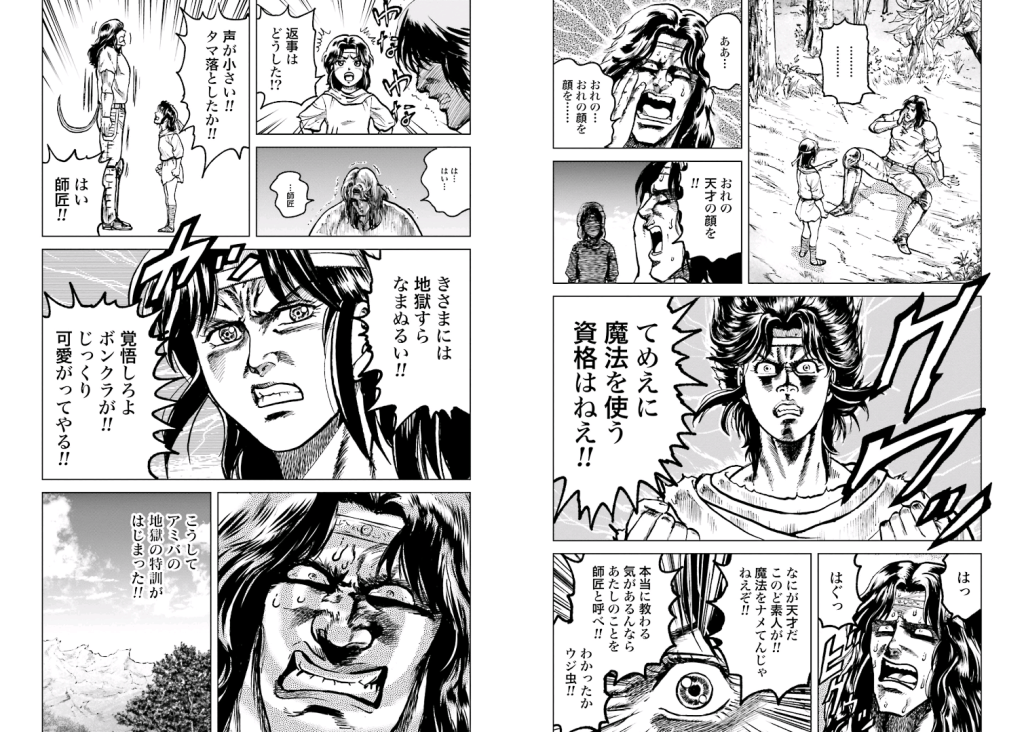
S-M-R-T! I mean, S-M-A-R-T: “Fist of the North Star Side Story: The Genius Amiba’s Otherworld Conqueror Legend”

Isekai are so ubiquitous these days that there exist genre parodies of famous properties. Whether it’s being reborn as Yamcha from Dragon Ball Z or Kycilia Zabi from Gundam, we have yet another twist to a familiar gimmick. I generally don’t pay attention to such works, but I made an exception for a recent manga that asks, “What if Amiba (aka Fake Toki) from Fist of the North Star got sent to another world?”

That’s Fist of the North Star Side Story: The Genius Amiba’s Otherworld Conqueror Legend. And upon hearing this premise, it felt so perfect. After all, one common trope is that the characters who get reborn and transported tend to be pitiful “losers” given a second chance, and Amiba is among the most pathetic of Kenshiro’s opponents. He’s also a terrible person, so the story feels ripe for both comedy and the possibility of greater development. For the most part, Amiba’s Otherworld Conqueror Legend does not disappoint.

At the start, the manga reveals that the way Amiba gets isekai’d ties directly into the events of Fist of the North Star: Kenshiro makes Amiba’s hands explode, then uses his pressure-points to force the delusional villain to walk backwards off a precipice. What’s worse, he never even hits the ground before exploding into a puddle of goo. Amiba probably wishes he got killed by a truck.

He then awakens in a new world that looks oddly similar to the post-apocalypse he once called home, but there are some notable differences. Namely, fantasy elements like magic and dragons are fairly common, no one has any clue about “Hokuto Shinken” or other martial arts, and a number of characters resemble established FotNS faces. Unlike Kenshiro’s young companion Lin, the girl Amiba first runs into is Lilin, a foul-tempered mage who reluctantly teaches him magic—which he turns out to be awful at. Amiba, of course, insists that can’t be the case because he’s a genius. He does manage to make effective use of his piddling magic by the end of Volume 1, so maybe there is something to his claims, but the manga makes it clear that Amiba is perennially just as much a dumbass as he is intelligent.

The series is quite good at playing on expectations from both isekai and FotNS. Amiba isn’t a terrible fighter—he’s just hopelessly outclassed in his original world. However, in his new world his combination of fairly extensive knowledge of Hokuto Shinken and its counterpart, Nanto Seiken, makes him a unique presence as per the standard isekai protagonist trope. The manga also shows that he got a power-up after reincarnating in true isekai fashion, though the gag here is that the boost is very minimal. 

As mentioned, many of the characters are intentional knock-offs of minor FotNS characters: Lilin, Pat, Devil Reversible, and so on. While their appearances are close, their personalities can differ tremendously, and often the “bad guys” aren’t so bad. A fairly major character’s counterpart even shows up at one point. I appreciate the joke, but wonder if it’s being overused, and if the series could benefit from having more characters who are original.

The idea that this is Amiba’s chance to find glory, and the way his arrogant personality both helps and hinders him, is what makes The Genius Amiba’s Otherworld Conqueror Legend work. Is he going to find an odd sort of redemption? Or is he going to repeat the same mistakes? The fact that he likely will end up doing both makes me want to see where the story goes from here.

Mother of Mercilessness: Everything Everywhere All at Once

Everything Everywhere All at Once is a film that defies tidy categorization. It’s both ostensibly and fundamentally the story of a Chinese family struggling to keep things together, and it adds a hearty helping of what feels like every genre under the sun and moon that nevertheless achieves a bizarre harmonious blend of flavors. There’s a lot worth discussing about EEAO, but where I want to focus is its exploration of a familiar topic: intergenerational trauma. Particularly, I find that centering the story on the mother, Evelyn Wang (played by Michell Yeoh), brings a powerful and challenging perspective to the subject.

When it comes to stories about the Asian diaspora, intergenerational trauma seems to be big on Asian creators’ minds. Turning Red is an animated feature about the pressure a Chinese-Canadian girl feels towards her mother’s expectations. Himawari House is a comic about different Asian women moving to Japan to find themselves. Crazy Rich Asians shows how the decisions of one’s ancestors can ripple forward in time, affecting individual descendants in disparate ways. Messy Roots is about growing up Wuhanese in a predominantly white American environment. These works tend to describe families that come into conflict over the frustrating combination of expressing familial love through familial structure and obligation, but in every case, it’s the sons and daughters who are the main characters. 

Michelle Yeoh also plays a mom of one of the main characters in the Crazy Rich Asians movie. There, she’s a Singaporean mom trying to prevent her son from marrying a Chinese-American girl who comes from outside the vast-yet-insulated world of the ultra wealthy. Like so many of these stories, she as a parent is not necessarily a “villain,” but she and those of her generation are at least a source of stress for their kids as they try to carve out their identities.

EEAO flips the script, with Evelyn being both the figurative and literal hero. On the one hand, she’s a mother struggling with her non-serious husband, her teenage lesbian daughter, her judgmental elderly father, and a tax audit on the family’s laundry business. On the other hand, her endless string of failures apparently have made her the perfect candidate to stop the destruction of the multiverse. To say that it’s rare for a character like Evelyn to be this kind of protagonist is to make the queen of understatements. 

Through the metaphor of the multiverse, I find that EEAO explores so many facets of that Asian intergenerational experience. It’s stated that Evelyn made sacrifices to move to the US from China, and that she has a tendency to leave a lot of goals unfinished, giving a sense that she’s, well, trying to be everything everywhere all at once. Similarly, the pressure she puts on her daughter to be better than her through a combination of shame and criticism—well-intended but nevertheless painful—is one of the major sources of conflict in the film. 

By having all of this told primarily from the perspective of Evelyn, however, the Asian mom ceases to be a close-yet-distant figure in the story to eventually understand, and becomes the primary conduit through which these conflicting emotions are experienced. And it all comes down to trying to figure out how to deal with the expectations of others while trying to raise a child to exceed all expectations.

There’s actually a lot more I’d like to discuss about Everything Everywhere All at Once, especially the daughter and the husband Waymond, and how they each add to the wonderfully complex milieu that the film provides. But Evelyn is the main character and star, and the stalwart yet wobbly pillar around which the story is built. It’s an uncommon but welcome sight, and it has me wondering if I need to view my own mother a little differently—even if that doesn’t come easily.

White House ga Abunai: Ogiue Maniax Status Update for August 2022

I’m back from Otakon in DC, and hopefully without catching COVID or the five million other diseases currently making life miserable for everyone. Did I make the right choice going to an anime convention? I guess my body will tell me soon. I’ll have a review of the event coming up this month, including my logic as to why I decided to attend despite the obvious risks involved (hint: taking steps to be cautious can go a long way).

By the way, the title of this month’s update is a reference to Jack King from Shin Getter Robo vs. Neo Getter Robo.

Thank you to my August 2022 Patreon subscribers, notably the following:

General:

Ko Ransom

Diogo Prado

Alex

Dsy

Sue Hopkins fans:

Serxeid

Hato Kenjirou fans:

Elizabeth

Yajima Mirei fans:

Machi-Kurada

Blog highlights from July:

Dance Dance Danseur, Ted Lasso, and Healing Masculinity

A look at two series that challenge toxic masculinity.

We’re All Stars: Love Live! Nijigasaki High School Idol Club Season 2

A post about how Love Live! Nijigasaki puts the spotlight on unexpected characters.

La+ Darknesss, Dance, and True Power Levels

This Hololive VTuber has an unexpected side to her that makes things all the better.

Kio Shimoku

Kio Shimoku’s Twitter this past month was pretty light, but I definitely enjoyed finding out his thoughts on various movies, both anime and non-anime.

Apartment 507

Some thoughts on the soccer anime Ao Ashi.

Closing

The summer heat has been harsh here and around the world. I hope everyone is doing what they can to stay cool, and that the people with the power to actually change things don’t just sit on their hands while they watch the world burn.

Kio Shimoku Twitter Highlights July 2022

The summer brings new anime, and new thoughts from Kio.

New chapter of Spotted Flower came out at the end of June! The digital version just came out, a month later.

Kio drew a flyer for a Night on the Galactic Railroad musical. He did some art for it last month as well.

Kio’s tablet has been acting up, leaving trails when he picks up the pen. The two images say “New book” and “Greeting cosplay wife by kissing.”

When Hashikko Ensemble first began, Kio actually drew rough sketches for all the classmates as background characters. This is actually how Shinji, Kozue, and Kanon started before being promoted to being a part of the main cast. He doesn’t really remember any traits he might have thought up for the classmates, though.

Kio at a Tower Records exhibit for BASTARD! That first image apparently was a defining part of his youth, as he wondered how the heck the artist managed to do what he did.

“Huh? Could it be that drawing manga is actually a huge pain in the ass?”

Kio is relieved that the anime adaptation of Uncle from Another World is good. He’s a huge fan (oshi) of elementary-school-era Fujimiya. (Note: Before you think that’s a lolicon thing, you have to actually see what the character was like as a kid.)

Kio struggling with a manuscript. He can’t seem to summon the physical will to work on it further.

Kio realizes that the original Genshiken was serialized for only four years. Reminiscing on that time, he remarks on how everyone who supported him helped him to develop his skills in real time. He remarks on how young he was then, looking back.

Another manuscript finished, with a little preview to boot.

This is the earlier “kiss the cosplay wife” brought to fruition. Read the latest extra chapter of Spotted Flower.

Kio would like to see an anime adaptation of the gag manga Overlord: The Undead King Oh!

Keep Chugging Along: Shinkansen Henkei Robo Shinkalion Z

I never got the chance to watch all of the first Shinkalion anime. I discovered it a little late, and the way episodes would be up on Youtube for only a week meant that a busy schedule could derail my hopes of keeping up with it. And let’s face it: The series is pretty generic in a lot of ways. Still, I wished I could have kept pace with it better.

In 2021, Shinkansen Henkei Robo Shinkalion Z debuted, and I saw this as my opportunity to do what I couldn’t before. I decided to keep up with the series week to week, not expecting my world to be rocked or anything. 

The basic story is that years after the events of the original Shinkalion, a new boy named Arata Shin becomes the driver of the new Shinkalion Z E5 Hayabusa. Unlike the original main character, Hayasugi Hayato, Shin is not a train otaku but rather a cryptid enthusiast. Alongside him is a new friend, Usui Abuto (named after the Apt trains), who is the train fan but can’t drive Shinkalions for some reason. Together, along with other allies, they have to fight against the forces of the extraterrestrial Teoti.

Shinkalion Z doesn’t dazzle, but it’s fun and it has a few twists and turns that add some welcome tension and drama. Also, it has a grade schooler version of Maetel from Galaxy Express 999. In a way, part of watching Shinkalion is seeing their argument for being the most ambitious crossover, as the meme goes.

One of the issues with Shinkalion in general is that the characters and the mecha themselves both feel kind of bland. I know I’m not the target audience, and I’m not saying they need to look amazing, but there’s something decidedly milquetoast about the aesthetic. In particular, the fact that all the Shinkalions have basically the same design with minor differences and even transform virtually the same way makes it less exciting than it could be—imagine if they had unique transformation sequences a la Precure or Sailor Moon. I’m sure it makes for convenient toys, though.

Shinkalion Z makes some improvements in both regards, though nothing mind-blowing. Abuto has some depth to him, while a Shinkalion driver named Taiji is hard to forget because he’s this weirdly muscular little boy from a family of lumberjacks or something. The inclusion of a big-bodied lady as a side character that doesn’t fall into fatphobia is also worth noting. As for the robots, there’s one that can turn into a centaur, which is the most eye-catching thing to come out of this franchise so far.

The show winds up being 41 episodes long, a bit unusual of a number, and it makes me wonder if the show got cut short. Of course, that means it’s in the company of many classic robot anime—First Gundam, most famously. Between this and its toyetic, “for kids” feel, perhaps Shinkansen Henkei Robo Shinkalion is the purest mecha series of all.

Ogiue Maniax Panels at Otakon 2022

Otakon 2022 is this weekend, July 29–31, and I’ll be heading back to my favorite anime convention of all. This year, I’m running two panels: one by myself, and one with an old partner in crime.

Hong Kong in Anime and Manga 

Friday 4:30 PM – 5:30 PM / Panel 2

I was motivated to do this panel because I wanted to celebrate the culture of Hong Kong but also critically investigate how it is used in anime and manga. Those who’ve been to my panels will know that I tend to take a more scholarly (yet still fun) approach, and this is no exception, I hope

Mahjong Club 
(aka Riichi! Ten Years Later)

Friday 5:45 PM – 6:45 PM / Panel 5

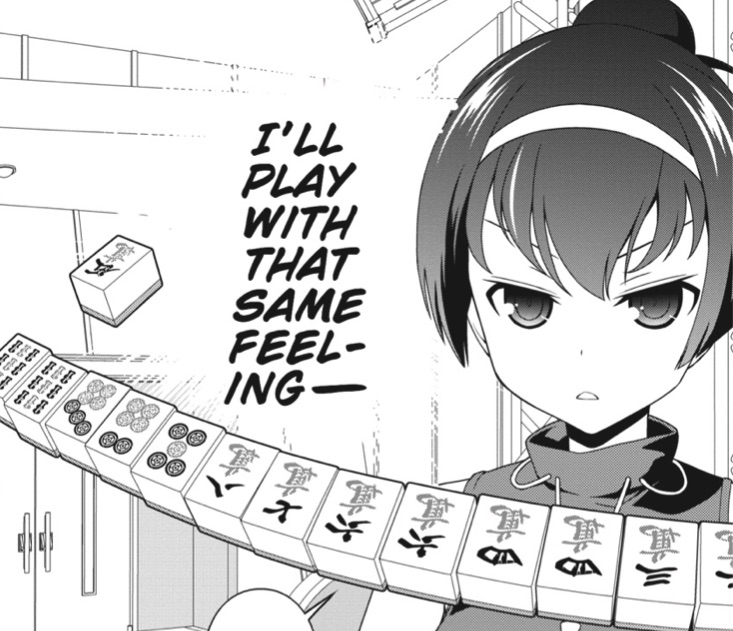
It’s been ten years, the Japanese mahjong panel is back! Once again, it’ll feature myself along with Kawaiikochans creator Dave. There are more riichi mahjong players outside of Japan than ever before, and more easy ways to play too! Whether you’re an experienced hand or someone who only knows mahjong by name, this panel has something for you.

See you in DC!

Kinoko Loco: Sabikui Bisco

I’m a fan of the combination of serious and silly in the anime Sabikui Bisco. Its premise of a post-apocalyptic world that revolves around conflicting views on mushrooms is patently absurd, but the sincerity of its characters is endearing and gives weight to their actions and decisions.

The world of Sabikui Bisco is full of peculiar individuals. There’s Milo, a gentle doctor who experiments with black market mushrooms in the hopes of healing his sister who’s afflicted with the “rust” disease that plagues humanity. The same sister, Pawoo, leads an elite guard in their city using her depth-defying strength. There’s the corrupt leader Kurokawa, who controls the city with an iron fist and goons in mascot heads. And then you have the brash protagonist Bisco, a member of the mushroom tribe who slings mushroom arrows and knows the truth about fungus: While it’s commonly believed to be the cause of rust, the reality is quite different. This here is an eclectic bunch, to say the least—but as ridiculous as they are, they’re all deadly serious about either saving the world or controlling it.

The general energy of the series reminds me a lot of the 1990s anime I grew up with. It’s not so much that Sabikui Bisco traffics in 90s tropes, but rather that it has a particular brand of irreverence combined with a lack of archetypes common to anime made in the 21st century. Had it emerged two or three e decades earlier, I don’t think it would look out of place alongside titles like Slayers or Trigun. In fact, there’s something very Vash the Stampede–esque about Bisco.

The anime thus far only covers part of what is an ongoing light novel series, but it ends in a satisfying place and never loses sight of that balance of earnestness and absurdity. Sabikui Bisco is about heroes going out there and doing things, and that simplicity is welcome.

La+ Darknesss, Dance, and True Power Levels

Since her debut, Hololive’s La+ (pronounced Laplus) Darknesss has become one of my favorite Virtual Youtubers. Her premise states that she’s both a mighty alien (?) demon (?) whose power has been sealed off—as well as the founder of Secret Society HoloX, an organization with designs for world domination. In practice, however, La+ comes across as a cheeky and overconfident brat. It’s within this context that the biggest surprise about her characters was revealed: the fact that she’s actually a fantastic dancer. I find myself re-watching her dancing clips, even though I normally don’t do that—not with VTubers, not with flesh-and-blood performers, and not even with the many anime dances over the years.

To those who are unfamiliar with Hololive and specifically the process by which its Vtubers go from “2D” to “3D,” most start off as flatly animated characters. In this “2DLive” format (named after the program used to rig their animations), La+ and others like her are able to move and tilt their bodies and heads to some degree, but it’s generally not meant to track the entirety of the performer’s physical movements. Over time, a Hololive member receives a 3D polygonal model, and can use more robust motion capturing to match the movement of their entire bodies. In other words, you generally can’t tell how comfortable a VTuber is with physical activity like dancing before they make their so-called 3D debut.

La+ was the last of HoloX to become 3D. Prior to that, she was primarily defined by two things. First, despite being the leader of her clandestine group, she’s actually the smallest; her oversized horns further emphasizing La+ as a relative pipsqueak. Second, she has an extreme amount of ego that swings wildly between being justified and unjustified. So when she started busting a move, I felt a degree of cognitive dissonance. “Wasn’t she supposed to be bad at this sort of thing?” In a later collaborative stream with the rest of HoloX, the sheer contrast in dancing ability between La+ and her subordinates (who are usually her betters in a variety of ways) hammered home that she’s a cut above the rest.

I think the reason this aspect of La+ works so well is that it ends up making her feel even more like a being of contrasts. She has that aforementioned “shortest but most important” quality, but in terms of competence, it’s like you never know if she’ll be a Hellmaster Fibrizo (Slayers) or a Katyusha (Girls und Panzer). If this really were an anime or something, La+’s dance reveal would be that moment where Yoda or Shifu from Kung Fu Panda gets serious. It’s a winning trope, generally speaking.

La+ Darknesss is neither fully an anime character or a fully flesh-and-blood performer, which is why the combination of her character background plus her strength as a dancer shine through. Like other VTubers, she lives in that transitional space between the real and fictional worlds. The fact that she’s so physically talented is inevitably to the credit of the performer, but it’s the surrounding setting that gives La+ the stark contrast to render her moves to be even more unforgettable.

Happy Girlmore – “Birdie Wing: Golf Girls’ Story”

As far as I can tell, no one expected Birdie Wing: Golf Girls’ Story. A yuri anime? Sure, there are plenty out there. An over-the-top sports series? That’s a well-established subgenre. A world run by powerful underworld forces? Organized crime is not an uncommon subject matter for Japanese media. To have all three and unexplained deep-cut Gundam references, and to put it all in an intensely bright package is to approach the schlocky majesty of Birdie Wing.

The heroine is a blonde teen named Eve, who lives in the fictional country of Nafrece. She’s a career golfer, but not in the traditional Tiger Woods sense. Rather, she plays high-stakes gambles where risk and reward are intense, and she does so by breaking almost every textbook convention possible. To Eve, golf is but a tool for psychologically attacking her opponents through her signature “bullets”—swings that embody the gunshot-like style taught to her by a mysterious mentor who sounds a lot like Char Aznable. 

However, when Eve meets Amawashi Aoi, an elite legitimate high school golfer whose skills are different yet similarly mindblowing, the gambler’s world begins to change. Eve begins to think that playing with Aoi would be the ultimate thrill, but what would it take for the two to meet? Is she willing to stake her livelihood, or perhaps even more? 

Eve, Aoi, and everyone else’s golf is sheer absurdity. It takes from the fine tradition of exaggerated competition like Star of the Giants, Saki, and Prince of Tennis—but just as much from gambling series like Kaiji and One Outs. In fact, Eve’s use of only a handful of golf clubs is reminiscent of the One Outs protagonist using only fastballs thrown at different rotational speeds. Yet, as ridiculous as the golfing is, I realized what makes Birdie Wing transcend even further is that the world surrounding the golf is even more mind-boggling. 

While a series like Yu-Gi-Oh! revolves around card games as the premier form of entertainment, this doesn’t seem to be the case in Birdie Wing. Sure, golf is a common sport used for illegal gambling, and there are entire high schools in Japan with elite golf teams, but the setting of the series is such that it would be a haven of bizarre world where sometimes a public figure just gets murdered by rocket launcher. 

I don’t think anyone could have predicted the places Birdie Wing has gone. For me, the peak so far might be the moment you think that the series is going for a powerful visual metaphor, only for it to be REAL. Even the de-escalation of hijinks that happens in the second half of this first season feels like a challenge to expectations. And yet, I can’t shake the feeling that the monster is still there, like they stapled Aim for the Ace! to the Mutant League cartoon. When the series comes back, there’s a 50/50 chance the girls are going to end up putting in outer space, and I’m all for it.
Is Birdie Wing about golf? The sport does play a prominent role. Does it feature girls? Yes, they are the stars. Is it a story? Boy, is it ever.