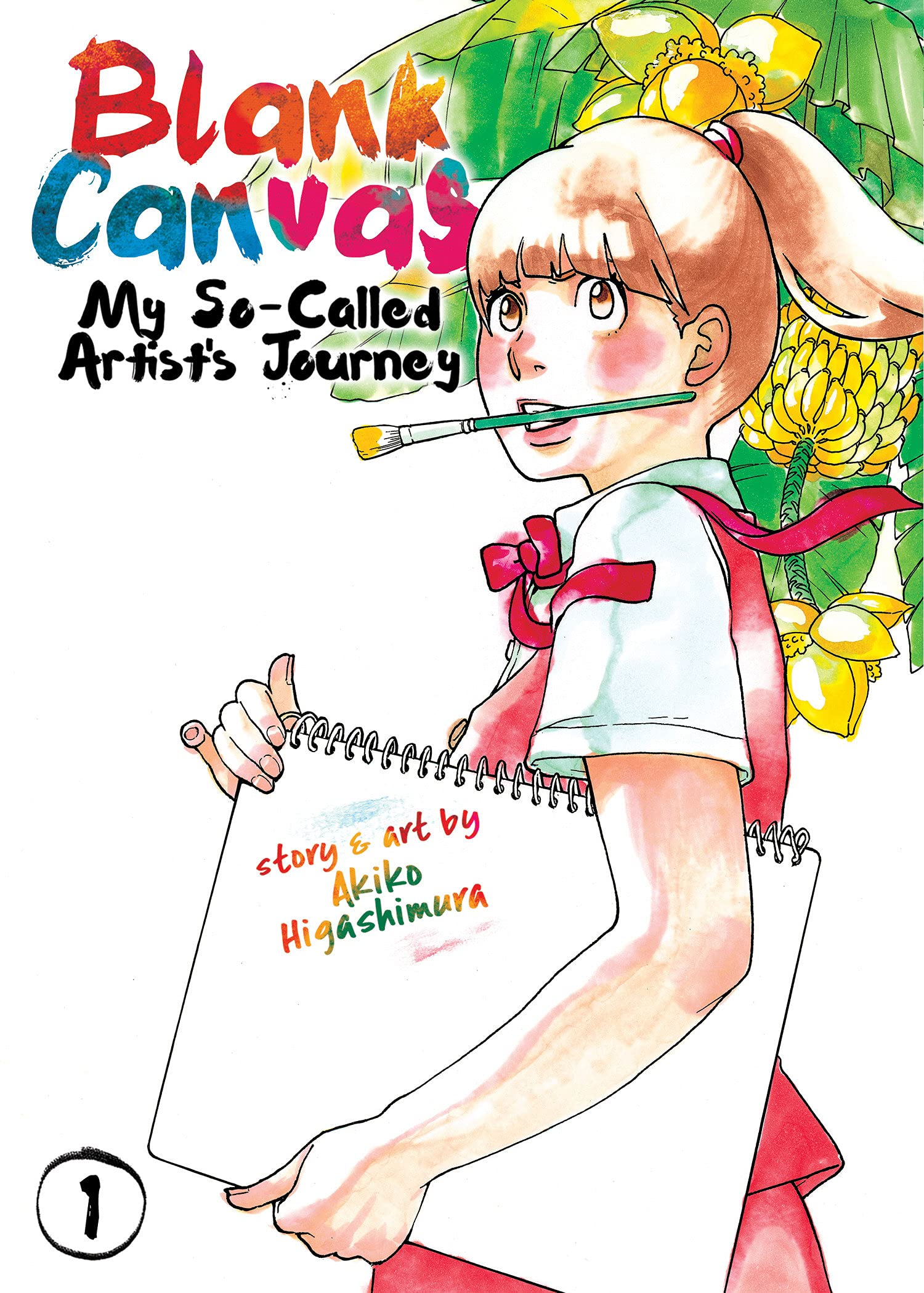
I love the works of Higashimura Akiko. Whether it’s Princess Jellyfish, Tokyo Tarareba Girls, or even the recent Webtoon A Fake Affair, her stories about women feel utterly authentic even as they can sometimes dip into the realm of the fanciful. But Blank Canvas: My So-Called Artist’s Journey is a little different from these other titles: an autobiographical series about how Higashimura herself became a renowned professional manga artist. Rather than some self-aggrandizing memoir, however, it declines to pull its punches by conveying the sacrifices she made, for better or for worse, to get to where she is.
Titled Kakukaku Shikajika (“And So On and So Forth”) in Japanese, Blank Canvas traces Higashimuta’s path starting from her days as an overconfident high school student assured that she’ll be the next big manga artist. Her plan to get into an art college and use that as a platform to launch her career leads Higashimura to her first art teacher, Hidaka-sensei: an expectations-defying hothead of an old man who runs his own independent class and constantly pushes his students to just keep drawing no matter what. From art lessons to art school to her first published manga and more, Higashimura lays out the strange-but-profound relationship the two of them share.
I myself attended a fine arts school but ultimately did not end up in a career directly tied to that particular world, and there are definitely elements of Blank Canvas I can relate to—particularly in terms of remembering the greater talent and hard work that I would see in my peers. I may even still have trouble honestly assessing how much of the opportunity I squandered versus how much it benefited me, but when I read Higashimura, I can feel the harsh yet fair weight of her self-assessment, as she emphasizes just how much Hidaka’s teachings stuck with her. Through the ups and downs of Higashimura’s artistic life, including a mentally and emotionally draining struggle between her “fine arts” side and her “manga” side, her teacher’s lessons (both in life and in art) crop up as both sources of inspiration and dread.
Hidaka-sensei is definitely a character, and reading it made me think about how differently people can be built both inside and out. Hidaka-sensei is portrayed as someone who would berate and even physically hit his students, but was nevertheless confident that anyone who put in the time with him would improve. The mix of faith and Spartan training is an odd combination, and I could see it being actively harmful to certain types of artists. Yet, Higashimura makes it clear that this helped her greatly, even if she didn’t always want to admit it.
The series also provides insight into the kinds of manga that influenced Higashimura, and it makes me interested in looking deeper at the shoujo magazine that inspired her the most: Bouquet. If the series found in Bouquet are part of the reason we got the artist of Princess Jellyfish and all these other great titles, they’re even more worth reading in their own right.
Blank Canvas is complete at five volumes, and its combination of levity and brutal honesty are hard to forget. I feel like it’s just as likely to convince someone to become a comic artist as it is to get them to rethink that career choice, but more importantly, it’s a gradual and thorough processing of all a life has to offer—the beautiful, the ugly, and the realization that it’s easy to mistakenly assume which is which.
I’ve been mulling over something lately: Is it safe to define a genre or trope preference in fiction as a case where you’re more accepting of less-than-stellar results? Much like supporting a local sports team through thick and thin, is being a genre fan about enjoying even the mediocre?
I’m ready to admit that the analogy falls apart under close scrutiny for a whole host of reasons. There’s no clear metric for winning vs. losing with something subjective like fiction. Supporting a player or a team, something made up of real people, is very different from being into a particular fiction genre—a more fitting comparison might be a favorite animation studio or book imprint.
But when I think about a genre I enjoy—giant robot anime for instance—there’s something about my appreciation that feels like it goes well beyond considerations of quality. When Good Smile Company announced a ton of new model kits for their Moderoid line, the sheer variety and obscurity of the line stood out to me. Some of the excitement came from the representation of series I consider personal favorites: Godannar!!, Reideen, Granbelm, Rayearth, The BIg O, and more. But it also came from seeing new or relatively obscure things get the spotlight, like Daitei-oh (the Eldoran series that never officially got an anime), Zeorymer, Promare, and iDOLM@STER: Xenoglossia. Not all of these series are genre-defining heavy hitters, but that they exist as merchandise fills me with warmth.
In contrast, I’ve watched a good amount of idol anime at this point, but I still don’t see myself as a fan of the genre. I appreciate the titles that stand out, though.
Perhaps, however, supporting your local fiction genre also comes with being able to recognize that you have a bias towards the tropes and expectations that come with it, because sometimes having a truly disappointing instance stings extra hard. But I also wonder if, like how you have sports fans of consistent winners and those of perennial underdogs, there’s a difference between the fans of a genre that’s seeing the limelight and one whose star has faded a bit—or, for that matter, a genre that may have once been big versus one that has never really ascended in the first place.
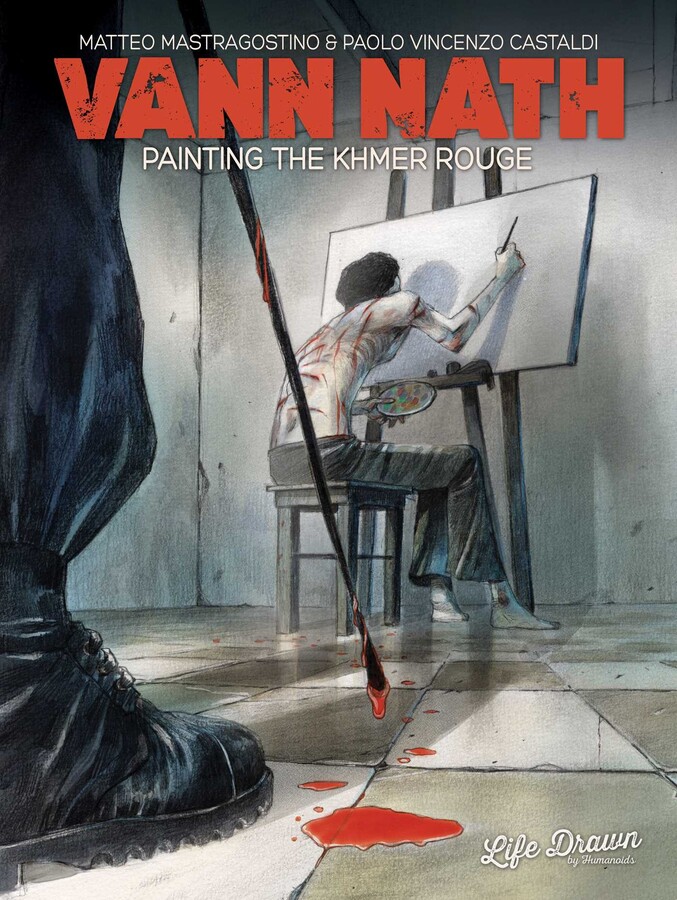
I continually feel humbled by my own lack of knowledge when it comes to the many atrocities of this world. Whether it’s the Holocaust, the burning of Black Wall Street, the Armenian genocide, and more, it’s all too easy to remain ignorant at the darkness of humanity, especially if you believe these events to be far-off relics of the past—or worse yet, if you’re never been taught them at all. It was while browsing the European comics catalog over at Izneo that a particular title caught my attention: Vann Nath: Painting the Khmer Rouge, written by Matt Mastragostino with art by Paolo Vincenzo Costaldi.
I’ve only ever had the vaguest understanding of Pol Pot and the tragedy brought upon the people of Cambodia, and thought this could be my introduction. Helpfully, the staff at Izneo listened to my request to receive digital access for review purposes, and so I began learning about the 2 million Cambodians who died, as well as the man who used his artistic skills to highlight these horrors.
The Khmer Rouge was the government regime that ran Cambodia from 1975 to 1979, and Vann Nath was a real-life survivor of the S21 prison where only seven out of 20,000 remained alive by the end. Vann Nath: Painting the Khmer Rouge is told from the perspective of its namesake. The story goes between Vann Nath living as a prisoner, revisiting his trauma even after the regime had collapsed, and ultimately being a painter who strove to make sure the brutality of the Khmer Rouge never leaves humanity’s collective memory.
The educational aspect is obvious, but Painting the Khmer Rouge largely isn’t didactic, and the comic’s greatest strength is that its art and story neither trivialize nor sensationalizes what transpired. The loose, painterly quality and the lack of gory detail make for a more sensitive approach, but the depictions of the horrors that occurred—torture, family separation, mass graves, and more—still carry a great deal of weight. Much of how the prison is portrayed (such as the eerie tiled floor) draws inspiration from Vann Nath’s own work, but the art does not try to mimic Vann Nath’s style outside of panels that specifically and purposefully call back to his paintings.
Reading through Painting the Khmer Rouge gave me not only a better sense of Cambodia’s past, but also the ways that language can be twisted, as well as how this dark history can’t help but inform the present. Even if the Khmer Rouge was a totalitarian dictatorship that strayed far from what communism is ideally meant to be, it’s no wonder that Cambodian immigrants (and other similar groups) might react strongly against anything described as communist or socialist. Similarly, the name of Cambodia under Pol Pot was Democratic Kampuchea, and much like North Korea (officially the People’s Democratic Republic of Korea), a word like “democracy” can be bandied about without much care for its actual meaning. During the Khmer Rouge’s reign, men had to call one another “brother” as a sign to show that they are all equal, but the reality of the situation is that it forced people to minimize the clear power disparities between those in charge and those crushed underneath. Words are worthless when they’re nothing more than tools to obscure truth and bludgeon people into submission.
A comic can only tell so much about history, and I understand that this is only scratching the surface. It’s inspired me to learn more about Cambodia and Vann Nath, and for that, I’m grateful.
Like all people not living under rocks, I’ve noticed the rise and sustained international popularity of Korean pop, with a fanbase nigh-unmatched in current times. I first caught wind of its global rise about ten years ago, when one Starcraft 2 tournament after the next would feature music videos of hits such as “Gee” and “Bubble Pop!”—Korean esports and K-pop seem to go hand-in-hand. But while there are K-pop songs I enjoy (and I can appreciate the creativity of BTS), there’s always been a sleek and shiny veneer that I’ve felt preventing me from embracing the genre entirely.
For a long time, I’ve wondered what exactly was the nature of my reticence. Recently, though, I read a 2019 article by a student journalist Yuzu I. comparing K-pop and J-pop (a genre I’m relatively more familiar with and enjoy more), they laid it out in a way that helped me to clarify my own thoughts and feelings. Essentially, the big difference between the two—or rather K-pop and the idol strain of J-pop that is so prevalent—is that K-pop is about presenting an image of perfection, whereas J-idols want fans to follow along in their growth like unpolished gems that their support to achieve greatness. It’s that “out-of-the-box” flawlessness that I think has always given me a slight pause when it comes to K-pop.
To be clear, I don’t think that the J-idol route is somehow more authentic; it’s merely presented as such. The two are different approaches towards the same end of getting loyal fans and hitting it big culturally and/or monetarily. That’s okay—they’re products designed to engender certain feelings in their audiences, like so much of entertainment. The ability to see your heroes improve and level up until they’re the strongest around is a hallmark of certain manga genres, and I can’t help but note that similarity to something like AKB48.
I find that the aesthetic of K-pop perfection is not limited to Korean pop culture or its music. It might not even be the primary driver of that aesthetic, as I often get a similar sense from more visually oriented forms of social media like Instagram, or even the way that video production has changed over time with Youtube. I understand why such things have occurred, and I don’t think it’s right to fault people (or even companies) for wanting to make their stuff look good. It reminds me of the concern among mothers about the pressure they feel from “Instagram moms” whenever their own lives are less than idyllic. I’m not saying that K-pop (or anything else) needs to show its performers behind the scenes screwing up and getting into fights—merely that while some can take positive inspiration from this totality of spotless presentation, I’m not naturally inclined towards that.
Unless, perhaps, you give it to me in the form of a cool cartoon.
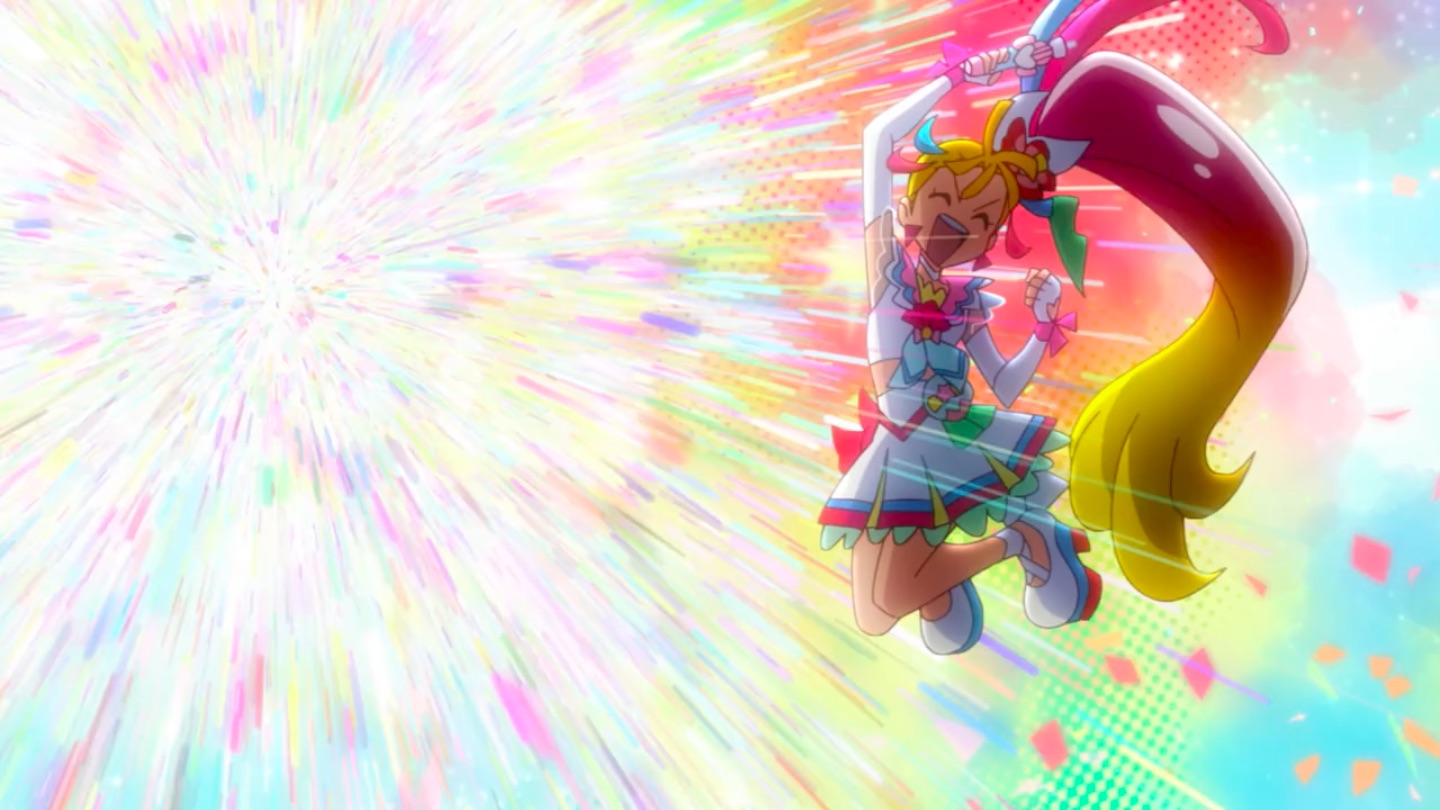
Precure is not exactly what you would call a dark franchise. While it’s capable of addressing serious ideas and can communicate mature messages, the brightly colored heroines and generally upbeat tone bring a certain expected level of happy enthusiasm. Even within this context, 2021’s Tropical-Rouge! Precure is by far the most energetic Precure series to date. From its delightfully spastic opening to its ever-active and ever-cheerful protagonist, the show radiates positivity. But Tropical-Rouge! also proves itself to be capable of tackling tough subjects and giving hope to viewers that they can take steps towards their dreams, whatever those may be.
Premise, Motifs, and Themes
Middle schooler Natsuumi Manatsu has spent most of her life on a tropical island, but has recently moved to Aozora City to live with her mother. There, she encounters a real-live mermaid named Laura, who aims to become the next queen of her people by finding one of the legendary Precure: warriors who can stop the dreaded Witch of Delays from stealing people’s Motivation Power. Manatsu turns out to have what it takes to be a Precure, and transforms into Cure Summer to defeat the Witch’s Yaraneeda monsters. Full of pep like no one else, Manatsu has always wanted to do all that she can, and now that includes being a Precure. As she recruits others in school to become fellow Cures, they form the Tropical Club, a kind of “do anything and try everything” group that’s eager to help others.
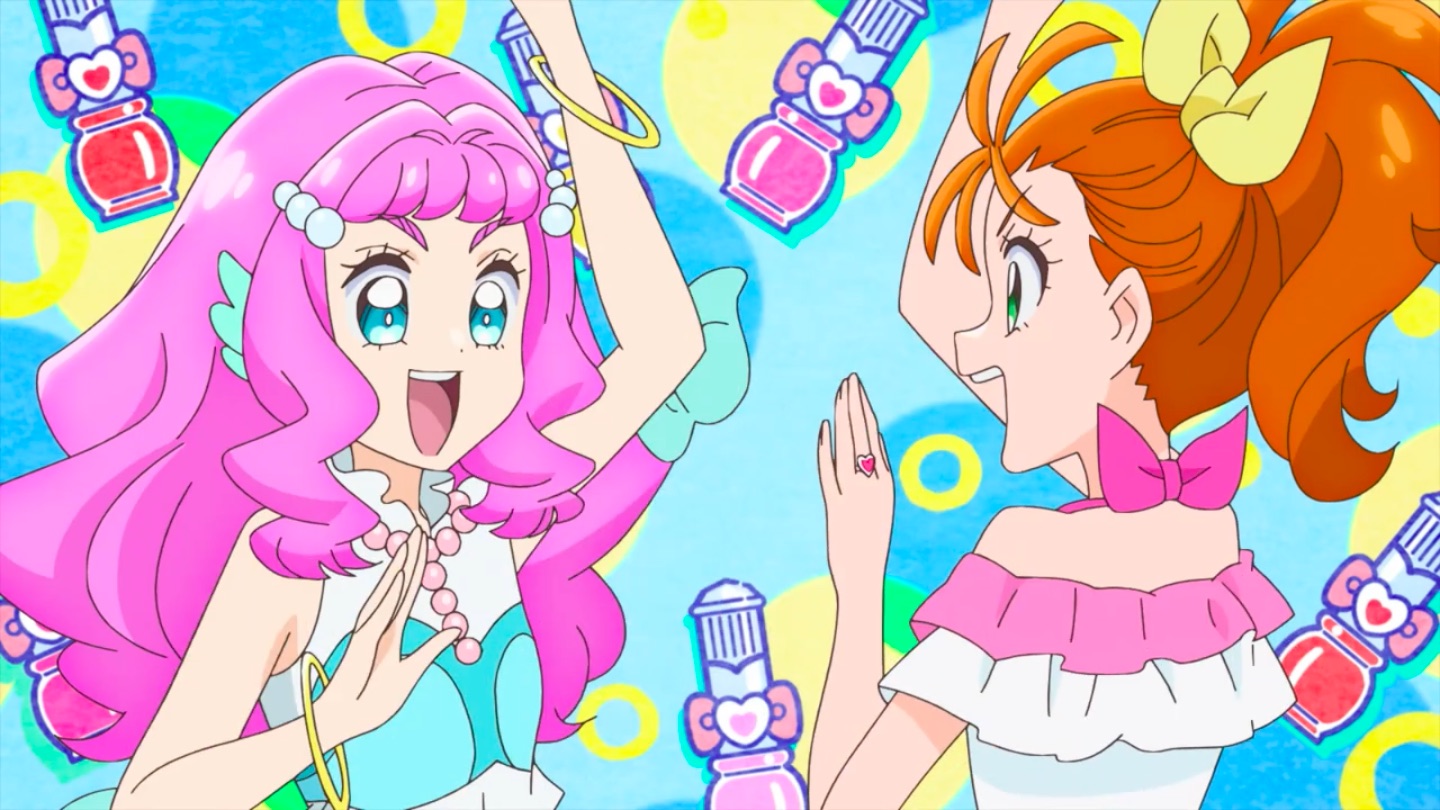
Tropical-Rouge! Precure is mostly episodic, so the series operates mostly as a showcase for its cast’s distinct personalities with some occasional Big Plot or Character Development moments that give a bit of forward momentum to the narrative. The primary motifs are makeup and tropical imagery, while the main theme is the struggle between finding the inner will to go and just do “stuff” and feeling the desire to put things off in ways that prevent people from resolving issues in their lives. Not all of it meshes together neatly (the makeup aspect can often feel tacked on), but the way each character navigates the motivation/delay dichotomy makes for a robust cast with complex feelings who have more dimensions to them than their frenetic presentation in the opening might suggest.
Characters and Motivations
Of the main cast, there are those who try to figure out what path they want to take but are having trouble figuring out what speaks to them, and there are those who know full well what their goals are but are prevented from moving forward.
The fashionable Suzumura Sango (Cure Coral) and Manatsu are examples of the former, with Sango gradually learning that not every dream needs to involve being in the spotlight. Manatsu, for her part, is one of the best executions of a “heroine without a concrete direction” I’ve seen in anime. It’s often easy for that kind of personality to feel flimsy or emphasize their generic “everyman” qualities, but the message conveyed by Manatsu is simple and profound: Even if you’re not sure what you want to be when you grow up, you should at least do what you want most in the moment. You remain motivated by staying true to yourself, and the learning process is a reward in itself.
Meanwhile, the athletic Takizawa Asuka (Cure Flamingo) and bookish Ichinose Minori (Cure Papaya) are great examples of those who feel their dreams may be last. As revealed later in the series, Asuka had a falling out with a friend that led her to stop pursuing tennis, and their soured relationship stems from a disagreement over how to react to an injustice done to you when your decision can affect others. Minori wants to be an author, but a bad experience with her old literature club has led her to put down her pen—and has her worried that she’s limited by her focus on reading about the world instead of experiencing it.
The stand-out character to me is Laura; I even picked her to be one of my best of 2021. Laura’s charming-yet-abrasive personality regularly steals the show in more ways than one, and I love how her identity as a mermaid isn’t forgotten or minimized over time. At the same time, you really get the sense that not all mermaids are like her, and that her confidence and ambition are wholly her own. And unlike the others, she understands perfectly well what her dream is (becoming queen) and will do all that she can to achieve it, but the lessons she learns about ambition and sacrifice end up being surprisingly profound and defy the notion that you should be forced to choose the path that causes the fewest waves (no pun intended).
And amidst all these different dynamics, what’s impressive is how Tropical-Rouge! animates its characters such that their general roles are emphasized while avoiding having them fall too neatly into their designated archetypes. Manatsu’s a whirlwind of expressiveness, but she isn’t just blindly optimistic, and this comes across in the fact that her reactions, both happy and sad, are nevertheless big. Minori, in contrast, is often not as outwardly emotional as the others. However, one gets the sense that she has a rich inner world, and that she isn’t stoic—she merely doesn’t react as powerfully on the surface. In this way, the characters feel multifaceted but also easy to understand even for younger viewers.
Best Precure “Villains” Ever?
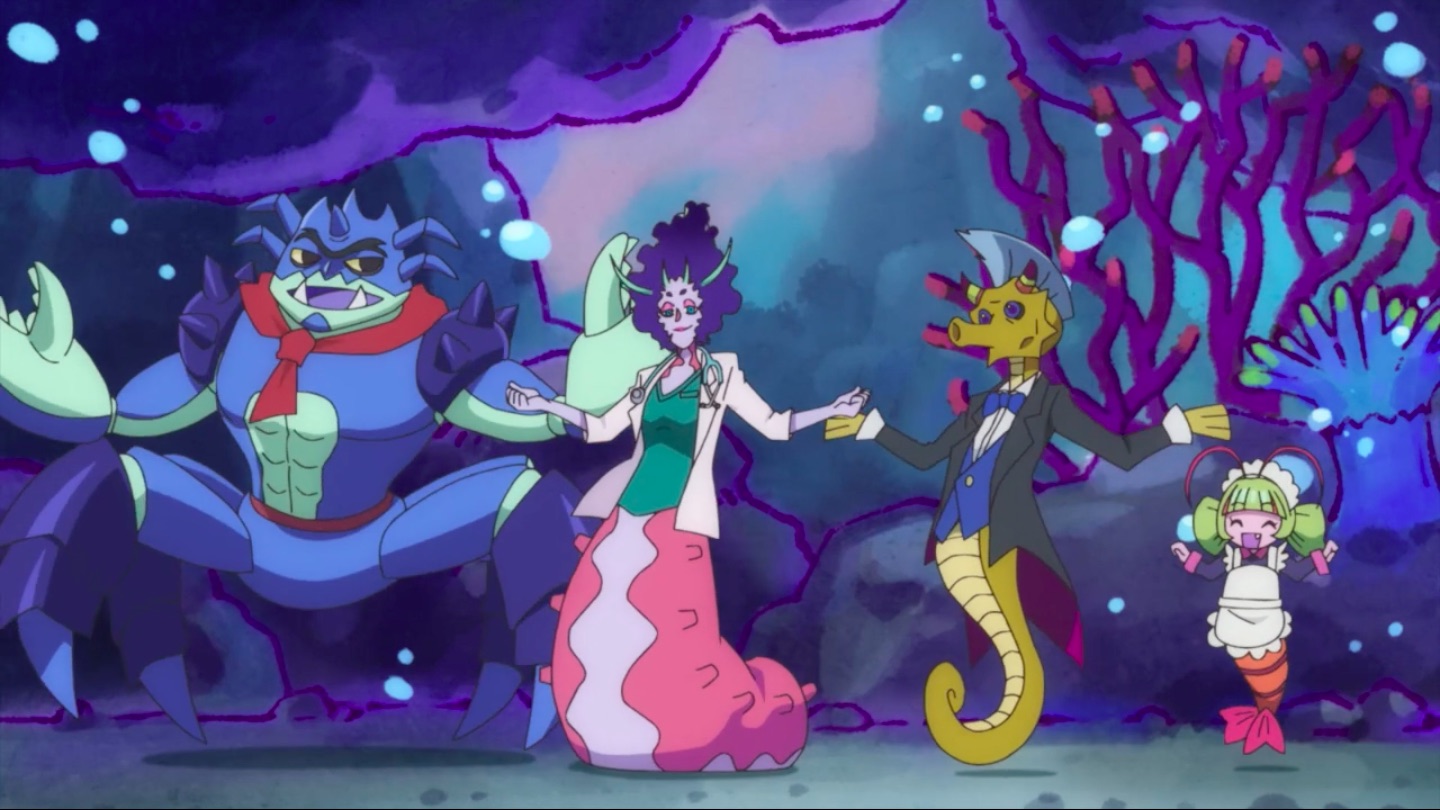
The strength of the cast even extends to the antagonists. The Witch of Delays’s henchmen—including Chongire the crab chef, Elda the (extremely adorable) shrimp maid, and Numeri the sea-cucumber doctor—are some of the most entertaining villains ever, and it’s mostly because they’re not that dedicated to their cause.
All of them come across as stealing Motivation Power from people because that’s part of their conditions for serving the Witch, and they’d really rather be doing what they were originally hired for—or in the case of Elda, play with dolls because she isn’t that into being a maid either. Seeing Chongi-re stop a fight because he needs to go check on something cooking really says it all, and what I love about that is it gives the bad guys a bit of depth while contributing to the generally lighthearted nature of Tropical-Rouge.
Final Thoughts
Tropical-Rouge! Precure is the kind of series whose unbridled energy can be both empowering and exhausting, like having a friend who’s eager to contact you anytime to see if you’re up for going out. They have a million possible plans, and you’re not sure where they lead, but one thing becomes clear as you try to find your way. That is, there are many possible paths to take—gentle ones, steep ones, straight ones, winding ones—and none are necessarily wrong as long as they encourage continued movement.
“Moving water never grows stale,” as the saying goes, but neither does the water need to be a rushing current. Between Manatsu, Laura, Sango, Akira, and Minori, viewers can witness a variety of different personalities and how they handle the unique challenges that face each of them—as well as how they can help one another along.
“Schoolgirls engaging in team tournaments” is a fairly specific yet common premise in manga that I really enjoy. Whether it’s a beloved series like Bamboo Blade or underdogs canceled early like Haru Polishand Hana Kaku, I’m always up for stories in this vein. On top of that, I’ve also found a casual interest in reading up on and researching martial arts in recent years. So when I saw Mabataki Yori Hayaku!! (Faster than a Blink!!), a manga about a girls’ sport karate club with cute art and solid action, it immediately felt like something right up my alley.
Kohanai Himari, a perpetually clumsy girl with a caring heart, is inspired to join her school’s karate club after a girl retrieves Hima’s umbrella from a guy who swiped it on a rainy day. Everyone—including Himari herself— thinks she’s a hopeless case, but the club’s veterans notice that there might be more to Himari than meets the eye. While she’s lacking in athleticism, knowledge, and experience, Himari has unusually sharp and perceptive vision—an X-factor that might turn her untapped potential into something more.
I’ve read four volumes so far, and one thing I really like about Mabataki Yori Hayaku is how slowly and gradually Himari improves, and how she isn’t just an overnight sensation. Not only are there girls physically more capable than she is, most are also more practiced and dedicated. She still feels very much like the underdog in all situations, and not the shounen hero kind who will pull out their secret technique and turn it all around. But the manga shows how her initial hesitant steps into the world of karate get larger and larger—as her enthusiasm grows, the confidence shows in her body.
The other characters also range from endearing to entertaining to compelling, whether it’s clubmates or rivals. The club president is a surprisingly rough-and-tumble sort who loves karate but has family issues with her sister. Another girl in the club, the razor-toothed and twin-tailed Izawa Sora, has both experience and a disdain for those who don’t take karate seriously, a feeling that we eventually learn hits all too close to home. A couple of characters from other schools see Himari’s latent potential, and they want to bring it out. No one seems boring so far, though one girl is the requisite “explain for the newbies” character, and there are times (especially when their hair is down) that it can become difficult to distinguish between characters. However, the characters are still generally expressive and memorable.
The artwork itself also goes a long way in conveying that character charm, especially when it comes to the portrayal of karate itself. There’s a dramatic sense of action that exaggerates just enough without feeling like it’s parodying sport karate, which is about landing light hits in a points-based system, unlike full-contact karate. The author, Funatsu Kazuki, actually has more experience drawing horny titles, though that largely doesn’t factor into the art in Mabataki Yori Hayaku!!—kind of tough when literally every girl is in a baggy gi. That said, the thirst does occasionally shine through, especially in the high kicks.
As for the decision to use sport karate instead of full-contact, it reminds me of the criticism sport karate can get for not being like a “real fight.” But this is actually depicted as an appealing quality, and it’s one of the reasons gentle Himari decides to take up karate in the first place. This is a series about competition, but no one wants to prove they’d win on the streets.
Whether Himari grows into a champion or not, following her journey is entertaining and uplifting. Now, if only this series doesn’t end too early.
Happy New Year (again!) to all who celebrate the lunar calendar and the Year of the T-T-T-T-Tiger.
As the Omicron variant (hopefully) peaks at varying times, I’m naturally spending a lot more time indoors—even more than usual. A new anime season has made things easier, with returning favorites like Attack on Titan, Demon Slayer, and Princess Connect! Re:Dive, as well as interesting new stuff like The Kodama’s Lazy Life and Tribe Nine. I’m also catching up on Ranking of Kings, which I’d heard such good things about, and there are still a few shows like Slow Loop I’m planning to check out.
I’m also delving into the world of Webtoons a bit more with Higashimura Akiko’s A Fake Affair (perfect for Valentine’s Day maybe) as I also read through her autobiographical series Blank Canvas. Her stuff is amazing, and I will almost always recommend Higashimura works. I’m relatively inexperienced when it comes to Webtoon stuff, so I’m open to suggestions.
My webspace is still down, and the administrators appear to be MIA. It’s kind of a pain, but this blog is old enough that trying to find every image I uploaded during my earlier years and switching to new hosting might not be feasible. If I get to the point where I’m supposed to renew, well, that’s another matter.
In the meantime, here are my biggest Patreon members, who help keep Ogiue Maniax going.
Every so often, I think about revamping my Patreon, as it’s been kind of stagnant in terms of approach for quite a few years now. One issue is that this is not my full-time job, and I don’t know how much I could actively devote to running it, so I’m hesitant to promise or aim for anything big. Would people be interested in Patreon-only content?
This month’s tweet highlights for Kio Shimoku are a little different: I’m doing them in chronological order rather than grouping them by subject. Tell me what you think!
January is also the month that Hashikko Ensemble ended. Check out my review!
Kio talks about what a big personal step it was for him to start a Twitter, and that he’s gradually learning how to use it. He thought he had to do it at some point, and thinks it was good timing in more than one sense.
Kio draws Kousei as a tiger man to celebrate the Year of the Tiger. B, the “I love Jin” superfan for the Hashikko Ensemble character asks if Kousei’s always been that buff (while also stating how Kousei’s cat-like qualities make the image work), to which Kio says he added a bit of fantasy to the drawing.
(Just as a warning, that Jin fan’s Twitter account is very NSFW. Their love of the character is serious business—as the Ogiue Maniax, I should know.)
Kio mentions finishing the manuscript for the final chapter of Hashikko Ensemble. When the Jin fan asks if the series got canceled, Kio says “more or less.” Elaborating a bit, he says he got the call to start wrapping it up in summer of 2020, but was given the opportunity to go past the School Festival arc and end on eight volumes total. For reference, the original Genshiken was nine.
Feeling some nostalgia from when he got this at Wonder Festival. A fan shows a similar arm from a model kit of theirs, and Kio replies that he was never able to get that one (the Mighty Beta).
Kio got a new scarf, and decided to draw what it looks like with Madarame as the model. He saw it being called an ascot scarf, but found that it didn’t match his Google searches. “New York scarf” seems to fit the bill better.
In light of the death of famed baseball manga artist Mizushima Shinji (Dokaben), Kio reminisces about growing up with Mizushima’s manga. In his home, there would always be assorted volumes of Dokaben around, and he would read them voraciously. In his estimation, a lot of baseball know-how for kids his generation came from reading Mizushima manga, and he especially enjoyed the series Dai Koshien. Kio offers a prayer at the end.
Kio wanted to reference an old chapter of Spotted Flower for his manuscript, and opened his old file, only to remember that he did it in the program Comic Studio. He’s switched over to Clip Studio Paint now, and seeing Comic Studio start up took him by surprise. He also notes that Asaka-sensei had a different hairstyle in this earlier chapter.
B the Jin fan has a question for Kio, asking how Kio managed to get a music note generator version of Sukima Switch’s “Kanade” because it doesn’t seem to be for sale. Kio responds that he uses a program called Score Maker Zero by KAWAI, which can also sing using a synthesized voice. Kio can’t read sheet music, so it’s very helpful for him.
Kio says that he generated these notes for “Kanade” himself, and asks if B lives nearby. B thanks him and doesn’t say anything about location, but he does mention going to the high school that Hashimoto Technical High School is based on. Kio is impressed.
As Kio was rearranging his desk in his room, his pet tortoise awoke (after barely moving during these winter months), and then stepped out of its box, ate some food, went outside, and then peed and pooped.
Kio made a Hashikko Ensemble Youtube channel, and uploaded a video of his tone generator version of “Kanade” by Sukima Switch for two male voices. It’s supposed to evoke the image of Akira and Jin singing together.
Kio made a Hashikko Ensemble Youtube channel, and uploaded a video of his tone generator version of “Kanade” by Sukima Switch for two male voices. It’s supposed to evoke the image of Akira and Jin singing together.
Some old NEO-GEO games from his college days that he found in a cardboard box. They include a bunch of Fatal Fury games, Samurai Sho-down, and even Far East of Eden.
48 chapters later, friends compete for the first time in this conclusion to Hashikko Ensemble.
Summary
It’s shortly after the start of the new school year at Hashimoto Tech, and all the clubs are presenting to recruit first-years. While the freshmen predictably look a little too rough-and-tumble to sing chorus/glee-style, Jin declares his confidence that they’ll find new members.
The chapter jumps back one month in time to White Day, where the last chapter left off. Akira and Jin both sing “Kanade” by Sukima Switch, but unlike the previous two times they’ve done this song together, this time they’re in a one-on-one “exhibition match.” For those familiar with Jin, especially Yumerun, it’s highly uncharacteristic to see Jin singing against someone rather than with them. At the end, with no clear victor, Jin proudly announces that he’s going to apply for music college just like Akira. Smiling, Jin calls Akira his rival, to which Akira happily agrees.
Then, Jin reciprocates Kozue’s romantic Valentine’s chocolate with a White Day chocolate of his own, and says he likes her too. Kozue is happy, but notices Yumerun staring daggers into her, leading to a bit of off-panel comedic fury.
The story then shifts forward again to the recruitment, and the group is going to be next on stage. Shion is nervous because all of her work to pass her classes has made her extremely competent at all that vocational work, but made her forget how to play. Kousei just says that she has to play decently, and it’ll be fine. The other members notice that they’ve gotten a bit closer, while Mai wishes she had the courage to give Akira chocolate.
As the announcer calls for them, Akira and the others come out to the audience as the official, full-fledged Chorus Club. The freshmen notice that there are an unusual number of delinquents in it—as well as girls—before the club starts their song.
Concluded or Canceled?
Having Hashikko Ensemble all end here feels both well-timed and abrupt, and the actual answer is that it’s a little bit of both. On Twitter, Kio Shimoku said that he was told to begin wrapping up at the start of the Culture Festival arc, and he was able to get enough time to finish that arc and wrap things up, ending the series at Volume 8. It’s not quite the same, but it reminds me a bit of what happened to the original Mobile Suit Gundam: It was slated to be a 52-episode series, only to be canceled early and revised to be a 39-episode show, but the staff managed to convince the higher-ups to at least make it 43.
That, in turn, makes me think of that old Genshiken anime episode preview where the characters talk about how so many great series got canceled early—like Gungal (Gundam) and Dizner (Layzner). Madarame turns it around and says that maybe it’s the opposite, and a series is only truly great if it gets canceled.
I feel that Hashikko Ensemble is a story that had plenty more room to grow, and I would have enjoyed seeing them at least get to the end of high school, if not further beyond that. Still, there was at least enough room to resolve things well enough, and the main thrust of the relationship between Akira and Jin ends at an interesting and uplifting point.
Unrequited or Unseen?
Of the many romantic threads in the series, It’s funny that Jin x Kozue was the only one that resulted in a definitive couple. Hashikko Ensemble largely didn’t dwell on their relationship, and a lot of their interactions didn’t even indirectly hint at the subject. This can be chalked up to their personalities—Kozue is not prone to flights of fancy, and oblivious Jin probably didn’t even think about romantic love at any point in his life until Kozue’s confession. Giving the least prominent romance closure but not the others feels like a troll of sorts, but one I welcome for it’s unexpectedness.
And even then, others are somewhat open-ended. Kousei and Shion appear to be closer, and that development is likely a direct response to Shion proving that she can successfully perform the physical labor tasks involved in passing her classes—and by extension someday live the kind of life Kousei envisions for himself. Mai regrets not confessing to Akira, but it’s not like there was any sort of rejection. In the world of the story, they’ve still got at least another couple of years. If this were a series that had people writing fanfiction about it, this would probably be a prime topic.
Learning to Be Selflessly Selfish
It feels appropriate that things would essentially boil back down to Akira and Jin. What’s fascinating is the journey they both took to get here.
The lesson Jin learns in the end is one that runs almost opposite of what is typical in anime and manga. Stories are often about someone discovering the power of teamwork, but what Jin needs in order to grow is the capacity to individually compete and outperform. His match against Akira isn’t about trying to win, but to see if he can actually use his singing as a tool to raise himself rather than support another. To go from “teammates” to “rivals” is, again, sort of counter to the standard narrative of manga about high school clubs.
As Akira states in his thoughts, he’s grateful for all he’s gained thanks to Jin. He originally was woefully self-conscious about the deep voice he suddenly developed in middle school, and it was something he sought to hide and minimize. But Jin encouraged him to go out of his comfort zone and embrace the bass in his voice, and here, Akira brings not only his gratitude but everything Jin ever taught him.
Poetically, Jin himself turns out to have been forced outside his comfort zone by Akira’s rapid progress, which is how we get to their relationship in the final chapter. Rather than the student becoming the master, the two recognize each other as true equals.
Songs
As stated, the last and only song for Chapter 48 is “Kanade” by Sukima Switch. As with every time “Kanade” appears, I’ve linked the official music video above, but there’s a very special treat this time as well.
Kio actually uploaded a version of “Kanade” that’s supposed to be an approximation of how the song would sound as a duet performed by Akira and Jin! According to his tweets, Kio stated that he made it himself because it didn’t exist, and that he accomplished it with the help of a couple music programs.
One thing I never really did with all these Hashikko Ensemble reviews over the years is provide analyses of the lyrics for the various songs used in the manga. This was partly for space and time reasons, but they often add meaning to each chapter, so it has been a bit of a glaring omission.
For this final chapter, I think it’s worth looking at “Kanade” and what the song is saying. The lyrics are largely about someone getting close to a person and guiding them, only to see them growing into an adult and changing. But even though things aren’t going to be the same, they’ll use their voice to protect the other.
How fitting for Akira and JIn, and perhaps the entirety of Hashikko Ensemble. So much of the series is about the characters finding support in one another, and watching them grow beyond what anyone expected.
Final Thoughts
The series is ending literally one month short of its fourth anniversary, and looking back, there are many questions about Hashikko Ensemble left unanswered and open to exploration. Mai, who ended up becoming my favorite character, never got enough time to fully shine, but I appreciate the fact that she ended up becoming a more prominent character towards the end. I also have to wonder if Jin’s mom was introduced during the Culture Festival because Kio knew the manga was set to finish. It feels somewhat like an appearance that resulted from things having to wrap up, and a longer series might have had her shadow (rather than her physical self) loom in the background for a greater amount of chapters. Would Jin ever learn that his mom thinks highly of his singing ability? I could see it going either way.
Hashikko Ensemble is notably different from pretty much all of Kio’s previous works in the way that there’s a concrete underlying goal for its cast. Whether it’s Genshiken or any of the series that have preceded or followed it, Kio’s stories have always been more about exploring character relationships in spaces devoid of strong ambition. Hashikko Ensemble is very much about the characters and how they connect with one another, but the theme of music and an in-story goal of forming a proper club (and a proper chorus) means that there’s a good deal of forward momentum that’s absent in Kio’s other manga—with the arguable exception of Kujibiki Unbalance. Seeing that relatively more “focused” Kio Shimoku manga makes me wonder how things would go if he took it a step further, maybe even into a more adventure-type work, or something like palace intrigue.
Akira, Jin, and the rest are so charming and authentic as characters. Their personalities contain both simplicities and complexities, and as they grow, they gain new dimensions while remaining true to their cores. It reminds me of past Kio series to be sure, but there’s a kind of enthusiasm that I think is indicative of the high school setting—a mark of youth and the potential that lies ahead. Yet, with all the adult figures in the background, there are characters even those who feel far removed from their younger days can relate to. The fact that Kio actually joined Twitter as this serialization was happening even lends an air of trying to communicate with an audience that’s both younger and older. It’s not TikTok, but maybe that’d be a step too far.
Hashikko Ensemble ends up feeling like it has the perspectives of both teens in the midst of their days and adults looking at youth in action, and that interaction has been a joy to read.
Encanto gave me an existential crisis, a first for a Disney film.
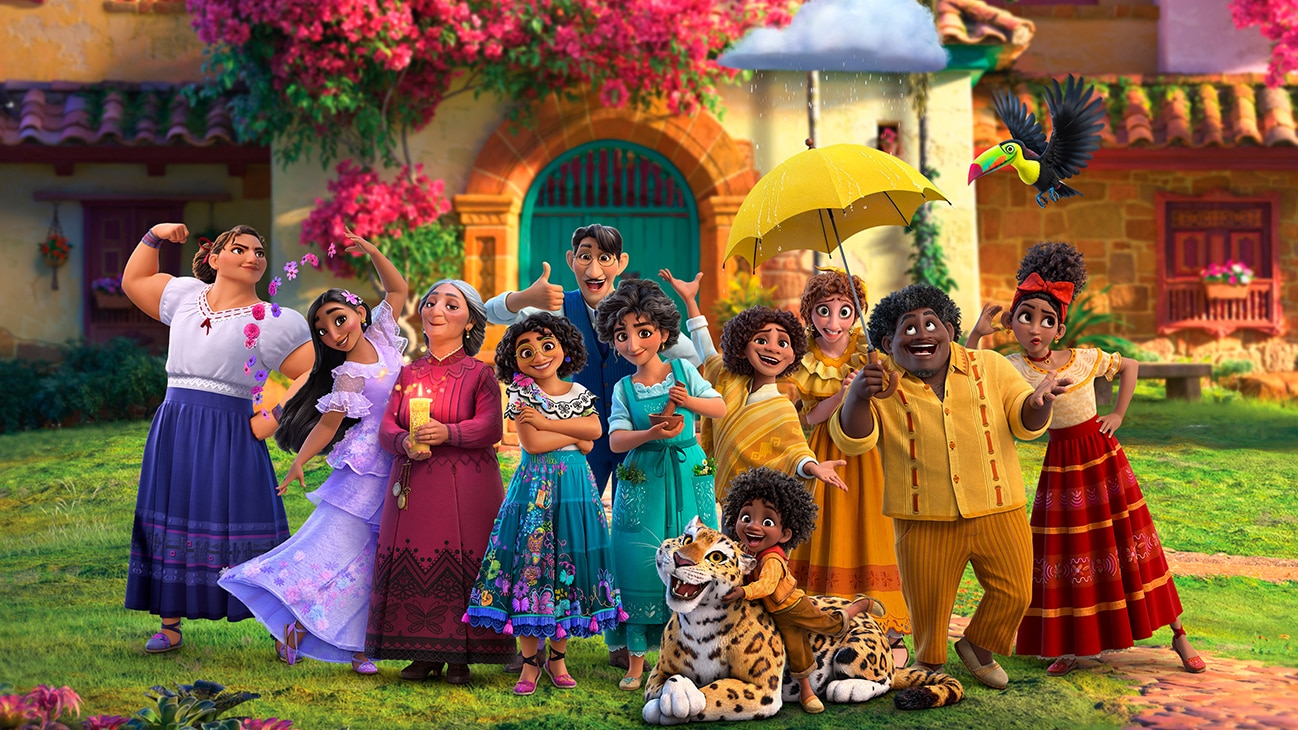
Its story centers around a family with supernatural powers called the Madrigals who have been the spiritual center of their town for generations. Each member of the Madrigals is bestowed a “gift” by a magic candle when they come of age, going all the way back to the family matriarch, Abuela (“Grandmother”), who received the candle through some unknown miracle while escaping from her hometown—and through the noble and tragic sacrifice of her beloved husband. The protagonist of the story is Mirabel, one of Abuela’s granddaughters, who is the only Madrigal to not have a gift. But when Mirabel begins to see what looks like a premonition about the destruction of their house and their magic, she takes action to solve the mystery, and in doing so, learns more about her family than she—or anyone else—ever knew.
The story of the “non-special” person who is surrounded by incredibly talented people and goes on to do big things doesn’t seem all that unique, and plenty of similar narratives never felt like a chest-wrenching experience to me. But the way in which the genuine mutual love between Mirabel and her family carries a vein of patronizing concern over Mirabel’s lack of conventional ability (by Madrigal standards) hits a little too close to home. It’s that complicated extra layer underpinning the interactions between Mirabel’s immediate and extended family, where a desire to help Mirabel ends up hurting by inadvertently reinforcing the idea that she’ll never be good enough, which makes the film wallop like a sack full of bricks.
But the film also has plenty of joyful highs, especially as Mirabel gradually breaks through the invisible barriers that obfuscate the state of her relatives’ emotional wellbeing. The emphasis on family is anything but shallow, and the simple yet profound truths about every character lend credence to the idea that the notion of the ideal and picturesque Madrigals is neither entirely true nor entirely false. The pressure to live up to greatness is heavy. And as for the eponymous uncle from the film’s hit song “We Don’t Talk About Bruno,” for me his story strikes closest to home.
What is also eminently relatable as someone who is descended from immigrants who had to basically start anew in an unfamiliar land is the story of the cultural gap that forms as each successive generation must deal with the challenges that lie ahead. Abuela’s priorities are the result of the circumstances that shaped her, and it makes me reflect on my own ancestors’ hardships—though not without pondering why the generational divide can be so very steep.
I don’t hate Encanto for making me feel all sorts of ways. Quite the opposite, in fact. It’s a powerful and authentic rollercoaster of emotions that reflect a family with a complex history, and I appreciate that a lot. I think it can sometimes be easy to think that those who have those feelings of inadequacy brought upon by familial pressure are alone, and it’s comforting to see such a story play out on so grand a stage.




 OGIUE MANIAX