Thoughts on Shinkalion, the Robot Anime Designed to Promote Bullet Trains

Shinkansen Henkei Robo Shinkalion is the most blatant advertisement in cartoon form that I’ve seen in a long time. It’s so upfront with its true purpose—promoting Japan Railways’ shinkansen (aka bullet train) system—that it’s right in the title. But I actually don’t mind the extreme shilling of Shinkalion all that much, and it’s for one simple reason: the Japanese train system, including its shinkansen, is astoundingly good.

The hero of Shinkalion is a young boy named Hayasugi Hayato, a total train otaku. Hayato discovers that his dad, ostensible a Japan Railways (JR) employee, works for a secret division dedicated to fending off monsters attacking Earth. In an emergency, Hayato becomes the pilot of a Shinkalion, a super-advanced train that can transform into a giant robo, and helps his dad in their fight against the forces of evil. Naturally, all Shinkalions are based on actual, real-world shinkansen trains. Incidentally, one recurring gag among Japanese Shinkalion viewers is referring to the series as a reverse-Evangelion because it’s about a young pilot who can’t wait to support his dad on his mission to fight off monstrous invaders.

It’s not just the Shinkalions themselves that are selling Japanese trains to the audience, as nearly everything about the anime talks up the country’s rail service. Hayato’s family name, Hayasugi, is a homophone for “way too fast” in Japanese—a reference to the high speeds of the shinkansen. His catchphrase, “I’m Hayasugi Hayato, the guy who always makes it on time!”, is based on the fact that the Japan rail system is famously on-schedule. Whereas other train systems around the world might see a 10-minute delay as “reasonable,” a five-minute difference is considered “extreme” in Japan. This is part of why train otaku exist, as it’s not just the mechanical aspects of the trains themselves that hold appeal. The precision and complexity allows enthusiasts to imagine riding from one part of Japan to another while planning the most perfectly efficient route possible.

While Shinkalion is indeed mainly about high-speed trains, it also advertises for a few other things. There’s tourism, the natural extension for a show about trains, with the ending theme showing various famous landmarks across Japan. While I haven’t researched it, I’m confident that all locales presented are reachable by shinkansen. Then there’s the Google product placement. Not only is one of the characters a popular Youtuber, they even use the term Youtube and show it off. The strangest promotion is the fact that the Vocaloid, Hatsune Miku (or a convenient alternate version of her), is a pilot in the show—and she’s actually voiced by the Hatsune Miku software! In this instance, it might be JR that’s benefiting from the association instead of the other way around. The result is that Shinkalion is a kind of marketing black matter. The characters would have to be plastered with logos like NASCAR racers for it to go any further.

I’ve taken bullet trains, and they’re an amazingly comfortable experience. I’ve taken regular trains, and they’re so reliable it makes coming back to New York City’s subway system almost feel like culture shock. If this fairly generic giant robot cartoon wants to sell me on shinkansen, it can do that all day long. That said, I would be wary of Shinkalion becoming propaganda for JR as this perfect entity, because there’s evidence that it isn’t. Glancing at reviews on Glassdoor, there are multiple negative comments about the companies being extremely conservative businesses and thus stifling its own growth. Perhaps the efficiency of the system comes at a (human) price.

Still, I can enjoy Shinkalion for what it is. This 500-yen Shinkalion model kit I bought is a testament to that.

Report: Retro Doujin Event Game Legend 28

On a recent trip to Japan, I attended a doujin event dedicated to retro games. It was an opportunity on my part to not only attend my first ever Japanese event dedicated solely to video games, but to see just what “retro” meant for a Japanese audience.

Held in the city of Kawaguchi, “Game Legend 28” saw a fairly packed attendance. I’m awful at estimating crowd sizes, but I’d say there was close to 200 people in attendance. The vendors there offered a diverse range of goods, even more than events I’d attended in the past, and it was primarily due to the subject matter. While the standard comics and essays were there in droves, one could also find CDs of video game music covered by amateur bands, entire archives of instruction manuals, people’s personally developed games, and even super-miniaturized (and playable!) versions of arcade and console titles. The last item seemed to be a trend, as more than one table offered them.

When it comes to trends one might not see at a US convention, I noticed that there was a great amount of love given to the PC-Engine (released in the US as the Turbo Grafx 16), and that certain popular Japanese meme characters such as Spelunker still held strong. I also met a woman who wore a Segata Sanshiro t-shirt and sold a photo journal of her time attending a Sonic fan event in Korea. Another dedicated herself to F-Zero, showing not only doujinshi but tiny F-Zero machine replicas as well.

It’s common to presume that doujinshi means “porn,” but I actually saw very few tables dedicated to 18+ material. Even then, one was selling a comic featuring a popular heroine from Tokimeki Memorial. In other words, even the smut was frequently retro.

Ultimately, I enjoyed Game Legend 28, and even bought a few things, including a Sega Smash Bros. parody doujinshi starring Alex Kidd. But the event also inadvertently curried favor with me when a small live brass band played a song from one of my favorite video game soundtracks ever. Following performances of the boss theme from R-Type and the ending theme to Chrono Trigger, they went straight into “Back to the Fire,” the Hydra stage music from Thunder Force III.

At that point, Game Legend 28 could do no wrong in my mind.

“Mogusa-san Fights Against Appetite” Concludes on a Body-Positive Note

Whether she’s a high school student discovering love or a college student striking it out on her own, the gluttonous Mogusa Minori is among my all-time favorite manga characters. Earlier this year, the story of a girl whose fondness for food transcends human limits had concluded in the fifth and final volume of Mogusa-san Fights Against Appetite. I’m not going to retread a lot of ground because my previous review still holds up, but I do want to elaborate upon the final message of the series and its overall positivity.

The main premise of Mogusa-san Fights Against Appetite is that Mogusa, whose appetite is virtually endless, is trying to transition into a more normal eating schedule. Where once she could be found snacking throughout the entire day, now she wants to limit herself to “only” three meals—albeit, every individual meal is itself more like three meals to the average person. Part of the comedy of this series is that, inevitably, Mogusa succumbs to her hunger pangs and has a rapturous encounter with whatever food’s in front of her. In the final volume of Mogusa-san Fights Against Appetite, however, this begins to increasingly weigh on her mind.

Seeing everyone, including her boyfriend Koguchi Torao, working hard to achieve their dreams and win their personal battles makes Mogusa very self-conscious about the fact that her own challenge—eating somewhat like a “normal” person—seems so frivolous compared to others’. But a trip back home and some advice from her mom helps Mogusa to see differently. She has matured, and in fact her gluttony has been of great benefit to her. She’s made great friends, met a wonderful boy who’s grown into a splendid man, and given her a wealth of experiences. Mogusa ultimately decides to embrace her food lust and aim to become a gourmet writer, sharing her passion for cuisines great and small with the world.

This conclusion resonates with me greatly, and not merely because I love to eat everything as well. When it comes to food shaming and body shaming, we live in a culture where outward physical appearance and behavior are often prioritized over one’s psychological well-being. The guilt Mogusa feels over eating is not uncommon, even if it’s exaggerated in her instance. Every so often, I see someone mention that a guy or a girl are disgustingly fat and that they need to get in shape, not taking into account the inner emotions of the person they’re speaking about. Some people are better off exercising and experiencing dramatic weight gain/loss because it can lead them to greater personal satisfaction and overall happiness. For others, however, the constant pressure to match a certain beauty standard means that being more physically fit can lead to mental turmoil. There’s no universal solution, even if at least some exercise is undoubtedly beneficial in e end.

This lesson isn’t limited to food. For as long as I’ve been a part of online communities, I’ve seen people twist themselves trying to hide what they deemed to be shameful hobbies or activities. They get so desperate in their desire to not be judged by their peers that it eats them up inside (Mogusa-san pun not intended), and I’ve tried to live my own life in defiance of that. Even if there might be problems that arise from one’s own interests, it shouldn’t be repressed to the point that it crushes people from within.

While Mogusa has an impossibly petite body given how much she eats, and she’s perpetually “anime-girl cute,” even she has to fight an image in her mind that she fails to live up to. In her case, it’s the yamato nadeshiko-style ideal Japanese woman archetype. She constantly imagines Koguchi, who’s living in the old Japanese capital of Kyoto, breaking up with Mogusa because she’s not traditionally beautiful enough. This also ties into how one of Mogusa’s greatest shames is the thunderous roar of her belly when she’s hungry. In Japan, many women find a growling stomach to be embarrassing, and Mogusa’s is capable of waking up sleeping animals. To see her overcome all that and be in a happier place fills me with joy.

Walking in Tokyo vs. Walking in NYC

As a life-long New Yorker, I am intimately familiar with living in a major metropolitan area where walking and mass transit are the norms. However, every time I’ve been to Japan, I’ve found myself at odds with Tokyo’s pedestrian traffic. Despite the fact that I should be accustomed to large crowds, something is perpetually off—as if I’m constantly on the verge of bumping into others.

What I’ve come to realize is that there’s an inherent difference in how New Yorkers and Tokyoites walk in large crowds, and in a certain sense they’re somewhat opposed to each other. So for those who are traveling to Tokyo and feel overwhelmed by all the people (and bikes!) seemingly on a collision course with you, this might prove useful.

One inherent difference is that people in New York City tend to walk on the right, while in Tokyo it’s common to walk on the left, but that doesn’t explain everything. Imagine an ideal situation where pedestrian traffic is flowing through like a two-way street, with an invisible center line roughly dividing the two groups traveling in opposite directions. Take two people walking on opposite sides towards each other. What happens?

NYC-style walking

In New York City, the common tendency is to avoid the center line as much as possible. The two people will see someone headed their way, and will begin to drift away from that center line to avoid accidentally bumping into each other. In my biased perspective, I consider this “normal.” Moreover, while I don’t think NYC is as rough and unforgiving as is commonly portrayed on TV and in movies, you really don’t want to inadvertently start a fight.

Tokyo-style walking

In Tokyo, however, there’s a tendency to gravitate towards that center line as much as possible. If there’s something in the way, they’ll snake around it, hugging the “curve” so that they can get back towards the middle. I’m not really sure why, though I’ve noticed that people in Tokyo take less issue with accidentally crashing into someone. My (unsubstantiated) theory is that people in Tokyo develop a tendency to head towards their destination (e.g. the train platform they need at a station) in as direct a path as they can manage, and that means staying along the center line instead of deviating from it.

Another possibility is that bicycles are allowed on sidewalks in Tokyo but not in NYC, so it might be part of the natural way to avoid bikes. Whatever the reason, walking in Tokyo and not being aware of this can make it seem like folks are constantly making a beeline for you. You’ll think you’re gonna run headlong into someone, only for them to stop at the last second and make a sharp turn to avoid you.

This post has been based largely on my own experience, as well as from talking to people who have been to or live in Tokyo. If you’ve had a different impression of pedestrian traffic there, feel free to chime in.

Back from the Future: Ogiue Maniax Status Update for June 2018

I’m back after an exciting honeymoon in Tokyo. It was a grand ol’ time full of food and nerdery, and also spending way too much money on otaku goods. For example, I actually bought all of Heartcatch Precure! on DVD—albeit at a huge discount. (I promise I didn’t just do Precure-related things, honest.)

I’m happy to answer (most) questions about staying in Japan to the best of my ability, so send ’em in!

But before that, I’d like to thank my sponsors on Patreon and Ko-fi.

A big thank you too…

General:

Johnny Trovato

Ko Ransom

Alex

Diogo Prado

Sue Hopkins fans:

Serxeid

Hato Kenjirou fans:

Elizabeth

Yajima Mirei fans:

Machi-Kurada

I still had some posts go up even while I was away, so here are my favorite posts from May:

Darling in the Franxx and Choice in a Sexual Dystopia

Some people think the show is greatness itself, while others think it’s hyper trash. Here are some of my thoughts.

Project Z Revived! “Hakai-oh – Gaogaigar vs. Betterman Part 1” Novel Review

My review of the latest Gaogaigar light novel, which is actually the long-awaited sequel to Gaogaigar Final!

“Flukes”: Competitive Rigor vs. Sustainability in Esports

How important is grabbing an audience vs. absolute competitive integrity in esports?

Hashikko Ensemble

Chapter 4 continues the kooky sense of almost-camaraderie.

Patreon-Sponsored

Gamblers’ Paradise: “Uma Musume: Pretty Derby”

My feelings on the new horse girl-themed anime and the expected franchise surrounding it.

Closing

As you might expect, I plan to have a ton of blog posts concerning my trip to Japan. It won’t be a full on travelogue, but I plan to have reviews of doujin events, reviews of series I picked up, and more. Who knows? Maybe it’ll even bleed into July!

That Distant Roar: Hashikko Ensemble, Chapter 4

As I continue to read this manga, I continue to find it hard to predict. That’s all part of the fun, though. There’s also much to be admired about the characters, especially Jin—even if he’s a bit lacking in social tact.

By the way, I was lucky enough to be in Japan when this new issue of Monthly Afternoon came out! That’s why the images are photos this month, instead of digital screenshots.

Summary

Jin’s found the perfect place for Akira to practice projecting his voice, and it’s an open stairwell at school with plenty of foot traffic. Acoustically, the location is ideal, and Jin does his best to break down how singing works. But Akira’s easily embarrassed, so they only get so far.

Jin’s still got his eye on the prize, though, and needs at least three more members to make the Chorus Club a reality. To that end, he has his sights on two classmates: Hanyama (that jokester son of a Buddhist priest), and the burly, delinquent-looking Orihara. Meanwhile, Orihara himself is getting into fights after getting accosted by a classmate. During this incident, Orihara’s heard uttering something cryptic: “I can’t hear it, but I can.”

Jin might be intrigued by Orihara’s statement, but it seems the rugby club also has their eyes set on him. Can the nascent Chorus Club get to Orihara before they can?

What’s in a Name?

Up to this point, I didn’t quite realize why the series is called Hashikko Ensemble. Turns out it was pretty much staring at me in the face the whole time! Much like how Genshiken is short for Gendai Shikaku Bunka Kenkyuukai (“The Society for the Study of Modern Visual Culture”), the full title of this manga is Hashikko Ensemble: Hashimoto Kougyou Koukou Gasshuubu, or “Hashimoto Technical High School Chorus/Ensemble Club.” So that clears up one mystery!

Another interesting tidbit I noticed is that the kanji for “Hashimoto” (端本) can also be pronounced as hahen, which means “incomplete.” Given how the characters are currently without a full club, I wonder if this is intentional.

Arts and Sciences

While I mentioned the technical high school setting of Hashikko Ensemble as an interesting backdrop for this manga’s narrative, it’s with this chapter that the juxtaposition of arts (music) and science (technical engineering) comes into the forefront. I think this is what makes Jin such a fascinating character. He takes a scientific approach to art, but his passion is anything but robotic.

Jin gives two different explanations for how voices work: a human one, and a technical one. The first one is “breath, vibration, and resonance.” The second one is “compression, oscillation, reverberation.” Akira seems to find something of an answer, but it’s not clear what did the trick.

A few years ago, I took some classes to help with speaking in public, and one of the lessons I learned was making “SHHH” sounds like I’m trying to shoot something down with my breath. In this chapter, Jin advises something similar to Akira as a way to train projecting his voice. I knew already that Kio does research for this series—it’s evident in the content—but it’s nice on a personal level seeing it line up with my own life experiences.

Orihara’s Secret

Orihara’s line has me curious too, but I’m just as curious as to why Jin responded to it so positively. Just what is it that Jin sees in him?

With only a layman’s understanding of sound and music, I can only guess at what the answer is. Perhaps Orihara has excellent hearing, and can detect sounds that most cannot. The beginning of the chapter features a lesson on how lower sounds remain longer, so maybe Orihara can hear those really low tones—the kind that Akira can produce.

What About the Girls?

Two female characters are featured in this chapter. Interestingly, both are in the same woodworking class as Orihara, and have scenes that involve him either directly or indirectly.

Kurata was introduced in the previous chapter, using more strength than necessary to saw through some wood, and we see in Chapter 4 that this is a persistent characteristic. She’s like a bull in a china shop, lacking in grace and trying to make up for it with energy and power. She’s shown right before Orihara, who’s much more in control even with his enormous strength, making a comparison between what Orihara does right and Kurata does wrong all the more noticeable.

The other girl is Hasegawa, who nonchalantly asks Orihara how she can complete the woodworking assignment in class more smoothly. As the other characters note, her lack of fear is impressive. I have to wonder if either of them will join the Chorus Club, especially given their proximity to the main cast at this point.

Songs

No songs again this month, only a lot of shouting, “AH!”

[Insert Akira Tozawa chants here]

Final Thoughts

Kurata’s only appeared twice, but I’m already enjoying her character. There’s something about a spaz who gets way too pumped that speaks to me. Both her and Orihara bring a lot of facial expressions that weren’t common in Genshiken, so it’s nice to see Kio’s expressive range in his artwork.

The Respectful Pervert: The New Ogler Archetype in Anime and Manga

Miroku, pervert monk from Inuyasha

In today’s environment, the “pervert with a heart of gold” anime and manga archetype has not aged well. While characters such as Great Teacher Onizuka, Miroku from Inuyasha, and Saeba Ryo (City Hunter) are ultimately presented as those who will fight for what’s right, their willingness to cop a feel or lift a skirt becomes less and less charming in consider the current age. They’re ultimately fictional characters, so they can afford to be flawed, but one person’s “acceptable quirk” is another’s deal breaker. They’re not automatically villains or abusers, but they can be increasing difficult to rally behind—and I say this knowing that Ryo, for instance, is classically quite popular with female readers. But I don’t think the solution is to pretend perverts don’t exist, or to portray them negatively, and in fact, I find that anime and manga are slowly moving towards a new type of ogler for the current age.

Before continuing, I understand that my discussion of the “well-meaning pervert” is rather heteronormative, owing to the fact that these characters are derived from a tradition of hyper-straight male protagonists. When you change the dynamics of gender and gender representation, the topic enters a whole new dimension. I’m open to thinking more in that direction, but it goes beyond the scope of this post.

The “respectful pervert” actively acknowledges his love of women’s bodies, but doesn’t step over crucial boundaries—a devoted believer in the mantra “look but don’t touch.” From this cloth, two recent and prominent examples are Space Dandy from Space Dandy and Sword from GARO: Vanishing Line.

Space Dandy with Boobies waitresses

Sword from GARO: Vanishing Line, paying respects to large breasts

Both will regularly express their love of breasts, but will remain more or less cordial. Dandy mostly indulges in his fascinations at “Boobies,” a restaurant whose purpose is to allow and encourage ogling, without physical contact. Sword’s tendency to offer a prayer of appreciation for nice breasts might potentially draw unwanted attention, but his overall actions do not encroach on women’s personal space.

This new-type pervert might not be to everyone’s tastes, but I find that his significance stands out more when comparing him to another attempt to dial down the pervert archetype: the passive harem protagonist. That archetype is perpetually in a position of convenience to have things happen to him as a way to resolve the character of responsibility. A lack of direct intent, e.g. “Oh no, I tripped fell into her breeeaaasts!!!” means self-control as an issue is ignored. In contrast, the respectful pervert is active in his expressions of sexual desire, but ultimately shows restraint. Power remains in the women’s control, without pushing the onus of responsibility onto them.

What do you think of the respectful pervert? Is it one step forward, two steps back? Is it a character you can get behind? I’m curious to hear opinions from anyone and everyone.

Gamblers’ Paradise: “Uma Musume: Pretty Derby”

My Little Pony: Friendship is Magic may be the most prominent cartoon about horse girls, but Uma Musume: Pretty Derby is bringing a different angle. Instead of wide-eyed ponies, it’s human-horse hybrids in the vein of anime catgirls. Instead of a children’s show reminiscent of magical girl shows, it’s a strange hybrid sports/idol anime focused on racing and dancing. As a result, Uma Musume: Pretty Derby veers closer to Girls und Panzer than Twilight Sparkle and friends.

Having watched the first two episodes, Uma Musume: Pretty Derby succeeds in being a sports show. It’s got an underdog main heroine with untapped potential, plenty of characters (perhaps too many) with a variety of personalities and competitive styles, and a sense of forward progress while keeping intrigue strong. For example, just what is up with protagonist Special Week’s adopted mother? She gives me a “mom from Aikatsu!” vibe; maybe that’s not a coincidence given the idol aspect of Uma Musume.

Taken on its own, the anime seems like a reliably strong show. However, much like Girls und Panzer, the point of potential concern is what happens when one looks beyond the cartoon itself and into what it’s supposed to advertise and accomplish. For Girls und Panzer, it’s possible glorification of the military. For Uma Musume, it’s gambling.

Uma Musume is a moefied version of horseracing, a popular betting sport. But it’s also part of a multimedia franchise from mobile games juggernaut Cygames, makers of Granblue Fantasy. When it comes to lootbox/gacha systems that drive players to empty their pockets, Granblue Fantasy is one of the grandmasters, and the chase for those slim 1% chances for ultra-rares is especially enticing for those vulnerable to gambling addiction. And yes, there’s an Uma Musume: Pretty Derby mobile game on the way.

So essentially, there’s a dangerous final form of Uma Musume that could become a reality someday. This monstrous version would involve going to the racetrack to watch and bet on the ponies while also playing Uma Musume and trying to get the right gacha gifts for your favorite horse girls. To use an ancient internet joke, they put a slot machine into your betting, so you can gamble while you gamble. It’s not gotten to this stage as of yet, but I have my eye out to see where Uma Musume will go.

This post was sponsored by Johnny Trovato. If you’re interested in submitting topics for the blog, or just like my writing and want to support Ogiue Maniax, check out my Patreon.

Darling in the Franxx and Choice in a Sexual Dystopia

Amidst shipping wars and attention given to its fanservice, hearing about the anime Darling in the Franxx secondhand gives the impression that it’s light on substance at best and alarmingly conservative in its sexual values at worst. Yet the more I watch it, the more I’m convinced that these descriptions do not accurately convey what the show has to offer. Instead, what I see is an anime that explores political discourse on what it means to be in a relationship, focusing on questions of equality, agency, and defiance.

WARNING: Spoilers for Darling in the Franx

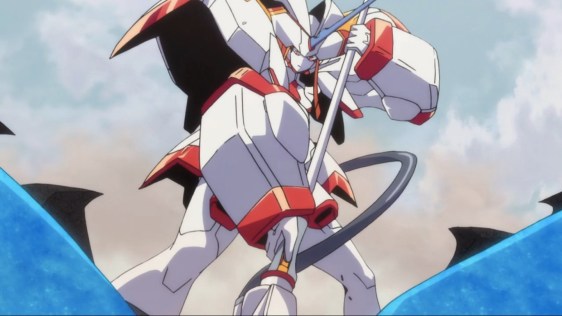
Darling in the Franxx takes place in a science fictional world where kids are artificially created and trained to use giant robots called “Franxx” in order to fight massive monsters known as Klaxosaurs. They live in a world that separates adults from children, has those same adults revered like virtual gods, and directs sexual energy towards combat. Those teens are put into not-so-subtle male-female pairings called “stamens and pistils,” who then enter a cockpit that has them basically pantomiming doggy-style sex without even knowing what it means to kiss. While these arrangements can seem like an excuse for some highly suggestive imagery, it’s implied throughout the series (if not stated outright) that this is an intentionally exploitative design within the context of their world.

The fact that their society is partly based on adults exploiting children, stunting and controlling their hormones, and making it seem like a favor is already a kind of political message. However, plenty of anime both deep and shallow have done the same. “Kids vs. adults” is a classic trope, and even the biggest names in mecha (e.g. Evangelion and Gundam) feature them to some extent.

This might appear to be an admonishment of “frivolous” romance. However, it’s quite the opposite. I find that the romances are of central importance to the complexity of Darling in the Franxx. The relationships, how they’re presented and what they represent, are a direct window into the shows’ political themes and messages. Those themes and messages, in turn, are actually supportive of more liberal views on gender and sexuality than assumed at first glance.

Futoshi and Kokoro: Relationship Betrayal or Relationship Freedom?

One of the more controversial episodes sees the character Futoshi pledge his devotion to Kokoro. After weakly promising to go along with Futoshi’s pledge to be his “partner [i.e. co-pilot] forever,” Kokoro later decides to try and switch partners to Mitsuru when the option becomes available—an implicit rejection of Futoshi. This was the cause of a great deal of consternation, with speculation that the show was trying to cheaply indulge in the NTR [cuckolding] fetish found in Japanese otaku culture.

However, what I think frames the importance of Kokoro’s actions is the fact that the stamen-pistil pairings are assigned. Yes, Futoshi was absolutely infatuated and Kokoro agreed to his pledge, but it was also established that Kokoro’s natural tendency is to oblige others and not speak her mind. This is what attracts her to the surly Mitsuru in the first place. He’s got a huge chip on his shoulder and isn’t afraid to let it be known—something Kokoro finds incredibly difficult. Rather than this being some “betrayal” of Futoshi, I find it better viewed as Kokoro finally taking initiative in her life and finding someone in Mitsuru who complements her flaws and benefits from her strengths. Kokoro breaks down the walls Mitsuru has established to hide his vulnerability, while Mitsuru’s attitude inspires Kokoro to prioritize her own feelings.

Certain elements of the series, such as the male-dominant sexual imagery of the cockpits, and the fact that other Franxx pilots outside of the core group tend to be emotionless, imply a world that thrives on power imbalances and sex without joy. While this could be considered the message of the show, romantic developments based on the need to find a true equal says otherwise.

Hiro and Zero Two: Equal Partners Against the World

Nowhere is the emphasis on equality more evident than in the main love triangle between protagonist Hiro, his childhood friend Ichigo, and the part-Klaxosaur pilot Zero Two. At first, it comes across as harem-esque wish fulfillment starring a guy who seems like he stepped out of every generic light novel ever. There’s a vague sense that the girls are in love with him because he’s ambiguously “nice,” in the most boring way possible. So why is Hiro so much more attracted to Zero Two?

It can seem like mere exoticism, or the series deciding that one girl has to win, but there are moments throughout the series that suggest a vital difference between how the two girls relate to Hiro. Ichigo worships Hiro, and places him on a pedestal. Zero Two, however, inspires Hiro to push forward and to try and overcome his limits. When we find out their lost history in Episode 14—that the two actually met when they were children and had their memories altered by the adults as a result—it’s not just about Zero Two being “another childhood friend.” Instead, Hiro’s attempt to rescue her and escape together is the ultimate act of a child who constantly questions the status quo of a rigid society. Similarly, Hiro is the catalyst that allows Zero Two to experience the outside world, and to see herself as more than a monster. There is a sense of equality and a constant desire to push one another forward that is present when Hiro and Zero Two are together—one that doesn’t exist with Hiro and Ichigo.

Surprisingly, Hiro himself becomes an increasingly fascinating character as the series continues, being revealed as not really the goody two-shoes his initial impression conveys. That childhood flashback to meeting Zero Two highlights the fact that he was actually a problem child for a society that encourages kids to stay ignorant and obedient. A young Hiro refuses to take “you’re not supposed to know” as an answer, and is punished for it by having his memories erased and being forced into a more complacent personality. When he meets Zero Two again for the first time years later (in Episode 1), that puts him on the path towards his naturally inquisitive self that dares to challenge society’s assumptions.

Gender Conformity or Gender Rebellion?

Accepting that the romances are more than skin-deep, the question then becomes: what exactly is the message conveyed through these relationships? A recent episode has garnered some backlash because it’s being seen as reinforcing gender conformity and a heteronormative worldview. However, based on other information about the world in Darling in the Franxx, I feel that it’s not so simple.

In Episode 17, Papa’s personal elite squadron, the Nines, move in with the main characters. Once there, they discover that Kokoro has discovered information on pregnancy and childbirth, which is forbidden in their world. The leader of the Nines, named Nine Alpha, talks about how traditional pregnancy and childbirth are unnecessary because humans have evolved past it, and that to go back to the old ways would be to restore rigid gender roles and identities.

An antagonistic character is making that point, which potentially makes it look like it’s being presented as the “wrong choice.” But if anything, Darling in the Franxx features a world where all sexuality regardless of gender, sex, or sexual orientation is taboo, so it’s not simply a matter of “proper gender roles” being enforced in the narrative.

Consider the fact that only one of the characters, Kokoro, is expressing any desire for a traditional pregnancy. Consider also that the characters literally have no idea how they came into the world, believing that the “Big Brother”-esque Papa “made them” in some mysterious fashion. It’s one thing if they knew how they were birthed, but they’re not even allowed to know in the first place. Moreover, a previous episode features one of the other pilots, Zorome, meeting an adult who is heavily implied to be his biological mother—which means the talk about having evolved past the need for traditional childbirth might very well be a lie. To me, it looks like the issue isn’t that Papa is cruel for preventing humans from being able to have sex and reproduce and fulfill established gender roles, but that he’s suppressed all education about the topic.

Adults have their organs removed and their puberty somehow controlled or skipped over. Franxx pilots are allowed to keep their reproductive organs solely because they’re the key to piloting their robots, and they die early as a result. Sex and sexual desire are made a tool of the government regardless of the people and who they’re attracted to.

Franxx piloting becomes the closest thing people have to being able to engage in physical relationships, and even that is not so cut and dry. One of the other pilots, Ikuno, is clearly a lesbian or at the very least bisexual, but the world doesn’t even acknowledge her state as a possibility. When she suggests an attempt at a pistil-pistil combination for piloting, it doesn’t work—as if the state-ordained sex substitute known as the Franxx cannot allow it. Even then, she comes to Kokoro’s aid, slapping Nine Alpha for verbally attacking Kokoro’s newfound values. Prior to this, Ikuno can be seen bristling at the idea that gender distinctions could become more dominant if society reverted back to ancient times, but she still comes to Kokoro’s defense. I believe this is derived from the commonality between Kokoro’s wish for heterosexual procreation and Ikuno’s own emotional defiance of heteronormativity, which is that both wish to be free of a world that denies their feelings.

Even the main couple itself, Hiro and Zero Two, is a subtle rebellion against rigid gender roles. If the ability to have children is what defines women according to the story, then that would invalidate Zero Two, who mentions in Episode 17 that it is physically impossible for her. Yet her romance is the paramount love story of Darling in the Franxx. While she expresses envy at the fact that the humans can potentially have children, it’s more to do with them having a choice in the first place.

More Questions

One curiosity the series has yet to address is why the Nines seem to be capable of piloting in formations counter to the stamen-pistil pairing. Nine Alpha, for example, reads as male, but takes the bent-over position in the cockpit normally reserved for girls. Are the Nines, in part or in whole, actually outside of the male-female dichotomy in terms of sex and/or gender? Are their Franxx units somehow different from the rest? These unanswered questions further deepen the story and its potential avenues.

Conclusion: Emotional Depth and Political Rebellion

Darling in the Franxx starts off with many signs that it’s a shallow endeavor centered around boring wish fulfillment, shock value, and an excuse for sex and violence. But the show carries a lot of themes I would dare say are important to where we currently are in society. Its characters are extremely emotional teenagers, the classic archetype of anime, but their actions within the context of their world and the restrictions that world places on their bodies and minds gives renewed importance to everything they do. The romance of Darling in the Franxx is both a window into the politics of society and the importance of equality in emotional and loving relationships that transcend the strict hierarchies and roles given to them by a world of adults that seeks to mercilessly exploit its children. Rather than fighting for sexual conformity, the characters in Darling in the Franxx fight for sexual freedom and the freedom to choose their bodies’ futures, whether they know it or not.

Given that the series is yet to conclude, there’s a definite chance my interpretation is off the mark. If that time comes, I will be happy to reassess my analysis, and to see what I got right and what I got wrong.

“Flukes”: Competitive Rigor vs. Sustainability in Esports

The question of whether or not to stratify different groups of competitors occurs in any competitive setting, but it tends to be ground zero for debate in gaming even more than in traditional sports or fields such as Chess. For this reason, a recent tweet by veteran League of Legends and Overwatch commentator MonteCristo lamenting the lack of “pros-only” tournaments for fighting games garnered a significant backlash.

There’s one core reason for the negative response to MonteCristo: those who consider themselves part of the fighting game community tend to consider the ability for “gods” and “mortals” to meet in open competition—and for god slayers to emerge at any moment—as one of the strengths of fighting games. In particular, people latched onto the use of the word “flukes” as evidence of the esports works being afraid of “true competition.” If esports could be compared to tennis, then to the FGC a world of invitationals (and nothing else) would be akin to the pre-open era of tennis—when pros and amateurs were not allowed to compete against each other at major tournaments.

However, having followed esports for over ten years now, I’ve noticed that this seeming incongruity in values stems from a difference in what aspects of competitive gaming are prioritized. Is it about competition and camaraderie, or competition and sustainability? While the two are not wholly incompatible, the esports side has long expressed a desire for recognition, expansion into the mainstream, and eventually a reverence similar (but not necessarily identical) to traditional sports. With respect to this, figures in esports have emphasized the importance of “narratives,” and seeing how big a deal they are is very telling as to how esports tends to try and achieve sustainability.

In 2010, StarCraft II ushered in a new era in esports, and tournament circuits such as GOM Starcraft League in Korea and the US-based Major League Gaming were established to give players a chance at competition. While there were many differences in their formats—GSL participants played only a handful of matches per day over the course of weeks and months, while MLG pitted hundreds of players against each over a single weekend—both came to the table early on with a certain goal in mind: to create stars.

GSL created a distinction between the cream of the crop (Code S) and the almost-greats (Code A), where players from the latter could earn the right to be promoted to the former. However, in the first few incarnations of the GSL, it was purposely made difficult for players to fall out of Code S. Essentially, the players who performed the worst in Code S had to compete against the best of Code A in a potential changing of the guard. The number of players who dropped down to these “Up and Down Matches” was restricted, and the Code S players could still end up defeating the hopefuls from Code A and send them back down. The reason? To make sure that recognizable faces remained on camera so they could establish fanbases, and by extension garner a sense of celebrity—to be people that fans and players could remember and look up to.

This was also the reasoning behind MLG‘s seeding system for its multi-tournament season, which saw players who did well at earlier tournaments get byes into much, much later stages of later league tournaments. Going on a tear in your first tournament could pay off down the line. If a player earned a top-32 spot in one tournament, they could keep getting place into a high spot for the next, and then play just well enough to not tank out, it meant a stable spot for increased visibility.

Eventually, both GSL and MLG revised their formats to encourage less ossification of brackets and more chances for rising stars to make a name, but that still doesn’t erase the fact that their initial versions tried to create a delineation between the “Pros” and the “Joes.” Central to all of this was the idea that “good narratives draw viewers in.” What better way to encourage a good narrative than to have a consistent cast of “characters” for the audience to know and root for?

Examples of the benefits that heroes and heroic narratives provide to competition are numerous, but one that stands out in particular is the story of basketball legend Larry Bird. At the time, basketball was seen in the US as largely a “black sport,” and thus had a relatively small white audience. Larry Bird helped to change that, as could be seen from one nickname of his: the Great White Hope. Was this racist? Yes, to a degree. Did it also help pull basketball into the mainstream? Yes it did.

(Is there a comparison to be made between this example and the fact that esports vs. FGC exists along something of a similar divide in terms of racial demographics? Also yes, but that discussion will be for another time.)

Narratives do not have to be manufactured whole-cloth. Seeing an underdog defeat a champion, or watching a winner cement his place with an undefeated streak happens just from competition existing. However, in a world where visual presentation can often be confusing to those unfamiliar, presenting these bouts as being between humans with wants and desires and emotions (especially simple ones like anger) can bridge that gap. So it’s no wonder why esports organizations frequently try to control it through player perception, delineations between pros and amateurs, and so on. But one question that arises is, does setting things up so conveniently end up compromising the integrity of competition? The answer is that it can, but it largely depends on severity.

Take professional wrestling, which has been predetermined for many decades precisely because the promoters understood that most audience members cared more when the wrestlers had charisma. Famously, when a bland 1940s wrestler named George Wagner dyed his hair blond and became the arrogant and effete “Gorgeous George,” his antagonistic demeanor drew audiences in droves to see him in the hopes that they’d get to witness George getting destroyed. Pro wrestling isn’t a true athletic competition precisely because it becomes easier to control the narrative and get viewers invested.

But even in a legitimate sport like mixed martial arts, the desire for narrative can influence decisions. While the results of matches aren’t fixed, the media and advertising machine surrounding MMA are there to try and produce the best narratives they can, either by using what’s there or cooking up some controversy. That’s because they know that narratives make people care. Athletes will be brought out to drum up a sense of animosity between the two. Is it real? Is it fake? Does it matter if it sells tickets? A guy like Conor McGregor, who’s naturally antagonistic but also an amazing fighter, puts butts in seats. People are eager to see him be on either the giving or receiving end of an ass-kicking.

At the same time, leaving things to chance can be scary for those who have substantial amounts of money riding on the success of their investment. Conor McGregor is in some ways the ideal, but he also has a tendency to get himself in trouble and make the UFC look bad in the process. One can even compare those blunders to the number of players caught blurting out racial slurs onstream. Just because someone’s a winner doesn’t mean they’re a good spokesperson, especially if they have no media training and are just kids plucked out of online lobbies and given an environment to train in. When there are so many variables at play where something can go wrong—quality of the game itself, image of competitive gaming to the outside world, the perception of “nerds”—it’s understandable (though not immune to criticism) why teams, tournaments, and organizations would want to control what they can.

The divide between FGC and esports, or the perception of it, has largely to do with community vs. respectability. The former looks inwards, and believes that having a solid core, a group of passionate players who can weather any storm together through a love of competition, is paramount. The latter looks outwards, and aims to establish itself as a permanent fixture in the world, something that cannot die because it has the size and backing to keep it going forever. The two are not irreconcilable, but finding a balance (if a balance is desired at all) requires parties that can trust each other to not abandon the other side’s principles.