The Role of Unique Voices in VTubing, K-Pop, and More

“Is it more important to me for a group song to sound good or have distinct voices?”

This is something that’s been on my mind lately as I’ve been exploring my own feelings about music- and idol-adjacent worlds.

I have an odd relationship with K-Pop. I think it can be good, but it’s also definitely not my preference generally, and as someone who seeks to be open-minded, I keep resisting the urge to write off huge swathes of it. The last thing I want to be is dismissive, so I listen and listen, but it just never seems to fully click. Even with songs that I enjoy, something bothers me in the back of my head. Also confusing is that I seem to end up enjoying songs inspired by K-Pop more than K-Pop itself. Case in point: “Dark Breath” by hololive VTuber La+ Darknesss. That includes both the song itself and the accompanying dance (which I know is part of the appeal of K-Pop).

Speaking of, La+ has been crossing over in all sorts of places: notably performing with non-hololive VTubers, doing covers of songs by the League of Legends K-Pop-style group K/DA (alongside her fellow hololive members) for Riot Games One, and being one of two VTuber ambassadors for the very first The iDOLM@STER/Love Live joint concert. 

And here, despite the hololive performances of “POP/STARS” and “Baddest” being less polished, I also enjoy them more than the originals. I don’t think it’s merely because I know the VTubers, so I’ve been doing a good deal of listening to K/DA for the first time, and revisiting Love Live! in between VTuber songs.

Different franchises and media projects have their own priorities. Love Live! and The iDOLM@STER are both just as much about voice acting as they are music, and being able to easily distinguish between individuals based on how they sound is a big part of helping each character/performer to garner their own fandoms. 

For example, I don’t think you need to have any familiarity with Love Live! to notice that “Cutie Panther” features three very distinct voices. The differences can be exaggerated, but they’re present nevertheless.

Similarly, the start of ReGLOSS’s “Shunkan Heartbeat” has each of the five hololive members singing a part of the beginning by themselves, and it’s because the song is as much an introduction of them as five distinct entities (each with their own Youtube channel). That’s part of the VTuber business model. 

This is not to say that songs need distinct voices to be good, and there’s plenty of music with easily differentiated voices that is lacking in other ways, including within those voice-acting/VTuber/idol domain. But when I listen to Blackpink, for instance, I find it is nowhere near as easy to tell the singers apart. It might just be a lack of familiarity on my part, but I also feel that it might not even be the fault of the singers themselves. After all, if you picked three random people out of a room and told them to all sing, there’s a good chance they’d all sound different from one another, even if they weren’t good.

The culprit, I believe, could be how K-Pop is produced. That industry seems to be built on projecting images of perfection, and the result is that everyone sounds flawless. However, this has the drawback of also removing the quirks in people’s voices and by extension their individuality. And even with K/DA, I feel that their songs do a relatively better job of keeping these qualities, perhaps because the source material was a game with over 150 unique playable characters.

Which is to say: 1) While I don’t think distinct voices can be the only thing a song has, nor a lack of such a quality to be a deal breaker, I think it can add a lot to a song. 2) I think part of the reason K-Pop feels so overproduced to me is because of the way it seems to hone and chisel the music to such an extent as to wipe out those interestingly unique qualities that singers possess. 

And all this leads me down another rabbit hole, which is thinking about the different roles a singer can have when it comes to music. Does the song serve them, or do they serve the song? Are they the centerpiece, or part of a greater sound? With idols, is it that the quality of music is less important than its ability to emotionally connect the fans to the idols? I feel like there are endless possibilities, and perhaps that how much we as listeners and audiences prioritize certain elements is what shapes our tastes.

Violence Miu: 22/7 Anime Review

Warning: Full Spoilers

When I first started watching the 22/7 anime TV series, what stood out to me was how generally serious it was—not only compared to other idol anime, but also what I knew of it from one of its official Youtube channels. Instead of the off-kilter hijinks of a bunch of virtual youtubers, the anime follows a formula of introducing the backstories for each character in order to show how they became who they were. While all of them have some element of drama or tragedy, with the recurring theme being that they weren’t all born with the personality and attitude they have now (especially when onstage), all of them are well within the boundaries of what one would expect out of idols, especially fictional ones.

By the finale, however, the one big exception to those confines is the main heroine, Takigawa Miu. I don’t know if I’d call her my favorite character of the series, but she ends up being the most memorable part of the 22/7 anime.

The first couple of episodes revolve heavily around Miu, who’s shy and unconfident to the point that it loses her a much-needed part-time job, and who has some sort of trauma when it comes to playing piano. At first, she’s extremely reluctant to join 22/7 and become an idol, but over the course of the series, she opens up and becomes more comfortable with her fellow members. We learn about the other girls as well, and then we reach episode 11, which focuses on the childhood of Nicole, the one among them who gave Miu the hardest time early on. What we see in that flashback is that the two knew each other in elementary school, and that a single event would tie the two together.

Unlike her current self, Nicole was very shy and quiet, often being bullied by other students. When it came time to put on a school play, Nicole’s name was volunteered by her tormentors to play the evil queen, and they play a prank on her in an attempt to embarrass her during the performance. Miu, who’s also in the play, runs onstage and tackles one of Nicole’s bullies. 

At this point, I think most idol anime, which tend to be kinder and gentler, would make that tackle one of the big moments. It would cut away and all the characters would gasp. 22/7 takes it a step further, and shows Miu actually wailing on the girl with closed hands—albeit, not as punches or anything, but more like the flailing hammer blows you’d expect from a little kid. Not only does this differentiate 22/7 from so many of its peers, but highlights a certain depth of character to Miu. She’s not just the girl who lost confidence and found it—she’s someone who has a strong sense of fairness, and is willing to throw hands to make her feelings known about that.

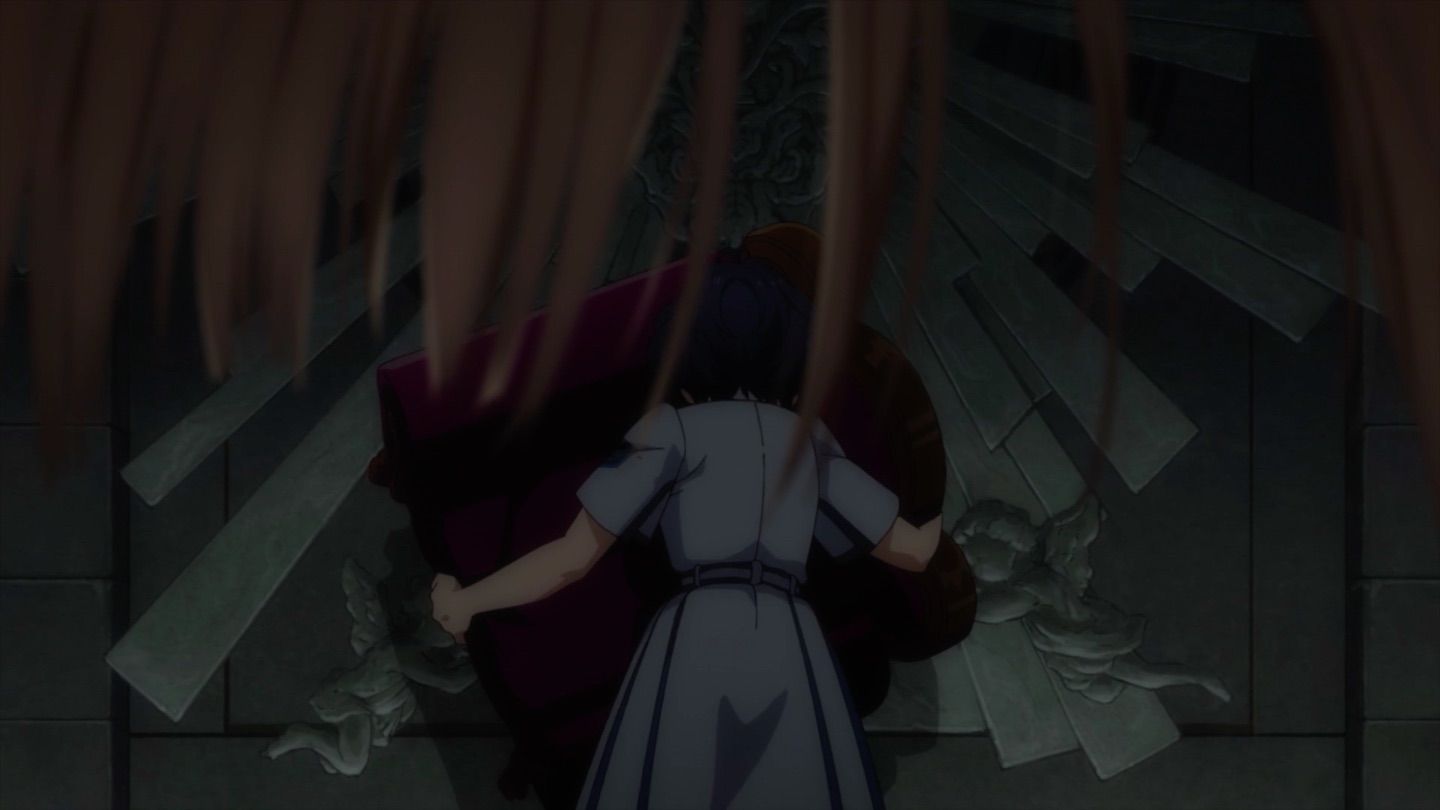
That was the past, and it doesn’t entirely gel with the image we have of her in the present. However, as the series nears its climax, the mysterious “wall” that was giving them instructions all along reveals that it is actually an AI that had been manipulating the girls for its own purposes and no longer needs them. As the 22/7 girls strongly plead to let them join back together instead of disbanding, the AI refuses to budge. When hope is all but lost, Miu steps up to make her intentions known…by hitting the wall with an armchair.

What really impresses upon me in this scene and the one Snow White performance in the flashback is that Miu’s actions aren’t portrayed as “wacky” or “cool.” They’re expressions of frustration and indignation over perceived malicious acts, and they come from someone who lashes out despite her lack of confidence because of what she believes in. It’s a far cry from a pillow fight or some slapstick antics, and it’s what establishes the 22/7 anime as a little more than just some forgettable idol fair. 

Aikatsu! and the Power of Not Running Jokes into the Ground

WARNING: Spoilers
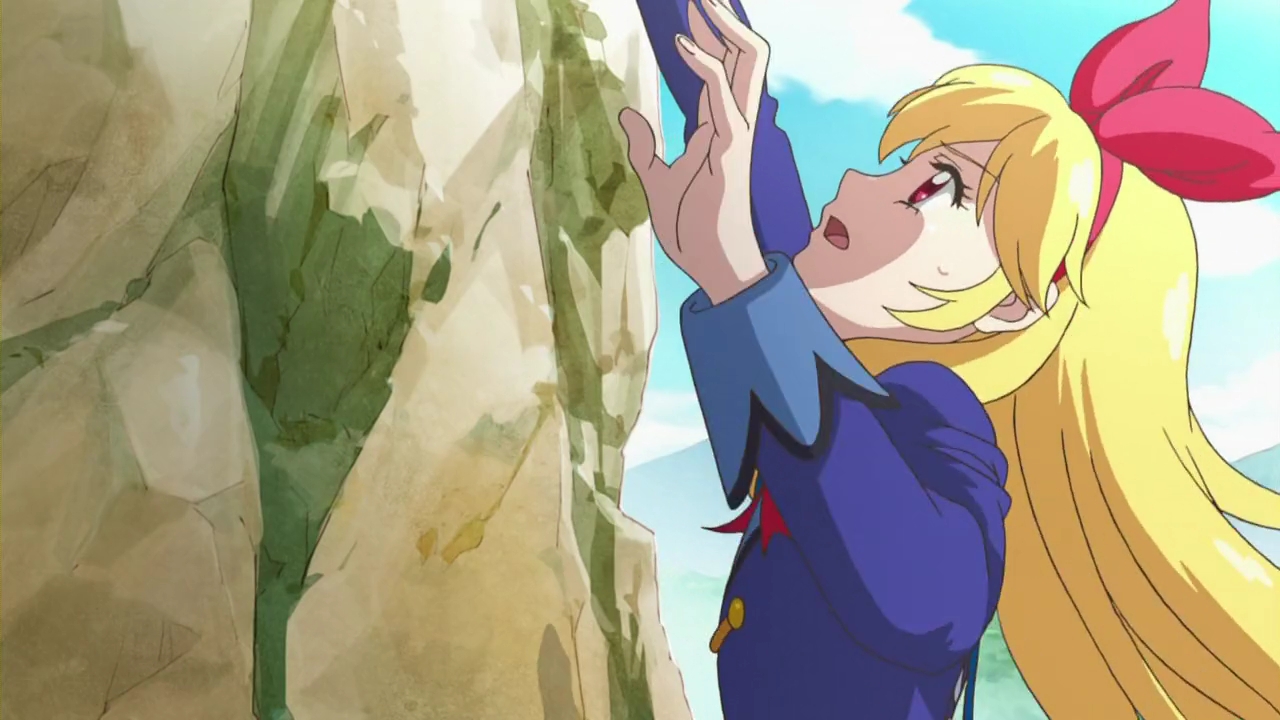
For all of their abundant, game-shilling elements, the Aikatsu! anime have done a remarkably good job of standing on their own. Whether it’s Ichigo or Akari from the first series, or Yume from Aikatsu Stars!, the franchise creates fun, interesting protagonists and then surrounds them with a large cast of equally charismatic and compelling characters. Another important quality of Aikatsu! is that it excels at not letting any of its running jokes overstay their welcome, which is best seen in how it handles its famous “cliff-scaling” gag.

In an early episode of Aikatsu!, Ichigo tries to get in contact with a world-famous fashion designer who lives atop Angely Mountain. Ichigo, willing to do whatever it takes, ends up climbing all the way up, unaware of the fact that she could’ve taken an elevator. After meeting the fashion designer, Ichigo goes on to view her as a guiding voice of sorts, someone to ask for advice. And every time she visits, she takes the hard way.

Ichigo’s “pilgrimage” is not overused. It doesn’t show up every episode, or even every other episode. Every time that mountain shows up, it’s an opportunity to laugh but also to view progress. Eventually, Ichigo climbs it with such ease that it becomes symbolic of her drastic improvement as an idol. I knew that, whenever that cliff showed up, I would smile with glee.

Not every running joke is used as sparingly. Yurika’s vampire gimmick is prevalent. Even here, however, the frequency with which Yurika plays up her faux-occult origins becomes part of the humor. Because Yurika works hard to maintain what pro wrestlers call “kayfabe” (essentially living the role), it becomes one of her endearing qualities. Her constant refrain of “I’ll suck your blood!” is presented as one of the many reasons Yurika’s fans love her.

When it’s revealed late in the first season that Ichigo’s mother is a legendary idol, nothing is more perfect than the further revelation that Hoshimiya Ringo is already well accustomed to visiting Ichigo’s designer. “It’s been a long time since I’ve done this,” she says, ready to climb. The cliff-scaling is not a gag exclusive to Ichigo, but actually permeates the entire idol universe of Aikatsu! 

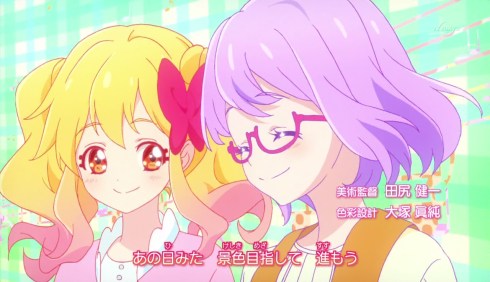
In one of the later openings, Akari (Ichigo’s successor as heroine) can be seen climbing along with her friends. Thanks to the context established by Ichigo, the scene encapsulates what’s great about Aikatsu!, instead of feeling like a callback to a worn-out image.

This post was sponsored by Johnny Trovato. If you’re interested in submitting topics for the blog, or just like my writing and want to support Ogiue Maniax, check out my Patreon.

Idol Activities are Serious Business: Aikatsu Stars!

aikatsustars-op

In contrasting the different eras of the popular idol anime series Aikatsu!, I once used a JoJo’s Bizarre Adventure analogy. If the original heroine Ichigo is equivalent to Jotaro, then her successor Akari is the Josuke of Aikatsu! If this comparison holds water at all, then the latest series, Aikatsu Stars!, must be the Steel Ball Run of the franchise, and therefore its main character, Nijino Yume, must be its Johnny Joestar. In other words, it’s a new world, a new setting, and all ties to past series have been more or less severed.

It’s unclear to me whether this “reset” was necessary, but then again it’s how the Precure franchise has rolled for the past 14 years. Whatever the case may be, to the discerning eye Aikatsu Stars! reveals itself to be a different beast. While it shares plenty of similarities to the Aikatsu! of years past, there are enough changes to make it feel like a new and almost separate entity.

Aikatsu Stars! follows Nijino Yume as she enters the prestigious idol school, Four Stars Academy, in order to chase after her idols, the mega-popular group known as S4. What she lacks in experience she makes up for in enthusiasm, as well as a strange potential that seems to only manifest itself when she’s directly onstage.

aikatsustars-hmph

The summary above mirrors both Ichigo and Akari’s own stories, but where it begins to diverge is that Aikatsu Stars! feels like a more serious story with higher stakes. This isn’t to say that the show is dark or cynical; they’re not poisoning each other and putting thumbtacks in each others’ lockers. However, whereas Ichigo is confronted in the early episodes by her classmate Ran’s fairly cutthroat attitude and quickly overturns it, I sense a much greater emphasis on rivalry in Aikatsu Stars! Adding to this feeling is the impact of S4 themselves. As the premier female idols, they give off the impression of being nigh-untouchable, their minds occupying a world almost beyond the reach of regular mortals. Not even #1 idol Tachibana Mizuki in the original Aikatsu! quite has that aura.

The most noticeable change with Aikatsu Stars!, however, is the new character design aesthetic. The girls and guys of Aikatsu Stars! have smaller frames and rounder features, giving them a look that feels to me be to more “gender-neutral.” What I mean is, the original Aikatsu! had designs that I see as closer to shoujo manga. Their large eyes weren’t just expressive, they were almost like miniature planets. With Yume and the rest of the Aiaktsu Stars! cast, the designs more resemble a balance between girls’ anime and bishoujo anime for guys. It’s effectively The iDOLM@STER meets Peach-Pit, the artist duo responsible for works ranging from Shugo Chara (shoujo) to Rozen Maiden (seinen featuring cute doll girls).

aikatsustars-s4

While the characters are all different and look different, there’s one semi-subtle link to the franchise’s lineage, which is that the girls of SF4 match the main four in original Aikatsu in terms of hair color. Blond, blue, red, and brown are all present, and although their personalities don’t really line up at all, it can’t possibly be a coincidence.

There are a couple of other differences which I think make Aikatsu Stars! rather interesting. The first is the greater prominence of male idols. Yume meets a boy who turns out to be a member of M4, the top group from the academy’s male division. The previous Aikatsu! as far as I know only barely bothered in male characters. Is this the influence of successful male idol spin-offs, such as Pretty Rhythm: King of Prism?

aikatsustars-sensei

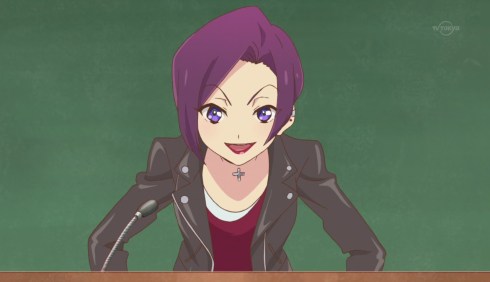
The second is that the series implies a greater and more diverse range of possible idols. Sure, Aikatsu! has things like an American idol, and one who likes to dress as a vampire. But Aikatsu Stars! has a teacher who has a rock background, and the first ending theme is an S4 dubstep song. What other possibilities exist? I want to find out.

Aikatsu Stars! feels more tightly focused and more dramatic, but I do wonder if this comes at the cost of the more lighthearted fun of the original series. That being said, there’s nothing so far that tells me it’s going to plummet or lose its footing. I look forward to seeing Aikatsu Stars! build on itself, and even if the episodic hijinks don’t feel as strong, it looks on-track to being a more polished work overall.

This post was sponsored by Johnny Trovato. If you’re interested in submitting topics for the blog, or just like my writing and want to support Ogiue Maniax, check out my Patreon.

Save

Aikatsu! and the Challenges of Protagonist Succession

aikatsuakari

Years of watching sequels has made one thing clear to me: it can be remarkably difficult to properly pass the torch from one protagonist to the next. For every Love Live! Sunshine!! that presents a cast with its own individuality, there’s a Saved by the Bell: The New Class, which, like so many in the graveyard of failed follow-ups, tries too hard to imitate the formula of the predecessor. In this respect, Aikatsu! takes on one hell of a challenge, not only taking the focus off of original heroine Hoshimiya Ichigo and re-centering it on newer star Oozora Akari, but actually keeping Ichigo and the rest of the old guard around.

The risk that comes with keeping the older characters around is that they might very well make the newer characters feel less worthwhile. In a post comparing the manga Genshiken to the series Kyuukyoku Choujin R, Japanese blogger tamagomago talks about how, while both series are about generations of college students, in the latter’s case the older characters stuck around to the extent that they overshadowed the younger ones. In Gundam SEED Destiny, protagonist Shinn Asuka ended up taking a backseat to the original Gundam SEED hero, Kira Yamato, to the extent that the opening changed to reflect this. Perhaps this is why the 800 lb. girls’ show gorilla known as Precure switches to a completely disconnected world with every new series more often than not.

To my pleasant surprise, I find that Aikatsu! does a fine job of re-focusing itself to highlight Akari as its new protagonist, with Ichigo passing into the role of support character in a manner that diminishes neither character.

It is necessary that I point out the following: for the sake of this post, I did not watch through the second year-long stretch of Aikatsu!, and thus cannot comment on how the actual transition from Ichigo to Akari went. All I know is that Akari was introduced partway through, and that, sort of like in the world of pro wrestling, she was gradually elevated to take center stage. By the time the third season starts up, Akari seems just different enough from Ichigo that it somewhat resembles the relationship and character contrast between Jotaro, the hero of JoJo’s Bizarre Adventure Part 3 and his Part 4 successor, Josuke. Like Jotaro, Ichigo even as an inexperienced individual feels like a powerhouse of sorts, a rock-climbing, tree-chopping force of nature. Akari, in turn, is more unsteady but brimming with life, akin to Josuke. She’s very much her own character, which is also the case for all of the newer cast.

Ichigo’s substantial role change into supportive mentor also has me thinking about the aura that emanates from characters who were ex-protagonists. Often, when a work no longer revolves around them, these former main characters gain a kind of stature or legendary status that elevates them above even the most prime moments of their time in the spotlight. Think of how the arrival of Cure Black and Cure White is generally considered a high-impact moment in the Precure crossover films, or how the arrival the original Red Ranger in the Power Rangers special Forever Red has the others standing in awe. Think of Goldberg at Survivor Series 2016. Ichigo is more or less the same character.

From my prior experience, Aikatsu! had been a consistently strong and entertaining series, so it’s not too much of a surprise that later parts of the anime manage are similarly high in quality. Akari’s a worthy successor thus far, and I’m curious as to how she and her friends will transform and perhaps someday become mentors themselves.

This post was sponsored by Johnny Trovato. If you’re interested in submitting topics for the blog, or just like my writing and want to support Ogiue Maniax, check out my Patreon.

Save

Save

Save

Save

Save

The Wacky (Not Wacky) World of Macross Delta: Ogiue Maniax on the Veef Show Podcast

macrossdelta

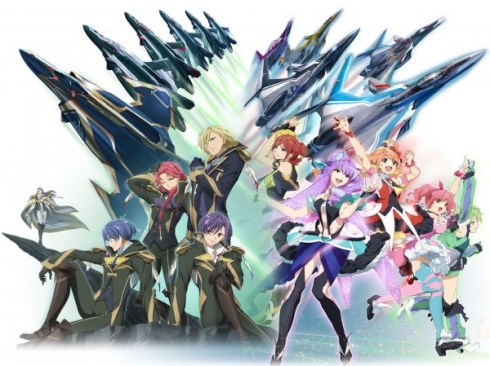
I recently made another appearance on the Veef Show to talk about Macross Delta. There, we discuss the ups and downs of the show, and I learn about fan reception to the series, as well as the illicit dealings of the owners of Robotech. Join us!

Save