Love Live! Superstar!! is one of my favorite entries in the Love Live! franchise, but even I was unsure if the third season was necessary. The previous season ended on a high note, and the girls of Liella! could have ridden off into the sunset for a satisfying conclusion. But despite some misgivings, I decided to stick with it. Fortunately, my faith was rewarded once again, and by the end, I found that this season solidified my ongoing belief that Superstar!! is the absolute best of Love Live! from a storytelling perspective.
Love Live! Superstar!! 3rd Season begins with protagonist Shibuya Kanon and the rest of Liella! coming off the high of finally winning the Love Live! national school idol competition. They start the new school year determined to be first back-to-back champions, but a few hurdles stand in their way. First is the pressure of being the reigning team. Second is the presence of one Wien Margarete, a transfer student from Austria who competed against Liella last time and decides to form her own school idol club at their school instead. Third is the fact that Kanon decides to pull a surprise heel turn (of sorts) and join Margarete’s side along with another girl, Onitsuka Tomari. Now, instead of everyone working as one, the two sides must compete to see who will represent their school.
The idea of rival clubs is an intriguing one, but Love Live! is not really a franchise that can make it particularly intense. Or rather, the last time they tried with the (now-defunct) Love Live! All Stars mobile game, it backfired among the fanbase, and the anime adaptation had to tone things down. And so events proceed fairly predictably, with the two sides eventually coming together and any animosity being just caring and affection in disguise. In that sense, Season 3 is a bit of a disappointment, but I eventually realized that this was the wrong angle to look at the whole thing.
The Love Live! competition itself isn’t actually the main focus in 3rd Season. Even the desire for a repeat victory and the challenge of getting there is merely a backdrop than the driving force. Instead, the real story is about how everyone deals with the inevitability of change that comes with the fact that Kanon and the other founding members will be graduating from high school. All the third-years are thinking about what their adult lives will look like and what careers they want to pursue. The second-years will be the ones to inherit the club, and they must go from being the newcomers to becoming the core. And the first-years, Margarete and Tomari, see their participation in more cynical terms. They’re all at different stages.
Superstar!! is also the first time we’ve followed a core cast from the start of high school all the way to the end. In the first season, Kanon’s main struggle is overcoming her trauma that prevents her from singing. In the second, it’s figuring out how to help others overcome their own fears and doubts. And in the third, it’s about leaving behind a system and legacy that will encourage even more in the future to have courage and chase their passion. This might seem par for the course compared to previous generations of Love Live!, but there is a significant difference.
In every other case, the story begins with a collection of first-, second-, and third-years all coming together. While characters develop in their own ways, they’re also limited to a degree by this format in one way or another. Often, the specific roster is portrayed as lightning in a bottle—something that cannot (and maybe even should not) be replicated. In contrast, all three seasons of Superstar!! collectively work to show that even as Kanon and her classmates leave, the club will continue to grow and change. Each iteration of Liella! has been important in its own way, and the anime implies that this won’t stop even after the original five are no longer there. This flow of time is what sets this series apart, and ultimately makes this third season satisfying to watch.
So that’s Love Live! Superstar!!…or at least until the series gets a feature-film send-off. While I have great fondness for all generations of Love Live!, I really do think that this one is special because of how strong it is as an overall piece of narrative fiction. Superstar!! relies the least on expecting from its audience an inherent receptiveness to idols (and by extension the “school idol” concept), and I think this versatility helps make it a very rewarding series overall.
If there was ever any sign that I’ve become a serious fan of VTubers, it would have to be the fact that I went to the Fantôme Thief’s Revenge concert in Atlanta, Georgia.
When this joint event between Dokibird and Mint Fantôme was first announced, I felt conflicted about whether to even go. On the one hand, I had decided to support Doki in ways I hadn’t back when she was Selen Tatsuki. Mint, for her part, is a charismatic performer whose friendship with Doki goes back to their previous incarnations in VTubing. On the other hand, this was pretty bad timing, being right before the holidays. Moreover, the concerts I had attended previously were either attached or adjacent to other things I was already doing, like conventions. Anime Weekend Atlanta was the same weekend, but I simply couldn’t stay too long.
But between the lack of an official streaming option and the reveal that one of the special guests was none other than Dooby (another big name who made the decision to go independent), I made my decision to go. I had a focused mission: Fly to Atlanta, go see Doki and Mint, sleep, go home. (Also, eat some fried chicken and Bojangles.) I never thought I’d do something like this, but here I am, and it was totally worthwhile.
Entering the Venue
Upon first arriving in the area of the concert, I saw a large line outside that gave me a bit of deja vu from Breaking Dimensions. While waiting in line is never fun, I did enjoy seeing all the eager fans. There were the Doki and Mint supporters, of course, and Dooby’s reputation precedes her, but I even saw some who were clearly there for the other guests—PiaPiUFO, Phoebe, and Juna Unagi.
After finally getting into the concert site, the Tabernacle, I was faced with a second line—this time for merch. Unfortunately, the penlights sold out before I could make it to the front, but I bought a few other things instead, including a holographic ticket that isn’t going to be sold online. Also, I thought there was a chance I might not get my hands on a concert penlight, so I brought a backup with me, just in case. From there, I made my way up to the balcony. To my surprise, a good number of seats were available despite the fact that the tickets for them were unreserved, so I got to have an amazing and unobstructed view. After a half-hour delay (due to the sheer number of people trying to buy merch), things kicked off with the opening acts.
The Opening Acts
I had little prior experience with PiaPi, Juna, or Phoebe. At the very most, I’d seen Phoebe on guest lists at conventions here and there. Knowing the lineup, I actually spent a bit of time in the days prior and on the plane getting to know their music. While I got the sense that they were all decent performers, I wasn’t prepared for how much more impressive they were at the concert. PiaPi did a great job building up hype and using her 2D model to its fullest, and she just sounded great. I’m glad I finally got to hear Phoebe in action, who was solid all around, and I enjoyed her cover of “Snow Halation.” Juna’s sultry voice and presentation worked well, though I’m not quite the audience for a parody song that describes gay sex and waterworks in extremely fine detail.
Each of them sang three or four songs, and were almost half the entire concert. I think Doki and Mint granting so much time to the other VTubers is very representative of them and their desire to create events that celebrate others. PiaPi has the smallest following out of all of them, and she’s seeing a significant bump in subscribers. While waiting in line before the concert, I happened to spot two PiaPi supporters (known as Pickles) dressed in themed happi.
It was then time for the main acts, and the screen transitioned to Dokibird—except she wasn’t singing or dancing, but was instead indulging in her latest gaming obsession: Marvel Rivals. The audience spent seven minutes watching her play as Luna Snow while Mint was telling her to wrap it up. If there’s anything that a more corporate VTuber event wouldn’t be able to do, it’s probably silliness like this.
The Main Attraction
Finally, on a stage decorated with their fan mascots waving penlights, Doki and Mint warped in, fully 3D and amidst raucous applause. I can’t say enough about how beautiful their models were. It was as if the original 2D designs had been brought to life, and to make them look that good both when still and in motion was no easy feat. Mint’s concert model wasn’t her official one, but the quality was still very nice. Dokibird’s is her official one, and she even hired for it a highly regarded artist in KarakuriPower (who’s done work for hololive).
I didn’t recognize a lot of the songs, and I even thought their first act was an original number when it was actually a cover with the words “Doki” and “Mint” swapped in. Regardless, I enjoyed the sheer variety of musical choices. Doki acknowledges that she’s nowhere near as good a singer or dancer as Mint, and so her individual performances tended towards meme picks, like “Xue Mao Jiao”, the Doraemon opening, and the Five Nights at Freddy’s theme. Even if she admitted to flubbing some choreography, I think she succeeded in bringing the fans along for the ride. Hopefully next time, she can do a Cantonese song too.
Mint loves idols and idol culture with all her heart, so she tended in that direction. Her performance of “New Romantic Sailors” was a personal highlight. Not only is it one of the best Love Live! Songs, period, but I actually got to see it performed live at Anime NYC a few years ago. While she delivered in spades on the “Minto-chan Laser Beeeaaaam!” (playing off “Riko-chan Laser Beam” from the original performer), I also appreciated seeing her substituting her name for all three Guilty Kiss singers in the lead-up to the yell. However, in between the idol stuff, she threw in a cover of “Break Stuff’ by nu metal band Limp Bizkit, which has become an anthem of sorts for Mint. The ghost maid is such a solid entertainer.
The Ultimate Callback
One of the biggest moments of Fantôme Thief’s Revenge snuck up on the entire audience. A duet began with Mint sitting at a table with a cup in hand. Doki walked over, also holding a cup, and then she sang the words that brought some of the loudest cheers of the evening: “Someday, we’ll have our last conversation…and drink our last cup of coffee.”
The significance of lilypichu’s “Last Cup of Coffee” to Doki and her fanbase cannot be understated. For her original supporters in her earliest days of VTubing, this was like Doki’s gift to them shortly before her original graduation. For those who discovered her as Selen, her cover music video was supposed to be her Christmas present to us, but its removal is what started the chain of events that led to her tumultuous firing and subsequent revival as Dokibid. And now here she was, almost a year later, singing it once again, as if to show that she dictates what the song means to her and her fans.
Much of Dokibird’s return since February has seen her reclaim aspects of her identity, such as her fan name (Dragoons), her appearance (a design by the same artist used for Selen), and her subscriber count (800,000+). This song was one of the last pieces of the puzzle. In later streams, Doki and Mint revealed that the decision to have this in the concert was Mint’s idea, and that it was to make “Last Cup of Coffee” a happy memory for the Dragoons.
Dooby and a New Age of VTubing?
What actually brought the loudest yells of the concert was the awaited appearance of the final guest.
As the stage screen transitioned to a red curtain backdrop, “Sugar Song and Bitter Step,” the ending theme to the anime Blood Blockade Battlefront, began. Mimicking the ending video, Doki appeared in a spotlight, followed seconds later by Mintl. This left an open spot in the middle, where a little train car suddenly appeared, signaling a warp-in by Dooby in all her train-conducting Jerboa glory. The audience erupted and I did my best to add to the excitement. This song was also a popular karaoke choice for Dooby in her previous identity, so it felt extra special to her fans who have been supporting her these past five years. Seeing them all dance and kick and just have a good time is one of my fondest memories from this concert.
I think the crowd reaction wasn’t simply because Dooby is a beloved Vtuber. Just as important was how these were three of the biggest names in English VTubing, now all working as indies. It was as if a new era had arrived.
Bringing It Home
The “final” song of the evening was emblematic of the general irreverence of the concert as a whole: “I Just Had Sex” by The Lonely Island. PiaPi, Phoebe, and Juna all joined in, still using their 2D models. The comedic nature of the song had the whole audience bopping along, and I think the fact that Doki and Mint brought the opening guests in for this performance once again speaks to their general interest in using their platform to bring attention to lesser known talents. It was an attitude that benefited their previous company, and it’s heartwarming to see them follow through on their desire to help others out. The encore was “shake it!” by Vocaloid composer emon. I didn’t know it myself, but in hindsight, having it end with a Hatsune Miku song is about as appropriate as it gets for a VTuber concert.
Closing Thoughts
While there was no official stream of Fantôme Thief’s Revenge, the two made it okay to record the concert. Later, I learned that there was a handcam stream on Twitter that had over 50,000 concurrent viewers. Days later, a full version was also uploaded to Youtube:
So why did I write all this up despite it being freely accessible to everyone? Because I think it’s important to still have these memories put into words for posterity. Also, I think there are some things that don’t easily come across even with a video,
In terms of criticisms, I don’t have many. I wish I could have gotten a penlight. Some of the reserved seating (which I wasn’t a part of) forced that part of the audience to view things at an awkward angle because of the screen. Not only was the timing of the concert inconvenient because it was so close to the holidays, but it also overlapped The VTuber Awards which had a halftime performance), as well as hololive EN’s musical, “The Broken Promise.”
I’m happy I ended up going to “Fantôme Thief’s Revenge.” It was both Dokibird and Mint’s first true 3D concert as their current selves using their updated designs, and I cherish the fact that I could be part of it. Getting to see Dooby make her concert debut was also a treat, as was being better introduced to Piapi UFO, Phoebe, and Juna Unagi. It was an experience that rewarded my fandoms and helped me discover new possibilities. And while I hardly talked to any other fans, I could at least appreciate their mutual enthusiasm and energy.
This interview was conducted at Otakon 2024. Uchida Aya is a Japanese voice actor, famous for playing the character Minami Kotori in Love Live! School Idol Project.
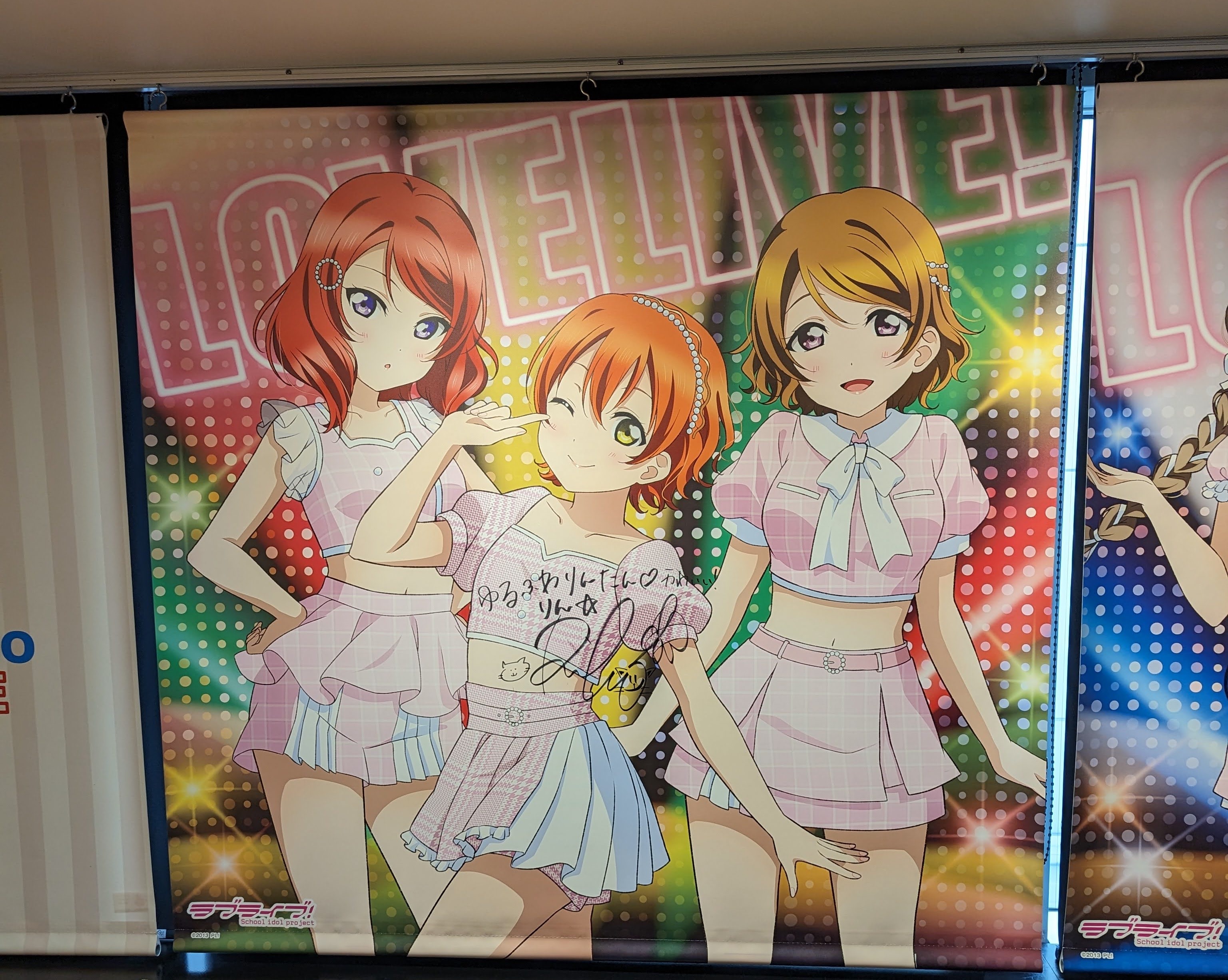
Many of my questions will be Love Live!–related because I’m a fan, but coincidentally, I was in Tokyo last December, and I visited the Love Live! cafe.
Uchida: Ahhh!
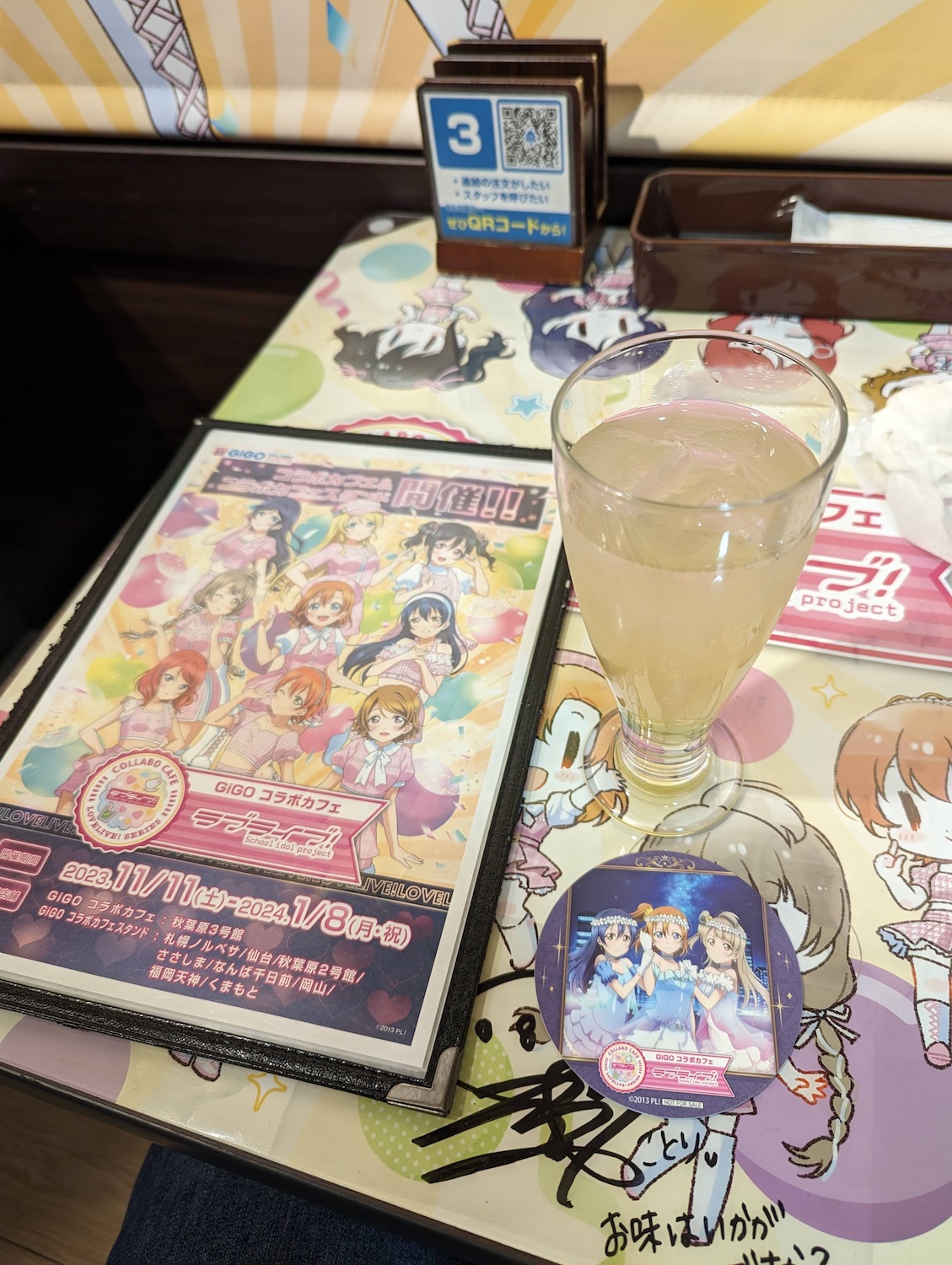
I just happened to sit at a table you autographed.
Uchida: In Akihabara!
I was wondering, for my own curiosity, do you remember when you visited to sign the table?
Uchida: I think it was December!
Love Live! Is now a worldwide phenomenon; people know it everywhere. But I know it was much less popular at first. How did you get started in Love Live!?
Before I was on Love Live!, I got my first regular role on an anime project, and the music director told me that his next project was something called Love Live! That’s how I got into it.
What was it like when you first started, and at what point did you realize it was starting to get huge?
Uchida: Love Live! was a very new creation, so there was a lot of motivation across the time. And personally, I love anime and also idols, and the fact that both those things are core to this project made me very excited. This made me want to really want to take the lead and bring it to the next level, and make this work even more fun. As it gained more popularity among fans, and as I realized more and more people were listening to the songs, it made me feel very, very happy. But because it started very small, I feel like I grew with this project, and that makes it more special.
Speaking of growth, that’s something I also noticed. I first became a fan of Love Live! through the anime, and when I looked at the prior material—all the song performances and recordings and such—I noticed that you and the other members of μ’s had grown a lot as performers. In what ways do you think your performance as Kotori, in acting but also singing and dancing, had evolved over time?
Uchida: I’m not so sure about my skills improving…I was always aiming to become a voice actor and didn’t necessarily want to be an idol, standing in front of a crowd smiling and dancing. I didn’t have any intention of doing it professionally, and it was something I had to get used to and was hesitant about in the very beginning.
At some point in the middle, we started doing more live performances, and it was a challenge. But because the other members were there and we were a team, we taught each other things—dancing, practicing, etc.,—and gradually, we acquired those skills and got better. I’m glad I had friends in the same boat with me who I could strive with and improve with together.
So you’ve performed many songs with the others, including with Hanayo’s voice, Kubo Yurika. One of your songs, “Suki desu ga, Suki desu ka?” Did the ’70s feel of the song change how you two approached it?
Uchida: It’s been quite a while, so give me a moment! So it’s a song featuring our characters, Koizumi Hanayo and Minami Kotori, and it was a duet of a kind we had never done before, so it was very fun. Hanayo-chan’s voice has a very “howaaah” fluffy and cute feel, and Kotori is a very cute character herself. So I was confident it would be a cute song.
Thank you for this interview!
Postscript
Two days after I interviewed Uchida, I managed to get an autograph from her. As she signed my copy of Love Live! The School Idol Movie, she actually recognized me from the interview. I point this out because I’ve had cases where the guests do not recognize me despite having spoken to them, and it made me realize that Uchida is indeed a pro at this, be it through her experience as Kotori or in her voice acting career. I left with an even more positive impression of her.
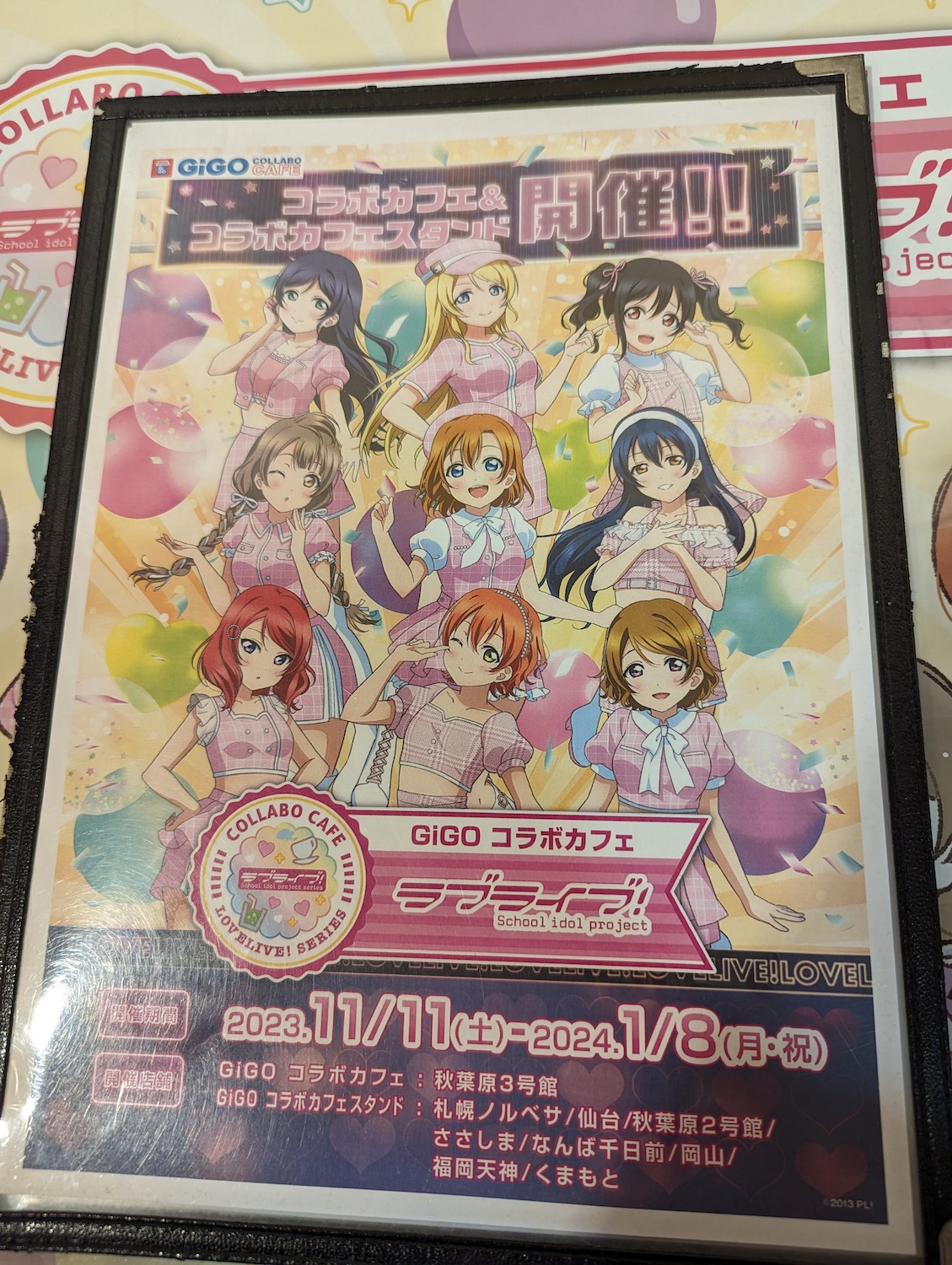
On my recent trip to Japan, I did the expected thing and went to Akihabara. While there, I spotted a Love Live! collaboration cafe at the arcade GiGO Akihabara Building 3, and decided that I had to go. Not only was it Love Live!-related, but it was actually focused on the OG μ’s girls!
I followed the signs, which led me all the way to the top floor. Curiously, the setup is such that you can’t take escalators all the way.
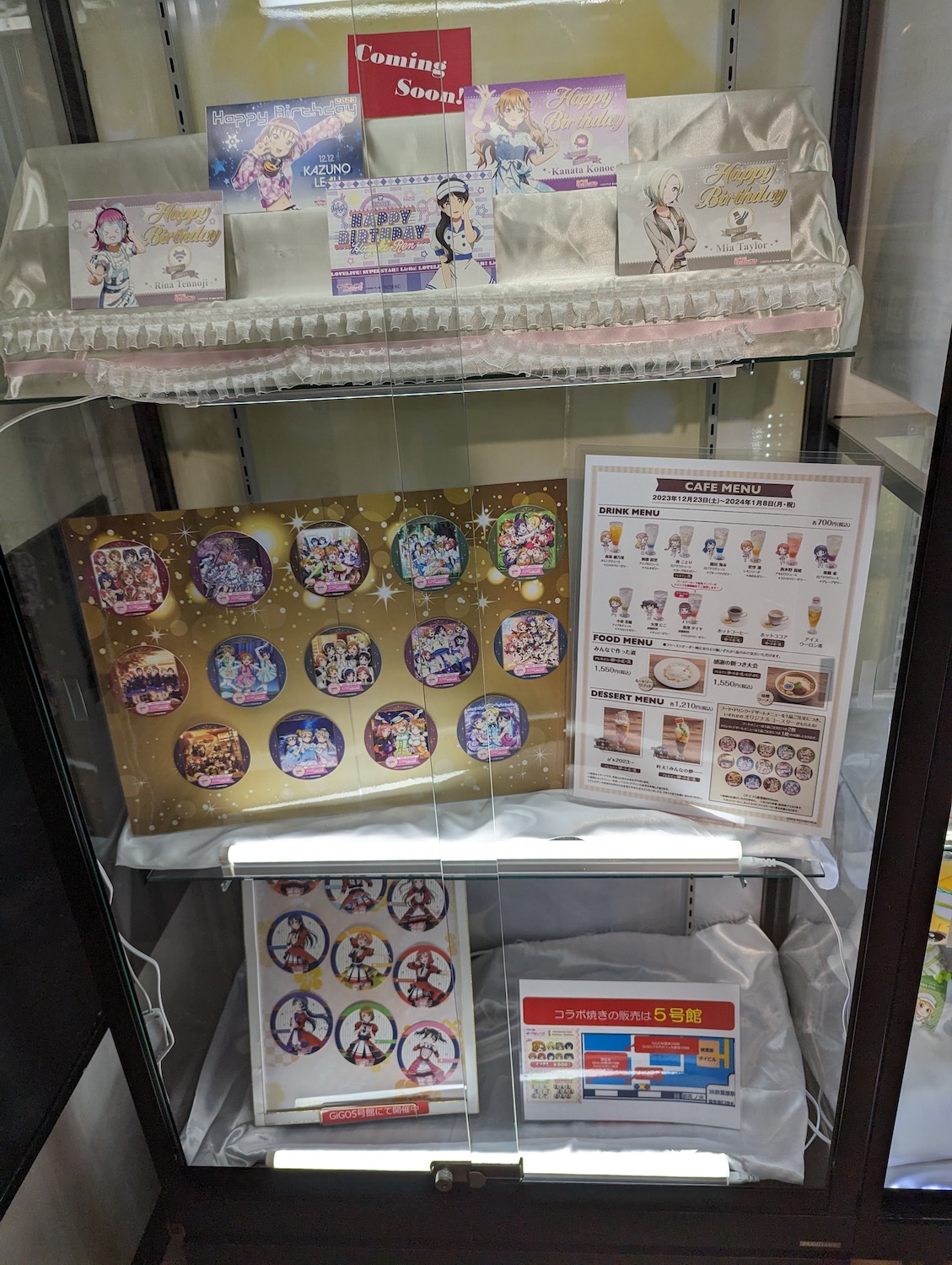
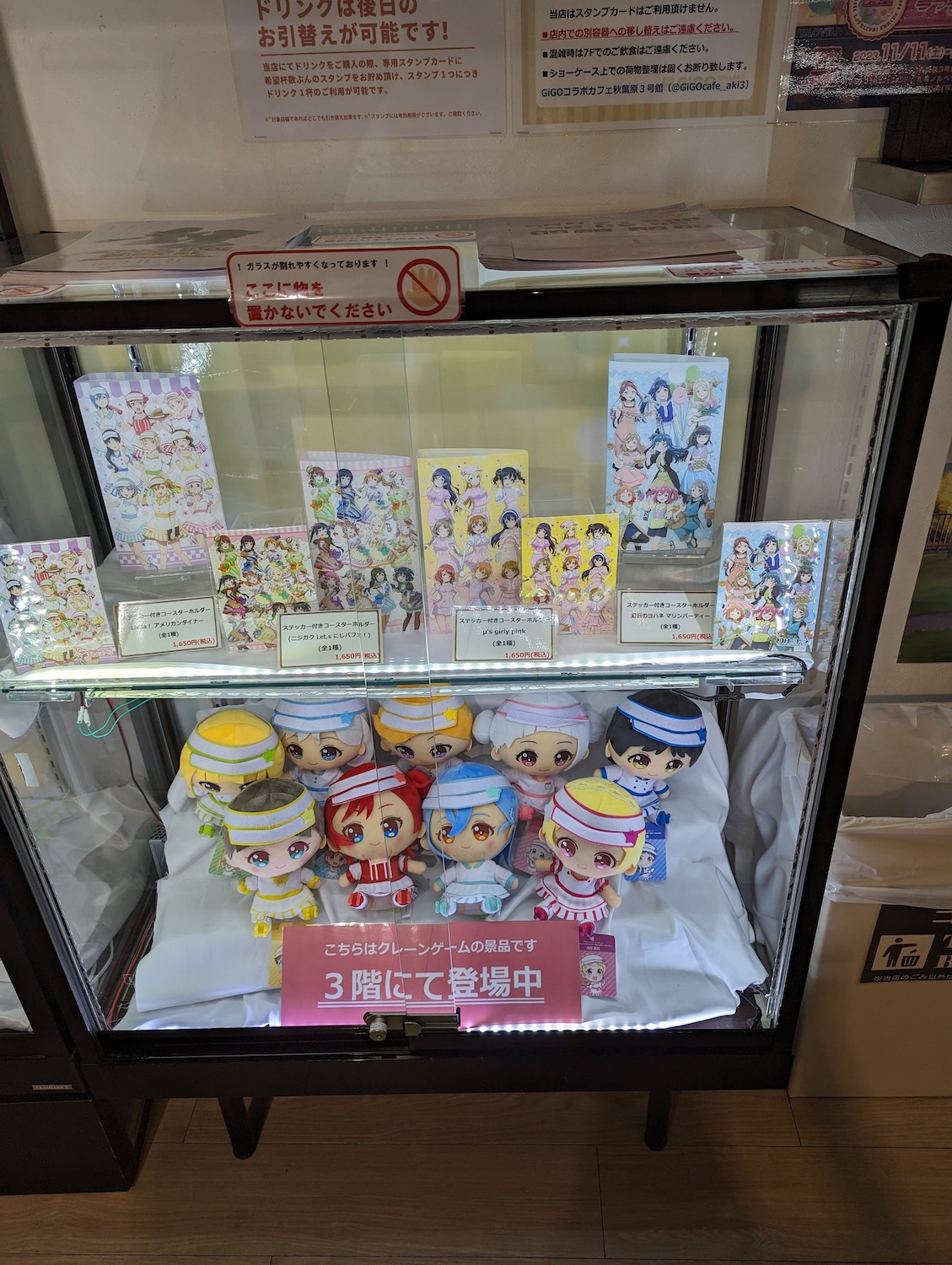
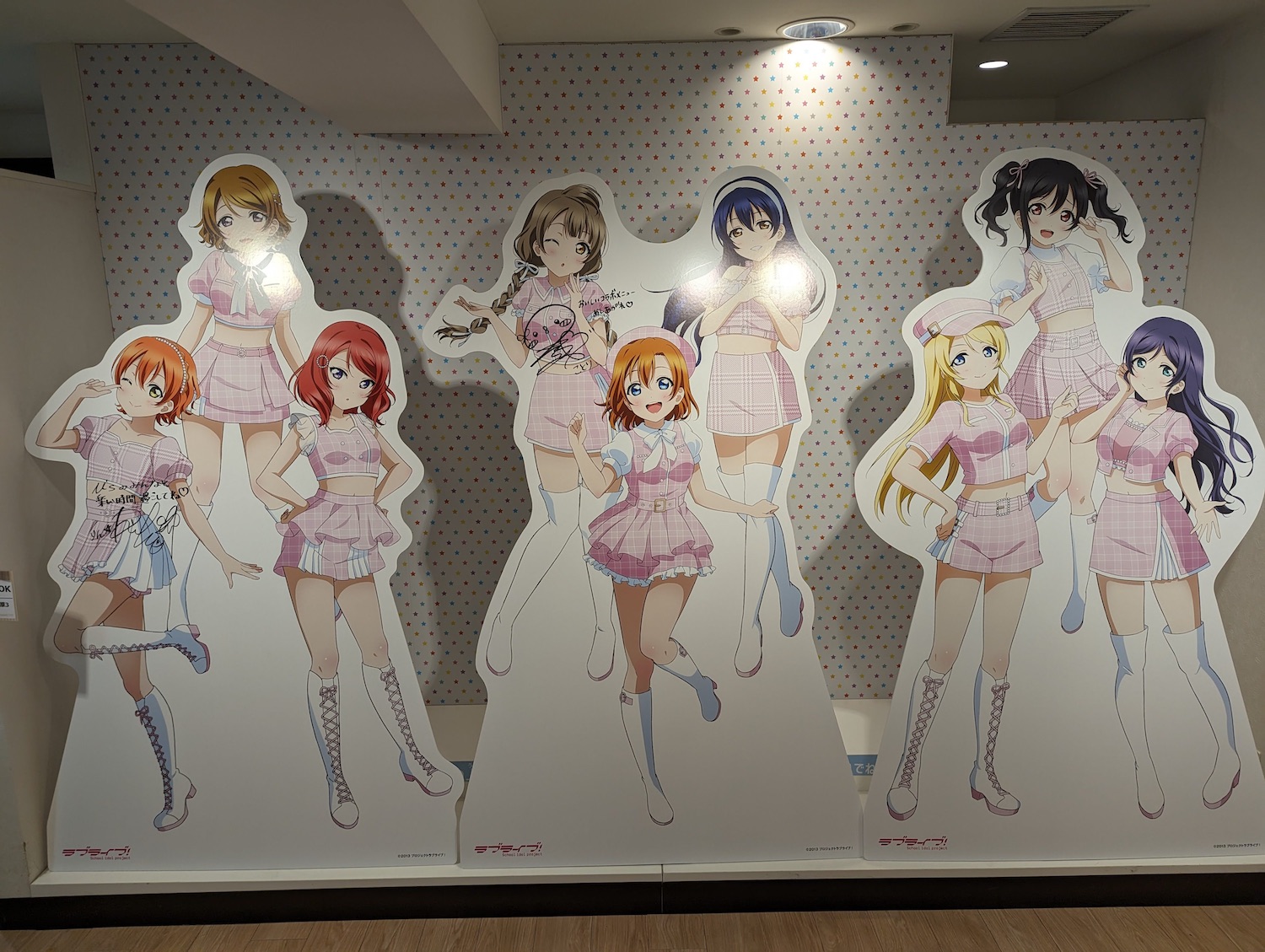
Upon entering, I found myself in a small room covered in Love Live! paraphernalia, including posters, gashapon machines, and display cases. As a video played with scenes from the anime, Love Live! Songs could also be heard at the same time, dividing my attention a bit. The actual cafe was hidden behind a door, making it impossible to actually see what it’s like without registering with the cashier there.
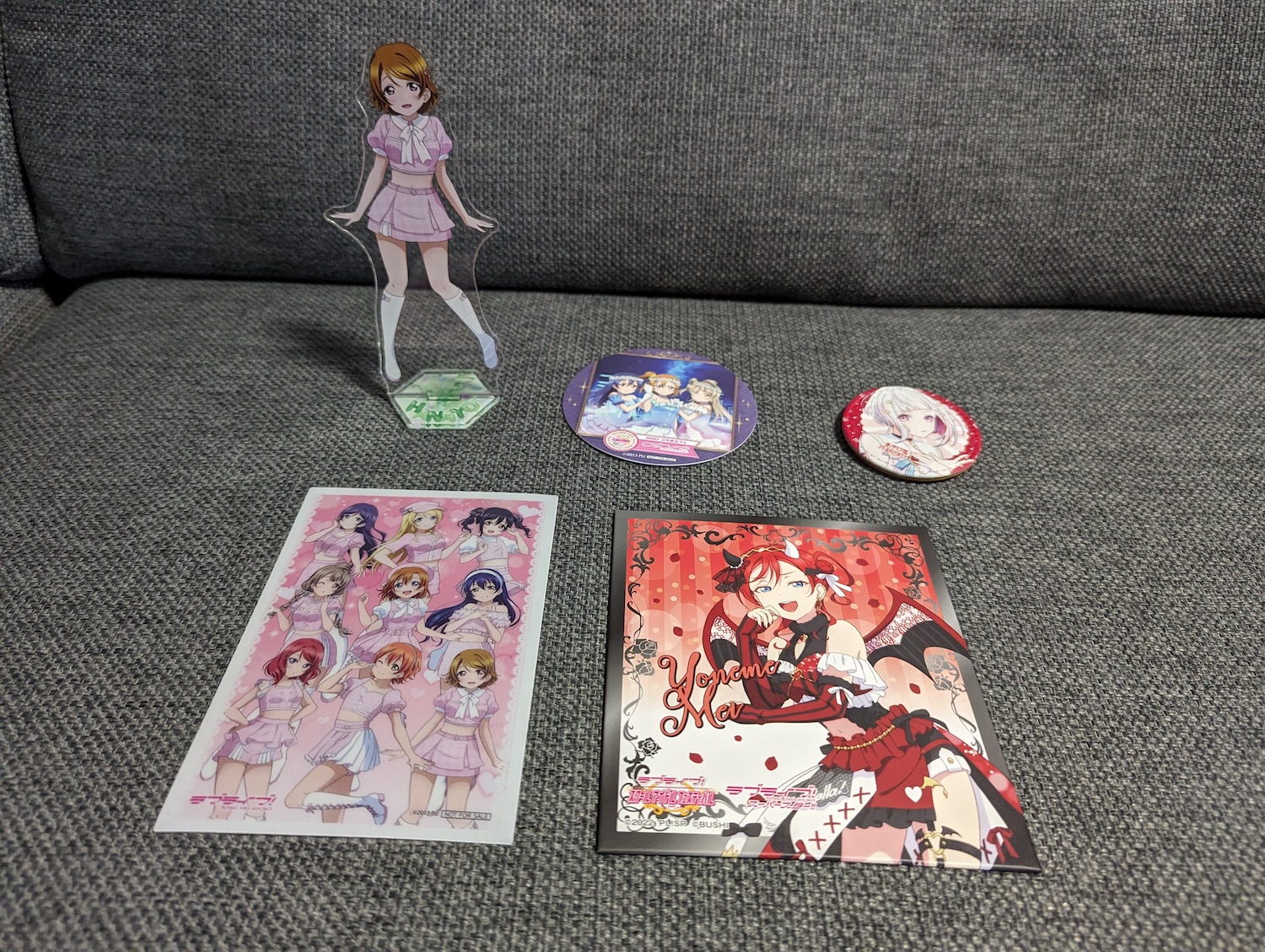
In addition to registering a time slot for the cafe, the cashier has another role: accepting payments for even more merch. The goods weren’t limited to the original girls but included all generations, though the only things that weren’t blindbox items were the acrylic stands featuring μ’s in pink outfits. I decided to play the odds a little bit, but as someone who much prefers a guaranteed thing, I also bought the acrylic stand for my all-time fave, Hanayo. Because I bought a couple things, I hit a threshold to also receive a free plastic mini poster with the other eight girls included.
There just so happened to be a time slot available shortly after I arrived, so I decided to put my name down.
The actual cafe was brightly lit and covered in μ’s art on the walls and the tables. A couple of the voices, Uchida Aya (Minami) and Iida Riho (Rin), had autographed some of the displays.
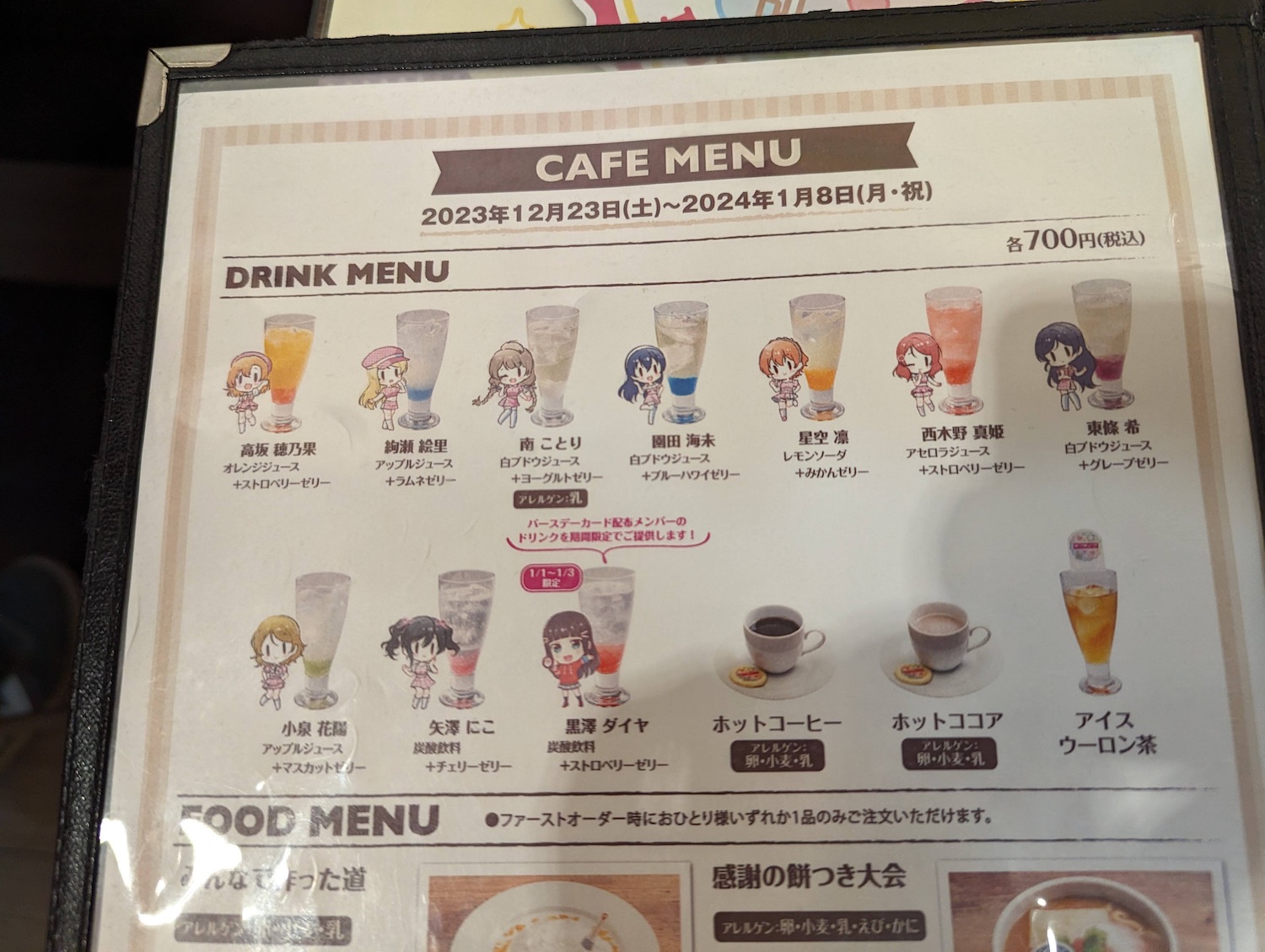
The only other collabo cafe/restaurant I’d attended had been for Legend of the Galactic Heroes, which is aesthetically and thematically quite far-removed from Love Live! However, one thing it had in common with the Love Live! cafe is that you could also get merch by ordering food and drinks. In this case, the items consisted of coasters selected at random (of course), with drinks and desserts netting patrons one coaster and main courses two.
I already had meal plans for later, so I decided to go with just a single Hanayo-themed beverage, which was a soft drink consisting of apple juice and muscat grape jelly (Side note: I learned through this trip that muscat grape is ridiculously delicious). I did not win a Hanayo coaster, but rather one for “START:DASH!!,” which in the anime is the first song performed by Honoka, Umi, and Minami.
In contrast to my conservative order, other patrons went quite hard. I saw one person end up with around five drinks, two main courses, and I recall at least one dessert (though my memory might be off). Other individuals were similar. However, as someone who never, ever whaled in gacha in mobile form, I was hesitant to do the IRL version any more than I already had. I understand the desire, though.
You can see everything I ended up with (plus a canvas badge of Yugiri Tsuzuri from Hasunora I purchased elsewhere). While nothing there is really mind blowing, I’m glad I got to have this experience, and I’m happy I got to share it today, on Hanayo’s birthday.
“Is it more important to me for a group song to sound good or have distinct voices?”
This is something that’s been on my mind lately as I’ve been exploring my own feelings about music- and idol-adjacent worlds.
I have an odd relationship with K-Pop. I think it can be good, but it’s also definitely not my preference generally, and as someone who seeks to be open-minded, I keep resisting the urge to write off huge swathes of it. The last thing I want to be is dismissive, so I listen and listen, but it just never seems to fully click. Even with songs that I enjoy, something bothers me in the back of my head. Also confusing is that I seem to end up enjoying songs inspired by K-Pop more than K-Pop itself. Case in point: “Dark Breath” by hololive VTuber La+ Darknesss. That includes both the song itself and the accompanying dance (which I know is part of the appeal of K-Pop).
Speaking of, La+ has been crossing over in all sorts of places: notably performing with non-hololive VTubers, doing covers of songs by the League of Legends K-Pop-style group K/DA (alongside her fellow hololive members) for Riot Games One, and being one of two VTuber ambassadors for the very first The iDOLM@STER/Love Live joint concert.
And here, despite the hololive performances of “POP/STARS” and “Baddest” being less polished, I also enjoy them more than the originals. I don’t think it’s merely because I know the VTubers, so I’ve been doing a good deal of listening to K/DA for the first time, and revisiting Love Live! in between VTuber songs.
Different franchises and media projects have their own priorities. Love Live! and The iDOLM@STER are both just as much about voice acting as they are music, and being able to easily distinguish between individuals based on how they sound is a big part of helping each character/performer to garner their own fandoms.
For example, I don’t think you need to have any familiarity with Love Live! to notice that “Cutie Panther” features three very distinct voices. The differences can be exaggerated, but they’re present nevertheless.
Similarly, the start of ReGLOSS’s “Shunkan Heartbeat” has each of the five hololive members singing a part of the beginning by themselves, and it’s because the song is as much an introduction of them as five distinct entities (each with their own Youtube channel). That’s part of the VTuber business model.
This is not to say that songs need distinct voices to be good, and there’s plenty of music with easily differentiated voices that is lacking in other ways, including within those voice-acting/VTuber/idol domain. But when I listen to Blackpink, for instance, I find it is nowhere near as easy to tell the singers apart. It might just be a lack of familiarity on my part, but I also feel that it might not even be the fault of the singers themselves. After all, if you picked three random people out of a room and told them to all sing, there’s a good chance they’d all sound different from one another, even if they weren’t good.
The culprit, I believe, could be how K-Pop is produced. That industry seems to be built on projecting images of perfection, and the result is that everyone sounds flawless. However, this has the drawback of also removing the quirks in people’s voices and by extension their individuality. And even with K/DA, I feel that their songs do a relatively better job of keeping these qualities, perhaps because the source material was a game with over 150 unique playable characters.
Which is to say: 1) While I don’t think distinct voices can be the only thing a song has, nor a lack of such a quality to be a deal breaker, I think it can add a lot to a song. 2) I think part of the reason K-Pop feels so overproduced to me is because of the way it seems to hone and chisel the music to such an extent as to wipe out those interestingly unique qualities that singers possess.
And all this leads me down another rabbit hole, which is thinking about the different roles a singer can have when it comes to music. Does the song serve them, or do they serve the song? Are they the centerpiece, or part of a greater sound? With idols, is it that the quality of music is less important than its ability to emotionally connect the fans to the idols? I feel like there are endless possibilities, and perhaps that how much we as listeners and audiences prioritize certain elements is what shapes our tastes.
It was almost 10 years ago when I discovered Love Live! and by extension the School Idol Festival mobile game. Koizumi Hanayo quickly became my favorite character, and so I set out with a simple goal: Make dedicated all-Hanayo teams while also avoiding whaling. It was both a way to show my fandom and to set a fairly concrete goal that I could dedicate my gacha pulls to.
In 2015, I achieved the first step in a long road: a Hanayo Team consisting of all unique versions. Now, in 2023, I have crossed what I consider to be my final finish line: Three all-Hanayo teams with every member an idolized and legit Ultra-Rare (as opposed to free-giveaway URs that have less power as a result).
I have, in my own way, “beaten” Love Live! School Idol Festival, and can finally lay this game to rest—at least until the recently announced Love Live! School Idol Festival 2 shows up. Will I even play the sequel? And if I do, will I maybe dedicate myself to a different character, like Love Live! Superstar!!’s Wakana Shiki? Whatever the case, it’s the end of an era.
Happy Birthday, Hanayo. It’s been fun to cheer for such an intensely passionate character of contrasts, and it’ll continue to be amazing.
In 2021, the first season of Love Live! Superstar!!made a powerful impression on me. With its tightly written story centered around heroine Shibuya Kanon’s lifelong struggle with performance anxiety and stage fright, it stood out in a positively memorable way. One of the aspects that helped the storytelling was its relatively small cast of characters compared to the Love Live! franchise standard, so when it was announced that Season 2 of Superstar!! would nearly double the main group from five girls to nine, I worried that the series might lose what made it work so well. Fortunately, my fears were unfounded, and Season 2 has turned out to be a solid follow-up that does a good job of playing off its predecessor—and also introduces my favorite member in the process.
Love Live! Superstar!! 2nd Season picks up from where the first left off. The elite Yuigaoka Girls’ High School has accepted the School Idol Club and their group, Liella! Kanon has managed to overcome her issues and can sing loudly and proudly on stage. There’s unfinished business in that Liella! couldn’t make it past the preliminaries of the Love Live! competition. The character arcs are mostly resolved, do the question becomes, what story do they tell given that fact?
The answer is to introduce new girls and place an emphasis on a senpai–kouhai dynamic that isn’t really present in other Love Live! anime. While other series actively celebrate the lack of such hierarchical distinctions, Superstar!! 2nd Season puts it front and center. That’s not to say it’s big on seniority, but the perspectives provided by experience becomes a key factor in the narrative.
The senpai characters do receive episodes of their own (like a hilarious one about gamer addiction), but they seem to get less screen time overall, and even theirs will link back to the new girls in some way. This is likely by design, as it not only does this work to introduce all the first-years, but it provides a clear indicator of progress for the original five as seasoned school idols who must mentor the next generation. After all their hard work, Kanon and the other senpai have gotten so good that they accidentally scare off most of the new student body, who are too worried about not being able to live up to the standards set by Liella! Like the ongoing debates over fighting game design, Superstar!! 2nd Season asks what is the right balance between granting accessibility and rewarding ambition.
Superstar!! 2nd Season idoes a good job of differentiating the new girls from their upperclassmen, though they can at times feel a little less three-dimensional. The big sticking point is that they seem to adhere more to anime character archetypes, but they’re developed well enough that it becomes less of an issue over time. Also, I have to admit that I myself can be a sucker when the tropes fall in my favor, such as in the case of my Liella! favorite, Wakana Shiki. She’s an aloof scientist with a secret soft side, and her similarities to Nunotaba Shinobu from A Certain Scientific Railgun (including liberal peppering of English phrases into her speech) is both noted and highly welcome.
As Superstar!! 2nd Season progresses, it gradually brings the focus back to the original girls of Liella!, reviving and adding new angles to some of the challenges from Season 1. For example, a rival antagonist shows up who reignites criticisms of school idols as being inherently mediocre artistically, adding a bit of Zhong Lanzhu–esque flair along the way. But the lessons Kanon has learned from her own challenges and the results of that mean her answers to the questions posed to her reflect the positive changes she’s made.
Overall, Love Live! Superstar 2nd Season manages to be a great continuation that builds on a solid foundation. While it risks getting bloated, its broader character dynamics help to mitigate that concern. What results is an anime that shows what Love Live! is capable of.
The summer of 2022 is starting to wind down, and it feels somehow different from even recent years. Maybe it’s that Japan hit a milestone with Comic Market 100 this past month. Maybe it’s the prospect of COVID-19 Omicron-centric booster shots potentially making me feel safer and more comfortable with traveling—including to Japan itself at some point. Or maybe it’s the passage of the largest climate bill in US history, as well as the announcement of a massive student loan forgiveness plan, that gives the vague sense that humanity can do something.
I hope this is a positive turning point, and that we’ll all be in a better position to do the things we love and plan for the future we want to see.
Thank you to my September 2022 Patreon subscribers, notably the following:
The rare portrayal of an Asian mom as action protagonist touches on so many aspects of the Asian diaspora.
Kio Shimoku
Kio Shimoku talks on Twitter about how he’s bad at doing panty shots.
And here’s a look at the Spotted Flower version of Angela Burton.
Apartment 507
An early review of Love Live! Superstar!! Season 2, focusing on the concept of the senpai.
Closing
As the seasons change and cooler weather (hopefully) arrives, I also want to think about revisiting some old projects. I keep meaning to do more Gattai Girls, but a lack of time and to some extent motivation has hampered that. I also wonder about continuing the Fujoshi FIles after many years of inactivity, but have to consider the possibility that it’s not my place to discuss how “rotten” fujoshi characters are. I’m not that BL and saw the characters with fascination, and am still wondering if I should let those closer to the fandom take over this sort of endeavor. I’m still entertaining the notion of a fan wiki, but who knows where it’ll end up.
I’m back from Otakon in DC, and hopefully without catching COVID or the five million other diseases currently making life miserable for everyone. Did I make the right choice going to an anime convention? I guess my body will tell me soon. I’ll have a review of the event coming up this month, including my logic as to why I decided to attend despite the obvious risks involved (hint: taking steps to be cautious can go a long way).
By the way, the title of this month’s update is a reference to Jack King from Shin Getter Robo vs. Neo Getter Robo.
Thank you to my August 2022 Patreon subscribers, notably the following:
The summer heat has been harsh here and around the world. I hope everyone is doing what they can to stay cool, and that the people with the power to actually change things don’t just sit on their hands while they watch the world burn.
As a franchise, Love Live! encourages people to be unique and do what they love despite self doubts. That said, I found its third incarnation, Love Live! Nijigasaki High School Idol Clubto be the first to really shake things up for the franchise. It emphasizes not just uniqueness but also individuality. Its anime utilizes a different art style from the rest. And it’s the first to challenge what it means to be a school idol. Season 2 of the anime brings more of that welcome divergence from the standard, most notably in a message that encourages people to not box themselves in. It’s as if Love Live! Nijigasaki is saying, “In life, there’s no such thing as ‘minor characters.’”
At the end of the first season, Nijigasaki High’s School Idol Club successfully pulled off the School Idol Festival, bringing fun and inspiration to all attendees. Now with newfound fame, the girls want to do even more as school idols. However, a couple new arrivals at Nijigasaki High are looking to shake things up: Zhong Lanzhu from Hong Kong, whose confidence lives up to her immense talent, and Mia Taylor from New York, a young prodigy and professional songwriter. Lanzhu finds the School Idol Club’s desire to treat the fans as equals to be a mistake, and believes that school idols should be about demonstrating to fans that the performers are a level above. Her defiant attitude leads to exploration of unfamiliar territory among the members, each of whom approach the challenge differently. Perhaps the most affected of all is Takasaki Yu, the only member of the club who’s not a school idol, and who has taken up piano as a way to help the other girls and to find herself.
One of the things I greatly enjoy about Season 2 is its celebration of lesser spotlights. To start with, three of the girls (Shizuku, Emma, and Kanata) began as generic “normal-rarity” characters in the first mobile game before being “promoted” to full-on franchise reps, but it doesn’t end there. Throughout the series, they meet and talk with school idols from other schools in the Odaiba area, and all of them are actually other “N girls”—the peers of Shizuku, Emma, and Kanata before Love Live! Nijigasaki came into being. Given life through voice and animation, they go from throwaway characters in a mobile game to people with lives and ambitions of their own.
Takasaki Yu also falls into this idea of elevating characters beyond what they’re “supposed” to be. An unusual presence in Love Live!, Yu is actually based on the player character from the second mobile game, Love Live! School Idol Festival All Stars. There, she has neither a default name or a character design—both came as a result of the Love Live! Nijigasaki anime. In Season 1, she more or less fills this role of audience insert/support, but Season 2 makes a concerted effort to flesh out Yu by giving her struggles and conflicts all her own. Together, both Yu and the N girls bring about this sense that everyone has their own journey.
The Nijigasaki Idol Club’s school idols do have the biggest spotlight, but even their stories end up being about taking the path that brings you joy, and to hell with sticking with what “suits you best.” This philosophy comes into play with Lanzhu, Mia, and especially a third new girl named Mifune Shioriko, but it also echoes across the club—and the anime—as a whole. Notably, whereas the other Love Live! anime make getting into and competing in the titular Love Live! national school idol tournament, it’s more of a background element here. The many performances throughout the season end up acting as culminations of personal and interpersonal growth, rather than a showcasing of talent and showmanship progress as idols.
Love Live! Nijigasaki High School Idol Club Season 2 places greater attention paid to what would otherwise be less prominent characters. It also introduces new characters as a way to challenge notions of what a school idol is supposed to be like. Then, it looks at the expected goal of school idols, and turns that on its head too. Over and over, this anime expresses how there is no one-size-fits-all approach to passion, and that passion need not be precluded by having the accepted forms of talent. Because of all these qualities, I find Nijigasaki to be perhaps the most encouraging Love Live! of all. Plenty of fiction talks about the importance of being yourself, but this feels special nevertheless. That message is expressed with a powerful sense of grace and caring that leaves a lasting impression.




 OGIUE MANIAX