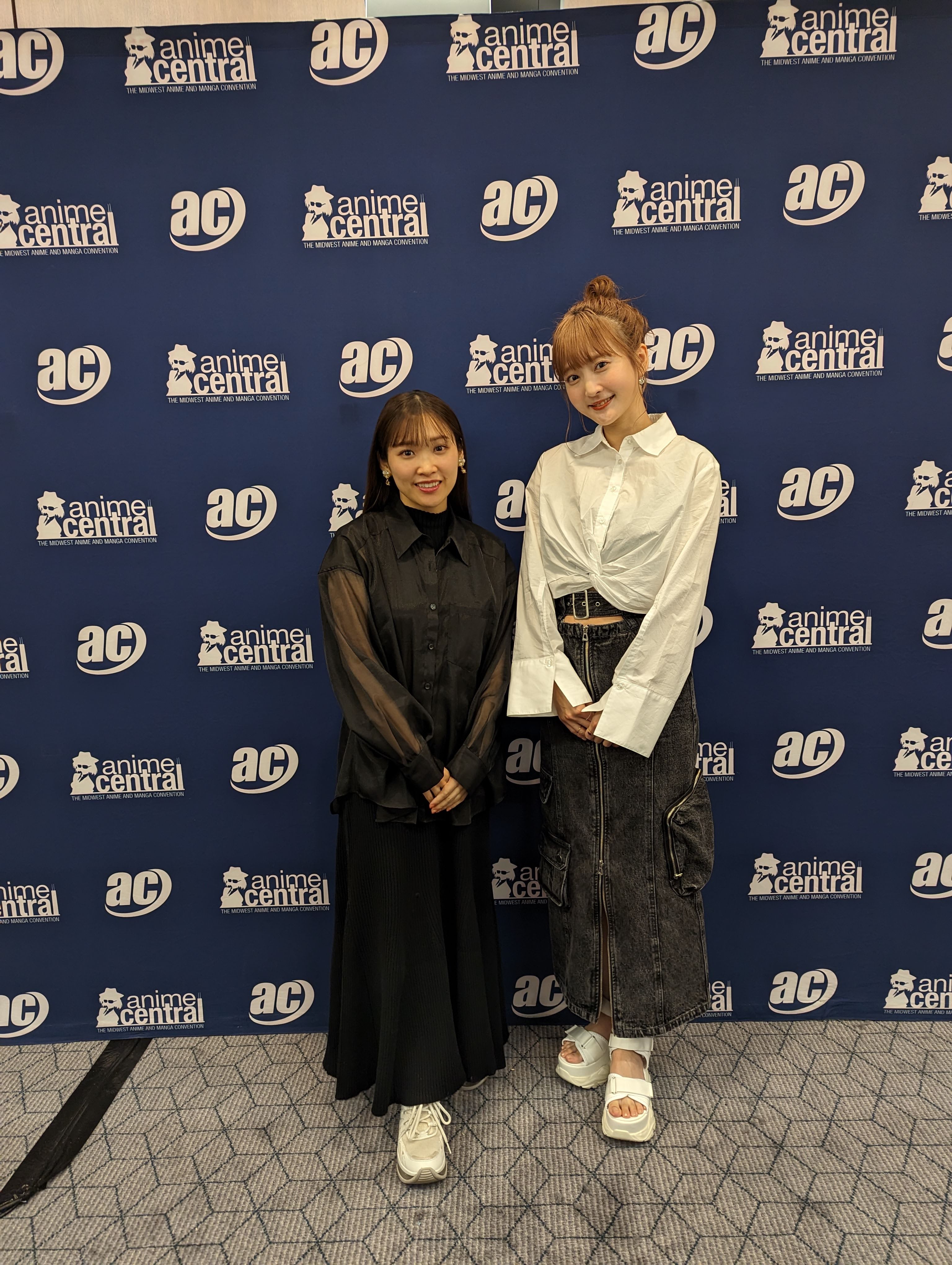
Gaogaigar, Godannar, and Gundam X: Kakazu Yumi Otakon 2024 Interview

Kakazu Yumi is a voice actor arguably best known for her role as Yuffie Kisaragi in the Final Fantasy franchise. I had the opportunity to interview her at Otakon 2024, where my questions focused primarily on her work in mecha anime. 

One actor you seem to work with pretty often is Hiyama Nobuyuki, such as in Gaogaigar, Godannar, and even Initial D. Do you have any fun memories of performing alongside him?

Thank you for coming to this interview. I’ve been a fan for many years, and I want to start off by asking about one role I know you for that others might not think about: Shizuru in Godannar. Do you recall what it was like working on that series, and how you approached the character?

Kakazu: Shizuru is a very grounded, very mature character, and she was also a commanding officer. It is a characteristic that’s unlike me, so I tried to perform that part when I was voice acting.

Another staff member who was on Godannar was Kimura Takahiro, who recently passed away. He also worked on another series that you were involved with: Gaogaigar FINAL. Did you ever get to know him, and do you have any memorable stories about him?

Kakazu: Actually, Kimura-san came to visit the studio when we were recording, and we also spoke together on stage. At the event, he tried to apply his own makeup, but he had never done it before, so he asked, “Kakazu-san, can you help me with this?” So behind the stage, I was doing it for him.

I never knew that he cosplayed! Do you remember who he cosplayed as?

Kakazu: I think he had a white wing…? Or maybe it was Shishioh Guy. I forget.

On the topic of Gaogaigar, you returned to the role of Renais a few years ago in Super Robot Wars 30. What was it like playing Renais back when you first worked on FINAL, and did anything change for you playing the role over the years in SRW?

Kakazu: Not a lot changed.

Related to that, I was actually at the Final Fantasy panel earlier, and you mentioned playing Yuffie since Ehrgeiz. So, similar question: Do you think your performance has changed, or has it been pretty solid throughout?

Kakazu: I said this on stage, but when I first started voicing Yuffie, she was one character in a fighting game. The only sounds she had were “Hahh! Hahh!” type noises.. But over time she’s gotten more chances to speak and more lines, and now she stands alongside the other characters, showing how mainstream she’s become. I’m grateful that I was able to meet Yuffie all the way back in the beginning, and also even more grateful to the people who have supported her up until now.

Another anime you worked on is a series called RahXephon, and your character, Hiroko, has a very powerful and tragic death. And do you have any advice for voice actors on how to approach such a challenging scene?

Kakazu: So I remember getting the script when I was recording, and I remember being very focused on reading and trying to understand it. Also, I remember the pain I felt when I was recording. When I’m acting out these tragic scenes, I try to recall my personal experience, and also use my imagination to expand the performance. So maybe this isn’t advice, but I realize that everything I’ve experienced in my life has become a resource that fuels my acting and performance. So maybe the advice I would give another voice actor is to find meaning in everyday life.

You seem to act alongside the actor Hiyama Nobuyuki pretty often. Do you have any fun memories of performing alongside him in any of the shows you worked on together?

Kakazu: I actually have a lot of fun memories with him. When Hiyama would say the line, “GAO! GAI! GAAAAR!,” he would shout the line in a great big voice, and it would reverberate through his entire body. I remember the first day of this recording, he did the line, and the mic actually broke!

Oh, I found the cosplay that Kimura-sensei did. [Shows a picture of Guy from Gaogaigar.]

Ah!

I interviewed the director of Gundam X, Takamatsu Shinji, at Otakon nine years ago. Do you remember what it was like working on that series and playing the character of Sala?

Kakazu: Sala was actually my debut role as a voice actor. She’s actually second-in-command and has an important role, but she’s only 17 years old. So there’s a difference between how she has to behave as second-in-command versus how old she actually is. So it was really difficult to figure out the balance between her age and her having this mature, heavy responsibility as second-in-command. I remember working very hard figuring that out, and this contributed to learning more about voice acting.

Thank you!

Anime Central 2023 Interview: Tanaka Rie

Tanaka Rie is a veteran voice actor with over two decades’ experience in anime.

How would you describe the voice acting industry back when you first started versus what it’s like today?

I feel like I’ve only been in the industry for 25 years, so there are other people who are much more senpai than I am. But back when I first started out, voice actors wouldn’t show their faces in the media a lot. Now, though, you see voice actors doing media, movies, TV shows, photo books, and such. So you start to see that it’s much more out there in the media. There are a lot of young kids nowadays who are really excited about the prospect of being voice actors, so in that sense it’s changed quite a bit.

You graduated from the famous Yoyogi Animation School. Are there any particular things you learned there that you feel have helped you greatly in your career?

I feel very fortunate and very blessed that I was able to attend Yoyogi Animation School. I only went for one year’s curriculum there, but I was able to gather a lot of experience. That’s because it’s very different when you’re a voice actor because in order to be a pro, you have to gather experience. And so even if you go to school, even if you go through a curriculum, and even if you graduate, you still have to get that experience at doing that job. But I do find that one thing that was really great was being able to be around other people who were also looking to be voice actors—that friendly competition, that rivalry. We also had auditions at school. 

When I originally went to the school, though, I debuted as a singer and not as a voice actor. I was with Sony for three years as a singer, and then went from there to being a voice actor. I feel that it was a very good experience. I’m glad I went to a vocational school.

When I think “Tanaka Rie,” the first character that comes to mind is Lacus Clyne from Gundam SEED. How did you approach playing the character, as well as Meer Campbell in SEED Destiny?

Lacus Clyne is the most difficult character I’ve ever played. She’s not a regular human, but rather one of a variation called Coordinators. They’re like a third era of humanity who are born having been adjusted and “coordinated,” and so Lacus’s emotional expressions were extremely challenging. Even through the full range of emotions, not much changes. She’s a human being, but she doesn’t emote in a very human way. In times of sadness or in times of joy, I had to portray her intense emotions in a calm and reserved manner. Whether she’s happy or crying, she doesn’t falter. 

Her name means “lake” [in Latin], and the director told me that the image of her is that of a tranquil lake that calms. Having to keep that image in mind was incredibly hard.

Lacus was a character in both SEED and SEED Destiny, whereas Meer Campbell debuted in SEED Destiny. People who’ve never seen these shows might be wondering who the heck Meer is, but she’s a copy of Lacus Clyne—a fan of Lacus who was surgically altered to look and sound like Lacus because Meer wanted to become her. She was a fake Lacus who was deceived by the villain of the series, Durandal, into believing she could become the real deal. 

Meer is actually a powerless and utterly normal human being, and so she has this very human quality to her. I found that it made her an incredibly easy character to play—Meer’s so human that it hurt. As a girl, she has a certain way of being and a strong personality. This comes out when she says, “I am Lacus!,” due to her brainwashing, and even when she’s confronted by the real Lacus Clyne, she still thinks, “I was Lacus, wasn’t I?” I loved Meer.

As I played her, I thought, the character of Meer really is a complicated girl. While Lacus was difficult to play, Meer was the opposite: a woman who was all too human. I could really empathize with her as a normal person. I approached her as a character one could easily empathize with. That’s what made Lacus so much more difficult, whereas when playing Meer, I could use the emotions I had going into the studio that day and put them into the character because she’s such a human character.

You were involved with the Precure franchise very early on in the role of Shiny Luminous. Do you have any memorable stories from working on Max Heart, and how does it feel to see Precure going for this long?

Luminous is not technically a Precure, and she’s actually a queen in that world. When I got the part, I thought she was a Precure, but in actuality she wasn’t. It was tricky in the sense that she’s a character who can transform like a Precure but isn’t actually one and doesn’t refer to herself as one. 

She transforms with a shout of “Luminous Shining Stream!” using her mascot Porun as a compact, but that doesn’t mean that she’s powerful. Precures fight using martial arts, throwing punches and kicks—that’s how they show their strength. Luminous can’t fight physically, though. She’s a character who runs away and guards using barriers, and thinks, “I’m going to protect everyone!” after she’s transformed. Luminous really tries her hardest, and because she can’t fight directly, she strives to safeguard Nagisa and Honoka, Cure Black and Cure White. However, when the time comes, all three are within her barrier to perform the attack Extreme Luminario. When that happens, all three are truly united.

When she’s Kujou Hikari, however, she’s just a normal schoolgirl who works part-time as an apprentice at a takoyaki cafe, and is rather shy. Playing her ended up requiring a lot of effort.

You play many “big sister–like” characters, such as Suigintou in Rozen Maiden, Maria in Hayate, Akira in Yamato 2199, and Maho in Girls und Panzer, yet you’re able to make them sound so different from one another. Do you have any advice for newer voice actors who would like to be able to diversify their style?

I’ve done so many roles, and when it comes to being a voice actor, we do a lot of solo recording these days. But before COVID-19, it was common to do voice recording as a group, and for like 23 people to share three mics.

When it comes to differentiating roles, well, there’s only 24 hours in a day. For example, you might have one project that goes from 10am to 3pm, and then another 4pm to 9pm, and you have to try your best to do well in both roles during those 24 hours. In that hour between, I make that “switch” inside me, like when I’m eating. While it’s tough to do so, being able to just go “I’m triggering that switch” is what being a professional voice actor is about. 

When I think about it, though, I don’t know for sure how I accomplish that. It’s true that my normal speaking voice isn’t the one I use for my characters, so perhaps it’s like putting on one mask and then switching to another. So it’ll be like: “Today I’m Nishizumi Maho.” “Today I’m Luminous.” “Today I’m Lacus Clyne.” I might be doing it unconsciously. But being able to “switch” like that is very important.

Those aiming to be voice actors shouldn’t just focus on voice acting but should learn from many things and observe more broadly. You often hear it said that you need to start your voice acting career in your teens, and if you wait until you graduate, it’ll be too late. They’ll even say that in the voice acting schools. But you’ll have some who start voice acting in high school, while others might go to college first or switch to becoming voice actors from a different career. It’s really about your own life, and the timing with which you decide, “I want to do this thing!” becomes important in terms of how you study and learn about the world and society. Between a voice actor who knows nothing of the world and one who has all kinds of experience, I find the latter more impressive. That’s what my senpai have always said as well, and it makes one want to try to have many different experiences.

Mobile games have become a major part of the entertainment industry, and you have worked on a great many. Do you do anything differently when voicing characters for mobile games versus anime or more traditional video games?

When it comes to mobile games, anime, and more traditional video games, the approach doesn’t really change. However, what is different is dubbing foreign media—dramas, movies, and such. That’s because they don’t want me to use “anime character voices” but rather something closer to my real voice. So the approach to voice acting for a TV show from abroad is different compared to doing something for a work that’s originally Japanese. 

In recent years, you started your own YouTube channel, playing games, releasing music, and showing your cosplay. What made you want to start streaming yourself?

During the coronavius pandemic, I thought, “Why not try?” but actually, the suggestion to make a YouTube channel began before COVID-19. I’d never done YouTube before, and between my main job as a voice actor and having to provide deliverables and content, I wasn’t sure if I had the capacity to handle doing it all. But I’ve always loved video games, and so when COVID-19 happened and things couldn’t continue as they had, I thought, “Well, guess I’m doing this.” But also, I thought about how I couldn’t interact with the fans—the tens of thousands of subscribers—and how hard it was for them, as well as how sad it made me as well as Vega-chan, who’s been working with me all this time. In terms of the scope of what we could do, we started with streaming from my home, and as things have opened back up, I can do more and even find sponsors. That said, things didn’t totally open back up, meaning it’s still a bit hard. So this is a kind of fanservice so I can connect to the fans through my voice, and I can give them joy through my broadcasts, where I deliver content twice a week. I love video games, and the fans like seeing me play them, so that makes me happy.

You are known for having a love of Indian curry. Do you have a favorite type of Indian curry?

Cashew curry! It has cashew and chicken. I always make sure to have cashews in my curry, and I love the spices. Indian food in Japan is amazing! I love it.

Would you like to give a message to your fans reading this interview?

I really cherish all my fans. Even if there are times you can’t hear my voice in anime or video games, I’ve been working hard with Vega-chan on my YouTube channel for a long while now, and fans can interact with me there. Also, there will be a lot of big projects coming up where you’ll be able to hear me again, and so to my fans not just in Japan but all over the world as well, please continue to support me. I look forward to seeing you all soon.

Anime Central 2023 Interview: Kubo Yurika and Ichinose Kana

Kubo Yurika and Ichinose Kana were at Anime Central 2023 to promote the game A Light in the Dark. Kubo is best known for her role as Koizumi Hanayo in Love Live!, and Ichinose is currently voicing Suletta Mercury, the protagonist of Mobile Suit Gundam: The Witch from Mercury.

I also had the chance to ask Kubo a question specific to Love Live! during her fan panel, which I’ve included at the end of the main interview. 

You’re both here at ACen because of your role in the visual novel A Light in the Dark. What are your most memorable experiences being involved with this game?

Do you mean during the recording?

Yes.

Kubo: Personally, this was during a time when I had a lot to record, so my sessions went on for days. My character, Mysterious Girl, goes through a lot of difficulties, and I was going through a lot of difficulties in my real life as well. So that overlapped, and I really realized that my life can be so easily influenced during recording.

Ichinose: By the roles you play?

Kubo: Yes, yes! That’s it! There’s a part of me that can be hurt quite a bit.

Ichinose: Oh, wow.

Kubo: So my memorable experiences tend to be about the heaviness of the role I play.

Ichinose: For me, I like playing serious roles, and my role hit close to heart. My character starts off very reticent, but there was still a lot of emoting involved. I do like heavy roles—and it was still heavy—but I still enjoyed it.

-How have your experiences playing characters such as Hanayo from Love Live! and Ichigo from Darling in the Franxx influenced the way you play your characters in A Light in the Dark

Kubo: So for both of us, it probably wouldn’t just be the roles from the works you mentioned—they’re all opportunities for growth as actors.

Ichinose: These are genuine experiences that contributed to our breadth of expression.

How do you balance playing multiple characters at once and keeping track of them?

Kubo: As for keeping track of roles, I think all the characters we’ve played so far don’t necessarily influence who we play in the moment. We just get into the role and do it that way. 

Ichinose: And since all the roles are so heavy in A Light in the Dark, resetting the emotions and getting out of the characters tends to be a bit of a challenge. But at the same time, as we work professionally, we do get ingrained with an emotional switch, or an acting switch, where we switch between roles in a very natural way.

Kubo: Yes, you’re right!

How does recording for a visual novel compare with other types of voice work?

Ichinose: Compared to recording for other types of video games, in other games, it’s more typical to do small voices like “Yah!”

Kubo: And “Hah!”

Ichinose: Yeah, and “Hah!” But there is a much longer story in A Light in the Dark, and there is much more emotional continuity. Depending on the recording, we might be skipping chapters, so we have to keep track of the continuity of the story and also the emotions. 

Kubo: But there are also branching paths in the story where the user has to select which path to go, and we have to be aware of the pre-selection emotion as well as which path the user chose.

Ichinose: One dialogue path would end, and then we’d have to do a different dialogue path.

Kubo: The level of tension and excitement would have to change too. It’s one of the fun and interesting things about the project.

Ichinose: I would sometimes have to rewind the emotional state of the character and go back. 

Kubo: Right!

That general area is part of the difficulty.

What inspired you to become a voice actor, or get into the entertainment industry in general?

Kubo: I started as a model for teenage magazines, but even before then, I was always watching anime and reading manga. While modeling, I was starting to wonder if I was unfit for the job, whereas I could always enjoy anime and manga. So I always wanted to take on the challenge if I ever had the opportunity. I did tell my agency that’s what I wanted to do, but they told me off that it’s not such an easy thing. They didn’t outright oppose what I said, but they said it’s not easy. When I got the role for Love Live!, though, that was my foot in the door into a career as a voice actor.

Ichinose: When I was in grade school and kindergarten I always loved watching anime, and my life more or less involved watching anime. I did play with my friends, but if I were at home, I’d spend pretty much the whole day watching anime. As I watched anime and loved anime, my thoughts turned towards the casts in anime, towards the voice actors, and eventually I would think that I wanted to get involved in the world of these various animation stories. So when it came time to choose a future for myself, one day I went to an open campus at a voice acting school, where I got my determination to go into voice acting.

For my three years in high school, I worked part-time and saved so I would have the money to pay for my own tuition for voice acting school. I paid my way through, did my audition, and got a role. So I started from a love of anime, refined my voice, and tried it out. I have the person who encouraged me to go into voice acting back then, who told me I had a chance, to thank.

Is there anything about your performances as Mysterious Girl and Young Girl that you’re especially proud of? 

Ichinose: What do you mean by that?

In the sense of, did you think you felt you had performed well, and can look back and say “I did a really good job here?”

Kubo: For my role as Mysterious GIrl, there is a portion in the latter half of the game where she goes through an emotional explosion. I played that part thinking, “I could lose my voice tomorrow, but I’ll go through with it.” If you can experience that scene, I would be very happy.

Ichinose: My character gets a little bit closer to the main character in the middle of the story, and she begins to open up and start talking about her dreams and aspirations—like how she would like to eat sweets. Normally, that’s the kind of dream that’s easily realizable if you have the money for it, but the girls grew up in an environment where that’s not something they could afford.

How is it to play a character who didn’t have something that was so ordinary and common for normal people? That was my challenge. So this is a serious title, but there are these small slivers of hope that my character can aspire towards, and if that kind of nuance gets through to the player, I think my acting will be rewarded.

Thank you!


Bonus: Extra Question for Kubo Yurika from the Previous Day’s Fan Panel

I love the way that you portray Hanayo’s shyness and intensity. My question is: I noticed your performance of her evolved over time; what changes did you make to playing Hanayo over the years?

Kubo: It wasn’t like I really changed my approach to Hanayo—more like as the years went by, Hanayo saw more of her character, experienced more, as did I personally. I think that’s kind of what led to that natural evolution. I wasn’t very conscious of it at all.

Mewtwo vs. Mewtwo: Notable Voices in “The Wonderland”

The Wonderland (Birthday Wonderland in Japanese) is a film packed with whimsy, imagination, and a tale of a young girl finding the strength to keep going. The movie is directed by Hara Keiichi (Miss Hokusai), and I really recommend it. 

But there’s also something about the film that delights me on a much more personal level: it features not one, but two different voice actors who have played the Pokemon Mewtwo.

In the role of Hippocrates the Alchemist is Ichimura Masachika, who voiced Mewtwo in the anime film Mewtwo Strikes Back, Mewtwo Lives (aka Mewtwo Returns), and Super Smash Bros. Melee. He’s known for much more than anime—being the original Japanese Phantom of the Opera—but it’s his performance as the Genetic Pokemon that is nearest and dearest to me. He brings a similar gravitas to his Hippocrates, though The Wonderland also allows a more comedic side as well. 

The antagonist of The Wonderland, Zan Gu, is played by Fujiwara Keiji—Mewtwo in Smash 4 and Super Smash Bros. Ultimate. He’s known for roles such as Maes Hughes in Fullmetal Alchemist and Holland in Eureka Seven. Zan Gu is actually more similar to Mewtwo, but Fujiwara doesn’t give the two the exact same vocal quality.

As an aside, if you want to hear both of them perform dialogue as Mewtwo, switch your copy of Melee and Ultimate to Japanese.

Having two Mewtwos is a rare distinction for any work, and it’s all the better that they give such stellar performances in a strong movie like The Wonderland. I’m not saying you should go see the film just for the acting, but they definitely make it even better.

Precure: The Crossroads of Voice Acting

Fifteen years is a long time for an anime to continue running strong, and Precure still stands at the apex of the magical girl genre in terms of prominence and notoriety. In that decade and a half, numerous voice actors have lent their performances to Precure, and it’s made this franchise into one in which seiyuu of all stripes, from anime veterans to relative newbies, intersect. To be involved with Precure can become a defining role, or an affirmation of an illustrious career.

In the original Futari wa Pretty Cure, Cure Black was played by Honna Youko, who at the time had more experience playing small roles in live-action series. While the few voice performances under her belt at the time were big deals—starring roles in Studio Ghibli films Omohide Poroporo and Whisper of the Heart—she wasn’t an anime industry juggernaut. Opposite Honna in the role of Cure White was Yukana, who was coming into her own as a fan-favorite due to roles such as Li Meiling in Cardcaptor Sakura and Teletha Testarossa in Full Metal Panic! Since then, Honna has earned some major roles in anime, notably Sumeragi Li Noriega in Gundam 00, but the bulk of her career is in voice-overs and narrations for television. Yukana, meanwhile, has become an anime industry veteran.

Mizusawa Fumie, voice of Cure Marine

Another voice actress who had a career-defining performance in Precure is Mizusawa Fumie, voice of Cure Marine. Prior to Precure, she was relatively unknown, playing roles mostly in small and relatively obscure anime. Now, she’s beloved by both children and adults for her energetic performance in Precure, and is considered a highlight of every crossover movie she appears in. In contrast, Mizusawa’s counterparts—Nana Mizuki (Cure Blossom), Kuwashima Houko (Cure Sunshine), and Hisakawa Aya (Cure Moonlight—were in 2009 already known for numerous characters in extremely popular series. These include Naruto (Nana as Hyuuga Hinata), Azumanga Daioh (Kuwashima as Kagura), and Sailor Moon (Hisakawa as Sailor Mercury).

The list of veterans goes on. Sawashiro Miyuki (Mine Fujiko in the more recent Lupin III works) became Cure Scarlet. Kugimiya Rie, the tsundere queen, came to Precure as Cure Ace. Tamura Yukari (the Magical Girl Lyrical Nanoha to Nana Mizuki’s Fate Testarossa) is Cure Amour. Koshimizu Ami, who originally began her career as Nadja Applefield from the 2003 Toei anime Ashita no Nadja, became Cure Melody. In each case, there’s a sense that they’ve “arrived in Precure” at long last.

One unique case is Miyamoto Kanako, who began her Precure career as a theme song vocalist across multiple series. In time, she landed the role of Cure Sword before going back to performing more themes. Other Precure singers have made cameo appearances, but only Miyamoto has made it as a Cure.

Various levels of acting experience existing in a production is hardly unusual, anime or otherwise. However, what Precure has is sheer longevity and the constant reboots to bring in new blood. It’s been around for so long that girls who grew up with Precure are now old enough to audition for it. To that point, according to the original producer of the franchise, Washio Takashi, 2017’s Kira Kira Precure a la Mode was the first time that girls who grew up watching the series became the voices behind the Precures themselves. Precure is in a unique position to push younger talent while also celebrating the efforts of voice acting’s Titans, and it should continue to do so for as long as it’s around.

Otakon 2017 Interview: Furukawa Toshio & Kakinuma Shino

At Otakon 2017, I sat down with a husband-wife duo who are also two veteran voice actors of the anime industry. Furukawa Toshio is probably best known for playing Piccolo in Dragon Ball Z, while Kakinuma Shino was Naru in Sailor Moon (Molly to dub fans!).

I did not have enough time to ask any Piccolo questions, but if you love giant robots it’ll be worth your while.

Mr. Furukawa, Ms. Kakinuma, thank you for this interview.

My first question is to Mr. Furukawa. You played the role of Kenta in Mirai Robo Daltanias, so you had experiencing working with Nagahama Tadao. What was it like working with him? 

Furukawa: I actually worked with Mr. Nagahama before Daltanias, on The Rose of Versailles. But the time of Daltanias was during the super robot era, with the iconic huge robots in Japanese culture. He brought me in saying, “You know, we have a role for a prince for you. He’s a really good-looking character. Why don’t you come in?” So that’s how I came on the boat.

He was a very gentle person, and as a director he never stopped smiling. He was a very kind figure.

I’d also like to ask you about a different, maybe very different, director: Tomino Yoshiyuki. What was it like working with him as Kai Shiden in Mobile Suit Gundam?

Furukawa: Mr. Tomino is on the opposite spectrum, I’d like to say. He is relatively the stricter type. He’d give long lectures when we were young and starting off with First Gundam. He was known as the scary kind of director.

My next question is directed to Ms. Kakinuma. When it comes to anime based on manga, oftentimes anime-original stories are considered to be not as important or significant. But the romance between Naru and Nephrite is considered a fan favorite. What was it like voicing Naru for that story?

Kakinuma: When we were voicing for Sailor Moon, unlike some of the works now where there’s a manga established, we were doing it at the same time that the manga was going on. Some of the people who worked on the anime didn’t even know that romance doesn’t happen in the manga. So when we voiced it, we were doing it as if it were canon.

You’ve both been in the voice acting industry in Japan for a long time. How do you feel it’s changed over the course of your careers?

Furukawa: When I began, “voice actors” not really a thing. We were a subgenre of the bigger category of actors, where there were actors, stage actors, etc., and voice actors were part of the mix. During that time, we were not well recognized. If you look now, though, you have voice actors appearing on TV. I’ve even appeared on TV myself. I’d like to say that we’ve gained a kind of citizenship. We’re now more recognized.

Kakinuma: Recording has changed from when I began until now. For example, when I first started, we were voicing things that were on film, projected. When a part was over, we would have to reel in the film to record again if we needed to. Now, you don’t have that “reeling in the film” time; you can just click and go back to your previous scene. It saves a lot of time.

It’s normal now to see a kind of timeline on the bottom of the screen showing where you are in that span. By going to that, you don’t need a sense of timing anymore. But back then, since there were no timelines whatsoever, we needed a kind of specialized skillset.

Furukawa: TV equipment also changed. For example, nowadays we have multidirectional digital surround sound, which gives you the ability to hear all around you from all sorts of different channels. But back then, we didn’t have any of that, so we expected everyone to hear from the two speakers. Everyone speaking at the same time would be the same as mixing everything together. Now, if you did that, you might not get the same experience, so you need to split the channels in recording. So technology has advanced, but this has gotten us to take additional time in the recording process.

My last question is about Muteki Robo Daiohja, another giant robot series. What was it like working on it compared to Daltanias?

The biggest difference is that, while they’re both in the era of prolific super robots and space and everything, Daiohja is kind of a parody. Although they’re both similar—I got to play a prince in both anime—the biggest difference is that Prince Mito’s name derives from Mito Koumon, the very famous Japanese period drama about a prince taking out all the evils in his era. Daiohja had a lot of these elements. The characters Skad and Karcus came from Suke-san and Kaku-san from Mito Koumon. Everything about it was pretty much a parody of Mito Komon, so that’s the biggest difference I felt.

Thank you again for the interview. I look forward to your continued successes in your careers.

Genshiken Nidaime First Trailer

The new Genshiken has its first trailer, a 30-second clip. It’s just a voiceover with Yoshitake, Yajima, and Hato, as well as a small bit of Ogiue, but there are some things I observed in the trailer.

The main thing I noticed is that the new Ogiue voice, Yamamoto Nozomi, sounds similar to the previous actor Mizuhashi Kaori, though not Mizuhashi’s performance of Ogiue. Mizuhashi is quite varied (Ogiue doesn’t resemble Miyako in Hidamari Sketch), and Yamamoto’s performance sounds a bit closer to some of Mizuhashi’s other roles, such as Rosetta in Kaleidostar or Mami in Madoka Magica. So it’s sort of a match, but sort of not.

The other notable thing, I think, is that they didn’t give Yajima a “fat” voice. A lot of times, heavyset characters in anime have a deeper, rounder voice to emphasize their weight, but Yajima’s voice sounds more normal. It doesn’t quite have the coarseness I was expecting, but it’s still good to see it not fall into that old stereotype.

Genshiken Nidaime starts July 6th. I still haven’t decided if I’ll episode-blog it or not, especially because that eats up a whole bunch of my post slots (even if it would make for easy content). The other issue of course is that I’ve already done chapter reviews of the source material, and I worry that it’d be quite redundant. That said, maybe I can use it as a way to revisit those previous chapters.

What do you think? Are the chapter reviews already more than enough?

Additional New Voice Actors for Genshiken Nidaime Anime

As people suspected, it looks like the entire cast is being replaced for the new Genshiken anime. In addition to the previous announcement, now we know the following:

Ohno: Yukana (Cure White, Teletha Testarossa), was Kawasumi Ayako (Lafiel, Mahoro)

Madarame: Okitsu Kazuyuki (Jonathan Joestar), was Nobuyuki Hiyama (Guy from Gaogaigar)

Kasukabe: Satou Rina (Misaka “Railgun” Mikoto), was Yukino Satsuki (Kagome from Inuyasha)

Sue: Oozora Naomi, was Gotou Yuuko (Asahina Mikuru)

Angela: Kobayashi Misa, was Kaida Yuki (China from Hetalia)

The two voice actors for the Americans are really new, which has me concerned as both of them require varying amounts of English. This is especially the case for Angela, who often speaks for minutes in English, and her previous voice actress had actually studied abroad in the United States, so she at least had a strong amount of English fluency. Even Sue uses some English in Genshiken Nidaime/Genshiken II, so it’s going to be tricky business if their English isn’t up to snuff.

Although Yukana’s voice is noticeably different from Kawasumi Ayako’s, it similarly has a soft and gentle feel to it which you can hear in her roles such as Cure White, and Satou Rina as Kasukabe fits her forward and no-nonsense personality. In regards to the DESTINY OF BLOOD as Madarame, while Okitsu is nowhere near the screaming veterancy of Nobuyuki Hiyama, I think his role as JoJo #1, especially in the early episodes, shows that he can play a dork of sorts. In these three cases, it’s easy to just imagine the Genshiken characters with the voices of their previous roles, and I’d have to say all of the replacement voices seem like they’ll fit their characters, though they may take some getting used to. Of course, a part of me would still like the old voice actors back, but if this is what they’re going with, then at least for the older characters it works out.

By the way, this is the second time Yukana is a replacement voice actress. The last time was with the Z Gundam movies where she became the new Four Murasame. Genshiken is no Gundam though, so I doubt there’ll be as much backlash.

Genshiken Nidaime Voice Cast…and a NEW OGIUE?!

UPDATE: Small point made below.

genshikennidaime-image

Ever since the announcement of the new Genshiken anime, I’ve speculated about the voice cast. Courtesy of one Anonymous Spore and the official anime website, the new cast for the Genshiken Nidaime (or Genshiken II as I prefer to call it) has been revealed, and the big, big shocker is that Mizuhashi Kaori will no longer be playing Ogiue, that most grand of angry, once-traumatized hair-brushed fujoshi.

My initial reaction has been genuine surprise and confusion, as I thought she fit the role tremendously well, and seemed to be well-established as Ogiue. Her Ogiue felt genuinely conflicted about everything, and it’s my favorite role of hers (biased perhaps). She even participated in the Genchoken radio shows with Madarame’s voice actor Hiyama Nobuyuki, and drew a comic about how she landed the role as Ogiue. Even putting aside my own Ogiue fandom I’ve thought for a long time that Mizuhashi ranks among the best voice actors out there.

ogiue-newvoice

That said, I think it would be a bit unfair to judge Yamamoto Nozomi before I even get to hear her voice the part of my favorite character. She’s pretty new, but she’s also already played roles such as Yukimura in Boku wa Tomodachi ga Sukunai, and Tetora in Joshiraku. When I think about Tetora’s voice in particular, it may actually be a bit closer to how I imagined Ogiue’s voice in my mind when I first read the manga. Actually, Gankyou’s voice would have been even closer, but that’s maybe getting too off-topic.

As for the rest of the cast, you have Uesaka Sumire  (Dekomori in Chuunibyou demo Koi ga Shitai!) as Yoshitake Rika in addition to performing the opening theme, Uchiyama Yumi as Yajima Mirei (Davi in Dokidoki! Precure, Arata in Saki: Episode of Side A), and a combination of Kakuma Ai and Yamamoto Kazutomi handling the female and male voices of Hato Kenjirou, respectively. If you look at their list of works, all of them are pretty new voice actors, so perhaps there was something on the production side that required the use of newer voices. I read that they may be changing the old characters as well? Or maybe there was just a good old-fashioned scheduling conflict, which even happened with the Genshiken 2 anime and Keiko’s voice actor. In the end, it’s all just speculation, unless someone more familiar with the seiyuu scene could inform me otherwise.

Based on the previous roles of the actors for Yoshitake and Yajima, I can imagine them fitting their roles well, especially if they go for more naturalistic and awkward voices. I think Yajima especially will be a challenge.

In addition, voices aside, the art and character designs look probably the nicest they’ve ever been for Genshiken anime. I guess it all remains to be seen (and heard).

miz84-1 miz84-2

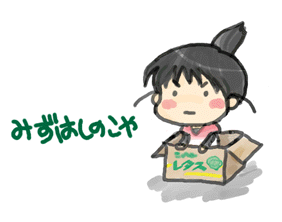
UPDATE: I decided to look at Mizuhashi Kaori’s official site, which isn’t really updated anymore, and what’s really curious is the fact that where once the front page image was of Ogiue in an empty cardboard box, now Ogiue has been replaced by a different character. I’m unsure if it’s meant to be Mizuhashi specifically or if it’s meant to be another one of the characters she played, but just the fact that she used to use an Ogiue image on her front page as early as September 2012 may indicate that she was rather close to the character of Ogiue.

Enter Animefan

A couple of days ago I made a post discussing the way in which the purchase of anime-related goods often transcends the purchase of anime itself. I didn’t concentrate much on the act of buying anime, and was planning a follow-up post, but Omo over at Omonomono beat me to the punch. He brings up some good points that I want to touch upon while also elaborating on this whole idea of what it means to “buy anime.”

First, a story.

I once told someone that I pretty much only buy DVDs of things with which I’m already familiar, to which he simply responded, “Why would you buy something you’ve already seen?”

Whereas I saw my ownership of DVDs as a testament of sorts to the shows I felt were good and enjoyable enough for me to have them in my collection, the other person saw DVDs simply as a way to try new things out. In the end, we agreed to disagree.

While this person was not what you’d call a hardcore fan of any kind of media, I think his philosophy applies to a lot of how anime fandom sees anime: Why spend money to see something that isn’t new to you?

Omo hit upon a simple, yet profound idea: the act of purchasing DVDs is “meta.” Anime fans generally love anime because it presents a world to them with a story and characters to whom they can relate or from which they can derive some kind of enjoyment or escapism. They become fans of the anime, but not necessarily fans of the anime as a creative work. If most anime fans find some way of watching their favorite anime for free, and they subscribe to the idea of not paying for shows already viewed, then it is difficult to see why they would purchase a DVD of it, as that would require them seeing their favorite show not necessarily as a window into another world, but as an endeavor born out of the thoughts and efforts of its creators. In other words, on some level, they would have to appreciate their favorite anime as a work of art, which I have to ask, how often does that happen with entertainment in general, let alone anime?

Are anime fans actually less likely to appreciate their favorite shows as works of art? I believe so, and I use anime conventions as an example. When it comes to anime convention guests, the people who get by far the biggest crowds are the voice actors. On the one hand this tells us that a lot of fans can at least see past the character the actor portrays to the individual performer, but on the other hand the voice of a character is directly a part of the show itself. The influence a producer or a director or even a writer has upon a work is less readily noticeable by someone viewing a show, and as such these guests tend to get fewer sheer numbers. Is this any more or less than the audiences who see actors over directors for live-action movies? I don’t think so, but I wanted to show that as far as anime is concerned, this is the kind of thing that happens.

My words bring up another potential conflict: is there something bad about being one of those fans who sees anime purely as a window into another world? My answer is that I do not find anything necessarily wrong with not engaging one’s favorite shows on that “meta” level. Nor is seeing the strings necessarily a good thing; it’s pretty much all subjective in the end. Actually, if you want to see a good example of a fandom which balances the meta with the immersive, then look no further than professional wrestling.

In pro wrestling, there traditionally have been two terms used to describe people who enjoy it: marks and smarts. Marks are people who believe wrestling is 100% real, that the Hulk Hogan in the ring is actually who he’s supposed to be. They see pro wrestling as a venue for good to defeat evil, or at least for bad-good to defeat namby-pamby-evil. Smarts on the other hand are fans who know that wrestling is all staged. They know that there are writers and scripts and politics behind the facade of Nothern Light Suplexes and Shining Wizards, and having a keen understanding of the backstage actions is where they derive their enjoyment.

But those are the two extremes, and in this age where the cat is completely out of the bag about wrestling being “sports entertainment,” there arises a new category of fan: the “smart mark,” otherwise known as the “smark.” Like smarts, they seek the truth of what goes on with the wrestlers as actors, but are also eager to suspend their disbelief just long enough for them to cheer for the good guys and boo the bad guys.

So who is the “better” fan? Is it the mark for his genuine immersion, or is it the smart who appreciates the performance?  Or is it the smark who tries to combine both worlds, arguably at the expense of either side?

And how do you get all of them to buy your stuff to keep you afloat?