
I’ve written a short, personal post about the late Wada Kouji over at Apartment 507. Wada was the singer of many beloved Digimon songs over the years, and had an unmistakable voice.

I’ve written a short, personal post about the late Wada Kouji over at Apartment 507. Wada was the singer of many beloved Digimon songs over the years, and had an unmistakable voice.

Parasyte, the story of a boy whose right hand is taken over by an alien parasite, was a popular 90s manga in Japan. Recently it’s gotten an anime adaptation with an updated look, so naturally Parasyte has been receiving more attention. What I hadn’t expected to see, however, was a Parasyte one-shot spinoff by shoujo manga legend Hagio Moto.
Hagio Moto is famous for being the mother of BL manga as the creator of Heart of Thomas. She’s continued to create manga since her debut in the 1970s, including science fiction, such as Star Red and A, A’, and even comics that act as allegories to the dangers of nuclear power. She generally stays within the realms of shoujo and josei, so the fact that she’s brought her talents to Monthly Afternoon (where Parasyte was originally published) is something special.
Yura no Mon o follows Yura, the young daughter of Tamura Reiko, who is the parasite disguised as the original hero Izumi Shin’ichi’s school teacher. Reiko decides to have a human baby with a fellow parasite, and her relationship with her daughter throughout the original series is portrayed as disturbing yet potentially redemptive. Yura is adopted by another family by the time of Hagio’s one-shot, but she every so often here’s a voice that tells her one thing: kill. Thinking it’s the voice of her mother, she goes through life with that whisper in the back of her head.
I’ll be honest, I’m not a fan of Parasyte, but that’s because it succumbs to many 90s manga tropes (particularly its portrayal of women). With Yura no Mon o, Hagio Moto brings the sensibility and soft style that made her one of shoujo manga’s most famous artists. If you have the chance, and you have even a passing familiarity with Parasyte, it’s worth checking out.
—
If you liked this post, consider becoming a sponsor of Ogiue Maniax through Patreon. You can get rewards for higher pledges, including a chance to request topics for the blog.

Of all the fujoshi-themed manga I’ve encountered (and I’ve read a lot), Okachimachi Hato’s Fujoshissu! is one of my absolute favorites. So, having recently found out that Okachimachi is starting up a new manga, I was immediately thrilled. While my search for fujoshi protagonists is why I first discovered her work, it’s Okachimachi’s expressive art style and subtle, considerate explorations of her characters that turned me into a fan.
Her new work, Kimi xxxru Koto Nakare (“You Shall Not xxx”) shows signs of being just as strong from the very first chapter, which is why I’ve decided to start writing monthly chapter reviews for it. This is only the third time I’ve ever done the “episodic review” thing (both previous instances were Genshiken anime and manga), so I hope you enjoy it.
Kimi xxxru Koto Nakare is the story of a budding teenage romance between Hayato, a male idol, and Nobuko, a female celebrity comedian. When the manga begins, we see that Hayato first discovers Nobuko at a very young age while watching television. Nobuko is the daughter of a famous comedian as well, and to Hayato, it’s love at first sight. He thinks she’s the cutest girl ever, and it inspires him to get into the entertainment industry as a child model.

Years later, the two are now classmates, and while Hayato is adored by legions of female fans for his handsome appearance and cool demeanor, his real aspiration is comedy. Hayato asks Nobuko for help, and after some important lessons (namely that Hayato can’t be serious about comedy if he’s afraid of being laughed at), Hayato finally succeeds in getting some laughs. Grateful to Nobuko, Hayato finally confesses his feelings to her and even gives her a kiss, but while Nobuko is shown to secretly feel the same way as Hayato, she backs away and tells him that he can’t do that.

There is so much to talk about in this first chapter, but I think what stands out most is Nobuko’s appearance. While Tonari no Young Jump, the website on which Kimi Nakare is published, can ostensibly be called “shounen” or “seinen,” it’s clear that Okachimachi comes from a very different background in terms of art style and approach to manga. Kimi Nakare is very much in a shoujo vein, but very rarely do shoujo manga feature a main female character as plain-looking as Nobuko. Generally speaking, they tend to be not the most beautiful but still thin and pretty in a conventional sense. In contrast, Nobuko is larger, has a rather masculine face with big bushy eyebrows, and is just noticeably less attractive than Hayato.
Even the story draws attention to the fact that Nobuko is not supposed to be good-looking. When a young Hayato is telling his parents that Nobuko is the cutest girl he’s ever seen, they react with puzzlement. “Cute? I would call her interesting…but cute?” Hayato “shouldn’t” be attracted to her to such an extent, but he is.

What’s amazing about this contrast is that it doesn’t feel simply like wish fulfillment that a handsome idol like Hayato would fall in love with Nobuko. Putting aside his love of comedy and the fact that she’s mentioned as being incredibly talented at getting laughs, Nobuko is strong, supportive, cheerful, and isn’t afraid to take someone down a peg. As the chapter progresses, it becomes evident that these qualities are what continuously draws Hayato to her. Okachimachi never draws Nobuko in a way implied to be Hayato’s “perspective” with the requisite that she then appears to be more beautiful than she is, but by just seeing them together, I could understand just how attractive Nobuko’s personality could be.
Suffice it to say, I already love this manga. I believe that Nobuko’s negative reaction to Hayato’s kiss and confession comes from the fact that he’s an idol and therefore isn’t allowed to date. Whether that means they have a clandestine romance or they have to constantly resist their own feelings, I can’t wait to see what happens next.
—
If you liked this post, consider becoming a sponsor of Ogiue Maniax through Patreon. You can get rewards for higher pledges, including a chance to request topics for the blog.

Name: Nakano, Amane (中野あまね)
Alias: A-chan (あーちゃん)
Relationship Status: Dating
Origin: Kiss Him, Not Me
Information:
Serinuma Kae’s best friend and fujoshi comrade, Nakano Amane shares in Kae’s penchant for pairing boys in their class. They disagree as to whether their classmates Igarashi and Nanashima should be paired in that order, or the opposite (7×5, Amane’s preference).
Amane is into seiyuu talk shows and otaku events, and has a non-otaku boyfriend named Mikoshiba.
Fujoshi Level:
Little is precisely known about Amane’s fujocity, but it appears to be comparable to Kae’s.
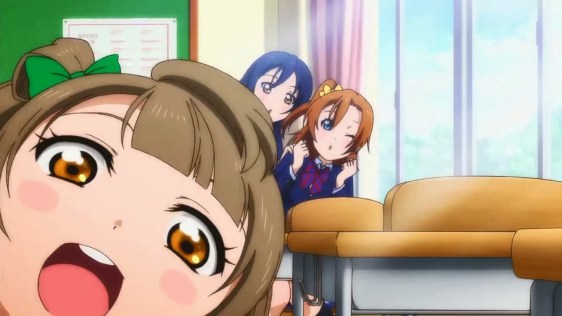
I’ve written another Love Live! character analysis over at Apartment 507, this time about Minami Kotori, aka Minalinsky Our Lord and Prophet. Where are my Kotori fans at?
Between showers, fools, and lambs, April is a month of change and transition. It’s only appropriate then that I try to evolve as well! As always, it’s with the help of my friends and Patreon supporters that I continue to try and improve Ogiue Maniax:
General:
Johnny Trovato
Ko Ransom
Alex
Diogo Prado
Sasahara Keiko fans:
Kristopher Hostead
Yoshitake Rika fans:
Elliot Page
Hato Kenjirou fans:
Elizabeth
Yajima Mirei fans:
Machi-Kurada
So, the first change I’m making is a small adjustment to my schedule. Since 2010 I’ve generally structured my weekly posting schedule to be posts on Tuesday and Friday with at least the occasional lighter post on Sunday, most typically a Fujoshi File entry. However, I’ve noticed that most of my readers come in on Sunday, and to give my lowest-impact content at that point feels like a shame, because if you’re coming to Ogiue Maniax I believe it’s to read something interesting. Because of this, I’ve decided to switch Sunday to being a main posting day, with either Tuesday or Friday being less heavy. I’m still on the fence on which one to use, but most likely it’ll be Friday. I hope you enjoy the change, and of course, if you miss the post it’s always there in the archives.
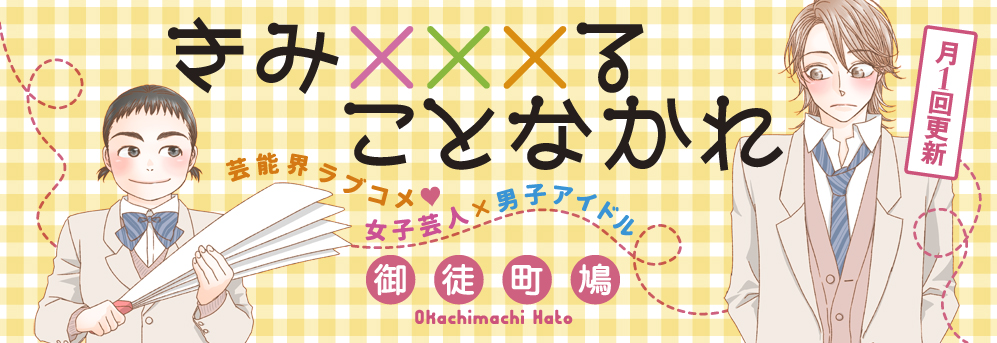
A second possible change is adding another series other than Genshiken for me to review regularly. The title is Kimi xxxru Koto Nakare (“You Can’t Do That”), the new monthly manga by Okachimachi Hato (creator of one of my favorite manga, Fujoshissu!) about a high school romance between a male idol and a female celebrity comedian. The question is, how should I cover it? To help me with this, I’m using a handy dandy poll:
Keep in mind that this is just for feedback and the winning answer won’t necessarily determine what happens. Also, I mistakenly thought it was a weekly manga, so a previous Patreon post of mine mistakenly had weekly options.
As for what’s happened on the blog over the past month, the biggest event for Ogiue Manaix and all current Genshiken readers definitely has to be the latest manga chapter, which concludes the Madarame harem story. I won’t say much more, so go check it out if you’re curious as to what goes down and my thoughts on it. Also, I need to point out that a funky translation of Chapter 122’s contents has been going around, and it provides an inaccurate image of the characters. In response to this, I’ve also translated a couple of small but vital excerpts from the chapter in the hopes of clearing up the confusion.
As mentioned last month, I went to see a whole bunch of animated films. These include The Boy and the Beast, The Case of Hana & Alice, Beyond Beyond, Kizumonogatari Part 1: Tekketsu, Psycho-Pass: The Movie, and Long Way North. This means it was a pretty danged review-heavy month, especially because I also covered Please Tell Me! Galko-chan, the mahjong manga Saki, and the ever-successful Aikatsu! I’m typically more of an analysis and deep thinking kind of writer, but it’s not bad to have months like this either, and most of the time I my reviews are more half-review/half-analysis anyway.
Speaking of reviews, I also finally updated the Reviews section of the blog. I neglected it for about…a year and a half? orz
I also talked last month about my concern over stagnating as a writer. My smart and ever-perceptive friend David Brothers gave me some advice in response to one of my Apartment 507 articles on Yandere characters, which is that I should think about putting more of myself into my writing. I think that ever since I’d gone in a more academic direction it’s improved Ogiue Maniax in a number of ways. At the same time, that sort of more casual and personal feel, while still present I believe, might not be as apparent. Sometimes I have to be more friend than teacher.
Three final comments:

Abadango vs. Ally Pound 2016 Grand Finals
This past weekend was the international Super Smash Bros. tournament known as Pound 2016. There, in the stacked, 500-man bracket for Smash Bros. for Nintendo 3DS & Wii U, a Mewtwo took home the gold for the first time ever at a major event. To a Mewtwo player such as myself, this is undoubtedly the most significant result thus far in the history of the game.
The player behind Mewtwo was Abadango, who at this point is a well-known name in the Smash 4 competitive community. He’s used a great number of characters throughout the life of Smash 4, and whether it’s been his creative Pac-Man, his dangerous Wario, his punishing Meta Knight, or now his Mewtwo, Abadango’s play turns heads. As someone who values deadly powerful combos and setups, the recent litany of improvements to Mewtwo have made the character an enticing choice for Abadango, though he has also expressed concern on his stream over its unforgiving nature. Nevertheless, Mewtwo’s worked out for him. Cutting through a sea of difficult opponents including VoiD’s Sheik and Ally’s Mario, Abadango made Mewtwo look deceptively simple, but anyone who knows the character is well aware that Mewtwo is anything but.
Mewtwo’s history in Smash 4 is a wild one. Designed from Day 1 to be a “glass cannon,” a character that is strong offensively but light and easy to KO, Mewtwo has benefited both from dedicated players pushing the character forward (such as LoF Blue, Mew^2, Killer Jawz, Rich Brown, and The Reflex Wonder) and from the “hand of God,” as the Genetic Pokemon might be the most buffed character in Smash 4. Mewtwo is now faster, hits more reliably, combos better, and more. The number of improvements that have been bestowed upon Mewtwo are nothing small, though it’s worth pointing out that among many fans of Smash for the past three months (since the buffs started happening) that people still doubted Mewtwo’s prowess. How could Mewtwo possibly be truly good, when the character is still very large, extremely light, and easy to juggle? The answer is, with an amazing versatile kit that allows Mewtwo to exert pressure at almost every point during the game.
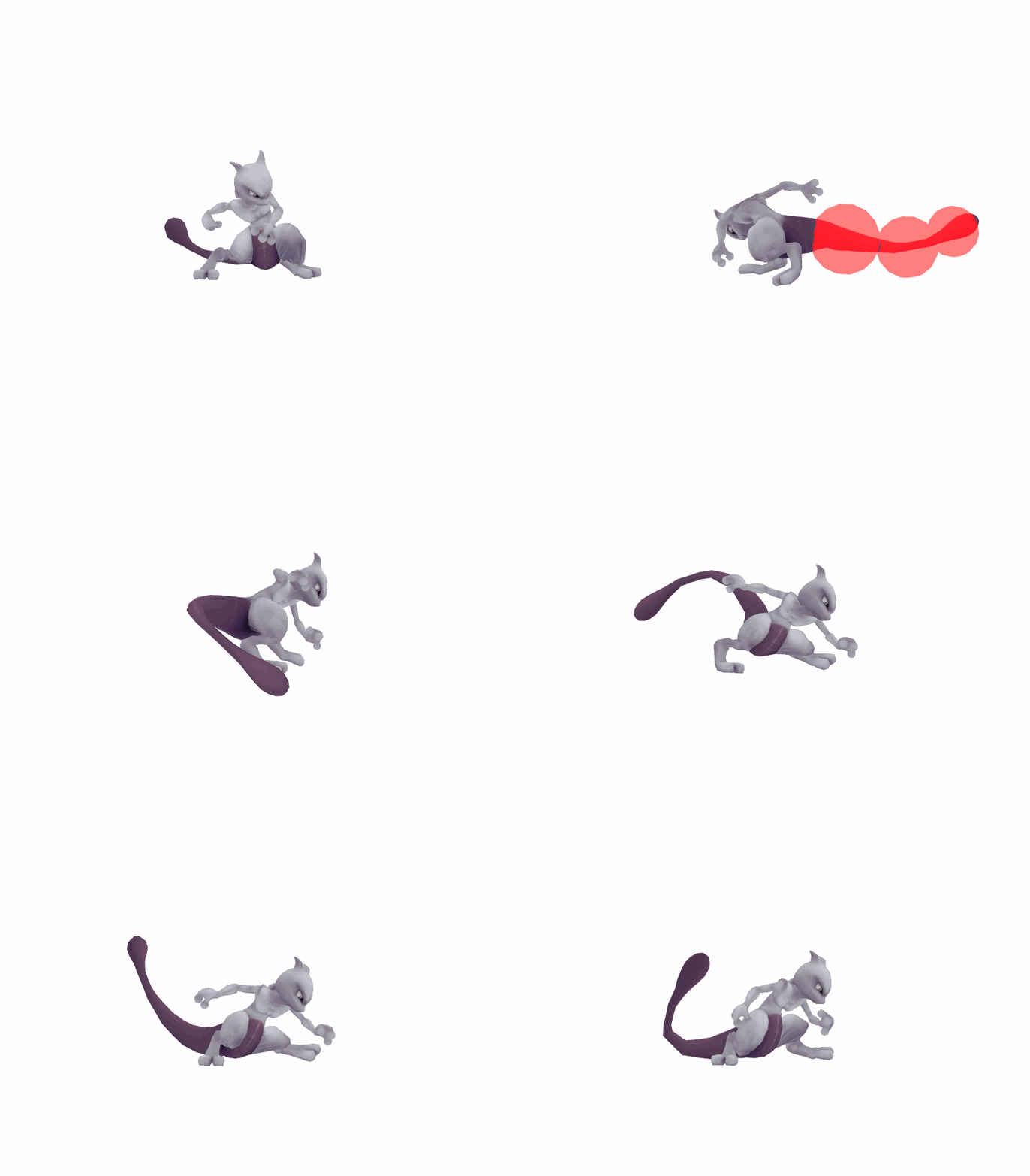
Don’t underestimate Mewtwo’s Down Tilt
Even in its darkest days, I never believed Mewtwo was truly a terrible character. Due to the unforgiving nature of its design (second lightest character in the game), Mewtwo makes you feel terrible for your mistakes. One wrong move and you can end up questioning your own existence. A Mewtwo played to perfection would still have been a force to be reckoned with even before the patches, but reaching that point and maintaining it was easier said than done. Now, I believe that a sub-optimal Mewtwo is still going to feel the sting of their mistakes (only Mewtwo now has more tools to avoid those mistakes in the first place), while a refined Mewtwo is easily high or even top tier. The fact that the top Mewtwo players present such a range of play styles—aggressive, defensive, technical, slippery, mind game-oriented—shows just how much potential the current Mewtwo holds.
That said, I think that the biggest change to Mewtwo that has come with the improvements both in the players and in the character is that Mewtwo now has access to a powerful ingredient that it lacked previously: fear. At first, Mewtwo could not instill fear in opponents, and that meant Mewtwo was always on the back foot because of how easy the character is to KO. Now, things are different.
It’s not just any fear, however, but more of a fear that’s mixed with the sweet scent of opportunity. When you fight Mewtwo, and you’re on your last stock while Mewtwo has a 60% lead, you’re aware of how good Mewtwo is at dealing damage and sealing stocks.
Then you remember, Mewtwo’s light and easy to kill. Opportunity knocks. “All you need to do is capitalize on one or two mistakes and the game isn’t just even, it’s arguably in your favor due to the weight disparity!”
The temptation is there, but so is the terror. Case in point, in an interview after winning the weekly tournament Wii Bear B-airs, LoF Blue mentioned that he switched from Sonic the Hedgehog to Mewtwo because the threat of Mewtwo’s myriad kill options forces the opponent to play differently at key moments.
A similar pressure is also placed onto the Mewtwo players, who are aware of how fragile their character is. If you’re down as Mewtwo it’s possible to make it back, and all you need to do is to not get hit, ever. A good Mewtwo draws strength from this tension, from teasing that glimmer of hope while still emanating a threatening aura.
If you’ve decided to pick up Mewtwo after Abadango’s win, I have one piece of advice for you: Be prepared to cry into your oatmeal as you die at 65% off of one critical mistake. Half the battle is a mental one. You have to maintain your composure as you’re getting bodied, or else the psychological damage you take just gets worse and worse. If you still stick with the character even after all that abuse (or maybe you’re kind of a masochist), then you’ll find a strong ally.
Also, if you’re interested in learning more, check out Dabuz (the best Rosalina in the world) and his analysis of Abadango’s Mewtwo:
—
If you liked this post, consider becoming a sponsor of Ogiue Maniax through Patreon. You can get rewards for higher pledges, including a chance to request topics for the blog.
 Based on the design of its central character, Please Tell Me! Galko-chan likely draws initial attention for two reasons. While I’m not denying the popularity of Galko herself, I do think the anime has an appeal that goes beyond eye candy or the potential thrill of hearing girls talk candidly about personal topics.
Please Tell Me! Galko-chan typically revolves around the conversations between three characters: Galko (a trendy “gyaru” whose appearance can be deceiving), Otako (an otaku girl who prefers to avoid social interaction but is still Galko’s best friend), and Ojou (a rich girl whose experiences differ greatly from the rest). Each short 7-minute episode, they talk about things like how eating spicy foods makes your butthole hurt or the difficulties of buying bras when your breasts are too large, usually instigated by Otako who loves to tease the easily embarrassed Galko. Even if she doesn’t get embarrassed about something, a whole group of boys fawning over her will easily let their imaginations go wild.

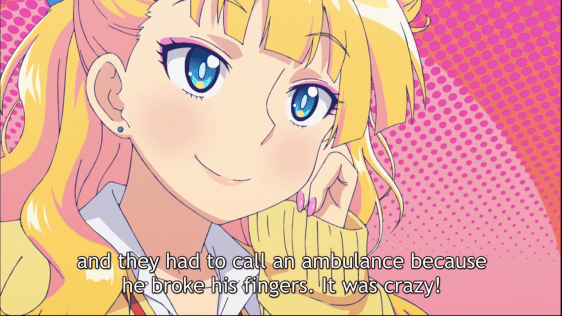
It is most definitely a fanservice anime, but I feel that the show is carried as much by its characters’ personalities as it is by their appearances (and even then it’s really only Galko-chan). When people mistakenly suspect a tired Galko of being out with men (she actually just stayed up all night watching anime), or when it turns out she’s into literature, the appeal isn’t simply that there’s a “mismatch” between her inside and outside. Rather, her character feels quite full-formed despite each episode being so short. The same goes for the other characters as well, such as how the overweight Nikuko is shown to not only be extremely athletic, but also brimming with confidence. In this respect, Otako is actually my favorite because of how her desire to tease Galko is shown to bring Otako out from her own shell, creating a beautiful (if weird) friendship. Also, Otako kind of has an Ogiue vibe.

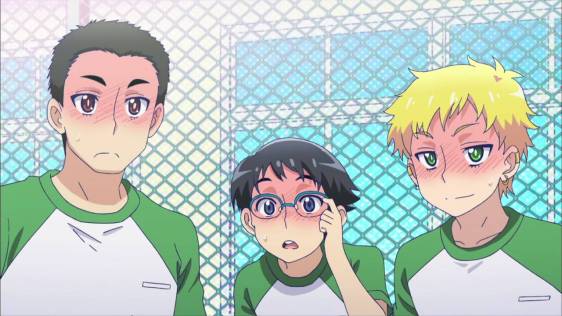
I think what maybe says it all is that, as I watched the show, I looked forward to seeing how the guys react to Galko’s conversations just as much as I enjoy Galko’s hijinks. They’re at that age where even one hint at something sexual will cause their hearts to race, and their confusing of Galko’s general warmth and friendliness with the idea that she definitely likes each of them feels just as much a part of youth as all of the stuff on the girls’ side. While I don’t know anyone who’s ever kneaded dough to try and replicate the feel of a boob (this really happens in the show), I don’t think it’s that farfetched given how cultures, inside or outside of Japan, mysticize the idea of being with someone to the point that even approximations gain a kind of value all their own.
—
If you liked this post, consider becoming a sponsor of Ogiue Maniax through Patreon. You can get rewards for higher pledges, including a chance to request topics for the blog.

 OGIUE MANIAX