Ask Genshiken Creator Kio Shimoku!

In preparation for the American bluray release of Genshiken: Second Generation (aka Genshiken Second Season, Genshiken Nidaime, Genshiken II), Anime News Network and NISA are accepting questions from fans for an interview with creator Kio Shimoku. Keep in mind that Kio has historically given very few interviews even in Japanese, so this is a very rare opportunity for anyone who’s a fan of Genshiken and the man himself.

I of course will be submitting my own question, and it will most likely be Ogiue-related. Also, I may have bought the Japanese blurays already, but I definitely plan on picking these up as well.

(Thanks to Patz for telling me about this.)

You Should All Check Out the Street Dancing Anime Tribe Cool Crew

I’m not a dancer. In fact, I don’t have a single rhythmic bone in my body, and the only reason I can or will ever dance is because I’m fairly shameless when it comes to humiliating myself. That’s why it might come as a surprise that my favorite anime out of the current season is Tribe Cool Crew, a show about street dancing. Though only a few episodes have aired, I find myself looking forward to Tribe Cool Crew every week because of how it combines the best of boys’ anime and girls’ anime for children.

The thing that really drew my attention to Tribe Cool Crew from the very beginning is the dynamic between the main characters, a boy named Tobitatsu Haneru, and a girl named Otosaki Kanon, both of whom love to dance. The two complement each other well not only in terms of personality and style, but also because they’re essentially the typical morning boys’ anime protagonist and typical morning girls’ anime protagonist who have met up in a single show. Haneru is small but energetic with a constant in-your-face attitude, and his burning desire to be the best and to meet his idol, Jey-El, wouldn’t be out of place in shows like Mushiking or Yu-Gi-Oh! Zexal. Kanon is shy but comes alive while dancing as the anonymous internet celebrity “Rhythm,” utilizing her great height and long limbs to accentuate her moves. In many ways she reminds me of Hanasaki Tsubomi, the main heroine of Heartcatch Precure!, especially because the show takes time to focus on her gradually building confidence.

Essentially, I find that it combines the ambition of the boys’ anime with the care and consideration of the girls’ anime. Though Tribe Cool Crew is still incomplete, it gives me the same general vibe as anime such as Battle Spirits: Shounen Toppa Bashin and Ojamajo Doremi, both of which I consider to be among the best of children’s anime. As the dances are all done in motion-captured CG, it’s also clear that the show is a response to popular CG dance anime such as Pretty Rhythm and Aikatsu!, taking what was previously solely the realm of idol anime and giving it a bit of a hip hop twist. It’s the kind of expansion of a genre or trend that I can really get behind, even if I don’t quite understand dance.

One aspect of the show that might be difficult for people looking for more plot-centric or character aesthetic-focused shows is that Tribe Cool Crew is still a show meant for kids at the end of the day. For example, the show sometimes features lessons for young, aspiring dancers on topics such as isolation. That said, the anime does feature some characters that an older audience might relate to better.

The look of the show might also take some getting used to, as the character designs are somewhat unusual for anime. They appear to take lessons more from Disney or other American cartoons that emphasize heavy variation in silhouettes to a heavy level of caricature, which can be a bit jarring. It has its own charms, however, such as in the case of Kanon, who is portrayed as an awkwardly lanky girl that perfectly fits both her personality and age, looking as if she just hit puberty and is beginning to feel conflicted between how she believes her upper-class family wants her to be and her inner passion for dance.

You can watch the show on Crunchyroll. Overall, I think Tribe Cool Crew is a really solid show and perhaps the sleeper hit of the season. It has a lot of potential, and I look forward to seeing where it all goes.

Random Thoughts Upon Revisiting Madoka Magica

Although I watched the original TV series of Puella Magi Madoka Magica, only recently did I finally see the movie trilogy. I’ve already laid out quite a few of my thoughts about the series including its status as a magical girl show  and how I felt about its ending, but revisiting Madoka has prompted me to contemplate certain aspects of the series some more.

Back when the Madoka Magica TV series first concluded, I remember kransom mentioning to me that one of the reactions from the Japanese fandom was this idea that Madoka was essentially the bookend for the era of anime that began with Neon Genesis Evangelion. That sounds pretty lofty and exaggerated, but when I was watching the movie I was reminded of the amount of indecision that goes into Madoka’s character. One of the questions throughout the anime is whether or not Madoka will indeed become a magical girl, but when she doubts and hesitates it’s shown to actually be to her advantage, while for Shinji it’s considered a clear sign of his weak, pathetic nature. The notion that lacking resolve can in some sense be a good thing because it means you think more carefully about the consequences and those around you is something that can be easily swallowed up by a society that tends to prioritize “getting things done no matter what.”

Another thing that struck me watching Madoka again was the presence of the abstract, mosaic-like qualities of the Witch realms by Gekidan Inu Curry. I was already familiar with his work from the Goku Sayonara Zetsubou Sensei intros, but when I thought about the fact that this bizarre yet beautiful work has been utilized in shows like Madoka, it made me wonder how many people have been exposed to this more unorthodox artistic style that would not have given it the time of day otherwise. I think it’s often easy to criticize SHAFT as a studio for taking on shows that frantically emphasize otaku tastes, but that very quality of “moe” (or “captivation” if you will) has also been the door into a higher level of artistic expression that isn’t quite as bound by the conventions of anime, if only temporarily.

Anyway, I might do a review of the movies, especially the third one, but no guarantees on that.

The Fujoshi Files 114: Tanaka Haruna

Name: Tanaka, Haruna (田中春奈 )
Alias: N/A
Relationship Status: N/A
Origin: Fujoshissu!

Information:
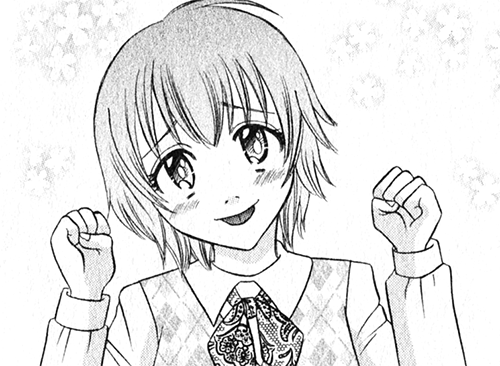
Tanaka Haruna is a professional manga author and an alumnus of Ryouhoku High School, where she was a member of the manga club 10 years ago. Because her manga had been doing poorly as of late, she visits her alma mater in an effort to find her early amateur work and to rekindle her passion. Haruna’s specialty is shoujo manga.

Haruna is boyish in appearance to the extent that she is easily mistaken for an approximately 14 year old male. Haruna’s old classmates are a little envious of her youthful looks, while the current Ryouhoku manga club members, especially the girls, find her incredibly moe.

Fujoshi Level:
Little is known about Tanaka’s fujoshi side, though she is shown in the past discussing various pairings with her fellow club members.

Slaughter of Twenty Faces: Genshiken II, Chapter 105

This month, we have our first ever Madarame and Sue-exclusive chapter. Sue tries to jettison her feelings for Madarame as only Sue can, by handcuffing him to a chair and putting funny masks on him until her perception of Madarame changes and encouraging him to date Hato. At the same time, Madarame, still reeling from his nearly physical encounter with Keiko, is trying to comprehend women’s behavior, which might as well be an ancient and inscrutable language to him. In the end, a poor of choice of words on Madarame’s part, a comment on breast size, may have resolved Sue’s problem for her.

Back in 2010, I wrote a small post on how interesting it is that Sasahara and Madarame essentially “traded preferences” when it came to their real-life vs. anime love interests. Namely, despite Madarame being into the character Renko (who is closer in personality and looks to Ogiue), he was head over heels in love with Kasukabe, who was closer to Sasahara’s favorite character Ritsuko. In Chapter 105, Madarame mentions the fact that, in a harem series, Sue’s type, a young-looking westerner with slender limbs and small proportions, is his favorite kind of character, and I think it’s quite notable that Madarame is only now realizing this himself. The explanation Madarame gives in this chapter is that Keiko and her attempted sexual advance on him has messed with his view of the world and how he approaches the subject of women, and it makes total sense, seeing as how the worlds of 2D and 3D have begun to blur in his head.

This is not to say that his confused behavior is Keiko’s “fault,” however, as Madarame himself sees it, but that the younger Sasahara putting the moves on Madarame has forced him out of the warm and comforting shell of his 2D complex. To Madarame, his former distinction between 2D and 3D is that 2D is where he can channel his desires both emotional and sexual, and 3D, the land of the mysterious creatures known as “actual women,” was so inaccessible to him that the best he could do was fawn over Kasukabe from a distance. When Angela was trying to get in his pants, Madarame likely saw that as so far outside reality that it might as well have been a dream within a dream. Keiko’s actions introduced the word “possible” to his real-world (meaning real women) vocabulary, and so in a way his protective layer of ignorance has been shattered in a manner different from Kasukabe rejecting him. Now, Madarame is conscious of the idea that women might be trying to send signals, but he’s basically a man who has been living in a cave all his life seeing sunlight for the first time. It is probably to his benefit that he becomes aware that women who like him can exist, but for now he’s merely blinded and clawing at open air.

Thus, Madarame tries to “read” Sue, given his limited context. “She’s on my bed! We’re by ourselves!” It’s very possible Madarame could have made a big mistake if not for Sue immobilizing him with those handcuffs, but it’s also understandable in that, when it comes to the opposite sex, he’s more or less a baby who has just learned to crawl, let alone walk. His comment to Sue that, well, Hato doesn’t have any breasts, is born from a brief moment of overconfidence (one might say even hubris) and a relative lack of interpersonal communication skills. Earlier in the chapter, Madarame notices that Sue is not completely flat-chested, and so in stating that Hato “doesn’t have any breasts, huh,” he tries to make a distinction between Hato and Sue. However, Sue has been shown to be sensitive to this subject, so it comes across as more of an insult. And even then, this sort of detail which otaku can elaborate upon extensively, the difference between an AA and an AAA cup or whatever, is not exactly going to win any points when talking to an actual girl.

As for Sue, I find that she’s trying to do what Hato himself had attempted before. Sue asks Madarame to date Hato, much in the same way that Hato was pushing Madarame towards being more assertive with his feelings for Kasukabe, and in both cases they were ways to distance themselves from their own feelings. “If he’s in a relationship, I can get over him!” For that matter, Madarame sort of did the same thing to himself with respect to Kasukabe, and even Yajima, who is not in this chapter, has been shown cheering for Hato x Mada as a way to keep her own attraction to Hato bottled up. With Sue specifically, however, it looks like this is her first ever crush, unlike the others who appear to have some unrequited feelings in the past, and so much like Madarame it is also Ms. Hopkins who is learning to crawl. However, Sue is arguably even more of an otaku than Madarame is, and in that way I can really see the perspective of Sue x Mada supporters. They even have that consistent interaction where Sue will pull out a reference and Madarame will instantly recognize it (this chapter it was Saitou Hajime from Rurouni Kenshin). While there are those who believe this swing and a miss on Madarame’s part is the death of this pairing, much like Keiko x Mada I find that it only opens things up more.

I don’t know if this actually a reference or not, but I find Sue’s “funny mask therapy” to be similar to one of the storylines in Space Brothers. At one point, the younger brother Hibito suffers from panic disorder due to a near-death encounter on the moon, which leaves him unable to wear a spacesuit. The treatment recommended to him is to wear various outfits, from football uniforms to animal mascot costumes, in order to gradually lighten the pressure his mind puts on him when in a spacesuit. Obviously, it doesn’t work the same way seeing as Sue is not the one wearing those ridiculous masks, but a similar effect is desired on her part.

The chapter ends with Hato struggling to draw manga. It might be setup for the next chapter, but what I find interesting is that Hato is having difficulty making his manga more interesting, as opposed to being unable to draw BL. Progress!


Making Lemons Out of Lemonade: Empty God Core at the B²OA Gallery

02_diablos

As an anime and manga blog largely focused largely on commercial output, it is rare that I will report on and review an Art Show in all of its capitalized glory. However, I feel it important to discuss the “Empty God Core” show at the B²OA Gallery, featuring the works of Japanese artist Umezawa Kazuki.

I am well aware of the fact that anime and manga have been subjects of exploration, self-discovery, and exploitation since at least Murakami Takashi and his “superflat” movement. Often times challenging and presenting the exoticism of Japan’s visual culture, artists like Murakami tend to feel as if they come not from the otaku subculture itself, but are reacting to it as it has grown over times. While I would not go so far as to say that this is some unforgivable flaw in his work, that he may not be a “true” otaku, it does make me notice when a piece of art conveys the perspective of someone who has embraced the lights and sounds of anime and manga as almost existential hazes.

That is the impression I received from Umezawa’s work, though even before I saw the actual show itself I had an opportunity to meet him for the first time thanks to our mutual friend, Ko Ransom. If there is anything that stood out to me most about him at first glance, it would have been his A Certain Scientific Railgun pins adorning his clothing. The one most prominent could be seen on his chest, a chibi version of Nunotaba Shinobu, my favorite character in the Index universe. A teenage scientist with a propensity for interlacing her speech with English, Nunotaba comes nowhere near the default choices for popular characters in her series, so I knew that Umezawa was serious business.

That being said, while I was aware that Umezawa was an otaku before I saw “Empty God Core,” I would have jumped to that conclusion almost immediately if I had come in without knowing a thing. Umezawa’s works consist largely of collages of anime characters, scrambled to the point of almost losing all recognizable qualities, and then rearranged to create futuristic, apocalyptic landscapes and large, god-like figures. I say “almost,” because the first thing I spotted in one of his digital paintings was the characteristic blonde poof of Cure Peace from Smile Precure! Soon after, I spotted bits of other characters as well, but it made me realize how distinct Precure hair is designed to be, so that, even divorced from the very bodies on which they sit, one can see that, yes that over there is a piece of Cure Blossom, and down by the side is Cure Beauty. The iconic nature of anime and manga characters jumps to the forefront, and their fragments are used to construct worlds.

There is a general idea when it comes to anime fandom that a lot of its qualities arose from the perception of 1980s Japan as a kind science fictional space. Like Blade Runner, which envisioned a future city amalgamated from Tokyo and various Chinatowns, the common discourse positions otaku as products of their time, and their subculture a result of changes to the world, the economy, and the degree to which societal values crumble or ossify in response. In this environment, otaku have historically been viewed in a negative light, people who cannot confront reality, loners who can only consume their media in ways which reinforce their divorce from society, while anime and manga become increasingly shallow and lacking in any real substance. What Umezawa’s work does is flip that script on its head, and show how this otaku subculture and its inhabitants can utilize the “vapid” qualities of anime and manga and its devotion to signs and icons of cuteness, beauty, and sexuality as building blocks, as atoms to form universes. Rather than a dystopian cityscape creating the otaku, the otaku creates the dystopian cityscape. He turns lemonade into lemons.

This post is regrettably a little late, but if you’re in or around New York City, the show is running until November 15th. The B²OA Gallery is at 515 west 26th street in Manhattan, and is open Tuesday through Saturday from 10am-6pm.

Old and New: Studio Ghibli’s Tale of the Princess Kaguya

Any adaptation of a folktale must inevitably face two challenges. First, in conveying a story that “everybody” has heard of, how much should the audience be expected to know, and how much should it act as an unfamiliar experience? Second, to what extent should the narrative and cultural qualities be adapted to more contemporary sensibilities? In the process of transforming the classic Japanese story “The Tale of the Bamboo Cutter” into Studio Ghibli’s Tale of the Princess Kaguya, director Takahata Isao (Grave of the Fireflies, Anne of Green Gables) has found it appropriate to use this 1000-year-old story to question the relationship between happiness and security, and in the process has created a film that is extremely accessible to audiences around the world.

In both the original story and the film, an old bamboo cutter finds a small girl inside of a bamboo stalk and, along with his wife, raise this girl as their own. As the girl grows into a woman of incredible beauty, the man regularly returns to the bamboo forest in which he does his daily business. There, he frequently finds bamboo filled with gold, and using this newly-acquired prosperity, moves his family to the capital. However, the film first concentrates heavily on the early period of Princess Kaguya’s humble life in the forest, during which she is shown to be a tomboy who loves running in the fields and forests, and then focuses on her struggle with the splendor, pomp, and adherence to customs that are valued by the wealthy nobility. As a result, the film conveys both the experience of watching a child grow up through the eyes of loving parents, but also life from the perspective of Kaguya herself.

Kaguya’s active personality and disdain for the formal are, at least to my knowledge, original aspects of the film, and through her character shapes the classic story into a criticism of the assumption that life is at its best when one is free of monetary worries, and that upward social mobility is worth any amount of sacrifice. Of course, this is not a new theme in fiction, nor even in anime. After all, even Kill la Kill addresses this theme at one point with the “Fight Club Mako” episode and its similar transformation of a poor family into the upper class. What Tale of the Princess Kaguya does to really magnify this point, though, is to present many of the values from the time in which the original folktale was written, and to have it juxtaposed with Kaguya’s own free-spirited personality draws attention to how much life in the capital wears on her, and indeed how much women had to do to be “proper women.” Apparently, a true lady never runs, and most of the time should not even get up while sitting, nor does she laugh or shout. A true lady does not need eyebrows because she will never sweat. Everything is about staying put, but Kaguya inherently loathes this way of thinking, try as she might to adapt to it for the sake of her parents. In this respect, the film at certain key moments carries a strong feminist vibe.

In a way, Tale of the Princess Kaguya comes across as something of a mix of Disney’s Frozen (adapted from “The Snow Queen”) and Pixar’s Brave. It gives a new sensibility to an old fairy tale, but it also concentrates heavily on a daughter and her unwillingness to bend to the rules that her society tries to force upon her. The similariities to Brave are especially highlighted at the point in the story when Kaguya is presented with five noble suitors who, only hearing of her beauty rather than seeing it (as was the custom of the time), rush to take her hand in marriage. This is also present in the original story as just a matter of course, but here the film uses it to display the cheap and shallow notions of love that pervade the capital, its people, and old notions of femininity. One difference is that, unlike Merida in Brave, Kaguya does have a love interest of sorts (also an original character to the film).

While the thematic elements are important, it would be remiss of me to not mention the visuals style of the film. Unlike most other works from Studio Ghibli which, while always splendidly animated, tend to go for a cleaner look, Tale of the Princess Kaguya looks as if it were a picture book or an old Japanese painting come to life. The style seen in the promotional posters for the film is how the movie looks, and it creates a strong ethereal quality that falls in line with the overall themes of “The Tale of the Bamboo Cutter.” Even most of the characters look quite unconventional in terms of more attention being paid to differentiating them on a design level, with the only character who truly looks like a Ghibli-style heroine being Kaguya herself. It was clearly an enormous task for the animators, and even looking at the credits one can see that many of the top Japanese animation studios contributed, including Studio 4°C and BONES. Tale of the Princess Kaguya may be worth seeing just to experience its aesthetics.

Most people know Takahata for Grave of the Fireflies, and in that sense it sort of feels as if he and his old Ghibli partner Miyazaki Hayao have swapped places in what might be each of their final films. Miyazaki creates the overtly political and morally challenging The Wind Rises, while Takahata tackles a classic Japanese story about a beautiful girl. However, certain qualities of the film remind me of one of Takahata’s directorial works from his pre-Ghibli days, namely Hols: Prince of the Sun. Kaguya and her struggle recall the conflicted heroine Hilda in Hols, which perhaps makes it less of a new path and more of a return to, and evolution of, established aspects of Takahata’s history, something rather appropriate for an adaptation of an old folktale.


Mewtwo is Back, Baby! Thoughts from a Mewtwo Fan

mewtwo-super-smash-bros-4

Back in 2008 when Super Smash Bros. Brawl was released, it was a bittersweet victory. While the new game was huge, and it had a ton of amazing new characters (King Dedede! Captain Olimar!), it came at the expense of one of my favorite Pokemon of all time and my favorite character to play in the previous game Super Smash Bros. Melee, Mewtwo. How cool was it that Mewtwo didn’t hold items with his hands but with his mind? How great was it that Mewtwo was voiced by Ichimura Masachika, his actor from the original movie and also the original Japanese Phantom of the Opera? I wasn’t depressed about his exclusion or anything, but I’d hoped he would be back next time.

Fast forward a few years to the impending release of a new Smash Bros. Not only did they announce another long time wishlist character of mine in Mega Man, but 2013 was a different time for Mewtwo. While it hadn’t really gotten anything new back when its position was essentially supplanted by Lucario, Mewtwo had developed further within its own games. It received the devastating Psystrike as its signature technique. It was upgraded to have two Mega Evolutions. It even appeared in a new Pokemon movie (albeit that Mewtwo was different from the first one). Surely Mewtwo had a chance now, right?

After another year, after closely following all Smash Bros. updates looking for any hints and being taken for a ride (the Greninja trailer not only makes it look like Mewtwo at first, but also conspicuously does not feature Mewtwo as part of the background Pokemon), the 3DS game was released and the final roster revealed. The bad news: no Mewtwo. I said to myself, “It’s not so bad, I at least got Mega Man, which in a way I’d hoped for even more.” And I’ve been having a ton of fun using Mega Man, getting used to all of his odd quirks. I also began using Palutena, who is sort of like Mewtwo. I was content.

Then came Thursday and the 50-Fact Extravaganza (not really 50). Mewtwo as DLC.

I freaked. Inside, that is. I’m not the type who loses all control of himself even in emotionally exciting times. The dream is real, Mewtwo strikes back, and he has a fancy new 3D model to boot. I have my most desired dual mains. The only thing left for me to do is buy a Wii U.

Now, given Mewtwo’s inclusion in Super Smash Bros. for Nintendo 3DS & Wii U, one question still remains in my mind: how will the game implement Psystrike? Will it be a Final Smash, or will that be reserved for one (or both?) of its Mega Evolutions? If it’s a special move, how would they translate the particular properties of Psystrike, if at all?

Here’s my idea. In the Pokemon games, there are different forms of offense, Physical Attacks, which are resisted by Physical Defense, and Special Attacks, which are resisted by Special Defense. Mewtwo in those games has long been famous for having an absurdly high Special Attack stat, and so the best way to combat it would be to use Pokemon with high Special Defense. However, Psystrike flips that relationship on its head. Instead, if calculates Special Attack against the opponent’s Physical Defense, allowing Mewtwo to more effectively attack opponents that it might have trouble with otherwise. While Super Smash Bros. doesn’t have Physical and Special stats, what it does have is horizontal survivability and vertical survivability. Mewtwo’s Smash rendition of Psystrike could play off of this distinction by having it be a vertical KO move but calculate its launching power based on the opponent’s horizontal survivability (or vice versa).

The easiest way to understand horizontal vs. vertical survivability is to look at some examples. Take Bowser vs. Dedede, for instance, where Bowser is generally the heaviest character in the Smash series without modifications and is thus the most difficult to KO off the left and right sides of the screen. Dedede, while also very heavy, isn’t quite as robust in this regard. However, try to take them out by launching them off the top of the screen, and Dedede lives longer. There are even more extreme casse: Samus is very difficult to KO horizontally but quite easy to dispatch vertically, while Fox and Falco are the opposite. Thus, assuming that Psystrike KOs vertically based on the opponent’s horizontal survivability, it would mean that the move is relatively ineffective against Samus but great for taking out team Star Fox.

I also decided to try and express these thoughts in audio, just as a fun test. Tell me what you think!

So in short, Mewtwo hype all around. See you on the Battlefield.

Why “Battle Spirits: Shounen Toppa Bashin” is Still the Best Card Game Anime I’ve Ever Seen

In my previous review of the card game anime Battle Spirits: Shounen Toppa Bashin, I stated that the series is the best show of the collect-em-all TCG competition genre that I’ve ever seen. Having finished the series, I stand by that opinion more than ever. Though the climax and resolution of the series is a bit too abrupt, the overall sense of consideration for what it’s trying to convey and the continued growth and progress of its characters on both emotional and “competitive” levels make Shounen Toppa Bashin remarkably deep and a joy to watch.

Spoiler warning.

In the transition to the latter half of the 50-episode Shounen Toppa Bashin, the series moves its characters from elementary school to middle school. This brings with it a whole host of changes, such as the shift to school uniforms. However, what is fundamentally different about the anime from this point forward is that the characters are beginning to be viewed as young adults, even if their designs don’t change that much.

The best example of this would have to be Episode 32. In a seemingly generic boys’ show about playing other people in card games, Shounen Toppa Bashin devotes 25 minutes to exploring the mother of the main character and her feelings of loneliness as she watches her son hit that age where boys begin to emotionally move away from their parents while also dealing with the fact that her husband is never home (he’s out adventuring). As the protagonist Bashin Toppa nonchalantly ignores his mother Hayami (a case of being oblivious in general but also taking her for granted), her sudden disappearance makes him realize that all of the little moments in which she was “bothering” him were actually cries for help and attention. Upon remembering that it’s his responsibility to look after her in his father’s absence, Toppa ends the episode by declaring that card games aren’t as important as their relationship as family.

Toppa’s mother Hayami worried about losing her little boy

The obvious joke with TCG shows (thanks in part to Yu-Gi-Oh: The Abridged Series) is that whenever there’s a deep emotional connection, it’s usually in the sense of friendship, that one’s companions give the moral support one needs to overcome any adversary. Though that also exists in Shounen Toppa Bashin to a strong extent (and is better developed compared to other series as well), the situation between Toppa and Hayami is actually a moment where the show says that its own card game is meaningless if it means neglecting those close to you who are in need. The complex emotions of a mother watching her son grow up take center stage in a genre that is more often known for actively ignoring parents entirely.

However, Shounen Toppa Bashin not only expresses this sense of change outside of the card game its purported to sell but within it as well. From the beginning of the series, each character is associated with a certain color-themed deck. For example, Toppa runs a “red” deck, which is primarily devoted to outright aggression, while his main rival Sawaragi J utilizes a “white” deck, which emphasizes healing, defense, and regeneration. Conveniently, both characters are color-coded in their designs as well. Early on in the second half of the anime, Toppa finds that while he’s continuously improved as a player, his red deck has reached its limits. When another character suggests that he incorporate other colors, Toppa’s initial response is that the red attribute is a part of his identity, implying that he thinks using other colors means abandoning his very way of being. Eventually, he realizes the benefits of mixing it up and being able to grow beyond the one-dimensionality of his old methods while still maintaining it as a mostly red-oriented deck. It’s at once both an easy example for kids to learn how to improve their strategy in this game and a way of showing Toppa’s increasing maturity.

The color-coded cast

Similarly, when J goes from friendly rival to antagonistic force in the series, he abandons the white deck that had previously characterized him in order to go for something more varied and ruthlessly efficient. At the finals of a tournament, Toppa confronts J, and at the climax of a fierce, back-and-forth match between the two, Toppa plays a card that can win, provided the opponent has no white cards with which to defend. This is seen as suicide by all of the characters given J’s propensity for that color, but then the show reveals that J’s hand is devoid of any white cards. In other words, in his desire to find the “best” way to win, J forgot who he was. Combined with the lesson Toppa learns earlier in the series about varying his own deck, the result is a greater message of being open to change but not to the extent that you forget who you are and what values are important to you. And all of this is through the card game itself!

The last example of personal and emotional progression I’d like to talk about has to do with something I mentioned in the previous review, which is the development of a character from sideline cheerleader to direct participant. This is the path taken by the character nicknamed “Meganeko” due to her over-sized glasses. While you have examples of both in TCG anime, such as Anzu/Tea in Yu-Gi-Oh! Duel Monsters and Asuka/Alexis in Yu-Gi-Oh! GX, rarely does one turn into the other, and as in strong a fashion as Meganeko.

At the beginning of the series, Meganeko is essentially Toppa’s close childhood friend, unwavering supporter, and tacit love interest. Around the half-way point of the series on their last day of elementary school, Toppa and Meganeko have a fight because Toppa just wants to go play more “Battle Spirits,” whereas interprets his behavior to mean that all of their cherished memories of elementary school and their friendship mean nothing to him. Rather than merely waiting for Toppa to realize his mistake, however, Meganeko decides to learn how to play “Battle Spirits” in secret in order to understand him better and to basically meet him half-way, thus showing her active desire to better herself.

Meganeko, from supporter to equal

The typical series would have Meganeko learn the basic rules of the game and place value on simply the fact that she tried at all while at the same time placing her on a skill tier below the “important” characters. Shounen Toppa Bashin, instead, actually defies this trend by transforming Meganeko into a formidable competitor as well. Through her training, Meganeko becomes about as proficient in “Battle Spirits” as Toppa in a lesser amount of time. Not only does she find her own identity within the card game (a yellow “spell and support” deck), but she also ends up overcoming an opponent who had previously bested J, and even meets Toppa himself in the semi-finals of a tournament. Though Meganeko loses in the end, the show presents their battle and Toppa’s reactions in such a way that it’s clear that she has firmly established herself as Toppa’s peer in the very field he so cherishes through her hard work. By the end of the series, neither wins nor losses are guaranteed for Meganeko (or any of the other characters for that matter), which further highlights her position as being equal to that of Toppa, J, and the rest of the core cast.

Overall, Battle Spirits: Shounen Toppa Bashin is able to provide characterization and emotional development at various levels, both in direct relation to the card game after which the series is named and with respect to the realistic concerns that might face children as they grow up. The former can be seen in how Toppa and J are symbolized and represented through their personal decks and strategies, while the latter is most evident in the amount of care and attention the series gives to the relationship between Toppa and his mother. Furthermore, the character Meganeko presents a mix of these two aspects while also showing how a “cheerleader” female character can transform into a direct participant in an anime, thus providing a potential template for other characters as well. The cumulative effect of these and many other aspects of Shounen Toppa Bashin result in a series that is worth emulating.

The Fujoshi Files 113: Daigouin Pyonko

Name: N/A
Aliases: Daigouin Pyonko (大豪院ピョン子)
Relationship Status: N/A
Origin: Hanaukyou Maid Tai

Information:
“Daigouin Pyonko” is a doujinshi artist who wears bunny ears and ends all of her sentences with “-pyon.” She is a friend of the Hanaukyou household’s maid Suzuki Ikuyo, though their relationship is somewhat antagonistic. She created the doujin Kappa Buta, a yaoi doujin about a kappa and a pig (likely a reference to Journey to the West or one of its adaptations).

Fujoshi Level:
Other than the unusual animal content of her doujinshi, nothing else is known.