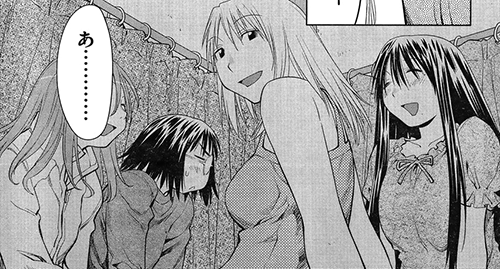
A Susanna Hopkins Hug Pillow…?!

I can’t say I’m entirely surprised that a Genshken hug pillow would exist some day. Kio Shimoku once drew a fake Ogiue hug pillow, and it’s not even that farfetched for the pillow to be Sue of all characters. When I think about it, though, isn’t Sue pretty much the polar opposite of the typical “hug pillow” character? She’s not just an awkward otaku, she’s an awkward otaku who actively makes others feel awkward, as opposed to some ideally flawed character. Or has the popularity of Tomoko from Watamote changed the dynamic and now this sort of girl is “in?”

I’m honestly curious as to who’s going to end up buying this. I get the feeling it’ll require a very specific and special type of fan.

news_large_genshiken2-suomote news_large_genshiken2-suura

The Fujoshi Files 98: Takaide

Name: Takaide (高出)
Alias:
Mikoten Trio (みこてんトリオ, Manken Three (漫研三人組)
Relationship Status:
Single
Origin:
Fudanshism: Fudanshi Shugi na Seikatsu

Information:
Takaide is a teenage student at Kentei Academy, who along with her closest friends Azumi and Nakajima comprise the Mikoto x Tentel pairing faction of the school’s manga club. This puts her in friendly contention with the Ten x Miko fans. Like her friends, she also pairs manga club president Matsumoto Atsumu with his best friend Kiyokawa Atsumu, in that order. Takaide is friends or at least acquaintances with Matsumoto Setsuna.

Takaide watches Omakase Tentel every week with Azumi and Nakajima in the hopes of seeing Miko x Ten win out over Ten x Miko. In addition to drawing and publishing Miko x Ten doujinshi, Takaide is also into construction tool personification yaoi, an interest she shares with Setsuna.

Fujoshi Level:
On a trip in Osaka, Takaide laments the fact that Miko x Ten is much more popular there, and wishes that she would be able to live there someday.

Shiftylook’s “Wonder Momo” Anime is Straight Out of the 90s

wondermomo-wonderhoop-small

As part of a move to briefly revive some of their old and beloved properties, Bandai Namco commissioned a comic based on the old Wonder Momo franchise, which was subsequently adapted into a short anime. At five episodes total and seven minutes per episode, it’s not much of a time commitment so even though it didn’t impress me at first I decided to just watch through the whole thing.

Here’s my verdict: The show looks fine, the actors (aside from Akihabara idol legend Momoi Halko) are clearly inexperienced. Overall, Wonder Momo is like a 90s OVA adaptation of a 90s anime fanfic. Let me explain that last point.

In the 80s and 90s, anime had a curious reputation in the United States. Aside from the idea that it was mostly porn and gore, the fact that a lot of the anime that came out were more long commercials for existing manga or video games resulted in the notion that anime was big on visuals but short on narrative. Stories didn’t make sense (and I don’t meant that they were boring, I mean they felt like nonsense), series ended at odd moments, and details like “who are these people” were glossed over readily because they expected you the fan to fill in the blanks. The Wonder Momo anime feels very similar in this regard, in that everything is a bit rushed and there’s no real sense of conflict.

The other thing is that a lot of the humor feels like it came straight out of 90s US anime fandom, like someone had taken inspiration from all of those Ranma 1/2 fanfics of the era and said, “Yes! This is what comedy is, you bakas!!!” While  the Wonder Momo anime is done in Japanese and so there’s no Janglish to speak of, it’s kind of surprising that it doesn’t devolve into a flurry of sweatdrops and chibis. I suspect it has to do with its webcomic source material, but I haven’t read enough of it to judge.

In a sense, Wonder Momo answers a long-standing question: what would it look like if the 90s US fandom’s idea of anime got made into an actual anime? In that regard, I find it to be more a proof-of-concept than anything else.

TONIGHT IS THE NIGHT: Free Pay-Per-View Event Featuring Kefka vs. Illidan Stormrage

Lately, I’ve been a fan of Video Game Championship Wrestling. It’s where you watch AI-controlled video game characters duke it out in a WWE game.

Tonight s “End Game 7,” the finale to the latest season of VGCW. I recommend that people turn in, as End Games tend to be the hypest of hype, rarely if ever disappointing. Whether it’s Phoenix Wright fighting his alternate-universe evil doppelganger, Little Mac coming back from the lowest of lows to bury Dracula in a casket match, or Kefka using the power of the Dragon Balls to become a god, there’s always something crrrrazy to look forward to.

Me personally, I’m looking forward to Kefka vs. Illidan, if only because there’s the possibility that Kefka will re-obtain his divine powers to fight Mr. Stormrage Winged Purple Beast to Winged Purple Beast.

You can check it out at the official VGCW channel at 6PM Eastern, 11PM UK, 12PM Central European.

Robotech Fans Wish They Had Yamato 2199

I recently finished Space Battleship Yamato 2199, the outstanding remake of the original Space Battleship Yamato. It’s a series deserving of an elaborate, detailed review to explain all of the thing they did to update the series and why the work, but this isn’t that review. Maybe it’ll come in the future, but what I’d rather talk about is a small revelation I had after I finished the series: Yamato 2199 is basically what Robotech fans wish they got.

The long-standing Robotech fandom is notorious for an obsession with minutiae. Every little detail in the series is scrutinized. Things are renamed to sound more “high-tech.” Every mistake in script and animation in the source anime (Macross, Southern Cross, Mospeada) is either ignored, retconned, or mentally transformed into something which makes technical “sense.” A whole slew of supplementary material exists to explain in a satisfying way to an audience who enjoys harder science fiction some of the sillier moments that come from the original anime.

While Yamato 2199 doesn’t go quite that far, it does accomplish a lot to smooth over some of the narrative and hazy science fictional bumps which littered the original version. Case in point, the ridiculous-sounding device that the crew of the Yamato must travel to Iscandar to pick up to save the Earth, “Cosmo Cleaner-D,” is rechristened the “Cosmo Reverse System,” and is given a technical explanation as to how it’s supposed to work. Moments in the original Yamato which were more for dramatic flair than anything else keep the drama but also add sounder technical elements. Aspects of the show barely touched upon originally receive elaboration in Yamato 2199, and where the old series at times looked like it was still trying to find what it really wanted to do, the new series has the benefit of hindsight to cleanly and efficiently aim for its narrative and thematic goals.

As far as I can tell, what Robotech fans really want is just Robotech as it was back in the 1980s with minor adjustments, and this is what really makes Yamato 2199 the ideal template for Robotech fans. Yamato 2199 is about 90-95% the same as the original in tone and feel, even though it is updated for the modern era to take into account social developments in the past 40 years and the character designs are a little more modernized. It’s this formula which something like The Shadow Chronicles does not appear to achieve, though it also helps to have a substantially higher budget and cleaner animation like Yamato 2199 does, to accomplish its goals.

Pokemon and Color

The depiction of race and culture in Pokemon over its nearly 20-year history has been a work in progress. Much of this has to do with the very Japanese origins of the game and their exportation to the rest of the world. A mostly assumed Japanese cast of characters suddenly wasn’t, like when the character Sakaki was renamed Giovanni to evoke the image of an Italian mob boss. At the same time, Pokemon with seemingly innocuous elements within Japan such as Jynx became a legitimate concern against the increased awareness in the United States of the history of discriminatory visual depictions of black people. Since then, thanks in all likelihood to its international success, Pokemon has taken considerable steps to try and be more culturally sensitive and inclusive, mainly through the depiction of characters with different skin tones and features. In some cases, the characters have more definite racial features, and in others they’re left vague, and the question of whether or not an “ambiguous brown” is for the better becomes an especially difficult question that is nevertheless worth exploring.

124Jynx_OS_animeJynx

The change to include characters who are neither vaguely white or Asian in appearance began with Pokemon Black and White, a series which I would argue not-so-coincidentally takes place in Pokemon universe equivalent of New York City, one of the most ethnically diverse cities in the entire world. Unlike the regions of Kanto, Johto, Hoenn, and Sinnoh (all based on areas of Japan), the Unova region (Isshu in Japan) would not reflect the NYC influence properly if everyone was of the same skin color (what sometimes gets referred to as Friends syndrome).

Black_White_IrisBlack_White_MarshalBlack_White_Lenora_2

Iris, Marshal, Lenora

Major characters of color were introduced during these games, such as the Gym Leaders Lenora (Aloe) and Iris, as well as the Elite Four’s Marshal (Renbu), all of whom are bosses one must face before eventually challenging the final opponent, the Pokemon League Champion. All three of these characters are shown to be strong trainers, and Iris even featured prominently in the Pokemon anime. At the same time, all three possess varying degrees of ethnic identifiers. Iris is difficult to pinpoint, Marshal has features which indicate black, and Lenora is undeniably black to a possibly stereotypical fault. Originally wearing an apron in her official design, the proximity of this depiction to the Aunt Jemima-esque mammy stereotypes of the United States (in a game based on a US city!) prompted a revision which portrays Lenora simply slinging the apron over her shoulder (though she still wears it in the in-game sprite). This is far from a Jynx scenario, as Lenora is both a clever gym leader and the curator of her own museum, and her design is still fairly restrained, but it is rather telling that the approach taken with the next generation of games, Pokemon XY, lean closer to Iris’s style.

XY_Grant                XY_Olympia

Grant, Olympia

Pokemon XY, which takes place in the France-inspired Kalos region, features not only Gym Leaders Grant (Zakuro) and Olympia (Gojika) but also individual trainers throughout the game such as the male Pokemon Ranger and Rising Star. As is evident from their designs, a greater amount of care is put into them as well. The location of not-France is also perhaps an influence here, as taking into account the centuries-old Arabic influence in Europe, colonialism, and even just recent immigration from other continents creates a complex milieu of cultures that differs in significant ways from that of the United States. The vagueness of these character designs may be a reflection of that aspect.

However, the biggest change is undoubtedly the fact that Pokemon XY actually allows you to choose the skin color (and eventually hair color) for your player character. Now, in addition to choosing gender (a feature available since the second-generation Pokemon Crystal), it is possible to get closer to having your avatar appear the way you do (or don’t, as the case may be). The ethnic vagueness idea comes to the forefront here, as only three skin tones are available, which leads to the question of whether or not this is the right direction to take, if it’s perhaps a washing out of cultural identity.

malecharactercustomizationchoices

femalecharactercustomizationchoices

I’m of two minds about this. With some characters such as the Gym Leader Marlon (Shizui), it’s actually difficult to tell if he’s supposed to be a darker skin color or just someone with a nice tan. The lack of concrete information, as well as the fact that many of the characters have very Japanese-sounding names in Japanese regardless of appearance, makes it easy to accuse them of just taking “white/Asian” designs and swapping the hues. On the other hand, it’s erroneous to assume that certain features are meant to evoke one race rather than another. After all, it’s a classic mistake to assume that anime characters “look white” because of their large eyes. When the racial features are relatively nondescript, perhaps it gives them a versatility that prevents those features from being abused as stereotyped caricature. That’s not to say that future games couldn’t benefit from adding more skin tones, for example, but there’s something to be said about allowing players to make their own interpretations.

Whether or not the racial ambiguity of character designs in Pokemon helps or hinders (or both), one positive that is hard to deny is the benefit of just having so many depictions of characters of color being happy and successful. They talk to dragons, climb mountains, run museums, practice martial arts, and go on adventures. They’re intelligent, dedicated, compassionate, funny, people you can look up to and want to know better. They’re role models with limitless potential. It’s especially notable that, in the follow-up games of Pokemon Black 2 and White 2, Iris would go from being a Gym Leader to being the Pokemon League Champion herself. The Pokemon games have always done a good job of portraying female characters, with three of the most recent games featuring female Champions, and to have a woman of color be the strongest and most celebrated individual in the land is nothing to scoff at.

Black_2_White_2_Iris

In the end, what I see as the greatest contributing  factor in the depiction of diversity in Pokemon is that the series has not gotten complacent. With every passing generation of games they continue to make improvements, and it’s a likely sign that this will continue as long as Pokemon stays alive.

The Fujoshi Files 97: Nakajima

Name: Azumi (あずみ)
Alias:
Nakajii (なかじー), Mikoten Trio (みこてんトリオ, Manken Three (漫研三人組)
Relationship Status:
Dating
Origin:
Fudanshism: Fudanshi Shugi na Seikatsu

Information:
Nakajima is a teenage student at Kentei Academy, and of the three primary members of the Miko x Ten faction of her manga club, or the group which supports the pairing of Omakase Tentel mascot characters Mikoto x Tentel, the opposite of Ten x Miko. Liker her best friends Azumi and Takaide, she also pairs the manga club president Matsumoto Atsumu with his best friend Kiyokawa Atsumu, in that order. Nakajima is also friends with amateur voice actor Ookubo, who eventually becomes her boyfriend.

Along with Azumi and Takaide, Nakajima watches Omakase Tentel every week to see if Miko x Ten will prevail over Ten x Miko. She also draws and publishes Miko x Ten doujinshi with her two friends.

Fujoshi Level:
Nakajima’s devotion to Miko x Ten is about the clearest indicator of how rotten she is.

Half Court Press: Genshiken II, Chapter 99

After being absent for many chapters, Yoshitake Risa makes her return. Having given up a potentially successful career in basketball to take the entrance exam for Shiiou University, she and her older sister Rika have a heart to heart talk the night before, which quickly turns extremely otaku. At the same time, Yajima, Hato, and Sue have their own conversation about the younger Yoshitake, based around the fact that part of her inspiration for trying to get into their university is Hato and his crossdressing. Despite waking up late, a freak snowstorm delays the test, and Risa manages to make it there on time and pass the test.

The title of this chapter, “Little Sister Entrance Exam II,” is a reference to when Sasahara’s sister Keiko tried to get into Shiiou University herself. She failed, though Risa appears to be a good deal sharper academically, which changes the result.

This month’s Genshiken, despite having a clear general focus on Risa and her test, is still surprisingly complex to the extent that I’m not sure if I can cover everything, though to be honest I rarely every do despite my attempts. There are three areas which I think are especially interesting, though, so I’ll focus on those. The first would be Risa’s relationship with Hato, or more specifically her image of him. An unabashed shotacon, Hato’s naked body is what made Risa realize that her interests could be fulfilled in the adult world. However, the fact that she sees Hato as a kind of real life version of her ideal male fantasy (she asks him to wear legs-exposing short pants if she passes, which over the course of the chapter degenerates into some kind of reverse-gender take on zettai ryouiki), clashes in an intriguing way with the developments we’ve seen Hato go through all this time. He’s gone through a period where he refused to wear women’s clothing, and then come back around as he’s accepted his own feelings for Madarame, and here Risa is projecting her own interests onto him. What was already a complicated situation continues to grow, and that’s not even mentioning Risa’s own gender-bending actions.

The second area would be the start of Hato’s “harem.” Recently, the focus of Genshiken has been the number of people interested in Madarame, which the series has been using to explore the idea of the harem manga by way of the otaku sensibilities of the Genshiken characters. In this chapter, we not only see once again that Yajima has feelings for Hato, but that there might also be something with Sue, and Risa expresses her own interests in Hato (even if they’re mixed up with her otaku fantasies). Then there’s also Konno the googly-eyed goddess, who doesn’t appear in this chapter. Suddenly the series isn’t about one man’s “harem” (even though the term is kind of bad for describing when two or more people like you), but two intersecting ones. Granted, Yajima’s fear of Sue seems fairly unfounded, and I think it’s meant to show more her concern over potentially being outclassed, as well as her realization that it’s getting harder for her to deny her own feelings for Hato when she references her and Risa as “rivals.” I also find it notable that Risa is the only one to state some sort of interest in Hato to him, instead of only confessing to friends.

The third area is of course the subject of the entrance exam itself. Rika’s advice to her little sister is this mix of big sister attitude and fellow understanding as an otaku. In particular, Risa struggles with whether it was okay to walk away from basketball on a whim, to which Rika essentially responds that being an otaku means living by your passions even if it means making seeming unreasonable choices. The idea is that otaku aren’t as able to stifle their interests in the hopes of integrating with the rest of the world, and Risa already has done a relatively bang-up job what with her successful high school life. Something about this really strikes a chord with me, probably because I know others who’d probably give the same advice, and it’s something I’d encourage as well. On the other hand, this advice can also be abused such that one might refuse to better oneself, but that’s the kind of risk that exists with this sort of philosophy.

One last note: Sue’s snow shenanigans at Madarame’s place make me think of her as a kindred spirit to Calvin from Calvin & Hobbes. Now that’s some crossover fanart I’d be interested in.

What do Takumi from Initial D and Izumida from Yowamushi Pedal have in common?

They both have HUMAN ABS.

The Best Reference in Gundam Build Fighters

Gundam Build Fighters is a fun series about people using Gundam model kits to fight each other, and it’s absolutely oozing with references to both popular and obscure parts of the Gundam franchise. In the last episode, the anime pulls out what I think is the best reference of all, especially given the concept of the show.

In the final battle against the (scale-model) space fortress A Baoa Qu, the characters work together to take down a common threat. Among these characters is the father of the protagonist Iori Sei. Having won the silver medal at a previous tournament using a model of the original Gundam, in this scene Sei’s father Takeshi brings out the Perfect Gundam.

Though it did get a Master Grade model kit a number of years ago, the Perfect Gundam is not the most well-known Mobile Suit in the franchise. Its relative lack of popularity, however, is less important than its actual origin. The Perfect Gundam is featured as the hero’s Gundam in the 1982 manga Plamo Kyoushirou, which is premised around kids using Gundam models to fight each other in virtual reality environments. In other words, the appearance of the Perfect Gundam is actually an homage to the spiritual predecessor of the Gundam Build Fighters concept, reinforced by the fact that it’s the father of the hero who is using it.

Amazing.