Otakon, the largest American anime convention on the east coast, is in trouble. Due to the ongoing pandemic stifling last year’s event and the nonprofit nature of its parent organization, Otakon is at risk of shutting down for good. In order to fight off this unfortunate possibility, Otakorp is now, for the first time ever, accepting donations online.
I make no effort to hide the fact that Otakon is by far my favorite anime convention. I’ve been an attendee since before I started Ogiue Maniax all the way back in 2007, and I’ve gone as press (and occasionally even a panelist) every year since. Writing con reports and conducting interviews with great Otakon guests have become staples of this blog and my experience as an anime fan. Donating to Otakon has been one of the easiest decisions I ever made.
What I love so much about Otakon is that it never feels as commercialized compared to some of the professionally run anime conventions that are so common these days. I can expect interesting guests from Japan, including those who might not be as well known to the mainstream anime fan, and it’s always a pleasure to pick their brains for industry insight. I also love the fan panel culture that has grown out of Otakon, where every year is full of genuinely enthusiastic presenters, both new and seasoned, who encourage their audience to explore a little further and think a little deeper about anime, manga, and fandom. And it’s also been a great place to connect to many of the fellow fans I’ve met online.
In honor of Otakon and in hopes of it continuing on, I’ve decided to list some of the great interviews I’ve done at the convention over the years. I hope they can at least show you why it’s a cultural touchstone worth saving.
We are on the other side of a terrifying four years, and I am glad to be here with you. Though we don’t know what the future holds, I feel somewhat optimistic.
However, we still have COVID-19 killing thousands of people a day, so I hope for the safety of you and everyone you hold dear. Also, I hope this is obvious, but please do not attend any anime conventions while we’re in the middle of a pandemic. Seriously, don’t. Stay home, and enjoy anime from the comfort of your TV or computer. The new anime season is in full swing, and Valentine’s Day is around the corner, which means plenty of talk about giri and honmei chocolates.
Thank you to the following Patreon sponsors for their support in the month of February:
How does this gymnastics-themed anime handle its “older” protagonist?
Hashikko Ensemble
Chapter 36 is the long-awaited debut of Jin’s mom! Spoilers: She probably got teen pregnant.
Closing
If you’ve got a favorite anime of the season so far, I’m all ears. I’ve been enjoying the return to form that is Show by Rock!! Stars! and the strange and irreverent Back Arrow.
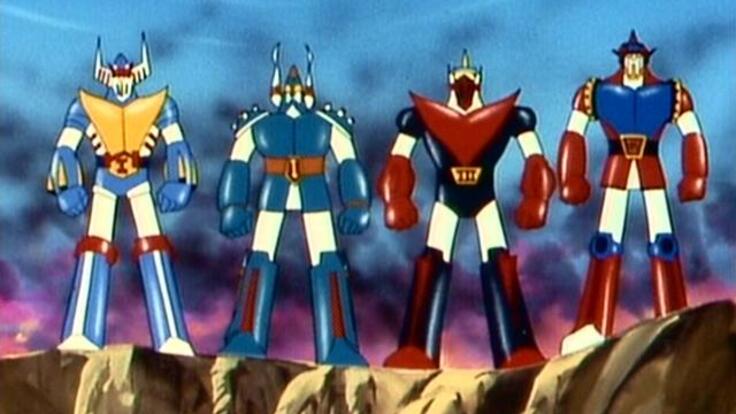
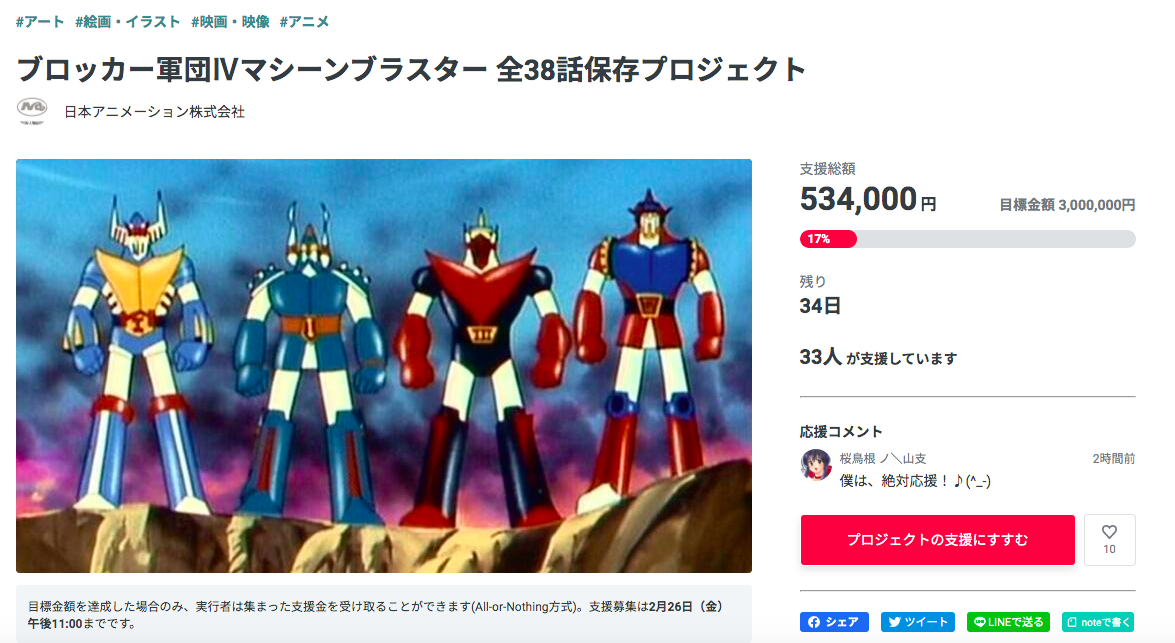
Blocker Gundan IV Machine Blaster is a 1976 super robot anime that most people have probably never heard of. It doesn’t have a long and storied legacy, and its international presence is limited to the Philippines and Italy, where it was known as Striker Force and Astrorobot, respectively. But it’s also a part of the grand history of giant robots in Japanese animation, and now one of the studios that produced the show, Nippon Animation, has started a crowdfund project to convert the Machine Blaster film reels into a digital archive through the site readyfor.jp. The goal is 3 million yen, or approximately $29,000 USD, by February 26 Japan Time.
While Machine Blaster is in many ways a footnote of anime history, that’s all the more reason why I want to see it preserved. I think it’s easy to assume that the art and entertainment we as humans create will always be around in some form, but film wears down, or it can get lost and buried. For many years, the sole copy of the Korean giant robot animated movie Robot Taekwon V was a badly damaged reel, and it was only by luck that a near-complete duplicate film reel was discovered. Machine Blaster is no Gundam or Mazinger Z, but I love giant robots and I would hate to see even this obscure series not have a proper archived version beyond its DVD releases.
Also, while Machine Blaster is indeed not Gundam, it actually shares a mecha designer! Ookawara Kunio, the man responsible for the mobile suits of the original TV series (as well as shows like Reideen, Zambot 3, and Daitarn 3), is also behind the robots of Machine Blaster. He even has a written message on the crowdfunding page talking about his time with the series as one of the many 20-somethings there being thrown into a full-on project without much experience.
If you’re like me and want to donate to saving Machine Blaster, I’ve provided a guide below, as the site is entirely in Japanese. Also, I should note that this is not a crowdfund to get a copy of the series; it’s just to help archive it. That being said, there are bonus goods for those who contribute more (though it’s not clear if they’ll send them abroad).
First, you’ll have to make an account on the site. At the top-right corner is a red button for logging in and creating an account. From there, you can either choose to register directly with readyfor.jp by clicking the red button on the right, or via Facebook using the button below it.
The blank spaces above, from top to bottom, are “user name,” “email address,” “password,” and “password again.” Then you’ll get a confirmation email, in which you’ll have to click a link to confirm your registration.
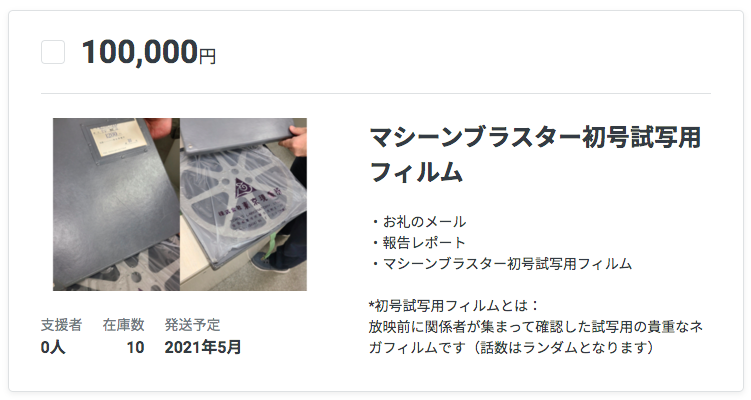
From there, if you go back to the Machine Blaster project, you’ll see another red button to the right of the main image. That’s the donate button, and it’ll take you to a page where you can choose how much you want to put in. Unlike other crowdfunding sites, you can only select along preset amounts, so the minimum is 3,000 yen, which gets you a thank-you message and updates via email. The most expensive one, seen below, is actually preview film reels of random episodes of Machine Blaster for 100,000 yen. The middle range has a bunch of merchandise you can get, like buttons and even a beach blanket. Choose which one you want, and note that you can actually select more than one at the same time. At the bottom, you’ll have the choice to pay via credit card or bank account. For payments outside of Japan, it’s probably better to use a credit card just because bank info in Japan can be very specific and have aspects that other countries don’t.
This is where it gets tricky. After putting in your credit card info, you’ll have to add your address as well. However, the form is not formatted for non-Japanese addresses, so you’ll have to work around it. Thankfully, if you just kind of fill it in as you would a normal address (and ignore the actual meanings of each form space, in case you can read Japanese), then it works out. Another crowdfund on readyfor.jp has provided a helpful screenshot, which I’ve also provided here. Note how the postal code in Japanese is just filled out as 111-1111. The only blank spaces this image isn’t showing are for your name.
From there, you hit the last button at the bottom and confirm your contribution! You can also write a message in the space provided.
Not every giant robot anime is going to be of legendary status, but I want to make sure we can keep and preserve as many as possible for both the fans who grew up with them and those who look back on anime’s history with curiosity. Blocker Corps IV Machine Blaster at least deserves that much.
PS: Like so many 70s giant robot anime, it got its own Italian theme song for the Italian dub. It is glorious, and worth comparing to the Japanese songs and their pleasant cheesiness.
The anime The Gymnastics Samurai is set in the year 2003, and nothing makes me feel older than having a fictional story ask “Remember back in the day?” about a time period that still in many ways feels like yesterday. But as the story of a veteran gymnast whose years are starting to catch up to him, it’s all too appropriate. The Gymnastics Samurai is not an altogether unique take on the trope of an old fighter trying to recapture glory, but it does stand out in a couple ways: its avoidance of faint and damning praise for its protagonist, and (for better or worse) the bizarreness of its setting details.
Protagonist Aragaki Jotaro, nicknamed “Samurai,” was once a former silver medalist in gymnastics who started a “Samurai boom” in Japan and around the world. Now, he finds himself a widowed father of one, unable to even approach his past success and considering retirement. However, a chance meeting with Leo, a foreigner dressed like a ninja, changes all that. Jotaro begins to wonder if there’s a chance he can keep doing what he loves, despite the fact that gymnastics is a young man’s game. In addition to the encouragement he gets from family and friends, he’s also egged on by a much younger rival who treats Jotaro as a dinosaur who should leave the spotlight for those with potential to fulfill.
The immediate comparison that came to mind watching The Gymnastics Samurai is 2006’s Rocky Balboa, the 6th movie in the Rocky franchise. In it, the famous Italian Stallion comes out of retirement for a boxing exhibition match against the current champion of the world, but has to re-invent his style once again (a recurring theme throughout the films) to make up for the fact that his body can’t move like it used to. Jotaro is in a similar position as Rocky, with a few key differences. First, Jotaro is nowhere near as old as Rocky in Rocky Balboa (29 vs. early 60s—almost a joke, in a way), and doesn’t have to deal with calcium deposits on his bones. Second, rather than Rocky’s approach of building muscle so that every punch he can land counts for more, Jotaro’s re-invention involves a return to fundamentals, and the muscle he does gain is to compensate for his old injury.
That second point is one of the most notable aspects of the story the anime is telling, because it’s in part a criticism of the notion that “spirit” and “hard work” can make up for anything. As the anime explains, Jotaro tried to work through his injury by just throwing himself further and further into gymnastics, only to end up aggravating his shoulder further. The fire of perseverance is not inherently a bad thing, but Jotaro has to learn how to work smarter instead of hoping to gain results from a mindless grind. Over-the-top training bordering on abuse is a classic (albeit dated) trope of sports anime and manga, so it stands out when a series like The Gymnastics Samurai puts it in stark relief with a more conscientious regimen.
There’s no doubt that it does get harder to keep up one’s physical peak as time passes, but the training Jotaro goes through is also not necessarily about abandoning what used to work for him. Instead, it’s a way to let him do what he was known for by providing a more stable structure. It reminds me of how Umehara Daigo, the most famous fighting game player in the world, trained to improve his reaction time rather than leaving it to his younger opponents because he didn’t want to limit himself by thinking like an old man (Daigo ended up winning a major online tournament). Note that Daigo is also older than Jotaro, being 39.
As for the bizarreness of The Gymnastics Samurai, although the anime is centered around a fairly straightforward sports narrative, there are a lot of little aspects of the show that seem like they come out of left field. Jotaro’s action movie-loving daughter, Rei, has a gigantic tropical bird (named Big Bird) who tells people to smile more. Leo appears to be a ninja-obsessed Japanophile whose use of theatrically archaic Japanese (de gozaru) is more a Japanese person’s idea of how a weeb would speak than any reflection of reality. Especially due to the bird, it reminds me of Tamako Market, which also has an avian creature providing comedy. These details make for a jarring tonal shift at times, which ultimately don’t remove the emotional impact of key moments in The Gymnastic Samurai but can still leave a sense of bewilderment.
The Gymnastics Samurai is one of the latest instances of a story that asks whether an old dog can indeed learn new tricks. While it’s not entirely a criticism of ageism due to its hero still being a reasonably spry 29, the series does give credence to the notion that re-invention and restoration are possible, especially where passion meets wisdom. In a genre of anime and manga dominated by stories about high school athletics—and where graduating at 18 is seen as the first step into mythology—Jotaro gives at least some hope to those who still want to compete.
It was Spring 2018 when I first encountered the Japanese multimedia franchise known as Hypnosis Mic: Division Rap Battle. I was on vacation in Japan, and on a visit to Ikebukuro, I happened to walk past a Hypnosis Mic collaborative cafe. Not wanting to disturb the customers, I quickly left while wondering what it was I had just seen, though the large images of handsome anime guys with microphones told me that it was something at least idol-adjacent. I eventually learned the gimmick of Hypnosis Mic—rap battles!—as well as its incredibly odd premise (more on that below), which both puzzles and intrigued me. So when the anime was announced (full title: Hypnosis Mic: Division Rap Battle “Rhyme Anima”), I thought it would be my chance to finally see firsthand what this was all about. The result: a show that’s not the most sophisticated work per se, but is consistently fun and ridiculous.
The outline: In the aftermath of World War III, Japan’s government has been taken over by a women-led political group called the Party of Words, who have managed to outlaw all weapons and replaced them with special devices called Hypnosis Microphones. These microphones can affect people physically and mentally, and they’re most powerful when wielded by talented rappers. In this environment, men are only allowed to live in specific areas of Japan called divisions, and in the present time, groups of men from each division are tasked with forming rap crews in order to compete in a tournament known as the Division Rap Battle.
The four main groups of Hypnosis Mic are Buster Bros!!! (three brothers from Ikebukuro), Mad Trigger Crew (a combo of yakuza boss, police officer, and military veteran from Yokohama), Fling Posse (a fashion designer, a literary author, and a gambler from Shibuya), and Matenro (a doctor, a host, and a salaryman from Yokohama. Both intra-group and inter-group dynamics between the characters make for prime shipping fodder, especially because the leaders of each have a shared history.
I certainly was confused upon hearing all this first explained to me, as I had a ton of questions about the political implications of the plot. Women are clearly the target audience, so why are women also the primary antagonists of the series? What does it say that women are both responsible for demilitarizing Japan and saving it from itself but also are incredibly authoritarian? What would a feminist activist or a men’s rights activist think if they watched Hypnosis Mic? My best guess is that the setting is mostly a pretense, and that all contradictions are secondary to style and drama.
One thing I have to acknowledge is that because I’ve come to primarily know Hypnosis Mic through the anime, I had a fundamentally different experience from the fans who were there at the start. In its original format of music CDs, fans could purchase and vote for their favorite groups to advance—akin to voting for one’s favorite idol in AKB48 or Love Live! In its anime incarnation, Hypnosis Mic is mostly about cool rappers shooting music laser blasts with and against one another, like a bunch of hip hop Nekki Basaras from Macross 7. They call forth ethereal sound sets through which they deliver their verbal beatdowns, and it’s heavily reminiscent of how characters from Yu-Gi-Oh! might summon the Blue Eyes White Dragon or the Stardust Dragon. I titled this post after a gag from Yu-Gi-Oh! Abridged because it just so perfectly sums up Hypnosis Mic that I couldn’t resist. Also, I think there really is a similar spirit of spectacle between the world’s most famous card game anime and the world’s only anime about superpowered rappers.
As for the raps themselves, I’m not the best judge of quality, even as I’ve been trying to learn. However, I believe there to be a genuine desire from the franchise to make rap exciting and interesting to an audience that is probably not well versed in it, and from what I’ve read, they do use experienced hip hop producers. The lyrics for certain songs can get pretty clever, and while not every voice actor in the series is a bonafide genius on the mic, the quality is generally high, and there are a few standouts. I’m particularly fond of Jyuto’s bars, the cop character from Mad Trigger Crew. Speaking of them, I don’t know if I’d call Mad Trigger Crew my favorite group, but I do like how Rio (the military guy) keeps accidentally grossing his teammates out by feeding them dishes made with bugs and other unorthodox things—someone I can relate to. My actual favorite character is the leader of the Party of Words, Touhouten Otome, but she doesn’t rap in the anime, so you can see where my preferences lie.
Hypnosis Mic is a trip, and the anime is worth checking out just to see with your own two eyes that such a show really exists. I love the idea that the franchise as a whole is potentially introducing rap and hip hop to people who might not have bothered with it otherwise; something akin to Hamilton. Much like how Hetalia inspired fans to learn more about history, it can be a gateway into discovering an entire musical genre. Though hat I really wonder is, how would the real world’s rap greats look in the world of Hypnosis Mic? Would someone like Tupac, Rakim, or Eminem summon rhymes so strong that they shatter the Earth itself?
A part of me understands that years are really just arbitrary designations of time, but I still feel a sense of relief that 2020 is officially behind us. I’ve never experienced anything like it, and I desperately hope that current and future generations learn the lessons we need about the important of healthcare, of helping those who are marginalized, and understanding that while competition is a part of humanity, it should not define us to the point of mutual destruction. Leave the power fantasies of invincibility to isekai anime, and let’s help one another out.
I also want to draw special attention to the Georgia runoff elections that will determine control of the US Senate. If you’re registered to vote there, you have the power to shape the future in your hands. If we want to establish even the chance for a future that benefits those in need rather than those addicted to power, this is our best opportunity for the next two years.
Anyway, thanks to the following Patreon sponsors at the start of 2021:
My initial impressions on the augmented-reality anime figure line.
Closing
On a less somber note, it’s the year of the ox, and we’re seeing a lot of cow cosplay anime fanart. I’d say something about being careful about NSFW pieces, but I get the feeling most people are currently at home.
Having the protagonist of a racing anime be a serendipitous inventor makes for an interesting dynamic. Appare chafes against the cultural norms and restrictions expected of him in his home life in Japan, and an impromptu trip to the US (along with an entry into a transnational motorcar race) allows his eccentric genius to flourish. Above all, there are two main things that make Appare great. The first is that his interactions with others both big and small make for a very convincing portrayal of a protagonist whose way of thinking, priorities, and philosophy run along a different path from everyone around him. The second is that he grows tremendously on his journey—in part due to his initially reluctant racing partner Kosame—and ultimately ends up with both a passion for technology and compassion for his fellow human beings in equal strength.
BEST FEMALE CHARACTER
Kanamori Sayaka (Keep Your Hands Off Eizouken!)
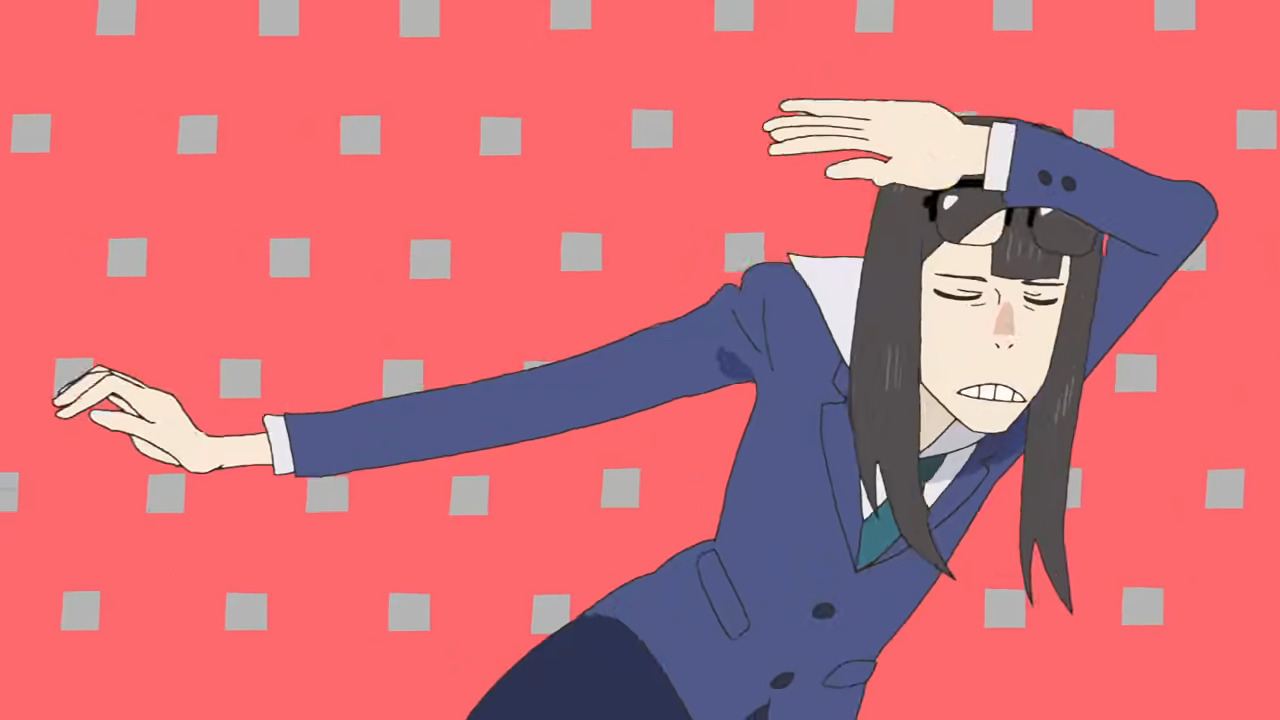
In one of the greatest celebrations of the creative process ever made, the most impressive character is Kanamori Sayaka, the practical-minded “producer” of the main trio. The very fact that she embodies that producer mindset (as opposed to director, artist, or animator) is a rare treat, and while she’s basically the fun police in terms of the narrative, the story portrays her as integral. There’s something downright refreshing about how grounded and logical Kanamori is in contrast to the rampant imaginations of her friends Asakusa and Mizusaki, and it makes a character who would otherwise recede into the background stand out all the more. In certain ways, she reminds me of Kasukabe Saki from Genshiken—always a fine character to be compared to.
Final Thoughts
When I look at my choices for best characters of 2020, the thing I see in common is that both are unorthodox characters who provide windows into the act of creation, be it artistic or mechanical. Funnily enough, Appare and Kanamori play opposite roles in their respective stories, with Kanamori being the straight man to her friends’ disregard for pragmatism and Appare being the unimpeded tinkerer who Kosame has to manage. It would probably make more sense if I had picked two similar characters on each side, but in both cases, the way they upend expectations makes me believe in them.
I’d also like to make an honoroable mention for Kaburagi from Deca-Dence, who was extremely close to being my pick for male character of the year. Kaburagi is an aged combat veteran, but as we learn more about his life and perspective, we can see the inner struggle in him extends beyond merely his loss of zest for life and into what it means for a society to survive versus what it means to prosper.
A turbulent year full of worries and delays has nevertheless seen many wonderful anime come out that both challenge norms and provide hope and inspiration.
It’s not uncommon for children’s cartoons to offer something to the parents watching with their kids, yet when it came to Shinkansen Henkei Robo Shinkalion: THE ANIMATION, I had believed that there wasn’t much in it for adults beyond those who already have an appreciation for a more classic type of kids’ anime. Recently, however, I’ve come to realize that what Shinkalion offers its older viewers is a dip into nostalgia—not only because of its relatively old-fashioned narrative beats, but also literal callbacks to pop culture moments of yesteryear.
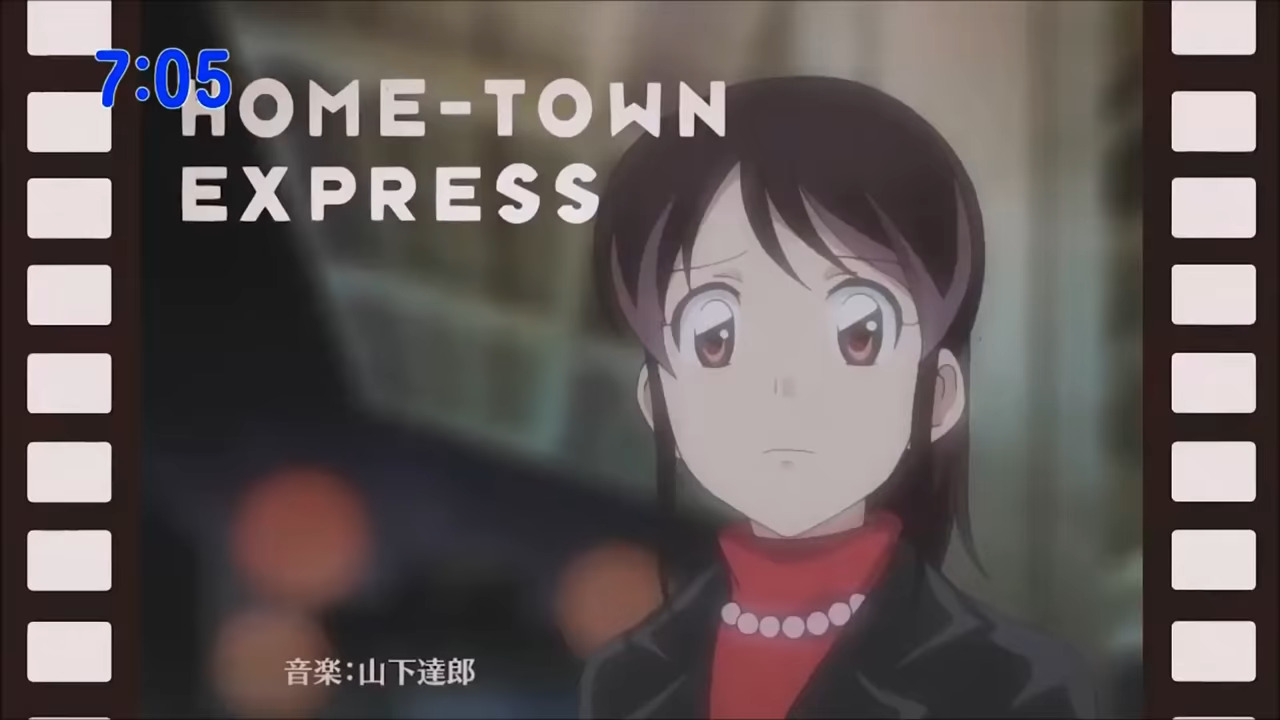
In a recent tweet, fellow mecha enthusiast Tom Aznable points out how Shinkalion actually features near shot-for-shot re-creations of late 1980s Christmas-themed commercials for Japan Railways, complete with 4:3 aspect ratio, a faux-CRT filter, and actual recordings of “Christmas Eve” by the renowned Yamashita Tatsuro. You can see side by side comparisons in the link above, as well as the full commercials below:
I was unfamiliar with that particular song, but it’s apparently considered a Christmas classic in Japan. And, like so many things Japanese, it just oozes nostalgia, and now it’s forever on my playlist.
In the context of the anime itself, the protagonist Hayasugi Hayato is a supreme train otaku, and so he thinks of everything—including other characters’ romantic recollections—in relation to trains. But the show is clearly using these moments to trigger powerful memories in its older viewers. Shinkalion doesn’t even limit it to Christmas commercials, either. Given all this, it becomes clearer that the Evangelion episode of Shinkalion, where Hayato visits Tokyo-3 and Shinji pilots a Shinkalion version of EVA-01, is also meant to play into this nostalgia.
The way that Shinkalion taps into a past zeitgeist makes me further aware of the improbability of the series ever getting licensed in English. The series is already focused primarily on viewers in Japan by virtue of its purpose and subject material. The show wants you to buy bullet train toys from Takara Tomy and encourages you to ride the train more (not exactly unwelcome in the grand scheme of things), and without the merch and the accessibility to the shinkansen—or, for that matter, the familiarity of Japanese high-speed rail—it would remain a weird and foreign thing to most kids in the US and other English-primary countries. When you throw the 80s and 90s Japanese media references on there as well, it becomes an even more difficult sell. Yamashita Tatsuro might be gaining more of an international reputation than ever thanks to his role as the king of city pop, but it’s those commercials just aren’t going to hit nearly as hard as they did with Japanese viewers.
There will always be something lost in cultural translation, but there need to be a lot of moving parts for this to work out, including likely a licensing process involving Japan Railways. And while Shinkalion has managed to reach beyond Japan and to places like Hong Kong, Asia’s relationship with anime is very different from the rest of the world’s due to proximity.
Still, I wouldn’t mind a Christmas miracle whereby Shinkalion gets licensed in some form—even a streaming-only release. There would likely be some music rights limitations that would alter the experience, as even the Japanese official Youtube versions of Shinkalion episodes had to replace “Christmas Eve” and “Cruel Angel’s Thesis,” but it would be a relatively small price to pay. As the line from the Japan Railways Christmas commercials puts it, “Getting to see you is the ultimate present.”
Augmented reality is a funny thing to me because its appeal feels somehow both obvious and yet elusive. Whether it was participating in Pokémon Goat the height of the craze or seeing people on Twitter post videos of their iDOLM@STER characters occupying “real” spaces, I end up thinking “that’s really cool” and “but do I really want to blur that line?” simultaneously.
I was asked this month, by Patreon request, to discuss HoloModels, which is an AR figures app by the company Gugenka. Essentially, rather than having physical PVC or resin kit models, you collect virtual ones that you can pose and “place” wherever you want. I had actually seen images of it without realizing what exactly I was looking at, thanks to retweets of the Lina Inverse HoloModel that have been filling my Twitter timeline. “Was it some video game? Maybe a fan project?” I thought.
Before trying out the app itself, my understanding of HoloModels led me to think that the advantage was basically like that of ebooks: the ability to keep a bunch of models without any of them taking up physical space. They can be placed and posed any way you want, so there’s also a certain degree of freedom for creativity. However, when I saw that HoloModels can be resized to pretty much any scale, I realized that the potential I had pictured was too limited.
The versatility of HoloModels means you can have life-size models, as if they’re less figures and more characters who have entered our world. Perhaps you can even pretend that they’re a friend or a lover. And even if you’re not into that sort of thing, you can still use them in a variety of different ways. You can use them in virtual dioramas or even as action figures after a fashion. What’s more, you can’t really “damage” them by accident. And of course, even this view is still probably a drop in the ocean of possibilities.
Because of the proximity of HoloModels to Virtual Youtubers—they’re essentially two ways of blurring fiction and reality together through anime aesthetics—I also had to see if there was any stronger connection between the two. It turns out that the default model you get when you first install HoloModels, Shinonome Megu, has since become a Virtual Youtuber with 40,000+ subscribers as of December 2020. I believe the HoloModels figure came first, based on comparing news articles announcing HoloModels with the oldest video on her channel, but if anyone has more information, feel free to share.
Am I interested in sticking with them? Not really. HoloModel figures are awfully pricey in my view, as less expensive characters run around 3,500 yen, and the Lina Inverse mentioned above is 5,000 yen. I might just be the wrong person to understand the true value of these AR characters—I’d still rather have a physical one, even if I can’t make it Godzilla-sized. That all said, if we compare HoloModels to another form of “virtual character collection,” i.e. mobile game gacha, the luck element is completely removed. That does make me wonder if that gambling high is part of why mobile game character lotteries work in the first place, but that’s another conversation for another day.
This post is sponsored by Ogiue Maniax patron Johnny Trovato. You can personally request topics through the Patreon or by tipping $30 via ko-fi.
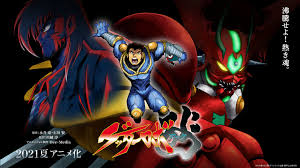
When I was first really getting into anime, it seemed as if the classic 1970s giant robot franchise Getter Robo was in the middle of some sustained renaissance. Whether it was 1999’s Change! Shin Getter Robo: Armageddon, 2000’s Shin Getter Robo vs. Neo Getter Robo, or 2005’s New Getter Robo, it felt as if another anime was always just around the corner. But then the well dried up (albeit not necessarily for other popular classic robots), and it’s been 16 years since. But finally, in 2021, we’ll be seeing a new entry: Getter Robo Arc, based on the manga by Nagai Go and Ishikawa Ken. Notably, this might also end up being the first fairly straightforward adaptation of a Getter Robo manga, and the first to try and really get close to Ishikawa’s art style.
The funny thing about the various Getter Robo anime is that there has never been a straight adaptation of any of the manga. You might be thinking of a long shounen fighting series ending up with a filler arc or three, but I’m not even talking about that. Rather, since the original inception of Getter Robo, the relationship between the many manga and anime have been an odd one. The first Getter Robo manga and the first Getter Robo anime debuted around the same time in 1974, but whereas the former depicted its heroes as virtual psychopaths, the latter portrayed them as relatively kid-friendly good guys. 1991’s Getter Robo Go took similar diverging paths with Ishikawa’s drawings being relatively unchanged and the anime adapting its character designs to a late 80s/early 90s look.
The later works were not much different. Change! Shin Getter Robo: Armageddon and Shin Getter Robo vs. Neo Getter Robo both take elements from throughout the franchise’s history and try to show a more action-packed style reminiscent of Ishikawa’s art, but neither quite goes all the way, balancing 21st-century anime designs with a throwback feel. What’s more, the two aren’t even meant to be connected to each other. New Getter Robo is in a similar boat, being a reboot of sorts that brings some of the insane personalities from that original 1974 manga, but changing just about everything else. This trend is par for the course with Dynamic Pro properties, be it Devilman, Mazinger, Cutie Honey, or anything else. “Canon” and “faithfulness” are distant concepts in this arena.
However, that’s also what makes the initial images for the Getter Robo Arc anime stand out all the more. Both the promo image and the trailer seem to exude a roughness that immediately calls to mind Ishikawa’s aesthetic, where trying to create eye-pleasing shots comes second to pushing a kind of gritty intensity. It’s understandable that anime want to try to grab audiences with more appealing character designs, but here we have Gou, the guy on the promo image, feeling like he almost fell straight out of the manga and onto a poster. If the animators at Studio Bee can really pull off making the anime adaptation look Ishikawa as hell, I will give them all the props in the world.
PS: Kageyama Hironobu was a guest at Anime NYC 2018, and during the Lantis Matsuri concert he actually sang “HEATS,” the opening to Change! Shin Getter Robo: Armageddon. Now, the Getter Robo Arc anime is bringing the song back as “HEATS 2021,” and I have to wonder if Kageyama knew back then that he would be called upon to revive that old banger.








 OGIUE MANIAX