Between Mister Rogers and Transformers is Precure

I had the opportunity to watch the Mister Rogers documentary Won’t You Be My Neighbor?, and one of the topics it discusses is the origins of Mister Rogers’ Neighborhood as a kind of counter-programming to the fast-paced “bombardment” that was (and continues to be) a staple of children’s television. Mister Rogers was meant to slow things down, and give kids a quieter and more contemplative half hour for them to learn and grow. Fred Rogers’ decades-long show took on an important challenge, but there’s the seed of doubt about its efficacy on people like myself, who remember their young childhood TV experience more along the lines of action-packed cartoons like Transformers or GI Joe. How do you reconcile the allure of such shows with the noble cause of trying to help kids learn to be better people? 

Especially in the 1980s and 1990s, there was a trend of including public service messages in those merchandise-shilling action shows—”Knowing is half the battle!” as GI Joe would say—but they would often come across as unbelievably hokey or even disingenuous. Going from watching GI Joe’s forces blow up an enemy Cobra base, to seeing kids learn how to install a smoke detector—it never felt right.

I began to think about if there were any children’s series out there that integrates a nice balance between satisfying action and good advice to children, and one answer popped into my head immediately: Precure. More than a few magical girl shows carry a strong sense of positivity and wonder—in fact, I once referred to 2001’s Princess Comet as being distinctly Mister Rogers-esque—but they often don’t hit that pleasure zone that comes with watching heroes vanquish villains the way Precure does. After all, its origins are built on “a magical girl show from the director of Dragon Ball Z, and while its staff has changed numerous times, it still more or less maintains that legacy. But when you also look at the various heroines throughout Precure, they serve as confident and inspiring role models for young viewers in ways that almost betray the heavy consumerism that it also engenders.

Consider Cure Yell in Hugtto! Precure, who’s all about giving support to those both looking for their dreams and those pursuing them. Or how Cure Flora in Go! Princess Precure overcomes a major problem by realizing that the power to change and improve comes from within. Or how Cure Heart in Doki Doki Precure! reaches for the stars in everything she attempts. These heroines are only the tip of the iceberg, as many individual episodes also try to speak to the concerns and worries of children, and how to deal with the complicated and confusing emotions they experience growing up.

I think this is why I am, and likely always will be, a fan of Precure. Its creators know the power of being a GI Joe, but it also knows the value of being a Mister Rogers’ Neighborhood. Striking that middle ground can come at a price—a muddled message, perhaps—but attempting that alchemy is valuable in a world where ideals and cynicism alike clash with each other on a daily basis.
Futari no Social Distance: Ogiue Maniax Status Update for May 2020

Anime Expo: Canceled. Otakon: Canceled. EVO: Canceled. But it’s all for the best as we try to keep one another safe in these strange times. I’m thankful to all the organizers for making the right choice, and I hope to see you all at conventions eventually. In the meantime, I find myself trying to make the most of my time spent at home.

Thank you to all my supporters on Patreon again this month, especially these fine folks below.

General:

Johnny Trovato

Ko Ransom

Diogo Prado

Alex

Sue Hopkins fans:

Serxeid

Hato Kenjirou fans:

Elizabeth

Yajima Mirei fans:

Machi-Kurada

Blog highlights from April:

Their Problem is Our Problem: The Promised Neverland, “Coronavirus,” and the Systems that Force Inequality

The Promised Neverland brings the fury as it asks readers to think about the world around them.

When Comedy Goes Nuclear: Spy x Family

This popular new Jump+ manga is probably going to be the next big hit. I highly recommend it.

Eureka Seven, Holland, and Fujiwara Keiji

My tribute to the recently deceased voice actor who brought his A-game to every role. If you want to see my Top 10 favorite anime roles of his, I also wrote something up for Apartment 507.

Hashikko Ensemble

Chapter 27 is, at last, the big performance…with a dash of possible romance.

Patreon-Sponsored

My Favorite (?) Anime Computer Games

It is what it says, sort of?

Closing

I’m nobody special when it comes to giving advice, but I hope everyone can enrich themselves and stay sane in these crazy times. As for me, I’m finding great joy in AI-generated memes (like the one you saw at the top of this post), and incredibly dumb and hilarious #partyparrot memes. (The joke is dicks.)

Eureka Seven, Holland, and Fujiwara Keiji

Voice actor Fujiwara Keiji passed away recently on April 12, 2020 at the age of 55 due to cancer. In my eyes, he was one of the greatest, and I had even written a little about him in my review of The Wonderland. That’s why I really wanted to delve into my absolute favorite performance of his: Holland from Eureka Seven

Holland is amazingly written, and one of many examples of both the rich characterization and extensive character development that help make Eureka Seven such an absolute masterpiece. He’s the leader of Gekkostate, and thus the most prominent face of rebellion against the government. He’s initially worshipped as a hero by the protagonist Renton, but as the two get to know each other, their relationship changes because Holland is not a perfect human being. He’s hot-headed, ill-tempered, and impatient. Perhaps more importantly, he has long envisioned himself as a hero of sorts—not out of a desire for glory but a feeling of dire necessity. When he begins to realize that he’s not the “chosen one,” so to speak, his character’s journey becomes about learning how to support just as much as he leads.

What Fujiwara gave to Holland is a performance that’s always convincing. The turbulent storm of emotions that reside in Holland having to do with his position, his self-image, and his relationship with both his real and adopted family, are always delivered with such absolute sincerity thanks to Fujiwara. To be sure, Eureka Seven is full of excellent acting from everyone involved, but Holland is a downright challenging character to give voice to, and Fujiwara just nails it. I can actually close my eyes and hear his performance in my head—the expressions of joy, frustration, enmity, and sadness. 

Finding out a voice actor is gone always feels like a bit of a shock. It’s less a matter of age, I think, and more about knowing that you’ll never hear their performances ever again. And unlike movie actors, their physical appearance is not as major a factor in the types of roles they can land (though many actors do transition to older characters over time). Fujiwara’s passing is not necessarily surprising, but I do wish he could have kept contributing his immense talents to projects of all kinds. He will be immortalized in roles like Holland in Eureka Seven, and the world is a better place because of what he gave. 

My Favorite (?) Anime Computer Games

I was asked via Patreon to write about my favorite anime computer games, which should theoretically be an easy proposition. The only problem: I’ve never been much of a PC gamer, and more recently, I haven’t had much access to a Windows PC, where most computer games reside. Thus, the scope narrows from “my favorites” to “the couple I actually played and remember with some fondness.” Hopefully that still counts.

The #1 title that sticks out in my mind is Melty Blood. Though it hasn’t been exclusively a computer game for a very long time, and it’s nowadays known for the running joke that Melty Blood tournaments can (or are forced) to be held anywhere and everywhere, it did start off as a doujin game on PC. I happened to be part of a fighting game forum at the time the game first appeared, and I had recalled a Japanese forum-goer singing high praises for the Tsukihime franchise as a whole. Lo and behold, here was a game that married those two forces—Type Moon and fightmans—together. 

I was never good at the game by any means, but when I think about that very first rendition of Melty Blood, I mostly recall the little humorous touches that faded away over time in favor of a more competitively robust experience. In the first Melty Blood, when Arcueid and CIel clashed with punches, it could set off a sequence that ended with both of them getting cross countered, Ashita no Joe-style. And whereas Mech-Hisui in later iterations has a more conventional forward and back air dash, she originally had a Jet Scrander from Mazinger Z, and she flew at an oddly steep angle when air dashing. It reminds me of the fictional Kujibiki Unbalance fighting game in the Genshiken manga, where the club members talk about how the game adheres so closely to faithfully capturing the characters’ qualities that the balance went right out the window. 

Another game I enjoyed a lot was MegaMari, a fan game that basically took the characters of Touhou and put them into a Mega Man clone. It was more than just a reskin, however, as the game took Mega Man’s famed platforming and added Touhou’s signature bullet hell. Nothing in Mega Man (except perhaps the abusiveness of later entries into the Mega Man X series) could compare to the ridiculous yet beautiful sprays of icicles and swords, and that was in addition to old blue bomber staples like the Quick Man stage instant-kill laser beams. I was never able to complete MegaMari on account of the difficulty, but I appreciated the marrying of two great flavors. It also introduced me to a lot of Touhou characters I didn’t know much about otherwise—Konpaku Youmu, Saigyouji Yuyuko, Reisen Udongein Inaba, and so on.

While my experience with anime computer games is extremely limited, there is one area I wish I could explore more: the Japanese home computers of the 1980s, such as the PC-88 and the PC-98. This is especially because there are a lot of secret shames buried within that time, and it’d be a fun and enlightening experience. Probably the closest I’ll be able to get without jumping through too many hoops is to just get the PC-98-inspired VA-11 HALL-A: Cyberpunk Bartender Action on the Switch. Although that game isn’t made in Japan, it actually got a variety of official art made by Suzuki Kenya (Please tell me, Galko-chan!) for the Japanese release. 

Expect my thoughts on that game in the near future?

This post is sponsored by Ogiue Maniax patron Johnny Trovato. You can request topics through the Patreon or by tipping $30 via ko-fi.

Love Live! April Fool’s “CYaZALEA☆Kiss”: References and In-Jokes

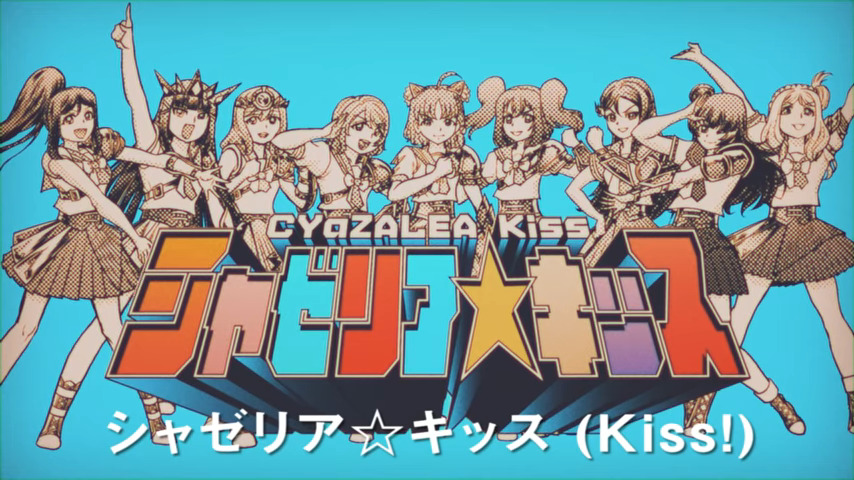
This year’s April Fool’s brought out one of the best things ever from Love Live!: the “announcement” of a new 80s-style action anime called CYaZALEA☆Kiss

But the Love Live! fandom and the 80s anime fandom generally don’t overlap, so I’m here to explain some of the jokes/references on both sides.

The name itself: “CYaZALEA☆Kiss”

The characters featured in this video are collectively known as Aqours (pronounced “aqua”), and are the heroines of the Love Live! Sunshine!! iteration of the franchise. These nine girls, in turn, are composed of three idol sub-units with their own distinct styles called CYaRon!, AZALEA, and Guilty Kiss. In the “plot” to this video, the three sub-units must join forces, but rather than calling them “Aqours,” their separate group names have just been mashed together.

It’s sort of like if you called the Teenage Mutant Ninja Turtles “Leodonphalangelo.”

The narration is a spoof on Fist of the North Star

The introduction of a post-apocalyptic backdrop set in the year 20XX is a reference to the opening narration of Fist of the North Star, a violent 80s shounen series about a world-saving martial arts hero who can make bad guys explode with his fists. In the anime, the narrator explains how in the year 199X, the Earth was ravaged by nuclear war, setting the stage for the series. 

On top of that callback, the over-the-top voiceover featured in CYaZALEA☆Kiss is none other than Chiba Shigeru, the actual narrator from Fist of the North Star! Famously, he’s known for getting more and more ridiculous and impassioned over the course of that series, and he brings that very style to this April Fool’s gag:

The general feel of the opening is an homage to Saint Seiya

From the team aspect, to the outfits the girls wear, to even the swooping logo (featuring 80s cel-animation shakiness), the whole CYaZALEA☆Kiss endeavor is largely based around the 80s shounen manga and anime Saint Seiya. Following a group of heroes who gain special armor and cosmic powers based on the constellations, Saint Seiya is famous for pioneering the “armored pretty boys” genre, and was responsible for bringing many female readers to Shounen Jump.

The general art style is also very reminiscent of the aesthetics of Saint Seiya author, Kurumada Masami.

Sentai colors run amok

At the beginning of the opening video, all the girls in CYaZALEA☆Kiss announce their designated colors, similar to what’s often seen in Super Sentai and other tokusatsu works. But whereas those shows typically have six, maybe seven members at most, there are nine in this case. Not only does this cause a jumbled mess of talking-over, but the actual colors named can get very specific.

Chika: Mikan 

Riko: Sakura pink

Kanan: Emerald green

Dia: Red

You: Light blue

Yoshiko: White

Hanamaru: Yellow

Mari: Violet red

Ruby: Pink

These are the actual signature colors of their respective characters in Love Live! Sunshine!! too. If you buy a glow wand (or “light blade,” as they’re officially called), it’ll come with all nine of these colors.

Though perhaps not intentional, it also harkens back to the sentai parody anime Shinesman, which featured a team of red, gray, sepia, salmon pink, and moss green.

The character designer and artist for CYaZALEA☆Kiss is a famous 80s manga artist

While the overall look of this parody is based on Saint Seiya, the actual artist himself is not Kurumada but rather Shimamoto Kazuhiko, creator of Blazing Transfer Student and Aoi Honoo, aka Blue Blazes

Blazing Transfer Student is a ridiculous school fighting manga. Blue Blazes is an exaggerated semi-autobiographical work about Shimamoto’s time in art college, when his classmates included modern anime/manga luminaries such as Anno Hideaki of Evangelion fame. The former received a 1991 OVA by Gainax (the original Evangelion studio), while the latter was adapted into a TV drama in Japan in 2014.

What did you think of CYaZALEA☆Kiss? Did you appreciate it as an 80s anime/manga fan, as a Love Live! fan, or perhaps as both?

Voices of a Social Distant Star: Ogiue Maniax Status Update for April 2020

Well, what a month it’s been. Back in March, the threat of COVID-19 was real, but I did not expect things to escalate so quickly. The number of sick and dead ever increases. We’re seeing the Tokyo Olympics get postponed to 2021 and Comic Market 98 get canceled. New York City and the United States have become epicenters of the virus. I’m among the many currently sheltering in place and doing my social distance thing, and I’m fortunate to be in a position where my life isn’t thrown into total disarray as a result.

Part of that has to do with the ongoing support of my Patreon supporters, especially the following.

General:

Johnny Trovato

Ko Ransom

Diogo Prado

Alex

Sue Hopkins fans:

Serxeid

Hato Kenjirou fans:

Elizabeth

Yajima Mirei fans:

Machi-Kurada

Not only is it a bit of extra cash, but having this blog and the responsibility of making sure the Patreon is worthwhile helps me maintain a schedule and keeps my mind active. Sometimes I need to remind myself that there’s always something to talk about on an anime blog, even if we’re seemingly entering a new period in the story of humankind.

That being said, if anyone can’t afford to keep up their Patreon subscription for Ogiue Maniax, don’t feel bad about putting it on pause for however long it’s necessary.

What remains to be seen is how many COVID-19-related puns can I make for these monthly updated posts.

Blog highlights from March:

Friends with Consequences: Spotted Flower, Volume 4

It’s been a few years since the last volume of Spotted Flower, and it ramps up the insanity of this Genshiken what-if like nobody’s business.

Brief Thoughts on Anime, Manga, and COVID-19

It’s the talk of the town…! I’m curious as to how the current pandemic might shape the storytelling and themes we find in anime and manga going forward.

Space Cases: Star Twinkle Precure

The recently finished Precure series is not just yabai, it’s kirayabaa~.

Hashikko Ensemble

Chapter 26 has me legitimately wondering if Jin might be on the spectrum.

Patreon-Sponsored

Aikatsu as Absurd Idol Anime Turning Point?

Idol anime can get quite zany these days. Is Aikatsu! the reason?

Apartment 507

I wrote a review of the Nintendo Switch version of Touhou Gensou Mahjong.

Closing

Stay safe, and remember that we’re all in this together.

Oh, and uh, look behind you.

April Fool’s ha ha ha…

Great Minds Think Differently: Keep Your Hands Off Eizouken!

Whenever there’s a work of fiction about creative types, I think back to an old art professor of mine. He would lament that the artistic process was rarely, if ever represented accurately in media. But if he had the chance to watch the anime Keep Your Hands Off Eizouken!, I think he would be pleasantly surprised. 

Adapted from a manga by Oowara Sumito, directed by Yuasa Masaaki and animated by his current studio, Science Saru, Eizouken! is very clearly made by people who believe just as strongly in the art of animation as the characters themselves do.

Eizouken! follows three characters–director Asakusa Midori (the main protagonist), animator Mizusaki Tsubame, and producer Kanamori Sayaka–as they form their own school club in order to make anime. Asakusa has a life-long passion for external exploring as a way to fuel her imagination, and her sketchbooks are filled to the brim with ideas and flashes of inspiration–from small doodles to elaborate world-building designs. Mizusaki is a model, but her true passion is in animation, and nothing gets her more excited as a sakuga fan than the hard work that goes into the art of portraying movement. Kanamori isn’t really artistic, but she has a knack for looking at the pragmatic side of things: costs, advertising and exposure, and deadlines. The difference between Asakusa and Mizusaki as similar yet distinct creative types, as well as the contrast between their energy and Kanamori’s, fuel the conflict and the camaraderie at the heart of Eizouken!

The series looks fantastic, has memorable characters, and is such a genuine love letter to anime and animation–even putting in nods to beloved classics like Future Boy Conan and Akira. However, what impresses me most is that Eizouken! makes a lot of difficult and daring decisions. It would have been all too easy to make Mizusaki the heroine because of how people tend to focus on characters in anime in the first place, and her specialty aligns closest to that. But not only is Mizusaki someone whose love of animation goes beyond simply making characters look impressive, but it’s the more conceptually oriented Asakusa who’s the main character. There’s something a little more intangible about Asakusa’s mindset, and the willingness to have her be the primary focus is something I appreciate.

But if having someone like Asakusa as main is uncommon, then featuring a character like Kanamori at all is like finding a four-leaf clover. While a similar series like Shirobako might have characters on the production side, it’s exceedingly rare to have a character who so clearly shows the “producer” mindset. It reminds me of something I heard once when it came to Studio Ghibli: while directors Miyazaki Hayao and Takahata Isao were considered the geniuses for their successful animated feature films, some consider producer Suzuki Toshio the real secret to Ghibli’s success because of his skills in promotion and turning a profit. Kanamori embodies this spirit, and I think that it also provides a window into how those who aren’t on the artistic side can still be big contributors to creative endeavors in a world where schedules matter.

Something that encapsulates the joy and detail put into Eizouken! is the opening video, shown above. There’s a part in the OP where it shows multiple quadrilaterals spiraling towards the center of the screen, one set for each character. Asakusa’s are chaotic, Mizusaki’s stylishly overlap, and Kanamori’s are rectangular and precise. They’re perfect summations of the girls’ respective mindsets.

Keep Your Hands Off Eizouken! is a series for anyone who’s interested in seeing an involved yet mildly fantastical portrayal of the creative process in action, as well as for anyone who enjoys seeing girls being passionate about what they do. There’s a lot of love that’s gone into Eizouken!, and I can’t help but expect a generation of creators to come out of watching this series eager to take the anime industry by storm. 

Brief Thoughts on Anime, Manga, and COVID-19

It’s rare that anything can have such a visibly profound global impact, but that’s what we’re seeing with COVID-19. I find it funny that I tried last year to predict what the 2020s would hold in store, and it hasn’t even been six months before everything has gone sideways. For many people around the world, it has disrupted various aspects of life, and even the anime and manga industries have already felt its effects. Notably, A Certain Scientific Railgun T was delayed for a little while specifically because of the novel coronavirus, and its situation portends to a general trend going forward.

But COVID-19 likely won’t just change the production logistics of anime and manga—there’s also storytelling, themes, visual expression, and just about all the things we might take for granted or perceive as the norm. While we’re probably see works that either try to explore disease and pandemics (either directly or metaphorically), even more escapist entertainment is going to have the specter of the coronavirus hanging over. What does a harem manga even feel like in an era of social distancing? What about seeing characters just give one another hugs? To what extent well even the fantasies of fiction feel odd? In recent days, I’ll look at old videos from a month ago—including but not limited to anime and manga—and their tacit assumptions about the world already feel…dated.

Another big factor is how globally common the problem of COVID-19 has become. Something like 9/11 affected the US differently compared to other countries (though the US’s actions continue to have widespread effects). 3.11 hit Japan in life-changing ways, but that’s not as much the case in other areas. COVID-19 feels different in that its basic consequences are similar the world over. The disease spreads very easily, and it doesn’t discriminate. Old people are most at risk but no one is necessarily “safe.” Restaurants, theaters, and other social gathering sites cannot function as normal. Staying home as much as you can in order to help out is the name of the game. This universality means any media or entertainment made in response to COVID-19 will be understood virtually anywhere. 

Incidentally, Season 2 of the Cells at Work anime was just announced for January 2021. How ironic it would be if that series got delayed due to these circumstances…

The way COVID-19 has changed and will continue to affect everyday life is difficult to fully grasp, and I hope humankind can come out of this safe and sound and ready to tackle whatever problems still face us. In the meantime, it’ll be interesting to see how our art and entertainment reflect this new world.

Recent Thoughts on Love Live's Nijigasaki High School Idol Club

In the past, the third Love Live! multimedia project, “Nijigasaki High School Idol Club” (previously known as “Perfect DREAM Project”), had somewhat eluded me in terms of its appeal. Certainly, when it comes to Love Live! In general, I’m usually something of a late adopter—it’s usually the anime adaptations that bring me in, as opposed to the games, magazines, or even the songs. I’m also not so big a fan that I’ll follow every crumb of information, or try to pick favorites before I’ve had a chance to learn about the characters.

Two things have changed since then: the Love Live! School Idol Festival All Stars mobile game (hereafter LLSIFAS) came out, and I attended a delayed viewing of the “Love Live! Fest” concert featuring the girls from all three generations. Together, they’ve given me a better insight into how this third Love Live! Is supposed to work, and its concept of “more individualized school idols” has me curious.

As soon as the nine Nijigasaki girls came out on stage at “Love Live! Fest,” it was clear that the thinking behind them diverged from what went into their predecessors. Rather than appearing as a nine-member unit with matching outfits, each of the singers/voice actors dressed like their characters, who themselves all have very different concert wardrobes. So instead of, say, having all of μ’s in white for “Snow Halation,” it was a hodgepodge ranging from a Swedish dress to a fancy nightgown to a kind of Vocaloid-esque ensemble. Their styles were incongruous, and intentionally so. As explained by one of the members, the theme of the Nijigasaki High School Idol Club is to emphasize each girl’s uniqueness above all else. It’s quite a departure from previous Love Live! projects, which were all about nine girls working as one. 

Each of the Nijigasaki girls also has their own solo number (in addition to a couple of group songs), which is something that the members of μ’s and Aqours didn’t get until later. I think it actually helps convey what each of their personalities is like, as opposed to trying to figure out which girl is which when they’re all singing at the same time. Asaka Karin is supposed to have a more mature sex appeal, and it comes across in spades when she’s the only vocalist. Speaking of Karin, learning about her character was an experience. First, she came out and called herself the “sexy” one. Then, she called her fans “slaves.” Last, it showed her signature symbol: a high heel (hmm). It dawned on me that Karin (as well as the other eight girls) are likely all going for very different audiences from one another.

LLSIFAS somewhat departs from its mobile game predecessor by having more of an ongoing narrative in the story mode. In Chapter 1, you learn that the Nijigasaki High School Idol Club is in a sorry state and on the verge of being shut down. Your goal is to bring back the old members and recruit some new ones, and you basically learn about each of the characters along the way. I think this has been effective in helping me get a better sense of what each of them is all about, with the heavy amount of interaction and the clearer direction doing a good job of showing how the characters are when there’s an obstacle to overcome. Still, I wonder why the forces that control Love Live! as a whole decided to move in this direction for their third endeavor.

I’m not ready to fully embrace Nijigasaki because I find that a bit of resistance is for the best when approaching idol franchises, even the continuation of one I’m already a fan of. The original Love Live! won me over even as I was very skeptical of it, and it took some time for me to enjoy Love Live! Sunshine!!, but it happened eventually. I don’t need to pick a favorite Nijigasaki girl, I don’t need to enjoy every song, and I don’t need to go all-in from the start. That said, I’m looking forward to how the more focused format of an anime will tell their story, and how this idea of individuality will play out. And with a fourth Love Live! project on the way, the Nijigasaki idols will become “senpai” themselves.

Aikatsu as Absurd Idol Anime Turning Point?

Every so often, I think about a specific kind of comic absurdity I see in many idol anime. It’s one thing for characters to be having pillow fights, but it’s another for the heroines to be digging miles-long tunnels, shooting lasers, and scaling treacherous cliff sides with the greatest of ease. Of the franchises that fall under this umbrella, I’ve started to wonder if Aikatsu! is actually a significant contributing factor, bridging the silliness of actual idol media appearances with the impossibility of cartoons. I’m much more of an anime fan than I am an idol fan, so my knowledge and experience in regards to the latter is limited, so take what I say with a grain of salt.

I often see clips of idols on variety shows, as well as in their own video specials and the like. There’s a certain lightheartedness portrayed in these instances that creates the opportunity of laughs and gasps. It’s the kind of humor you see more in Love Live! or The iDOLM@STER, which initially tried to be a little more “down to Earth” with their characters and presentation, though are willing to stretch the boundaries of believability. The difference between those examples and what we see out of Aikatsu, Purichan, and Show by Rock! (not exactly idols per se, but a similar vibe) is that these three franchises venture into a very different reality where even everyday interactions are colored by the strangeness of their worlds.

Take for example the go-to mantra of Aikatsu!: “Ai-katsu!” Characters chant it while exercising, practicing, and engaging in pretty much any situation. Sure, it’s just short for “idol activity (aidoru katsudou),” but the way the phrase is treated as this perfectly routine thing everyone understands sets the stage for series after series where the humor is about challenging expectations of what’s normal. Whether it’s the aforementioned climbing, chopping down trees like Paul Bunyan, or visiting an idol school that’s also literally a gigantic cruise ship, the girls of Aikatsu! do what their flesh and blood counterparts cannot—not always because it’s harder for the latter, but sometimes because the laws of real-world physics do not permit them to do the same thing.

So why do I point at Aikatsu! as a possible origin point? It’s because the closest series to it when Aikatsu! first began was Pretty Rhythm, and that franchise was the predecessor for Purichan. Over the course of that transition from Pretty Rhythm to Purichan, the humor changed to something more akin to Aikatsu’s. A little more distantly relevant is the Precure franchise, but even the magical superpowers on display there aren’t quite the same as the at-times Looney Tunes-esque slapstick and accepted norms of Aikatsu!-esque series.

I’m not a deep fan of any of the series mentioned (with the possible exception of Love Live!), so there’s a lot more to potentially deve into. If there’s anything I’m missing or clearly mistaken about, don’t hesitate to let me know.

PS: Today is an idol shared birthday between Hoshimiya Ichigo from Aikatsu! and Sonoda Umi from Love Live! You know what they say: “Beware the idols of March.”

This post is sponsored by Ogiue Maniax patron Johnny Trovato. You can request topics through the Patreon or by tipping $30 via ko-fi.