Wizards Are Among Us!: Maho Girls Precure

mahogirls

Witches were the original magical girls in anime, so it’s somewhat surprising that the now nearly-15-year mahou shoujo franchise Precure would take so long to make a series where magic in the conventional sense is front and center. That’s what Maho Girls Precure brings to the table, and the result is a series that, while not terribly ambitious, is a still a good deal of fun.

Maho Girls Precure follows Asahina Mirai, a normal Japanese girl who one day runs into a witch in training named Liko. Searching for a magical item called a Linkle Stone, the two run afoul of a villain searching for the same item. Despite the fact that Mirai knows nothing of magic and Liko’s own skills aren’t the best, they’re able to summon the legendary power of Precure, transforming into magical girls named Cure Miracle and Cure Magical, fighting off the enemy with their new-found abilities. From there, the two become fast friends, even traveling between the magical and non-magical worlds to attend school, have fun, and protect both from malevolent forces.

Given the presence of a magic school, comparisons with Harry Potter are practically invited. There’s even a wise old headmaster (though considerably younger-looking) and a stern female teacher. You might even call Mirai and Liko “chosen ones.” However, unlike J.K. Rowling’s famed series, Maho Girls Precure isn’t a detective story with the elaborate trappings of a magical world, and in terms of seriousness vs. levity remains roughly in the territory of the early, prepubescent Harry Potter stories. That being said, it’ll occasionally raise the stakes at climactic moments and pull it off well. When it comes time to finish, Maho Girls Precure pulls out all the stops in terms of dramatic flair and animation, which is customary for the franchise but always welcome nevertheless. By the end, it’s even the first to really acknowledge the world beyond junior high since my beloved Heartcatch Precure!
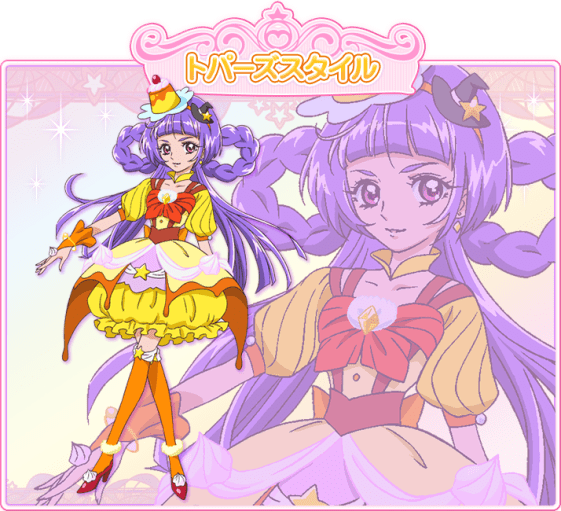
curemagical-topaz curemiracle-topaz

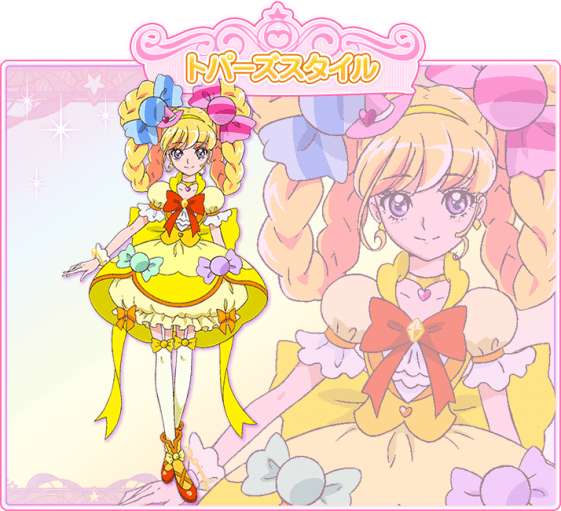
The series is not a terribly bold or daring work, but it also never promises more than it can live up to, which was the issue with the earlier HappinessCharge Precure!—a series that introduced the idea of Precures from all over the world, but never elaborated on it to a satisfying degree. Speaking of HappinessCharge, one aspect from that series utilized to greater effect here is the ability for the Precure to transform into different costumes with different abilities. While it’s not always clear why they use one over the other, they’re all stylish enough in appearance and unique enough in application to not wear out their welcome. My favorites are the topaz outfits, which carry dessert themes and also Green Lantern powers.
mahogirls-sleepingbags

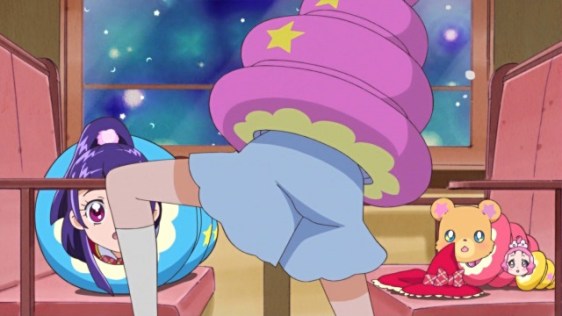
The aspects of the magical world I enjoyed most were the silly little quirks of a different society accustomed to spells and physics-defying elements. From the default incantation of “Cure-up! Rapapa!” to the bizarre shell-shaped sleeping bags found on the snail trains (sort of the Maho Girls equivalent of the Hogwarts Express) to the wizard versions of fairy tales (the fairy godmother is the main heroine!), I looked forward to seeing what simple yet amusing elements of magic would pop up next.
mahogirls-kana

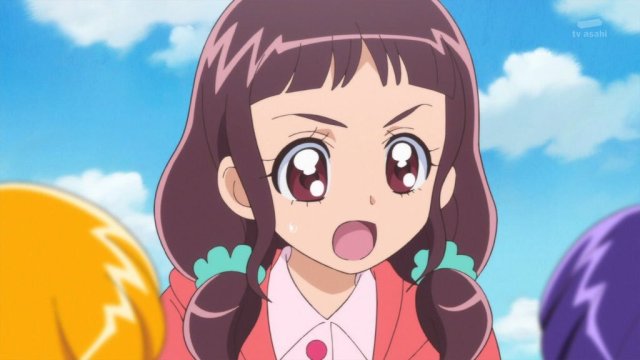
However, the most telling thing about how I view Maho Girls Precure is that my favorite part of the anime is not the heroines or their fight against the forces of chaos, but a side character, Katsuki Kana. A fan of the paranormal, Kana is quick to notice that some unusual things are going on in their town, except no one else seems to notice, and the Precures themselves actively deny it. When she first encounters Liko’s witch friends, they nonchalantly blurt out about how things are so different in “their world,” prompting a frantic expression from Kana in response. In addition to her panicked reactions towards any hint of magic, her ongoing desire to learn the truth, carry shades of one of my other favorite supporting characters in Precure, school newspaper journalist Masuko Mika of Yes! Pretty Cure 5.

Speaking of characters, I’d also like to mention that Liko is pretty much the anime version of Twilight Sparkle from My Little Pony: Friendship is Magic in both appearance and personality. Any fans of Twilight would probably enjoy her antics.

 Maho Girls Precure only rarely ever had me dying to see what happens next, but its simple yet expansive relationship between its characters and their worlds made sure I never tired of it. It’s a series you can take your time with, and it’ll entertain and move, at least one step at a time.

I Have a Choco: Ogiue Maniax Status Update for February 2017

February might be Valentine’s Day Month, but how much I’ll actually discuss romance on the blog remains a mystery even to me!

Whatever the situation, I know that if I were in Japan, I’d be giving giri choco to my Patreon sponsors.

General:

Johnny Trovato

Ko Ransom

Alex

Diogo Prado

Viga

Yoshitake Rika fans:

Elliot Page

Hato Kenjirou fans:

Elizabeth

Yajima Mirei fans:

Machi-Kurada

Given that this will be the tenth year of Ogiue Maniax, I decided last November to do a Genshiken series 1 re-read. I’ve started with Volume 1, and you should expect to see them come out every other month. (I would have said bi-monthly but that phrase can also mean “twice a month,” so…) I’ve already felt like I’m stepping back into a different world, so I’m looking forward to the next article too.

Speaking of Genshiken, I also wrote a little post comparing Kasukabe Saki to Love Live‘s Nishikino Maki. The latter’s cooldere attitude reminded me of Madarame’s fantasy version of the former.

Perhaps the most important post I’ve written this month is on the subject of butts in anime. In it, I detail increasing presence of large rears in Japanese animation, and put forth my own hypothesis on why this has occurred. The seeds of this post have been germinating in my head for a very long time, even before Ogiue Maniax ever began. If you want to see more content like this, let me know. I just hope it doesn’t take me another 10 years to write one!\

I was also sad to see the end of Soredemo Machi ga Mawatteiru aka And Yet the Town Moves. It’s a very unique series in a lot of ways, and I look forward to seeing what the artist does next.

On the video game side, I’ve written a couple of posts thinking about what how players view competitive games, and what they can potentially do to both bring in a bigger audience and keep them from running away in fear.

As for this month’s Patreon-sponsored post, I looked at the subject of babies in anime and manga. My rating of babies is based on how much they make their parents suffer, I guess. If you have a subject you really, really want me to write about, it’s just a one-time $30 pledge.

If you’re wondering why I have it at that price, it’s just because I don’t necessarily want the blog to consist primarily of requests as opposed to my own ideas. That being said, I am considering maybe offering a poll with three or four topics that can be voted on with Patreon pledges. Is this an idea readers would be on board for?

Overall, I think this was a pretty solid month. I don’t have a wholly solid idea of what’s going to come next, but it might be a bit less review-heavy compared to this one.


Good Idol/Wise Sister: Dia, Ruby, and Notions of Ideal Japanese Women in Love Live! Sunshine!!

diaruby-featuredimage

Following up my character spotlight articles for the girls of Love Live!, I’ve written a post analyzing Dia and Ruby from Love Live! Sunshine!! and their relationships with the concept of the “ideal Japanese woman.” Spoiler alert: It can be hard to be the perfect wife when men seem to barely exist in the world of Love Live!

From Cutie Honey to Keijo!!!!!!!!: The Rise of Big Butts in Anime History

NOTE: This post is NOT SAFE FOR WORK

yamato2199-moriyuki-characterlineart

Introduction

For as long as there has been fanservice in anime, there has been an emphasis on rear ends. Few things are more associated with anime (for better or worse) than the panty shot, and the form-fitting suits in works such as Neon Genesis Evangelion and Ghost in the Shell have helped to bring posteriors to prominence. However, I believe that buttocks have not remained static over the course of anime’s history and that, over the past 10-15 years, we have reached a point where big butts are “in.” The purpose of this post is to show this gradual change in tastes while also positing some possible reasons that this change has taken place.

Continue reading

Love Live School Idol Festival and Ten Fes: Rise of the Normal Girls?

tenfes

Recently, the Love Live! School Idol Festival rhythm game began featuring a new comics series within the English-language app itself: a 4-panel comic series called Ten Fes: Transfer Student Fesival. Its premise is that, rather than focusing on the expected stars of Love Live!, these manga put the spotlight on the lesser-known girls exclusive to the game. Whereas once these characters’ stories were told in only the briefest vignettes, they might now have the chance to really show off their charms.

llsifgirls-small

I once expressed a desire to see these “Normal Card” characters fleshed out more than they currently are, and I feel that Tenfes, while not an absolute game changer, is significant in this respect. To understand the potential impact it can have, it’s important to look at a rival fictional idol franchise: The iDOLM@STER.

The iDOLM@STER is devoted to having every one of its idols, be they the original ensemble from the first game or new ones created for their mobile apps, feel like a star. Love Live!, on the other hand, went as far as to create a new set of core girls to focus on, while the lower tier from School Idol Festival remain as essentially “fodder,” cards sacrificed to level up the ones that “matter.” Although being featured in short gag manga isn’t quite the same as getting to star in a full-fledged show like what happened with The iDOLM@STER Cinderella Girls, it still gives a chance for these “lesser” Love Live! characters to be characterized in more than just brief vignettes you earn within the game.

I’m not the kind of person who can thrive off of just sparse character descriptions. Even when it came to the main stars of Love Live!, I needed the anime. I could not feel any particular attachment to them when they were merely faces with semi-long descriptions. Also, while properties like Touhou and Kantai Collection can get away with it because all of its characters are equally barebones, the fact that this massive rift exists between the central casts of Love Live! and the School Idol Festival-exclusive girls makes that much more difficult.

Ten Fes allows for greater opportunities to portray interactions and relationships between the “common” characters. In isolation, these girls can only provide so much interest, but if they’re reacting to each other, playing off of each other, and maybe even butting heads with each other, then it gives them the chance to establish a lasting presence and build fan bases of their own.

Save

Save

When Anime Babies Get Real

Babies in anime and manga serve many differing purposes. They can mark the passage of time, or a transition into a new stage in life. In series for young girls, they’re often a way for children to emulate their parents. Whether they’re a source of comedy, an adorable presence, and evil force in the world, the role of the baby is myriad and generally based on the audience being served. Among these varied works, the baby portrayal that tends to catch my attention the most are the ones that get a little “real.” These depictions aren’t necessarily trying to portray the entire baby-raising experience, but they will bring up the inherent difficulty in bringing up a small child. Even when they’re doing it for laughs, there is a sort of sobering effect that can potentially apply to all ages and demographics.

s2e4hana The first baby that comes to mind is Hana in Ojamajo Doremi. In the second season of the magical girl franchise, titled Ojamajo Doremi ♯ (“Sharp”), elementary school girl Doremi receives a magical witch baby from a tree. From one season to the next, she and the other girls take care of her. In many similar series, such as Doki Doki! Precure, the baby is often just there for cuteness factor, or maybe to sell a few baby-themed toys. Doremi plays it differently.

s2e4haruka

In one episode, Doremi, generally a clumsy girl, is having immense trouble taking care of Hana. She gets so frustrated by it, and the fact that the other girls are scolding her for doing a poor job, that she runs home to her mom looking for comfort and understanding. Instead, her mom slaps her (off-screen), and basically says, “If you get hurt, you just feel bad. If there’s no one to take care of Hana, it’s a matter of life and death.” In that moment, Doremi’s mom makes a crystal-clear point about how literally helpless an infant is, as well as the responsibility and strength absolutely required for their sake. Hana still acts the part of the precious anime baby, but even as a burgeoning witch with immense magical powers, reality sets in.

However, if we’re talking harsh depictions of the mental and physical toll babies can take on their parents, then one need look no further than Jigopuri: The Princess of the Hell. A short, two-volume manga by the author of Genshiken, Kio Shimoku, Jigopuri follows a young widowed mother named Ayumi and her newborn child, Yumeko. In contrast to the older characters, who all have a more typical moe look, Yumeko is drawn strangely hyper-realistically. The manga portrays raising Yumeko as a harrowing experience. Ayumi occasionally wishes ill on her own daughter due to the stress she causes, and feels immensely guilt over it. In one chapter, as Ayumi attends a meeting for new mothers, she finds out that others occasionally look at their children with disdain as well, which gives her immense joy and relief.

Unlike Doremi, which targeted an audience of young girls presumably into the idea of playing pretend-mama, Jigopuri ran in a magazine targeting adult otaku, Monthly Afternoon  which might be why it wasn’t terribly successful. It’s just not the kind of thing otaku are expected to know or care about. I find it kind of funny that a series targeting small children could deliver a serious message about raising children and then go on for two-three more years, while adult men rejected a similar message.

Nevertheless, I think that attempt to confront a reluctant or perhaps ignorant audience of certain truths or circumstances is what I find appealing about the “real” baby, even if seeing an infant girl with invisibility powers as per JoJo’s Bizarre Adventure Part 4 garners more laughs. In fact, I think of Spotted Flower, another Kio Shimoku manga about an otaku and his pregnant wife (who gives birth in the second volume) is kind of a do-over of Jigopuri. Even though it runs in more of a josei magazine, Rakuen: Le Paradis, it’s a compromise of sorts. Perhaps just as Hana is a magical baby with fun powers, having an otaku father can settle it into a more comfortable place.

This post was sponsored by Johnny Trovato. If you’re interested in submitting topics for the blog, or just like my writing and want to support Ogiue Maniax, check out my Patreon.

Save

Keijo!!!!!!!! + Gaogaigar

keijio-heavenandhell

Astute fans of giant robots might have noticed a reference to a certain lion-chested titan in the final episode of Keijo!!!!!!!! For those who didn’t know about the connection, I’ve written a post on Apartment 507.

Moe + Saki = Maki: A Genshiken/Love Live! Character Comparison

sakimaki

On occasion I’ve had to explain to those unfamiliar with Love Live! the appeal of Nishikino Maki. While terms like “beautiful” or “cooldere” kind of get the point across to an extent to those who already know her, I’ve found that they still don’t quite do the trick for people outside the fandom. However, I’ve recently thought up a comparison that I think works well, provided that you have some experience with Genshiken. Maki, in esssence, is like Kasukabe Saki—or more specifically, the “moe” version of Saki that Madarame once envisioned.

In the extra at the very end of Volume 9 of Genshiken (the finale of the first series), the characters are discussing why Saki isn’t “moe.” They talk about how she essentially has no weaknesses, that she’s just an extremely capable person overall. Even her boyfriend agrees that Saki isn’t moe. Then, Madarame has an idea: the only way Saki would be moe is if she was a virgin.

While this might bring to mind the issue of “purity,” it’s more that being a virgin would be a chink in the armor of Saki’s all-powerful self. She would be this smart, no-nonsense woman who just knows how to get things done, but her relationship advice would come not from personal experience. By being a virgin, she’d have that essential vulnerability that would bring her into moe territory.

When it comes to Love Live!, being a virgin isn’t any more or less special from on character to the next, as it’s implied that all of the main girls don’t have sexual experience (no matter what fans think/hope). However, the idea of an overall intelligent, talented girl with a firm head on her shoulders who is also naive in certain respects and easily flustered by embarrassing things is right in the same territory as “Moe Saki.” Within Nishikino Maki exists both the girl who keeps Nico in check, and the girl who believes in Santa.

Side Note: While Maki is basically Moe Saki, I bet Madarame’s favorite Love Live! would be Nico. 2D is different from 3D, after all.

Save

New Year, New Look: Ogiue Maniax Status Update for January 2017

The Year of the Rooster has arrived, but given the tumultuous nature of 2016 it’s hard to be…cocksure.

Bad jokes aside, it’s time to look backwards and forwards. And as we enter this new year, I’d like to once again express my gratitude towards my Patreon sponsors.

General:

Johnny Trovato

Ko Ransom

Alex

Diogo Prado

Viga

Yoshitake Rika fans:

Elliot Page

Hato Kenjirou fans:

Elizabeth

Yajima Mirei fans:

Machi-Kurada

You might have noticed things being kind of different. Half on a whim, half as a result of ruminating on the dated look of Ogiue Maniax for the past year, I decided suddenly to change the look of the blog. While I think ultimately it’s the content that matters, I got the feeling that people were turned away by the fact that the site looks like it’s from a decade ago (which it pretty much is). This is actually the first aesthetic change I’ve made in a very long while. The last time was when I moved from Blogspot to WordPress back in 2007!

I’d like to know you think about the new look, so feel free to drop a comment. In fact, don’t be afraid to tell me what you’d like to see out of Ogiue Maniax. I can’t accommodate everyone, of course, but I’m still keen on finding out what my readers think.

Given that the end of the year just passed, the blog has been full of reflective articles and the like. Check out my picks for best anime characters of 2016, read my Anime Secret Santa review of Queen Millennia, and take a look at what’s in the final volume of Genshiken. I also took a picture showing off in part one of my Christmas gifts: Nendoroid Shidare Hotaru from Dagashi Kashi!

I also finally got around to reviewing the first volume of the fantastic Ojamajo Doremi16, the light novel sequel to the beloved early 2000s magical girl anime. And leading off from November’s post on the latter part of the original Aikatsu!, I wrote something about Aikatsu Stars!

And over at Apartment 507, I discuss both the end of Sabagebu! and what this bizarre survival game-themed manga brought to shoujo manga, as well as some of my favorite anime openings that came at the tail end of 2016.

The last article I’d like to mention is my very first of the new year, about the manipulation of time in adapting manga to anime. I think it’s a good way to start off 2017, personally.


The Transformation of Time from Manga to Anime

jotarovssheerheartattack

How much does time pass when the mighty Star Platinum punches an enemy Stand in JoJo’s Bizarre Adventure? There are many factors to consider, such as how much time has passed in the show itself, as well as how time is being manipulated within the series’ universe itself. Another important element is the fact that the anime is an adaptation of a manga, where the flow of time is abstracted by manga’s existence as a 2-D paper medium.

As far back as Tetsuwan Atom, adaptations of manga have been a common mode of anime production. Manga act as a spring of new stories to present, and the jump from the comic book format to animation opens up many opportunities. An anime can try to forget its own path through interpretation or divergence from the manga (such as both the Ghost in the Shell films and Stand Alone Complex), or they can faithfully attempt to recreate what exists in the original. However, while the latter cases might often appear to be “direct transplants” of the manga to the screen, the act of having to take a physical and spatial image such as a panel and assign to it a finite amount of time can greatly change the impact of a given scene in spite of the desire for faithfulness to the source material.

In a general sense, having to time dramatic beats for an anime often requires playing around with the contents of the manga. For example, in an episode of Dragon Ball Z, filler sequences (such as the infamous minutes-long powering up spots) not only save budget, but can also be a way to make sure the episode ends on a cliffhanger. On a broader multi-episode scale, Initial D: Fourth Stage does something similar by reversing the order of the final two opponents. Originally, the manga has protagonist Takumi race against a man known as “God Hand,” while his teammate Keisuke races against “God Foot” afterward. In order to make sure the series ends with a climactic battle for its hero, the show has God Foot go first instead.

One consequence of this is that there can be moments when a series feels as if it’s dragging. Sometimes it’s successfully padded out or rearranged so that nothing feels particularly off, but in other instances it is possible to sense an uneven rhythm or pacing.

This notion also extends to the transform of panels into time. Consider that there is generally no specific amount of time that is said to pass in a given panel in manga, or indeed comics in general. What makes a panel feel “fast” or “slow” is partially about how long one’s eyes linger on a panel, and it’s dependent on the amount of content there and the flow of the page. But because time exists differently in manga, things that seemingly pass quickly on the page take much longer on the screen.

shoujofight-hit-small

A common example of this would be the frantic explanations of special moves in an action or sports series. Because we tend to read more quickly than we speak, it is possible to believe that an elaborate speech or thought is being made within the span of a ball being passed from one player to the next. However, commit that to concrete time in an anime, and suddenly you begin to wonder why no one is doing anything as they talk for 30 seconds. To appreciate those moments, it requires a viewer to understand that time portrayed is not literal. This is the case even with series not adapted from anime. It does not “really” take Voltes V two or three minutes to combine together, or for Erika to become Cure Marine.

So when what is a single, snappy panel in manga gets stretched out into an extended scene in an anime, it can dramatically effect how a person can feel about a particular title. I find this to especially be the case with comedy series. Take Azumanga Daioh, a four-panel series. In the manga, there will be a comedic moment that lasts for only one or two panels, such as Sakaki rolling on the floor while holding a wild Iriomote cat. In the anime, this becomes a full-on extended display of non-stop rolling with musical accompaniment. A small moment becomes a big one thanks to time. A more recent title would be Nichijou, where the staccato presentation of the manga’s gags are the equivalent of sharp, quick jabs. In anime form, however, the characters’ movements are exquisitely animated and exaggerated, and the result is a series that is in a way much more physical and almost “luscious” in a sense. While the Nichijou anime pretty much takes things directly from the manga, the two turn out to be pretty different experiences.

My belief is that the unusual handling of the (broadly speaking) space-to-time transition of manga to anime is a likely culprit of why someone might love a manga but hate its anime (or vice versa!) even if the adaptation process is largely faithful. It’s kind of like when an actor is cast in a movie based on a book; what was once a nebulous image reliant upon visual/mental interpretation becomes a little more solid and finite.

Save

Save

Save

Save