OGIUE MANIAX

Anime & Manga Blog | 50% Anime Analysis, 50% Ogi

Hi-sCoool! SeHa Girls Ending Theme Translation

sehagirls-radionights-small

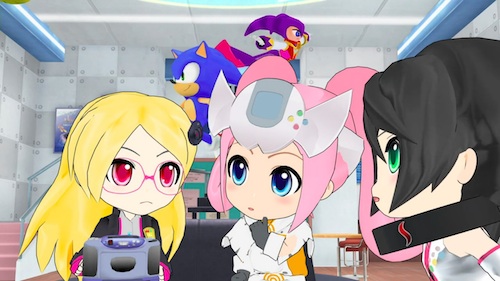
A couple of cool podcasts, Anime World Order and GME Anime Fun Time, recently released their reviews of Hi-sCoool! SeHa Girls, a bizarre, low-budget 3DCG anime about personified Sega game consoles from the creators of the incredible gdgd Fairies and Straight Title Robot Anime. As a huge fan of Sega growing up, the show hit all the right spots.

At one point, the AWO crew and guest Heidi Kemps talk about the SeHa Girls ending theme, which they explain is actually the company song for Sega in the 90s, but is sadly left untranslated in the official Crunchyroll release. I decided to take it upon myself to translate the song, only to realize that there is not only a full version of the original song, but that there’s also a full version of the variation used in SeHa Girls as well.

Thus, I present to you a translation of “Wakai Chikara -SEGA HARD GIRLS MIX-.”

A couple of notes: Wakai Chikara, or “Youthful Power,” was the Japanese Sega slogan in the 90s. Similarly, a lot of the quotes spoken in reference to Sega hardware are also advertising slogans.

Title: Wakai Chikara -SEGA HARD GIRLS MIX-
Composed by Wakakusa Kei
(Japanese lyrics taken from here)

Verse 1

知的創造 あふれる 英知
Chiteki souzou afureru eichi
Intelligent creations, overflowing wisdom

共に築こう 豊かな文化
Tomo ni kizukou  yutaka na bunka
Together let’s build a flourishing culture

夢と希望は 宇宙(あおぞら)高く
Yume to kibou wa aozora takaku
Dreams and hopes are as high as space (the blue sky)

社会に貢献 我らが使命
Shakai ni kouken warera ga shimei
It’s our mission to contribute to society

明日の創造 生命(いのち)にかえる
Ashita no souzou inochi ni kaeru
Creating tomorrow, changing lives

セガ(SEGA!) セガ(SEGA!) セガ(Fu-!!)若い力
SEGA! (SEGA!) SEGA (SEGA!) SEGA (Fu-!!) Wakai chikara
Sega (Sega!) Sega (Sega!) Sega (Foo!!): Youthful Power

Verse 2

先進技術 絶ゆまぬ 努力
Senshin gijutsu tayumanu doryoku
Leading technology, trustworthy effort

共に目指そう 新たな流れ
Tomo ni mezasou arata na nagare
Together, let us aim for a new current

夢と希望は 海原広く
Yume to kibou wa umibara hiroku
Dreams and hopes are as wide as the ocean

時代の先取り 我らが挑戦
Jidai no sakidori warera ga chousen
Anticipating the times is our challenge

未来の創造 生命(いのち)にかえる
Mirai no souzou inochi ni kaeru
Creating futures, changing lives

セガ(SEGA!) セガ(SEGA!) セガ(Fu-!!)若い力
SEGA! (SEGA!) SEGA (SEGA!) SEGA (Fu-!!) Wakai chikara
Sega (Sega!) Sega (Sega!) Sega (Foo!!): Youthful Power

Spoken Section

「すべての始まり」 SC-3000
“Subete no hajimari” SC-3000
“The beginning of everything” SC-3000

「楽しさいっぱい」 SG-1000
“Tanoshii ippai” SG-1000
“So much fun” SG-1000

「ソフトの数だけ 興奮してね」 SG-1000Ⅱ
“Sofuto no suu dake koufun shite ne” SG-1000II
“Just the amount of software alone is exciting! SG-1000II

「野球もテニスも」 ロボピッチャ
“Yakyuu mo tenisu mo” Robopiccha
“Baseball, and tennis too” Robo Pitcher

「1メガビットの大容量」 マークⅢ
“1 megabitto no daiyouryou” Maaku III
“1 megabit capacity” Mark III

「スーパーゲームメカ」 マスターシステム
“Suupaa geemu meka” Masutaa Shisutemu
“Super game machine” Master System

「時代が求めた16BIT」 メガドライブ
“Jidai ga motometa 16BIT” Megadoraibu
“16BIT: what the times were looking for” Mega Drive

「ワールドワイドでナンバーワン!」 ジェネシス
“Waarudowaido de nanbaa wan!” Jeneshisu
“Number one worldwide!” Genesis

「色いっぱいだよ」 ゲームギア
“Iro ippai da yo” Geemu Gia
“So many colors” Game Gear

「2つの頭脳がドッキング」 テラドライブ
“Futatsu no zunou ga dokkingu” Teradoraibu
“The docking of two brains” Tera Drive

「ゲーム革命!」 メガCD
“Geemu kakumei!” Mega CD
“A gaming revolution!” Mega CD

「高性能ボディコン・ペア」 メガドラ2 メガCD2
Kouseinou bodikon pea” Megadora 2 Mega CD 2
“High-performance body-conforming pair” Mega Drive 2 Mega CD 2

「メガドライブ新次元」 スーパー32X
“Megadoraibu shinjingen”  Suupaa 32X
“A new dimension for the Mega Drive” Super 32X

「脳天直撃!」 セガ・サターン
“Nouten chokugeki!” Sega Sataan
“Right in the head!” Sega Saturn

「セーブはお任せ」 ビジュアルメモリ
“Seebu wa omakase” Bijuaru memori
“Leave the saving to me” Visual Memory

「夢を繋いで!」 ドリームキャスト
“Yume o tsunaide!” Doriimukyasuto
“Connect our dreams!” Dreamcast

Verse 3

人社一体 みなぎる闘志
Jinsha ittai minagiru toushi
The people and the company are as one, with overflowing fighting spirit

共に進もう 絆も固く
Tomo ni susumou kizuna mo kataku
Let’s move forward together and solidify our bonds

夢と希望は 永遠(とわ)に尽きない
Yume to kibou wa towa ni tsukinai
Hopes and dreams are never-ending

目標追求 我らが誓い
Mokuhyou tsuukyuu warera ga chikai
Pursuing our goals, that’s our vow

世界の創造 生命(いのち)にかえる
Sekai no souzou inochi ni kaeru
Creating worlds, changing lives

セガ(SEGA!) セガ(SEGA!) セガ(Fu-!!)若い力
SEGA! (SEGA!) SEGA (SEGA!) SEGA (Fu-!!) Wakai chikara
Sega (Sega!) Sega (Sega!) Sega (Foo!!): Youthful Power

If you liked this post, consider becoming a sponsor of Ogiue Maniax through Patreon. You can get rewards for higher pledges, including a chance to request topics for the blog.

Searching for Something: When Marnie Was There

This film is part of the 2015 New York International Children’s Film Festival

Studio Ghibli is by far the most famous and well-regarded Japanese animation studio, but over the past two years Ghibli has been defined instead by a sense of finality. Director and co-founder Miyazaki Hayao, known for the Academy Award-winning Spirited Away, has declared the challengingly self-critical The Wind Rises to be his last feature-length film. Though not saying anything to that degree, his fellow co-founder, the 79-year-old director Takahata Isao (Grave of the Fireflies), might very well end his career with the artistically beautiful Tale of the Princess Kaguya. For a long time people have been speculating as to what would happen once Studio Ghibli lose Miyazaki and Takahata, leading people to ask who might be Miyazaki’s successor. The problem, of course, is that “the next Miyazaki” is a weighty title that no should be burdened with carrying.

Nevertheless, this is perhaps the challenge that faces director Yonebayashi Hiromasa and his latest film, When Marnie Was There, a book adaptation that has the distinction of being the last Studio Ghibli film in production, at least for the time being. However, while Yonebayashi’s films for Ghibli undoubtedly utilize the “Ghibli look” that is derived from Miyazaki’s personal drawing style, what becomes clear upon watching Marnie (as well as Yonebayashi’s previous film The Borrower Arrietty) is that Yonebayashi’s directorial style is unmistakably distinct compared to the veterans who originally founded and defined the studio.

When Marnie Was There centers around a 12-year-old Japanese girl named Anna, an adopted child who suffers from asthma and perpetually feels like an outsider among both her classmates and her family. Her adopted mother, concerned for her well-being, decides to send Anna to live in the countryside, where the fresh air should be good for her. However, even in a different environment, Anna still continues to feel alone, until she comes across an old, mysterious mansion and a blonde girl named Marnie. She immediately connects to Marnie, while also feeling that there’s something oddly familiar about her.

When I think about both Marnie and how it feels different compared to other Ghibli films, the first word that comes to mind is “haunting.” This is not to say that the film is dark or depressing, and though weighty in its own way, it also feels different from something like Grave of the Fireflies or even Nausicaa of the Valley of the Wind. Much like Arrietty, I find that the film, though basking in its gorgeously rendered environment and all of the little details that go into it, is much more introspective. The narrative conflict is less a manifestation of our inner struggles (as so many films and anime are), and more just a straight-up look at Anna’s own emotions. While Miyazaki cast Anno Hideaki, director of Neon Genesis Evangelion, in the starring role of The Wind Rises, it’s Marnie that feels almost like a Ghibli take on some of the themes of Evangelion. Anna’s somber worldview and her initial resignation towards her lack of sense of belonging make clear that her circumstances are emotionally complex, made all the more difficult by the trouble she has communicating with others.

It wasn’t until the end of the film that I came to realize what it was Anna was searching for, and though I assume this was fully intended given the mysterious air surrounding Marnie and Anna’s relationship, I had jumped to numerous erroneous conclusions while watching. Perhaps it’s my own experience watching other anime, but the friendship between Anna and Marnie appeared to be so intimate that I wondered if Anna and Marnie’s difficulty fitting it might come from the repression of lesbian sexual desires, now let loose through a time-space paradox. I wondered if Studio Ghibli would be so daring, and when taken individually I think these scenes can still evoke that sort of impression, but ultimately it’s nothing so bold. That certainly doesn’t make it a worse movie as a result, though it leaves me to consider what would happen if a studio as renowned and with such international presence as Ghibli indeed made an animated movie with a lesbian protagonist.

Overall, Marnie fits into the rough mold of a Ghibli film, with its attention to environment and space and its story of a young girl learning about herself and about life in general, but it really stands on its own by speaking to that feeling of not being able to quite fit in, and having the solution amount to more than just gaining confidence. Whether Yonebayashi continues with Ghibli or some other studio, I’m looking forward to what he does next.

If you liked this post, consider becoming a sponsor of Ogiue Maniax through Patreon. You can get rewards for higher pledges, including a chance to request topics for the blog.

Up and at Them: Ogiue Maniax Status Update for March 2015

This past month I lost one Patreon sponsor while gaining another. While in business this might be called stagnation, I’m actually very grateful that so many of my patrons have decided to continue to stick with me. Of course I can’t hit it out of the park for everyone all the time, so I’m thankful for even one-time contributors.

Speaking of thanks, shoutouts to the following fine folks for being especially awesome patrons.

Ko Ransom

Alex

Johnny Trovato

There are also a few others, but they’ve chosen to remain anonymous, and I can appreciate that.

Last month’s most popular post was Smash Bros. vs Traditional Fighters and What Lies at the Core of Fighting Games, where I wrote about different philosophies concerning simplicity vs. complexity between different fighting game communities. Part of the reason it got so many hits is that I posted it to Reddit myself, but I do think it’s some of my better work. I know I’m more of an anime and manga blogger, but I do have interest in video games and other things as well, and I hope, even if you’re not quite into everything I enjoy, that I can at least make you think.

A few questions for my readers to end off:

1) What kinds of rewards do you think would be interesting for Patreon sponsors of Ogiue Maniax?

2) What do you think of review posts that cover more of the middle point of an anime as it’s airing, as opposed to ones that wait until the very end? They kind of serve two different functions, with the former being more “in-the-moment,” and the latter being more retrospective. I’m aware that some anime fans like to keep up with the new season as much as possible, while others prefer to wait and build up a back catalog, and I’m curious as to which type reads Ogiue Maniax more.

Nobodies on an Adventure: The Rolling Girls

rollinggirls-motorcyclefallSource: Kirishii

The Rolling Girls is currently my favorite anime of this season, even more than Yuri Kuma Arashi which I think is incredible. Both shows have quite a bit in common with each other in terms of creative visual presentation, but whereas Yuri Kuma Arashi has more of a theatrical and fairy tale feel, Rolling Girls I think can best be described as “charismatic.” When watching I sometimes feel like I’m falling in love, not so much with the girls in the story, but rather with how its world is presented and how its people move through their environment. I’m not sure just how popular The Rolling Girls is inside or outside of Japan, but I’d like more people to watch it, so I’m hoping to make a convincing argument as to why it’s at the very least an interesting show, as well as a refreshing and invigorating experience.

The overarching premise of The Rolling Girls has Japan split into a variety of independent territories, somewhat like a contemporary warring states period. In this new era, different factions try to get ahead, either by fighting other territories or through peace. People are divided into two categories: exceptional individuals known as Mosa (meaning “valorous individuals”, translated officially as “Bests”), and the regular masses who at best provide support in conflicts but mostly stand out of the way, known as Mobu (literally “Mob” but translated as “Rests”). Without going into too many details, the somewhat off English subtitle for the show explains its concept well: “Rolling, Falling, Scrambling Girls. For others. For themselves. Even if they’re destined to be a ‘mob.'”

In other words, a group of girls, despite not having any superhuman abilities, try to do their best in their crazy world, and following them has been an absolute joy.

rollinggirls-alwayscomimaSource: Beautiful World

I imagine that the first thing people will notice about The Rolling Girls is its colorful palette, attention to environment and backgrounds, and stylish animation, reminiscent of Kyousou Giga and to a lesser extent Kill la Kill. Any time a character says something, does something, or even just stands still, there’s an energy and vibrancy to their actions. The Rolling Girls has the feeling of a really dazzling billboard come to life, and while anime is no stranger to slick animation and bright colors, what I especially enjoy about the series is how this presentation emphasizes the connection between the characters and their world.

At the time I write this, the narrative and the world of the story have barely begun to unfold as they travel from one place to the next, experiencing the unique customs and cultures that have arisen since Japan broke apart as a nation. I want to find out more about their world and their characters. It’s kind of like Kino’s Journey in certain respects, only without the idea that the beauty of the world is in its ugliness, and even sometimses reminds me of Redline in the way that the world seems to be constantly teeming with activity. The aesthetics of the show enhance the world-building not so much because of beautiful backgrounds or other more expected ways, but because the world and the people seem to be breathe as one, and that breath is somehow chaotic and erratic and all the better for it.

If you liked this post, consider becoming a sponsor of Ogiue Maniax through Patreon. You can get rewards for higher pledges, including a chance to request topics for the blog.
Did You Spot This Manga Reference in The Rolling Girls?

Have you been watching The Rolling Girls? So far, it’s one of my top 3 shows of the Winter 2015 anime season. I’m planning a larger write-up for the series, but for now I wanted to point out a small reference in Episode 4 of the show.

Episodes 3 and 4 take place in an area named “Always Comima,” a land that is a perpetual Comic Market doujinshi festival. At one point, the girls end up at a house in Always Comima, whose owner once met one of the girls, Kosaka Yukina, who gave her gratitude by drawing a portrait of their family. You might have noticed that the portrait looks somewhat…peculiar.

The style used in the portrait is actually a reference to a manga artist named Jigoku no Misawa, or Misawa of Hell. Having gained popularity among 2ch users, Misawa is mainly known for his bizarre one-panel comics depicting silly-looking characters trying to act cool.

While his claim to fame is like some Bizarro version of Family Circus, Misawa’s actuall had a few manga long-form published in Jump SQ by Shueisha, the same company that puts out Shounen Jump. I’ve only read Kakko Kawaii Sengen! (“Cool-Cute Proclamation”), which features a girl who is known for being clumsy and popular with the boys, while still looking like this:

Kakko Kawaii Sengen has actually received an animated adaptation, and some merchandise to go along with it.

If you’re interested in checking out Misawa of Hell’s stuff and you have a smart device, then you’re in luck. His series, The Great Phrases Women Fall for, is currently available translated into English on the Manga Box app.

iOS

Android

If you liked this post, consider becoming a sponsor of Ogiue Maniax through Patreon. You can get rewards for higher pledges, including a chance to request topics for the blog.

It Just Works Better: Tantei Opera Milky Holmes TD

This post was sponsored by Johnny Trovato. If you’re interested in submitting topics for me to write about, or just like my writing and want to sponsor me, check out my Patreon.

milkyholmestd-milkyholmes

The original Tantei Opera Milky Holmes is an anime I viewed as largely a disappointment. Ostensibly about a group of cute female detectives with superpowers, the premise is more window dressing for moe comedy and reference humor. That combination can be okay, but in Milky Holmes the jokes are very hit or miss (mostly the latter). The majority tend to be rather one-dimensional (That’s from that anime! Haha!), though every so often there would be a truly impressive gag. Case in point, I fondly remember the “Baritsu” gag, which spent an entire episode setting up the name of a semi-fictional martial art found in the Sherlock Holmes novels in order to deliver a pun based on the climax of Laputa: Castle in the Sky. However, because the show felt so flimsy and the humor fell flat so often, when it came to the next one, Futari wa Milky Holmes, I felt little need or desire to check it out even if there were some brighter moments.

I’ll be honest when I say that, if it weren’t for my Patreon sponsor Johnny Trovato, I probably would not have given the franchise a second look. As wide as my tastes are in anime, and as willing as I am to give shows a second chance, I had ignored it in favor of other current series. That’s why I was rather surprised to find that the third and latest anime, Tantei Opera Milky Holmes TD, is pretty much an improvement all around compared to its original predecessor.

milkyholmestd-jojo

While the humor continues to be a mixed bag of weak, one-note references and stronger, more developed jokes, what makes Milky Holmes TD work better is that its story provides just enough stability that the anime doesn’t live or die by its gags alone. The four main characters, Sherlock, Nero, Cordelia, and Hercule (all named after famous fictional detectives), must solve a rather bizarre missing “persons” case. An idol, whose songs are powered by fairies that have been a part of her since birth, have gone missing, and nobody knows who is responsible. What makes this mystery even more difficult is that the fairies end up in the bodies of people who are unassociated with the original crime, and so the girls of Milky Holmes work towards finding them one by one, with the ultimate goal being to find the original culprit. Though not much actual detective work goes into the series, it’s enough to get a sense of progress from one episode to the next, and to inspire a viewer to feel invested.

Essentially, as the girls find each of the fairies, there is this general forward movement where they move one step closer to accomplishing something. In contrast, although the first anime starts off somewhat similarly with the Milky Holmes girls themselves losing their powers and by extension their positions as the best detectives in school, that storyline doesn’t go anywhere until the last episode (which admittedly was an enjoyable finale). I doubt that existing fans of Milky Holmes care too much for that sort of thing, at least within the context of Milky Holmes itself, but I think it gives an “in” for those who might otherwise pass it up. It might not seem that significant, but I believe this is the sort of thing that can expand a franchise’s fanbase, if only a little.

milkyholmestd-raohmarshmallow

Speaking of abilities and reputation, I like the fact that the Milky Holmes girls are re-introduced in Milky Holmes TD with a kind of reverence. I think it’s meant to show just how far the Milky Holmes media franchise has come, and that while they were “rookies” of sorts in the original, now they’re back and better than ever. Also, because they have their powers and at least try to make use of them, you can believe that they’ve actually had past success in helping others out. It’s a fine line, I think, because it’s not like the girls show powerful deductive reasoning, and for the most part that is barely even a consideration in Milky Holmes. However, having capable yet humorously hopeless characters appeals to me more than just having them be all but useless.

From my perspective, you can more than easily skip the original series and go straight to Tantei Opera Milky Holmes TD. It certainly isn’t for everyone, but I think it stands a better chance of drawing in an audience beyond those who think “cute girls and anime references” are enough content. Now if they start to better utilize their detective and phantom thief motifs better, then it’ll really turn some heads.

PS: Akechi is the best character.milkyholmestd-akechi

Kio Shimoku Interview at Anime News Network… and He Answered My Question!

A couple of months back, Anime News Network announced that they were interviewing Kio Shimoku for the release of the new Genshiken Second Generation (aka Genshiken Second Season aka Genshiken Nidaime) bluray set. The interview is now up, which you can read here. Kio speaks about topics such as why he decided to introduce Hato to Nidaime, how he feels about otaku culture.

Kio actually answered my question, which I’m totally stoked about! I’ve reproduced it below, though I’m sure you could find it by just hitting “ctrl+f Ogiue.”

When it comes to Ogiue, one of the more notable visual changes is how her eyes are drawn. As this quality is unique to Ogiue in Genshiken, why did you decide to express her mental and emotional growth in this manner? Additionally, is it something you planned to do from the start, or was it something you developed as you worked on the manga?

It was accidental and naturally developed.

To put emphasis on her unfriendly look and distant nature, I designed her eyes without the highlight. After her mental transition, those characteristics changed and the initial design for her eyes simply didn’t work anymore.

It’s not surprising to me that the change in Ogiue’s would have come from a whim of sorts, as this is the case with a lot of creators and their characters. As much as I love the original Ogiue’s eyes, it also makes complete sense that they wouldn’t work nearly as well as she began to truly open up to Sasahara. It’s also quite noticeable how differently she looks and behaves compared to her former self (something I’ve tried to show off in my new banner).

The 0ther answer I find most interesting has to do with how Madarame’s “harem” has developed, because Kio states that it’s something of a natural progression. There were already characters interested in Madarame in some capacity, and when Saki finally rejected him, it opened up the playing field, so to speak. He wasn’t suddenly popular, they just began to be interested in him for just the way he is. If I were to interpret it further, it’s not like Madarame became the image of the attractive guy, but rather that he attracted exactly the type of people that would be into him.

As for the rest of the interview, it’s really worth a read and gives a lot to think about, especially when compared to his old interview with Publisher’s Weekly back in 2008. At the time, Kio expressed a lot of discomfort with the increasing attention otaku were getting in the media, and even in this ANN interview he talks about how he came from the generation where people were ashamed to be otaku. It’s really fascinating to see this mindset play out and evolve over time, as well as how the concept of “otaku” itself has become more nebulous. In fact, this sentiment has also been expressed by Tamagomago, who calls himself an old-type otaku standing in the face of these changes. In a way, it makes me wonder if Genshiken Nidaime is an attempt to navigate this newer environment in a way that embraces it, rather than shunning the unfamiliar.

If you liked this post, consider becoming a sponsor of Ogiue Maniax through Patreon. You can get rewards for higher pledges, including a chance to request topics for the blog.


What If There Was a Bodybuilding Manga?

462508

Artist: Haepo Heidi

After having watched the famous bodybuilding documentary Pumping Iron (1977) featuring Arnold Schwarzenegger and Lou Ferrigno, I think that bodybuilding might not be such a bad premise for an anime or manga series.

The reason I came to this conclusion is that there is an important performative aspect to bodybuilding competitions, and I could see this being depicted in a manner similar to a series such as Ariyoshi Kyouko’s Swan, which is about ballet, or Miuchi Suzue’s acting-themed Glass Mask. The way that both the appearance of the body and the way that posing factors in as a way to highlight one’s strengths and obscure one’s weaknesses can provide ample material to dramatize matches and for an exposition-type character (e.g. Speedwagon in Jojo’s Bizarre Adventure, Ryousuke in Initial D) to go into some extremely granular detail: “His arm is at 47 degrees instead of 44 degrees, causing it to look slightly bigger than it actually is!!!”

I think the real meat of a bodybuilding competition manga would be the freestyle pose-off, where bodybuilders try to make themselves look better and the other guys look worse by changing their poses in response to what the others are doing. There’s the psychology between the competitors and the psychology of how the judges are perceiving the interaction between them, and so it would perhaps be a nice way for a strategist type to psyche his opponents out. When Akagi with Muscles makes his opponent feel smaller, this could even be represented in the art by having a guy suddenly shrink down to half his actual size.

And if you want them to look freakishly muscular, just get Baki the Grappler artist Itagaki Keisuke to work his magic.

Extra points if this were a shoujo manga.

If you liked this post, consider becoming a sponsor of Ogiue Maniax through Patreon. You can get rewards for higher pledges, including a chance to request topics for the blog.

The Intertwined Histories of Magical Girls, Idols, and Science Fiction Anime

Magical Angel Creamy Mami

I recently learned (thanks to Japanese popular culture scholar Patrick Galbraith’s new book The Moe Manifesto) that Magical Angel Creamy Mami is not only an influential magical girl anime but the very first anime about an idol. In other words, idols and magical girls have been conceptually tied to each for decades now. You can see this not only in the the fact that you’ll get the occasional idol + magical girl still (Cure Lemonade and Cure Sword in the Precure franchise, for example), but the fact that the latest competitors to magical girl anime have been idol-themed shows, such as Aikatsu! and Pretty Rhythm, both of which feature magical girl-like transformation sequences. I think Creamy Mami is especially significant here because the majority of magical girls prior to it were more “witch girls,” characters who already have magical powers without the need for transformation and use them for mischief.

Of course, the common trait of magical girls and idols is that they both feature cute girls, and with idols especially they’ve always occupied a position where they are innocent yet sexual, and I don’t mean that necessarily in an “idols are creep magnets” way. Both men and women respond to idols for a variety of reasons, and a lot of it is tied to the image they present. They can be somewhat literal idols for girls and targets of affection and desire for men, and this can be seen in how idols are used in anime. While Creamy Mami built an unexpected older male audience, for example, Superdimensional Fortress Macross reveled in it by combining the idol with the extremely prominent aspects of science fiction and giant robots. The 1970s brought forth a lot of giant robot anime, and the 1980s saw the time when those who became fans of robots and SF began creating their own works, as seen with Kawamori Shouji and Macross and later Studio Gainax and their Daicon III and IV animations. Many of these creators said, “I like SF, and I like cute girls,” and created a defining combination of anime where mecha and other forms of fantastic technology are mixed with cute girls.

Daicon IV

It can also be argued that the girl in the Daicon animations is herself a magical girl, but the connection between magical girls and science fiction is especially evident in the 1990s and the advent of the fighting magical girl, most notably with Takeuchi Naoko’s Pretty Guardian Sailor Moon. While Sailor Moon does not feature giant robots, it’s undoubtedly influenced by the Super Sentai (i.e. Power Rangers) franchise with its own transformation sequences, color-coded costumes, and monster of the week fights. Super Sentai is not only traditionally marketed at boys (though this too changes as they eventually start trying to appeal to the “moms” market), but it’s also more broadly tied to tokusatsu, the costumed fighters and rubber monsters genre that more or less literally means “special effects.” What I find significant here is that when it comes to categorization of genres in Japanese, you often see “SF/tokusatsu,” tying things back, at least somewhat, to science fiction.

Pretty Guardian Sailor Moon

Moreover, the manga group CLAMP have been fans of titles like JoJo’s Bizarre Adventure, Saint Seiya, and Galaxy Cyclone Braiger, and have produced titles such as Magic Knight Rayearth, which features magical girls in a swords-and-sorcery world who also gain the power to summon giant robots. “Rayearth” itself is the name of a giant robot, thus making the title itself reminiscent of the naming scheme of many mecha anime such as Mobile Suit Gundam or Super Electromagnetic Machine Voltes V. It’s as if these female creators have taken the works that were made “masculine” by Kawamori, Gainax, and others, and in a sense re-feminized them in a process that created something new and exciting.

If we’re talking influences though, Sailor Moon and CLAMP works such as Cardcaptor Sakura are huge in and of themselves, and their shadows can be seen in a number of anime from the 2000s on. Sailor Moon basically transformed magical girls to such an extent that many assume that fighting magical girls have always been the norm, and Precure has come up as a spiritual successor that has lasted even longer than Sailor Moon. The protagonist in Sunday without God practically is Cardcaptor Sakura protagonist Kinomoto Sakura, and Magical Girl Lyrical Nanoha, which has as its primary audience older men, clearly takes a lot from Cardcaptor Sakura as well. In the case of Nanoha, it also incorporates an increasing level of science fiction from one series to the next, as the franchise goes from technology-based magic staffs that shoot lasers in battles reminiscent of Mobile Suit Gundam to spaceships and interdimensional travel. Once again, the magical girl as cute girl is tied to SF. As for idols, they not only haven’t been forgotten, either in real life or in anime (as seen with series such as Love Live! and the aforementioned Aikatsu!), but Kawamori makes his return in the form of AKB0048, a series that not only features idols as magical girls of sorts both piloting and fighting giant robots in a story that spans a galaxy, but is directly based on one of the biggest real-world idol acts in Japan today.

AKB0048

It’s as if magical girls, idols, and SF have been doing a song and dance for years and years, changing partners along the way but always being drawn to each other. They’re seemingly tied together by the fact that just a few tweaks to either appeal to a male or female audience more, while the fact that people will not necessarily stay within the genres or types of entertainment that they’re “supposed” to remain with. Cuteness is a versatile tool that at times reinforces societal and gender norms while other times becoming a tool to defy them, and this continues to influence anime to this day.

If you liked this post, consider becoming a sponsor of Ogiue Maniax through Patreon. You can get rewards for higher pledges, including a chance to request topics for the blog.

The Fujoshi Files 125: Torisawa Mii

Name: Torisawa, Mii (鳥沢美以)
Alias: N/A
Relationship Status: Complicated/Dating
Origin: Tora to Ookami

Information:
Torisawa Mii is a high school student who works at her family’s restaurant, Himawari. One day while preparing food at the restaurant she meets two older men one day. Sengoku Torajii and Ookami Ken turn out to be two new student teachers at her school, but Mii also uses them as fodder for her BL fiction which she posts on her blog. Mii finds herself attracted to both of them, but due to her familiarity with the two she becomes a target for jealous bullying. Mii ultimately begins a relationship with Ken, moving away to live together.

Mii is an excellent cook and has a very strong sense of responsibility, especially when it comes to managing Himawari and taking care of her grandmother. When a businessman attempts to buy out the land under Himawari, she remains steadfast in her desire to preserve the restaurant that her parents left behind. In the end, she arrives at a compromise with the businessman where Himawari would be sold and replaced by a restaurant that serves food based on her family’s recipes, but Mii also opens up her own new version of Himawari in her new town.

Fujoshi Level:
While she was already into BL, meeting Torajii and Ken made Mii get more into writing hardcore material.