It’s February, which means the day everyone with romance in their hearts looks forward to.
That’s right: It’s new Precure anime time. And with Precure Full Bloom and Soarin’ Sky Precure finished, I’m hoping to have reviews of both series done this month.
Of course, the must-watch show for me this season is Bang Brave Bang Bravern. The culture clash between a very super robot and a gritty realistic world is hilarious, and I want to see where it all goes.
This month is also a momentous time for two of my favorite VTubers. La+ Darknesss, fresh off a new outfit reveal, will be having her first solo concert. It’s sponsored by Nissin UFO yakisoba, of all things. Meanwhile, Hakos Baelz will be celebrating her February 29 birthday with streams every day (and hopefully won’t collapse from overwork). After the string of unfortunate VTuber events recently, I am looking forward to some fun times.
I can count on one hand the number of times I’ve been to Japan, and every stay has been memorable in the best ways. However, there’s was always one item on the bucket list that I could never quite fulfill: going to Comic Market (aka Comiket), Japan’s—and likely the world’s largest comics-related event in the world.
That’s now changed. In an adventure that felt like nearly two decades in the making, I am proud to say that I am (technically speaking) a Comiket veteran.
My Feelings Going In
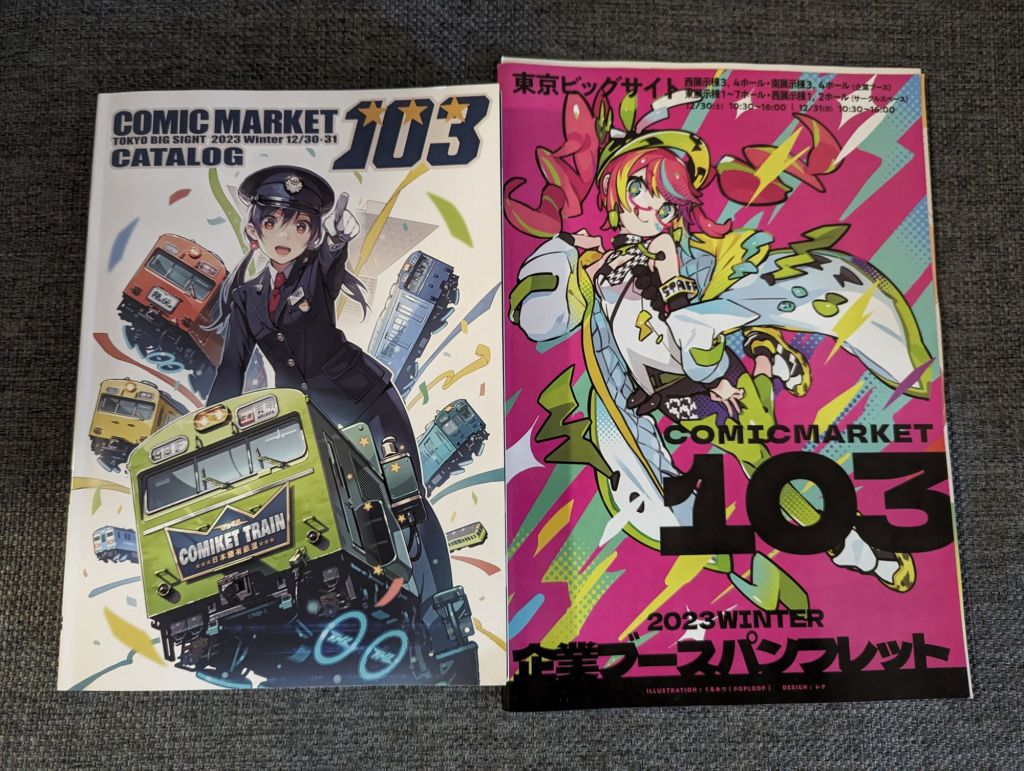
Comic Market 103 catalog and industry booth pamplet
I’ve read a lot about and related to Comiket over the years. I’ve had friends and acquaintances tell me about the times they went and the money they burned. The event also looms large in my favorite manga, Genshiken—scenes such as Sasahara losing every inhibition his first time attending, Madarame breaking his hand but choosing to try to stay anyway, and an incognito Ogiue spilling her BL all over the floor are all downright iconic. But I’ve also seen comments that the event is some combination of overrated and overhyped, so I wanted to make sure I came to Comic Market 103 with expectations that were neither ridiculously lofty nor blatantly unfair.
A classic cautionary tale is that of the anime fan who gets disillusioned upon visiting Japan, because they had previously been viewing the country and its culture through the inherently distorted lens of anime. My first time there, I was prepared for everyone I met to actually dislike anime because I didn’t want to make that mistake, only to have a different experience. While Japan wasn’t quite like my animes, it was also not that far removed, and I could still appreciate it as a fan. I approached Comiket with all this in mind.
Downside
I want to start by laying out some of the negatives I ran into.
First and foremost, there were no Genshiken doujinshi, as far as I could tell. Boooo.
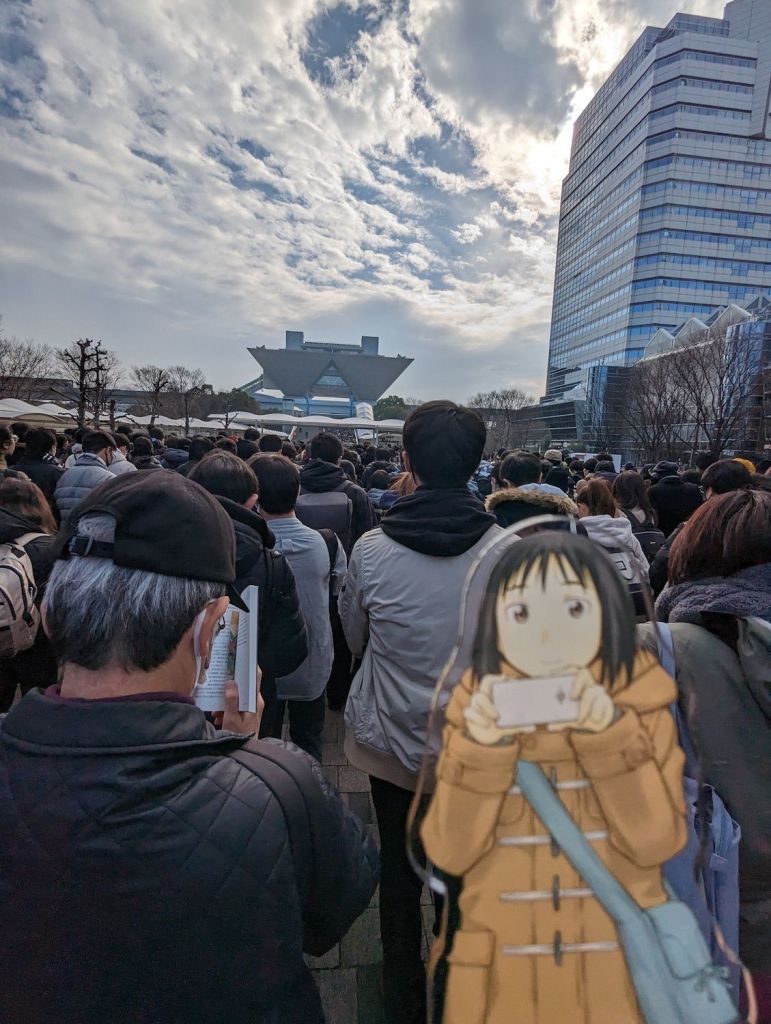
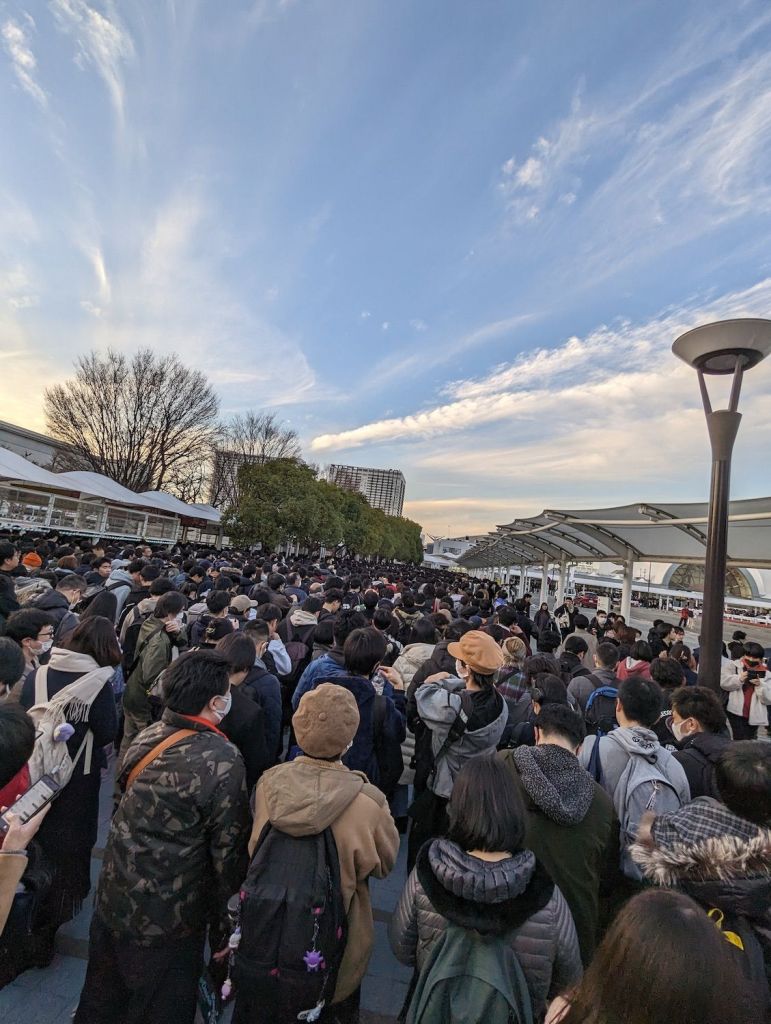
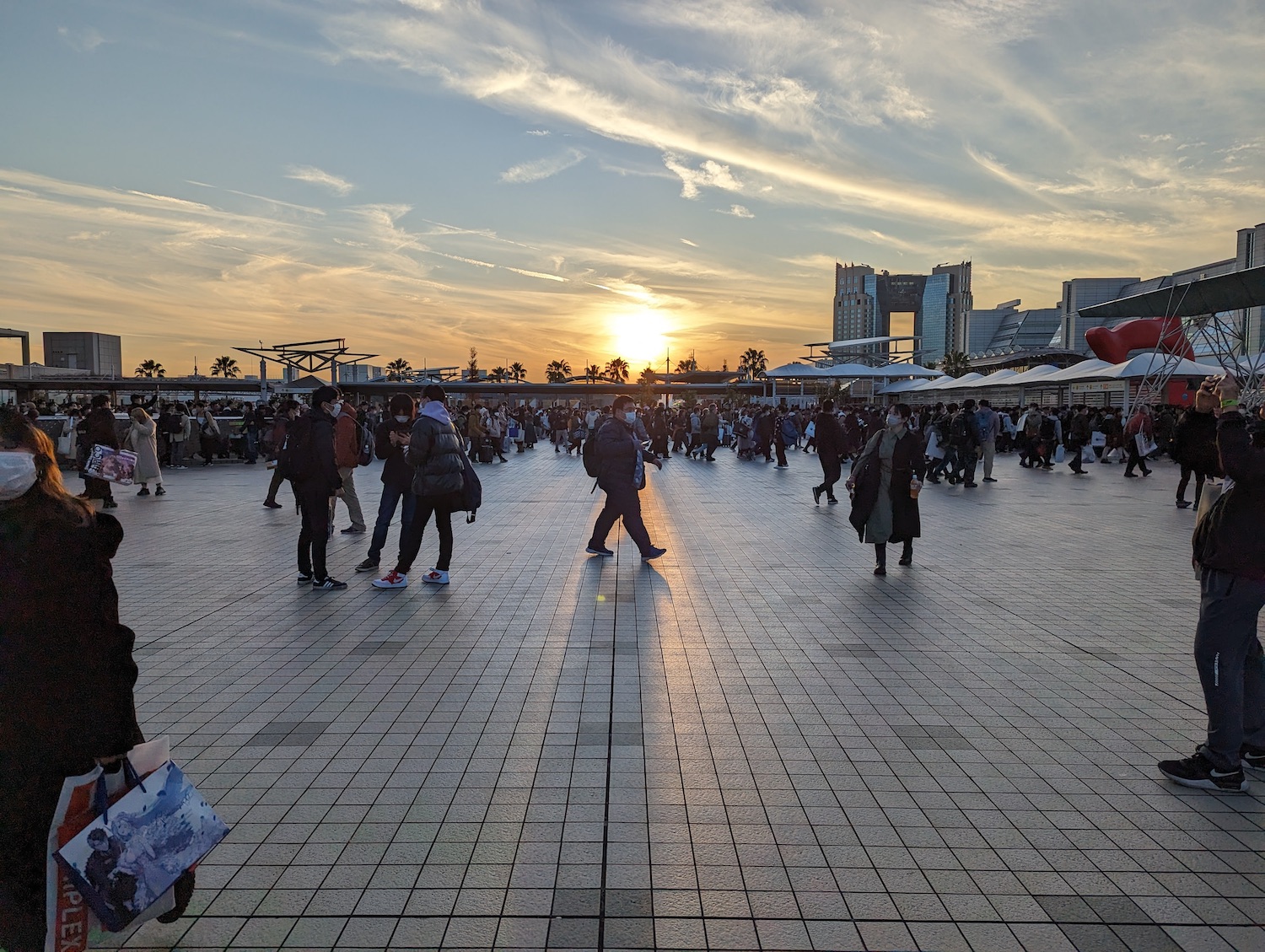
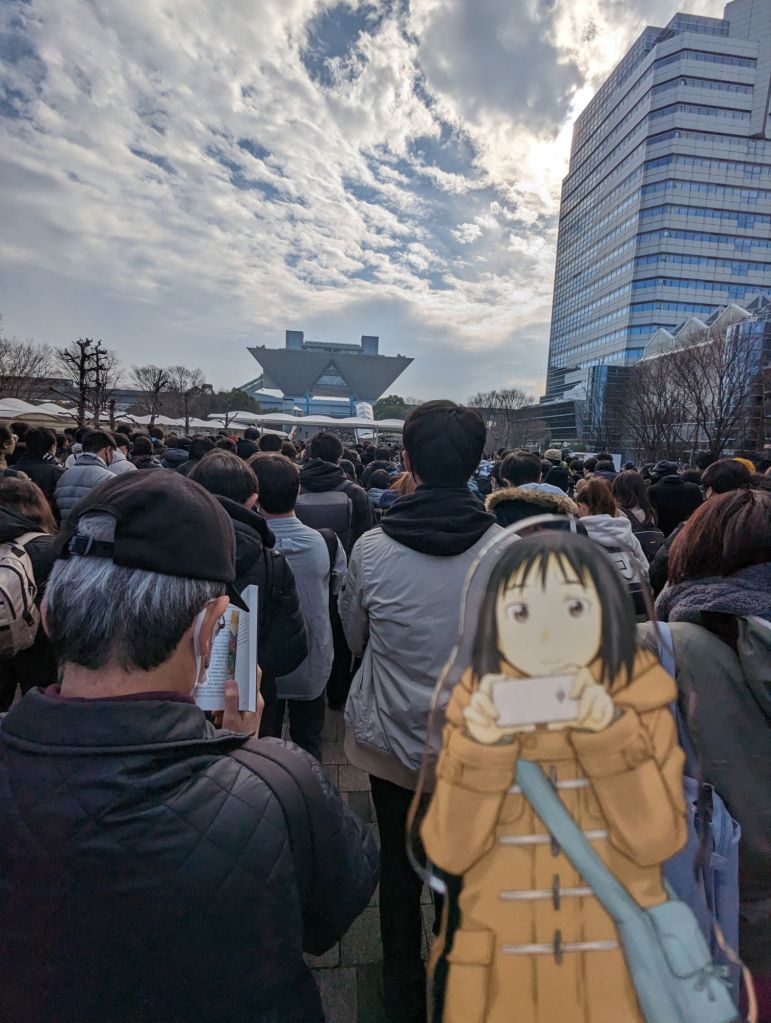
Second, getting to and from the venue, Tokyo Big Sight, can be an ordeal—especially depending on what time you decide to travel. On Day 1 (of 2), I ended up in a classic sardines-in-a-can situation in the morning, had to wait in line for about two hours before I could actually get into the exhibition space, and made the mistake of staying to the very end. In that last instance, it meant that a walk back to the train station that should have taken five minutes ended up being about an hour. Comiket is literally the most highly attended comic event in the world, and the approximately 30,000 circles (i.e. doujinshi vendors) would itself be considered a large convention. When you have to walk back with that many people, the pedestrian traffic jam is intimidating.
I was very fortunate that, despite Comiket taking place in late December, the weather was surprisingly pleasant. Had things not been so nice, the wait (and my overall experience) might have been more miserable.
Third is that there is very limited time to get anything, and nothing is guaranteed. A small fraction of tickets are for early entry (the doors open at 10AM), and are sold at a premium while also being lottery only. Otherwise, most people (including myself) have regular morning or early afternoon entry tickets, and can only get in later. On top of that, each day ends at 4pm, circles typically are there for only one day, and the most popular artists (especially the 18+ ones) will have massive lines. For example, I tried to get something from Mika PikaZo (character designer of Hakos Baelz and Fire Emblem Engage), and ended up going through three lines only to discover she had sold out of everything. There is a serious sense of FOMO that can make the losses sting—if something is popular, you basically have to impulse buy, or else it might be gone.
But This Is Accounted For!
There may be inevitable issues at Comiket, but that’s all the more reason I have to commend the staff for their excellent organization and crowd control. While things took time, they still progressed smoothly. And once inside, the crowds were not difficult to manage—about comparable to a large-ish anime convention. This is also owing to the attendees and circle members themselves, both of whom generally tried to follow the rules. On a few occasions, I had inadvertently blocked one table while looking at the content of another, and was asked to avoid doing so in consideration of others. The sense I got was that a lot of people involved, be they staff or otherwise, were very familiar with both Comiket and Tokyo Big Sight itself.
Something that helped with the crowds was that halls could open up to the outside, which prevented massive lines for certain artists from clogging up the aisles. I heard from a friend that this seems to have started since 2020 as a COVID precaution, and that this is an added side benefit. There’s a chance I might have felt somewhat differently if the weather hadn’t been so good, but I would have appreciated the improved ventilation regardless.
And as for FOMO, it turns out that a lot of artists sell their stuff in stores after the event, in places like the popular doujin shop Melonbooks. So not all hope is lost (though for buyers outside of Japan, you likely have to spend more on shipping fees and third parties).
What this all means is that negatives do exist, but they are accounted for and mitigated to a decent degree.
Upside
My haul
Although Comiket is not perfect, it’s still a great event that showcases what makes the otaku spirit special. There are drawbacks to being so massive, but the sheer amount of stuff both ultra popular and extremely niche, all in the same space, is a sight to behold.
The biggest categories this year were VTubers and various mobile games (or at least mobile game–adjacent works). But even if you’re into none of that, there’s still a chance you can find creators with which you share a common interest—and that’s even putting aside the 18+ stuff.
Here is some of what I ran into over the course of two days.
Srungle fanfiction
Guides to NYPD call signs and insignia
Illustrated food guides
Andy Hole x MIX from Aquarion EVOL in the year 2023
Original mecha drawings
Pilgrimage guides for fans of particular franchises
A book dedicated to events for Kawamura Maria, the voice of Naga from Slayers
Guides to bootleg ZOIDS
Cure Precious x Black Pepper Precure het shipping
Illustrated collections from actual VTuber character designers/collaborators
Cosplay model photo collections
Initial D BL
Yotsuba& parodies of Zambot 3 and Daitarn 3
Both het and LGBT Gundam: The Witch from Mercury shipping
Literally Sonoda Ken’ichi
It might be easier to find smaller events throughout the year that are hyper-focused on your particular interests, but nowhere is the sheer diversity of fandoms more on display than at Comic Market, even if certain specific titles dominate the majority of the physical space. It’s wonderful.
Vs. Conventions
The sense of discovery at Comiket is second to none, and I can’t help but contrast it with anime conventions in the US. One of my biggest problems with artist alleys is that it’s hard to find fanart of more obscure titles. This is because con tables are expensive (Otakon is $375 USD as opposed to Comiket’s 8000 yen, around $60–$80), and artists tend to display what’s most popular, probably out of the need to recoup the expenses. It’s not impossible, but sussing out the weird stuff involves going through artist portfolios or asking, which can be awkward or time-consuming. On the other hand, because Comiket tables are generally grouped together by interest, and their specific interests are front and center, you can know at a glance what to expect.
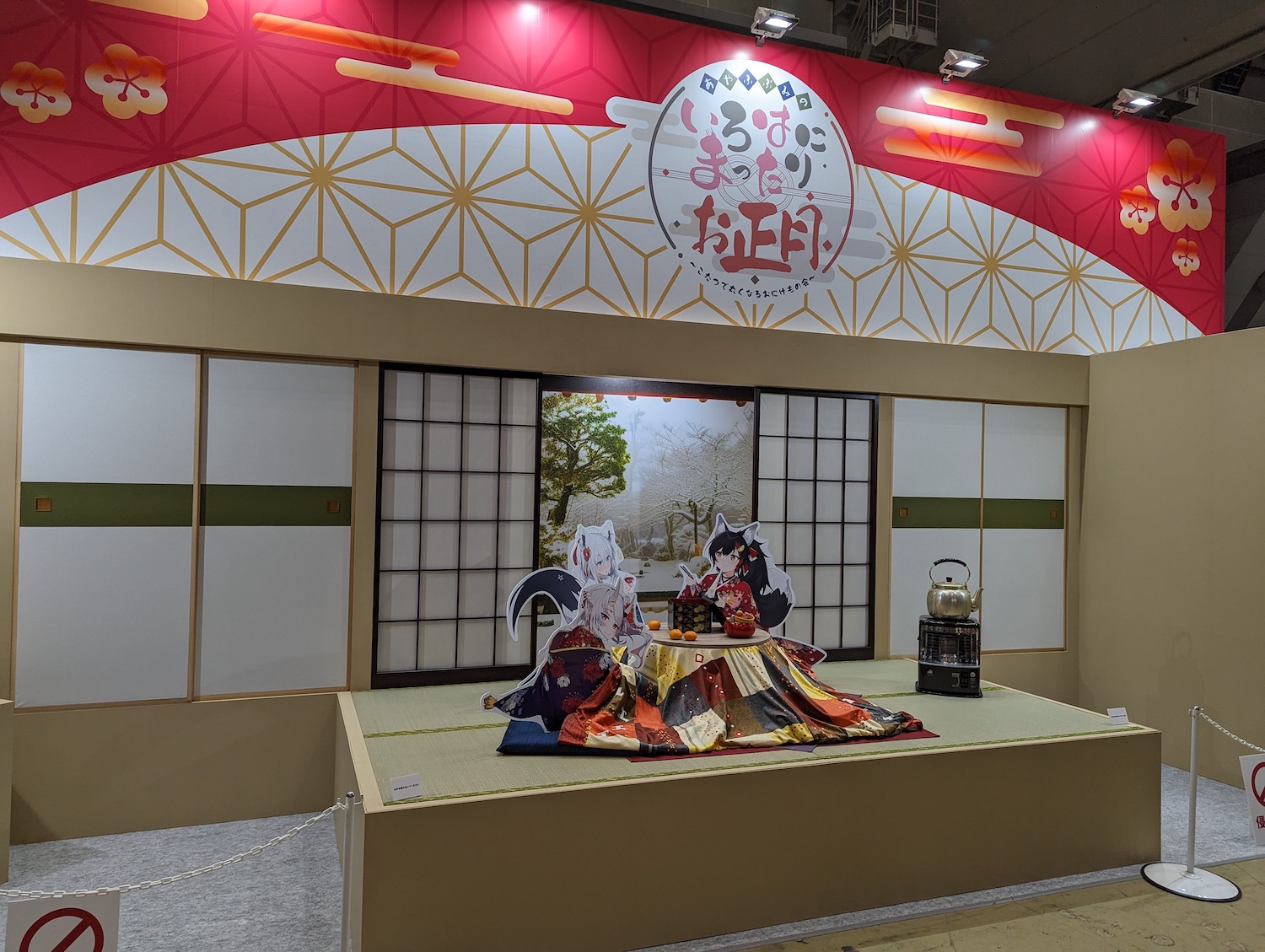
The hololive booth
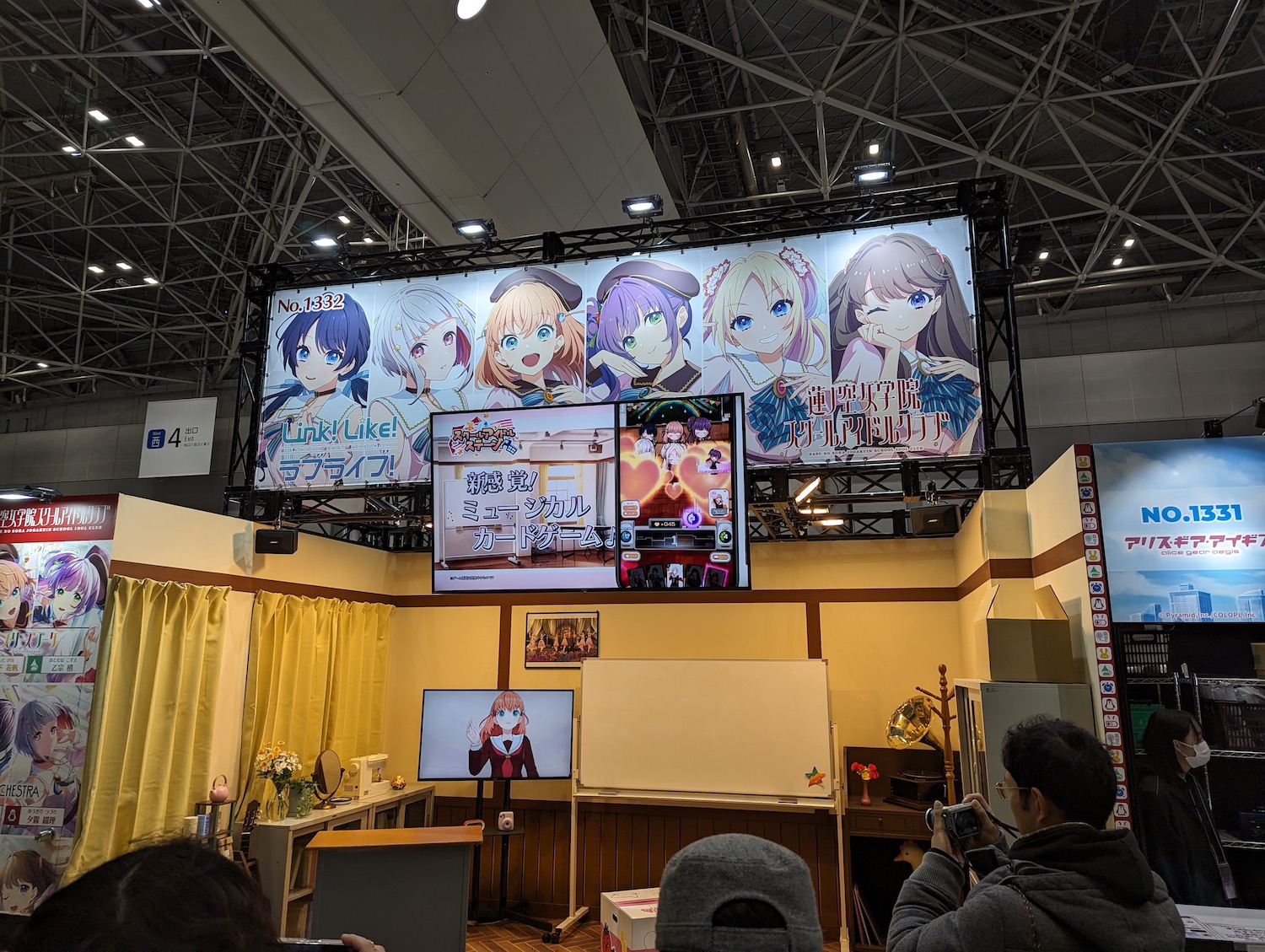
There was an industry presence at Comic Market 103, but it was much smaller than the space dedicated to doujin works. This is actually the opposite of American conventions, where the official booths and merch usually take up the majority of floor space. One thing I found interesting is that most of them, more than being manga-related, were more otaku-focused. That is to say, they were properties that attract hardcore dedicated fans—things like VTubers, Love Live!, The iDOLM@STER, mobile games, etc. One interesting presence was a booth for My Youth Romantic Comedy Is Wrong, As I Expected, which is celebrating its 10th anniversary. I saw quite a line for merch there, and as a fan of the series, I’m glad to see it get some real love.
Another difference is that con-style panels and talks, be they fan-run or professional, are non-existent. They’re typically one of my favorite things, so their absence is a tad disappointing, but I also already knew that would be the case. All this goes back to time being a precious resource. No one really lingered or tried to socialize either, and the fact that the food truck lines were short (unlike an anime con) encapsulated one important fact: Attendees had priorities, and only a few hours to get what they wanted.
Overall Thoughts
Comic Market isn’t really one fandom, but rather dozens side by side in the same space. This approach has its strengths and weaknesses, and both are magnified by the sheer size of the population attending it. But while there are disparate groups, they all have the same general goal of finding the books that resonate on a personal level, and I think this gives the entire event a certain focused energy.
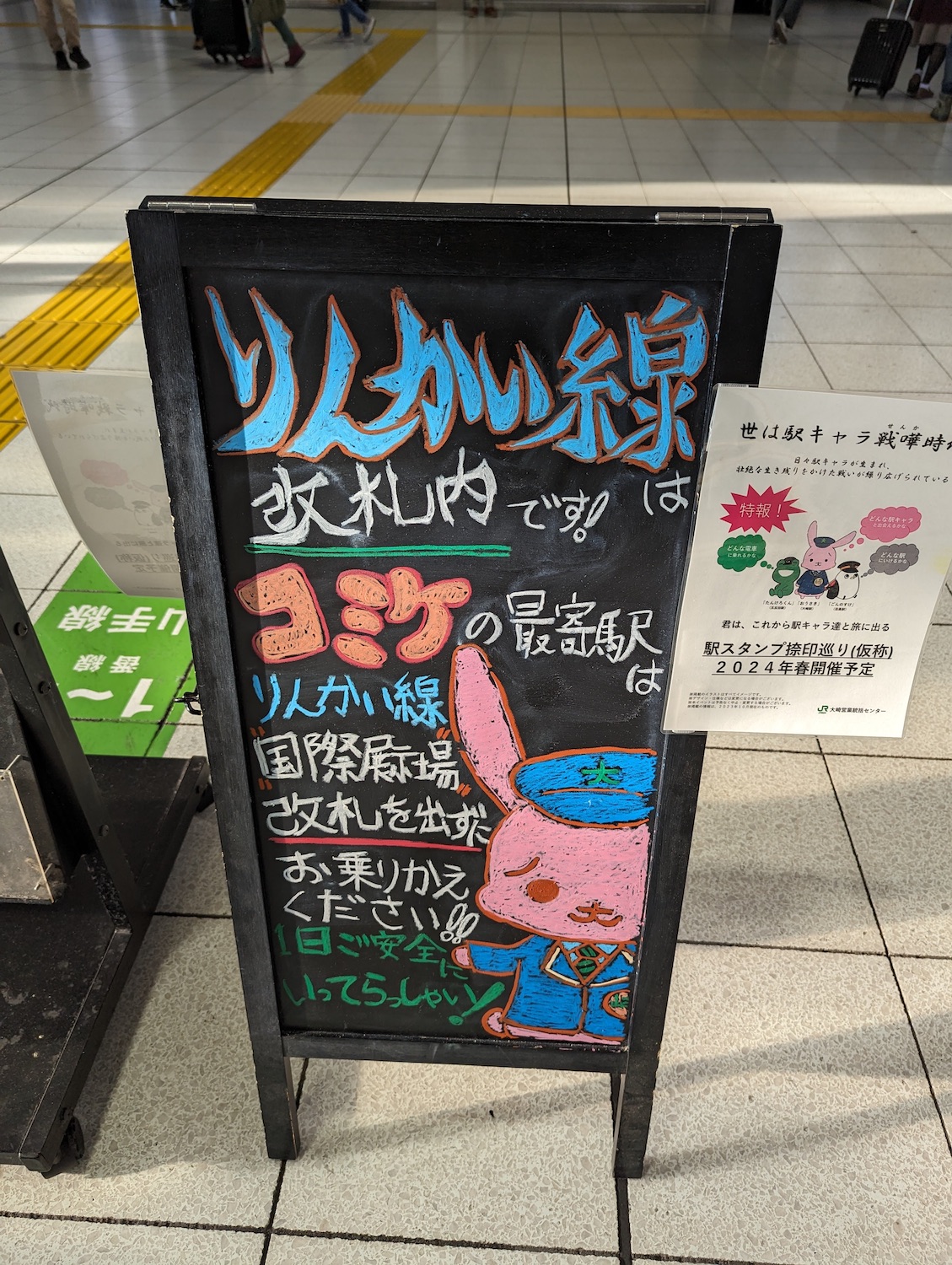
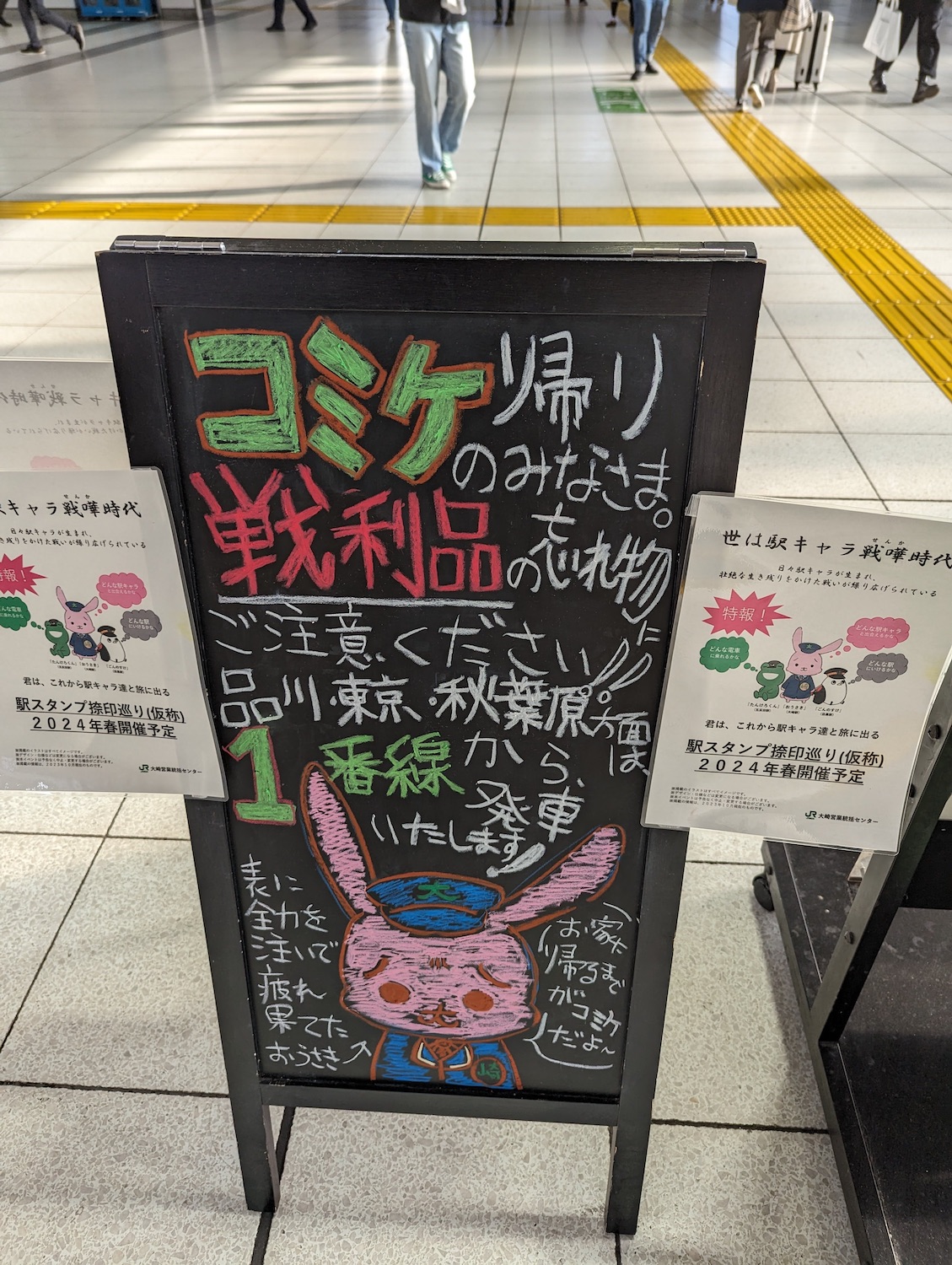
At the Osaki train station, one of the transfer points to get to Tokyo Big Sight, there was a chalkboard sign both welcoming people to Comiket and thanking everyone on the way back, depending on which direction you were coming from. It’s a small gesture in the grand scheme of things, but this double-sided sign’s presence really hit home for me the fact that the majority of hardcore fandom in Japan descends on a small strip of land.
I can’t say if this should be the first doujin event a person should visit, and it might not even be the best choice, depending on what one values. However, I can personally say that I had a great time, I’m happy to have done it, and if the stars align, I’d be more than willing to go again.
I mentioned having some fun surprises last month, and I let the cat out of the bag on Twitter a few days ago: I attended Comic Market for the first time!
While I don’t have a schedule fully planned out, you can expect the next couple months to have at least a few blog posts about my experience at Comiket, as well as other bits of my trip to Japan. I’m actually a bit worried about them overshadowing other topics, including the new anime season, but hopefully it’ll all work out.
May the Year of the Dragon bring fortune to everyone, but especially my Patreon subscribers:
I did experience the earthquake that hit Ishikawa Prefecture, but fortunately only from a great distance. I know there have been some tragic losses, but I hope everything gets up and running for those most affected.
Kio made his first trip to Akihabara, but took a different route this time. The last visit, he went to Melon Books, ZIN, K Books, etc. This time, it was Yodobashi, Volks, Yellow Submarine.
When asked if his interests are going from books to 3-dimensional things, Kio says that his interest in ero is growing weaker, while his desire to build gunpla is growing stronger.
Another reply shows Kio that the old Genshiken capsule figures still exist, to which he expresses surprise. He’s also amazed at how the swimsuit figures of Saki and Ohno managed to happen. The original replier says he likes this Ohno figure, but likes the bouncing boobs Ohno bust that came with an issue of Monthly Afternoon.
(Ogiue Manaix note: I have this one too, but I never managed to get the Ogiue counterpart because it was Japanese mail-order only…)
The Kimura Jin super fan known as “b” talks about how pure and innocent Jin looks, and asks Kio if Jin is saying “ni” (two) in the countdown image above. Kio gives an affirmative.
I had to ask if there’d be any limited store exclusives for Volume 8. Kio answered “no,” which helps me a lot because it determines how I order the book.
Technically not Kio tweets, but manga artist Shigisawa Kaya drew some Hashikko Ensemble fanart! In the first image, they mention loving Kozue’s fat fingers.
The artificial rendition of “Kanade” by Sukima Switch, as performed by the main characters of Hashikko Ensemble, goes away April 25th, 2022! Make sure to listen.
Kio wonders who the heck “Nagayama Koharu-chan” is. (Note: It’s actually a weird troll account by the author of Chainsaw Man where he pretends to be a third grader into Chainsaw Man).
The pet tortoise returns! Kio apologizes for only having lettuce.
Next month is after the release of the latest chapter of Spotted Flower, and when the final volume of Hashikko Ensemble goes on sale. I expect a lot more tweets in March.
This month’s tweet highlights for Kio Shimoku are a little different: I’m doing them in chronological order rather than grouping them by subject. Tell me what you think!
January is also the month that Hashikko Ensemble ended. Check out my review!
Kio talks about what a big personal step it was for him to start a Twitter, and that he’s gradually learning how to use it. He thought he had to do it at some point, and thinks it was good timing in more than one sense.
Kio draws Kousei as a tiger man to celebrate the Year of the Tiger. B, the “I love Jin” superfan for the Hashikko Ensemble character asks if Kousei’s always been that buff (while also stating how Kousei’s cat-like qualities make the image work), to which Kio says he added a bit of fantasy to the drawing.
(Just as a warning, that Jin fan’s Twitter account is very NSFW. Their love of the character is serious business—as the Ogiue Maniax, I should know.)
Kio mentions finishing the manuscript for the final chapter of Hashikko Ensemble. When the Jin fan asks if the series got canceled, Kio says “more or less.” Elaborating a bit, he says he got the call to start wrapping it up in summer of 2020, but was given the opportunity to go past the School Festival arc and end on eight volumes total. For reference, the original Genshiken was nine.
Feeling some nostalgia from when he got this at Wonder Festival. A fan shows a similar arm from a model kit of theirs, and Kio replies that he was never able to get that one (the Mighty Beta).
Kio got a new scarf, and decided to draw what it looks like with Madarame as the model. He saw it being called an ascot scarf, but found that it didn’t match his Google searches. “New York scarf” seems to fit the bill better.
In light of the death of famed baseball manga artist Mizushima Shinji (Dokaben), Kio reminisces about growing up with Mizushima’s manga. In his home, there would always be assorted volumes of Dokaben around, and he would read them voraciously. In his estimation, a lot of baseball know-how for kids his generation came from reading Mizushima manga, and he especially enjoyed the series Dai Koshien. Kio offers a prayer at the end.
Kio wanted to reference an old chapter of Spotted Flower for his manuscript, and opened his old file, only to remember that he did it in the program Comic Studio. He’s switched over to Clip Studio Paint now, and seeing Comic Studio start up took him by surprise. He also notes that Asaka-sensei had a different hairstyle in this earlier chapter.
B the Jin fan has a question for Kio, asking how Kio managed to get a music note generator version of Sukima Switch’s “Kanade” because it doesn’t seem to be for sale. Kio responds that he uses a program called Score Maker Zero by KAWAI, which can also sing using a synthesized voice. Kio can’t read sheet music, so it’s very helpful for him.
Kio says that he generated these notes for “Kanade” himself, and asks if B lives nearby. B thanks him and doesn’t say anything about location, but he does mention going to the high school that Hashimoto Technical High School is based on. Kio is impressed.
As Kio was rearranging his desk in his room, his pet tortoise awoke (after barely moving during these winter months), and then stepped out of its box, ate some food, went outside, and then peed and pooped.
Kio made a Hashikko Ensemble Youtube channel, and uploaded a video of his tone generator version of “Kanade” by Sukima Switch for two male voices. It’s supposed to evoke the image of Akira and Jin singing together.
Kio made a Hashikko Ensemble Youtube channel, and uploaded a video of his tone generator version of “Kanade” by Sukima Switch for two male voices. It’s supposed to evoke the image of Akira and Jin singing together.
Some old NEO-GEO games from his college days that he found in a cardboard box. They include a bunch of Fatal Fury games, Samurai Sho-down, and even Far East of Eden.
Every month, I collect highlights from Genshiken author, Kio Shimoku’s, tweets. This month’s provide some interesting insight into Kio’s work history beyond the manga he’s known for!
Kio quotes a tweet about a special one-shot manga in Monthly Afternoon by Samura Hiroaki (Blade of the Immortal, Wave, Listen to Me!) about the life of the renowned second chief editor of Afternoon, Yuri Kouichi—a man who, prior to Afternoon, was responsible for bringing hits like Akira and Ghost in the Shell to publication. In the manga, Samura mentions his interactions with the famous manga artist Takano Fumiko, and Kio says in his quote tweet that he once worked as an assistant for Takano. He only did screentones for her, but she smiled and said to him, “I don’t care whether you’re a rookie who’s yet to debut—you did a good job.” The moment stuck with Kio.
3 out of 4 of the CDs for his 2010 doujinshi work seems to not be working. While he has the original 350-page paper manuscript somewhere (for a Star Wars parody called Sister Wars Episode I), he doesn’t know where it is. A fan mentions wanting to buy it, but Kio’s not sure what format he should sell it in. He also feels a desire to make Episode II. He’s had plenty of ideas for it, but he feels like he’s been forgetting them lately, so he probably needs to get it done sooner than later.
(Kio mentioned Sister Wars in his interview with the Vtuber Luis Cammy. You can read my summary of that interview here.)
Oguro Yuuichirou, the chief editor at Anime Style, gives high praise to Hashikko Ensemble and its characters, story, and visual presentation of music. Kio tweets being happy about it, to which Oguro re-expresses how genuinely good he thinks the manga is. Kio gives a thank you.
December featured an online extra for Spotted Flower that focuses on the editor character Endou. Kio responds to fan feedback, including from a fellow Ogiue lover and Twitter mutual of mine!
Kio is done with the last rough drawing, whose expression he changed around four times. A fan (who’s a huge Jin from Hashikko Ensemble fan) asks which character it is, to which Kio responds “the ostensible protagonist, Fujiyoshi,” and then reacts to the fan’s Jin profile picture.
He took some kind of online quiz, I think, and the result it gave him was that he lives life on “hard mode.” Kio responds with “What the?” The test also apparently says that someone like him wants a life where they love and are loved. He thinks this might be fitting for a manga artist.
Kio retweets Kotobuki Tsukasa (character designer for Saber Marionette J, Gundam: The Origin) talking about turning 50, and realizes he himself turns 50 next year.
Next month is going to be the end of Hashikko Ensemble, so I suspect there is going to be lots of reminiscing on Kio’s timeline. Here’s hoping!
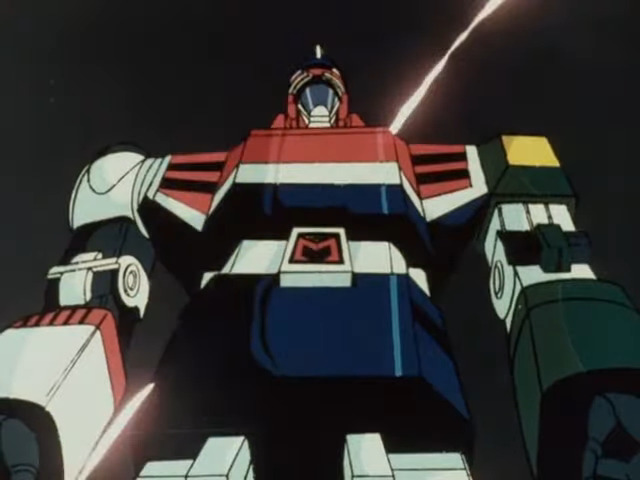
There are two success stories to tell about the 1981 giant robot anime Six God Combination God Mars. The first is about a combining giant robot that was better as a toy than as an animated figure in motion: toy sales were strong enough to extend the series beyond its first year, but the awkward stiffness of the titular God Mars itself is something of a running gag (as seen in the YouTube comments here). The second, and I think the one that should get more attention among English-speaking anime fans, is about the tremendous influence of God Mars on Japan’s female anime fandom and doujinshi scene. In a time when pairing same-sex characters from your favorite series was not yet the full-on cottage industry it is today, God Mars was a cornerstone title alongside Captain Tsubasa.
I personally came to know about God Mars twenty years ago, although knowledge about the two aspects of the series came at different times. It was a collection of giant robot anime openings around 2001 that introduced me to the show and its impressive-looking mecha, but it was actually 2004’s Genshiken Official Data Book (of all things)that first brought to my attention God Mars’s popularity with women. Years later at Otakon 2010, voice actor Mitsuya Yuji mentioned among his most popular roles a character from God Mars named Marg. Now, I have the entire series on physical media thanks to Discotek (with 25 episodes up for free on TMS’s Youtube channel), and I’ve finally come to understand what made God Mars one of the granddaddies of fandom pairing in Japan.
Simply put, it’s Marg. Once you know about him, it becomes crystal clear why a female fandom around God Mars developed.
Marg is not the main character. That honor goes to Myoujin Takeru, a guy with psychic powers who discovers that he is actually an alien named Mars sent from the planet Gishin to destroy Earth. However, Takeru manages to defy the evil Emperor Zul and use the very weapon originally meant to eliminate Earth to instead form God Mars and beat back the Gishin Empire. Along the way, he discovers many truths about his original home world, including that he has a long lost brother—Marg—in Zul’s clutches. The dramas that emerge from their familial relationship include attempts to reunite, the pain of separation, and even the crossing of swords due to various plot contrivances.
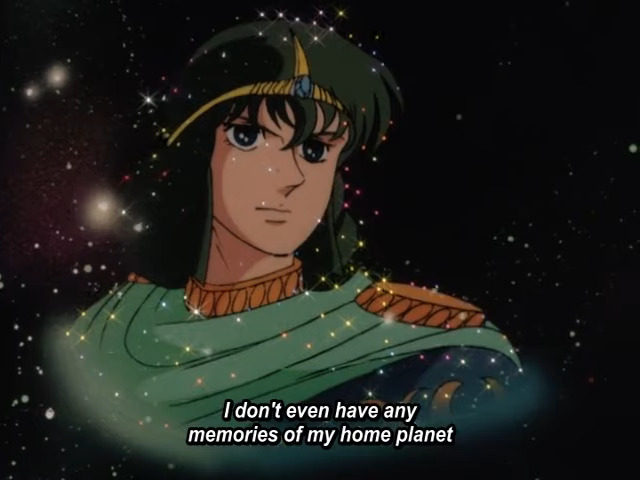
Marg is ridiculously beautiful both inside and out. He has lush locks of long green hair, and eyes that can express the deepest kindness but also the most fervent passion. His voice is gentle yet powerful, and his forlorn communications with Takeru express a longing and desire to see Takeru—unless he’s being brainwashed into being the enemy, of course, at which point his anger is spine-tingling. Whenever Marg shows up, he becomes the most captivating figure on screen.
Given that we’re talking about shipping and coupling, it’s not entirely accurate to pin it all on Marg. The popularity of a series among female fans traditionally hinges on the relationships between characters rather than singular personalities, and Takeru himself is no slouch. Not only does he look like a more handsome version of many a 70s robot protagonist, but he is perhaps the angstiest hero ever to grace a giant robot anime. Sure, Shinji from Evangelion is traumatized and depressed, and Heero Yuy from Gundam W is dark and brooding, but they don’t angst the way Takeru does. Naturally, more often than not, that anguish has something to do with Marg. And yes, they’re brothers by blood. Whether that was an additional awakening for fans in 1981, I’m not sure. I wouldn’t be surprised.
Even before God Mars, there were plenty of good-looking and charismatic secondary characters in mecha anime. Between directors Tomino Yoshiyuki and Nagahama Tadao, they all but cornered the market: Prince Sharkin (Reideen), Garuda (Combattler V), Prince Heinel (Voltes V), Richter (Daimos), and both Char Aznable and Garma Zabi (Gundam). The key difference between these major rivals and Marg is that the latter is so many things in one. He’s an adversary at some times, but at other times he’s basically a damsel in distress.
There is something I need to make clear: Unlike so many later anime, which could be constructed from head to toe with a female audience in mind (or at least pay regular lip service to that side of fandom), God Mars is still built on the foundation of a toy-shilling kids’ anime. It is 65 episodes long, and not every episode is exactly compelling. There’s an unsurprising inconsistency in terms of the show’s quality with respect to storytelling and animation quality. In addition to the notorious stiffness of God Mars the robot, the anime is rife with fights between characters with psychic powers that revolve around dramatic poses in still shots in lieu of actual movement—a style of action scene the book Even a Monkey Can Draw Manga mocks for its laziness. And dashing canon hopes of brotherly love, the series pairs Takeru with a female character, albeit one with a connection to Marg. In other words, back in 1981, fujoshi had to walk uphill both ways to get their BL shipping fix.
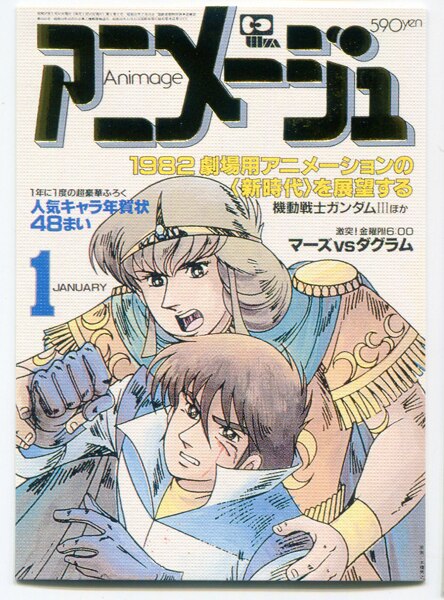
Even so, a girls’ fandom emerged out of God Mars, and plenty of evidence exists that the creators became aware of this audience eventually. The TV series keeps finding ways to bring him back in different forms. A 1982 movie recap of the first 26 or so episodes reduces the screen time of other supporting characters in favor of more Marg, and the poster advertising the film even features him prominently (see above). A later OVA released in 1988—well after God Mars’s heyday—centers around Marg entirely. A look at God Mars merchandise reveals both official and unofficial works where Marg takes up a lot of real estate.
When I was going over my own prior history with God Mars, I omitted one thing: the game Super Robot Wars D for the Gameboy Advance. God Mars is one of the titles included, and in the game, you can manage to not only recruit Marg to your side but also have him pilot an alternate God Mars from that 1988 OVA in which he’s the star. Once together, Takeru and Marg can perform combination attacks like the “Double Final God Mars.” I can’t help but wonder if there were both kinds of God Mars fans working on this game, bringing together the hopes and dreams of those whose lives were changed in some part by God Mars and its two successes.
Kio Shimoku has historically been a very private person, not even revealing his face until 2018. Shockingly, the Genshiken author had his very first audio interview, and it was by a Virtual Youtuber to boot! Luis Cammy is apparently a big fan of Kio’s work, and talked with him for a whopping 80+ minutes.
Translating the whole thing would be a whole endeavor in itself, but you’ll find all the notes I’ve taken from the interview. There’s a lot of it that’s all-new information and insight into Kio’s creative history.
Note that Kio has a remarkably deep voice. Personally, he reminds me a bit of Kugayama from Genshiken.
Also, as a final disclaimer, it’s possible I misunderstood some of the things spoken about. If anyone has corrections, feel free to leave comments!
Introduction and Miscellaneous
Luis has been a fan of his work since Gonensei (“The Fifth Year”), an early Kio manga and dark sequel to his prior work, Yonensei (“The Fourth Year”).
As part of their collaboration, Luis sang a cover of the Kujibiki Unbalance opening, and Kio provided drawings of Luis cosplaying as Ritsuko Kübel Kettenkrad for a music video. The video
It’s meant to resemble late 1990s to early 2000s galge/dating sim intros. Luis looks like Saki from Genshiken/Ritsuko already, so it was a challenge to differentiate her.
Kio learned about VTubers from manga author gatherings. He doesn’t watch YouTubers much, let alone VTubers.
When asked if he knew how popular his work was at the time, Kio said he didn’t really look at comments online, but felt he rode the wave of the era.
The very beginning of Genshiken was Kio wanting to draw otaku as normal people. He want to madk what he himself wanted to read.
Luis mentions that otaku and their status have changed drastically since the days of Genshiken (when otaku were picked on and persecuted), like how there are light otaku now. Kio says his daughter is in middle school right now, and to her, she doesn’t get the whole otaku-as-negative thing. A group of popular kids in her class have Demon Slayer: Kimetsu no Yaiba merch. Kio responds, “Times have changed, huh?”
Luis talks about how even regular folks say they like her, and it’s like the wall between normies and otaku isn’t there. Madarame has become a popular representative of otaku (to the extent that he’s Kio’s visual stand-in for this interview).
Kio talks about how, in the very earliest planning stages, the first idea he sent to editorial was about the relationship between Madarame, Kousaka, and Saki. The love triangle was inspired by Ping-Pong Club, the nose-hair chapter in particular. That scene was thought up very early on, back when Genshiken was a mere chick. In a sense, Madarame and his romantic relationships were a part of Genshiken from the start.
Luis talks about her mahjong teacher, Saito Go (a professional player and mahjong VTuber), likes Genshiken. He especially remembers that scene with Madarame and Saki eating sushi together, and then not talking afterward on the train ride home.
Luis points out that Kio likes to use silent panels, which Kio agrees with. However, he thinks overdoing it with those types of panels isn’t good either. The nose-hair chapter ends in silence too. Luis says a lot of information can be conveyed in such panels. Kio says it can convey a sense of realism.
Luis points out that the recording was the day of Saki’s birthday!
When creating character profiles for the compiled manga volumes, Kio had to come up with birthdays. He actually used Gundam Horoscopes to think them up. [This has been mentioned in other sources before, like the Japan-only Genshiken Official Data Book.] Actually, it was sort of like a backwards horoscope, in that he picked a mobile suit that would fit Saki well, and decided the birthday based on that. Sasahara is a Ball.
Personal Questions and Family Life
Kio is into Gunpla. He got into it when he was a 6 thanks to his bigger brother. Plamo-Kyoshiro (the 1980s precursor to Gundam Build Fighters) was his “bible.” He would categorize himself as a plastic model otaku above all else. He still wants to continue it as a hobby, but he’s busy. In Plamo-Kyoshiro, the way they used cardboard boxes in the manga really sparked his imagination as a kid.
Luis asks if Kio’s daughter ever says, “Why is our home filling up with more [otaku] stuff?” Kio says that his workplace is different from his home, so it’s his workplace that gets filled up instead. Doesn’t think his daughter is an otaku, but can’t say for sure. Luis jokes about Kio’s daughter showing up on the live recording and telling him not to say so much. Kio mentions that she doesn’t know about this, so Luis responds that she could come in saying, “It sounds like you’re doing a broadcast with someone from Nijisanji.” Kio comments that she might actually know what VTubers are.
Kio’s daughter has always walked in while he’s drawing manga, so she’s been reading manga for a long time. Kio still reads current manga. Luis says that manga has become like a “communication tool” these days, like, “What? Do you know this title?” as a conversation starter.
Genshiken More In-Depth
Luis describes the first Genshiken as being about ancient otaku. She asks Kio, if there was a Genshiken Third Generation, would it have VTubers and stuff in it? What kinds of characters and what sort of content would it include?
Kio concurs that they’re ancient otaku. His thinking was, “If I try to draw something totally new, it’ll quickly date itself. But if I make them feel older, than it’ll age better.” He doesn’t consider himself to be on the cutting edge. Genshiken came from whatt he personally wanted to draw. As it continued, it progressed into fujoshi stuff.
As for VTubers, once they become old, maybe then they’d show up in Genshiken. Kio says that plenty of current manga have VTubers in them already.
Luis asks if Kio is happy to have ended Second Generation when he did, and Kio says yes. “It felt like, ‘That’s about where it should stop.’” He explains how the sequel started out as a one-shot, but he’s not good at doing extra stories and the like, so he kept on working on it. Kodansha editorial (the publisher of Genshiken) said he should do enough to fill one volume. It was originally supposed to be a short serialization.
Kio began with the thought of “How would Ogiue and the others continue the club?” and of course, it would end up with a bunch of fujoshi. But would it be all girls? What about guys? Hence, Hato.
Kio really went back and forth about whether or not to include a character like Hato. When he was drawing the manuscript, he kept having the feeling of “Is this really okay?” Coming up with the idea of Hato purposely using a more feminine voice is when he finally thought he could make it work. Fujoshi and otoko no ko (boys who dress convincingly as girls) are the main aspects of Second Generation. Kio didn’t want to put Hato through so much hardship, but as the story progressed, he felt that’s what should happen—though he did worry over it.
The original Genshiken was supposed to be in real time, and things moved quickly. But it stopped being that way during the Ogiue story at Karuizawa. At the time, Ogiue was a “problem child” when it came to drawing the manga, as he didn’t know if he could resolve her backstory. It’d be difficult to do that and still maintain the “real-time” thing, and he would’ve selfishly wanted to end the series in the Spring if it had stuck to being in real time. But it took multiple months to get through the Ogiue story.
The series was supposed to end at Volume 8, but then there were plans for the second special official doujinshi [the first one was included with Volume 6]. Because of that, they decided to continue the series up to Volume 9. The original Genshiken features Ogiue’s turmoil, and Second Generation features Hato’s turmoil.
Luis comments how there are the Ogiue fans, and then there are Hato fans. Kio responds, “The Ogiue fans really are somethingl…” and then trails off. [Ogiue Maniax note: I feel attacked.]
Spotted Flower
There are things that were hard to put into Genshiken, like sexual stuff. That’s where Spotted Flowercomes from. From here, the two jokingly pussyfoot around Spotted Flower’s similarities to Genshiken.
Luis talks about how Spotted Flower is a different world (tongue-in-cheek), but it has kind of a crossover feel. Kio responds that they’re ostensibly different characters. Luis replies that the series is like a “what-if” universe (if-sekai in Japanese).
Kio says it’s not supposed to be them, but through it, he can do what he couldn’t in Genshiken.
Luis says, “What-If Madarame has a ‘Why youuuu!’ feeling.” Kio laments the husband as well.
Spotted Flower was supposed to be just a few short pages for Rakuen: Le Paradis magazine. The resemblance to other characters was originally not planned, but is actually something he noticed after the fact. He didn’t explain the meaning of the title to them when he submitted it [madara means “spot” and saki means “bloom”], so they probably didn’t realize at first. So he figured, “Why not keep going?” and it developed along the way.
“And now there are four volumes,” says Luis..
Kio’s feelings: “It’s not a book that comes out often, but if it interests you, I’m grateful.”
It was one thing when it was just the husband and wife, but then he added the Hato-like character, and the Kousaka-like character, and so on. He still can’t really say for sure that it’s them.
Hashikko Ensemble and Kio’s Overall Career
Luis finds the Hashikko Ensemblemain character Akira cute. Kio says that he began with the idea that Akira would have that gap between his very deep voice and his shy personality.
Volume 5 of Hashikko Ensemble should be coming in September.
Kio says he’s been in the manga business for 25 years. Luis thinks all his works are great, in terms of information provided, emotion, and atmosphere all being wrapped up in them. “It’s no small stuff.” To Kio, he sees all the things she mentioned as his shortcomings Luis comments that she enjoys seeing Kio reflect on his work.
Kio is the type to regret not saying this or doing that. Luis remarks that this is a live broadcast—is Kio okay?
Kio doesn’t recognize his own voice when recording. Luis said she never thought of her voice as anything special but the fans would say it’s cute. Luis compares Akira’s voice to Kio’s. Kio never had any experience with singing or choruses, but figured, why not give Akira a deep voice like himself?
He thinks people who can come up with characters purely from imagination are amazing.
Hashikko Ensemble a story of the passion of youth, but Kio didn’t originally plan it that way. Like Genshiken, he wanted the story to be something ridiculous and fun, and landed on “chorus club high schoolers.”
Luis loves stories about the passion of youth (seishun), like Yowamushi Pedal and Big Windup. Kio replies that he’s never drawn manga in that vein—like Chihayafuru—but thought, “If I put all I had into it, could I draw one?” The characters in Genshiken are all pretty mellow. He wasn’t that good at drawing the kind of youthfulness that appears in Hashikko Ensemble, at first.
Luis makes the argument that the original Genshiken is a “passion of youth” story, because it’about figuring out what club to join and what to do? Like, Kugayama’s waffling on whether or not to draw, or Ogiue’s decision to go, “I guess I’m gonna draw.”
The kinds of “passion of youth” stories Kio enjoys are a little strange—not so much “hot-blooded stuff.” Luis describes Madarame as a hot-blooded otaku. As for being a passion of youth story, what about that story with Saki mentioning Madarame looks good in his new glasses?
Originally, Genshiken was supposed to be a club that doesn’t put anything out. One of the things that made Ogiue tricky is that she wanted to draw herself, so Kio had no choice but to make a story about her trying to get into Comic Festival [the Genshiken in-universe equivalent of Comic Market].
Doujinshi???
Luis says Genshiken is what made her want to attend Comic Market as part of a circle. She asks Kio if he ever participated as an artist. Kio says yes!
Kio released a doujinshi at Comic Market in 2003 (Luis points out that 2004 was the year of the first Genshiken anime, which Kio totally forgot about).
Kio did not use the name “Kio Shimoku” for Comic Market. He sold 200 books, which impresses Luis. For reference, Luis says that 100 is considered a lot, and she herself sold 50 copies of her own doujinshi at a Comitia [a major doujin event primarily dedicated to original, non-fan works].
The doujinshi was indeed pornographic, and an original work. It bears resemblance to Kujibiki Unbalance and Genshiken.
Luis talks about how big sister loves Kujibiki Unbalance, to the extent that she put out a pornographic doujinshi starring Ritsuko. Luis helped her a lot with it, including stapling it together.
“Putting out a Kujibiki Unbalance-esque doujinshi yourself is like actually being in Genshiken,” says Luis.
Kio also participated at Comic Market a second time—in 2010. It was a doujinshi based on a “certain space opera that uses Episodes,” flipping around the genders of the character roles involved. The inspiration was that with some wordplay, the title resembled the phrase “Sister Wars.” He drew what was supposed to just be a manuscript based on Episode 1, but it ended up being 350 pages. Kio wanted to draw up to six.
“Please complete it!” Luis says.
“But I wouldn’t be able to sell it!” Kio replies.
[Ogiue Maniax note: One of Ogiue’s characteristics is prolific output, just like Kio here.]
Luis asks if there’s anything he’s watched lately, old anime or new anime. Kio doesn’t have anything, and Luis says his free time to just sit down and watch without moving must have decreased. Kio agrees.
Kio wants to absorb more shows, but just doesn’t have the time.
Questions from Kio for Nijisanji
As future reference for manga, Kio asks if VTubers wear sensors to track movement. Luis responds that it uses 3D tracking. She quickly “corrects” that the animated figure you see is the real her.
Luis says that Kio’s participation in Comic Market makes his manga feel more real.
The two talk more about the Kujibiki Unbalance music video they collaborated on. Kio says it’s like a doujin-style fan work. Luis talks about how she has Genshiken and Kujibiki Unbalance merch. Luis has the Kujibiki Unbalance Ritsuko school swimsuit clear file drawn by the light novel artist, Yagumo Kengou. Kio mentions that the image was a request from him [Ogiue Maniax note: Not 100% sure about this last sentence].
Kio mentions that he gets some harsh comments, but others will say “That’s the kind of author he was all along!” But he doesn’t want to remember himself from the Gonensei era.
What an Interview!
There’s a lot to unpack in this interview. I hope to follow up with an analysis.
Also, I can’t believe there’s a Virtual Youtuber who’s into Genshiken, Kio Shimoku, and mahjong! It’s like someone designed a VTuber especially for me.
I guess the Ogiue Maniax VTuber pantheon is now Sugomori Tenkomori and Luis Cammy.
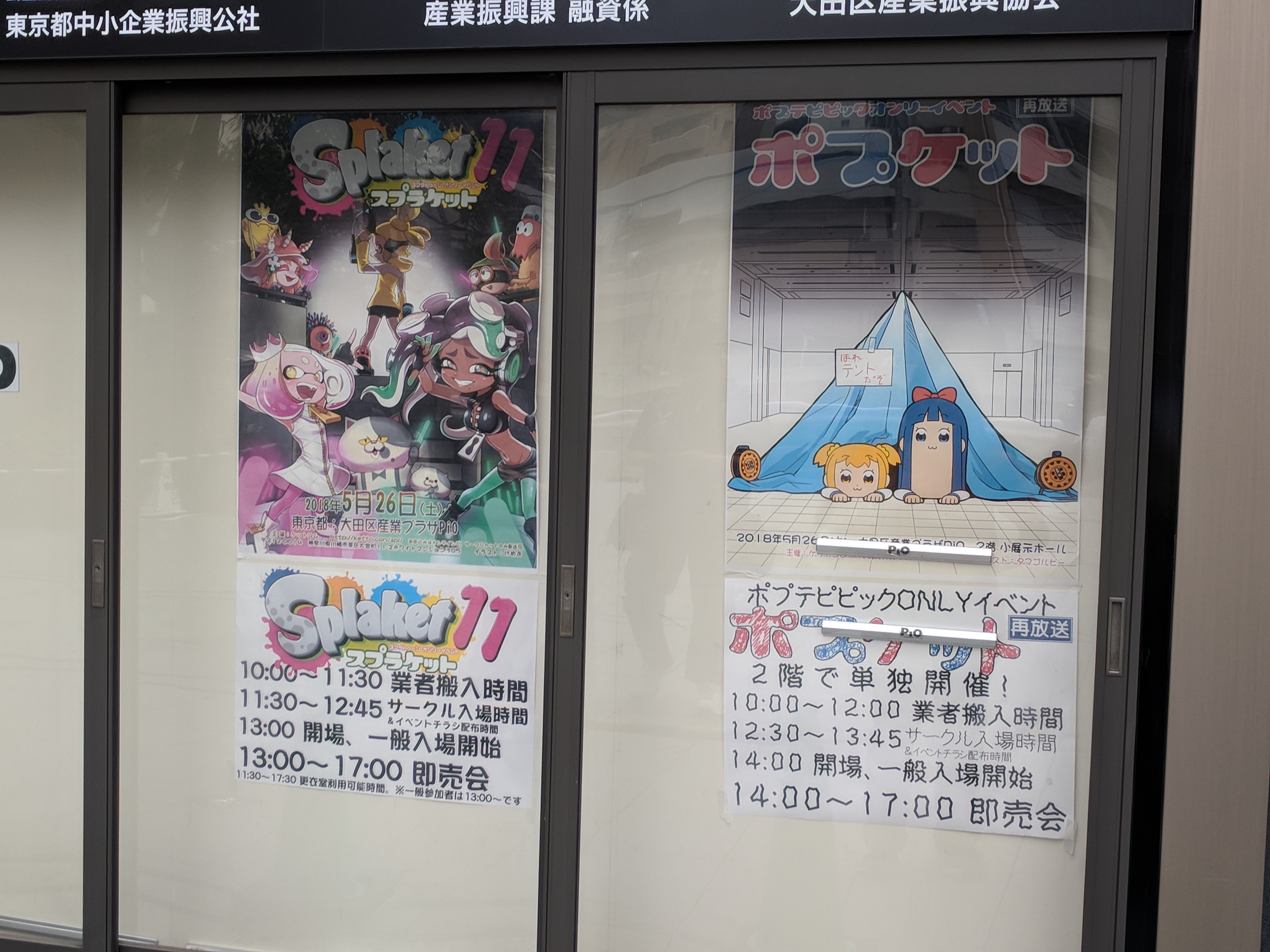
On my recent trip to Japan, I had the opportunity to visit not one but two doujin events at the same venue: the Splatoon-themed Splaket 11 and the Pop Team Epic-themed Popket Rebroadcast. Both were held at Ota City Industrial Plaza PiO, which is the same venue as the Love Live! event I attended two years prior.
Splaket
Splaket wasn’t overwhelmingly large by any means, but it did get plenty of foot traffic. I actually saw a few parents bringing their young, Splatoon-loving kids there. I like to imagine they were otaku parents introducing their kids, but Splatoon is big enough a series that I’m not sure that’s guaranteed.
What stood out to me most, however, were the ways artists and creators of these doujin works transformed the Splatoon concept to fit their needs. It’s like the world established by the games is just detailed enough to girl the imagination and just open enough to let that same imagination fill in the blanks. I saw detailed weapons catalogs, fashion guides, BL, yuri, straight romance, Callie and Marie, Marina and Pearl, and everything in between. It made me feel what an astounding success Splatoon is in terms of visual aesthetic and design.
Popket
The first thing I saw upon reaching Popket was the event catalog—a standard of doujim events. However, when I tried to pay for it, it turned out that the ¥333 price tag meant exactly that amount. It’s based on a Pop Team Epic joke about how animators make only ¥3,330,000 (approximately $33,000 USD) in spite of the grueling labor required. if you wanted them to keep the change, they wouldn’t let you! It was free to enter, but if you wanted that extra item, you had to come prepared.
Given that Pop Team Epic actually had a fair amount of mainstream penetration in Japan, I was expecting a fairly large event, but it was actually significantly smaller than Splaket. I’m not sure why this was the case, but I wonder if it was a combination of factors, like scheduling and Pop Team Epic being a difficult series to parody for the purposes of doujinshi.
The goals of fan works are many, but two are taking the original property to new and curious places, and trying to faithfully extend it such that the characters remain familiar as they’re adventures continue. But Pop Team Epic defies nearly all expectations. How do you parody a work that practically parodies itself? How do you tell jokes on its level? It’s not easy.
What I saw from Popket was less parodying Pop Team Epic and more using it to parody other series. Rather than trying to put Popuko and Pipimu in new situations, the doujin creators mimicked the drawing style of the original artist, bkub, to spoof other works. It reminds me of that artist who keeps drawing parody doujinshi of various series in which all the characters look and act like they came from Fist of the North Star.
Overall
It was an afternoon well spent, and a good chance to connect with Japanese fans. As always, I wish there was more of a doujin culture in the US and elsewhere.




 OGIUE MANIAX