

At long last, it’s the final date! Hato gets his turn with Madarame, but while their time together starts off with some comedy, it quickly turns into a very serious conversation that brings Genshiken back to a core theme: 2D characters vs. 3D relationships.
Actually, to be more accurate, the clash between “fantasy” and “reality” emerges from the very beginning. Just calling it a “date event” betrays the entire club’s otaku orientation; among regular people it would just be a “date.” From there, Hato starts to clearly delineate the differences between a biological woman and he himself who only dresses as a woman, namely that a crossdresser tends not to want people to get too close, otherwise they might recognize the truth. Though it ends with a funny moment where Madarame and Hato try out holding hands (did you know that Madarame has cold hands?), only to pull them apart after being spotted by the rest of the group, the tension is already set.
Though the dirty looks from Sue and Keiko (and Kuchiki) are magnificent.

Throughout the chapter you see Madarame use certain words that associate Hato with the the characters in the boy-girl (otoko no ko) games Madarame plays. He uses terms like “spice,” or “forbidden,” which eventually causes Hato to directly confront Madarame about what it would take to be in a homosexual relationship. Hato outright says to Madarame, “I’m a guy!” (pairing an effeminate “watashi” with a masculine “otoko”) and essentially asks if Madarame has really thought about what that means. If he actually starts something with Hato, then in the long term it won’t be a crazy alternative, or a thrilling experiment. Dating a man, even one that dresses convincingly like a woman, won’t be like seeing it in an anime or a visual novel, where no real consequences can occur. If he chooses Angela, Sue, or Keiko, then he won’t have to deal with these hardships.

I don’t know if I’m reading too much into this, but I think that implicit in Hato’s words is the awareness that gays are stereotyped and discriminated against in Japanese society. Picking Hato comes with it a future of tribulations, and the question is if Madarame is really prepared to take this seriously, or if it’s just a fetish at the end of the day that can’t move beyond fantasy.
Madarame’s response in turn, “Sorry,” then signals two things. Hato’s devastated reaction indicates that he’s not so much taken aback by Madarame’s apology, but the very nature of it. That’s because the “sorry” comes across as noncommittal, another case of Madarame vacillating because he still desires for the pieces to fall into place without him having to make any hard choices. Madarame has the potential to start a real relationship with Hato or any of the others, but he’s still afraid to make a decision. It calls back to the Madarame who originally decided to let his crush on Kasukabe slide by unrequited, and was willing to let it eat away at him for the rest of his life.
What I also find fascinating about this entire situation is that it not only subverts that harem aspect of the series, but that it’s a strong reminder that the qualities that have made Madarame somehow charming to these prospective partners are also the very things that can aggravate them. He’s both his own best friend and his own worst enemy, and I believe it keeps the series from truly entering actual “harem” territory.

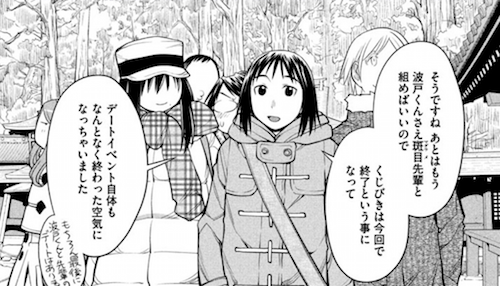
The question of how Madarame will engage with the reality of having a flesh and blood partner is what I think makes Ogiue’s appearance at the end so interesting. As stated in the chapter itself by Ogiue, Hato’s running away from Madarame mirrors Ogiue trying to reject Sasahara out of fear of both hurting others and being hurt. However, I also feel it’s not really the same situation.
Sasahara hesitated because he was a naive dork who couldn’t read between the lines. Even though he recognized his own feelings for her at that point, when Ogiue told him that she couldn’t date guys, Sasahara took it at face value and almost gave up as a result. Madarame, on the other hand, has to decide whether his feelings are for Hato the person or Hato the image, and whether he’s willing to take a much more difficult road in the process when he clearly has three less troubling options moving forward that he also seems to have feelings for.
Writing all of this out, it makes me realize that Madarame’s hesitation can also be interpreted as wanting to make certain that he makes the right decision. He’s been raised to believe that romance is a special thing, a world of childhood friends and deep bonds that are anything but frivolous (though at the same time sex is raunchy and powerful). It might be another angle worth exploring.
Angela believes that Madarame clearly has eyes for Hato. We’ll see if she’s right.
—
If you liked this post, consider becoming a sponsor of Ogiue Maniax through Patreon. You can get rewards for higher pledges, including a chance to request topics for the blog.






 OGIUE MANIAX