Witch Hat Atelier: The Fantasy of Science, the Science of Fantasy

Witch Hat Atelier is a manga with gorgeous art, compelling plot and characters, and an endlessly fascinating world. What I’m especially impressed by, however, is the way it manages to achieve a near-perfect balance of complexity and simplicity in its storytelling. It goes beyond the boundaries of manga and deep into the general world of fantasy fiction.

A Robust Yet Accessible Tale

I love the variety brought by manga in general, but it can often be difficult to recommend titles to a wider audience because of a focus on an incredibly niche subject, an issue of how approachable problematic tropes might be, or just the sense that you have to be “into” manga to read certain titles. More emotional stories might get criticized for lacking a robustness of environment, while those with careful attention paid to world building might be seen as too heady for their own good. Where Witch Hat Atelier differs from so many titles is that it manages to be both emotional and intellectual, and makes it difficult to distinguish where one begins and the other ends.

The Story

Witch Hat Atelier takes place in a world where magic exists but is almost entirely out of reach for most people, instead being the sole domain of those inherently gifted with it. Coco, the young daughter of a dressmaker, wishes she could become a witch, but when she tries to mimic a Wizard named Qifrey by drawing runes, she accidentally turns her mother to stone. Qifrey takes Coco under his tutelage so that she can learn how to undo the curse on her mother (a forbidden spell), and it’s from Qifrey that she learns the truth: Magic is usable by anyone, but the devastation it has caused in ages past has resulted in its gatekeeping by the Wizards, who seek to keep history from repeating itself. All it takes is the right ink and the ability to draw magic circles, but with that knowledge comes great responsibility.

The Political Nature of Witch Hat Atelier

Right from the premise, you have many different elements coming together into a tale that stimulates on multiple levels. Coco is a young heroine whose goals tap into a love of the mysterious but also a sense of guilt, and the supporting characters all have their own hopes and dreams that are as myriad as their unique personalities. The true nature of magic is that it’s built on a logical system, but having it executed through drawing brings a wondrously creative and artistic side as well. Most fascinating of all, the fact that magic is essentially a form of structured knowledge evokes both the political and the philosophical—namely whether closely guarding the truth of magic is ultimately for good or for ill.

Overall

What Witch Hat Atelier manages to achieve is a story with depth and breadth. There’s an endless path of discovery beyond the characters due to magic’s history within the world, but Coco, Qifrey, and every other soul within the story are like universes unto themselves. Their stories are straightforward yet intricate, and each chapter is more rewarding than the last. It’s no wonder that this manga is so beloved. Between this and Shirahama’s other title, Eniale & Dewiela, I hope we can see more of her manga work in English.

Kakushigoto: Refined Absurdity

The style of manga artist Kumeta Kouji is unmistakable. His brand of comedy focuses heavily on humorous misunderstandings combined with rantings by off-kilter characters eager to point out the absurdities of the world while blissfully unaware of their own eccentricities. Previous anime adaptations of his work have totally embraced and even enhanced this manic energy (Sayonara, Zetsubou-Sensei, Joshiraku), but the anime version of Kumeta’s Kakushigoto takes a relatively more mellow approach. It makes sense, given that Kakushigoto is a more subdued and down-to-Earth story by the artist’s standards. The key difference between Kakushigoto and his past works is an emphasis on the tenderness of a father’s love for his daughter.

Kakushigoto is the story of Gotou Kakushi, a manga artist and single dad who will go to any length necessary to hide his profession from his young daughter, Hime. Specializing in ribald humor, Kakushi’s greatest fear is that he will permanently embarrass her, make her a laughingstock among her peers, and ruin her life. Luckily for Kakushi, Hime is extremely naive, though that doesn’t stop them (and everyone they know) from getting caught up in humorous misunderstandings. As fitting the manga author, the title of the series is a pun on the fact that it can mean “something you hide” (kakushi goto) and “a job where you draw” (kakushi goto). 

Many of the jokes revolve around Kakushi’s job, and like Monthly Girls’ Nozaki-kun, there’s a lot of inside baseball about things like deadlines, color pages, industry trends, useless editors, and decency standards. These are often the source of many of the aforementioned Kumeta-style rants (and Kakushi himself shares Zetsubou-sensei’s voice actor), but because the general subject of these ravings are smaller in scope than the societal condemnations of Sayonara, Zetsubou-Sensei, it actually gives Kakushigoto a noticeably more intimate feel. Because of this, as well as the focus on Kakushi and Hime’s relationship (and some extra familial drama with his in-laws), I find this anime to be more accessible and enjoyable to a wider range of potential fans who might get exhausted by Kumeta’s other works.

If Sayonara, Zetsubou-Sensei is a spicy ketchup, Kakushigoto is a high-quality tomato sauce. 

What I mean is that Kakushigoto has a certain kind of maturity, and a willingness to try to find a middle ground between the unadulterated creative style of Kumeta and something that can speak to others beyond those already familiar with his work. It’s a tricky balance to strike, reminiscent of Shinkai Makoto’s your name. and its greater mainstream appeal compared to his older films. Importantly, Kakushigoto does not abandon Kumeta’s signature style, but rather refines it into a more well-rounded experience. 

Violence Miu: 22/7 Anime Review

Warning: Full Spoilers

When I first started watching the 22/7 anime TV series, what stood out to me was how generally serious it was—not only compared to other idol anime, but also what I knew of it from one of its official Youtube channels. Instead of the off-kilter hijinks of a bunch of virtual youtubers, the anime follows a formula of introducing the backstories for each character in order to show how they became who they were. While all of them have some element of drama or tragedy, with the recurring theme being that they weren’t all born with the personality and attitude they have now (especially when onstage), all of them are well within the boundaries of what one would expect out of idols, especially fictional ones.

By the finale, however, the one big exception to those confines is the main heroine, Takigawa Miu. I don’t know if I’d call her my favorite character of the series, but she ends up being the most memorable part of the 22/7 anime.

The first couple of episodes revolve heavily around Miu, who’s shy and unconfident to the point that it loses her a much-needed part-time job, and who has some sort of trauma when it comes to playing piano. At first, she’s extremely reluctant to join 22/7 and become an idol, but over the course of the series, she opens up and becomes more comfortable with her fellow members. We learn about the other girls as well, and then we reach episode 11, which focuses on the childhood of Nicole, the one among them who gave Miu the hardest time early on. What we see in that flashback is that the two knew each other in elementary school, and that a single event would tie the two together.

Unlike her current self, Nicole was very shy and quiet, often being bullied by other students. When it came time to put on a school play, Nicole’s name was volunteered by her tormentors to play the evil queen, and they play a prank on her in an attempt to embarrass her during the performance. Miu, who’s also in the play, runs onstage and tackles one of Nicole’s bullies. 

At this point, I think most idol anime, which tend to be kinder and gentler, would make that tackle one of the big moments. It would cut away and all the characters would gasp. 22/7 takes it a step further, and shows Miu actually wailing on the girl with closed hands—albeit, not as punches or anything, but more like the flailing hammer blows you’d expect from a little kid. Not only does this differentiate 22/7 from so many of its peers, but highlights a certain depth of character to Miu. She’s not just the girl who lost confidence and found it—she’s someone who has a strong sense of fairness, and is willing to throw hands to make her feelings known about that.

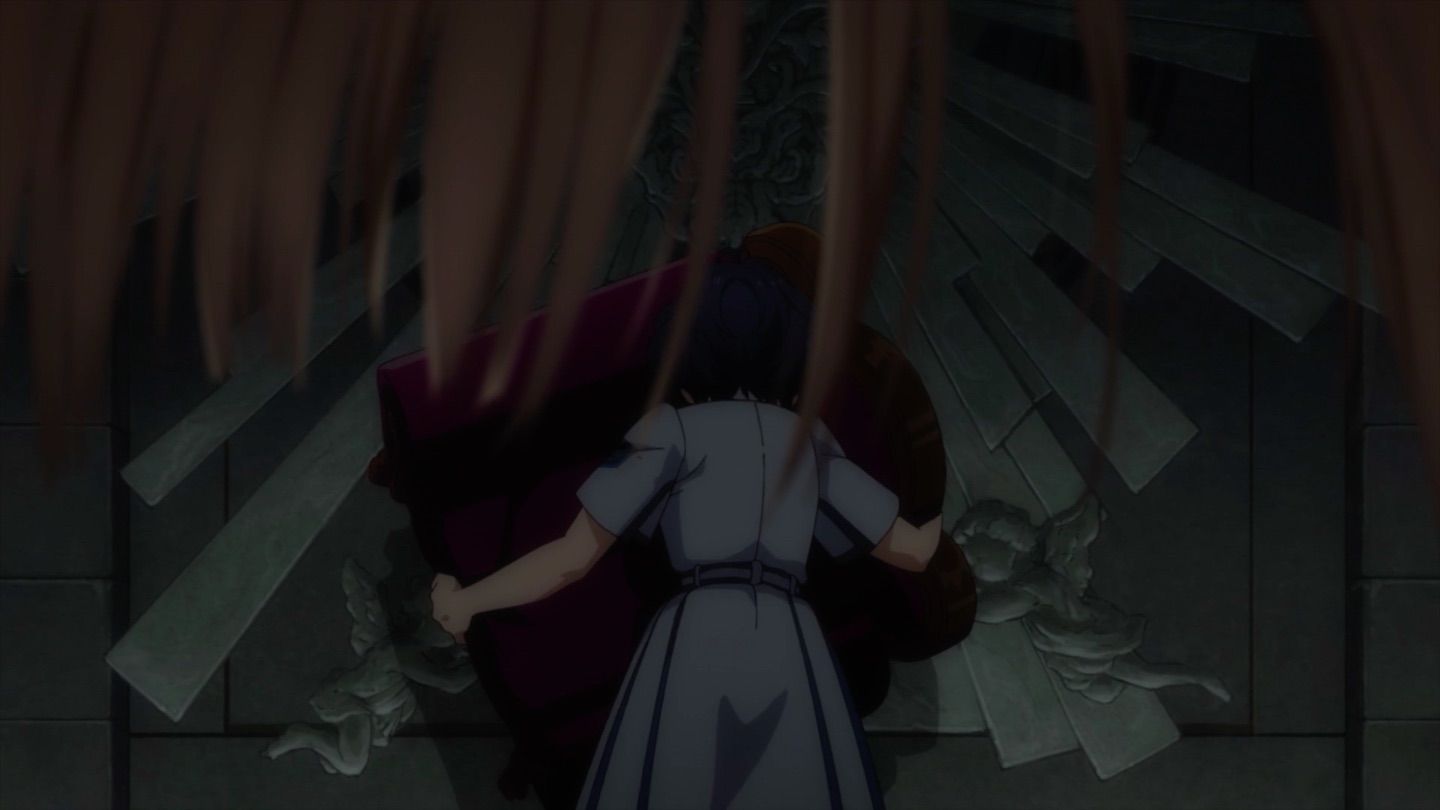
That was the past, and it doesn’t entirely gel with the image we have of her in the present. However, as the series nears its climax, the mysterious “wall” that was giving them instructions all along reveals that it is actually an AI that had been manipulating the girls for its own purposes and no longer needs them. As the 22/7 girls strongly plead to let them join back together instead of disbanding, the AI refuses to budge. When hope is all but lost, Miu steps up to make her intentions known…by hitting the wall with an armchair.

What really impresses upon me in this scene and the one Snow White performance in the flashback is that Miu’s actions aren’t portrayed as “wacky” or “cool.” They’re expressions of frustration and indignation over perceived malicious acts, and they come from someone who lashes out despite her lack of confidence because of what she believes in. It’s a far cry from a pillow fight or some slapstick antics, and it’s what establishes the 22/7 anime as a little more than just some forgettable idol fair. 

Heel Behavior: Hashikko Ensemble, Chapter 39

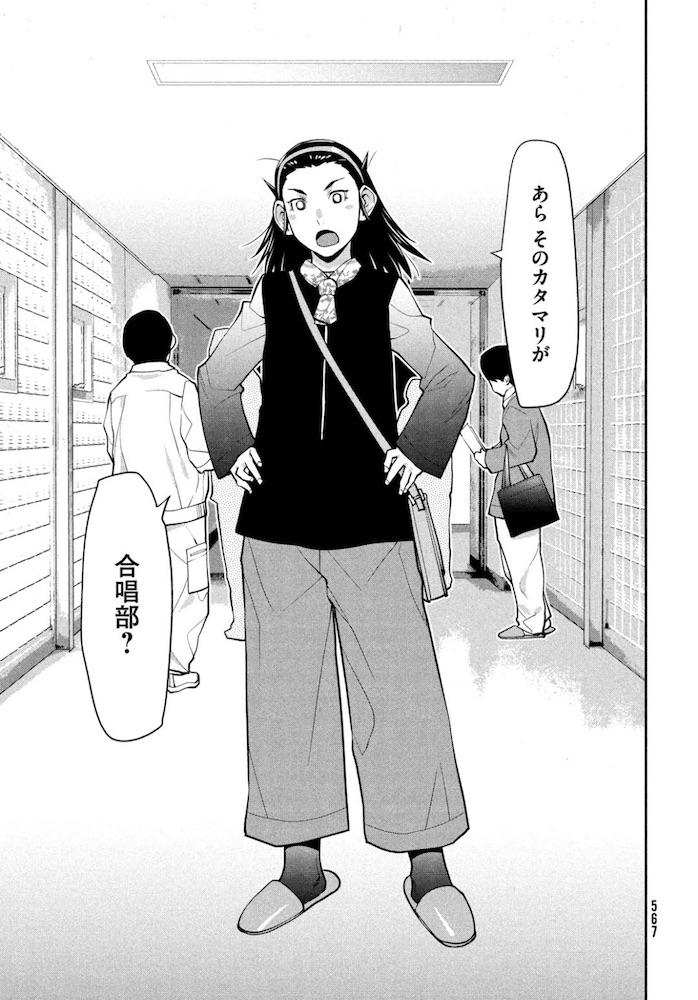
Reika, Jin's Mom, telling the Basso Masters to sing from the heels

Jin’s mom continues to be a tour de force in Hashikko Ensemble, Chapter 39.

Summary

It’s now the finals of the Culture Festival’s music competition, and the Chorus Appreciation Society is up against the mysterious masked Basso Masters. However, not everything is as it seems. The leader of the Basso Masters isn’t anyone special or known—just a friendly third-year named Satou who was inspired by Jin to follow his interest in music. And even though Jin’s mom, Reika, gave Jin a deal to let him go to music college if they win, Jin himself doesn’t really care about that. In fact, he likes applying his match and science skills in electrical engineering, and simply wants to show Reika the merits of singing as a group.

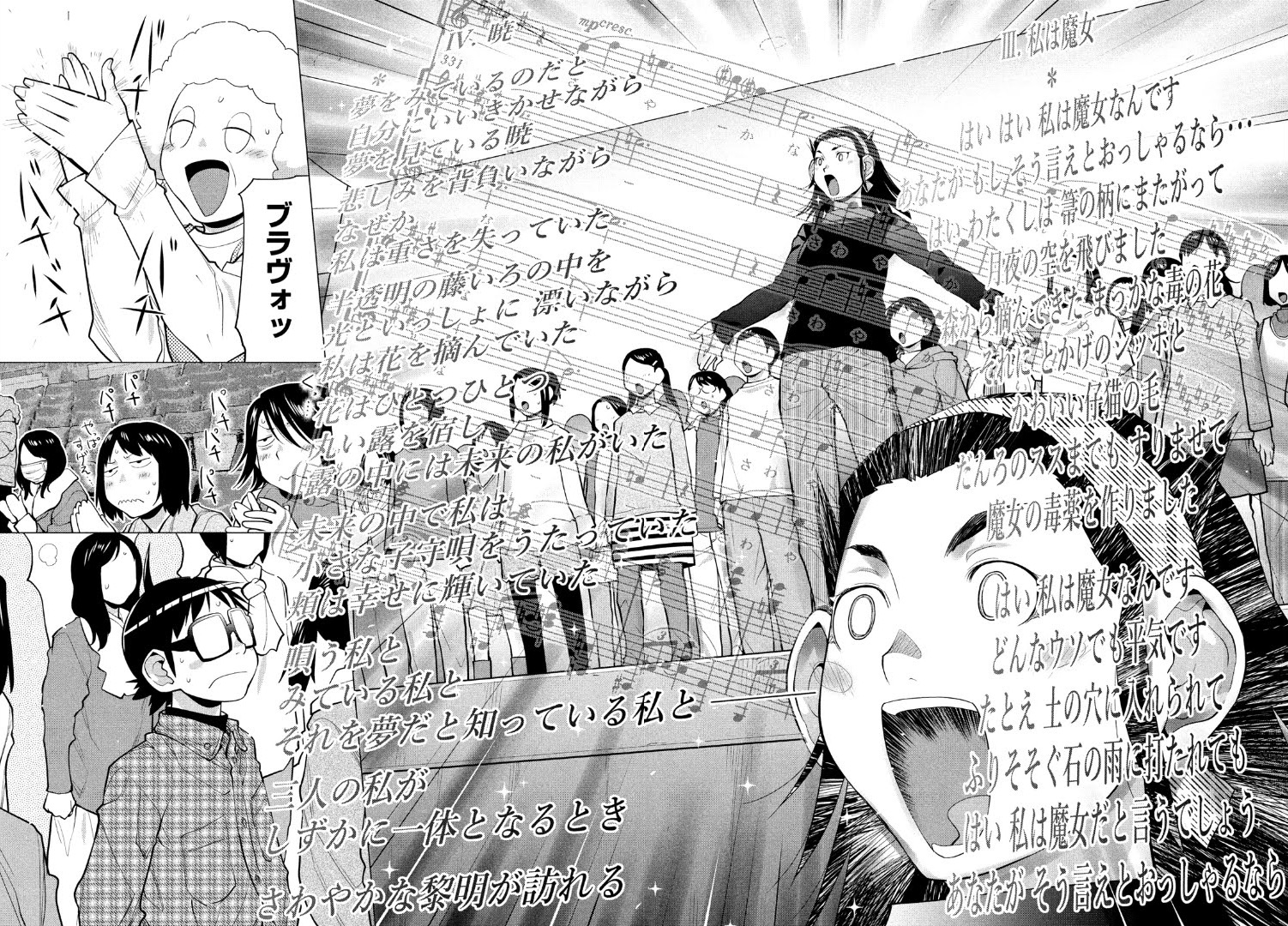
The Basso Masters go first, but just as they begin their performance, Reika interrupts them to rearrange the singers’ positions to group them according to roles (Bass I, Bass II, Tenor I, Tenor II). She also provides some advice on how to sing from the entire body instead of just from the throat. The difference is so immediately noticeable and significant that even the members of the Chorus Appreciation Society can’t help but applaud by the end.

The Basso Masters singing intensely after taking Reika's advice

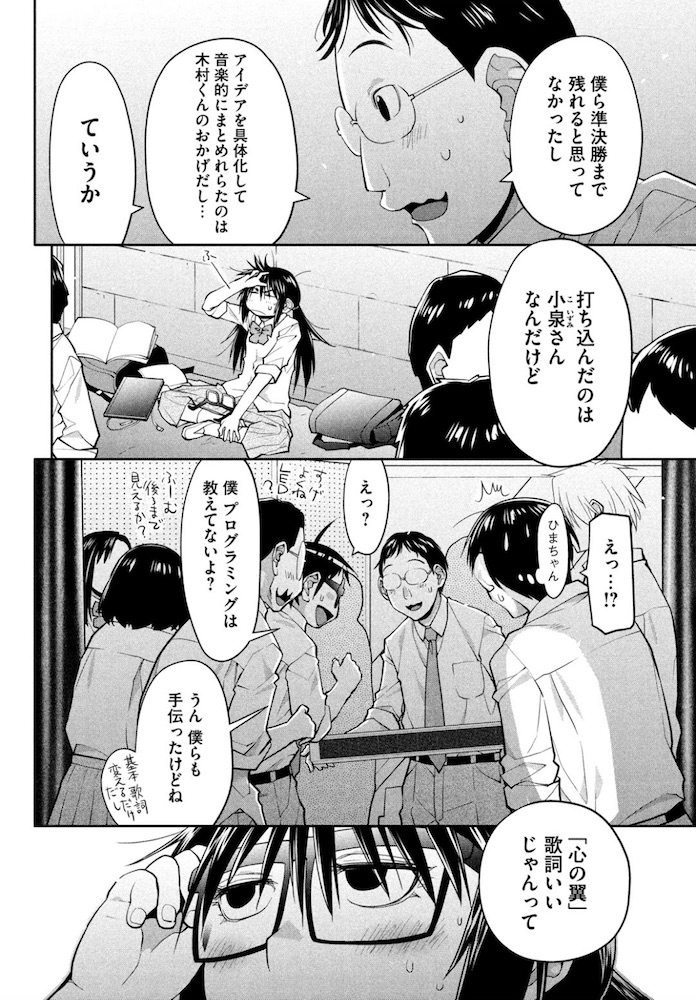
As Jin, Akira, and the others get ready for their turn, a student from electrical engineering brings to Jin an LED display meant to show the lyrics to their next song, “Kokoro no Tsubasa.” Here, we learn that Himari has been hard at work getting this done, going so far as to learn how to program. Akira, seeing how many people Jin has touched and changed with his passion for music (Akira himself included), encourages Jin to consider music college after all.

The Power of Reika

Once again, Reika steals the show, as she presents an interesting obstacle for Jin. I think the really challenging thing about her from Jin’s perspective is that her talent, as well as her ability to recognize talent, are undeniable. While Reika believes group singing is less important than solo performances, it’s not as if she dismisses it outright. In fact, it’s thanks to her immense understanding of chorus dynamics that the Basso Masters are able to put on an amazing performance. She also specifically tells Satou, the Basso Leader, that he’s actually pretty good at conducting, so it’s not as if she has an ego about it. Reika is simply incredibly unfiltered—another similarity she has with her son, even if they manifest differently. At one point, Reika puts on a spare pair of glasses, and the students at school instantly recognize her as Jin’s mom. The way the Kimura family carry themselves is unmistakable.

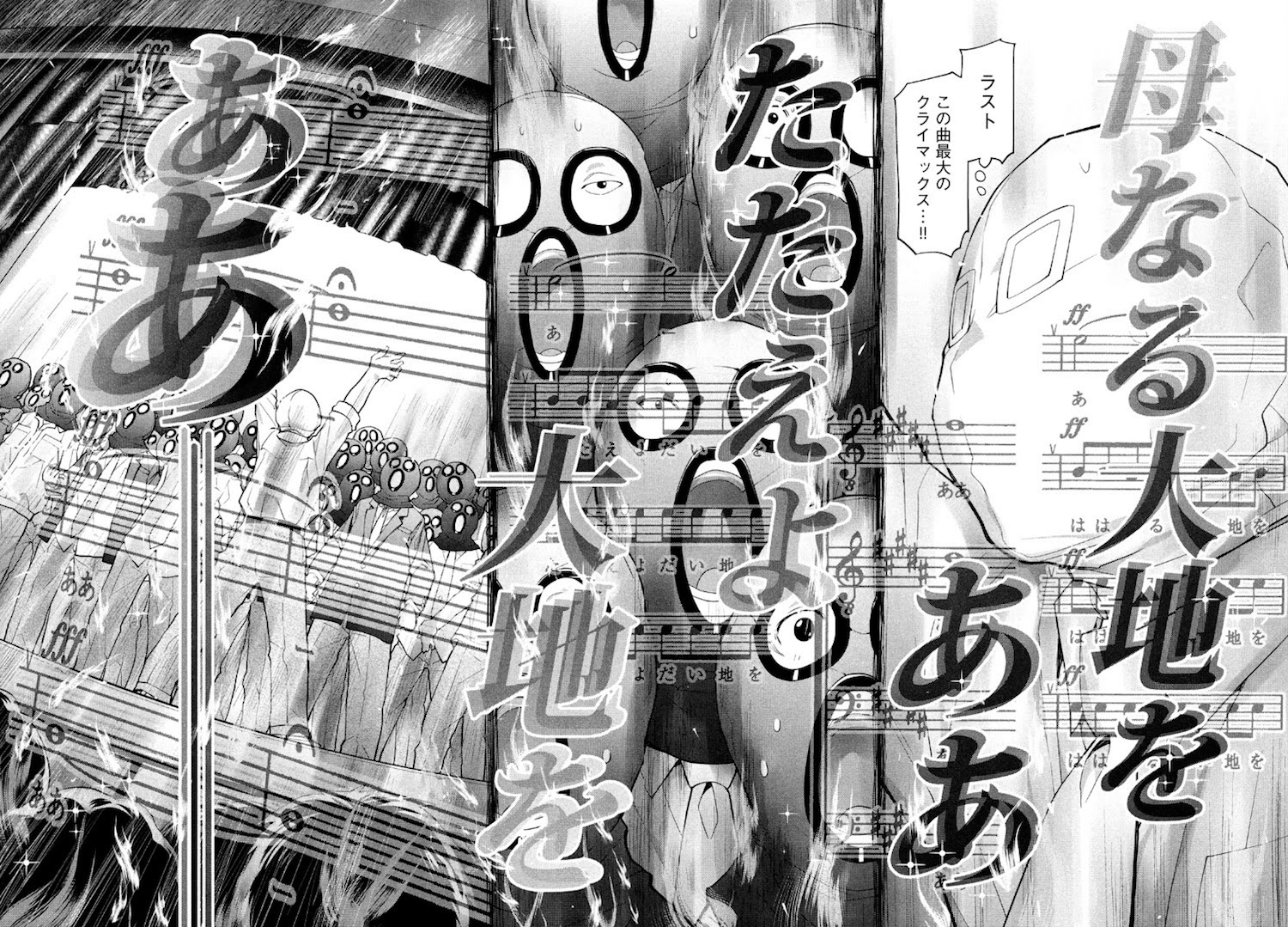
Reika’s advice for how to sing better explains a lot as well. Essentially, she says that the common folk breathe from the throat, the experienced breathe from the spine, and the true masters breathe from the heels. So, when you sing, your feelings should erupt forth like magma—through the butt, then the spine, then the throat, then the forehead, then the top of your head. Not only is it a vivid visual metaphor (especially for a song called “Hymn of the Earth”) but it explains why Reika believes that an exposed forehead makes for better singing.

Himari Working Behind the Scenes

I had been wondering about Himari’s lack of presence in recent chapters, and I’m glad that it wasn’t just her being outshone by other characters. The fact that she hasn’t been in the spotlight is also quite fitting for her personality, and in hindsight I think it was the smart move overall. She’s trying to help in her own way, and she doesn’t make a big fuss out of it because she doesn’t want the attention. This likely goes all the way back to Jin leaving Himari’s apartment (and the inevitable misinterpretation of events that occurred): she was probably helping Jin with this LED display. Moreover, Akira points out that Himari has always been fond of picture books and poetry and such, so the lyrics of “Kokoro no Tsubasa” must have resonated with her. 

Himari isn’t a writer, as far as we know, but could her appreciation of the written world lead to her eventually joining the Chorus Appreciation Society? Either direction would work, and would indicate where her character has headed.

Songs

Basso Masters: “Daichi Kinshou” (Hymn of the Earth) from the cantata “Tsuchi no Uta” (Song of the Land)

“Kokoro no Tsubasa” (“The Wings of Mind”) composed by Kitagawa Noboru

Final Thoughts

I’m worried that something disastrous is going to happen to Akira and Jin! Something tells me the conflict with Reika isn’t over by a mile.

Graveyard Smash: Kemono Jihen

Kemono Jihen is an anime that succeeds in just about everything it aims to do. As a shounen action series with a bit more of an otaku bent than the big traditional Jump titles, it manages to straddle the line between “energetic young kids fighting” and “entertaining character-interaction comedy/drama.” 

When a private investigator named Inugami comes to a rural inn to investigate some mysterious animal mutilations, he discovers a boy named Kabane who seems to be hated by his adopted family. Inugami soon discovers that Kabane is actually a half-human kemono (monster) capable of immense strength and with an indestructible body. After faking Kabane’s death, Inugami takes him to Tokyo, where he becomes one of a trio of young teens who work for Inugami’s detective agency. Together, they help to solve supernatural crimes, which sometimes involves having to get their hands a little dirty.

Kabane is in many ways a typical shounen hero: unusually strong and enormously naive. However, he’s not quite a Goku or a Luffy. While I might be dating myself a bit, if you’ve ever watched the old “Coneheads” Saturday Night Live skits (or even the 1990s film), Kabane has a similar kind of tendency to talk as if he’s not entirely sure how words and emotions work, while being both blunt and kind at heart at the same time. The other characters—like the brash yet slightly tsundere spider boy Shiki and the effeminate and social media–obsessed snow boy Akira—provide Kabane with personalities to bounce off of, as well as allies to bond with. A later side character, a kitsune girl named Kon, is my favorite character in terms of her interactions with Kabane, as they’re equally charmingly dim. Kabane and Kon give me a vibe very akin to Denji and Power in Chainsaw Man

As for the series being more otaku than the norm, I think this comes across mainly in the character designs. They’re not egregiously pandering by any means, but they possess a general cute yet cool aesthetic that seems to be leaving the door open for all manner of fanart and fan interpretations to happen. Which is to say, I wouldn’t be surprised if the fan base was mostly a combination of those who love fights and those who love young and charismatic characters.

Action-wise, Kemono Jihen stands quite well on its own, and the superpowered fights that do occur are refreshingly straightforward and easy to follow without too many special attacks gumming up the clarity of a battle. The contrast of those cute characters fighting somewhat brutally might not appeal to everyone, but it’s never excessively grotesque.

Will Kemono Jihen stay a relatively down-to-Earth story about investigating mysteries, or will it lean towards escalating power levels and big fights? I actually don’t mind either direction because the characters are so endearing. In a way, that’s some of the best praise I can give.

Courage and Experience: “Hakai-oh – Gaogaigar vs. Betterman Part 2” Novel Review

WARNING: SPOILERS FOR THE FIRST GAOGAIGAR VS. BETTERMAN NOVEL

The Hakai-oh – Gaogaigar vs. Betterman web novel series has been a blessing for giant robot fans. Taking place in the Gaogaigar universe ten years after the cliffhanger ending of the Gaogaigar FINAL OVAs, it tells the story of how the world has changed since the Gutsy Galaxy Guard got trapped in another universe, and the new challenges those on Earth must face. A now twenty-year-old Amami Mamoru has gone from plucky kid companion to a seasoned robot pilot in his own right, working alongside his fellow alien adoptee Kaidou Ikumi to control Gaogaigo, a successor to the King of Braves in the fight against the forces that threaten the world. The series is being collected into print novels, and that’s the way in which I’ve been reading it.

The end of Part 1 saw the triumphant return of Shishioh Guy, the original pilot of Gaogaigar. However, his comeback was not without cos,t as the robot lion Galeon nobly sacrificed itself to free Guy from the clutches of their mysterious god-like adversary, Hakai-oh (“World-Conquering King.”) The second novel, Part 2, picks up directly from that point with a new challenge: a reunion with some old and familiar faces, not as allies but as enemies. Guy and Mamoru must fight across the world, respectively as the Mobile Corps Commanders of the Gutsy Galaxy Guard (GGG Green) and the Gutsy Global Guard (GGG Blue).

Genuine Care for Lore and Characterization Alike

When I read Gaogaigar vs. Betterman, I’m always struck by how much attention is paid to its own history and lore. While it can sometimes get a little too into the weeds, the general feeling that comes across is real affection and respect on the part of the creators for the universe they’ve created, as well as the fans who have embraced these stories. From the way fights play out to moments of character introspection, everything and everyone is portrayed with a robust three-dimensionality that rewards readers who remember both Gaogaigar and Betterman

For example, we’re reminded that Neuronoids (the robots of Betterman) are powered by artificial brains based on neurological patterns of actual species. This novel answers the question of what brain is in Gaogaigo: a dolphin from the Gaogaigar video game who was turned into a G-Stone cyborg like Guy, and who ultimately had to pass when the “Invisible Burst” that compromised electronics before the successful establishment of the Global Wall made it impossible to maintain the dolphin’s cybernetics. During a fight, it’s revealed that Gai-go is actually extremely strong in underwater combat—a product of being based on a marine creature.

There’s also a side story at the end of the novel that takes in the space between Part 1 and Part 2, where Guy and Mamoru visit a transit museum to see the original Liner Gao, the bullet train that becomes the shoulders of the original Gaogaigar. As they converse, the topic of the Replicant Mamoru from Gaogaigar FINAL comes up. While Repli-Mamoru ended up being merely a clone of the real Mamoru, Guy still carries a lot of guilt over killing him—especially because Guy hasn’t aged and still remembers that trauma as if it were mere weeks ago. It would have been all too easy to forget that part of the OVAs, especially because of the grandiosity of its later battles, but both the author (former Gaogaigar staff Takeda Yuuicihirou) and supervisor (the original director, Yonetani Yoshitomo) put in that extra mile. 

As a funny little moment during this side story, Guy is less astounded by the giant “Global Wall” defense system that allows wireless communications to work after a previous disaster than he is by Mamoru’s smartphone. When he last left, beepers (like Mamoru’s special GGG version) were still the norm, and to see the progression of human technology (as opposed to G-Stone technology derived from Galeon) puts a smile on Guy’s face.

Spotlight on Betterman 

Because Gaogaigar is the bigger franchise between the two marquee titles, it gets the (robot) lion’s share of the attention overall. However, Part 2 does devote more pages to the Betterman side of things than previously—while the first novel’s Betterman-focused pages are mainly about the Somniums (the titular “Bettermen”) and the question of whether they would help defend the Earth, this novel explores the original main characters, Aono Keita and Sai Hinoki, in greater detail. In particular, Keita was a relatively minimal factor in Part 1, but here, his romantic relationship with Hinoki is front and center for a significant portion of the book. Keita’s portrayal is interesting because of how humble his situation is. Rather than staying in space with Hinoki (who has since become highly educated and is a science officer for GGG Blue), Keita is without a college degree and works at an electronics store, where his otaku knowledge makes him an ideal employee. But Keita also works hard with the dream of providing a home that Hinoki can come back to, especially because Hinoki tragically lost her family as a young child.

The color insert at the beginning of the novel also has colored design images of Keita and Hinoki courtesy of the original character designer, Kimura Takahiro. As a huge fan of Kimura’s art (and his work creating Hinoki), it’s a welcome addition.

Intense(ly Clever) Battles and the Value of Experience

The real meat and potatoes of Part 2 are the many fights that take place throughout. Because they’re a pretty major surprise and make up such a huge portion of the story, I’m going to put an extra SPOILER WARNING here.


While there’s a bit of fighting between Guy and Betterman Lamia that makes the Gaogaigar vs. Betterman title technically true, the main thrust of conflict in Part 2 comes in the form of the old Gutsy Galaxy Guard members who have now been taken over by the “Triple Zero” energy that comes from Hakai-oh. Now greatly powered up and known as the “Hakai Servants,” Brave Robots and human GGG agents alike now fight against the Earth with the goal of bringing “divine providence” to the universe. 

The first character who shows up to oppose the heroes is actually Hakai Mic Sounders, and I will say that “Evil Mic Sounders” is indeed quite a trip. Still using his characteristic mix of English and Japanese, it’s easy to not take a line like “SORRY, but I have to destroy you” seriously—that is, until you’re reminded of how powerful Mic truly is. With the ability to produce sound waves that can break down anything (if given the right information), Mic Sounders is capable of rendering even the toughest armors useless. The only reason they win is because a Betterman who can control sound herself is able to provide a counterbalance.

That battle introduces the recurring idea in the fights against the infected Brave Robots: GGG is a great asset when on the side of humanity, but beyond dangerous when its powers are turned against Earth. Goldymarg’s signature toughness (enough to withstand the power of the Goldion Hammer when in Marg Hand form) makes him able to withstand just about anything, and it takes a “Goldion Double Hammer” weapon wielded by Guy in Gaofighgar to even begin to even the odds. Tenryujin and Big Volfogg make for similarly intimidating opponents with their own unique strengths, Volfogg’s role as guardian of a young Mamoru in the past providing an extra layer of stakes in that particular fight. But it’s also not just the robots who are a threat—the human members have also become Hakai Servants, and the tactical prowess of Commander Taiga and the genius hacking skills of Entouji provide extra hurdles for GGG Green and GGG Blue. 

Another recurring theme throughout these fights, however, is that the time dilation difference between the old GGG members and the current ones means that Mamoru and the others have ten years of their own experience under their belts. There’s a moment at the beginning of the novel where Mamoru says that he’s willing to relinquish the role of GGG Mobile Corps Commander to Guy, only for Guy to reject his offer and to praise Mamoru for having clearly been through many tough trials of his own, and at this point actually has fought with GGG for longer than he has. He further explains that he was originally just the right man for the moment, having been an astronaut transformed into a G-Stone cyborg to save his life, and wasn’t a born fighter himself.

And so we see that sentiment play out. In the fight against Tenryujin, her younger “sister” Seiryujin, the latter targets Tenryujin’s knees—a seemingly odd move, until one remembers that the individual robots that compromise the “Ryu” series all turn upside down to combine, meaning their chests (and thus their Hakai-infected AI boxes) are located in the legs. When dealing with Entouji’s computer virus, GGG Blue member Inubouzaki Minoru takes center stage. Originally a jealous rival of Entouji’s who became a Zonder in the TV series, and later returned as an ally when the Gutsy Geoid Guard became the Gutsy Galaxy Guard, Inubouzaki shows the progress he’s made the past decade not only in terms of improved skills but also being more at peace with himself and his past.

Just as everything seems to be going Earth’s way, however, the next Hakai Nobility appear: Goryujin and Genryujin (who both have access to THE POWER), as well as Soldat J and King J-Der. The preview of the next (and last!) volume hints at what’s to come with the key to victory: something called “Goldion Armor.”

To the End

The web novel version of Hakai-oh – Gaogaigar vs. Betterman has concluded, and the concluding print release is supposed to be out this summer. While I could jump in and start reading it online now, I think I’m going to wait once more. If I could wait close to 15 years before, I can withstand a few months. 

In the meantime, I’ve also been reading the manga adaptation of this series, which provides some of the visual flair that’s inevitably missing from the prose version. I can only hope that we might see an actual anime come out of this someday.

Business as Usual: The Unchallengeable Trider G7

1979’s Mobile Suit Gundam is a milestone in anime history, a show whose evergreen influence as the ancestor of the “real robot” genre has continued across four decades. But like so many innovative and revolutionary works, it’s not as if Gundam changed everything overnight. Nowhere is this clearer than with Gundam’s immediate Sunrise robot anime successor—1980’s The Unchallengeable Trider G7, a series so straightforwardly kid-oriented that it feels like the anime’s goal was to try to turn back the hands of time.

Trider G7 (sometimes written as Tryder G7) is the story of Takeo Watta, an elementary school boy who also happens to be the president of his own business, Takeo General Company. Having inherited it and a powerful giant robot called Trider G7 from his deceased father, Watta has to juggle being a kid who attends school just like everyone else, keeping his company in the green, and defending the Earth from the Robot Empire of Planet Gabarl.

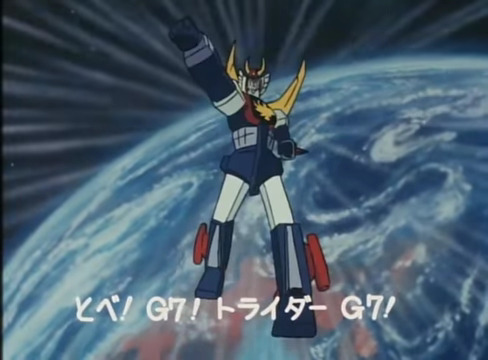
Titled in Japanese as Muteki Robo Trider G7, the anime is considered a part of the Muteki trilogy along with Muteki Choujin Zambot 3 and Muteki Koujin Daitarn 3. But while Daitarn 3 could get extremely serious at times, and Zambot 3 was consistently brutal, Trider G7 steers clear of that mood, instead presenting itself as a lighthearted fantasy for a young boy audience. Nothing sums this up better than Trider G7’s launch sequence, which involves having the robot emerge from the local playground (of which its head is a centerpiece) while a loudspeaker announcement kindly requests everyone clear the area. Unlike its fellow Muteki anime, Trider G7 is not directed by Tomino Yoshiyuki, instead being under Sasaki Katsutoshi. This likely helps the “not-traumatizing” aspect.

Unlike many series I write final reviews for, I did not watch all 50 episodes of Trider G7. Instead, I used the 10 episodes temporarily uploaded by the Bandai Spirits channel on Youtube as a kind of “essential episodes” list, supplementing it with some reading. (Side note: that project in the link provided never got off the ground). While this does compromise my ability to gauge the complete series from beginning to end, I still think it gave me a good idea overall. My verdict: Trider G7 is a pretty mediocre anime, and it feels intentionally so.

I’m not someone who disparages children’s shows or episodic ones, as I believe both have important places in anime. Some of my favorite works are “incident-of-the-week” and aimed primarily at kids, but what I love to see is when they try to really bring something to challenge their audience while still being fairly conventional. Trider G7 only ever seems to hint at greater potential without ever reaching it. 

The series acknowledges that Watta is still a kid, and that the burden of being a company president is not easy for someone so young, but it’s mostly played for laughs. The Gabarl Empire is run by a super-AI called Mother Computer Sigma, and one of the recurring flaws of the enemy Mega-Robots is their reliance on pre-programmed data in battle, unlike Watta’s human intuition and experience. This is touched upon somewhat often, notably in an episode where we learn that Trider G7 itself was built by the Robot Empire’s top scientist who had defected due to the soulless nature of his designs, but it doesn’t go beyond “rah, rah, human spirit.” It also doesn’t have a whole lot of style points, given that the robot itself is nowhere near as cool as Zambot, Daitarn, or the Gundam; the animation isn’t even off-the-wall enough to make up for a bland design like with Gold Lightan. Trider G7 does have a female character whose popularity is fairly enduring, an attractive OL named Sunabara Ikue (who also provides the aforementioned loudspeaker warning), but that seems to speak more to her status as an early crush for young boys rather than anything related to the anime’s quality. 

I do want to give some praise to the opening and ending themes because of how silly and creative they are. The opening has the amazing line, “Do we fight to protect our company funds? NO! We fight to protect peace on Earth!” The ending, in turn, has lyrics that basically sound like a speech delivered to all employees working at a company, with lines like “The future fate of our company is about 1) guts and 2) effort.” Amazing.
The legacy of The Unchallengeable Trider G7 is mainly in nostalgia through things like Soul of Chogokin toys and appearance in Super Robot Wars, where the aesthetic can be updated just enough that it can give adults some sense of what it’d be like to enjoy the series as a child. This is probably for the best, as it’s where Trider G7 shows its strongest self: as a kind of cool, kind of cheesy return to a more innocent era of kids’ giant robot anime.

Humble Adventure: Nahuel and the Magic Book

This film is from the 2021 virtual New York International Children’s Film Festival.

Nahuel and the Magic Book is a 2020 Chilean-Brazilian co-produced animated film whose down-to-Earth yet wondrous approach to fantasy I really enjoyed. In certain ways, it reminds me of The Lord of the Rings, despite the markedly different setting of a more contemporary real-world setting. 

Nahuel is a young boy afraid of the sea, which causes problems for his fisherman father. Worried that he’ll never be of help to his dad and will always be seen as a screw-up, he desperately wants to overcome his phobia. When he discovers the Levisterio, a magic book said to be the most powerful of all, he steals it in order to use the bravery spell contained within. However, bringing the book out into the open makes it a prime target for an evil sorcerer who has been seeking the tome for a long time.

Likening anything to The Lord of the Rings might seem trite and a little meaningless, but the reason I make the comparison is because of the humble qualities of each story’s protagonist. Frodo is characterized as being no one special, especially not compared to the figures who accompany him on his quest, but it’s that lack of remarkableness that makes him suitable to deliver the One Ring to Mount Doom. Similarly, Nahuel’s ambitions are anything but grand—overcome a fear of the sea and help his father—but that’s also what makes him the right bearer of the Levisterio. Where others would abuse its near-limitless powers, his desires are from a simpler and kinder place. Anybody can imagine themselves as Nahuel, and his story and characterization are no lesser for it. 

I don’t know much about South American folklore and religion other than that magic and witchcraft are such a part of the region that they’re even incorporated into the way Christianity is practiced. From that perspective, the way the magical and fantastical are portrayed in Nahuel and the Magic Book feels very natural and almost effortless—which is usually a sign that a great deal of effort was involved. There is a sense that magic is indeed far removed from Nahuel’s normal life, but is also just there and ever-present if only one looks. 

Although I’m not a kid, I feel that Nahuel and the Magic Book has real potential to resonate with young viewers. That worry of being a disappointment to one’s parents is also a powerful and relatable fear for children as well as adults, and the world it portrays is one where love shines through even when things get dark and scary.

Breakers Revenge: Hashikko Ensemble, Chapter 38

A new chapter shows Jin’s mom, Reika, in all her glory. But before I dive into the review, a few important pieces of news:

First, Volume 6 of Hashikko Ensemble is currently on sale in Japan. This volume doesn’t appear to have any limited edition extras, which is good for my wallet.

Second, Kio Shimoku is finally on Twitter! Follow him @kioshimoku1. In addition to posting art on occasion, he also tweets stories about his life both past and present. For example, did you know his family only had Betamax instead of VHS growing up, and he used the money from winning the Afternoon Four Seasons Award in college to buy a VCR? I’m thinking of making occasional posts summarizing interesting tweets from Kio. 

Third, today is Ogiue’s birthday! Happy birthday to the best girl ever.

Now, on to Chapter 38!

Summary

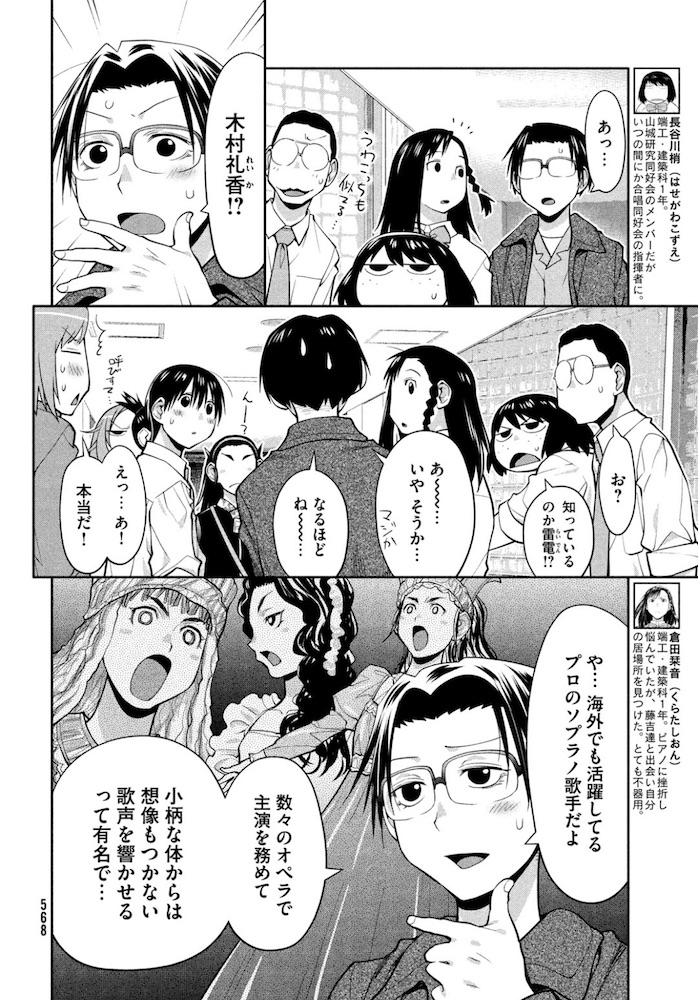
Despite a fantastic performance by Mai and her group, Noi Majo, the Chorus Appreciation Society beats them and moves on to the finals of the School Culture Festival tournament. Stepping away from the stage to take a break, Jin’s mom (with Yumerun) finally arrives at the high school. Shuusuke immediately recognizes her as the world-famous soprano, Kimura Reika, who has sung in operas across the globe. She’s also infamous for her selfish attitude that has earned her the nickname “Breaker”—a portmanteau of burei (rude) and Reika. The members see a lot of her qualities in Jin.

Jin is bothered by his mom’s attitude, feeling that she allows her immense talent to be her excuse for poor behavior. Jin tells a story from middle school, about Reika agreeing to sing with his boys’ and girls’ choir—only to never come to practice until the very last day, put on an astounding performance at rehearsal, recognize Yumerun’s ability, and then skip out on the actual day of the recital in order to perform for an Italian conductor. 

While Reika explains that she 1) called to cancel rather than bail without warning 2) ended up making way for Yumerun’s rise 3) didn’t want to take away from a performance that was supposed to focus on the kids, Jin still can’t accept how much she inconveniences others because music is something people create together. Reika responds that music is about self-expression and the passion of the moment, and points out that there are no “chorus majors” at any music colleges, showing how important individuals are in the field. But when she questions the usefulness and motives of Jin joining a technical high school just to form this group, Akira comes to his defense to talk about how much discovering singing thanks to Jin has helped him change and grow. Reika then decides on a deal: if they can win the entire competition, then she will let Jin go to a music college. Jin seems more confused than pleased.

Giga Drill

Reika was introduced two chapters ago, but her “true” debut (i.e. meeting Akira and the others) exceeds my expectations in nearly every way. This manga has great moms, and I don’t mean it in that way. 

In my Chapter 36 review, I mentioned how I had originally imagined Reika as much more strict and demanding, but everything about her screams the opposite. She’s like pure “id,” doing whatever she wants whenever she wants. And while she seems to have this in common with her son, the finer details of their respective approaches and philosophies regarding music do reveal a profound divide between the two. 

Jin sees music as a product of effort, and cooperation; Reika sees it as spontaneous artistic expression. Whereas Jin has broken down music scientifically in order to master its ins and outs, Reika utilizes intuition and natural sense. There’s a part in the flashback where Jin thinks, after hearing his mom sing with the group during rehearsal, “Why couldn’t I have inherited that talent?” To put it in Naruto terms, it’s sort of like if Neji had a Rock Lee for a kid.

(Though, incidentally, Rock Lee’s actual situation in Boruto is the opposite of Reika’s. His son, Metal Lee, is a born genius. But I digress…)

I really love this conflict in the Kimura family because it’s simple on the surface yet has so many layers in terms of the characters’ respective personalities and views of the world. Neither of their respective views on music are necessarily wrong, but they’re clearly a product of what does and doesn’t come naturally to them. Yet, while Jin is trying to make up for what he lacks and doesn’t have that innate understanding of song, his ability to thoroughly analyze and break down music can be considered a talent in and of itself. Jin’s forcefulness doesn’t fall far from the tree, further highlighting the ways Kimura is influenced by his mom both consciously and subconsciously.

I also am beginning to wonder if I should reevaluate my thoughts that Jin might be somewhere on the autism spectrum. It’s not been stated outright at all, but Jin’s personal admission to not being able to interpret song lyrics without outside help, his scientific breakdown of music, as well as his seeming ignorance about social mores all seemed to point in that direction. However, now that we’ve seen Reika on full display, there’s a chance that he’s comparing himself to the ridiculous standard set by his world-renowned operatic soprano mother. Of course, there’s a chance he could be neuroatypical and also have to deal with a genius mother, so the jury’s still out.

Romance Odds and Ends

While Reika dominated the chapter, Akira does get some small moments. When seeing Mai perform, he’s in awe of her ability to sing both boy’s and girl’s roles. He even blushes a little, but he seems to blush all the time. And when Akira begins to defend Jin in front of Reika, Shion can be seen enthralled by Akira’s passion, giving him more courage as well. I don’t know how that love web is going to end up, but I hope they’ll all be happy.

Songs

Noi Majo: “Zenryoku Shounen” (“All-Out Boy)” by Sukima Switch

Electrical First-Years: “Moonlight Densetsu” (aka the Sailor Moon opening)

The song Reika sang with the kids is “Origami” Suite, for Soprano Solo with Girls’ Choir and Piano by Kobayashi Hideo (not available on Youtube).

Final Thoughts

If it isn’t obvious, I think Reika is a fantastic character as both an adult figure and foil for Jin.

As for her nickname, if it were to be translated in English, I think I would go for Breaker standing for “Brazen Reika.”

Helen Keller’s Impeccable Riichi Defense: Greatest M ~Mahjong Tournament of Eminent Figures~

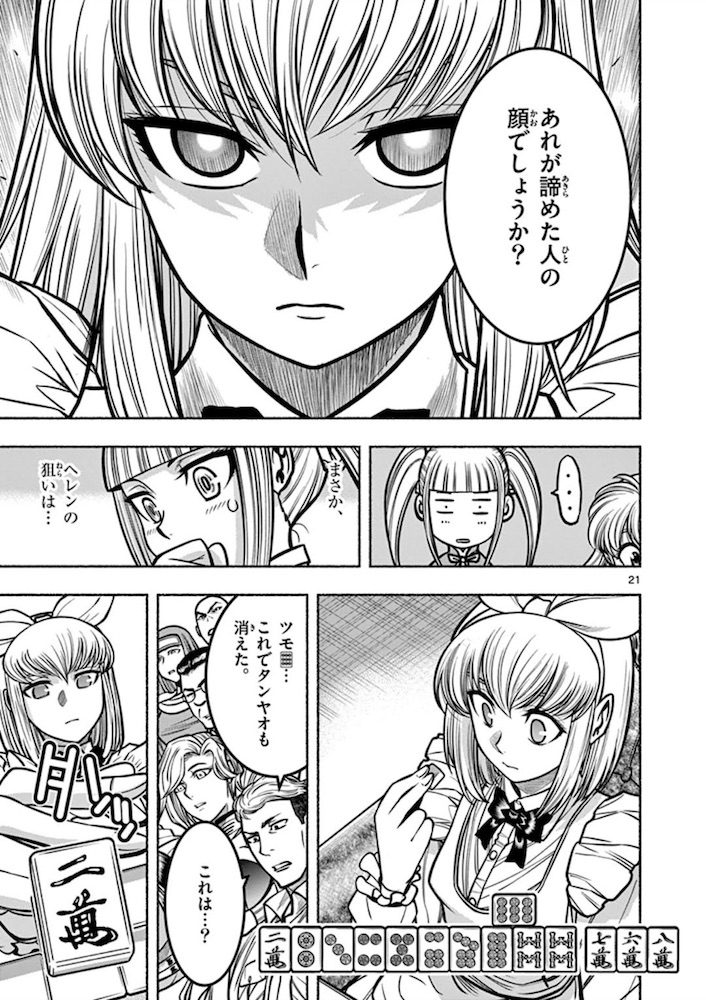
Greatest M ~Mahjong Tournament of Eminent Figures~ is a manga about Helen Keller playing Japanese mahjong co-written by one of the creators of Kakegurui. No, seriously.

If that’s not enough, it’s actually about Helen Keller competing against other famous historical figures in order to determine who will become the next God, as the current Almighty has decided to retire and needs a successor. The solution, provided by other deities: use a test of luck, i.e. gambling, to determine who is best suited for the role. Also, contrary to mainstream conceptions, He is actually a She, and basically acts like a Japanese idol—it’s unclear if that last bit of irony is intentional.

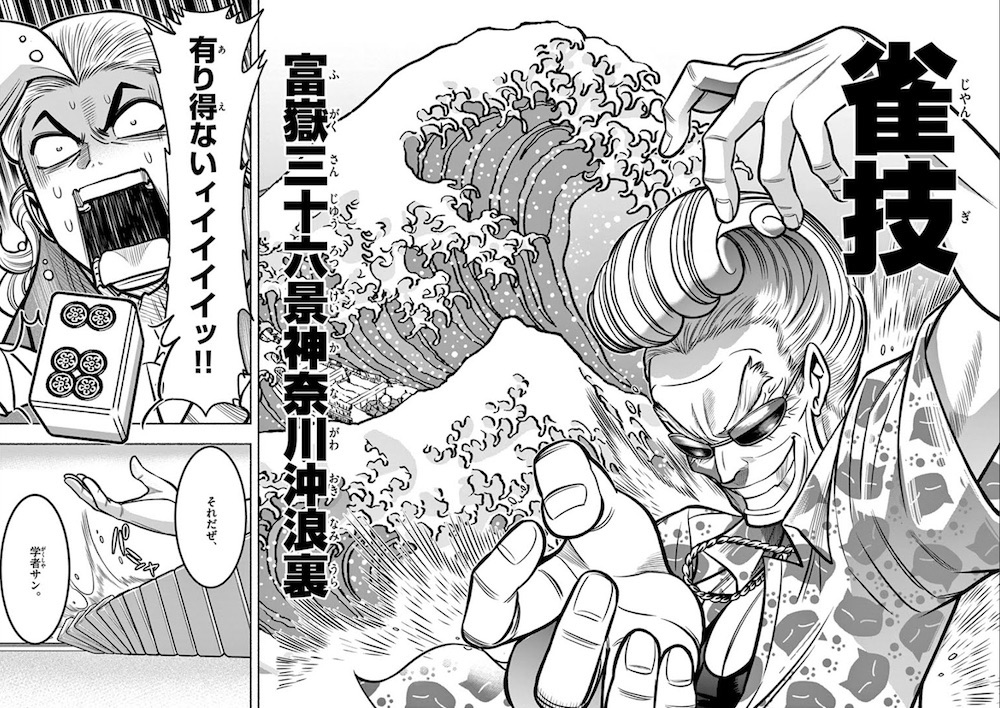
Over-the-top mahjong manga is not all that uncommon. Saki is about yuri and ridiculous mahjong feats. Mudazumo Naki Kaikaku: The Legend of Koizumi is about superpowered politicians instead of superpowered lesbians playing the game. Greatest M is no exception, and indeed bears considerable resemblance to Mudazumo in many ways. But while the essence is very similar, this particular manga presents its players’ abilities as only seemingly magical. No one’s bending reality to cheat—they’re just so impressive that it looks that way. 

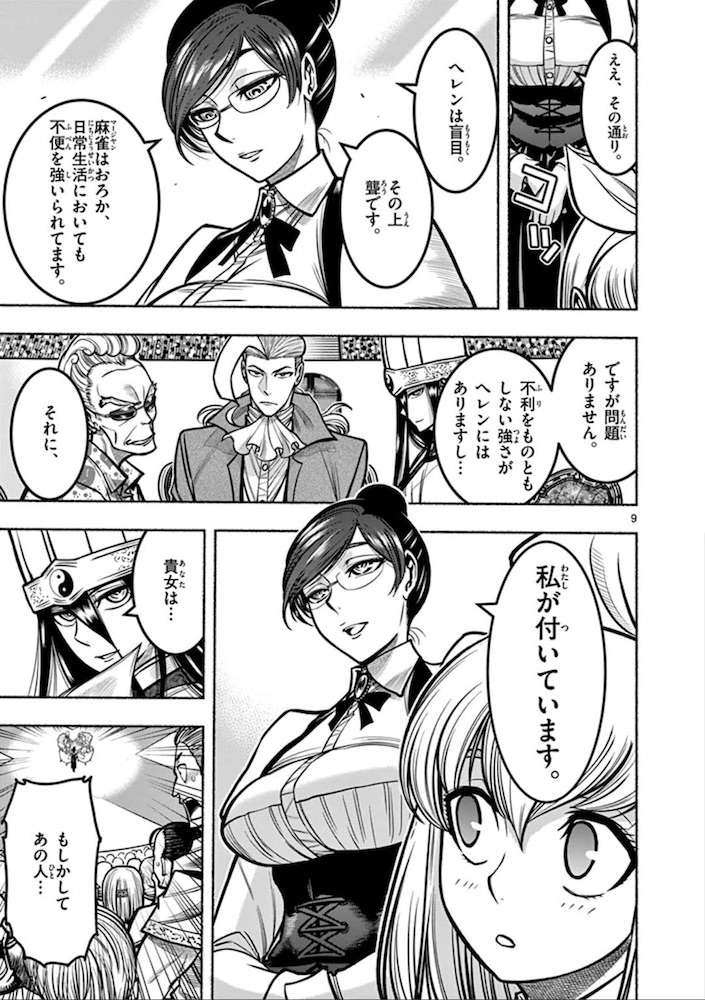
For example, one of Helen’s opponents is the Japanese artist Katsushika Hokusai (famous for “The Great Wave Over Kanagawa”), and while it seems like he can see what every tile is going to be, it’s actually because he’s such a master of capturing everything in a single moment that his observational skills allow him to metaphorically “freeze” time. As for Helen herself, her life spent both deaf and blind makes her skilled at navigating tricky table situations, owing to the strength she possesses to move forward in total darkness. 

I should mention that I’m merely assuming that Helen Keller is the main heroine of the story because she’s on the cover of Volume 1, and it’s been promoted on Japanese manga news sites as the series featuring Helen Keller playing mahjong. Given the tournament format of the story, it might very well be Zhuge Liang who goes ahead. Because Helen would be the most intriguing protagonist, my hopes are that she remains in the spotlight, not least of which is because the manga’s portrayal of Helen’s teacher Anne Sullivan is absolutely perfect.

Greatest M is a fun manga and I like the not-too-serious matching of wits and deception that comes part and parcel with a manga that depicts both theatrical competition and the game of mahjong. I’m not sure how those with disabilities might regard Helen Keller’s portrayal—both in terms of her being a cute anime girl and how her blindness and deafness is depicted in the series. Nothing seems especially offensive to me as of yet, but it is curious to see her drawn like a blind girl you’d see in an older visual novel. Also, while the first volume is a wild ride, I’m not certain that this series can maintain its momentum before the gimmick runs a little dry. I’m going to keep up with it in the hopes that it goes somewhere interesting, even if it doesn’t include Super Saiyan Hitler as a final boss.