It’s been almost one year since Nintendo released their gorgeously produced Pokémon music video “Gotcha!” Even now, I find myself thinking about how amazing and emotional the short video is.
The song in the video, “Acacia” by Bump of Chicken, communicates a sense of both nostalgia and discovery; even on its own, its gentle and soulful sound makes it linger in my mind. When combined with the accompanying animation, however, it becomes something magical to those of us who have grown alongside Pokémon.
“Gotcha!” features virtually every major and minor character from across eight generations of games, but I think it’s not merely the sheer amount of familiar faces that make the music video so impactful Rather, what it pulls off (with a sense of both elegance and down-to-Earth grit) is a celebration of what it’s like to make your way through one or more of the games—to capture those memories of triumph, accomplishment, and exploration.
With a big franchise like Pokémon, content is often traditionally made to celebrate what’s to come, as opposed to what has passed. There will always be new players, and while Pikachu and Charizard would remain popular even if you gave all existing fans amnesia, there’s a general aim towards a presentation that doesn’t delve too deeply into the lore and history of its world. “Gotcha!” defies that throughout its short timespan.
At one point, silhouettes of virtually every legendary Pokémon can be seen moving around the background, i.e. elements of the Pokémon single-player late game that are meant to communicate how far you’ve come in an adventure. These images then recede, and in their place are shadows of all the major antagonists from throughout the series—again, characters who are indicative of not the beginning but the end of these stories. The video then transitions to a gorgeously animated showcase of most of the league champions, whereas normally such characters would not be displayed in such close succession in advertising or merchandising.
Later in the video, the remaining champions appear. Blue, the rival from the first generation, summons his six Pokémon while standing in front of a door and a couple of statues—portraying the moment after you defeat the Elite Four’s Lance and have to defeat Blue to take the title away from him. The attention to detail is notable, as all of Blue’s Pokémon are exactly the ones he would have if you picked Charizard as your starter: Pigeot, Alakazam, Rhydon, Gyarados, Arcanine, and Venusaur. The video then transitions to showing the battle on Mt. Silver between the player character from the second generation and the final boss of those games: Red, the player character from generation 1. In other words, this shift from fighting Blue to fighting Red conveys the passage of time through Red’s growth from player insert to final boss.
For those who don’t know anything about Pokémon, “Gotcha!” is plenty impressive, but what astounds me about the whole thing is that it just does an unbelievably good job of communicating and celebrating the nostalgia of Pokémon. It’s as if the music video captures not so much what happens in the games, but rather the memories that have been created through our experiences as players. It’s the sort of thing that can only happen with a series that has such a robust history and connection to its audience.
It’s incredibly strange to go from the finality of the fourth Rebuild of Evangelion movie to seeing Shinji and Gendo characters show up in Shinkansen Henkei Robo Shinkalion Z, the fun-filled sequel anime about kids piloting bullet-train robots. What’s even more bizarre is that there’s a kind of thematic resonance between the two. The portrayals of the Eva characters in 3.0+1.01: Thrice Upon a Time and their Shinkalion Z appearances actually feel like they fit together.
Possibly due to its transportation and tourism connections, Shinkalion is famous for its unexpected pop culture cameos. A version of Hatsune Miku is a recurring character in the original Shinkalion. The franchise also makes multiple explicit references to city pop legend Yamashita Tatsuro, has Godzilla in a feature film, and showcases a Hello Kitty Shinkalion. It even just had a tiny Maetel from Galaxy Express 999show up. Evangelion is just one of many pop culture icons to appear, but the sheer tonal difference between it and Shinkalion makes its presence all the more jarring on paper.
Shinkalion already had a crossover with Evangelion in the first series, but whereas the main character back then (Hayasugi Hayato)visited Tokyo-3, here we have Shinji showing up in the world of Shinkalion. What really stands out about Shinji here is how gentle and reassuring he is in this world. The Shinji we see greeting the new protagonist, Arata Shin, has a calming presence that feels closest to the version of him we see towards the end of 3.0+1.01, as if parallel Shinjis arrived at the same place, only one had to go through some of the most dire trauma possible. The next closest would be the Shinji often found in Super Robot Wars after the positive influence of hotblooded pilots has rubbed off on him.
Not only does Shinji come across as a mature ment figure to Shin with the aura of a mentor, but he specifically mentions that he’s met a Shinkalion E5 pilot before. In other words, not only does the series acknowledge the previous Evangelion cameos within the world of the story, but we’re also likely seeing a Shinji who’s a little older. In a previous episode, it’s revealed that Shinkalion Z takes place in the world of the original Shinkalion after its climactic final battle, and reuniting with a Shinji with memories of what has come before actually creates a kind of anticipation for Hayato to return at some point.
As for Gendo (featured in the image at the beginning), he’s mostly played for laughs in terms of how incongruous he is with the relatively lighthearted world of Shinkalion. He says all the things you expect (“Shin, get in the Shinkalion”), but delivers it all with such a straight deadpan that it veers straight into parody territory. At the same time, his presence and demeanor feel reminiscent of a key scene in 3.0+1.01 involving trains, which makes the aforementioned resonance between that film and Shinkalion Z all the more noticeable.
Ultimately, both Shinji and Gendo seem to be in better places in Shinkalion Z. While there’s nothing concretely saying so, I like to believe that the Shinji and Gendo of Shinkalion are better people because they have robots that are also trains—the kind of thing both father and son would probably enjoy, given their personalities and histories.
Episodes are up on the official Youtube only until the following Monday EST, so anyone who wants to check out Shinji and the Shinkalion Z 500 Type EVA should do so as soon as they can. Unlike the last series, this episode actually has “Cruel Angel’s Thesis” for the streaming version.
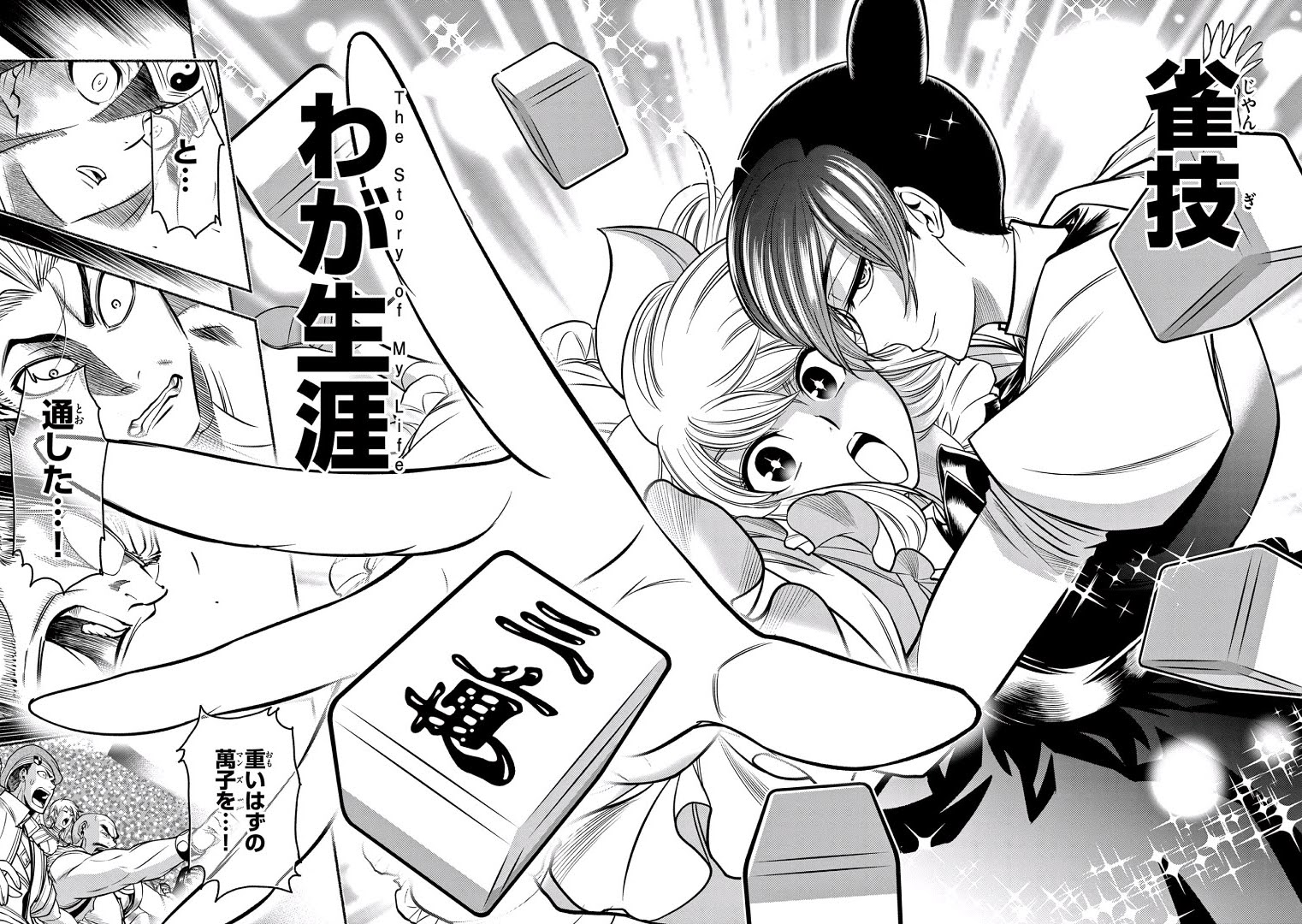
Greatest M~Mahjong Tournament of Eminent Figures~starts with a premise that sounds like something out of a Type-Moon Fate series parody: What if famous figures from history competed in mahjong to inherit God’s position? And while there actually is a Fate mahjong series as well, this one works from the headline-worthy premise of having a cute anime-girl depiction of Helen Keller as the protagonist.
Volume 2 continues the story along largely expected lines: big hands being played by bigger personalities. Helen Keller’s “Miraculous Girl” title and ability are explained as her being able to stand up to even the greatest obstacles through her bond with Anne Sullivan—the moniker actually refers to both of them at once.
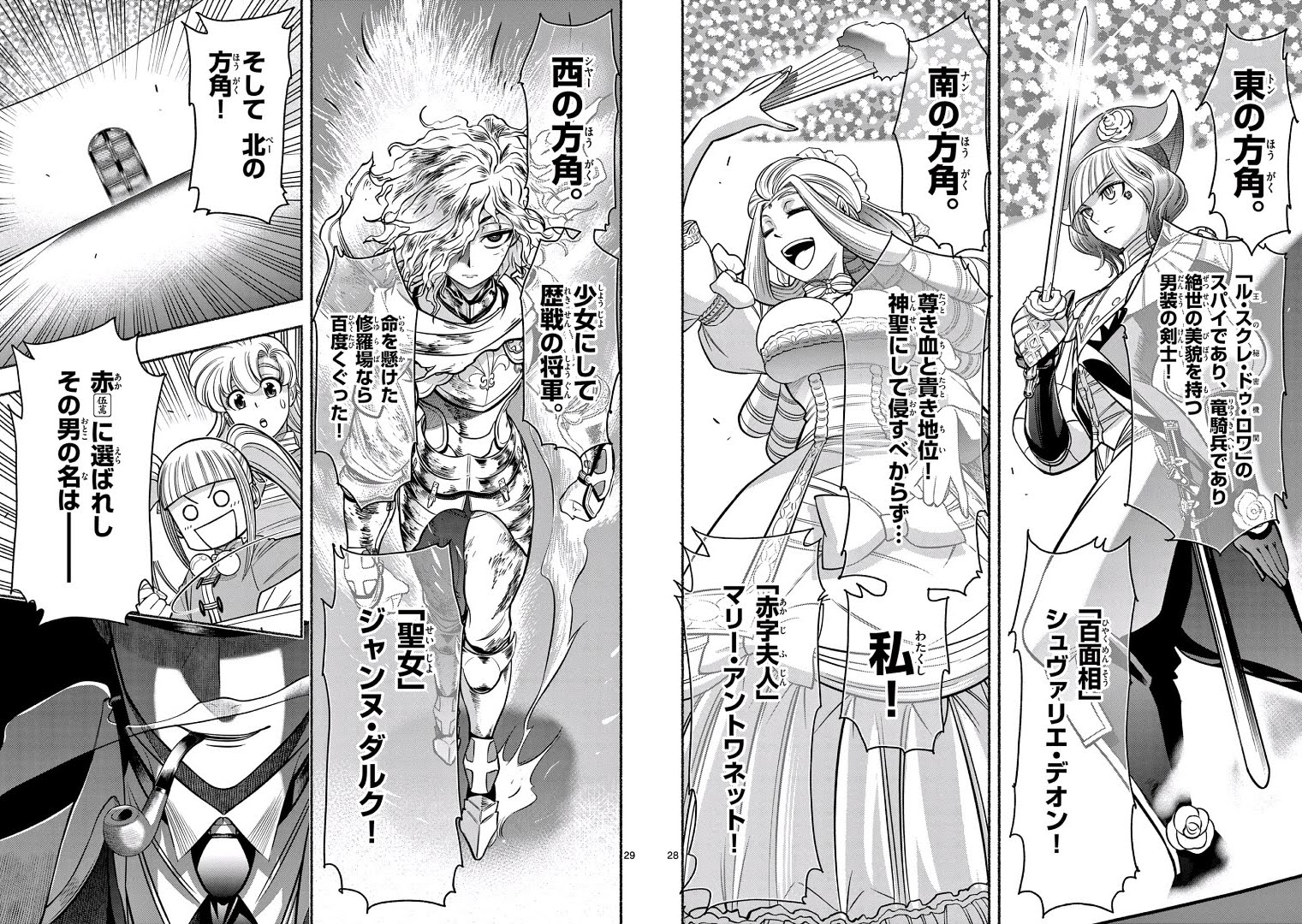
The results of the second match are decided off-panel, with a genderswap Toyotomi Hideyoshi emerging from a one-sided victory. While I’m not well versed in Japanese history, I’ve never seen the idea that Hideyoshi was really a woman, so I wonder where this might be going. In any case, the manga goes straight into the third match, which features three big names from France…and the world’s most famous detective.
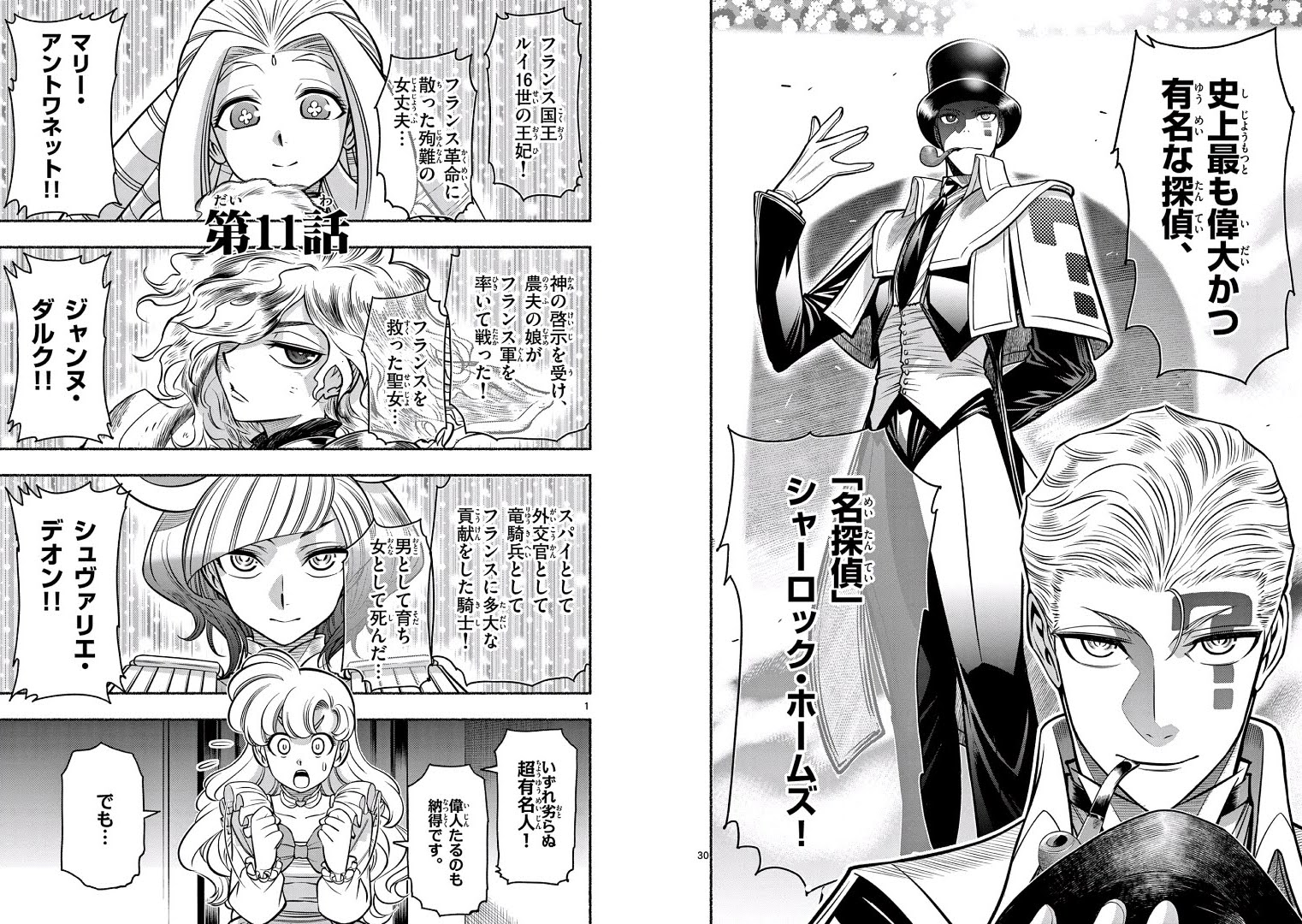
Le Chevalier D’eon, Marie Antoinette, and Jeanne D’arc are all famous figures (and all three have been characters in anime and manga already), so it’s no surprise that these three would end up in Greatest M. However, for all three to be at the same table is a curious move. Moreover, the fourth seat—Sherlock Holmes—opens up the realm of possible contestants to not just historical figures (embellished though they might be), but also fictional characters. The Fate comparisons stay strong. I’m fond of all the character designs here, especially Jeanne’s battle-weary look, but the depiction of Sherlock is downright theatrical.
This manga could easily wear itself thin, but the third round also introduces the idea of alternate rulesets that can potentially spice things up. In this case, you can give a “Jong Command” and order your opponent to either discard a specific tile, force them to call a discard and open up their hand, or make them reveal their wait. It’s sort of like Go Fish, only the penalty for guessing incorrectly is losing 10,000 points. Especially with Sherlock in the picture, I expect a lot of predicting opponents’ motivations and deceptive strategies. That said, I actually expect there to be a twist, and for Sherlock to not make it through—possibly due to the chaos of mahjong itself.
At this point, part of the fun of Greatest M is seeing just who will compete. What are the odds of Jesus showing up…?
In many ways, 1984’s Giant Gorgfeels like an “anti–giant robot” anime. Sure, it has Yasuhiko “Yaz” Yoshikazu (one of the chief visionaries of Mobile Suit Gundam) as both director and character. And it’s indeed about a boy and his mecha guardian in the middle of a conflict that stands to change the entire world. But where most giant robot series before and after would aim for some combination of bombast, gritty science fictional realism, and/or gripping human melodrama, Giant Gorg often comes across as more concerned with atmosphere and conveying a sense of place in the world.
Giant Gorg follows 13-year-old Tagami Yuu, a Japanese boy who travels to New York City following clues about the death of his father. This takes him on a whirlwind adventure, all the way to the mysterious New Austral Island, where he learns about a mysterious organization named GAIL that seeks to discover the island’s secrets. There, he encounters a massive robot—Gorg—that seems to obey his every command. With a group of allies by his side, as well as the might of Gorg, Yuu works with the natives to push back GAIL, but he may have an even closer connection to the truths of New Austral Island than he realizes.
I enjoyed Giant Gorg for its moody feel, its excellent artwork and animation, and the fact that it feels more like you’re jumping into a specific time and place in world events. On the other hand, I would not call it “riveting.” While I had the ability to watch many episodes in one sitting, I rarely would watch more than two or three because the anime doesn’t really set itself up to compel viewers to keep going. Events that finish a given episode in Giant Gorg feel like the half-way point for an episode of Mobile Suit Gundam. Whereas the latter might leave you off with tears and shouting, the former more often hits the ending credits with the reveal of a hidden cave or something.
Because of this, Giant Gorg feels unabashedly Yaz. Whether it’s a manga set in the dawn before the Russo-Japanese War or his retelling of the Gundam story in Gundam: The Origin, Yaz tends to focus on giving his stories the same feel as a fascinating but dense historical text. This makes it all the easier to see what he and Gundam director Tomino Yoshiyuki each brought to that franchise—Yaz’s attention to detail and physical realism contrasts with Tomino’s chaotic energy and far-reaching visions. It’s like Yaz is a master baker who can produce incredibly well-made cakes, but never quite got the hang of how to do amazing icing. Giant Gorg, in turn, can feel both like a distillation of one man’s style and half an anime.
As a final note, I want to end off by recounting a sort of “personal history of Giant Gorg”:
I was studying abroad in Japan in 2005 when I saw a commercial for the upcoming DVD release of Giant Gorg. I had heard of the series before, but was mostly struck by how fantastic the robot itself looked. It’s an aesthetic that stayed with me for a long time.
Ten years later, I found myself sitting near the front of the Sunrise anime studio panel at New York Comic Con 2015, alongside my friend Patz. The presenter was going through a list of Sunrise series available in the US, when Giant Gorg came on-screen. The series had been licensed for US release just months before, and as mecha nerds, both Patz and I began shouting with excitement. We were sitting close enough to the presenter that she noticed and, with a surprised look on her face, asked, “Really?” The two of us responded by shouting, “GOOORG!” in unison. We were just excited for the opportunity to own such an obscure and gorgeous piece of anime and mecha history. While Giant Gorg won’t go down as one of my all-time favorites, its flavor is unmistakable and appreciated.
PS: There’s an antagonistic group in the show called the Cougar Connection led by Lady Lynx. The jokes are silly and obvious, but I can’t help chuckling every time it comes up.
Gundam Reconguista in G compilation films Part I and Part II are currently available on the official Gundam Youtube channel. Having previously seen the first film at Anime NYC 2019, I wondered if the smart changes that made Part I significantly better than the TV series would also carry into the sequel. I’m happy to say this is indeed the case.
Gundam Reconguista in G Part II: Bellri’s Fierce Charge continues where Part I: Go! Core Fighter left off. In this era of the classic Gundam‘s Universal Century timeline, the massive space wars of the past are ancient history and the nations of the Earth are managed by a central mediating body known as the Capital Tower, home to a space elevator that receives energy batteries from space and distributes them across the world. Bellri Zenam is the son of Capital Tower’s leader, but after the Tower’s defense force, the Capital Guard, starts to be supplanted by the more militaristic Capital Army, Bellri gets caught up in the middle of a new conflict. As the pilot of the mysterious G-Self, he ends up traveling with what is ostensibly a pirate crew as he tries to figure out his place in the world.
This film continues the trend of being far more understandable compared with its source material, though that’s not to say it’s easy to follow—merely easier. Director Tomino Yoshiyuki’s style can be famously obtuse and bombastic, and that’s the case here as well. However, Bellri’s Fierce Charge establishes the characters more solidly and allows them to act as a focal point for the story. So while the complex and sparsely explained politics of the G-Reco setting can still be a recipe for confusion, viewers can anchor themselves to the emotions of those characters who are often equally confused. If there’s anything viewers might get mixed up on that the characters take for granted, it’s the distinction between the Capital Guard and the Capital Army, which reflects an ongoing debate over the role of the Japan Self Defense Force and Japan’s constitutional anti-war stance.
This is especially the case with Bellri himself, who in the TV series could sometimes unintentionally come across as carefree at best and a sociopath at worst. Here, what should have been a major turning point in his life in the original version gets a proper amount of attention, and you can see the degree to which there is a clash between Bellri’s ideals, his frustration at adults for making the world a worse place, and the decisions he feels forced to make.
Other characters shine as well. Whether it’s Captain Mask, Aida Surugan, or even Bellri’s mom, the strong portrayals of their personalities—facilitated by great animation—give Part II an extra oomph that keeps it memorable and shows the complexity of their world. Yoshida Ken’ichi’s character designs are always excellent, with side character Barara Peor (above) being an especially strong design.
I think the Gundam Reconguista in G movies are well on their way to becoming the definitive version. The new edits and footage take what were excellent but obtuse ideas and criticisms about humanity’s current relationship with war, and convey these ideas much more solidly and emotionally. I would have watched the entirety of the tetralogy already, but now I’m really looking forward to seeing the end again.
One final note: The main theme of Bellri’s Fierce Charge is by the famous Japanese group Dreams Come True, arguably better known internationally as the composers of the first two Sonic the Hedgehog games. The theme, shown above, can be found on their official channel.
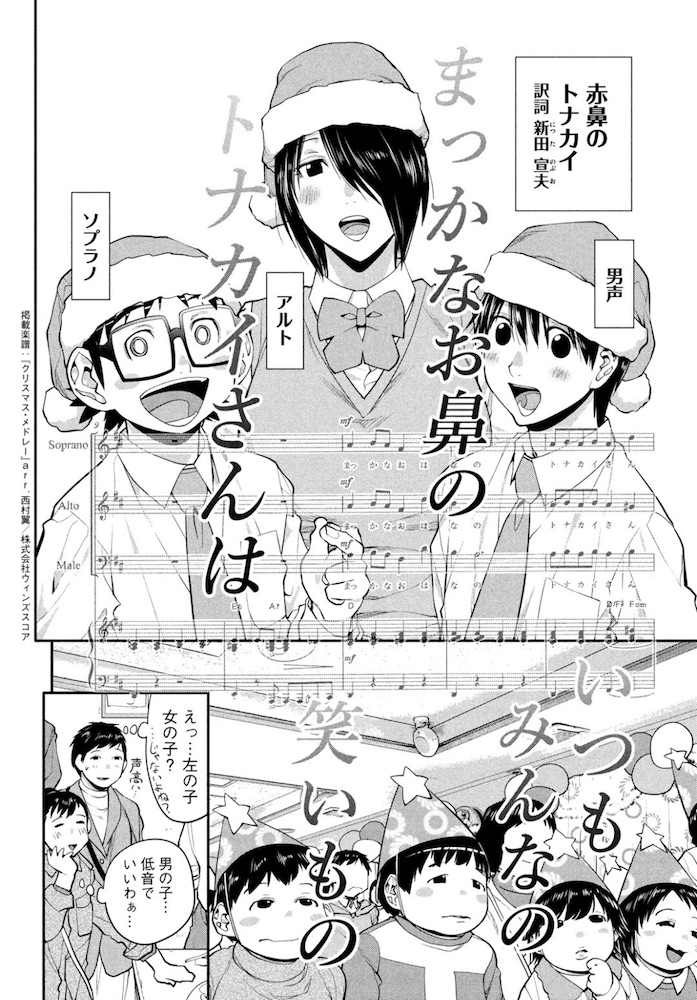
Akira, Jin, and Mai singing “Rudolph the Red-Nosed Reindeer” to little kids
We get a glimpse of Kousei’s home life (and a Christmas concert!) in Hashikko Ensemble, Chapter 43.
Summary
The Chorus Appreciation Society is visiting the orphanage where Kousei’s been raised, and they plan to hold a Christmas concert for the kids there. ItThere, Akira and the others meet three people in particular: Zenba Yoshimi, the assistant director of the orphanage; Hayase Minori, a 6th grader; and Sawamura Rikurou, a middle school delinquent. Rikurou clearly looks up to Kousei, and he doesn’t understand why Kousei would hang out with the Chorus Appreciation Society or take up singing.
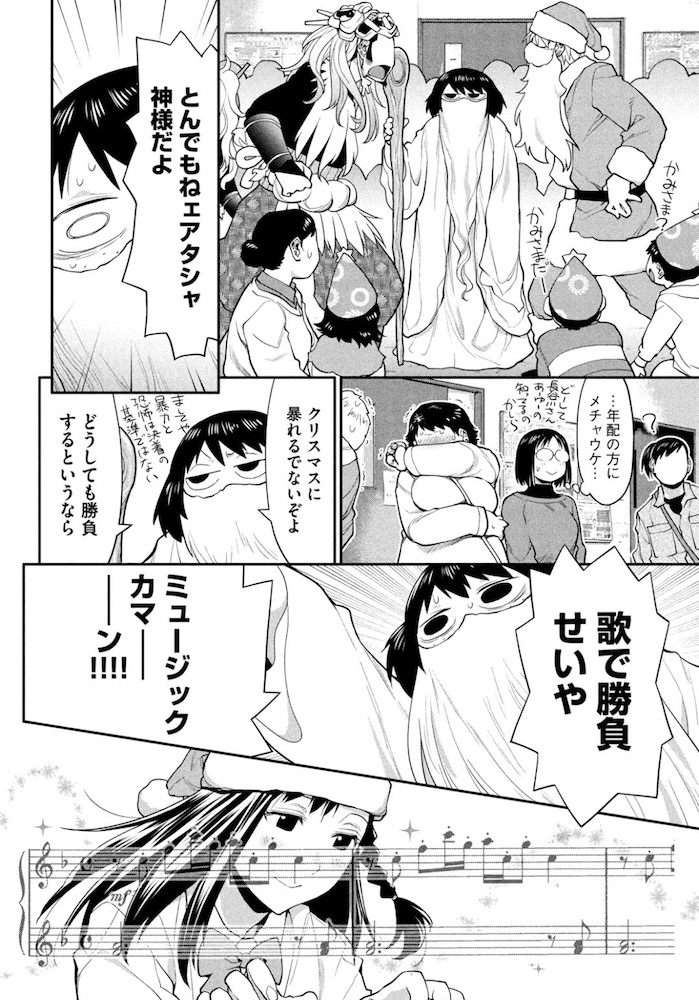
The day of the concert, members of the Appreciation Society are dressed for the occasion, with Kousei taking on the role of Santa Claus himself. The Tsuyamers then come in as namahage(New Year’s demons) to “scare” the children, only for a fight between Santa Kousei and Hage Tsuyama to be interrupted by Kozue dressed as God. Though part of the show, the tension between Kousei and Tsuyama is all too real.
God Kozue proposes a singing competition instead. Tsuyamers go with “My Neighbor Totoro,” while Akira’s group sings “Let It Go.”
Happy Holidays
Kozue, dressed as God, declares a sing-off between Santa Kousei and Namahage Tsuyama
I appreciate the particular blend of cultures we see around Christmas and New Year’s in Japan, between the Santa stuff, the namahage, and Kozue as the Judeo-Christian God with stereotypical white beard and all. The fact that they didn’t go with Jesus probably says a lot.
Imagination Station
I find it noteworthy how this chapter is how it starts, which is right at the orphanage. There was no scene in the previous chapter showing Kousei explaining his past to the other characters, nor was there any discussion regarding singing at his orphanage. And yet, because the characters have such strong and rich portrayals, it’s easy to imagine how this ended up happening. In particular, because Kousei has opened up over time, one gets the sense that he barely okayed this because he’s easily embarrassed but would like to give back to the place where he grew up.
It’s also through the new characters we meet that we can get a glimpse of what Kousei’s life has been like since he was rescued from his abusive mother.
The People in Kousei’s Life
Yoshimi, the assistant director of the orphanage, mentions that Kousei used to cry into her chest at night
Yoshimi, Minori, and Rikurou each make quite strong first impressions, and it’s easy to see how they’ve affected and been affected by having Kousei in their lives.
At the start of the chapter, Kozue asks Yoshimi what Kousei was like as a kid, and despite Kousei angrily telling Yoshimi to keep shut, she nonchalantly mentions him often crying at night. She seems like a tough lady who takes no shit from anyone, and someone who’s accustomed to handling children like Kousei and Rikurou. I can also easily see her attitude rubbing off on Kousei. The orphanage itself also seems well run.
Minori tries to act mature, explaining that she’s not like the other little kids there. Yoshimi explains to the group that she’s smart, but she’s also in a hurry to grow up. From the little we see of her, she does come across as actively trying to have a good head on her shoulders, even dispensing advice to the older Rikurou. Minori is the one who points out that Kousei established the rule about not hitting anyone younger than you at the orphanage, and calls out Rikurou’s anger as jealousy over possibly losing Kousei.
Rikurou is the closest in demeanor to Kousei, to the point that much of it is probably him trying to emulate his role model. The kid clearly thinks the world of Kousei, and he’s threatened by the Chorus Appreciation Society the way an only child might feel about a new sibling. There’s fear and pain there, and Rikurou likely tries to compensate for it with his tough-guy persona.
Speaking of Jealousy…
There are a few moments concerning the ever-so-slightly icier relationship between Jin and Akira. Jin mentally notes how much Akira has improved, while Akira realizes he kind of likes the change in attitude from Jin towards him. While not explained why Akira sees an upside to this, it’s probably because Jin has always been this larger-than-life figure when it comes to singing. For Jin to look at Akira with any kind of envy is, in a certain sense, a sign of Akira’s own progress.
Songs
Because they’re singing for an orphanage, all the tunes this month are for kids.
(Note that Youtube doesn’t let you add children-oriented videos to playlists, so many of these won’t be included on the big Hashikko Ensemble playlist).
“Rudolph the Red-Nosed Reindeer” (Japanese)
“Awatenbou no Santa Claus” (Hasty Santa Claus) is a Christmas song of Japanese origins.
“Jingle Bells (Japanese)”
“My Neighbor Totoro” from the Studio Ghibli film
“Let It Go” (or “Ari no Mama de” in Japanese) from Frozen
Final Thoughts
It’s interesting that the three characters we meet at the orphanage are all different age groups compared to Kousei. Their interactions show less of a peer dynamic and more of a somewhat intergenerational one. Because these three aren’t high school age, I don’t think we’ll be seeing a whole lot of them, but I’m sure they’re going to pop up from time to time even after this specific story ends.
Harry Potter is synonymous with magical school fantasy, defining the genre for an entire generation. However, one criticism I increasingly see is that it’s more about maintaining/restoring the status quo rather than trying to effect a real and lasting positive societal change that goes beyond defeating evil. While it’s a bit unfair to pigeonhole the books in this way, it’s also hard to deny that Harry Potter eschews structural issues about the world it presents, and that this is not especially uncommon in similar fiction.
That’s why the last place I expected to see a more boldly progressive take on the inequities of a wizarding society would come in the form of a comedic shounen manga called Mashle: Magic & Muscles.
I want to be clear that Mashle is not some leftist manifesto that proudly announces its overthrowing of capitalist oppressors. Jack London’s The Iron Heel this most certainly is not. But when you compare how Mashle and Harry Potter tackle the same premise, the differences stand out.
Both protagonists, Harry Potter and Mash Burnedead, enroll in a magic school where they must deal with being outsiders while also being under the benevolent watch of the school’s wise, old leader. However, whereas Harry Potter at the start is simply inexperienced with wizardry but has potential for greatness, Mash is completely incapable of magic. In order to get through his classes and achieve his goal of becoming Divine Visionary (a motivation from the beginning unlike Harry’s initial uncertainty), Mash has to overcome his disadvantage through sheer physical power.
The contest between Mash’s muscles and the occult abilities he faces is generally played for laughs, but there’s another layer to that contrast. Sure, it’s funny to see his “magic” be activating different muscle groups and his “spells” amount to suplexes and punches to the face. Yet, because he is doing this purely through his human physiology, his victories over other students both read differently from Harry’s accomplishments and are received differently by the very mages he bests. By beating them without magic, Mash makes his opponents realize on some level that they are themselves victims because of how they’ve been drawn into society’s incessant and blinding obsession with hierarchy and power. The problem is not exclusive to any specific group of rogue ne’er-do-wells, it’s systemic.
Mash himself is not a sharp mind capable of bold leadership. He’s from that Goku/Luffy/Saitama lineage where thinking is not their strong suit. He merely wants to live a comfortable life with his grandfather, but he’s forced to attempt the impossible and become the top of a magical school because his world despises the weak. Mash defies his society in multiple ways: upending what strength means, as well as rejecting the notion that those with less deserve less.
Around Chapter 65, the “Voldemort” of the series is revealed, as are Mash’s true origins. While not quite the same as the concept of horcruxes relative to Harry and Voldemort, Mash and the main villain share a similar connection. Mash turns out not to be the everyman he assumed himself to be, but that doesn’t change the fact that he uses his particular skills to upend people’s preconceived notions. The difference between Harry discovering the magic within and Mash working to overcome the magic he lacks remains stark.
That all said, it’s hard to think of Mashle as being in the same league as Harry Potter when it comes to the ability to capture people’s imaginations. It simply doesn’t have that sense of wonder that makes Harry Potter so enduring; instead, it goes for lots of comedy, absurdity, and the occasional cool fight. Spiritually, it’s cut from the same cloth as Kinnikuman and early Dragon Ball, during the kid Goku era. I have trouble seeing children running around pretending to be Mash because Mashle doesn’t really provide for that.
Mashle and Harry Potter both operate under the idea that the power of love is in a category of its own. But where Harry Potter’s is either abstract in its sentimentality or all too literal, Mashle’s manifests in a grandfather taught the value of human life, and a grandson who strives to live up to that ideal through both word and deed.
Bringing closure to as tumultuous and influential an anime as Evangelion is a task of confounding proportions. Back in 2007, the Rebuild of Evangelion film series started with the intention of being the definitive final word on the franchise, but when it came time to produce the fourth and final installment, numeroussetbacks delayed its premiere from 2008 to 2015, and now to 2021. With so much anticipation and so many expectations to answer, it would hardly be surprising if the movie was a spectacular flop. But against the odds, Evangelion 3.01+1.01: Thrice Upon a Time is exactly the conclusion that we needed.
Before I get into the weeds, I want to make it clear that I’m coming at this as a long-time fan of Evangelion. What Star Wars has been to so many, Eva is for me, with the added benefit of helping me explore the inner depths of my psyche. I discovered the series in high school thanks to friends, and spent many days discussing and speculating every aspect of it with them. Even my screen name is a reference to the series. And as a fan whose identity was shaped in part by this experience, Evangelion 3.0 + 1.01 (also known as Shin Evangelion) is an immensely satisfying work. While I had plenty of questions by the time the credits rolled, I came away feeling…at peace. It’s as if the 20+ years since I discovered Eva, and the personal journey I’ve taken as a human being during that time, are reflected in the progression and transformation of the characters themselves.
Warning: Heavy Spoilers Ahead
Neon Genesis Evangelion
The TV series Neon Genesis Evangelion is an exploration of the inner turmoil of people who desperately try and fail to connect to others while engaged in a futuristic battle of biblical proportions. The protagonist, 14-year-old Ikari Shinji, is brought before his estranged father, Gendo, and ordered to work for his organization, NERV, by piloting a mysterious biomechanical titan known as an Evangelion (or EVA) to fight off reality-defying monsters from above called Angels. But Shinji suffers from severe depression due in part to being abandoned by his father at a young age, and his relationship with his father is one of craving acceptance and acknowledgment. He soon meets other EVA pilots (collectively known as the Children), notably the hauntingly quiet Ayanami Rei and the aggressively competitive Sohryu Asuka Langley, each of whom have their own complex issues. Later, Shinji also meets a pilot named Nagisa Kaworu and establishes an intense bond, if only briefly.
An overt recurring theme of NGE is the idea that it’s impossible for humans to truly understand one another. Often mentioned is the Hedgehog’s Dilemma: a metaphor for people who are afraid to pursue close relationships because of the risk of hurting themselves. The EVAs and Angels fight using Absolute Terror Fields, nigh-impenetrable force fields that are revealed to exist to a lesser degree as the psychic walls that separate human hearts and minds from one another. Another concept thrown around is “Instrumentality,” a state in which all humans are fused together physically and spiritually, and where no barriers to misunderstanding exist.
NGE’s legacy is in part the popularization of what would become the mysterious doll-like character archetype (Rei) and the tsundere (Asuka), but it also does an amazing job of articulating psychological and emotional pain. That said, one potential weakness is that it does little in the way of offering solutions or steps to overcome that internal suffering, despite a desire to inspire and motivate its viewers by the end. In fact, the bizarre and trippy final episodes of the series were heavily lambasted at the time of airing, with director Anno Hideaki discovering that angry fans were discussing ways to kill him—an experience that contributed further to his depression at the time. In response, he created a pair of bitter “compilation” movies that revised the last parts of the TV series into a brutally violent trauma festival where the protagonist Shinji rejects Instrumentality but fails to make an actual firm decision on which direction he wants humanity to take.
Rebuild of Evangelion (Thus Far)
In a sense, the Rebuild films are heavily revised formations of Eva that are far more than either a retcon or, in Star Wars terms, a “Special Edition.” Existing elements might be 99% similar, but that 1% makes a crucial difference. A new pilot, Makinami Mari Illustrious, is introduced, and she seems to lack the baggage of the other Children. Most importantly, compared to NGE, Rebuild sees the characters initially tracing the same path, but taking gradual steps to challenge the Hedgehog’s Dilemma instead of living in fear of it. Each film gets further and further away from the original, and by the time of the third entry—Evangelion 3.33: You Can (Not) Redo—thrusted the characters fourteen years into the future, the idea that Anno had ruined Eva was accepted by many.
I disagreed and wrote a long review of Evangelion 3.33 that was part defense and part analysis of how Anno was trying to “address the differences between older and newer anime narratives, create a Tale appropriate for contemporary culture, and respond to current criticisms of youth culture.” I began by referencing an essay Anno penned expressing concern about the decline of the “Tale”—the kinds of grand narratives like the “journey to another galaxy to save the Earth” plot of Space Battleship Yamato that used to be common in anime—and his desire to see them return. I ended by making my own prediction on what the “Tale of Evangelion” would be, based on my analysis of the third film as a criticism of those who admonish the youth for being not hard-working enough:
A 14-year-old boy estranged from his father and suffering deep personal agony is thrust into a situation far greater than him, and though he is told to sacrifice himself for the greater cause, through the connections he makes with his peers he finds that he would lose too much in the process, including his own identity. This prioritization of the self and what he finds valuable in life does not come without its own consequences, but it becomes the potential ground for him, and those like him, to find their own solutions to the problems of the world. Of course, the fourth film has yet to debut, so we’ll see if I’m right.
At the time, I expected to get an answer fairly quickly, but history repeated itself and Anno fell into depression again, with the catalyst that brought him back being, of all things, working on the film Shin Godzilla. So now, coming into 3.0+1.01, I indeed wondered how my predictions would fare, but more importantly, I wondered how this final film might choose to resolve (or leave open) much of the baggage of Eva, both within the works and within Anno himself.
Finally, Shin Evangelion
The end of the third movie has the three pilots surviving a traumatic battle and wandering into a post-apocalyptic world, with Asuka pulling Shinji up and out of his cockpit, and Rei (or rather, a clone of Rei) following along after having just awakened to her own individuality. The symbolism of that moment, of seeing them reach out to one another, encapsulates the challenge to the Hedgehog’s Dilemma that Rebuild of Evangelion. Evangelion 3.0+1.01 comes in almost directly after that moment, and leads into what I can only describe as a thorough (yet never boring or tedious) conclusive response to all the thematic and cultural fragments of Eva that have piled up over the years, and that the general contours of my above prediction about Evangelion 3.0+1.01 have come to pass.
Shinji and Space
The early part of the Evangelion 3.0+1.01 sees Shinji, Rei, and Asuka staying in a makeshift farming village, where they reunite with some old school friends who have established their own lives. It can feel far removed from what’s expected of Eva, but there is a great significance to this part of the story. During this time, Shinji most greatly resembles the Shinji of the old TV series: retreated into his shell in a state of depression, too weak to do anything but not weak enough to want to die. But while NGE would have characters, at best, try to force Shinji out of his shell, here you see him finally get what he needs to heal: support that understands who he is and the space he needs to find himself. It’s a process that can’t be rushed. In this town without any EVAs to pilot, the characters experience a slice of what it would be like to discover themselves and what they truly want.
Rei and Opportunity
Rei is a major catalyst in Shinji’s change, and I’m reminded of something her voice actor, Hayashibara Megumi, wrote in her career memoir: In order to help Hayashibara understand the character better, Anno explained that Rei doesn’t lack emotions—she’s just unfamiliar with them. The result is a person who doesn’t have the filters humans establish to operate in society, and with the different Rei’s we’ve seen over all of Eva, we see it play out in different ways.
It’s witnessing the current Rei clone in an environment where she can discover life with child-like wonderment that awakens Shinji and brings him to a state of calm that we have never seen in any mainline Evangelion work (Super Robot Wars and Shinkalion don’t count). Back at the very, very beginning of both NGE and the first Rebuild film, Rei was Shinji’s original reason for piloting EVA-01 due to his guilt over seeing her in pain. But while this Rei ends up in an even worse place, what seems to be in Shinji’s heart is not guilt or regret but determination to help others. He decides to fight for the happiness of those he cares for, instead of as a desperate attempt to find acceptance.
Asuka and Time
Evangelion 3.33 begins with a 14-year jump forward in time. Much of that third film feels very jarring because of how much the characters have changed and how bitter they feel towards Shinji for triggering the apocalypse, but in Evangelion 3.0+1.01, it also shows how time has transformed characters inside and out. Toji and Hikari (two of Shinji’s old classmates) have a family together. Katsuragi Misato, Shinji and Asuka’s old guardian, takes on a gruff, Okita-like exterior which, along with WILLE (the organization she leads to oppose NERV) come from her desire to protect her children, both figurative and (as we find out) literal. But out of all the characters, Asuka’s growth in this timespan is especially significant.
Due to being an EVA pilot, Asuka has not aged physically. However, she has matured mentally, and the final film establishes how she’s grown over those 14 years while Shinji was in stasis. She’s still Asuka at her core, but an Asuka who doesn’t seek validation, and it helps her communicate with others in her own way. Earlier in the film, when Shinji is listless, she basically forces food down his throat, in essence telling him that she’s going to help whether he wants it or not. Later, she has a brief heart-to-heart with Shinji about how one of his biggest problems isn’t that he makes the wrong decisions, but that he’s afraid of making decisions and owning them—and such indecisiveness can end up making things worse. As Asuka departs for combat, she even mentions that she did indeed have feelings for him back then, but she’s grown past that point. In other words, Asuka is no longer the tsundere who can’t be honest with her feelings.
Between Asuka, Shinji, and Rei, one gets the sense that the timeskip is also addressed toward the viewers. The jump into the future brings those characters out from their 1990s roots and shows how people like them (or indeed character archetypes like them) might have transformed two or three decades later.
Action and Homage
The fights in Evangelion 3.01+1.01 do a lot of things at once. While they’re thrilling from a technical perspective (sometimes to the point of being overwhelming), they’re also windows into the components that make up Eva as a whole. Some of the fights are closer to that classic Eva style, drawing inspiration from the tokusatsu stylings of Ultraman. Others completely flip the script on what Eva fights are supposed to look like, as the enemy they face isn’t individual Angels but rather entire armies of chimeric EVAs that almost trivialize the specialness of the EVAs themselves.
And then there’s the battle that basically comes across as Anno’s love letter to Space Battleship Yamato. The third film introduces the Wunder, a flying fortress that functions, and in the fourth film we see it engage in a ship-to-ship combat scene straight out of Yamato, complete with the old-fashioned orchestral soundtrack. If Yamato is the gold standard of the Tale, and that style of story is woefully underrepresented in anime over the past two decades, then putting in a Yamato-esque fight potentially feels like there’s a desire to indeed bring Rebuild of Evangelion into one cohesive whole. At the same time, Anno’s ability to add in all of these elements of his life—his favorite shows, his depression, his feelings about Eva itself—suggest a desire to communicate another important lesson: when it comes to stories, you can have your cake and eat it too. You can put in all the escapist elements and the otaku fantasies, but you can also bring it all together and motivate people to return to reality.
Out of all the battles, though, there’s one that stands head and shoulders above all as arguably the most important conflict in all of Evangelion: At long last, Shinji directly confronts his father, Gendo.
Shinji vs. Gendo
Seeing Shinji finally come face to face with Gendo, determined to settle things once and for all, was a powerful emotional experience. Even before anything truly began, I couldn’t help but smile as my body was jolted by a strange catharsis. To see this culmination of two and a half decades, to see Shinji do what he has never dared even try—it’s like the film and Eva as a whole are showing how Shinji has truly healed and grown into a better place. In that moment, the boy has finally become a man, and it has little to do with the new generation taking over the old. Rather, Gendo is the source of so much of Shinji’s grief, but in the ensuing confrontation, Shinji sees Gendo not as the distant and intimidating patriarch but another human being who, like him, has trouble sharing his feelings.
Gendo reveals that he has merged with an Angel and given up his humanity, and the fight between Shinji and him takes them on a tour through Shinji’s memories. It’s explained as them being in the realm of God that defies all physics and human comprehension, Minus Space, and so this is how Shinji’s mind is interpreting what’s there, but it’s also a two-fold callback to Neon Genesis Evangelion. First, many of the Angel fights featured psychological deep-dives full of abstract imagery. Second, NGE uses quite a bit of recycled footage in artistic ways. Rather than truly reused scenes, however, the fight sees their respective EVAs, EVA-01 and EVA-13, clashing against familiar backdrops without consideration for size and scale differences, as if to say that this fight is about the big as well as small moments that permeate Eva.
During their battle, Shinji notices that they’re in a stalemate—all of his EVA-01’s moves are mirrored by Gendo’s EVA-13. Shinji comes to the realization that this conflict cannot be solved through violence, and begins a true conversation with Gendo. He asks his father about what makes him tick, what motivates him to take things so far as to try to essentially remake the whole of humanity, and the answer is that Gendo is all too much like his own son.
Gendo goes through his entire history, explaining how as a boy, he cherished solitude and the calculated predictability of things like a finely tuned piano. Meeting his future wife, Yui, taught Gendo that he could find happiness living with others, but after her tragic death/disappearance (she was caught in an EVA experiment gone haywire and absorbed into it), Gendo was afraid that he could no longer return to his old way of being. Gendo has actually never been contemptuous of Shinji but rather scared of him—scared of having another connection that could be severed. This is even visually manifested when Gendo’s AT Field activates to his own surprise; it implies that he feels (absolute) terror towards his son. The only way Shinji can make it through was by handing Gendo back the old portable music player that both have used as a mental respite from the world.
Gendo built up power and a fearsome presence as protection for his own emotions. In doing so, he passed down his suffering to his son. It’s only after Shinji tries to understand (but not necessarily forgive) his father that this cycle could be broken. Just like in The End of Evangelion, Gendo could never forget Yui and would go to any lengths to bring her back (down to killing the gods if he needed to), but Shinji effectively saves him from that path—and as it’s revealed, Yui saves them both in turn.
Healthy Connections
The Shinji we see as Evangelion 3.0+1.01 starts its build to the end is one who has found his center and now aids the other Children in reaching peace and acceptance themselves. This process of Instrumentality is not the forceful clashing of souls that bring all the ugly demons to the surface like in NGE, but something calming and joyful. The world Shinji looks to remake isn’t one where humanity has evolved into a single entity, but one where humanity has the ability to move forward, and where EVAs don’t exist.
One notable aspect of these scenes is that they call back to not just the previous Rebuild films but also what came before. Regardless of whether this is meant to be merely symbolic or is actually saying that all the Eva anime exist in the same multi-reality and are all connected, the result is a move towards resolution as a whole. When talking with Asuka, Shinji and her return to the beach at the final parts of The End of Evangelion. This Asuka is actually wearing the plugsuit uniform of NGE (a visual marker of the difference between Sohryu and Shikinami), and when Shinji says, “I loved you too,” he’s both responding to the future Shikinami’s casual reveal of her old crush and the more emotionally stormy Sohryu.
Similarly, when Shinji is talking with Rei (who is initially presented as a kind of ethereal presence with uncharacteristically long hair), behind them is footage from The End of Evangelion during Shinji’s mental breakdown. In that movie, Rei wanted to rescue Shinji by starting Instrumentality, and giving him control, only for him to reject it partway (thus resulting in another half-decision). This time, Shinji is the one who seeks to say goodbye to all Evangelions (a statement that clearly has a double meaning between the mecha and the franchise) but has peace and compassion in his heart rather than conflict and shame.
Unlike The End of Evangelion, Instrumentality in Evangelion 3.01+1.01 is not initiated with the Spear of Despair, Longinus, a reference to the crucifixion of Jesus Christ that in the context of Eva is a weapon capable of piercing the divine protection of AT Fields. It also doesn’t use the weapon obtained initially by Shinji, the Spear of Hope, Cassius. Rather, Instrumentality is accomplished by using the Spear of Will, Gaius, a new weapon created by Misato aboard the Wunder. This isn’t supposed to be possible, but it’s all in the name: Gaius has been willed into existence. This also reflects the vital difference in Misato’s organization, WILLE, compared to all the other groups that have shown up in the Eva franchise. Unlike NERV (“nerve”), SEELE (“soul”), and GEHIRN (“brain”), WILLE (“will”) is about what humans create rather than what has been created for them.
Looking again at my prediction about the final film, I wrote, “This prioritization of the self and what he finds valuable in life does not come without its own consequences, but it becomes the potential ground for him, and those like him, to find their own solutions to the problems of the world.” I believe this plays out through the Instrumentality of Evangelion 3.0+1.01. Prioritizing the self means helping oneself in order to help others, and that process wills a solution into existence.
Kaworuand Love
Aside from Asuka and Rei, there’s another character Shinji connects with during Instrumentality: Nagisa Kaworu. While I only briefly mentioned Nagisa earlier, and he indeed only appears for one episode in NGE, the character actually has an outsized impact on Eva as a whole. The twist with Kaworu is that he reveals himself to actually be an Angel in human form, that Rei is much like him, and that he was sent by the organization above NERV, SEELE, in a betrayal. Even so, it’s clear that his love and compassion for Shinji is genuine, and Kaworu even allows Shinji to kill him at the end in one of the most heart-wrenching moments of the TV series. Because of this portrayal, Kaworu has long been a popular character—especially among fujoshi—because of how he could establish a bond with Shinji when no one else truly could.
Kaworu exerts such a tremendous influence that other versions of Evangelion (such as the manga drawn by character designer Sadamoto Yoshiyuki) make the move to introduce him sooner. That includes Rebuild of Evangelion, where Kaworu first appears acting as if he’s been through all this before, and is determined to save Shinji this time around. Here, his actions amount to trying to spare Shinji the pain of the past—even going as far as ending his own life in Evangelion 3.33 to keep the blood off Shinji’s hands this time around. In Instrumentality, Shinji says that Kaworu reminds him of his dad, but in a positive way. Kaworu’s love is so powerful, yet he is literally a higher being to the point that it’s hard to tell how much is romantic and how much is angelic, or if that distinction matters to Kaworu at all. For his part, while that love is genuine, Kaworu made the mistake of thinking he wanted to make Shinji happy, but he himself was looking for happiness through Shinji.
But Kaworu is not the only minor character with major influence, and this requires me to talk about Makinami Mari Illustrious.
Mariand the Outside View
Rebuild of Evangelion is where Mari makes her introduction to the franchise as a whole, and her presence in the films can be puzzling. She’s another pilot, but her story is never explored in depth for three entire films. Yet, it turns out that she’s crucial to Evangelion 3.0+1.01, which drops a number of revelations about her.
Mari is revealed to actually be “Mary Iscariot,” and the name implies that she is both bringer of good and betrayer—though what she betrays (the gods?) is unclear. Mari is also shown in flashbacks as being a peer of Gendo and Yui’s, implying that she’s much older than she actually appears. I speculate that this means Mari was the first EVA pilot, but the importance of her age comes down to shifting expectations as to what her role truly is. It means she’s more mature than everyone else, and that—much like Asuka—it gives her a certain long-yet-decidely-human view that the others don’t have, not even Kaworu.
Mari is the one who fights on the “outside” while Shinji is warring with his dad on the “inside,” and the one who comes to bring back Shinji during Instrumentality. Notably, Mari is also the only one of the Children with whom Shinji does not have that final talk about their feelings, as if Mari simply doesn’t need it the way the others do. And at the very end, in a world without Evangelions, Shinji and Mari are older and romantically connected.
I’ve seen much criticism of Mari—that she’s a shameless marketing ploy, that she’s pointless, that she does too much or too little, and that she should not be the one with Shinji given how small her proverbial shadow is. But I think that—much like Kaworu—this is the point of Mari. Her role is that of the external force who brings a new perspective and can spark bits of change in people caught in a spiral. We think that major characters should do major things and minor characters should do minor things, but that’s our assumptions about storytelling.
Is Mari “Anno Moyoco”?
Anno Hideaki’s wife is manga artist Anno Moyoco (Anno is actually her maiden name, by coincidence, albeit written with different kanji), and the film makes a number of references to her. A poster for Sugar Sugar Rune shows up in the background, as does a physical copy of another series by Moyoco called Ochibi-san—and on the cover is Ochibi-san talking to a porcupine. Given that Shinji reflects so much of Anno, it’s easy to think that Mari is therefore based on Moyoco. Both Studio khara and Moyoco herself deny this, though.
I think the truth is somewhere in the middle. It’s not so much that Mari is Moyoco, but that she’s based on her manga, or more specifically, the strength of Moyoco’s manga. In Moyoco’s thinly veiled autobiography about their married life, Insufficient Direction, Anno writes some illuminating commentary. He describes Moyoco’s works as consistently accomplishing what Anno never could: bring the reader back into reality from the fantasy of the story and leave them energized. Not only does Evangelion 3.0+1.01 feel like Anno finally getting it down, but Mari literally shows up to pull Shinji from disappearing into the work that is Eva. In another callback to NGE, Shinji and the world around him starts to break and the way down to initial outlines used in anime production, only to come back to full color once Mari arrives.
Rebuild Reflecting on the Past and the Future
Rebuild of Evangelion has different titles in Japanese: Evangelion: Jo, Evangelion: Ha, Evangelion: Q (Quickening), and Evangelion: :𝄂 (the musical symbol for repetition). The first three refer to the concept of jo-ha-kyu, a form of structuring found in Japanese music and noh theater. But given that it’s four parts, and the way these films have played out, I also find that they embody a different dramatic structure: kishoutenketsu.
Each film ties almost perfectly into one of the four sections. Evangelion 1.11 is the awakening (ki), largely following the events of the original NGE to tell audiences that this is indeed Eva but with some notable differences. Evangelion 2.22 is the development (shou), further extrapolating the consequences of those seemingly small changes. Evangelion 3.33 is the change or twist (ten), where what we thought we knew about Eva is turned on its head. And finally, Evangelion 3.01+1.01 is the conclusion (ketsu), seeing where the story goes after that shift in expectations. I can see even more clearly now why Evangelion 3.33 left so many concerned, because without that last part, we would have been left in the dark, perhaps worrying about whether the underlying message was full of hope or despair.
One of the old criticisms of the third film is that the way people attack and blame Shinji but don’t tell him what he did seems both like bad storytelling and unfair to Shinji himself, but with the added context of Evangelion 3.0+1.01, it feels different now. There’s a part in the final film where many of the side characters express their bitterness over Shinji’s actions 14 years ago leading to the death of their loved ones, but they also admit that they’re cognizant of the fact that Shinji also ended up saving them. He’s their “savior and destroyer,” as the movie puts it, and it’s impossible to stay rational when confronting a person like that.
From Shinji’s point of view, he arrives at a place where he doesn’t fear decisions or blame because he understands that paralysis in the quest for perfection is a trap, and he’s willing to take the lumps to make the world a better place for those he loves. Thus, Evangelion 3.0+1.01 ends up being a look at the past, present, and future. It encourages a renewed viewing of what came before, but doesn’t leave audiences trapped there, and shines new light to illuminate what was but also what could be.
I’ve made a couple of comparisons to Star Wars, and it doesn’t hurt that here, too, the son must face the father in a battle for the soul. Along this vein, another similarity is that both have new works meant to bring their franchises into current times. However, I find that Eva manages to succeed where Star Wars could not because the latter ended up being too intimidated by the potential for actual change. Episode IX, the final part of the Star Wars sequel trilogy, is a retreat into the comforting space of its own history and popularity. Evangelion, in stark contrast, forces the spotlight on its own influence and tells audiences to let them go if that’s what will help them heal.
Ending Thoughts
Evangelion 3.0+1.01 is one of the most emotionally satisfying films I’ve ever seen, to the point that it goes far beyond the confines of cinema and animation. It’s as if Evangelion has grown up and found itself, and in many ways I find my own journey these past two decades and change reflected in the changes found in Shinji, Rei, Asuka, and the others. Rebuild of Evangelion ultimately feels like a reunion with old friends, catching up on where we’ve gone in life. And as we share our adventures and anecdotes, we can take mutual pride in the fact that we were able to find the will to do and experience so much. I understand that this sentiment is about as subjective an impression as it gets, given that not everyone who has watched or will watch Eva will have the same perspective, but I hope that those who are still lost might know that someone understands them.
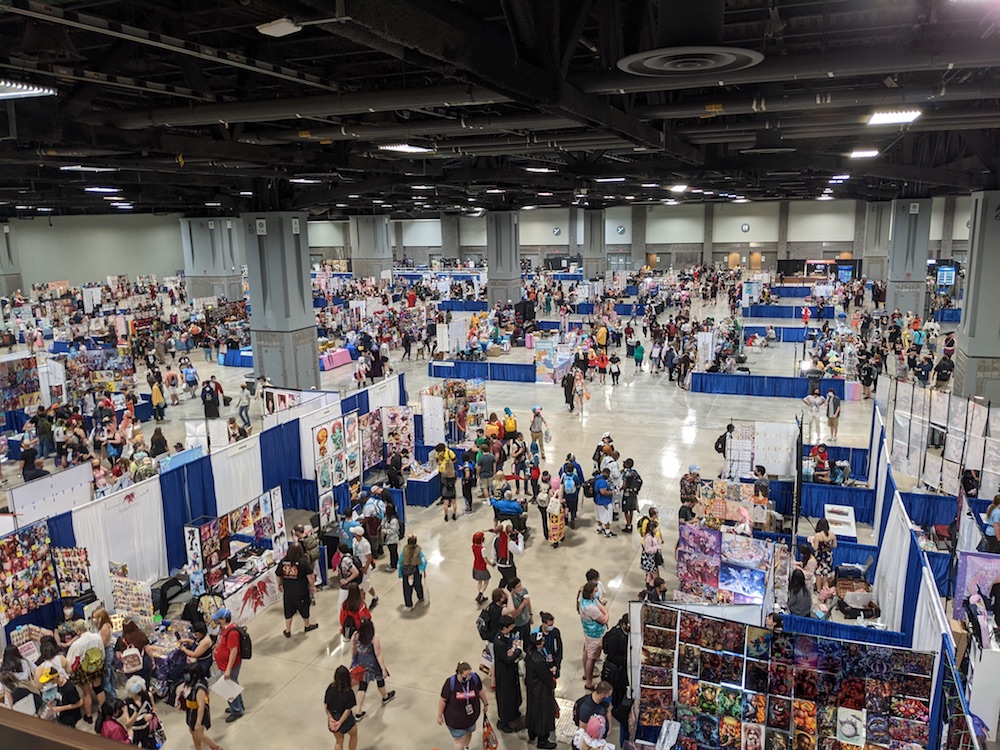
2021 was the first year where I questioned whether going to Otakon was a good idea. It’s long been my favorite anime convention, but the ongoing threat of the COVID-19 pandemic and the frightening rise of the delta variant in the United States made me anxious about attending an event that regularly brings close to 30,000 people into a single indoor venue. Ultimately, I decided to make the trip to Washington DC—partly because I wanted to support the fan-run con that has provided so many excellent moments. But it was also because I wanted to try to do something “normal” while taking every precaution I possibly could in order to avoid straight-up tempting fate.
Personal COVID-19 Precautions
I traveled to DC fully vaccinated and wearing the best facemasks I could obtain. I decided not to do any interviews with guests this year (though the lack of Japanese industry guests helped that). I largely steered clear of the dealer room and gaming room. And I greatly reduced my normal frantic pace of checking out every panel imaginable to eat and take respite in my hotel room, where everyone else was a familiar face who was fully vaccinated.
Otakon COVID-19 Precautions
Prior to Otakon weekend, attendees would receive emails about the numerous precautions being taken to try to ensure everyone’s safety. Masks would be mandated, the convention center would be well ventilated, and temperature checks would be included. Vaccinations were not required, which I hope can change for next year.
In terms of masks, the vast majority of people I saw wore masks and wore them properly, and even those whose mask etiquette was questionable would at least try to fix it eventually. This was only my limited perspective, so I can’t say if there were pockets of people resistant to doing so, but it gave me at least a bit of faith that most attendees wanted this event to work. However, trying to enforce a mask mandate on 23,000 people is no easy feat, and I’m not sure if a greater amount of staff/security would do the trick.
The Walter E. Washington Convention Center is a very spacious venue with high ceilings, and was even used as a temporary hospital for COVID-19 patients in previous months. In a more cramped space, I would have been much more alarmed, but walking past people on the way to a panel felt no busier than a New York City sidewalk, albeit indoors—at least on Friday and Sunday. Saturday had more attendees (an inevitability for any weekend convention), and that had me feeling more apprehensive. I took particular care not to remove my mask for any reason on Saturday.
The panel rooms themselves could have used better social distancing, as there was no incentive presented to steer clear of others outside of one’s own desire to do so. In some cases, volunteers encouraged us to pack in for the more heavily attended panels, and I found myself (perhaps against better judgment) staying and hoping my mask and vaccinations (as well as the masks of those around me) would be enough. I feel there should have been more done to encourage social distancing in rooms, even though I understand the disappointment it would inevitably cause for those who wouldn’t be able to enter a panel or event they could have in previous years. I myself presented a panel this year with the best attendance I’ve ever seen for one of my presentations, and I feel conflicted about it because of these circumstances.
As for the temperature checks, I did not see any, and I’m not sure how they were supposed to work or if anyone was indeed caught having a fever. If anyone spotted the temperature checks in action or have more information, I would like to know more.
Fan Panels
As mentioned in the introduction, there’s a lot I typically look forward to at Otakon—interviews with Japanese guests, especially—that simply didn’t happen this year. The ability to get interesting industry guests who are willing to share greater insight into the world of anime and manga beyond just pitching their latest projects has been one of the most valuable parts of the Otakon experience up to now. In their absence, I had to wonder if the other appealing aspects of the con could carry the event.
While guests are great, I think the real lifeblood of Otakon is the robust fan panel programming, and I was happy to see it out in full force. A combination of veteran presenters and (I assume) new blood kept things entertaining and informative. While not every panel was an absolute winner, the energy that comes from seeing people onstage sharing topics they find fascinating or encouraging others to expand their scopes is always encouraging.
Thirty Years Ago: Anime in 1991
Daryl Surat from Anime World Order is always a solid presenter. He picked a nice and diverse set of works and made good cases for why they’re still memorable today. As I expected, he made reference to Brave of the Sun Fighbird, the super robot anime that gave birth to the “Is this a pigeon?” meme.
The Best Openings for Shows You (Probably) Didn’t See
This had the Anime World Order crew in full force. As advertised, there were some I didn’t see, and I liked that it had a real mix of genres. The fact that it started off with the opening to Goshogun earns it plenty of points.
Japonisme: A History of the First Japanese Culture Craze in the 19th Century
This panel looked at the weebs of the 1800s, particularly in terms of the great artists of the century. The presenter (an art history teacher) did a solid job of showing how names like Cezanne, Van Gogh, Gauguin, and more were influenced by the woodblock prints and other forms of art coming out of Japan—as well as the problematic Orientalism surrounding the whole thing.
Manga Masters: Kentaro Miura
Patrick (The Cockpit) and manga expert Ed Chavez did a retrospective on the life and career of the late, great Miura Kentaro. Some of the big takeaways were that 1) Miura was not just a skilled artist, he was a nurturing and supportive figure to his friends and fellow artists 2) he single handedly put seinen on the map for the predominantly shoujo-oriented publisher Hakusensha 3) he changed the landscape when it came to manga and fantasy titles. Overall, it was an informative and insightful panel.
Samus vs. Ridley: A Metroid Historia
Not just a video game history panel, this one looked at how the disparate scraps of lore and storytelling gradually came together to form the Metroid we know today. It was fascinating how seemingly everything, even the Nintendo Power comic from the 1990s, somehow has found its way into the mythos in part or in whole.
Bad Anime, Bad…The 20th Anniversary!!
One of the enduring highlights of Otakon is back to celebrate twenty years of awful animation, and I think it’s important to note how much this panel acts as a predecessor of sorts for the current Youtube anime review scene. Not just limited to Japanese animation, it was good to see this still going strong—and Dracula: Sovereign of the Damned is evergreen terrible.
The Wonderful World of Yas
Another creator retrospective, this time it was for Yoshikazu Yasuhiko, the character designer of Gundam and one of the finest artists to ever grace the industry. Finding out that he was dissatisfied with his work in the 1980s makes a lot of things click together in terms of my understanding of him. I wish this panel was better attended, as I think plenty of fans would love seeing not just Yaz’s mecha stuff but also his love of history. However, it was literally up against a different Gundam-related panel.
When Anime Companies Knew Nothing About ANIME FAN WANTS
Run by George Horvath, this panel was a series of painful lessons in industry hubris. However, perhaps it had the opposite effect on me, and I kind of want to start my own anime company…
Ogiue Maniax Presents: Saturday Morning MILFs
A few years ago, I decided to turn an idle observation about anime into a panel where I introduce fans to the surprisingly wide variety of interesting and attractive mom characters cropping up in works for kids. Amid the perennial love of high school characters in anime, I thought MILFs was a worthwhile subject. Unfortunately, my initial attempts to present it were met with rejections and waitlists.
But this year, I decided to swing for the fences and apply for it as my sole panel submission…and actually got the okay! While I was out of practice when it came to public speaking, I actually had most of the panel prepared from previous years’ attempts, and felt comfortable that I could deliver something at least decent.
What I didn’t expect was to be in Panel 1 (one of the two biggest panel rooms at Otakon), and for my silly little project to have the largest convention audience I’ve ever dealt with on a personal basis. It was packed (though that was perhaps not a good thing, given COVID and all).
The funny thing about me is that I often feel a lot more pressure presenting in a vacuum than I do to an actual audience. In front of a gathering of otaku eager to see some MILFs, I worked to educate and inform, while also throwing some red meat out there (because at the end of the day, it was an 18+ panel). Afterwards, a few longtime friends complimented me on the panel, saying I successfully threaded the needle and balanced learning with pleasing the horny audience.
Despite a lack of Japanese guests, the industry panels I did attend were all worthwhile in their own way. The DENPA panel was run by Ed Chavez, and he’s always your best bet for getting an inside look at the manga industry. AnimEigo has the benefit of CEO Robert Woodhead’s many decades in the industry, and I was impressed by his company’s dedication to preserving art and design material for anime projects. Discotek panels are always a blast, but the announcement of blu-ray releases for both Aim for the Top! Gunbusterand Machine Robo: Revenge of Chronos practically stole the whole show at Otakon. I’d been waiting years for the former, and the latter never got a full release—it was actually licensed by accident!
I also decided to check one off the bucket list and finally watched Project A-ko, or rather, Discotek’s remastered blu-ray edition.
In addition, there was a screening for a 3DCG short called HOME! by the animation studio Orange. It was a brief but sweet story about an astronaut and a ghost inhabiting a space colony, and it showed why Orange’s CG work is a cut above its competitors in Japan. A short panel afterwards elaborated on Orange’s approach to 3D work, and it’s easy to see the care that goes into shows like Beastars and Land of the Lustrous.
Artist Alley
Artist Alley is usually not one of my priorities, but it sort of took the place of the Dealers Room for me this year. Below are all my purchases at Otakon. It’s not much, but I think it all looks great.
Food
The places I went to this year for finer eating were Farmers & Distillers, SUNdeVICH, and Bantam King. There was also a newly opened Ben’s ChilI Bowl in the convention center (and the old dining area near the underground entrance to the Marriott was closed for renovations).
Farmers & Distillers’ claim to fame is that they get everything directly from local farms. It’s more expensive than your standard restaurants and requires a reservation, but the food is amazing. I got the Yankee pot roast and the vanilla bean cheesecake with strawberries and cream—a combination that was as delicious as I’d hoped but left me regretting the heaviness of the overall dinnerl. the next day. Take a lesson from me and try to balance your meal out better.
SUNdeVICH is a sandwich shop with a variety of solid choices with an international flair. I tried the Shiraz (Persian beef tongue) over salad and the Rome (Italian cold-cut combo) on a sandwich, and both were top notch.
Bantam King I’d been to on my first trip to DC for Otakon, but this time I went for the curry snow fried chicken plate instead of the chilled ramen. The onions and white sauce on top reminded me a lot of coleslaw and fried chicken, and the flavor profile worked well. However, the simplicity and sheer deliciousness of the chicken drippings over white rice was the real winner.
Ben’s Chili Bowl at the convention center suffered from being short staffed (a common problem caused by the pandemic), but once I got my chili half-smoke (chili over a beef-and-pork sausage on a bun), it was amazingly solid.
Cosplay
This year’s cosplay had the inevitable addition of masks. Some of the cosplayers would temporarily remove their masks for photos but kept them on otherwise.
Final Thoughts
The overall Otakon 2021 experience, for better or worse, was surprisingly normal. In any other year, it would’ve felt par for the course, but the surrounding circumstances at times made things awkward. There were moments where it was easy to almost lose myself in the moment, but had to get snapped back to the reality of an escalating pandemic. I’m still not sure if going was the right idea, and as the delta variant escalates, I worry about 2022. In the meantime, though, I made it back with plenty of good memories. I hope everyone else can say the same thing.
When SHIROBAKO The Movie was first announced, I was filled with excitement and anticipation. The original TV series is one of my favorite anime from P.A. Works, as its romanticized look at the Japanese animation industry through the P.A. Works formula (cute girls doing X in a town) delivers some pretty deep-cut in-jokes while working to encourage viewers to consider joining the anime industry. I looked forward to reuniting with a fantastic cast of characters and seeing how their careers in anime would continue.
A few pandemic-induced delays on both sides of the ocean later, and I finally got my chance to attend a one-night-only screening through Fathom Events.
The Story
SHIROBAKO is about five girls who make a promise to join the anime industry and turn their club project into a full-fledged anime, and enter the field by specializing in different aspects of anime production. The movie takes place four years after the TV series, and sees them still working in the industry but suffering from stagnating careers. In particular, protagonist Miyamori Aoi is dealing with the decline of her studio, Musashino Animation Productions (aka Musani), after a disastrous show cancellation. As Aoi wonders if there’s any way to bring it back to its old glory, a proposal comes her way: take a risk and start production on an anime film.
A Theatrical Feel
In many ways, the film feels like it’s trying as hard as possible to indeed be SHIROBAKO…THE MOVIE. Just as the TV series is about making shows, this involves the characters working on a feature-film. And because one of the biggest appeals of SHIROBAKO is its cast of characters, a lot of the movie is about bringing the old team back together and rediscovering the energy and inspiration they’ve lost. A couple of musical numbers—a feature absent from the TV series—also get thrown in, as if the staff is saying, “We’re doing this because we can.” It’s definitely the experience I was looking for, from reuniting with the cast (writer Imai “Diesel-san” Midori being my favorite) and it ends in a satisfying and uplifting way, though ironically, I wish I could have spent more time with them.
Rosy, Yet Not without Criticisms
SHIROBAKO can be thought of as a story about people within an industry, as opposed to the industry itself. It peels back the curtain enough to show the strain of deadlines, creative clashes, the perils of overwork, and many other things that can go wrong during an anime production. However, it doesn’t point any fingers at the systemic issues that cause these to be common problems, notably chronic underpayment of staff. SHIROBAKO is willing to deliver a few lumps, but holds back the ugliest parts. Though, given that it’s not meant to be a hard-hitting work, I don’t really mind. At the very least, it’s not all sunshine and rainbows in SHIROBAKO.
This approach extends into the movie, but this time, it’s willing to show a bit more about how precarious everything can be within anime production. Part of the reason Musani fell from grace is because the studio’s owner (who, as a reminder, is a parody of legendary industry figure Maruyama Masao) tried to get ahead of schedule by starting production before the ink had dried on the contract, and got burned for doing so.In other words, trying to be more responsible came with an inherent risk, which on some level indicates an unforgiving industry. This also ties into the direction the movie goes, as well as Aoi’s role in the process. Like Keep Your Hands Off Eizouken!’s Kanamori, Aoi is a producer, and the dramatically reduced time span to finish the film seems like a recipe for disaster. Aoi has to know how to best use previous resources and experience to allow for some shortcuts, and when to put your foot down to keep on schedule vs. when to encourage and allow for greater creative flexibility.
Overall
SHIROBAKO The Movie is more or less what I wanted and expected out of it, and the challenges it presents its characters—trying to get out of their respective ruts and reignite their passion for anime—helps to paint an image of the anime industry as complicated and full of ups and downs. Though this is clearly a film from before COVID-19 was an issue,
I have to wonder if it was meant to be P.A. Works‘ giving a pep talk to itself, trying to provide some hope when things feel hopeless.