Nazuna Insomniax: Call of the Night

Kotoyama’s Dagashi Kashi is one of my favorite manga of the past ten years. So, when I saw a couple years ago that they started another manga, I jumped at the chance to give my early impressions of their new title: Yofukashi no Uta. Since then, I kept reading in Japanese while doubtful that it would get licensed in English, but that’s exactly what happened! 

Released by VIZ, Call of the Night (as it’s now called) is a laid-back yet moody story that’s subtly charming while defying expectations.  The story revolves around Japanese boy named Yamori Kou, who wanders his town at night due to a general feeling of dissatisfaction, and Nanakusa Nazuna, an immortal vampire girl who’s not big on creating undead progeny and would rather have fun her own way. Kou decides that he wants to become a vampire, but it’s not just a matter of having his blood sucked—he also has to fall in love with Nazuna for it to work. Thus, in order to fulfill his goal, Kou must learn to understand his own feelings and to find what it would take for love to enter his heart.  

Not Just a Vampire Story

I think it’d be all too easy, and even unfair, to write off Call of the Night as just another vampire story. Personally, I’m not a big fan of the genre, but I think the way Kotoyama approaches the concept and builds his story to include it gives more than enough for those who just want an interesting manga regardless of its supernatural trappings. In addition to the basic vampire-oriented jokes (Kou’s blood is apparently super delicious), it’s just a really clever and poignant character study that touches on the balance of joy and malaise, as well as the burden of social expectations. One defining contrast between Kou and Nazuna is that the former is comfortable talking about romance but blushes at anything remotely dirty, while the latter is the exact opposite. Anytime a conversation veers towards sex, Kou quickly tries to change the subject, while Nazuna can’t stand thinking about love. 

That’s the foundation for a lot of the humor in the story, but there are other amusing moments as well. For example, the topic of cell phones comes up, and Nazuna replies that she has one already. However, Nazuna’s phone turns out to be one of those gigantic Zack Morris-style portable bricks, hinting that she’s at least a couple decades older than Kou despite her appearance. The presence of “outdated” items like the cell phone and even wristwatch walkie-talkies lend a certain nostalgic atmosphere to the series in general, somewhat like how dagashi plays a role as old-fashioned candy in Dagashi Kashi.

Future Volumes

I’ve read past the first volume that’s currently out in English, but without spoiling too much, there are later developments that add some interesting wrinkles. The addition of new characters familiar with Nazuna expands her world and her identity more, such that her story gets fleshed out to a greater degree. She already isn’t quite your typical vampire, but the story goes on to further emphasize that. 

While I have some of the books in Japanese, I plan on getting all of them in English going forward. Kotoyama makes some fine manga, and I hope that they find success outside of Japan as well.
Wild Wings: Hashikko Ensemble, Chapter 40

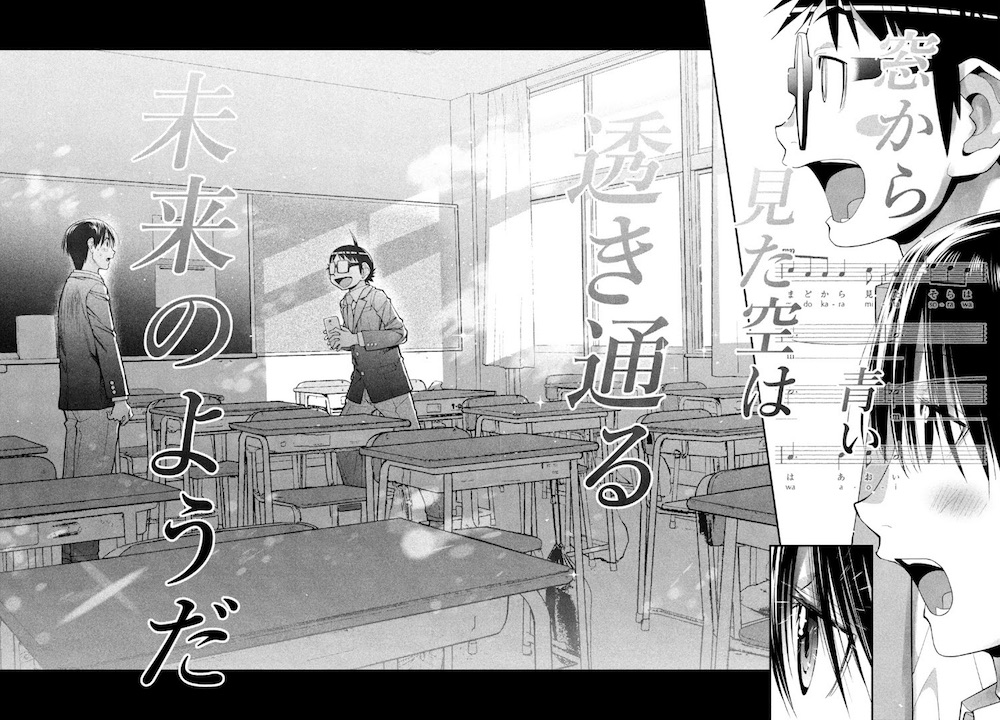
As Akira and Jin sing, they remember their first encounter in the classroom when Jin asks Akira to join his Chorus Club.

It’s time for the Chorus Appreciation Society to sing in their last song of the School Culture Festival, and Jin is nervous about being onstage in front of his mom. Fortunately, Kozue delivers a confident speech about their happiness spreading music through the school, which calms Jin down—though she then turns it into a taunting preemptive declaration of victory. 

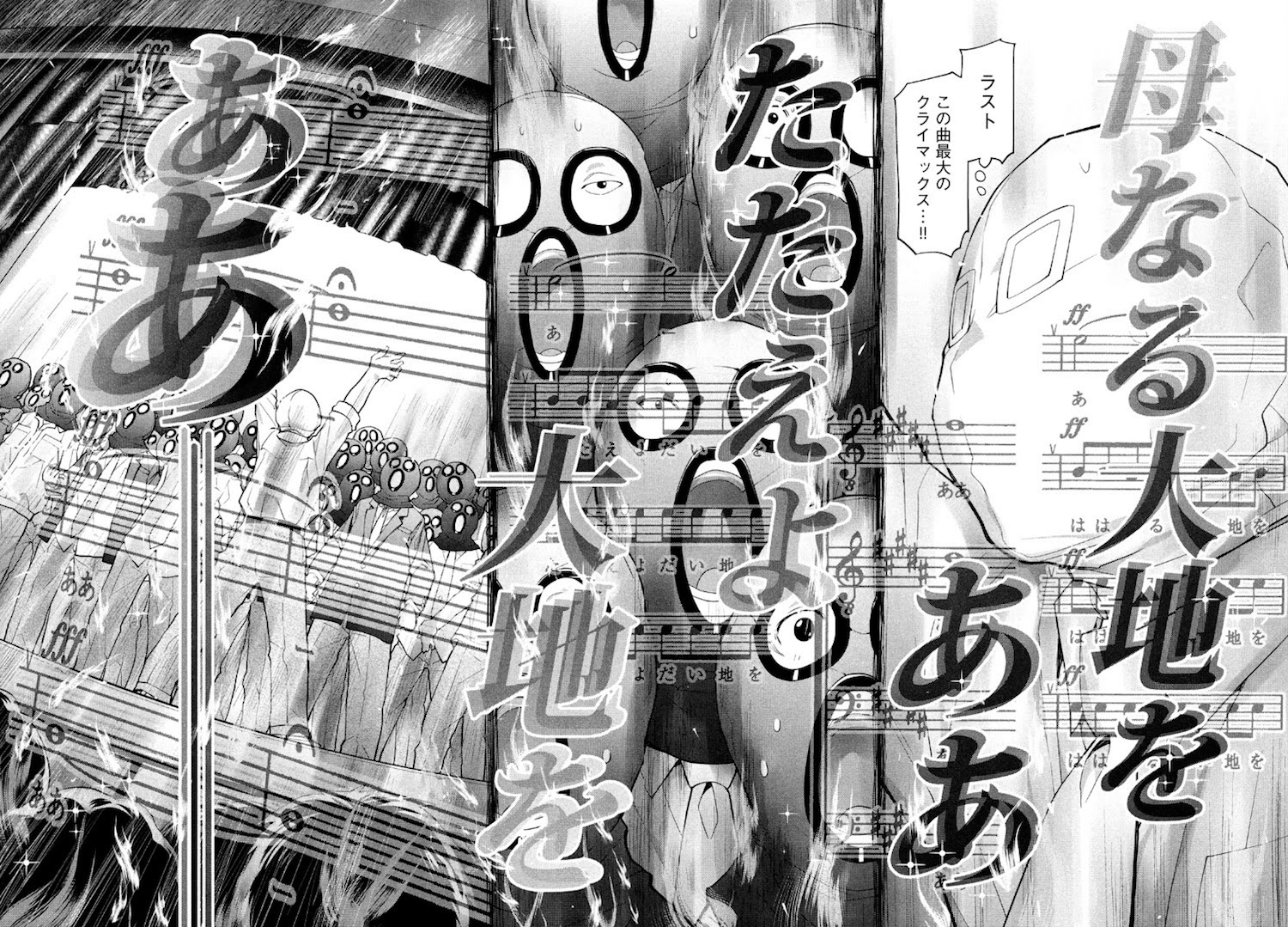
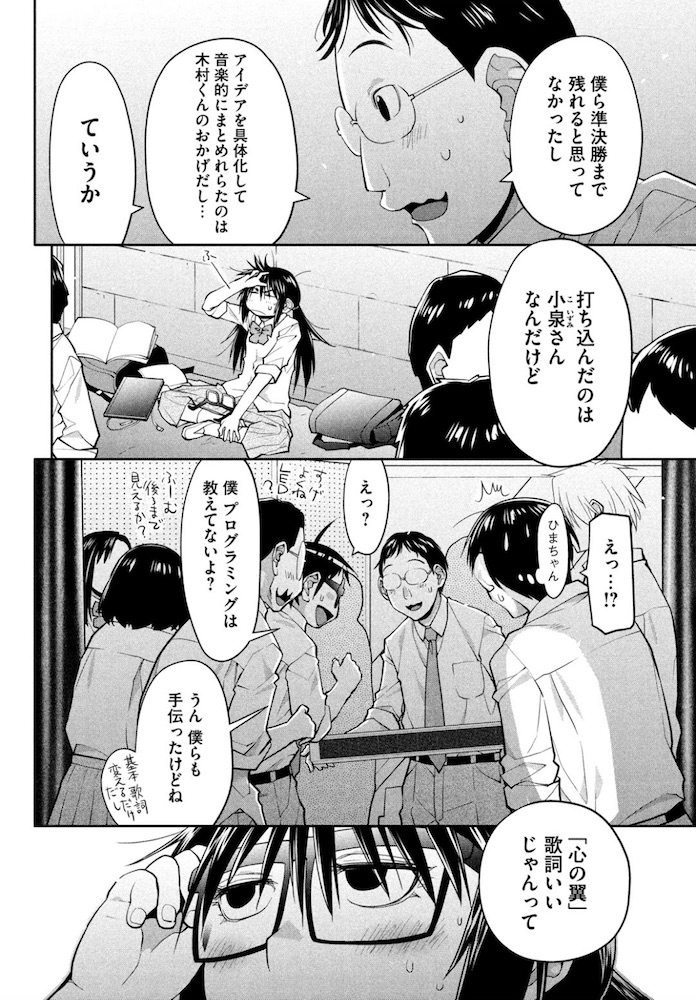
Their performance of “The Wings of Mind” begins, and the four guys harmonize perfectly, the beauty of the song causing emotions to well up in nearly everyone listening. The LED display Himari programmed displays the lyrics, and before everyone realizes it, the entire audience is doing the same as she is: singing along and being drawn into the performance. However, the chapter ends with Reika with an ambiguous expression that seems to read as her not being terribly impressed.

Song, Singular

This month, there’s only one song, and it’s the centerpiece of the entire chapter. The power of “The Wings of Mind” seems to be its ability to resonate on a very personal level with everyone listening to it. The song brings about a range of emotions: hope and disappointment, nostalgia and discovery, past and future. The two flashbacks indicate this strongly: Akira remembers meeting Jin in the classroom and being introduced to the world of music, while the senior members of the Rugby Club recall looking at the younger teammates as they themselves have to move on to the next phase of life. 

This potentially ties into a previous conversation Akira had with Jin about individual interpretations of a song’s meaning. It’s something Jin has trouble with, and to see “The Wings of Heart” hitting people in different places highlights the notion that we bring a part of ourselves into the songs we hear. “Art is how you interpret it,” or something like that.

Thanks to the LED display of the lyrics, the audience is singing along with the Chorus Appreciation Society.

Perhaps this is why the audience gets swept on in singing. As explained in the chapter, it’s not just that the lyrics are visible, but that it’s as if everyone is being compelled to follow along by the song. Everyone, that is, except Reika. 

1v1 Me, Son

The bit of nervousness (or self-consciousness) Jin feels before the performance is not just understandable—it speaks to the core of Jin’s internal conflict. His mom thinks he’s not trying to prove that talent doesn’t matter so much as he’s hiding his own lack of, and Jin is afraid that she’s right. In this respect, I think the whole “sing-along” plan he thought up might actually backfire, as I suspect Reika sees it all as a gimmick: more camouflage for Jin’s comparatively mediocre vocals. 

Reika and Jin’s contrasting priorities reminds me of arguments made about competitive games. Players of 1v1 games will point to the fact that in a 1v1 scenario, you own all your wins and losses, whereas team games soften the blow of failure by giving players the excuse of blaming their teammates. At the same time, there are impressive things achieved through the group cooperation of team games that 1v1 games can’t touch. All of it is true at the same time, making it so that neither side is inherently correct.

The Hasegawa Kozue Show

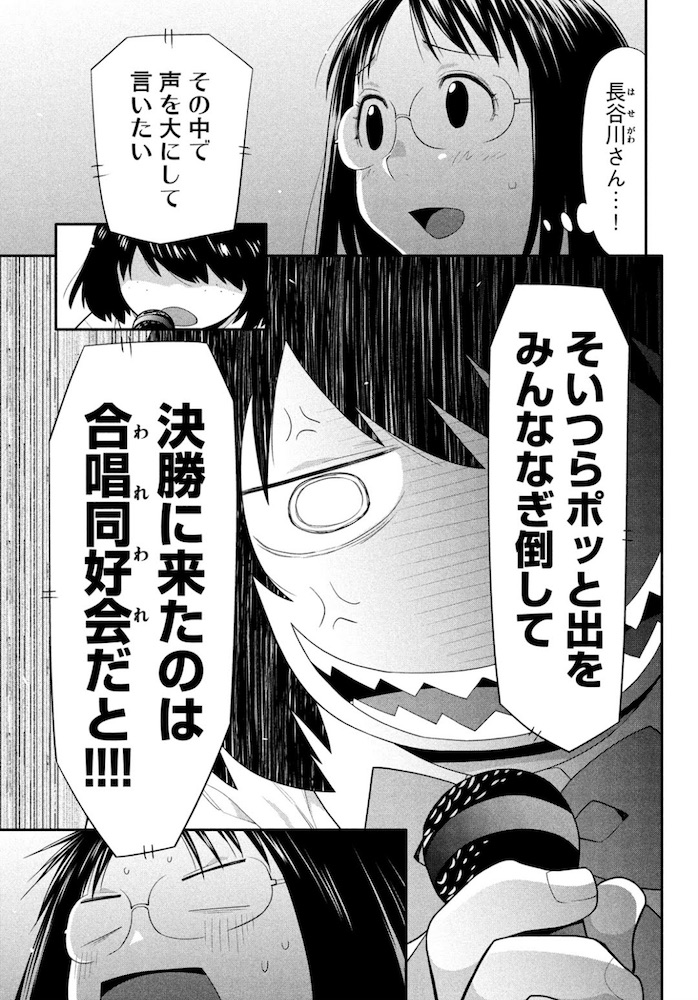
Kozue provokes the other groups by saying they knocked everyone else the hell out the tournament, and they're here to win.

This comes as a shock to Mimi-sensei, who thought Kozue was going somewhere kinder.

Kozue carries such power in this manga, being a kind of motivational force that can redirect the inertia of the other members, not unlike Saki from Genshiken. The confidence in her speech, the way she sets Jin back on course, she’s proving more and more how invaluable her friendship can be.

Even if he never said so outright, it’s clear at this point that Kozue is one of Kio’s favorite characters. One thing I like about her character and the emphasis given to her is that she’s nowhere near a traditional “bishoujo” by manga standards, and I like that it bucks expectations and stereotypes. Even her romance (of sorts) with poor Sora from the Rugby Club feels refreshing and new. 

She gets thanked by Kousei and blushes a bit, but I don’t yet see it as anything special. It feels more like Kozue is unaccustomed to such direct gratitude, especially from a guy like Kousei.

Final Thoughts

This sort of feels like the series could end soon, but I really hope it doesn’t. I want to see the club officially form, and for some new faces to give opportunities for more interesting storytelling and drama. 

Skate or Cry: SK8 the Infinity

SK8 the Infinity is an anime with great potential for mass appeal, but rather than catering to a “general audience,” it’s more a series that crosses over so many different niches that it merely appears generic from a distance. The series combines the thrilling world of skateboarding, the involved races of Initial D, the designer+pilot friendship dynamic of Gundam Build Fighters, the over-the-top characters of JoJo’s Bizarre Adventure, and the nudge-and-wink male “friendships” of Free! If you have a passing interest in just two or more of these elements, there’s a good chance you’ll get a kick (flip) out of the whole thing.

The story: Langa is a half-Japanese, half-Canadian teenager who has just moved to Japan with his mother. Reki is one of Langa’s new classmates, and he’s obsessed with skateboarding—a world that Reki is eager to introduce to Langa. While Langa doesn’t know the first thing about it, the way he approaches this unfamiliar sport reveals another side of him: Langa is actually an expert snowboarder who lost his spark after the death of his father who taught him. With Reki’s knowledge and passion, as well as Langa’s unique talents borne out of his history on Canada’s snowy slopes, the two are poised to take the world of underground skateboard racing by storm. Looming in the shadows, however, is the mysterious “Adam,” an antagonistic figure who is one part Dio Brando from JoJo, and one part flamboyant matador.

SK8 the Infinity fires on all cylinders, providing compelling characters and a beautiful story of friendship, but also a kind of ridiculousness that can only come from trying to portray the high-energy world of extreme sports in as loving and passionate a way as possible. The best episodes offer some of the best animation quality you’ll find in a sports series, and the relationship between Langa and Reki takes a lot of twists and turns that feel natural and personal. It’s the kind of anime capable of bringing a lot of disparate groups together, and it’s just plain fun.

Spotted Flower and Fusion Characters?

Spotted Flower is Kio Shimoku’s refracted-universe version of his hit manga Genshiken, but as the series goes on, more and more major differences crop up. Recently, I realized that one major change might be that a few characters are, in essence, fused together from different Genshiken characters.

Since her first appearances in Spotted Flower, there has been a certain character who looks and behaves much like Sue Hopkins from Genshiken. Outside of age—Spotted Flower characters are all far into adulthood as opposed to being roughly college age—the major difference between Sue and Not-Sue is that the latter has much wider hips and larger breasts. From the neck down, she’s much closer to Angela Burton, the other Genshiken American character.

I originally chalked up Not-Sue’s physical qualities to just being another way to slightly bend the details of Genshiken to make it “different enough,” but a recent side chapter of Spotted Flower, 35.5, makes me think that the merging of characters might be a recurring aspect of the series.

In it, Not-Sasahara racks his brain over trying to interpret Not-Sue’s signals, and the possibility of a threesome. As he’s trying to shake off the mental image of Ogino-sensei (aka Not-Ogiue) and Not-Sue together nude, he has an expression that is very uncharacteristic of Sasahara but makes him look just like Kuchiki, the annoying guy from Genshiken who has issues with boundaries. The resemblance to Kuchiki is further enhanced by the character’s hairstyle. This leads me to believe that Not-Sasahara might actually be better described as a kind of “Kuchihara,” though mostly dominated by the Sasahara side in terms of personality.

Endou, the “original character” who’s actually closer to Yoshitake than anyone else is probably not a fusion, but she feels like she belongs in a similar territory. In her case, it’s almost like she’s a mix of Yoshitake and a Genshiken character who never made it off the drawing board.

Not every character in Spotted Flower is a mash-up, as plenty map onto their Genshiken characters pretty comfortably. However, I’m keeping my eye out for any potential combos from now on.

Show by Rock!! Stars!!

The original Show by Rock!! anime was a surprise hit for me. “Cute animal-eared girls in bands by Sanrio” sounds fun but not especially amazing, but the execution turned out to be magnificent. Between the fluid animation and excellent comedic timing, I still think fondly of the series and its immediate sequel, Show by Rock!!#. The third season, however, didn’t quite hit the mark with me. The relatively low-key Show by Rock!! Mashumairesh!! took place in the same general setting, but it just didn’t have the charm or humor that made the first two anime such winners. 

I’m not sure if the aim of the fourth season, Show by Rock!! Stars!!, was to bring back some of that old magic, but it pulls the “crossover” card and decides to combine the old and new casts together. Now, the band Mashumairesh (whose name still confuses me) has joined up with the original heroines, Plasmagica, to participate in an all-star band competition. The crossover isn’t limited to the characters either, as the staff includes talents from all the previous series. 

The result is that Show by Rock!! Stars!! brings back much of that old magic. From the very beginning, it feels closer to the earlier seasons. Mashumairesh, new to the big city that Plasmagica calls home, accidentally ends up doing some serious property damage that gets them landed in jail and facing a criminal trial. “These are the absurd antics missing from the Mashumairesh!! season,” I thought while watching it. By the finale, I think it’s largely satisfying and captures  most of the spirit of Show by Rock!! at its best, though it doesn’t go quite as far as I hoped.

Ultimately, I think the problem is that Stars!! focuses much more on Mashumairesh. While the fourth season brings snappier writing and performances to the story that helps elevate the Mashumairesh girls, they and their surrounding cast just don’t strike the same strong balance between friendly personalities and character flaws that help define Plasmagica and friends. Though Howan is by no means a poor character, Cyan makes for a more appealing protagonist. Plasmagica’s ChuChu has a personality of tempered ruthless ambition that’s just absent among the Mashumairesh members. Moa the alien sheep is the best, as always. And how do you beat the overwrought melodrama of a band named SHINGANCRIMONZ, whose band leader is adored as a man among men by the other members because he holds steady employment as an accountant? None of the all-guy bands originally featured in the Mashumairesh!! season even come close.

That’s not to say Show by Rock!! Stars!! is a failure. For the most part, the series is highly amusing and does a good job of bringing out the best qualities in its many characters. It elevates a B+ cast into A-rank players, but I still wish I could have seen more of the S-rank superstars.

Witch Hat Atelier: The Fantasy of Science, the Science of Fantasy

Witch Hat Atelier is a manga with gorgeous art, compelling plot and characters, and an endlessly fascinating world. What I’m especially impressed by, however, is the way it manages to achieve a near-perfect balance of complexity and simplicity in its storytelling. It goes beyond the boundaries of manga and deep into the general world of fantasy fiction.

A Robust Yet Accessible Tale

I love the variety brought by manga in general, but it can often be difficult to recommend titles to a wider audience because of a focus on an incredibly niche subject, an issue of how approachable problematic tropes might be, or just the sense that you have to be “into” manga to read certain titles. More emotional stories might get criticized for lacking a robustness of environment, while those with careful attention paid to world building might be seen as too heady for their own good. Where Witch Hat Atelier differs from so many titles is that it manages to be both emotional and intellectual, and makes it difficult to distinguish where one begins and the other ends.

The Story

Witch Hat Atelier takes place in a world where magic exists but is almost entirely out of reach for most people, instead being the sole domain of those inherently gifted with it. Coco, the young daughter of a dressmaker, wishes she could become a witch, but when she tries to mimic a Wizard named Qifrey by drawing runes, she accidentally turns her mother to stone. Qifrey takes Coco under his tutelage so that she can learn how to undo the curse on her mother (a forbidden spell), and it’s from Qifrey that she learns the truth: Magic is usable by anyone, but the devastation it has caused in ages past has resulted in its gatekeeping by the Wizards, who seek to keep history from repeating itself. All it takes is the right ink and the ability to draw magic circles, but with that knowledge comes great responsibility.

The Political Nature of Witch Hat Atelier

Right from the premise, you have many different elements coming together into a tale that stimulates on multiple levels. Coco is a young heroine whose goals tap into a love of the mysterious but also a sense of guilt, and the supporting characters all have their own hopes and dreams that are as myriad as their unique personalities. The true nature of magic is that it’s built on a logical system, but having it executed through drawing brings a wondrously creative and artistic side as well. Most fascinating of all, the fact that magic is essentially a form of structured knowledge evokes both the political and the philosophical—namely whether closely guarding the truth of magic is ultimately for good or for ill.

Overall

What Witch Hat Atelier manages to achieve is a story with depth and breadth. There’s an endless path of discovery beyond the characters due to magic’s history within the world, but Coco, Qifrey, and every other soul within the story are like universes unto themselves. Their stories are straightforward yet intricate, and each chapter is more rewarding than the last. It’s no wonder that this manga is so beloved. Between this and Shirahama’s other title, Eniale & Dewiela, I hope we can see more of her manga work in English.

Kakushigoto: Refined Absurdity

The style of manga artist Kumeta Kouji is unmistakable. His brand of comedy focuses heavily on humorous misunderstandings combined with rantings by off-kilter characters eager to point out the absurdities of the world while blissfully unaware of their own eccentricities. Previous anime adaptations of his work have totally embraced and even enhanced this manic energy (Sayonara, Zetsubou-Sensei, Joshiraku), but the anime version of Kumeta’s Kakushigoto takes a relatively more mellow approach. It makes sense, given that Kakushigoto is a more subdued and down-to-Earth story by the artist’s standards. The key difference between Kakushigoto and his past works is an emphasis on the tenderness of a father’s love for his daughter.

Kakushigoto is the story of Gotou Kakushi, a manga artist and single dad who will go to any length necessary to hide his profession from his young daughter, Hime. Specializing in ribald humor, Kakushi’s greatest fear is that he will permanently embarrass her, make her a laughingstock among her peers, and ruin her life. Luckily for Kakushi, Hime is extremely naive, though that doesn’t stop them (and everyone they know) from getting caught up in humorous misunderstandings. As fitting the manga author, the title of the series is a pun on the fact that it can mean “something you hide” (kakushi goto) and “a job where you draw” (kakushi goto). 

Many of the jokes revolve around Kakushi’s job, and like Monthly Girls’ Nozaki-kun, there’s a lot of inside baseball about things like deadlines, color pages, industry trends, useless editors, and decency standards. These are often the source of many of the aforementioned Kumeta-style rants (and Kakushi himself shares Zetsubou-sensei’s voice actor), but because the general subject of these ravings are smaller in scope than the societal condemnations of Sayonara, Zetsubou-Sensei, it actually gives Kakushigoto a noticeably more intimate feel. Because of this, as well as the focus on Kakushi and Hime’s relationship (and some extra familial drama with his in-laws), I find this anime to be more accessible and enjoyable to a wider range of potential fans who might get exhausted by Kumeta’s other works.

If Sayonara, Zetsubou-Sensei is a spicy ketchup, Kakushigoto is a high-quality tomato sauce. 

What I mean is that Kakushigoto has a certain kind of maturity, and a willingness to try to find a middle ground between the unadulterated creative style of Kumeta and something that can speak to others beyond those already familiar with his work. It’s a tricky balance to strike, reminiscent of Shinkai Makoto’s your name. and its greater mainstream appeal compared to his older films. Importantly, Kakushigoto does not abandon Kumeta’s signature style, but rather refines it into a more well-rounded experience. 

Violence Miu: 22/7 Anime Review

Warning: Full Spoilers

When I first started watching the 22/7 anime TV series, what stood out to me was how generally serious it was—not only compared to other idol anime, but also what I knew of it from one of its official Youtube channels. Instead of the off-kilter hijinks of a bunch of virtual youtubers, the anime follows a formula of introducing the backstories for each character in order to show how they became who they were. While all of them have some element of drama or tragedy, with the recurring theme being that they weren’t all born with the personality and attitude they have now (especially when onstage), all of them are well within the boundaries of what one would expect out of idols, especially fictional ones.

By the finale, however, the one big exception to those confines is the main heroine, Takigawa Miu. I don’t know if I’d call her my favorite character of the series, but she ends up being the most memorable part of the 22/7 anime.

The first couple of episodes revolve heavily around Miu, who’s shy and unconfident to the point that it loses her a much-needed part-time job, and who has some sort of trauma when it comes to playing piano. At first, she’s extremely reluctant to join 22/7 and become an idol, but over the course of the series, she opens up and becomes more comfortable with her fellow members. We learn about the other girls as well, and then we reach episode 11, which focuses on the childhood of Nicole, the one among them who gave Miu the hardest time early on. What we see in that flashback is that the two knew each other in elementary school, and that a single event would tie the two together.

Unlike her current self, Nicole was very shy and quiet, often being bullied by other students. When it came time to put on a school play, Nicole’s name was volunteered by her tormentors to play the evil queen, and they play a prank on her in an attempt to embarrass her during the performance. Miu, who’s also in the play, runs onstage and tackles one of Nicole’s bullies. 

At this point, I think most idol anime, which tend to be kinder and gentler, would make that tackle one of the big moments. It would cut away and all the characters would gasp. 22/7 takes it a step further, and shows Miu actually wailing on the girl with closed hands—albeit, not as punches or anything, but more like the flailing hammer blows you’d expect from a little kid. Not only does this differentiate 22/7 from so many of its peers, but highlights a certain depth of character to Miu. She’s not just the girl who lost confidence and found it—she’s someone who has a strong sense of fairness, and is willing to throw hands to make her feelings known about that.

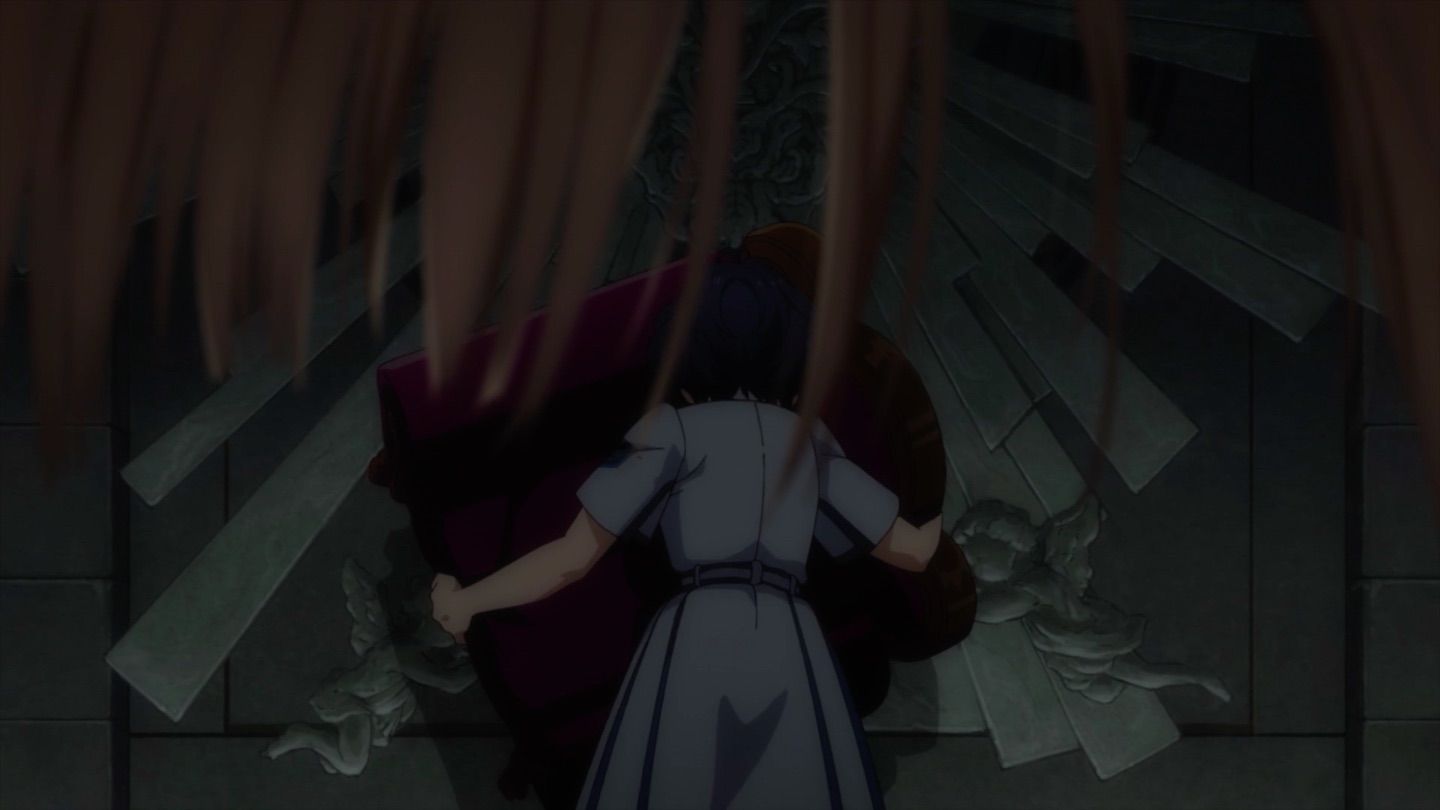
That was the past, and it doesn’t entirely gel with the image we have of her in the present. However, as the series nears its climax, the mysterious “wall” that was giving them instructions all along reveals that it is actually an AI that had been manipulating the girls for its own purposes and no longer needs them. As the 22/7 girls strongly plead to let them join back together instead of disbanding, the AI refuses to budge. When hope is all but lost, Miu steps up to make her intentions known…by hitting the wall with an armchair.

What really impresses upon me in this scene and the one Snow White performance in the flashback is that Miu’s actions aren’t portrayed as “wacky” or “cool.” They’re expressions of frustration and indignation over perceived malicious acts, and they come from someone who lashes out despite her lack of confidence because of what she believes in. It’s a far cry from a pillow fight or some slapstick antics, and it’s what establishes the 22/7 anime as a little more than just some forgettable idol fair. 

Heel Behavior: Hashikko Ensemble, Chapter 39

Reika, Jin's Mom, telling the Basso Masters to sing from the heels

Jin’s mom continues to be a tour de force in Hashikko Ensemble, Chapter 39.

Summary

It’s now the finals of the Culture Festival’s music competition, and the Chorus Appreciation Society is up against the mysterious masked Basso Masters. However, not everything is as it seems. The leader of the Basso Masters isn’t anyone special or known—just a friendly third-year named Satou who was inspired by Jin to follow his interest in music. And even though Jin’s mom, Reika, gave Jin a deal to let him go to music college if they win, Jin himself doesn’t really care about that. In fact, he likes applying his match and science skills in electrical engineering, and simply wants to show Reika the merits of singing as a group.

The Basso Masters go first, but just as they begin their performance, Reika interrupts them to rearrange the singers’ positions to group them according to roles (Bass I, Bass II, Tenor I, Tenor II). She also provides some advice on how to sing from the entire body instead of just from the throat. The difference is so immediately noticeable and significant that even the members of the Chorus Appreciation Society can’t help but applaud by the end.

The Basso Masters singing intensely after taking Reika's advice

As Jin, Akira, and the others get ready for their turn, a student from electrical engineering brings to Jin an LED display meant to show the lyrics to their next song, “Kokoro no Tsubasa.” Here, we learn that Himari has been hard at work getting this done, going so far as to learn how to program. Akira, seeing how many people Jin has touched and changed with his passion for music (Akira himself included), encourages Jin to consider music college after all.

The Power of Reika

Once again, Reika steals the show, as she presents an interesting obstacle for Jin. I think the really challenging thing about her from Jin’s perspective is that her talent, as well as her ability to recognize talent, are undeniable. While Reika believes group singing is less important than solo performances, it’s not as if she dismisses it outright. In fact, it’s thanks to her immense understanding of chorus dynamics that the Basso Masters are able to put on an amazing performance. She also specifically tells Satou, the Basso Leader, that he’s actually pretty good at conducting, so it’s not as if she has an ego about it. Reika is simply incredibly unfiltered—another similarity she has with her son, even if they manifest differently. At one point, Reika puts on a spare pair of glasses, and the students at school instantly recognize her as Jin’s mom. The way the Kimura family carry themselves is unmistakable.

Reika’s advice for how to sing better explains a lot as well. Essentially, she says that the common folk breathe from the throat, the experienced breathe from the spine, and the true masters breathe from the heels. So, when you sing, your feelings should erupt forth like magma—through the butt, then the spine, then the throat, then the forehead, then the top of your head. Not only is it a vivid visual metaphor (especially for a song called “Hymn of the Earth”) but it explains why Reika believes that an exposed forehead makes for better singing.

Himari Working Behind the Scenes

I had been wondering about Himari’s lack of presence in recent chapters, and I’m glad that it wasn’t just her being outshone by other characters. The fact that she hasn’t been in the spotlight is also quite fitting for her personality, and in hindsight I think it was the smart move overall. She’s trying to help in her own way, and she doesn’t make a big fuss out of it because she doesn’t want the attention. This likely goes all the way back to Jin leaving Himari’s apartment (and the inevitable misinterpretation of events that occurred): she was probably helping Jin with this LED display. Moreover, Akira points out that Himari has always been fond of picture books and poetry and such, so the lyrics of “Kokoro no Tsubasa” must have resonated with her. 

Himari isn’t a writer, as far as we know, but could her appreciation of the written world lead to her eventually joining the Chorus Appreciation Society? Either direction would work, and would indicate where her character has headed.

Songs

Basso Masters: “Daichi Kinshou” (Hymn of the Earth) from the cantata “Tsuchi no Uta” (Song of the Land)

“Kokoro no Tsubasa” (“The Wings of Mind”) composed by Kitagawa Noboru

Final Thoughts

I’m worried that something disastrous is going to happen to Akira and Jin! Something tells me the conflict with Reika isn’t over by a mile.

Graveyard Smash: Kemono Jihen

Kemono Jihen is an anime that succeeds in just about everything it aims to do. As a shounen action series with a bit more of an otaku bent than the big traditional Jump titles, it manages to straddle the line between “energetic young kids fighting” and “entertaining character-interaction comedy/drama.” 

When a private investigator named Inugami comes to a rural inn to investigate some mysterious animal mutilations, he discovers a boy named Kabane who seems to be hated by his adopted family. Inugami soon discovers that Kabane is actually a half-human kemono (monster) capable of immense strength and with an indestructible body. After faking Kabane’s death, Inugami takes him to Tokyo, where he becomes one of a trio of young teens who work for Inugami’s detective agency. Together, they help to solve supernatural crimes, which sometimes involves having to get their hands a little dirty.

Kabane is in many ways a typical shounen hero: unusually strong and enormously naive. However, he’s not quite a Goku or a Luffy. While I might be dating myself a bit, if you’ve ever watched the old “Coneheads” Saturday Night Live skits (or even the 1990s film), Kabane has a similar kind of tendency to talk as if he’s not entirely sure how words and emotions work, while being both blunt and kind at heart at the same time. The other characters—like the brash yet slightly tsundere spider boy Shiki and the effeminate and social media–obsessed snow boy Akira—provide Kabane with personalities to bounce off of, as well as allies to bond with. A later side character, a kitsune girl named Kon, is my favorite character in terms of her interactions with Kabane, as they’re equally charmingly dim. Kabane and Kon give me a vibe very akin to Denji and Power in Chainsaw Man

As for the series being more otaku than the norm, I think this comes across mainly in the character designs. They’re not egregiously pandering by any means, but they possess a general cute yet cool aesthetic that seems to be leaving the door open for all manner of fanart and fan interpretations to happen. Which is to say, I wouldn’t be surprised if the fan base was mostly a combination of those who love fights and those who love young and charismatic characters.

Action-wise, Kemono Jihen stands quite well on its own, and the superpowered fights that do occur are refreshingly straightforward and easy to follow without too many special attacks gumming up the clarity of a battle. The contrast of those cute characters fighting somewhat brutally might not appeal to everyone, but it’s never excessively grotesque.

Will Kemono Jihen stay a relatively down-to-Earth story about investigating mysteries, or will it lean towards escalating power levels and big fights? I actually don’t mind either direction because the characters are so endearing. In a way, that’s some of the best praise I can give.