Beastars and the Fight Against Behavioral Absolutism

Exploring the tension of anthropomorphic animal society from the perspective of high school students, Itagaki Paru’s Beastars can at times feel like it’s encouraging a very dangerous view of the world. In a world where carnivores and herbivores co-exist peacefully and eating your fellow animal is illegal, the constant pressure faced by the timid wolf protagonist, Legoshi, for not embracing his violent, meat-eating ancestral nature seems to bleed into sexist alpha/beta nonsense territory. Yet, by the end of a first anime season filled with tumultuous and shocking developments, the message I took away was something far different and more nuanced than a simple animalistic nature vs. civilization dichotomy.

Warning: Beastars spoilers ahead

Legoshi is portrayed as shunning the spotlight. Although he’s in the drama club, Legoshi works as a meek behind-the-scenes stagehand, leaving the attention to others such as the club’s star actor, Louis the red deer. But what Louis notices is that Legoshi is clearly stronger and potentially more intimidating than he lets on. As a gray wolf, he possesses might that no herbivore can hope to match, and it incenses Louis that Legoshi can be such a pushover. When Louis gets hurt and a shuffling of roles causes Legoshi to appear in a play, a tiger clubmate named Bill tries to bring out Legoshi’s dormant ferocity.

However, Legoshi is afraid of his own carnivorous side. Not only was his good friend, Tem the alpaca, eaten by a carnivore, but Legoshi himself comes dangerously close to succumbing to his lupine instincts and devouring a female dwarf bunny named Haru—a girl he later develops strong feelings for. Legoshi does not want to be that kind of animal, which is why he looks up to Louis, who accomplishes things through grace and diplomacy. Even so, there’s no denying that Legoshi would be incredibly powerful if only he let himself be. 

Part of what holds Legoshi back is a society that discourages carnivores from exerting dominance through force. Meals for them are made with high protein content, e.g. eggs, as a way to sate hunger, but the appeal of real flesh can be overwhelmingly difficult to endure. Throughout the series, Legoshi struggles to fight that desire for meat, which then blends in odd ways with his love/lust for Haru, further complicating things in his heart.

Towards the end of the series, Haru gets kidnapped by an organized crime group—a cadre of lions called the Shishigumi—with the intent to eat her. Having discovered previously that Louis is seeing Haru (though what Legoshi doesn’t know is that Haru is extremely promiscuous as a way for her to have some control over her life), Legoshi tries to bring Louis along. However, Louis declines, having already learned about the kidnapping and being told that he must stay quiet if he is to accomplish his goal of rising to the top of society and being able to effect widespread change. Legoshi storms the Shishigumi base without the red deer, and by fully tapping into his violent side, is able to rescue Haru. 

At first, the lesson seems to be that Legoshi finally set aside his false persona of timidity for what was truly inside, but what happens afterwards communicates what I found to be the most important takeaway from Beastars: when it comes to instinct vs. reason, there is no universal answer.

Having saved Haru, Legoshi and her end up at a love hotel prepared to take their relationship to a physical level. Legoshi confesses that he was the one who tried to eat her, and Haru says she always suspected it was him but was still drawn towards Legoshi. However, just as they are on the verge of consummating their relationship, Legoshi’s mouth moves uncontrollably as if he’s going to eat her, and Haru’s body moves, as if on its own, to be eaten by him. Built into their genetics is a relationship of predator and prey, and sex between them isn’t “supposed” to happen. Even so, they’re genuinely in love with each other and they want to make it work, which means denying what their DNA is screaming at them to do. If Legoshi wants his heart’s desire, reason must prevail over instinct.

The underlying message I take away from Beastars is that the question of whether to follow or rebel against one’s animalistic nature is not an all-or-nothing proposition. There are times when it can be of great benefit, but other times when it can be a mistake or lead to disastrous outcomes. Moreover, whether or not doing so is a right choice will vary from individual to individual. Legoshi is not Louis. Legoshi is not Haru. They can naturally accomplish things he cannot and vice versa, but they’re also all capable of going out of their inherent comfort zones to do even more. It is the moderation of both reason and instinct relative to each other that allows us to flourish.

Learning About the Butterflies and the Bees: Saotome-senshu, Hikatakusu

The first thing one notices when looking at the cover of a volume of Saotome-senshu, Hitakakusu (Saotome Covers Up) is the main heroine and her abs. Who is this muscular girl? How did she get that impressive six-pack? What’s her deal? The answer: she’s the heroine of a beautiful manga that’s a little romance, a little sports, and a whole lot of stupid in the best possible way. More than that, its central boyfriend-girlfriend relationship is portrayed so wonderfully and positively that I would present it as a shining example of a love that feels healthy and genuine.

Saotome Yae is her high school boxing club’s ace, blessed with strength, agility, and a preternaturally good knack for fighting. But the first chapter opens up with a low point, as the boy she likes, Tsukishima Satoru, rejects her confession. The reason: he’s also in the boxing club, and he doesn’t want to jeopardize her next crucial match. However, the romantic feelings are clearly mutual, and by the end of the chapter, Tsukishima has become Saotome’s coach—a setup that not only hides their going out against school rules, but also allows Tsukishima’s endless passion for boxing to benefit Saotome as well.

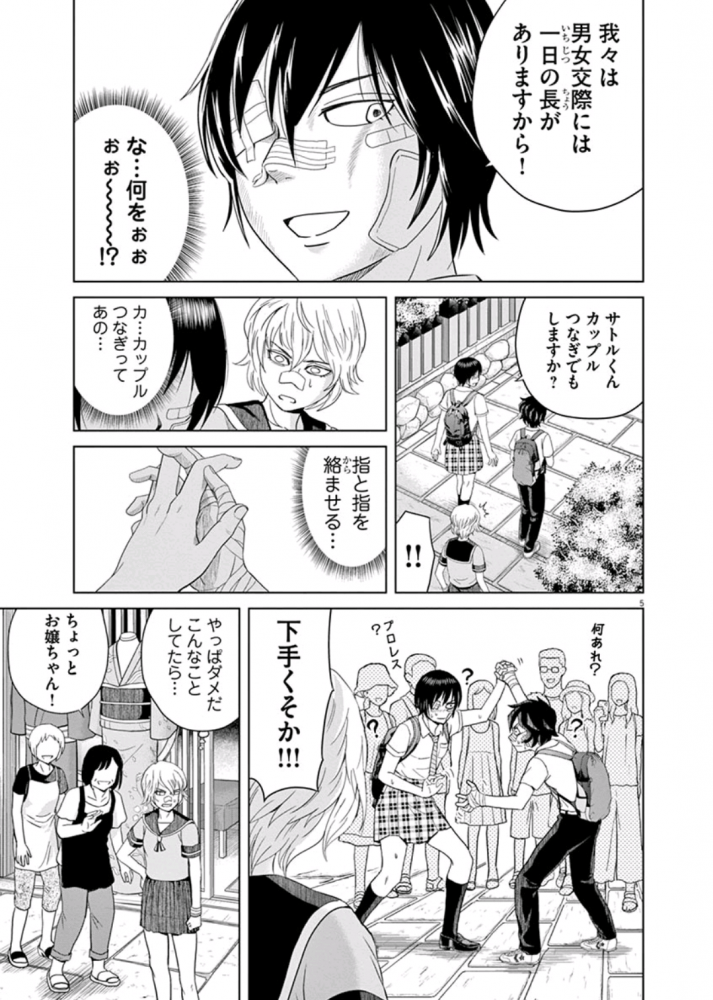
Saotome and Tsukishima are the definition of adorkable. They will try to hold hands, but their unfamiliarity with doing boyfriend-girlfriend things makes it look closer to a test of strength. At another point, Tsukishima declares that they’ll succeed through the power of love, only to realize that he’s talking to Saotome’s little brother, who proceeds to forever call him “Power-of-Love Man.” This is one of those series where everyone is kind of an idiot on some level, and it results in a wonderfully silly and sweet series that isn’t afraid to go for a heartfelt scene one moment and immediately transition to a gut-busting gag the next. The humor is somehow both subdued and absurd, and I can’t really think of many similar works. It somewhat approaches the stylings of Shibata Yokusaru’s 81 Diver, but isn’t quite as extreme and over-the-top.

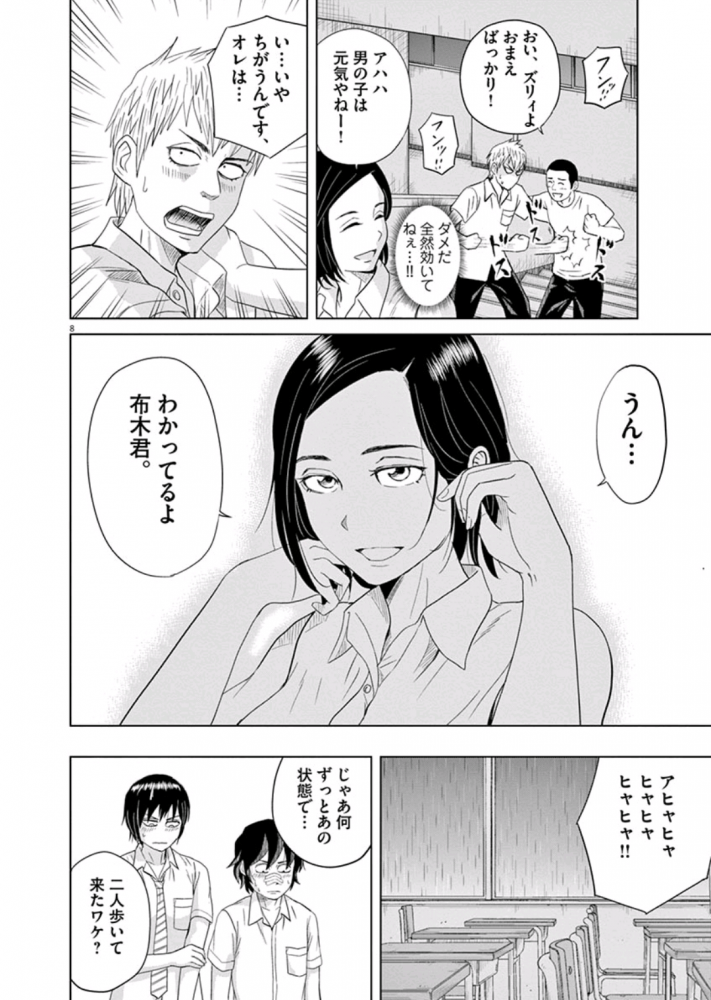
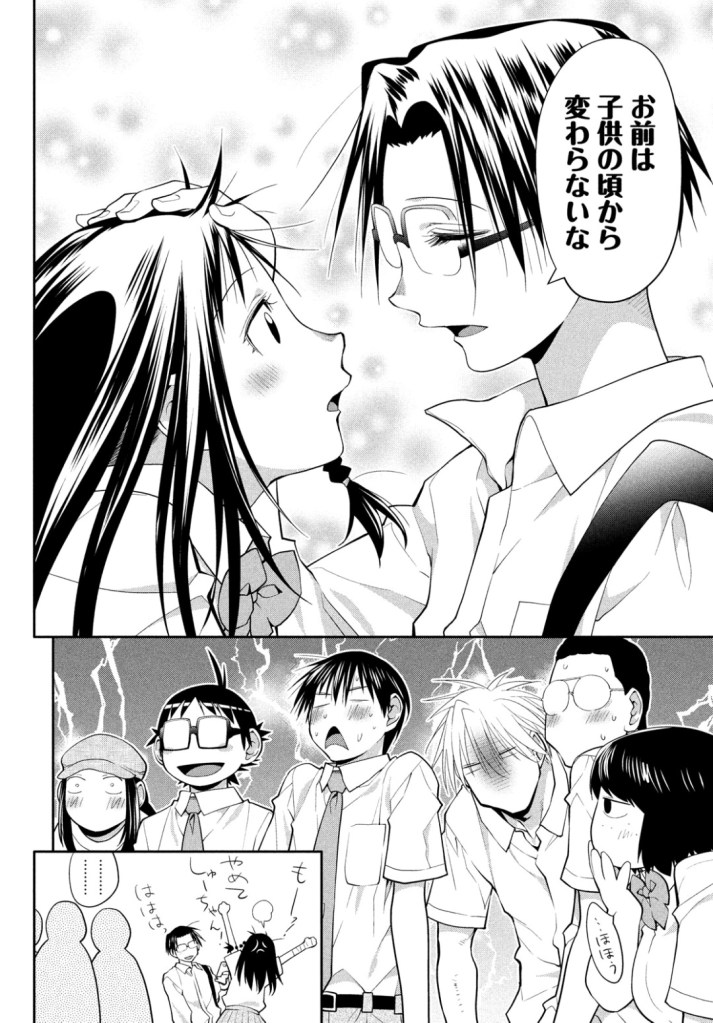
Virtually every character, from the main couple to the wide array of side characters, are hilarious and memorable—even Saotome’s random clubmates. Above is a scene where one of their clubmates tries to get some alone time with Wakano, a college-aged boxer and childhood friend of Tsukishima’s, by incapacitating his own friend with a punch to the stomach. …Except, they’re all boxers and can take a hit, so his friend just stands there laughing merrily. This whole thing ends with Wakano showing how to really deliver a body blow, leaving the clubmate doubled over but also a little happy.

Of the supporting cast, my favorites are Satsukawa Mizuki, a rival of Saotome’s who transitioned from karate to boxing with the most terrible sense of direction, and Konno Mito, the boxing manager who basically teases anyone and everyone. In those rare instances where the two are together, it’s even better.

But what I think really anchors this series and will make it endure is the depiction of Saotome and Tsukishima’s excellent relationship. On the surface, the two look like a somewhat mismatched couple that seems to thrive on reversing gender roles. Saotome is big and tough, and knows how to achieve victory after victory. Tsukishima is small and weaker, and has yet to win a single match in his boxing career. However, you can see that the two think the world of each other, and both inspire each other to greater heights. Saotome does not see Tsukishima as a “loser” who’s capable of less, but rather as a guy full of love for boxing, and who is making progress on his own terms through his own power. Tsukishima, for his part, is 100% supportive—not jealous—of Saotome’s greater success. He’s a challenge to toxic masculinity and the fear of emasculation: he’s shorter and less skilled in his own chosen sport than his own girlfriend, but absolutely no one thinks less of him, especially himself.

One unfortunate thing about Saotome-senshu, Hitakakusu is its timing. Saotome’s boxing path is about aiming for the  2020 Tokyo Olympics, and the series even ends with a flashforward to them. Before, it would have been possible to imagine the characters actually being there for the real deal, but COVID-19 has turned the 2020 Olympics into the 2021 Olympics, forever dating the series as a pre-coronavirus title. However, while that dates the manga, this doesn’t really detract from its overall excellence, and I hope as many people as possible end up reading it.

Boy, Become Mythology: Hashikko Ensemble, Chapter 28

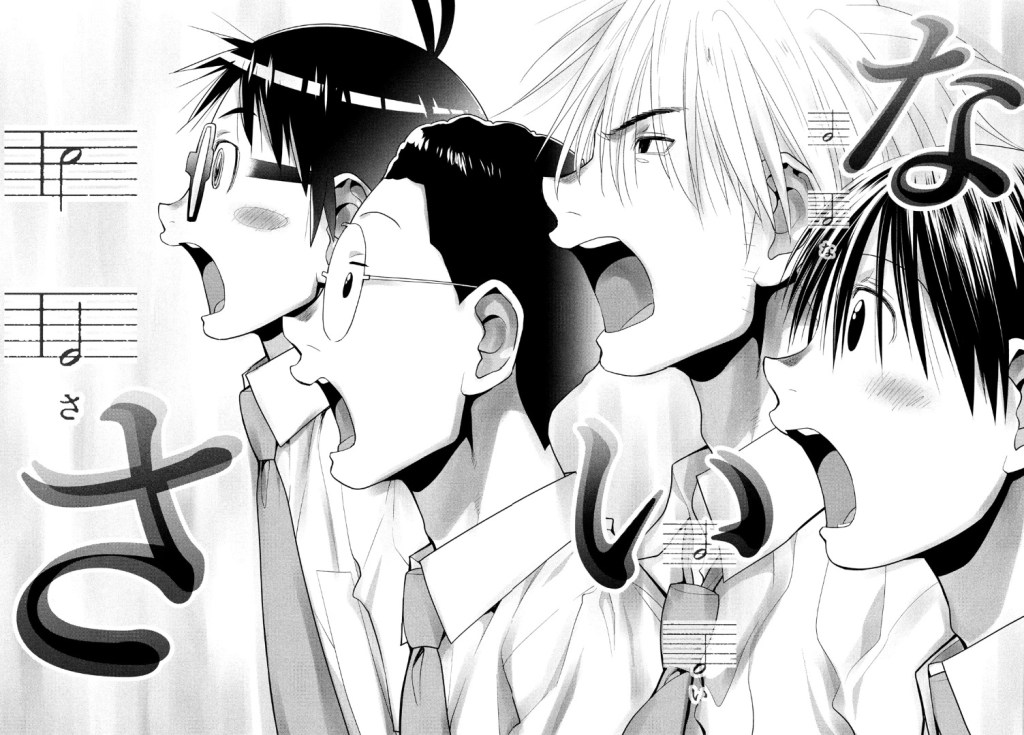
It’s Shinji’s turn to live his passion in Chapter 28 of Hashikko Ensemble.

Summary

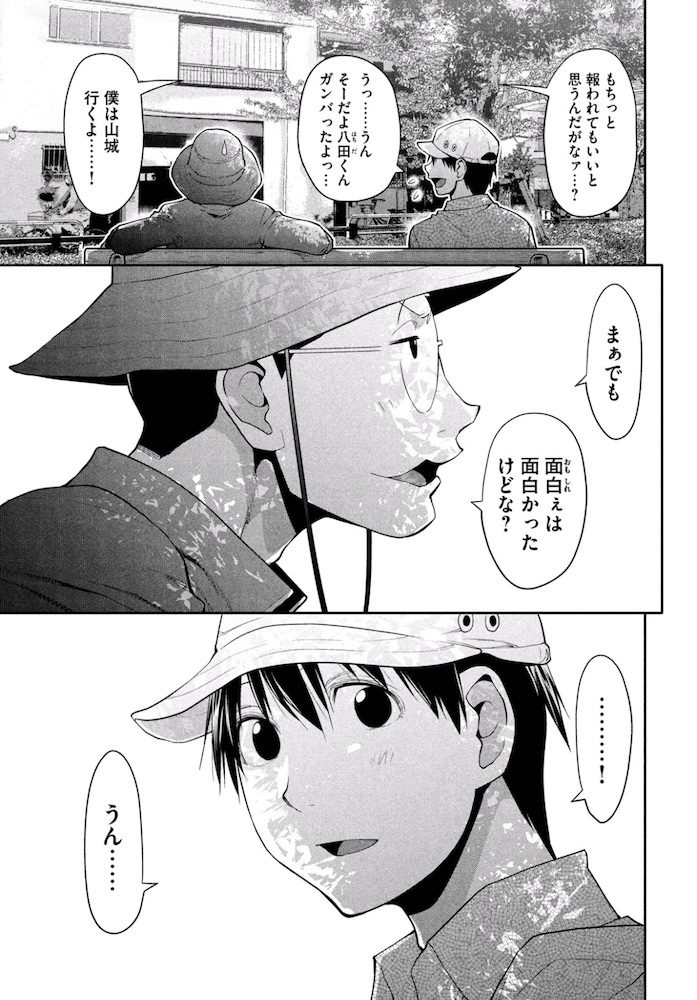
Now that M-Con is over and the rest of summer break is left, Shinji decides to do what he’s been wanting to this whole time: visit a castle! After all, his original plan in high school was to make a Mountain Castle Club, before he got roped into singing. He wanted to bring the other members along, but only Akira and Hasegawa ended up joining him. Also, it’s technically a valley castle and not a mountain one, but that’s better for amateurs like the latter two anyway, according to Shinji.

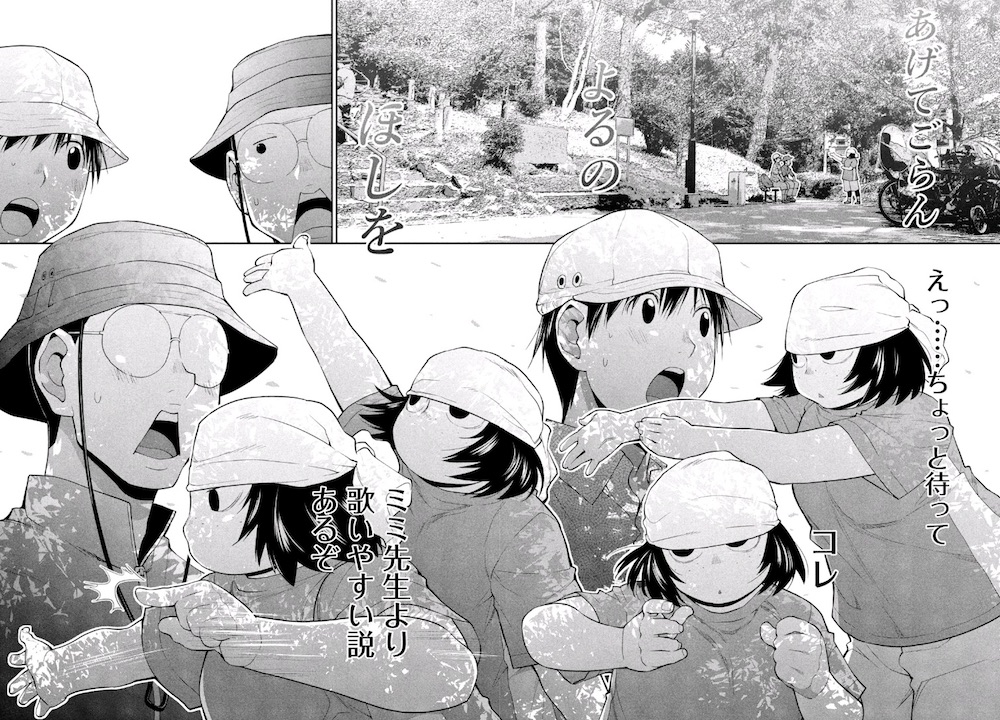
As the three take a break, Akira expresses his desire to sing more, while Shinji admits that even he got into it more than expected. Hasegawa surprises the both of them when she suddenly starts conducting, and the two guys start singing. She reveals that she’s been practicing in secret while watching Mimi-sensei, and the two immediately realize that she’s actually better at it than their club adviser.

The singing draws the attention of an old man walking around, who explains that he’s a member of the Suns—the chorus they had visited when they were trying to figure out Orihara’s “hearing issues.” The old man, whose name is Yoshinaga, is himself a castle enthusiast, which thrills Shinji. During their conversation, he mentions having a vacation home in a nice outdoor area they could use for a training camp. After some calls, most of the club is into the idea, including Jin, who responds to Akira last. However, just as Akira is leaving his place, he sees Jin exiting Himari’s apartment while greeting Akira with a smile!

Oh Castle, My Castle

I had been wondering if Shinji’s love of castles would forever remain on the back burner in Hashikko Ensemble, so I’m happy that he finally gets to enjoy his true passion. Unfortunately, we don’t actually get to see the castle they visited, which is a reminder that this is indeed a manga primarily about music. I hope he eventually gets a true mountain castle.

I wonder if we’ll end up seeing more of Yoshinaga, if only because this would give a real mentor to Shinji—someone who can foster his love of castles and his burgeoning interest in singing. It could be something unique to Shinji among all the characters, and it might be the key to leveling him up really quickly for the next time the Chorus Appreciation Society performs.

Jin x Himari…?

In all likelihood, Jin stepping out of Himari’s family apartment (along with Himari’s angry grunt at being discovered) is going to just be some innocent misunderstanding on Akira’s part. Still, if i were to entertain the notion that something happened between the two during summer vacation, I have to admit that I think they’d be a cute couple. There’s something about the contrast between Jin’s overwhelming cheer and Himari’s curmudgeonly attitude that would appeal to me if they were an item, and one can only imagine how awkward everything about their relationship would be.

But putting that aside, the real purpose of that last-second shock is to highlight that Akira has romance on the brain to a certain extent. He’s been thinking about Shion a whole lot, even feeling continued jealousy toward Shunsuke after finding out that Shion’s been visiting Shunsuke’s home to practice piano now that her hand has healed. Now that Hasegawa is aware of the truth, her teasing is getting stronger, though it’s interesting that Hasegawa isn’t being protective of Shion. Instead, she seems to be encouraging it.

The innocence of the romances in Hashikko Ensemble is such a contrast to Spotted Flower, I must say.

Conductor Hasegawa

I figured at least a few of the characters not directly involved in the music would eventually join the club in a more involved capacity, but certainly didn’t expect Hasegawa to start working towards a role as conductor. I have to wonder how the others might eventually reach this point, and if this is the real reason behind Jin being at Himari’s home.

Then there’s Kurotaki Mai, the girl with the deep voice. I still think she’ll come in for a more prominent role eventually.

Songs

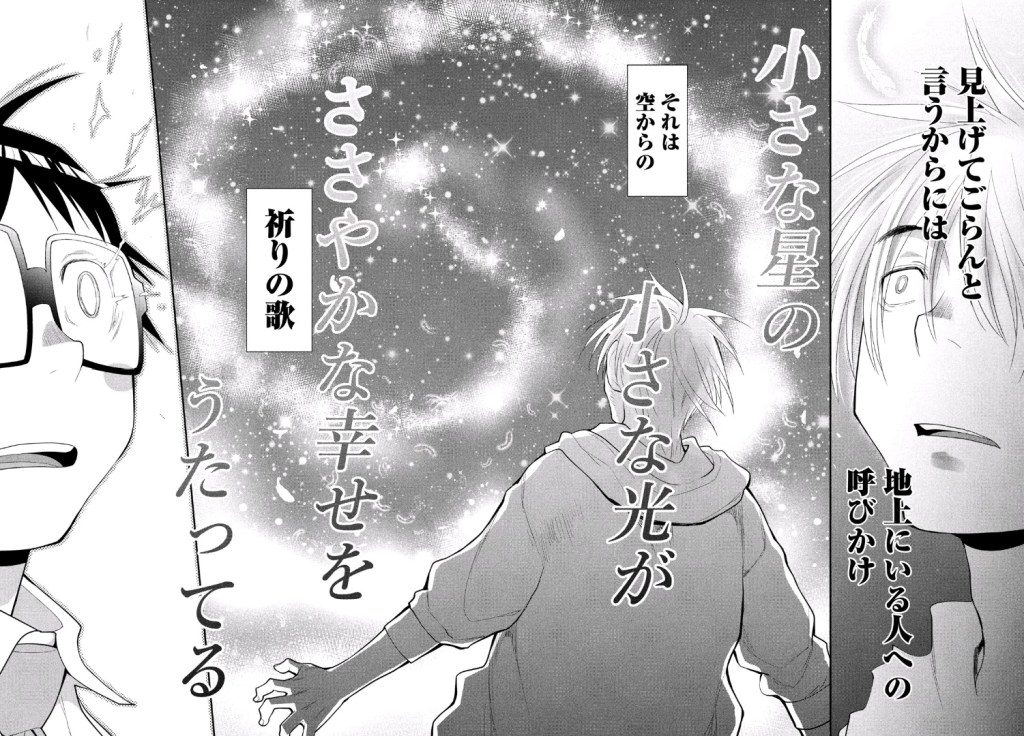
As Hasegawa conducts, Akira and Shinji sing “Miagete Goran Yoru no Hoshi o” by Kyu Sakamoto—the same featured song as the last handful of chapters.

Final Thoughts

Given that M-Con is in the past now, I can only assume they’ll be practicing some new songs to add to their repertoire. I wonder where they’ll go next. I personally don’t have any must-see songs, but something far off from “Miagete Goran Yoru no Hoshi o” could be a nice change of pace.

The Moral Trolling of Prison School

What if I told you that there’s a manga that points out the vanity of its male heroes, and ends by emphasizing the degree to which their shallow treatment of women is their undoing? Now, what if I told you that this series is actually, of all things, Prison School—a series generally known more for its gratuitous T&A and absurd toilet humor? By the time Prison School reached its conclusion, that’s exactly what we got. 

Prison School is about a group of teenage guys who are the only male students at Hachimitsu Academy. When they get caught peeping, they discover that the school actually has a complex prison system underneath run by the “Shadow Student Council,” three powerful girls who are all extremely attractive and who all hate men with a passion. Over the course of 277 chapters, the manga gets increasingly ridiculous in just about every way possible, from fanservice to schemes to the fact that the series will set up exceedingly complex plots just for the sake of delivering a stupid pun.

If you look at the fan reaction to the end of Prison School, a great deal of comments express utter disappointment. There were shipping wars over who the hero Kiyoshi would end up with. There’s frustration that the story went far off the rails from where it started. Somehow, people read this series as if it was some kind of romantic comedy, as opposed to an exercise in the absurd. What’s more, I truly believe this this bitter response towards Prison School by its former fans is actually what the author, Hiramoto Akira, was actually going for. Prison School was a long, elaborate troll to point out the inanity of anyone who cheered for the heroes.

The Case of Kiyoshi

Kiyoshi is the hero of Prison School, and throughout the series he’s motivated by a few key factors. Early on, he develops a crush on one of his classmates, Kurihara Chiyo. She’s the first girl to really talk to him in class, and one of the reasons he strives to escape the school’s prison is so they can go on a date together. However, while he’s unusually smart in certain respects, he’s also an incredible dumbass who’s 1) ruled by his hormones and 2) often jumps to the wrong conclusion about things.

Kiyoshi does good deeds, but he’s not necessarily a good person, and his antics lead him to having oddly close love-hate relationships with two of the Shadow Student Council members. Early on, he accidentally sees Midorikawa Hana (the Shadow Student Council secretary) peeing in the woods, which starts this bizarre bond based in trying to see the other pee and involves angry kisses, swapping underwear, and other “unorthodox” forms of affection/revenge. And while Shadow Student Council president Kurihara Mari starts off as Kiyoshi’s greatest nemesis, the two eventually end up as erstwhile allies who begrudgingly respect each other. Also, one time Kiyoshi had to suck snake venom out of her butt.

By the end of the series, Kiyoshi is ready to confess to Chiyo (to Hana’s frustration). He’s been thinking about Chiyo all this time and sees her as his ideal girl, despite the fact that many of his “firsts” are with Hana. Chiyo, for her part, sees Kiyoshi as a brave and noble soul. However, Kiyoshi has tried to get by entirely on his ability to bullshit others, and it all comes home to roost at the end. Chiyo is an avid fan of sumo, and Kiyoshi pretends to like the sport too to get closer to her. Kiyoshi and Hana at one point accidentally switch underwear, and both realize that they’re more comfortable wearing the other’s. When Chiyo asks what happened to Hana’s panties, Kiyoshi tries to tell a half-truth by saying that he keeps them in a drawer and is ashamed about it—except that’s a lie, and he’s wearing them during his confession. Early on, in regards to Kiyoshi, Chiyo prophetically says, “There’s no such thing as a bad person who likes sumo.”

When Hana suplexes Kiyoshi and flashes Chiyo with the truth, Kiyoshi accidentally pees on both of them. All of his graceful ploys and last-minute reversals of fortune are for naught because, in Kiyoshi’s own words, “I never learned anything.”

The Case of Gackt

Gackt is one of Kiyoshi’s fellow inmates, and is known for his absolute love of Romance of the Three Kingdoms. He even speaks Japanese in an old-timey way (never mind that it was originally Chinese) as if to emphasize his love of the literary classic. Part way through the series, he begins developing feelings for a girl named Yokoyama Mitsuko, a hyper-klutz who also happens to be obsessed with Romance of the Threee Kingdoms.

(Fun trivia: Mitsuko’s name is a reference to Yokoyama Mitsuteru, legendary creator of Tetsujin 28 and author of one of the most beloved Three Kingdoms manga adaptations ever!)

Despite all the trials and tribulations, Gackt and Mitsuko seem destined for each other. However, one major curve ball shows up in the form of a character nicknamed “Slut-senpai” (real name unknown). Slut-senpai starts to fall for Gackt, and it motivates her to start learning about Romance of the Three Kingdoms to the point that she develops a genuine interest as well.

Eventually, the girls confront Gackt and ask for him to decide. However, he ultimately is unable to make a choice, and the two basically leave him and become friends with each other instead. In other words, Gackt based his entire criteria for his ideal girl on a good but ultimately limited trait—sharing a common hobby—and he couldn’t handle the possibility that there might be more to consider. Even his supposed preference for a chaste and innocent girl fell by the wayside at the prospect of a girlfriend who was willing to get down and dirty.

The Case of Andre

Unlike the two examples above, this one results in a happy ending—arguably against all odds.

Another one of the boys allied with Kiyoshi, Andre is a gentle soul and also a raging masochist. When he finds himself in his school’s prison, nothing excites him more than being under the eye of Meiko, the Shadow Student Council Vice President and the very epitome of a dominatrix.

But one day, another girl named Risa enters the picture, and around the same time, Meiko has a traumatic experience that turns her mentally into a meek 10 year old. For Andre, this means losing the very person he worshipped, and he spends most of the series trying to bring her back. At the same time, however, Risa sees a kind of inner strength in Andre and has fallen in love with him. Yet, because she cannot match the lofty ideals of sadomasochism Andre possesses, he has trouble seeing her in the same light.

Eventually, Meiko does recover, and all seems right in the world for Andre. However, what he realizes in the end is that Meiko might be the pinnacle of his carnal desire, but his heart and his feelings belong to Risa. Andre may have one hell of a kink, but in the end, it’s not enough to be the basis for an entire loving relationship. Andre chooses a person over a fetish.

Lessons Learned

Prison School is a series where one character, despite having multiple potential love interests, ends up with nobody because he’s ultimately an immature idiot who can’t truly take others into consideration. A different character has two romantic prospects but ends up with neither because his entire criteria for “ideal girlfriend” is “likes the same book.” Not only that, one of the few guys who does end up in a relationship chooses the girl who truly cared for him (and he, in turn, her) over the girl he’s worshipped and fetishized for ages. “Did you really cheer for this jackass of a protagonist?” Prison School asks, as it ends, perhaps against all odds, on a moral note. Goodness and genuine human connection win out. Shallow reasoning and deception are the realm of losers.

M-Pros: Hashikko Ensemble, Chapter 27

It’s the Hashikko boys’ first real test: performing at the M-Con!

Chapter Summary

The Chorus Appreciation Society is up at the M-Con, and their performance impresses at least one of the judges. While they’re part of the “free” section—i.e., participation only—Akira and the rest take it very seriously. In a powerful moment, members of the audience could swear they heard an angel, thanks to the harmonizing by the four on stage. In the final moments, Jin’s thoughts are about proving how great choruses are.

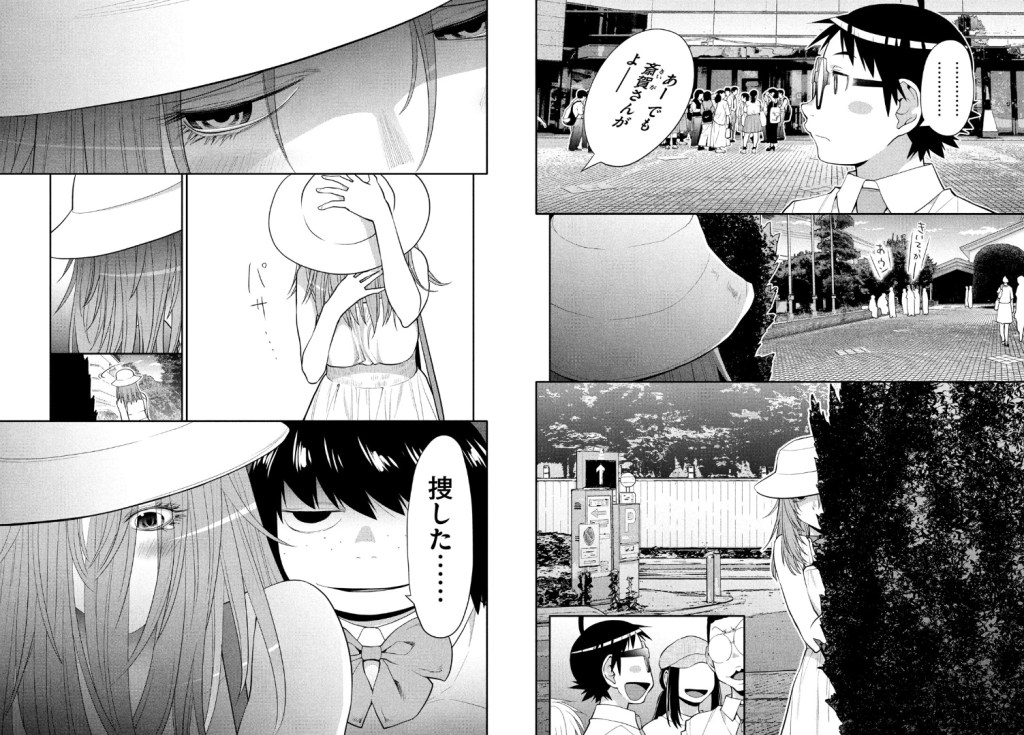
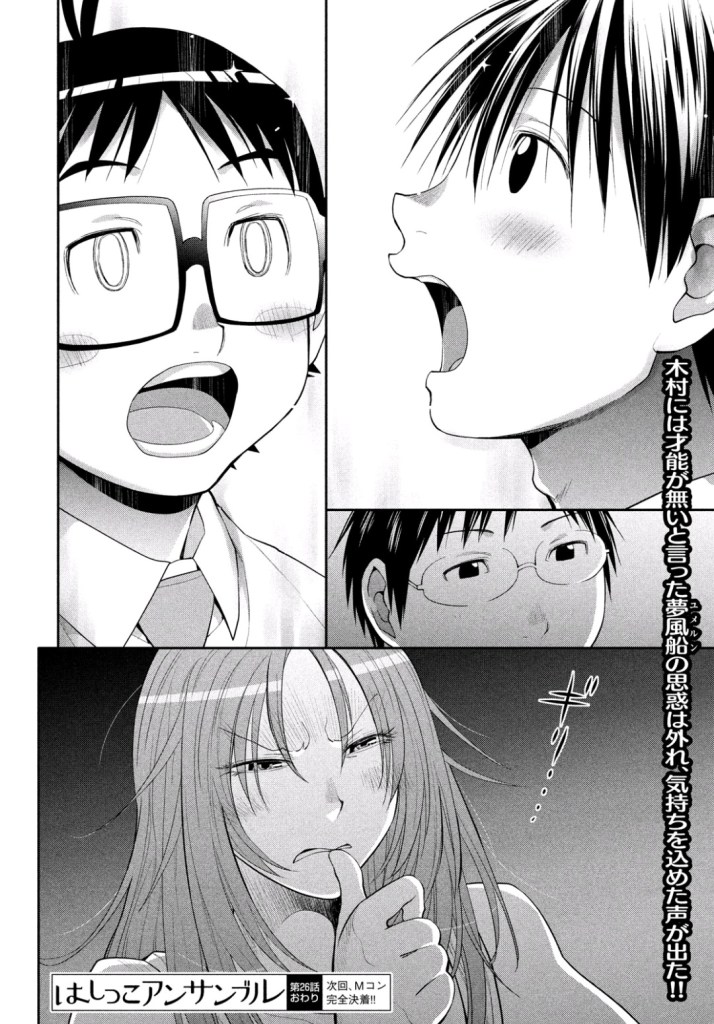
Afterwards, many congratulations are had, including from Shion’s mom and the Nishigafuchi club members who attended. Nishigafuchi’s message is loud and clear: you’re good enough to compete. Elsewhere, Yumerun is observing from a distance, and seems upset about Jin to the point of tears. Hasegawa spots her and, mysteriously, offers to exchange Line account info with Yumerun.

Shuusuke, who was on piano due to Shion’s injury, offers to take a photo of the club (plus associated classmates). However, when Shion tries to assert that she’ll be the one playing for them next time, she trips and falls into Shuusuke’s arms in a repeat of a childhood moment between the two. The situation seems ripped straight out of a romance manga, which causes a great deal of shock and blushing, albeit for different reasons. While Akira very clearly has feelings for Shion, Kousei is just mad that Shion’s nickname for Shuusuke, Shuu-chan, is what he used to call his deceased little brother. In the end, they manage to take a rather awkward but hilarious group photo, while also giving (Mashino) Shuusuke a new nickname: Masshie.

The Judge’s Thoughts

I found the aforementioned judge to be an interesting part of the chapter because it showed how an expert would see a fairly amateurish club and still recognize in them some potential. In my view, the key is when he describes what proper harmonizing is: It’s not about thinking, “I will try to let my voice out in a way that matches up with the others,” but rather, “If I let my voice out, it will match up with the others.” 

He also expresses being impressed by the way they transform into tenuto in their performance, which is a musical direction meant to convey “holding a note for its full length.” (I’m not sure I’m using that term correctly, so feel free to correct me!) Jin actually reaches him for comments afterwards, and he encourages them to get more members so they can participate in different types of competitions.

I hope this isn’t the last we see of him.

Romance in the Air?

I’ve written a good deal about the potential for romance and love triangles in Hashikko Ensemble, but I’ve tried not to focus too much on it because I didn’t want these reviews to overly emphasize that side to the extent that people might assume this was a primary focus of the series. That being said, it’s now crystal clear that Akira has a thing for Shion, and that it wasn’t just him being somewhat naively overprotective. There also might be something going on with Yumerun too, but those tears are kind of ambiguous. 

I still wouldn’t quite classify Hashikko Ensemble as a romance manga, though. Rather, it’s a story about human connections through the world of music, of which love is one possibility. It’s exactly the kind of story Kio Shimoku excels at, and why I continue to be such a big fan of his.

Back to the subject of Yumerun, I would think that everything about this chapter—the encouragement Jin got to find more members, Yumerun’s reaction, Hasegawa’s gesture—would lead to her joining them. However, that would first require her to transfer to Hashimoto Technical High School, an environment likely unsuited for her implied musical talents overall. It would be a hell of a move, and if it happened, it would signal some very clear intent on Yumerun’s part.

I also got a kick on the little swerve we got in terms of Kousei. It seemed like he had some feelings for Shion, but it turned out to be something about his little brother instead. It’s a bit of dark humor that ironically lightens the moment.

Songs

Naturally, the only song this month is (once again) “Miagete Goran Yoru no Hoshi o” by Kyu Sakamoto. 

Final Thoughts

It’s clear from previous reviews that I didn’t quite understand what the “free” part of M-Con meant. I took it more as like, an “open competition,” as opposed to being the distinction between “For Fun” and “For Glory,” to use Smash Bros. terms. 

I think this is probably inevitable with my writing about Hashikko Ensemble because of how music is not my forte. It makes me want to see someone who does know a thing or two about music read and review this series!

When Comedy Goes Nuclear: Spy x Family

Comedies based on perpetual misunderstandings can be really hit or miss. Characters misunderstanding one another’s intent and motivations can work as an endless source of humor, or it can eventually lead to frustration over a lack of progress. The manga series Spy x Family by Endo Tatsuya falls square into this category of humor, but it’s able to achieve a nice place between its overarching plot and its chapter-to-chapter antics that keeps it fresh, enjoyable, and even a little heartwarming.

Spy x Family tells the story of Twilight, an unparalleled spy who is given an order to start a family in order to get close to this next target. In order to make the charade seem as real as possible, he takes on a new identity (Loid Forger), adopts a daughter named Anya, and finds a woman willing to pretend to be his wife (Yor Forger). However, while Loid is extremely good at his job, what he doesn’t realize is that his new family members have their own secrets. Anya is actually a telepath, and Yor is actually a top-class assassin known as “Thorn Princess.” They all have their own reasons for wanting to keep this act going, with only Anya knowing the full truth but loving every minute of these bizarre circumstances.

In both story and presentation, this manga is superb. The character designs are excellent and the artwork is consistently solid no matter the situation or setting. The characters themselves are endearing and memorable. Every time I finish a chapter, I find myself wanting more. Spy x Family juggles a lot of balls in the air, whether it’s shifting settings between its three core characters, switching between comedy and action (or a mix of both), or portraying the way they grow closer even as they continue to keep their respective cards close to their chests.

The closest manga I can think of in terms of being this good at the “comedy of misunderstandings” shtick is Monthly Girls’ Nozaki-kun, but that title is far more extreme when it comes to keeping its characters forever ignorant. Spy x Family, on the other hand, is more than willing to have both long- and short-term plot threads, and it does each kind so well, I would be easily satisfied if it stuck with one or the other. However, it manages to pull both off well, and we’re all the better for it. I think part of the reason Spy x Family succeeds despite not taking the Nozaki-kun route is that there’s actually a character who is privy to what’s really going on in Anya Forger. From her hilarious reactions to everyone’s true thoughts and feelings, to the contrast between her powers and her lack of smarts, to her strong desire to keep the charade going so that she can keep her happy little nuclear family going, Anya might just be the lynchpin of this series.

Spy x Family is available on VIZ’s Shonen Jump app, and chapters come out roughly once every other week. There’s a lot to love about this series, and I don’t see it wearing out its welcome anytime soon.

Mogusa-san Finds New Success on Twitter

Amid these uncertain times, a strange success story involving one of my current favorite manga artists has emerged over the past few weeks. 

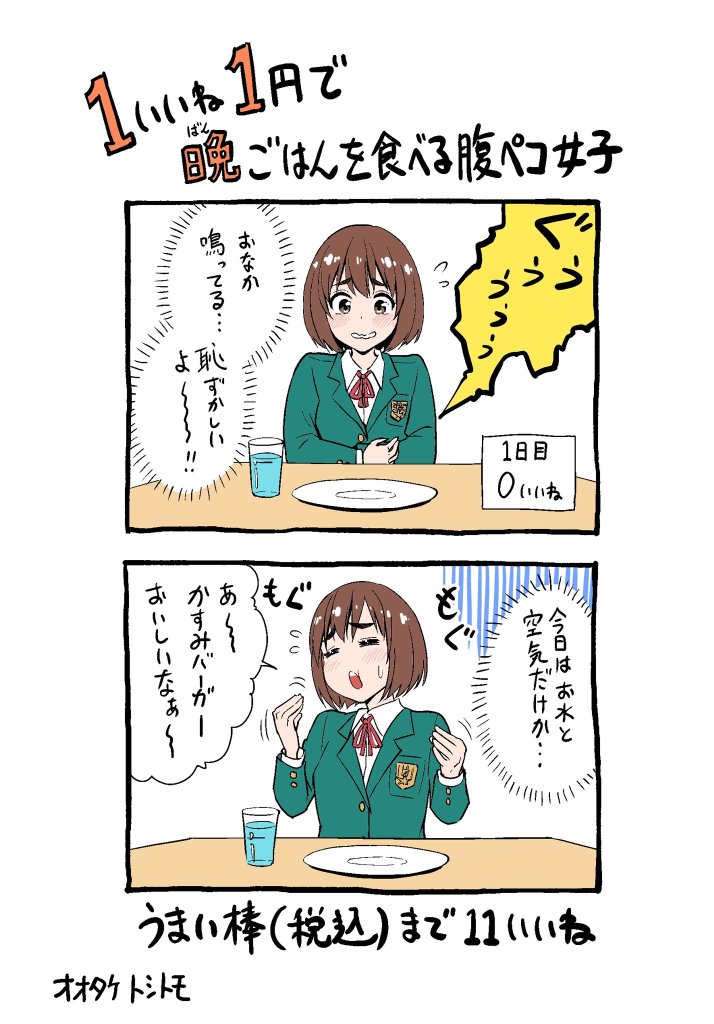
Ootake Toshimoto, author of Mogusa-san and Teasobi, has been drawing a comic series titled 1 Iine 1 Yen de Bangohan o Taberu Harapeko Joshi, or in English, Hungry Girl Eats Dinner Where 1 Like Equals 1 Yen. The premise: Minori Mogusa, the perpetually hungry heroine of Mogusa-san, is in a situation where she gets 1 yen for every Twitter like. Then, she’s supposed to use the amount earned in each comic on her next dinner. In the first strip above, she has 0 yen, so she’s “air-eating.” 

But while the expectation was that she’d get maybe a few hundred likes, and could build a meal based off of that, reality panned out very differently.

The first comic received 70,155 likes. 1 yen is about 1 cent USD, so that’s about $700. Mogusa freaks out.

The second comic received 115,117 likes, or about $1,150. Below is Mogusa gorging herself on 200 pieces of expensive fatty tuna (as well as some salmon roe) in one sitting. 

By the next comic, a rule was implemented so that the ratio would be 10 likes = 1 yen in certain situations to keep things reasonable.

Not only have these manga strips been cute and hilarious, but it’s giving Ootake and the character of Minori Mogusa a lot more exposure. It’s even to the point that other artists have started their own version of the 1 Like = 1 Yen dinner format. It’s fantastic. I love the hell out of the Mogusa-san manga, and I’m genuinely happy to see Ootake getting the notoriety I know he deserves. I hope this gives Ootake a lot more opportunities, and that the world will come to appreciate Mogusa as just an amazing character.

You can find all the comics in the following Twitter thread: Hungry Girl Eats Dinner Where 1 Like = 1 Yen. Bon appétit!

A Different Way of Seeing: Hashikko Ensemble, Chapter 26

Jin reveals an important part of himself while Akira shows his kind heart in Chapter 26 of Hashikko Ensemble.

Summary

It’s the Hashimoto Chorus Appreciation Society’s turn at the M-Con competition, but before they go up, Jin has a question for Akira: how does Akira interpret the lyrics to “Miagete Goran Yoru no Hoshi o” (Behold the Nighttime Stars)?

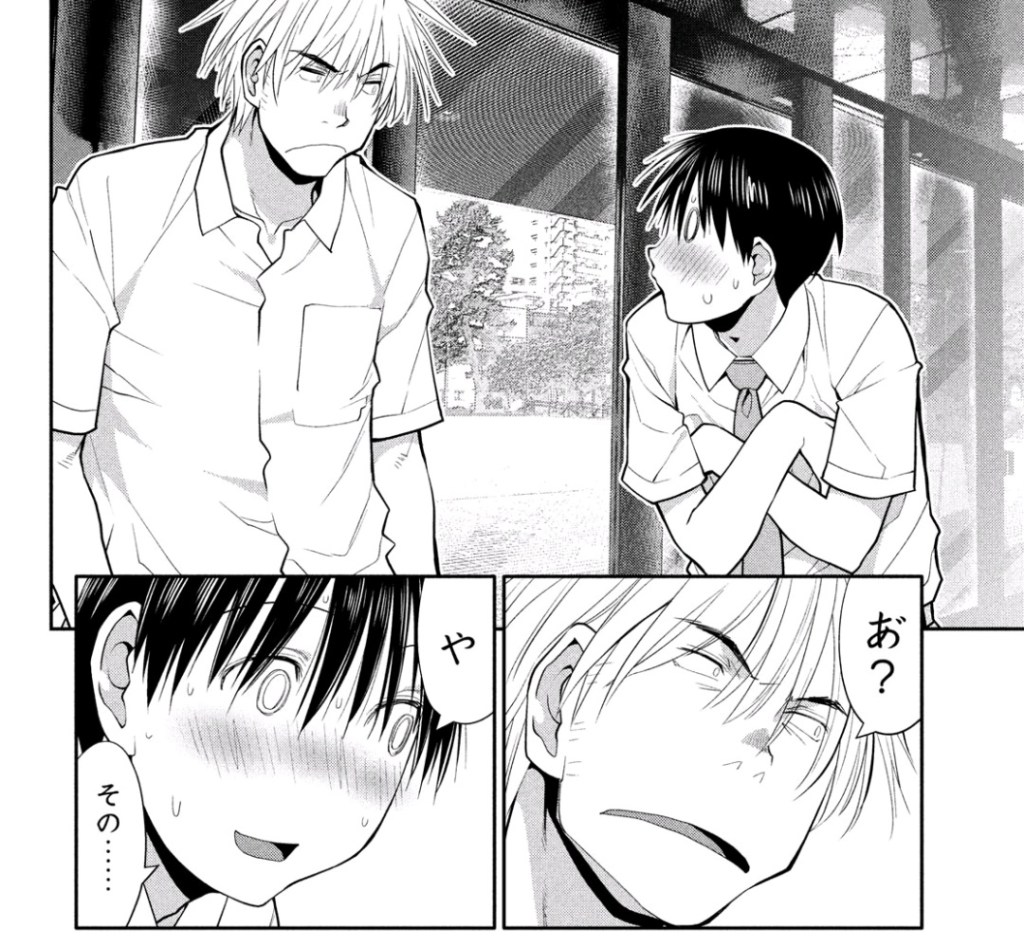
It turns out that while Jin can read up on the history of a song to understand what went into it, he can only ever understand lyrics at face value. After some hesitation, Akira explains in private to Jin that he picked the song while thinking about Kousei, who lost his little brother when they were young. To Akira, it sounds like a song of prayer—an explanation that seems to awaken something inside of Jin. Right after, Jin blabs to Kousei, causing some embarrassed tension, threats of violence, and teasing accusations of Kousei being a tsundere.

That little moment resolved, the guys start their performance, with Kousei drawing the most attention with his delinquent attitude in this more formal concert hall space. As they sing, they impress one of the judges in particular, but in the stands, Yumerun (Jin’s childhood friend) looka extremely annoyed for some reason.

Is Jin Neuroatypical?

Jin has always come across as a huge nerd who’s really into music as a kind of scientific phenomenon. However, based on what we’ve learned over the past two chapters, I’m genuinely starting to wonder if Jin might be somewhere on the autism spectrum, or is perhaps neuroatypical in some other way. 

Not only have we learned that he has trouble with making his singing feel more expressive, but now he’s explained that he’s basically incapable of interpreting lyrics on his own. I’m not very familiar myself, but I’ve known people who have Asperger’s, and from what I understand, people on the autism spectrum often have difficulty grasping the emotional meaning behind how things are said, or even sarcasm and the like. Hashikko Ensemble itself hasn’t said anything explicit, but I think it would explain a lot about the character, including how he approaches social interaction.

Akira and Kousei

The fact that Akira showed such concern for Kousei further fleshes out his character. There’s something about his trying to help Kousei out, as well as his interpretation of the lyrics, that reminds me of his childhood friendship with Himari and his love of children’s picture books. Akira is a kind soul, and I increasingly like him as the central protagonist of this manga.

Yumerun’s Anger

Part of the imagery of Yumerun grinding her teeth is that it “rhymes” with the panel of Shion doing the same out of frustration over not being able to play the accompanying piano. But beyond that, I really can’t seem to figure out why Yumerun is expressing some dismay over seeing Jin sing there. Their mutual past might be even more complicated than I first thought, and I wonder if maybe Yumerun is actually there on behalf of Jin’s mother. If not, maybe Yumerun sees chorus singing as somehow painfully common. I’m sure there’ll be more information in the coming months, but for now, this has me fascinated.

Songs

It’s just “Miagete Goran Yoru no Hoshi o” by Kyu Sakamoto again this time, but given that it’s front and center in this chapter, I think it’s worth it to go into greater detail about it.

As Jin explains, the song in question was written after the Great Kanto Earthquake of 1923  when the lack of light pollution made the starry sky visible. The stars are a metaphor for people’s souls, and the song itself functions as a song for repose of the soul. Akira’s interpretation as a song of prayer approaches it from a different angle. To him, the lyrics seem like they’re calling out to the souls of those who have been lost, but the second half makes the name of the song sound like a comforting call to those left on Earth. 

Final Thoughts

If Kio Shimoku is indeed writing Jin as having some sort of neurotypical mind, it would be new ground for him. Genshiken has a lot of eccentric characters, but that series always came across as just a bunch of fanatical dorks who really like anime and manga. Jin’s obsession with music seems driven by something different. 

Great Minds Think Differently: Keep Your Hands Off Eizouken!

Whenever there’s a work of fiction about creative types, I think back to an old art professor of mine. He would lament that the artistic process was rarely, if ever represented accurately in media. But if he had the chance to watch the anime Keep Your Hands Off Eizouken!, I think he would be pleasantly surprised. 

Adapted from a manga by Oowara Sumito, directed by Yuasa Masaaki and animated by his current studio, Science Saru, Eizouken! is very clearly made by people who believe just as strongly in the art of animation as the characters themselves do.

Eizouken! follows three characters–director Asakusa Midori (the main protagonist), animator Mizusaki Tsubame, and producer Kanamori Sayaka–as they form their own school club in order to make anime. Asakusa has a life-long passion for external exploring as a way to fuel her imagination, and her sketchbooks are filled to the brim with ideas and flashes of inspiration–from small doodles to elaborate world-building designs. Mizusaki is a model, but her true passion is in animation, and nothing gets her more excited as a sakuga fan than the hard work that goes into the art of portraying movement. Kanamori isn’t really artistic, but she has a knack for looking at the pragmatic side of things: costs, advertising and exposure, and deadlines. The difference between Asakusa and Mizusaki as similar yet distinct creative types, as well as the contrast between their energy and Kanamori’s, fuel the conflict and the camaraderie at the heart of Eizouken!

The series looks fantastic, has memorable characters, and is such a genuine love letter to anime and animation–even putting in nods to beloved classics like Future Boy Conan and Akira. However, what impresses me most is that Eizouken! makes a lot of difficult and daring decisions. It would have been all too easy to make Mizusaki the heroine because of how people tend to focus on characters in anime in the first place, and her specialty aligns closest to that. But not only is Mizusaki someone whose love of animation goes beyond simply making characters look impressive, but it’s the more conceptually oriented Asakusa who’s the main character. There’s something a little more intangible about Asakusa’s mindset, and the willingness to have her be the primary focus is something I appreciate.

But if having someone like Asakusa as main is uncommon, then featuring a character like Kanamori at all is like finding a four-leaf clover. While a similar series like Shirobako might have characters on the production side, it’s exceedingly rare to have a character who so clearly shows the “producer” mindset. It reminds me of something I heard once when it came to Studio Ghibli: while directors Miyazaki Hayao and Takahata Isao were considered the geniuses for their successful animated feature films, some consider producer Suzuki Toshio the real secret to Ghibli’s success because of his skills in promotion and turning a profit. Kanamori embodies this spirit, and I think that it also provides a window into how those who aren’t on the artistic side can still be big contributors to creative endeavors in a world where schedules matter.

Something that encapsulates the joy and detail put into Eizouken! is the opening video, shown above. There’s a part in the OP where it shows multiple quadrilaterals spiraling towards the center of the screen, one set for each character. Asakusa’s are chaotic, Mizusaki’s stylishly overlap, and Kanamori’s are rectangular and precise. They’re perfect summations of the girls’ respective mindsets.

Keep Your Hands Off Eizouken! is a series for anyone who’s interested in seeing an involved yet mildly fantastical portrayal of the creative process in action, as well as for anyone who enjoys seeing girls being passionate about what they do. There’s a lot of love that’s gone into Eizouken!, and I can’t help but expect a generation of creators to come out of watching this series eager to take the anime industry by storm. 

Recent Thoughts on Love Live's Nijigasaki High School Idol Club

In the past, the third Love Live! multimedia project, “Nijigasaki High School Idol Club” (previously known as “Perfect DREAM Project”), had somewhat eluded me in terms of its appeal. Certainly, when it comes to Love Live! In general, I’m usually something of a late adopter—it’s usually the anime adaptations that bring me in, as opposed to the games, magazines, or even the songs. I’m also not so big a fan that I’ll follow every crumb of information, or try to pick favorites before I’ve had a chance to learn about the characters.

Two things have changed since then: the Love Live! School Idol Festival All Stars mobile game (hereafter LLSIFAS) came out, and I attended a delayed viewing of the “Love Live! Fest” concert featuring the girls from all three generations. Together, they’ve given me a better insight into how this third Love Live! Is supposed to work, and its concept of “more individualized school idols” has me curious.

As soon as the nine Nijigasaki girls came out on stage at “Love Live! Fest,” it was clear that the thinking behind them diverged from what went into their predecessors. Rather than appearing as a nine-member unit with matching outfits, each of the singers/voice actors dressed like their characters, who themselves all have very different concert wardrobes. So instead of, say, having all of μ’s in white for “Snow Halation,” it was a hodgepodge ranging from a Swedish dress to a fancy nightgown to a kind of Vocaloid-esque ensemble. Their styles were incongruous, and intentionally so. As explained by one of the members, the theme of the Nijigasaki High School Idol Club is to emphasize each girl’s uniqueness above all else. It’s quite a departure from previous Love Live! projects, which were all about nine girls working as one. 

Each of the Nijigasaki girls also has their own solo number (in addition to a couple of group songs), which is something that the members of μ’s and Aqours didn’t get until later. I think it actually helps convey what each of their personalities is like, as opposed to trying to figure out which girl is which when they’re all singing at the same time. Asaka Karin is supposed to have a more mature sex appeal, and it comes across in spades when she’s the only vocalist. Speaking of Karin, learning about her character was an experience. First, she came out and called herself the “sexy” one. Then, she called her fans “slaves.” Last, it showed her signature symbol: a high heel (hmm). It dawned on me that Karin (as well as the other eight girls) are likely all going for very different audiences from one another.

LLSIFAS somewhat departs from its mobile game predecessor by having more of an ongoing narrative in the story mode. In Chapter 1, you learn that the Nijigasaki High School Idol Club is in a sorry state and on the verge of being shut down. Your goal is to bring back the old members and recruit some new ones, and you basically learn about each of the characters along the way. I think this has been effective in helping me get a better sense of what each of them is all about, with the heavy amount of interaction and the clearer direction doing a good job of showing how the characters are when there’s an obstacle to overcome. Still, I wonder why the forces that control Love Live! as a whole decided to move in this direction for their third endeavor.

I’m not ready to fully embrace Nijigasaki because I find that a bit of resistance is for the best when approaching idol franchises, even the continuation of one I’m already a fan of. The original Love Live! won me over even as I was very skeptical of it, and it took some time for me to enjoy Love Live! Sunshine!!, but it happened eventually. I don’t need to pick a favorite Nijigasaki girl, I don’t need to enjoy every song, and I don’t need to go all-in from the start. That said, I’m looking forward to how the more focused format of an anime will tell their story, and how this idea of individuality will play out. And with a fourth Love Live! project on the way, the Nijigasaki idols will become “senpai” themselves.