The Precarious Balance of Tradition and Progress: Sakura Quest

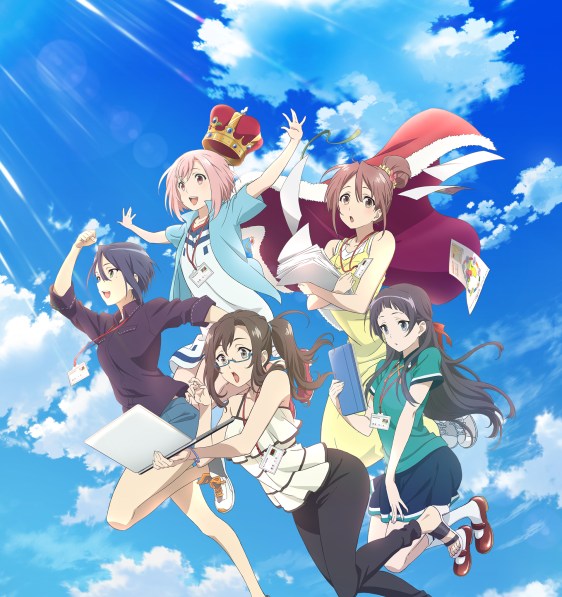
For years, the raison d’etre of the anime studio P.A. Works appeared to be creating intetesting settings as a pretense to showcase cute female characters. Whether it was True Tears, Hanasaku Iroha, Tari Tari,  or something else, they appeared to focus on personal relationships above all else. A more careful look, however, will reveal another major theme permeating many of their works: the declining population of rural Japan, and the complicated effects of tourism on this situation. Now, P.A. Works has doubled down on this idea in their new anime, Sakura Quest.

Koharu Yoshino is a young woman struggling to find work, when she’s been asked specifically by name to come work in the small, virtually forgotten town of Manoyama. Desperate for employment, she takes the offer, only to discover that it was a mistake. But the contract’s been signed, so now Yoshino—along with a group of other young women—are tasked with helping to revive Manoyama.

Much like one of their previous hits, Shirobako, the main cast of Sakura Quest is notably all adult-aged women as opposed to high school girls. When I interviewed P.A. Works at Otakon 2016, they expressed that they’d been wanting to do that as early as Hanasaku Iroha, but trends and the need to make a profit pushed them to stick with the reliable teenage formula. Now, with two series bucking that trend, it looks like they’re eager to challenge that status quo—at least in part.

The use of attractive girls to anchor Sakura Quest means that the series does not fully escape the market forces of young, attractive heroines, but in many ways it also does not pull its punches. Yoshino and the rest of the core cast, consisting of both those new to Manoyama and life-long residents, are confronted with difficult decisions that often leave their best plans only half-formed and arguably doomed to failure by the many considerations they must account for.

Central to this conflict is the contrast between valuing the traditions of Manoyama and its people, and when those traditions stifle the potential for the town to adapt and evolve. Trying to make tourism and local promotion work in a long-declining town is portrayed as a struggle where the gains are few and the solutions are rarely cut-and-dry, if available at all. The series is not necessarily a cynical one, but any progress comes in small steps.  This can be frustrating at times, but it grounds the show in more realistic expectations. After all, if the solution to the rural decline of Japan were easy, we’d probably have seen it by now. It also highlights the idea that, while gimmicks can boost tourism, this is a serious double-edged sword.

Sakura Quest is not one of those gripping anime that keeps you in suspense, or has you falling in love with the girls so hard that you feel compelled to buy their merchandise. It’s a pretty slow burn, and the characters will repeat their mistakes on more than one occasion. However, it’s a very satisfying work in its own way, as it challenges viewers to think about one of Japan’s major problems today, and the myriad factors that complicate it.

Save

Save

Gattai Girls 7: Shinkon Gattai Godannar and Aoi Anna

Introduction: “Gattai Girls” is a series of posts dedicated to looking at giant robot anime featuring prominent female characters due to their relative rarity within that genre.

Here, “prominent” is primarily defined by two traits. First, the female character has to be either a main character (as opposed to a sidekick or support character), or she has to be in a role which distinguishes her. Second, the female character has to actually pilot a giant robot, preferrably the main giant robot of the series she’s in.

For example, Aim for the Top! would qualify because of Noriko (main character, pilots the most important mecha of her show), while Vision of Escaflowne would not, because Hitomi does not engage in any combat despite being a main character, nor would Full Metal Panic! because the most prominent robot pilot, Melissa Mao, is not prominent enough.


This Gattai Girls entry is a bit unusual because I’ve already posted a review of the series before. Moreover, with a series like Godannar, I’ve already written extensively about the the portrayal of female characters because it’s all but unavoidable. If the prevalent fanservice wasn’t enough, there’s the fact that over half of the cast is women. While I’ll inevitably retread some old territory, this time around I’m going to focus more heavily on the main heroine of the story, Aoi Anna.

Godannar follows 17-year-old Aoi Anna, who’s engaged to burly, veteran robot pilot Saruwatari Gou in a May-December romance. Years ago, he rescued her from a monster attack, and eventually their feelings blossomed into love. But while she’s no slouch herself when it comes to mecha—she’s a prodigy who’s dreamed of fighting in a robot since childhood—Gou forbids her from becoming a full-fledged defender of the Earth. The reason? That’s how he lost his previous lover and trusty co-pilot. Still, Anna and Gou are humanity’s greatest weapons, as their robots combine into the mighty robot, Godannar Twin Drive, the “marriage of god and soul.”

From a characterization and narrative perspective, Anna’s story stands out in a way capable of overshadowing even the infamous double decker cheesecake of Godannar. Romance traditionally takes a backseat in many giant robot series, and when it does show up, such as in Macross, the two sides are often from different worlds, either metaphorically or literally. In Godannar, however, not only are Anna and Gou equal partners, but they have to work together as a team both personally and professionally. The cockpit becomes a second home of sorts, as they iron out their differences and fight the enemy. The series literally has relationship plot and mecha action resolve simultaneously, as if the two sides are permanently fused together, and it’s glorious. In a way, this is the story about the power of love, but it’s less “love defeats everything automatically” and more “love opens them up to resolve problems they couldn’t otherwise.”

In a certain sense, this heavy emphasis on relationships plays into the stereotype of girls only caring about guys, and one might even feel that Anna’s character is directly tied to her connection with Gou. While I think there’s some truth to that, I also find that Godannar‘s direct focus on its main couple (as well as many other couples throughout the series) is a big part of its, and by extension Anna’s, appeal. It’s basically a story about newlyweds who are also co-workers, and having to navigate that tricky interpersonal landscape. Through it all, Anna’s inner strength stands out. When Gou first tells her to stop piloting for her own sake, her response is that they have a duty to take care of each other as husband and wife. At one point, she feels herself unable to fight as Gou’s equal, but is able to find the motivation within herself to not back down in the end. By the end, due to unfortunate circumstances, she’s actually the one having to do the lion’s share of the work, to make up for what Gou can no longer do. Her strength, perseverance, and caring make her one of my favorite characters ever.

I’ve already made mention of it a couple of times, but when it comes to how women are depicted in Godannar, the series heavily sexualizes on a level where few others can compare. To say otherwise would be disingenuous. When the girls, including Anna, are piloting their robots, they’re in ultra-form-fitting suits that leave less than nothing to the imagination. During combat, their breasts jiggle to and fro as if made from some alien substance. Even when they’re in regular clothing, the fabric hugs every curve as if holding on for dear life. The camera angles can also be extremely voyeuristic. Even if I wanted to say, “You should really just ignore all this,” that’s pretty much impossible whether you’re into heavy fanservice or not. There’s an incredibly good series with some strong, well-written characters both male and female there, but it requires either an acceptance or tolerance of just a non-stop barrage of sexual imagery.

One last aspect of the series I want to talk about is the interesting way it addresses the topic of gender roles. In the second season of Godannar, the enemy monsters begin to utilize a different tactic. Instead of just trying to out-muscle Earth’s giant robot forces, they also evolve to spread a virus that specifically targets hot-blooded, macho men—the very people who are supposed to excel at being mecha pilots. As the men become increasingly unable to fight, the women, led by Anna, have to take a stand. On the one hand, this plays into the idea that men are supposed to be strong and tough (though it should be noted that a more masculine girl gets hit by the disease while a more effeminate playboy guy does not). On the other, it brings up the notion that hyper-masculinity can become a weakness to be exploited.

Godannar is a contradictory anime. Its unrestrained sexualization of the female body makes it seem like a series all about pure objectification of women, but at the same time its female characters, notably its main heroine Anna, are fully realized characters who have goals and dreams and a desire to stand on their own feet. They’re fleshed out as human beings, but also practically the embodiment of “temptation of the flesh.” But if marriage is a union of separate yet compatible beings, then Godannar is an unlikely marriage of disparate elements that somehow, some way, work to make something beautiful.

My Favorite Light Novel Anime

Light novel anime adaptations get something of a bad rap, but there are plenty of gems in that sea. If I were to list all of the light novel anime I thought were good, I’d have a pretty hefty list—big enough that even I’m surprised by looking at it. Instead, I’ve narrowed it down to a few, with reasons why I enjoy them so much.

1. My Youth Romantic Comedy is Wrong, As I Expected (aka My Teen Romantic Comedy SNAFU)

I’ve written at length on more than one occasion about why I think so highly about Youth Romantic Comedy, but every time I think about it I come back with even more reasons. This time around, an aspect that sticks out to me is how the series positions its central love triangle with a kind of thoughtfulness one might not expect.

Even though they all have significantly different perspectives on life, the characters’ contrasting viewpoints allow them to accomplish tasks that each of them alone could not. This extends to their love triangle. Where usually girls in these series are interested in the same guy for the same reason, Yui and Yukino are drawn to different qualities in Hachiman. Yui sees him as a good person deep down inside (whether he realizes it or not), and Yukino sees Hachiman as someone on a similar, socialization-shunning wavelength.

It’s good stuff.

2. The Disappearance of Suzumiya Haruhi

In general, I’m pretty fond of the Suzumiya Haruhi anime, even if it’s not viewed with as much reverence as it once was. The story of a girl who might very well be god of the universe without realizing it hits a lot of interesting notes. However, I put the film The Disappearance of Suzumiya Haruhi on a whole other level. The powerful emotions swirling around the characters—especially Nagato—as well as the tough decisions they have to make, just sticks with me in a way that not even the series’ other high points can. The only significant flaw of the movie, in my opinion, is that it requires viewers to have all the background context of the series prior to watching, but I think it can still probably do fine stand-alone.

For more of my thoughts, check out my review.

3. Humanity Has Declined

I sometimes forget that this series is based on a light novel because of how witty its satire can be. Taking place in a world where humankind is no longer the dominant race on Earth—instead supplanted by a race of fairies—it often showcases the folly of humanity by having their mistakes repeated in fast-forward by the fairies, who are somehow brilliant and imbecilic at the same time. The fairies can easily fashion new and highly advanced forms of science and technology, but are extremely prone to group-think, bandwagoning, and lack of foresight. It’s all too fitting that we as a species would get outdone by more extreme versions of us.

This is another series I’ve written a review for, which you can find here.

4. Kino’s Journey

If there’s one thing more recent light novel anime tend to lack, it’s a strong sense of atmosphere. Sure, they’ll have complex environments and elaborate magic systems, but they don’t capture the sense of a world in flux the way that Kino’s Journey does. Kino is a “traveler,” an unusual profession where she travels from one land to the next, learning about what each distinct culture is like. It’s a quiet and contemplative series, but at times can swell with tension and action. I’ve written a little about Kino’s Journey before, but only one of the short films.

I’m really looking forward to the upcoming new anime.

5. Slayers

While light novel anime are sometimes thought of as a more recent phenomenon due to the increased influx over the past 10-15 years, in my opinion the true grandmaster of the light novel adaptation is Slayers. Black magician Lina Inverse fancies herself a hero, but she’s more an agent of destruction, feared for her lack of concern for collateral damage. As she continues to make allies, she finds herself having to fight for the fate of her world, but not without keeping her characteristic wit, fury, and hungers both literal and metaphorical.

It was one of my gateway anime, and one of the first series that I was proud to own. Its mixture of humor, adventure, and dramatic development at the right moments makes it forever a classic in my mind. It’s one of the defining series of the 90s, and while its age often shows, I think it still has potential for wide appeal to a current audience.

This post was sponsored by Johnny Trovato. If you’re interested in submitting topics for the blog, or just like my writing and want to support Ogiue Maniax, check out my Patreon.


Save

Save

Save

Save

Save

Save

Save

Return to Genshiken: Volume 5 – Pride and Fujo Justice

Volume 5 holds a very special place in my heart—it was my first ever manga purchase when I studied in Japan, and my first real exposure to the character of Ogiue. As such, it’s one of the volumes of Genshiken I know best, but in re-reading it I’ve still managed to pick up on some things I hadn’t before!

What is Return to Genshiken?

Genshiken is an influential manga about otaku, as well as my favorite manga ever and the inspiration for this blog, but it’s been many years since I’ve read the series. I intend to re-read Genshiken with the benefit of hindsight and see how much, if at all, my thoughts on the manga have changed.

Note that, unlike my chapter reviews for the second series, Genshiken Nidaime, I’m going to be looking at this volume by volume. I’ll be using both English and Japanese versions of Genshiken! Also, I will be spoiling the entirety of Genshiken, both the first series and the sequel, so be warned.

Volume 5 Summary

Ogiue’s is one of the club’s newest members. After some spirited discussions/arguments” with Saki and Ohno about yaoi, she inadvertently reveals her true fujoshi nature. Her kink: BL inspired by shounen manga.

Madarame attempts to take on his greatest foe: premium clothing shopping. Although it nearly drains him of all will, he ultimately succeeds. Ogiue, following similar advice, does not.

Sasahara’s Comic Festival application is accepted, and Genshiken must fight through a meddling pest (Haraguchi), editor and artist tensions between Sasahara and Kugayama, and a fast-encroaching deadline on the way to their first vendor experience at a doujin event. In the end, they manage to make it in time. They even sell out of their Kujibiki Unbalance-themed doujinshi onsite, thanks in part to the cosplay/crossplay powers of Ohno and Kohsaka.

Ogiue Exposed

There’s a lot we learn about Ogiue in Volume 5. She’s indeed a fujoshi, in spite of her vocal disdain for them. She comes from the Tohoku region (and, as we learn in Nidaime, Yamagata specifically) when she panics and slips into her native accent. She’s also an artist, though we’ve yet to learn the significance of art to Ogiue (and how it ties into the trauma of her past). But there’s another major development in this volume that has major implications for the rest of the series.

Before I get into that, however, I do want to point something else out. Ogiue’s initial excuse when Kuchiki mentions that he caught her at a Scram Dunk event is that it was “for her little brother.” I never got around to it in my Nidaime reviews, but it turns out that she actually does have a little brother. The reveal happens in Volume 16, in a 4-panel comic where Ogiue and Sue visit Ogiue’s family home. A simple “Sis?” followed by “He’s my brother” is all it takes to finally know that the brother, at least, was not a lie.

The True Origins of Sasa x Mada

As an Ogiue fan, one of my favorite aspects of Genshiken is naturally her gradual acceptance of her fujoshi side, and her quiet obsession with Sasahara x Madarame yaoi is a part of this. While that particular thread comes to the fore in the next volume, I realized during my re-read that the seeds were planted in Ogiue’s head in Volume 5.

In one of the doujinshi planning scenes, Haraguchi reveals that he’s already made plans for Genshiken’s book (he wants to turn it into a big seller by bringing on a ton of high-profile guest artists). Sasahara keeps trying to politely refuse Haraguchi’s “kindness,” as his tendency as a non-confrontational person. However, as Haraguchi keeps pushing and pushing, eventually Sasahara’s expression grows stern (similar to how he reacts to his own sister). He puts his proverbial foot down, saying, “I will personally call all the guest artists you brought on board (without my consent) and turn them down.”

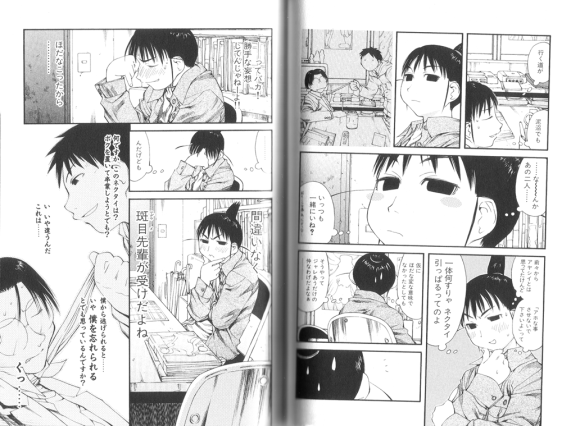
It’s potentially easy to miss, but immediately afterwards there’s a small panel with an Ogiue closeup, and she has the ever-so-slightest blush on her face. Without later context, it can just seem like she’s surprised or shocked at Sasahara’s change of behavior, but now it’s clear to me that this was the catalyst for her perception of Sasahara as a a “seme” character, and also her eventual attraction to him. When Sasahara is later arguing with Kugayama about getting the doujinshi done, and he refuses Ogiue’s help because he doesn’t want her picking up Kugayama’s slack, this also contributes to her fantasy image of Sasahara. It might also have “helped” that he made her cry, showing his gruff, masculine side, however limited.

As for Madarame as “uke,” right after Sasahara tells Haraguchi that emphatic “no,” Haraguchi turns to Madarame to ask if it’s really okay. Madarame then mentions that Sasahara is president now and it’s up to him to make the final decisions. I think this moment of deference towards Sasahara by Madarame is what plants the seed of “bottom-ness” in Ogiue’s mind, along with Madarame’s general behavior around Kasukabe.

Doujinshi Creation: From Passive to Active

Sasahara’s decision to participate in Comic Festival in the first place is a major pivot for Genshiken. Up to this point, they were an extremely passive club, where things sort of happened to them. Now, they’ve stepped into the field of creators; they’re making an active contribution to otaku culture, so to speak. This experience is also clearly what eventually leads Sasahara to becoming a manga editor. All of the back-and-forth with Haraguchi, having to know when too far is too far, and basically managing disparate elements of production to create a single complete product in a limited time span is portrayed as a tiring yet invigorating experience for Sasahara—and one that he’s pretty good at too. His personality is somehow a good fit for editorial work, especially in the manga sense of also having to manage artists.

Speaking of passivity, the argument between Kugayama and Sasahara is too real. Sasahara basically accuses Kugayama of discounting his own ability to become a professional manga artist to protect his “flimsy pride.” In other words, Sasahara is saying that Kugayama is choosing to give up because it would feel even worse to try his hardest and fail. While the opposite mentality is encouraged in life and in movies, fearing failure is something that virtually anyone can relate to.

Saki in Transition

Saki, as much as she’s spending time with the Genshiken crew, is still in a period of transition between being absolutely new to the world of otaku and being fully accustomed to it, as she is in Nidaime. While she’s always the “normie” outsider in the series, there are a number of choice moments in Volume 5 that speak to her status being in flux.

When Saki is talking with Ogiue next to the gigantic pile of homoerotic doujinshi, she looks at one of them, gets suspicious, and then opens it up and has her supicions confirmed. If she were an otaku, or at least much more familiar with the stuff, she probably would’ve realized it immediately. Still, the fact that she noticed something was “off” speaks to the time she’s been in Genshiken.

At Comic Festival, Saki sees Kousaka in drag and is clearly taken aback. Back when I first read it, it seemed like she was about to say something sad, but knowing Saki better now, I get the impression that she was going to respond with something kinder, albeit still embarrassing. In Nidaime, she reveals that she has plenty of gay friends and friends who crossdress, which makes me wonder if Saki’s response was actually going to be more “If you’re into that sort of thing, I guess I can accept that,” before she’s interrupted by Kuchiki.

But she’s also learning, whether she likes it or not. In one of the post-ComiFes 4-panel comics, Saki mentions that having the Kujibiki Unbalance vice-president (Ohno’s cosplayed character) selling pornographic doujinshi of the president must be pretty strange. Ohno gets a look of surprise on her face that Saki has shown a small example of otaku-esque perception.

However, just as we think she’s adjusting, the otaku world smacks her right in the face. At the very end of the volume, she’s shown reading the doujinshi Genshiken put out and reacting with awkward disgust. It’s clear why: the doujinshi is lolicon (and the volume has a heavily censored version of it), featuring a young Chihiro and Ritsuko from Kujibiki Unbalance having an early sexual encounter. Ultimately, while the rest of the club is treating it like nothing big (and it’s likely powered by Sasahara’s general obsession with Ritsuko, as opposed to any specific age range), Kasukabe’s reaction is all too expected, and is likely the sort of thing that keeps her from ever fully embracing otaku subculture.

She never really interacts with Nidaime‘s resident shotacon, Yoshitake Risa, either. I wonder how that conversation might go…

Mebaetame

This time around, Genshiken’s small club doujinshi looks at the Kujibiki Unbalance anime, which, in case you didn’t know or forgot, was actually made. A lot of the screenshots are actually taken directly from the anime, but a few of them are actually drawn by Kio Shimoku to resemble a TV anime screenshot. I find that kinda funny.

Final Random Thoughts

Madarame and Ogiue’s fashion trips might have seemed like one-off adventures originally, but looking back it’s clear that their voyages made an impact. Madarame starts to dress at least a little better, especially after he starts to work professionally, but it still sticks even when he quits his job in Nidaime. As for Ogiue, she starts to wear better-fitting clothing, and after she starts dating Sasahara she becomes even more fashionable. By the time Nidaime rolls around, Yajima is actually kind of intimidated by how good-looking Ogiue is. That’s quite some progress for a girl who used to actively shun fashion.

Save

Save

Save

Save

Save

Save

Save

Save

Save

Save

Save

Save

Save

Save

Save

Save

Save

Save

A Belated Samurai Jack Season 5 Review

It’s been a long journey for fans of Samurai Jack. A cartoon that’s always been notable for its visual creativity, the original series ended abruptly, leaving viewers without any sort of resolution to the battle between Jack and his arch-nemesis Aku. 13 years later, Samurai Jack finally has a decisive conclusion to cap off Jack’s journey. This in itself makes the fifth and final season something special, but what makes this concluding chapter stand out even more is how the darker, more mature feel of these last episodes are not as effective without the more kid-oriented approach of the past providing context.

As explained in the opening each episode, 50 years have passed since Aku sent Samurai Jack into the future. During this period, Jack discovers that he does not age, possibly as a side effect of time travel. Jack at the beginning of the fifth season seems almost like a different character, worn down by the death and suffering of others and his inability to vanquish Aku and save the world.

In the old Samurai Jack, Jack only destroyed robots as a consequence of its kid-friendly rating. Stories could be mature, but they had to toe a certain line. In the final season, he is shown to confront the issue of taking mortal lives on numerous occasions. While the story of a man who tries his best not to kill being forced to do so is compelling enough, it works especially well because of that past history as a children’s show. Moreover, the 13-year gap between the previous season and the final one means that the show’s audience has also aged, and I imagine that this creates a degree of empathy towards Jack, even if it hasn’t been 50 years for us.

Originally, the plan from creator Genndy Tartakovsky Samurai Jack was to do a feature film that would finish the story. While that would’ve likely been good in its own right, and likely more in line with how the series was back then, I’m glad we got this version instead. Plenty of shows these days, from Full House to Twin Peaks, are doing this “years later sequel” thing, but I can say for sure that Samurai Jack doesn’t suffer for it. The final season is artistically and negativity ambitious, and any flaws in it are in my opinion forgivable.

Capitalizing on a New Home: Otakon 2017

“Howatto?! Washington ni?!”

-Jack King, Shin Getter Robo vs. Neo Getter Robo

Introduction: To DC

Otakon has always been my favorite anime convention. With its fan-oriented approach and variety of content, it always feels surprisingly intimate despite its sheer size (it’s generally the largest anime con on the east coast). This year marked a big change, as Otakon moved from its long-time home of Baltimore to Washington DC. It might not seem like that much of a difference—it’s only one extra stop on Amtrak—but for those of us who had grown fond of the previous venue, warts and all, Otakon was synonymous with Baltimore.

However, I will likely not be the only one to tell you that the new location is one of the best things to happen to Otakon. Subjectively, I still have an attachment to Baltimore. Objectively, outside of increased cost, pretty much everything is superior. The Walter E. Washington Convention Center is roughly double the size of the old Baltimore Convention Center, meaning less congestion. The adjacent hotel, the Marriott Marquis Washington DC, is bigger and more accommodating. The food choices are greater both inside and outside the convention center, and still fairly reasonably priced. For those who are especially cost-conscious, a Giant Foods supermarket within walking distance is an improvement over Baltimore’s 7-Elevens.

Thus, without even taking into account what happened at the con itself, this new setting certainly provided a more comfortable space for Otakon to put on a show. It was off to a good start right from the beginning.

Dealer’s Hall and Artist’s Alley

One of the best things about having such a large space for Otakon is that the Dealer’s Hall and the Artist’s Alley were easily navigable. Instead of having to wade through a sea of people in order to get anything done, actually going where I wanted to provided little challenge, aside from unfamiliarity with the new convention center. In terms of content, it’s pretty much what you can expect out of a large-sized con. In the Dealer’s Hall, large, official company booths acted as centerpieces with smaller booths on the sides selling figures, posters, manga, anime, and more. The Artist’s Alley had a wide variety of styles, with series such as Voltron, Yuri!!! on Ice, and Persona 5 being especially popular.

One of the hiccups in both areas was a lack of clear marking as to where you were. Booths had individual numbers, but sometimes they didn’t follow a consistent logic, and a lack of visible markings to tell you what row and column you were standing in made things worse. Fortunately, this was brought up at the Con Feedback panel at the end of Otakon, and it’s something they had intended but couldn’t get around to.

There are a couple of other challenges they’ll have to tackle for next year as well. First, the line to the Dealer’s Hall would occasionally get capped. This in itself isn’t unusual, but at one point a friend of mind mentioned that he couldn’t get in while I was already there. But when I looked around, the Dealer’s Hall was the opposite of congested. There was literally room to run around if I so choose. I later realized that it wasn’t the Dealer’s Hall itself that was the issue, it was the space leading to the Dealer’s Hall that was becoming a fire hazard. That’s something that should be addressed by 2018.

The Artist’s Alley also ran into an unfortunate bit of flooding due to a water main break on Saturday evening. A major factor in this was an enormous storm that hit DC. From what I saw, Otakon handled the situation fairly well, and there were no major injuries. This might just be a fluke accident for the first year, so I’ll give them the benefit of the doubt.

Concert: JAM Project/TM Revolution

This year, Otakon teamed up with the Anisong World Matsuri to bring a number of musical acts to DC. Because tickets cost money (unlike most anime cons), I could only see the Friday concert featuring JAM Project and TM Revolution. As a long-time fan of the former and someone who definitely enjoys the music of the latter, I can say with the utmost confidence that they did not disappoint. Both acts are known for creating not only songs that are good in and of themselves, but for embracing the anime they create music for and elevating them through their compositions. I first saw JAM Project at their US debut back at Otakon 2008, and it was a welcome return.

Both TM Revolution and JAM Project are really adept at making live performances special. Their voices ring out clearly, they get the audience involved, and by the time they’re done you end up feeling like you were part of something greater. Even a few technical hiccups during TM Revolution’s performance couldn’t dent the audience’s fervor.

Before the concert, I had bet on JAM Project and TM Revolution doing an encore together. Most likely, it would be JAM Project’s signature song, “SKILL.” They came through, and the collaboration was everything I hoped for.

For further thoughts on the concert, check out my post on Apartment 507.

The official set list for Otakon 2017 is as follows:

JAM PROJECT

1. Crest of “Z’s”
2. Hagane no Resistance
3. Garo ~Savior in the Dark~
4. The Brave
5. THE EXCEEDER
6. Hero
7. THE HERO!! ~Ikareru Kobushini Hiwo Tsukero~
8. Victory〜Gong
9. Rocks
10. Rescue Fire

T.M.Revolution
1. Inherit the Force
2. Invoke
3. ignited
4. Meteor
5. resonance
6. High Pressure
7. White Breath
8. Hot Limit
9. Flags
10. Sword Summit
11. Heart of Sword

ENCORE
1. SKILL (JAM Project x T.M.Revolution)

Panels

Due to a busy schedule this year and some mishaps on my part, I was unable to attend as many panels as I would have liked. However, this means I can talk about ones I did see in greater detail!

(I also didn’t have any panels this year. Better luck next time?)

The first was “Romance and Abuse in Shoujo Manga,” which looked at many of the bad boys of shoujo and how their behavior can reflect an often implicit hand-waving of abusive relationships. It looked at both works that ignore its characters’ abusive behavior towards their partners, as well as those that call the characters out on it. The presenter also took time to point out the difference between enjoying something as fiction vs. understanding how it would play out in reality, so it’s not as if it was an automatic admonishment of the audience’s tastes. I thought it was a strong panel overall, but it could be taken to the next level. Perhaps it could even go into understanding why the trope of the abusive boyfriend as lovable partner is so popular and occurs in so many well-received anime and manga.

I would also like to compliment the presenter on giving her stamp of approval to how the series Kiss Him, Not Me approaches the subject of abuse, because while the series is thoughtful in a lot of ways, its initially flippant handling of weight and beauty can really turn people away—even I was put off by it. The fact that the presenter used it as an example showed that she wasn’t trying to automatically write off certain series but was actively trying to figure out what messages these shoujo series send.

Another panel I attended was “Iyashikei: Animated Healing.” It focused on the so-called healing genre of anime and manga, explaining the emotionally therapeutic aspect of such works and why they garner such loyal fans. It was a very thorough panel that showed a wide variety of series that can be considered iyashikei, including both classics and genre-bending examples. One thing the panel didn’t get into but I would have liked to see was the tendency towards an assumed male viewership for healing anime. Still, it was well-presented and informative, and I’d look forward to checking it out again.

Screenings

I had the opportunity to see two films, one of which was a world premiere. I’ve written more extensive reviews for both.

In This Corner of the World

Eureka Seven Hi-Evolution 1

Interviews

I also interviewed a few of the illustrious guests at Otakon! This year, it was the dynamic seiyuu duo of Furukawa Toshio and Kakinuma Shino, as well as an interview with the director of Eureka Seven, Kyouda Tomoki.

Final Thoughts

The move to Washington DC is the best decision Otakon has made in years. There are very few drawbacks I can think of, outside of a sentimental attachment to Baltimore (and its delicious crab cake truck), but I know that my experience is not necessarily shared with everyone else.

Second, you want to hear other random thoughts about the con, I also appeared on a post-Otakon podcast over at Ani-Gamers. We recorded it right after the con closed on Sunday!

To end this report, here are some cosplay highlights, as is Ogiue Maniax tradition.

Save

Save

Save

Save

Save

The Star that Shines Brightest: Thoughts on the Aikatsu! Five-Year Anniversary Crossover

“Five years of Aikatsu! sounds strange. Sometimes, the series seems like it’s been around forever. Other times, I remember it as one of the many young upstarts nipping at Precure‘s “anime for young girls” throne. However my feelings sway, the reality is that the show is long enough now to have a mega crossover event.

In episodes 69 and 70 of Aikatsu Stars!, the characters if the latest series encounter their predecessors from seasons past. While there are plenty of interactions across the cast, the main focal point is how heroine Nijino Yume meets her protagonist senpai, Oozora Akari and Hoshimiya Ichigo.

One thing is crystal clear after these episodes: out if all three main characters, Ichigo is by far the most memorable and the most meme-able.

That’s not to say that Akari and Yume are bad characters or uninteresting. However, everything about Ichigo leaves an impression. Like in so many other franchises or enduring works, being the original confers a kind of aura of greatness. Whether it’s Amuro Ray from Gundam, Superman, or Cure Black and Cure White from Precure, there’s a sense of reverence for being the first.

But it’s not just being the inaugural protagonist that elevates Ichigo; it’s that she comes across as amusingly superhuman compared to the other two. Like Cure Black and Cure White in their own crossover specials, Ichigo is portrayed as the strongest. She scales cliffs with ease. Her skill with an axe is so notable that the crossover puts special emphasis on it. I’m fact, nowhere is the animation as lovingly handled as the tree-chopping scene, as the anime plays with dynamic angles, fluid animation, and perspective. Yume and Akari recede into the background in the face of Ichigo’s might.

If you look at the S.H. Figuarts figure for Ichigo, she actually comes with an axe. It’s an identifying element for fans. What would Akari and Yume come with? It’s less obvious. One might argue that they’re more subtle as characters, and that this is a strength, but even Cure Black and Cure White don’t overshadow their Precure successors this much.

It might sound like I’m being critical of the franchise for not developing its later heroines more, or of the crossover episodes for not doing a good enough job, but I’m not. I found the crossover episodes to be a fun celebration of all things Aikatsu! I especially enjoyed seeing the previous S4 (Yume’s senpai group before she got to the top of her school) and Soleil (Ichigo’s group) perform. It was also great to see my favorite, Ichinose Kaede. My thoughts on Ichigo are more of an observation.

On a final note, I thought the character designs for Aikatsu! and Aikatsu Stars! would clash more, but they really don’t. I think they made the original Aikatsu! girls’ faces a bit rounder to make the different casts more visually cohesive. This is generally the sign that a crossover knows what it’s doing.

This post was sponsored by Johnny Trovato. If you’re interested in submitting topics for the blog, or just like my writing and want to support Ogiue Maniax, check out my Patreon.

A Tale of Daily Loss: In This Corner of the World

This review is part of Ogiue Maniax’s coverage for Otakon 2017

Of the many Japanese creators who tackle the subject of Japan in World War II, manga artist Kouno Fumiyo has stood out perhaps more than any other over the past decade. Avoiding overt criticism of the war, she tells stories from intimate civilian perspectives instead of focusing directly on the horrors of war or the battles themselves. Her first notable work, Town of Evening Calm, Country of Cherry Blossoms, is about how Hiroshima coped with the aftermath of the atomic bomb from the ground-level. Her second major title, In This Corner of the World, has now been made into a feature film, and the transition from page to screen captures the pain, nostalgia, and conflicted emotions of the wartime period in subtle yet profound ways.

Directed by Katabuchi Sunao (Mai Mai Miracle), ITCotW follows a young girl named Suzu, an airhead with a talent for art who grows up in 1930s-1940s Hiroshima City. As she reaches adulthood and moves to nearby Kure, her everyday life slowly changes, chipped away by the surrounding reality and the ever-encroaching war. She and her family make the best of their situation, able to smile and laugh even in the most dire situations, but the war takes its toll and truly tests Suzu’s ability to go on living.

Avoiding clear-cut criticism of Japan’s actions during WWII carries an enormous risk. Suzu, who lacks of education and tends to just go along with whatever happens to her, can be seen as a lack of critical examination of the war, as well as an overly idyllic portrayal of Japan at the time. However, the film uses both the surrounding environment and Suzu’s portrayal to show how, underneath the facade of imperial prosperity, lies the gradual degradation of what it means for the world to be “normal.” A trip to a school includes young girls singing propaganda, unaware of how it is indoctrinating them. When Suzu witnesses an aerial battle, she is shown imagining it as splashes of paint, the aesthetic beauty of it peering out before the harsh image of destruction returns her to reality.

ITCotW risks being interpreted as celebrating Japan’s glorious past, or at the very least portraying Japan and its citizens as mere victims of war instead of being a major player. The film does not address the atrocities Japan committed, nor does it ever show anything but the fight on Japanese soil. Yet I do not find the decision to avoid confronting such topics head-on to be a crime by omission. I think that, within Suzu and the other characters’ lack of extensive examination is an exploration of how even those who tried to live ignoring or being unaware of Japan’s position are ultimately thrust into it, whether they liked it or not. Not everyone has the strength to risk themselves challenging the establishment, but even those who try to go with the flow can find themselves challenging the tides in small ways.

Another aspect of the film is that it does not utilize the typical images of World War II. When the atomic bomb hits Hiroshima, it does not show the infamous mushroom cloud we all know. Moments later, they look towards Hiroshima, and at the cloud that has begun to lose its shape. The fact that most of the movie takes place outside of Hiroshima is also a clear intent to examine life in wartime outside of the expected locales.

As the film progresses, it moves from beautiful to hauntingly so, a reflection of how the characters, their world, and their sense of normality wear away. A major tragedy in the middle of the film brings about in Suzu a struggle to hold onto the things that have allowed her to take everything in relative stride. How she emerges from that challenge becomes itself indicative of a nuanced message about the perils of patriotism.

Save

Save

Return to Genshiken: Volume 4 – Ogiue Descends


It’s finally here—the advent of Our Lady of Surly Shipping, the Angriest of Fujoshi, Ogiue Chika. To call this a major event in the series would be an understatement, but I’m getting ahead of myself.

What is Return to Genshiken?

Genshiken is an influential manga about otaku, as well as my favorite manga ever and the inspiration for this blog, but it’s been many years since I’ve read the series. I intend to re-read Genshiken with the benefit of hindsight and see how much, if at all, my thoughts on the manga have changed.

Note that, unlike my chapter reviews for the second series, Genshiken Nidaime, I’m going to be looking at this volume by volume. Starting with this volume, I’ll be using both English and Japanese versions of Genshiken! Also, I will be spoiling the entirety of Genshiken, both the first series and the sequel, so be warned.

Volume 4 Summary

Due to the fire accidentally started by Kasukabe, the Society for the Study of Modern Visual Culture has been temporarily suspended, with club room privileges revoked and its members assigned mandatory community service. Feeling incredibly guilty over causing all of this trouble, Kasukabe reluctantly volunteers to go to Comic Festival to buy doujinshi for the others and even participate in a cosplay contest. There, she not only punches out a guy trying to get some upskirt shots, but her striking appearance causes the embers in Madarame’s heart to ignite into a flame.

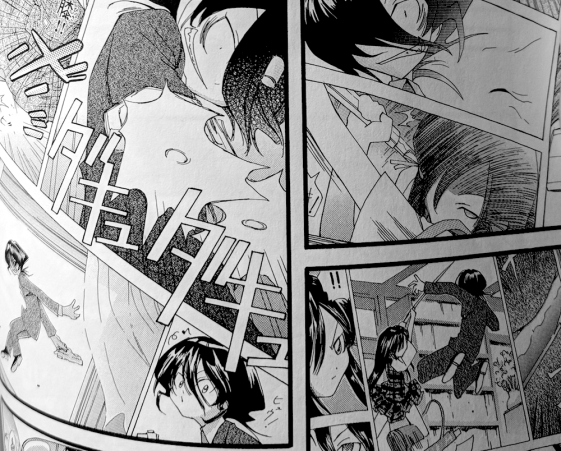
More revelations and events follow. Tanaka and Ohno have started dating. Madarame passes on the mantle of club president to Sasahara, who declares his intent for Genshiken to create a doujinshi to sell at ComiFes. The club even gains two new members: Kuchiki, a familiar face who was rejected from the Anime Society, and Ogiue, a standoffish otaku-hating girl who literally jumped out a second-story window to spite the other Manga Society girls. So Genshiken grows with two problematic additions.

Saki’s Remorse

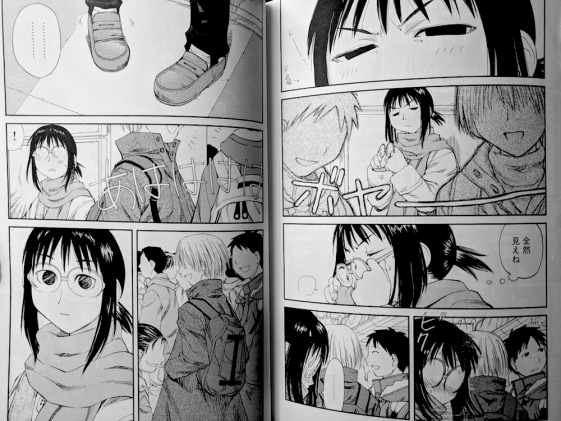
The way Saki’s guilt slowly eats at her, culminating in that single tear rolling down her cheek, is quite subtle. Her stoic expression as they move from one member’s apartment to the next in lieu of a club room is easy to miss. Even more significant is why she feels so bad about the situation.

It’s not simply a matter of being responsible for the fire, it’s that she sees how lifeless the others have become. It’s as if her actions have robbed them of the very space where they can open up and just enjoy being who they really are. This is where I think Saki truly becomes one of them—even if she’ll never be an otaku, she at the very least can empathize with their energy.

Later in Nidaime, when Madarame finally confesses to Saki, his thoughts go back to this moment: “I always knew that Kasukabe-san cries easily.” It was her first true moment of vulnerability in the series, and may be what planted the seeds of “Kasukabe is moe” in his head.

The Ritsuko Kubel Kettengrad cosplay she does in this volume is, in some ways, merely the icing on the cake. But what an icing it is!

The Cosplay Heard ‘Round the World

Saki’s cosplay is the catalyst for many future threads in Genshiken. It’s the moment Madarame confirms his own feelings for her. It’s what prompts him to get those photos of her, which eventually are found by Hato. It’s what leads to Saki pressuring Ogiue to cosplay as Renko from Kujibiki Unbalance.

Speaking of those Saki photos, I’ve always been fascinated by how they’re made to look more…lustrous…than the actual characters themselves, including Saki. It gives those pictures a kind of aura, almost like this is how Madarame sees her. Comparing the photos to the actual depiction of Saki, the difference is that the photos use screentone shading for her outfit, and that she looks comfortable and poised in them (as opposed to nervously sweating like in the image earlier).

There’s actually another moment related to this cosplay that I think marks the beginning of something special, which is a clear sign that Kio Shimoku is paying more and more attention to page composition.

In the above scene, we see from Kasukabe’s point of view as she tries out her Ritsuko cosplay for Ohno. For each panel, Ohno is in a similar position on the page, creating a clear vertical column that unites the page from top to bottom. At the same time, the fact that Ohno’s size varies relative to each panel gives it some variety and keeps it from feeling repetitive. It’s simple yet highly effective, and captures well the concept of “flow” in manga.

Tanaka: Best Friend and Boyfriend

Model kit and cosplay-loving Tanaka ultimately gets fewer dedicated chapters than many of the other characters in Genshiken. It’s sort of a shame, as the brief spotlights he gets here (though shared), point towards an interesting fellow. Not only do we get the sense that he and Ohno have been developing their feelings not-so-under the surface all along, but let’s not forget that he was the first of the “total dork” otaku to get a girl. As the characters themselves mention, it only makes sense. It’s not just that their hobbies overlap, but that their respective passions for their hobbies run equally strong.

The anime Genshiken 2 actually saw it fit to devote an episode to exploring the sexual side of Tanaka and Ohno’s relationship. In the manga, we only get Ohno’s lament that he still hasn’t made a move, and then towards the end of Nidaime we find out that he gets to see Ohno “only” once a week. Talk about progress!

Tanaka’s connection with Ohno is not the only highlight here. When most of the club finds out about them dating, it turns out Kugayama knew already because Tanaka told him. Here, you get the idea that they’re really close friends, arguably closer than any other two characters in a platonic relationship in the entire manga. By being a little more in the background, I get the sense that they’re having these private conversations on the regular, and we the readers are only privy to the crumbs.

Sasahara’s Ambition

The reason behind Madarame giving Sasahara the presidency is the interesting one. Essentially, he says that Sasahara is the one most true to being an otaku. From the perspective of 2017, this brings to mind the notion of “real geeks” vs. “fake geeks,” but it’s worth noting that Sasahara is the most inexperienced otaku out of all potential prospects (and Saki doesn’t count by not having a single otaku bone in her body). Ohno is well-known cosplayer with years of experience, and Kousaka is basically Madarame-level, but the big difference is that both Ohno and Kousaka are able to fully function in the world of non-otaku. Part of it is simply due to looks, but there’s a sense that what lies at the core of Genshiken as a club is personal and social dysfunction. If you’re able to function and thrive that easily among “normal folks,” can you be true to the spirit of the classic otaku?

The assumption that otaku will always be society’s rejects is also very telling in hindsight. After all, the whole Densha Otoko boom was about a year or two away at this point in Japan, and eventually Ohno does become president after Sasahara. The image of otaku begins to transform from those whose passions prevent them from being able to succeed to those whose passions help them succeed. It’s why Yajima in Nidaime is so self-conscious about her role in Genshiken—everyone else is attractive and/or successful, and Yajima is, in her own mind, fat and ugly and untalented.

But perhaps Sasahara is himself emblematic of this change. As soon as he becomes president, he declares his desire to create a doujinshi for Comic Festival, something that the club has basically avoided because none of them have the drive or the active desire to put in the hard work. After all, they did reuse their club presentation materials so much that the paper has started to brown. They’re slowly going from a do-nothing club to a do-something club, and a certain paintbrush-haired fujoshi eventually becomes central to that.

Ogiue Time

I had almost forgotten that, when we first meet Ogiue, we don’t quite know that she’s a closet fujoshi yet. We know she’s an otaku who hates other otaku for whatever reason, but it’s not until the next chapter that we see her get tempted by the Genshiken honeypot pile. She just comes across as an incredibly troublesome character with very brief glimpses of vulnerability, especially when Saki comforts her after Kuchiki puts a hand on Ogiue.

Because Ogiue is introduced alongside Kuchiki’s re-introduction, they’re presented as contrasts. Ogiue, coming from the Manga Society, is reticent, grumpy, and unwilling to open up to others. Kuchiki, coming from the Anime Society, is loud, spastic, and a little too lacking in a filter. Perhaps I’m biased, but I can see why Ogiue got more of the spotlight as the series goes on.

I think there’s a bit lost in Ogiue’s introduction in English versus the original Japanese. “My name is Ogiue, and I hate otaku” is a perfectly good translation, and it’s how I’d translate it as well. It sounds good in English, and it’s how English speakers typically introduce themselves: I’m [name] and I [do/like/am something]. But in Japanese, she says, “Otaku ga kirai na Ogiue desu“—”I am the otaku-hating Ogiue.” The very first thing she blurts out is her dislike of otaku and, as we later learn, her self-loathing. Maybe something like “I hate otaku. Hi, I’m Ogiue” would work better?

It’s also notable that Ogiue’s design is somewhat different at this point. Her side hair antennae are a little more angled, and her face is sharper. The character designs as a whole get a bit rounder over the course of the manga in general, but this specific version of Ogiue really gives off a “dangerous, do not touch” vibe.

Another thing to point out is how, while Ogiue’s eyes change permanently after she starts to date Sasahara, you see glimmers of it in Saki’s interactions with Ogiue right from the beginning. Saki’s quite good at breaking down walls, after all.

Final Random Thoughts

I need to make a correction to something I said back in Volume 2, which is that the original president never shows up again. But he does, right here in Volume 4! He dispenses some advice for Saki, that flits off to wherever wizened old otaku leaders go.

Last thing: One of the club discussions that crops up in this volume is comparing the Kujibiki Unbalance manga to the anime, where the former is inevitably considered better than the latter by its members. The anime is noted as having many more jokes, and overall being a crazier experience. What’s funny to me about this comparison is that it’s clear the Kujibiki Unbalance OVAs we got with the first Genshiken anime are trying to be the anime spoken of in this volume. It’s a bit of meta-humor for Genshiken fans, and it won’t even be the last time this sort of referencing occurs.

Save

Save

Save

Save

Save

Save

Save

Save

Save

Save

Save

Save

Save

Ogiue Maniax Chats About Zambot 3 on The Cockpit Podcast

I was recently invited on The Cockpit, a mecha-themed podcast, to discuss one of my favorite anime ever: Muteki Choujin Zambot 3. We get into what makes the show interesting and pioneering, and why it still holds up today for the most part.

If you want to read my old review of Zambot 3, you can check it out here.

And if you want to hear my previous Cockpit appearances, I’ve also been on to talk about Brave Police J-Decker, King of Braves Gaogaigarand Pacific Rim.