Glitter Force: Afraid of Sadness?

smileprecure-yayoidadWhat is appropriate for an audience of American children? This is a concern that comes up all the time with cartoons, whether it’s My Little Pony: Friendship is Magic‘s first season explicitly giving moral lessons to live up to its E/I (Educational/Informative) Rating, or the decision to change Japanese names to English ones when adapting anime. Though it feels out of place in this current era, the recent Glitter Force goes to great lengths to hide its Japanese origins as Smile Precure!, one of many series in the long-running Precure franchise. While the edits are not surprising, and obviously I’m not in the target demographic of little girls, I do worry about the point at which these edits hinder animation for children in terms of addressing difficult but important subjects.

When Glitter Force was first announced, it was described as having 40 episodes, down from the 48 in Smile Precure! Fans and curious onlookers speculated as to which episodes would be cut. With the first half of Glitter Force available on Netflix, we now know the first three.

curegorilla

Two of the episodes are clearly gone for being “too Japanese.” While we could have a debate as to what that even means, in this case it was because they were just too difficult to edit around. One is an episode about okonomiyaki, and while you can call it Japanese pizza all you want, kids know what pizza looks like. Saban wants their young audience to feel like the show is taking place in a city or town much like their own. Another episode guest stars actual Japanese manzai comedians. Not only are there potential likeness rights issues, but manzai comedy is notoriously difficult to translate. Again, makes sense.

The third episode cut is where my main concerns come up. Titled “Thank You, Papa! Yayoi’s Treasure,” the story involves Yayoi trying to recall memories of her late father. In an otherwise silly series, it naturally stands out as a serious and heartfelt story.

It’s not surprising why they would remove it. They want Glitter Force to be even more of what Smile Precure! is: a cartoon that generally emphasizes fun characters, positive female role models, and vibrant animation, which can then be used to sell toys. Even in Japan, series like Ashita no Nadja failed to be commercial successes possibly because of its moments of gravitas. However, decisions such as removing the story of Yayoi’s dad feel as if they contribute to the long-standing belief that cartoons for children can’t be serious, that they’re incapable of respecting children’s intelligence. Why can’t a fun kids’ show take some time to say something more, and maybe let parent and child feel sad together?

The tide of current children’s animation is actually going against this entrenched view. Shows like Adventure Time, Steven Universe, Avatar: The Last Airbender, and even to an extent shows like Kim Possible and American Dragon: Jake Long have brought weight and substance to kids’ entertainment. Glitter Force could have also contributed to this, and it might very well still be able to, depending on how they handle the second half, but things are looking grim. With five episodes on the chopping block, my worry is that they’ll cut the most character development-heavy episodes.

(Or even worse, the Happy Robo episode.)

I actually don’t think Glitter Force is that bad of a dub. The acting’s decent, the characters still look hilarious, and the edits they’ve made to bits of the story and such are odd but not deal breakers. I also understand where Saban is coming from, and given that they have all this successful Power Rangers money and all, they probably know more about marketing to American kids than I do with my obtuse-for-a-casual-audience anime blog. I can even see how Smile Precure! was probably the best fit for an American audience. That said, I’m not a fan of how they had to go to great lengths to write around the fact that Reika/Chloe is extremely Japanese, to the extent that they ended up removing her stern dedication to 道, “the path,” the seeking of truth and oneself. In Glitter Force, they replace it with “GF.”

sp705

I also feel as if I really cannot trust them with any other Precure series, especially not the stronger ones like Go! Princess Precure or Heartcatch Precure! If they can’t let a deceased father by, how are they going to handle Cure Moonlight’s path to redemption, Cure Flora’s introspective confrontation at the middle point, or any of the other equally powerful or memorable stories?

If you liked this post, consider becoming a sponsor of Ogiue Maniax through Patreon. You can get rewards for higher pledges, including a chance to request topics for the blog.

Future Boy: Genshiken II, Chapter 119

At long last, it’s the final date! Hato gets his turn with Madarame, but while their time together starts off with some comedy, it quickly turns into a very serious conversation that brings Genshiken back to a core theme: 2D characters vs. 3D relationships.

Actually, to be more accurate, the clash between “fantasy” and “reality” emerges from the very beginning. Just calling it a “date event” betrays the entire club’s otaku orientation; among regular people it would just be a “date.” From there, Hato starts to clearly delineate the differences between a biological woman and he himself who only dresses as a woman, namely that a crossdresser tends not to want people to get too close, otherwise they might recognize the truth. Though it ends with a funny moment where Madarame and Hato try out holding hands (did you know that Madarame has cold hands?), only to pull them apart after being spotted by the rest of the group, the tension is already set.

Though the dirty looks from Sue and Keiko (and Kuchiki) are magnificent.

Throughout the chapter you see Madarame use certain words that associate Hato with the the characters in the boy-girl (otoko no ko) games Madarame plays. He uses terms like “spice,” or “forbidden,” which eventually causes Hato to directly confront Madarame about what it would take to be in a homosexual relationship. Hato outright says to Madarame, “I’m a guy!” (pairing an effeminate “watashi” with a masculine “otoko”) and essentially asks if Madarame has really thought about what that means. If he actually starts something with Hato, then in the long term it won’t be a crazy alternative, or a thrilling experiment. Dating a man, even one that dresses convincingly like a woman, won’t be like seeing it in an anime or a visual novel, where no real consequences can occur. If he chooses Angela, Sue, or Keiko, then he won’t have to deal with these hardships.

I don’t know if I’m reading too much into this, but I think that implicit in Hato’s words is the awareness that gays are stereotyped and discriminated against in Japanese society. Picking Hato comes with it a future of tribulations, and the question is if Madarame is really prepared to take this seriously, or if it’s just a fetish at the end of the day that can’t move beyond fantasy.

Madarame’s response in turn, “Sorry,” then signals two things. Hato’s devastated reaction indicates that he’s not so much taken aback by Madarame’s apology, but the very nature of it. That’s because the “sorry” comes across as noncommittal, another case of Madarame vacillating because he still desires for the pieces to fall into place without him having to make any hard choices. Madarame has the potential to start a real relationship with Hato or any of the others, but he’s still afraid to make a decision. It calls back to the Madarame who originally decided to let his crush on Kasukabe slide by unrequited, and was willing to let it eat away at him for the rest of his life.

What I also find fascinating about this entire situation is that it not only subverts that harem aspect of the series, but that it’s a strong reminder that the qualities that have made Madarame somehow charming to these prospective partners are also the very things that can aggravate them. He’s both his own best friend and his own worst enemy, and I believe it keeps the series from truly entering actual “harem” territory.

The question of how Madarame will engage with the reality of having a flesh and blood partner is what I think makes Ogiue’s appearance at the end so interesting. As stated in the chapter itself by Ogiue, Hato’s running away from Madarame mirrors Ogiue trying to reject Sasahara out of fear of both hurting others and being hurt. However, I also feel it’s not really the same situation.

Sasahara hesitated because he was a naive dork who couldn’t read between the lines. Even though he recognized his own feelings for her at that point, when Ogiue told him that she couldn’t date guys, Sasahara took it at face value and almost gave up as a result. Madarame, on the other hand, has to decide whether his feelings are for Hato the person or Hato the image, and whether he’s willing to take a much more difficult road in the process when he clearly has three less troubling options moving forward that he also seems to have feelings for.

Writing all of this out, it makes me realize that Madarame’s hesitation can also be interpreted as wanting to make certain that he makes the right decision. He’s been raised to believe that romance is a special thing, a world of childhood friends and deep bonds that are anything but frivolous (though at the same time sex is raunchy and powerful). It might be another angle worth exploring.

Angela believes that Madarame clearly has eyes for Hato. We’ll see if she’s right.

If you liked this post, consider becoming a sponsor of Ogiue Maniax through Patreon. You can get rewards for higher pledges, including a chance to request topics for the blog.

My Shirona: Nendoroid Cynthia and the Sinnoh Champion’s Amazing Popularity

nendoroidcynthia-official_pose-closeup Merry Christmas from the Sinnoh Champion!

This year, I received from a very good friend of mine an awesome gift I wasn’t expecting at all: Nendoroid Cynthia! Also known as Shirona in Japan, as well as “the best Pokemon champion ever” by most fans of the franchise, her presence continues to be felt over 9 years after her debut in Pokemon Diamond & Pearl.

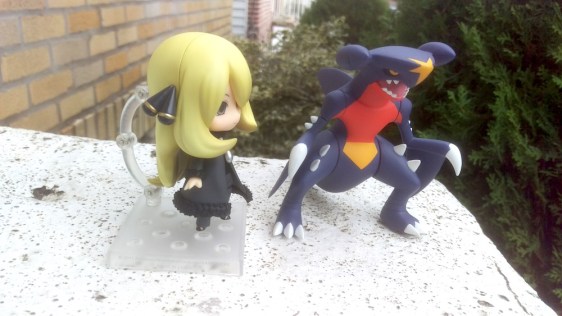
As you can see, Cynthia comes with one slightly bent leg and one bent arm so that you can faithfully recreate Cynthia’s pose from her official artwork. The attention to detail on this figure is so good…it comes with a second figure!

nendoroidcynthia-garchompfocus

I knew beforehand that Cynthia came with a Garchomp, but I didn’t realize how large it actually is relative to the Cynthia Nendoroid. It’s a crazy time we live in where the accessories for figures are at a higher quality than what official merchandise used to look like back in the late 90s for Pokemon.

nendoroidcynthia-sideview

Though I originally wanted to just show off Nendoroid Cynthia, I ended up also thinking about the fact that she got a Nendoroid figure in the first place. Consider this: Cynthia is only one of two Pokemon characters to get a Nendoroid in the first place. The other? That would be Red, the original protagonist of the Pokemon series.

That means, more than Misty, Brock, Lorelei, Lance, Flannery, Roxie, or any number of other characters, Cynthia is a fan favorite and flagship character. To a certain extent, given the excitement of battling her, the personality she shows throughout the games, and even her overall visual design, it’s not surprising that she is so beloved, but she seems to have some other “X Factor” that puts her over the top. In comparison, Diantha, the XY Champion, seems to get hardly any fanfare. Maybe it’s her amazing battle theme:

So do you think Cynthia’s popularity is justified? Is there any Pokemon character you’re dying to see as a Nendoroid? Just the fact that Nendoroid Pokemon characters are even a thing still amazes me.

If you liked this post, consider becoming a sponsor of Ogiue Maniax through Patreon. You can get rewards for higher pledges, including a chance to request topics for the blog.

[Anime Secret Santa 2015] The Possibilities of Adolescence: Simoun

simoun

My first exposure to Simoun came about 10 years ago, when many of my online friends had been discussing the series. As my friends were fans of cute, sexy girls, and girl-girl relationships of both the Ikkitousen and Maria Watches Over Us variety, at the time I had felt it difficult to genuinely gauge the series based on their positive responses. Though my wariness caused me to set aside Simoun as an afterthought, more recently it was chosen for me to review as part of the 2015 Reverse Thieves Anime Secret Santa. Having finished the series  I realize now that I had unfairly judged Simoun for its surface qualities, and that is in fact a very strong, emotionally-oriented science fiction story that fits in and exemplifies a long and evolving tradition of science fiction anime and manga.

In the world of Simoun, everyone is born a girl and choose their genders when they become adults. The main character of Simoun, a teenager named Aer, joins the Sibyllae, priestesses who fly divine vessels known as Simouns. The Simouns and the priestesses, normally meant to fulfill a religious role, are also thrust into conflict because their vehicles can be weaponized, though unlike conventional crafts they fight primarily by inscribing patterns across the sky that trigger magical effects. The key to the Simouns, and why Aer and the others are chosen to be Sibyllae, is that they can only be piloted by those who have yet to become adults. Simoun Sibyllae form close bonds with their co-pilots, signified by a kiss before they take flight.

Sometimes there will be an anime where where you can maybe argue that it’s concerned with gender and sexuality, women’s rights, and other similar topics, but that requires a fairly loose reading. Simoun is not one of those anime. It is a work, and a world, where questions about sex, gender, and sexuality are front and center. For example, while it’s not difficult to see why Simoun is labeled as a yuri series, in many ways it defies that categorization. Though everyone enters the world as a girl, the paths they make towards their ultimate choices are contingent upon the circumstances of their world, who they fall for, and how they go about navigating their lives in general. Children who fall in love as girls might both become women, or men, or any combination.

I have to stress how much this series plays with the ideas of gender and sexuality, because it’s such a major factor in Simoun. Girls, as they become adults, slowly transform into their new bodies, so a girl, even a buxom one, will only start to resemble a man after a few years. While the idea of transitioning between sexes is nor considered the norm in our world, in Simoun this is just the natural way of things, both physically and culturally. One interesting choice Simoun makes to emphasize this fact is that all characters, from children to bearded old men, are voiced by women.

Simoun features a very emotionally and environmentally robust science fiction narrative that interestingly is tied strongly to the emotional weight of its characters. Romance is a part of their world, but it’s not their entire world. Other countries attack Kyuukyoku because the Simouns do not pollute the sky like their own aircraft. The war itself is ever-present, and the Syballae put themselves on the line, but they’re shown to also be somewhat disconnected due to their positions as religious figures. The girl-girl kissing that happens before every battle might be seen as a thrilling yuri moment, but it’s not necessarily the case that the characters need to form romantic relationships to fly their Simouns.

The very power afforded those who have yet to become adults, the power of potential, is integrated into the very core of the narrative and its explorations of this alternative universe. Even the Simouns themselves have a certain bizarre quality in their designs that make it difficult to ascertain how much they’re truly divine aircrafts and how much they’re simply highly advanced technology.

Part of the reason I had my slight misgivings over Simoun back then were that the character designs are very reminiscent of more fanservice-oriented series. While I myself like the designs, and Simoun does not have a great amount of sexual allure on display, it’s enough in its promotional materials and its general aesthetic that one could,  even while watching the show, take only shallow titillation from it. This isn’t inherently bad, but I can imagine there are others like myself who approached the series with an eyebrow raised because that was all it appeared to be. Moreover, there are elements that might have come across as merely fulfilling certain fetishes, such as large age differences, incest, and more. However, they are for the most part developed well, and exist as a few of many possible relationships in the world, and just in general I do not feel like they hold back Simoun to any large degree.

Overall, I would highly recommend Simoun to just about anyone, but especially those who want to see an anime that fosters thought and discussion. It presents a unique and robust world of utopian/dystopian imagination full of limitations, possibilities, and unique characters.

If you liked this post, consider becoming a sponsor of Ogiue Maniax through Patreon. You can get rewards for higher pledges, including a chance to request topics for the blog.

Save

Love, Shogi, and World Domination: 81 Diver

greatuglymanga-81diver-020001-small

At long last, after many years and 35 volumes of manga, I have finished the exhilarating, hilarious, ugly, and beautiful shogi manga known as 81 Diver. Its bizarre narrative and even stranger art work captivated me from the very beginning, and now that I have seen this series to its end (one of the three series I followed intently that have concluded recently), I want to write to confirm that 81 Diver not only ends strong but in many ways either matched or exceeded my expectations.

81 Diver is the story of Sugata Kontarou, a failed shogi [Japanese chess] player who has taken up gambling through shogi to make ends meet and to fulfill his love of the board game. One day, he decides to order a maid service to clean up his apartment, and discovers at his doorstep an absolutely voluptuous redhead as if out of a fantasy. However, this maid has another identity as Akihabara’s strongest shougi player and a gambler just like Sugata. Known as “Ukeshi,” what translates loosely to “master of defense,” Nakashizu Soyo (as we later learn her name) has her own mission in life: to avenge her brother and father who were both killed by shogi.

As the series progresses, the characters wind up not only challenging and befriending a variety of powerful shogi players and for some reason martial arts experts (actually it’s because the author Shibata also wrote Air Master), but end up in a tournament to save the world from the Kishoukai, the “Demonic Shogi Organization.” The amounts of ridiculous twists and turns this series goes through are almost too many to count. As crazy and as strangely epic as this sounds, however, what really makes 81 Diver special is that the art looks like this:

When discussing the character Kiryuuin Satsuki in Kill la Kill, I once wrote that she has so much presence and so much inner strength that it is the very first thing you notice even as she’s wearing the most ridiculous and revealing outfit possible. I find 81 Diver‘s portrayal of Soyo to be of a similar vein. Sometimes there will be pages of her character where half of it is occupied by a shogi board and the other half is taken up by her enormous chest. At the climax of the manga, her breasts become one of the central points of conflict. And yet, her raw shogi power level is what stand out most about her.

The difference is that, while Kill la Kill achieves this through incredibly well-rendered, stylized, and intense artwork, I ended up including 81 Diver as one of the many titles at my Otakon 2015 panel, “Great Ugly Manga.” On some level, this is clearly on purpose, but it’s also clear, especially given Shibata’s guest essay manga in Gundam: The Origin, that he’s making the best out of what he has, and what he has is a lot of spirit and not a lot of conventional drawing talent.

greatuglymanga-81diver-02-small

I would not call 81 Diver an intentionally feminist or progressive work, especially given all of the attention given to girls’ bodies, but it is notably diverse in its cast. There’s an admirable homosexual character who isn’t stereotypically flamboyant, who also dresses like a tokusatsu character and shoots rocket punches. There are also numerous romances between unlikely individuals, and what stands out most is the strange romance between Kontarou and Soyo that portrays them as equals above all else.

When you look at many shounen and seinen manga, there is often something of a lopsided relationship where love interests aren’t allowed to be as prominent in the particular subject focus of the manga (be it sports, fighting, or whatever). Not so with 81 Diver. Though Soyo is dressed in maid outfits throughout the series, and though she will sometimes playfully call him “master” as a callback to how they originally met, at the end of the day they are bonded by their mutual skill and passion for shogi. In fact, when the series begins Soyo is clearly Kontarou’s superior, and when they are able to play again much later in the series, it is one of the most satisfying duels I’ve ever seen in manga.

As mentioned by the characters, the characters fight as if they’re communicating their love through the game of shogi itself. When you see the two of them play, you genuinely don’t know who’s going to win because, even if you set aside the idea of skill in favor of narrative progress, both characters have convincing reasons why they need to win. Ultimately, I love the way they resolve all of this, but I won’t say more so that it remains a surprise for readers.

I could probably write a whole series of posts on 81 Diver, and in fact I’m quite tempted to do so. Suffice it to say, 81 Diver comes highly, highly recommended from me. If you can get past or even embrace the terrible (or perhaps terribly endeaering) artwork and style, it becomes one of the funniest, surprising, and involving manga you’ll ever read.

If you liked this post, consider becoming a sponsor of Ogiue Maniax through Patreon. You can get rewards for higher pledges, including a chance to request topics for the blog.


Growing Up in a World of Monsters – Digimon Adventure tri. 1: Reunion

Screen Shot 2015-11-23 at 8.05.03 AM

Digimon Adventure, known around the world as simply Digimon, is an anime that helped to define a certain generation of fans. For many, it was either the anime, or the the other anime, relative to its thematic rival, Pokemon. Where Pokemon was about traveling in a world where monsters and humans co-exist, and the stakes were generally about winning tournaments, Digimon was about traveling to an alternate digital world of monsters and saving the world. Where Pokemon generally had a core cast of three, Digimon had over twice that amount. Perhaps most important for our purposes, where Pokemon‘s characters seem to remain eternally young, Digimon‘s characters would age.

This brings us to Digimon Adventure tri., a direct sequel to the original two Digimon anime. Taking place with its main cast now older and in high school, main character Yagami Taichi (Taichi Kamiya in English) and the others have long since lost contact with their old Digimon friends as they transition from childhood to adulthood. Suddenly, Digimon start appearing in the real world, prompting the old team to reunite with the Digital World.

Screen Shot 2015-11-23 at 8.08.46 AM

Digimon Adventure tri. is very intentionally a more mature series than its prequels, though not in the sense that it’s supposed to be “darker.” Rather, between the more subdued character designs, a general aesthetic that’s closer to the Hosoda Mamoru-directed Digimon movies than the TV series, a new version of its beloved theme song Butterfly featuring hints of melancholy, and just the portrayal of the subtle turbulence that comes with being of high school age, Digimon Adventure tri. is aimed towards the young fans who are now adults themselves (or close to it). The series says, “We’ve grown up with you, and we know what it’s like.”

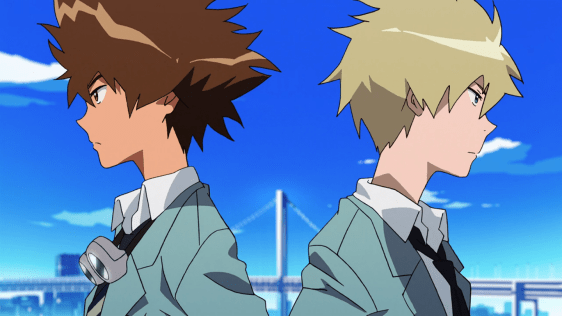
For example, Kido Joe, the straight-laced and responsible one, is now being consumed by college entrance exams, and Taichi himself feels like he can no longer charge ahead like he used to when he was the de facto team leader of the Chosen Ones (“DigiDestined”). This is not to say that the new series is a total downer, stripped of any of the joy and wonder of the original anime. What I think they’re going for, instead, is a kind of rediscovery of those simpler and more magical times, while grounding that kind of experience in the process of becoming adults.

Screen Shot 2015-11-23 at 8.07.27 AM

Screen Shot 2015-11-23 at 8.18.24 AM

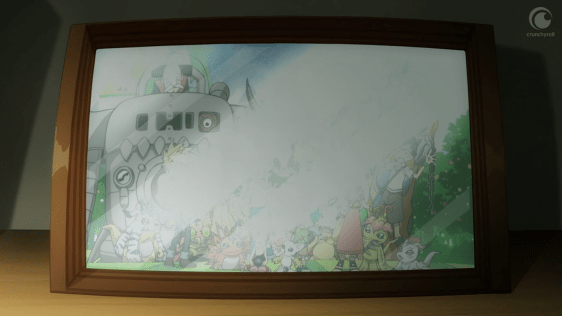
Digimon Adventure tri. actively works to maintain a strong connection with the original series, and a lot of attention is paid to continuity as a result. Whereas Taichi and the older kids have their original DigiVices, the portable tools based on the original hand-held Digimon virtual pet, the younger Hikari and Takeru (“TK”) have different ones, a nod to their continued battles in Digimon Adventure 02. Somewhat similarly, the story is set very intentionally not in 2015 but somewhere in the mid-2000s, as reflected in the technology. Most cell phones are flip phones with number pads, and no smart phones are in sight. It’s not like failing to do these things would have made it a worse series, but it shows that, to a large extent, Digimon Adventure tri. aims to evoke strong feelings of nostalgia for both for the franchise itself and for those who know what it’s like to be a teenager.

Screen Shot 2015-11-23 at 8.15.02 AM

Screen Shot 2015-11-23 at 8.15.51 AM

There are a couple of notes that I feel the need to point out for the die-hard fans (I know you’re still out there). First, if you watched this series dubbed in English (or perhaps other languages, I’m not sure), the lack of dialogue and constant banter might seem unusual or even off-putting. The original Japanese versions of Digimon had a lot more “dead air,” that is to say long moments of silence, and adding music or dialogue to fill space is an old American television tactic that you could also see in the dub for Pokemon. Digimon Adventure tri. uses even larger periods of silence and its unsteady atmosphere (perhaps all the better to convey that feeling of becoming adults), so it’s something to expect going in.

Screen Shot 2015-11-23 at 8.12.33 AM    Screen Shot 2015-11-23 at 8.19.23 AM

Second, you should know that the plains of the shipping wars are revived and more serious than ever. While the previous series had some hints of romance (or maybe more if you count the controversial time-skip ending of Digimon Adventure 02), relationships are nearly front and center in Digimon Adventure tri. There’s a clear love triangle between Taichi, Sora, and Yamato (probably the site of the most fierce battles). Koushirou (“Izzy”) clearly has a powerful crush on Mimi. Takeru and Hikari tease each other about their mutual popularity among the opposite sex. If you had any stake in these old battles, the series might very well draw you in like honey.

As of this first movie (split into 4 episodes on Crunchyroll), it’s clear that Digimon Adventure tri. won’t give viewers the same experience as the original anime from over a decade ago. Unlike Pokemon, which tries its best to maintain the same constant feel (though to be fair there have been subtle changes in that series over the years), Digimon Adventure tri. wants you to know that the characters have grown, that their inner and outer (and perhaps even digital) worlds have changed as a result, and it’s inviting you back to take a look. The next film/batch of episodes won’t be out until March 2016, so you’ll have plenty of time to catch up.

Screen Shot 2015-11-23 at 8.04.51 AM

If you liked this post, consider becoming a sponsor of Ogiue Maniax through Patreon. You can get rewards for higher pledges, including a chance to request topics for the blog.

Hammer Connect!: Ogiue Maniax Discussing Gaogaigar on the Cockpit

As a long overdue follow-up to our discussion on Brave Police J-Decker, I was invited along with the Reverse Thieves‘ Kate to talk about King of Braves Gaogaigar on Space Opera Satellite’s “Cockpit” series. Many have called it the best show in the Brave franchise, and it’s been 10 years since I first finished Gaogaigar, when that sentiment was at its strongest.

For your reference: Silverion Hammer

The real question is, why are there so few King J-Der toys?

Nendoroid Tomoyo, Champion of the Universe

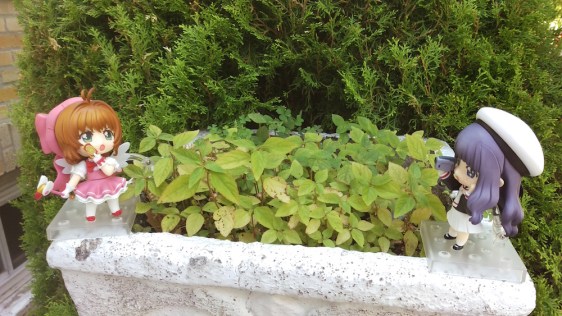
nendoroidtomoyo-sutekidesuwa

Daidouji Tomoyo from Cardcaptor Sakura is one of my favorite characters ever, from one of my favorite anime ever, and if you’re not a fan of Tomoyo… what’s wrong with you? Whereas normally I would hesitate to buy even some of my most beloved heroines, Nendoroid Tomoyo was a no-brainer. Upon seeing it go up for pre-order, I hit purchase and looked back with zero regrets. Sakura merchandise is common, but Tomoyo much less so, and I couldn’t let this sort of thing pass me by.

nendoroidtomoyo-sakuradistant

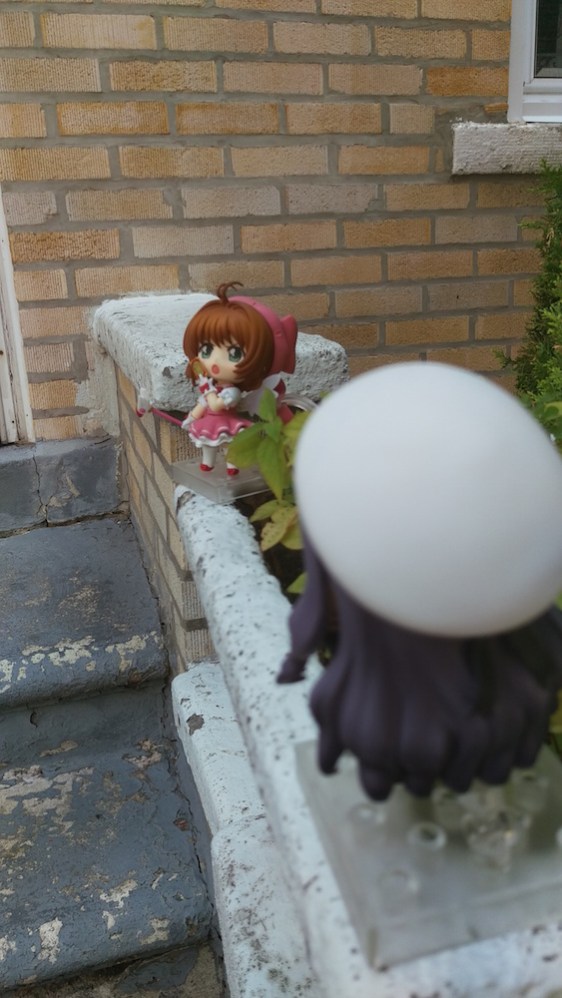
I don’t own a lot of Nendoroids. In fact, my first one was a Kinomoto Sakura (seen above) that I received as a birthday present. Quite smartly, my friend purchased it because he (correctly) expected that I would not hesitate to pick up Tomoyo. Thus, I don’t have a lot to compare to, and I’m extremely biased, so I’ll call this less a review and more of a celebration.

nendoroidtomoyo-closeup

Nendoroid Tomoyo is mostly based on her anime design, as opposed to the softer shoujo look of the Cardcaptor Sakura manga. However, one thing that they did bring from the manga was a hint of Tomoyo’s lavender hair; in the anime it’s more of a gray. When I think about it, rarely do figures try to replicate the look of shoujo manga, likely due to how complicated and not designed for 3-D they are. At least with anime, you can rely on more solid colors.

Tomoyo comes in a standard Tomoeda Elementary school uniform, and has a choice between a hat or a hairband, as well as smiling and ecstatic faces. I’ve gone with the hat + sparkly eyes combo for these photos in order to achieve maximum radness, but what really takes this figure over the top is the inclusion of her signature camcorder.

Remember kids, this anime was made in the early 2000s, before mobile phones could take HD-quality video. Back in her day, Tomoyo would have to walk 20 miles uphill both ways in the snow in order to film her lovely Sakura-chan and add to her massive archive of Cardcaptor Sakura footage in her private viewing room inside of her mansion, under watch by her squad of lady bodyguards.

nendoroidtomoyo-withsakura

It’s supposed to have a swing-out screen, but a small missing part makes it impossible to attach. I’m not sure if it was defective or if I had simply lost it while taking it out, that’s how tiny the connecting piece. The other flaw is that the giant head is rather unwieldy, especially with the hat, and sometimes moving it around can cause Tomoyo’s noggin to fall off.

Overall, it’s a fine addition to the collection, and when I think about it, I am fortunate that the characters I like tend not to get a ton of merchandise. That’s what I would say…if I didn’t get into Love Live. That’s for next time.


Aquarion Logos Has a Way with Words

Wordplay has always been important in the Aquarion franchise. Generally set in a world where love reincarnates thousands of years in the future, many solutions across both the original Genesis of Aquarion and Aquarion EVOL literally come out of transforming words in order to access a plethora of elaborate giant robot attacks. Even as far as those series go, the latest incarnation, Aquarion Logos, takes this love of language manipulation to a whole new level, positioning it as the most prominent factor. For a lover of puns such as myself it makes for a fascinating series, not only because it’s often quite clever, but because Aquarion Logos looks at the very way in which people perceive words.

In the original Aquarion, the Japanese title was Sousei no Aquarion, where sousei (創聖) means “construct” and “holy.” Hence, its English translation is “Genesis.” When characters combine their robots, they say, “Sousei Gattai,” or Genesis Combination. Already this is where Aquarion Logos takes a different angle. In that series, sousei is written with the Japanese kanji for “construct” and “voice” (創声). Translated into English as “verbalism,” it represents the fact that the main pilots in the series all have a talent for bringing words into reality. Whether they’re aiming to be a politician, a comedian, or indeed a “savior” as the main character Kaibuki Akira does, they believe in the power of language, and can almost literally walk the walk by talking the talk. When characters shout “Sousei Gattai” in Aquarion Logos, it thus takes on a completely different meaning.

The ways in which words are used becomes the central conflict of at least the first half of the series. The villain, a man named Kenzaki Sougon, is able to travel into the very world where words exist and transform them into creatures called “M.J.B.K.” Pronounced mojibake (literally “word monsters”), these enemies of the week (again, giant robot show) devour the words on which they are based, manipulating their presence in reality. Because of the way kanji works, many other ideas are eradicated as well. For example, in Episode 1 the M.J.B.K. is created from the word maki (巻), which means “roll,” causing things to get twisted into knots, but it’s also the word used to mean “volume” as in “volume 1 of a manga,” which causes that concept to disappear as well.

Sougon believes that people have sadly lost their connection to the origins of words, that the power of words comes from the desire to communicate what exists. Words are in service to reality, and forgetting that means words become useless. In contrast, Kaibuki Akira goes the opposite direction. He draws on the creative potential of words as a way to construct reality. The key example of this is the fact that Akira frequently refers to himself as a “savior,” and tries his best to just constantly save people. When asked why he’s a savior or why he’s so hung up on the idea, it turns out that there’s no particular reason. He takes the meaning of the word itself and makes it into reality through his actions, fulfilling its potential. The Japanese word for savior, kyuuseishu literally means “one who saves the world,” and that’s what Akira aims for.

In Episode 13 the team fights a particularly dangerous M.J.B.K. that represents Mu, or nothingness. Written as 無, perhaps people might recognize it as the symbol used by Gouken in Street Fighter IV. Sougon uses it because the power of nothingness is able to consume other words and concepts, but Akira responds by saying that nothingness also means endless possibilities. At this point, he and his co-pilot Maia utilize the signature attack of the Aquarion franchise, the Mugenken, or “Infinite Punch.” Mu is one half of the word for infinity. At another point, as the world risks being reduced to that nothingness, the word “savior” carries the potential for recovery, as it consists of the characters for “help,” “world,” and “person.” What else is needed to start over other than these concepts?

Aquarion Logos is both a powerful and silly anime, and intentionally so. It’s potentially a difficult series to watch because of how prominent kanji is, making it a bit obtuse for those unfamiliar with Japanese, particularly because English and other languages don’t necessarily utilize symbols in the same way. So far, many of the references are to the original Aquarion, but Episode 13 drops a possible callback to Aquarion Evol, so it’ll be interesting to see how things develop now that the second half has been under way.

How the Gorgeous Food Manga Mogusa-san Does Side Characters

I recently picked up Volumes 2 through 5 of one of my favorite manga in recent years, Mogusa-san. Featuring a girl who eats anything and everything and has developed seemingly superhuman skills in order to get as much food in herself as possible without anyone noticing, it’s basically a series made just for me. One question that arises from reading Mogusa-san is, how do you keep this premise going? What kinds of characters do you introduce as complements or foils to Mogusa herself? The answer is, a closet picky eater who has some of the qualities of a tsundere without necessarily falling squarely into that archetype.

mogusasanvol3-chigumi-small

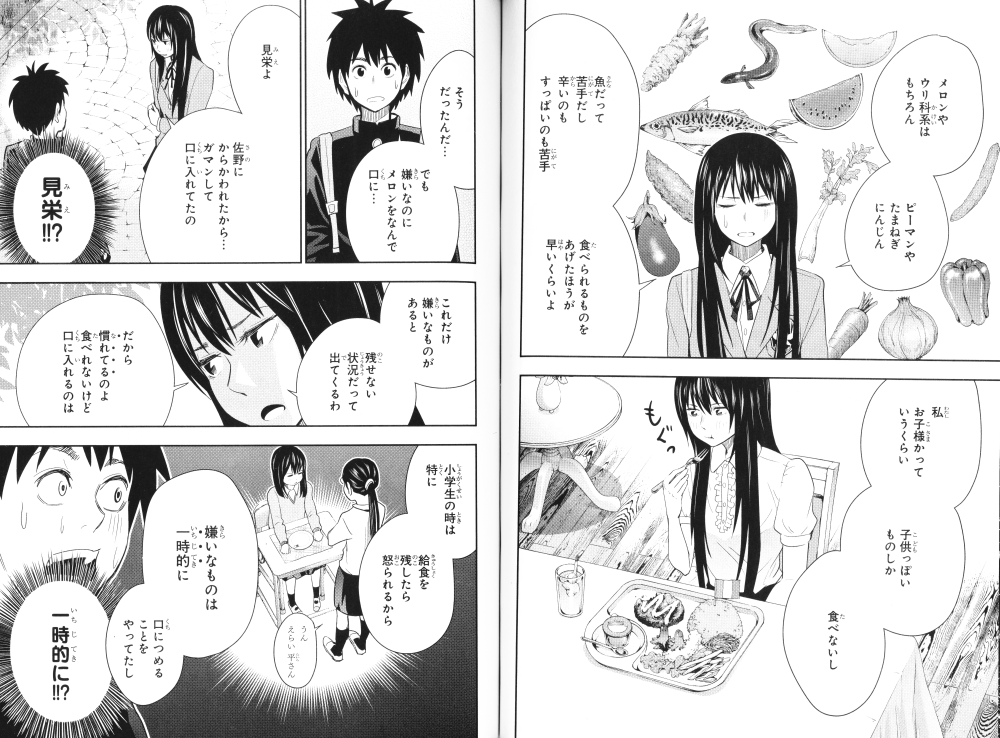
Taira Chigumi is the president of Mogusa’s class, and a seemingly strait-laced, no-nonsense individual. However, she harbors a deep, dark secret: she has the palate of a 10 year old. That means hamburg steaks and gummy candies are in, tomatoes and fish are out. Of course, she has an image to uphold, so she’s learned to basically keep gross foods in her mouth without swallowing them, and then force them down with a helping of coffee milk.

It makes sense in a way: opposite a girl who eats anything is a girl who eats almost nothing, and the added twist of giving her the taste buds of a child makes her rather endearing. When Koguchi (the male POV character) discovers her secret, she responds by violently attacking him. On the surface, this appears to be the stereotypical tsundere reaction, but it’s a little too active and conscious for that to be the case. Tsundere characters are usually based around having an almost involuntary reaction to embarrassment and having their true selves revealed (as parodied in the manga Mozuya-san Gyakujousuru, about a girl with tsundere as a form of clinical disease). Also, rather than having her priorities be love or the denial thereof, Chigumi simply wants to be friends with Mogusa because she sees how Mogusa just seems to love food more than anything else, and maybe, just maybe, if she spends enough time with her, that this quality will rub off on Chigumi as well.

mogusasanvol3-corn-small

Chigumi isn’t the only character who adds to the world of Mogusa-san, as it also features a little sister who eats character-shaped foods as if she were a Titan from Attack on Titan, and even an eating rival. Suffice it to say, I recommend this series 110/10. No, that’s not a typo.

If you liked this post, consider becoming a sponsor of Ogiue Maniax through Patreon. You can get rewards for higher pledges, including a chance to request topics for the blog.