Old Spice’s Isaiah Mustafa vs. Terry Crews is the Batman vs. Superman of This Generation

Commercials about deodorant are not a common topic on Ogiue Maniax, a blog dedicated to anime and manga discussion. However, one thing that anime, Old Spice in 2015, and superhero comics have in common is a love of crossovers in varying capacities. With Old Spice, this comes in the form of ads where its two biggest spokesmen, Isaiah “Hello Ladies” Mustafah and Terry “POWERRRRRRRRRRRR” Crews pit their respective deodorants against each other. It’s been a long time coming (and basically instant money for Old Spice), but what stands out to me about these commercials is just how much they actually pay attention to keeping their respective superhuman abilities consistent as they’re utilized to both entice the viewer and outdo each other.

738px-Lupin_vs_Conan_Movie

When placing characters into a crossover, especially one that involves a direct conflict, what’s important is maintaining the strengths and identities of the characters being brought together. Superman is immensely strong, unbelievably fast, and has a variety of astounding abilities, while Batman is extremely intelligent, excels at planning, and puts in more effort than anyone else. Detective Conan is a master of deduction and observation, while Lupin III is renowned for his deception and improvisation. When these characters meet, there is ideally a clever interaction that enhances their mutual reputations, and that’s what happens when Isaiah takes on Terry.

Both Isaiah Mustafa and Terry Crews exhibit reality-bending powers in Old Spice commercials, but they’re uniquely different when compared to each other. Isaiah’s “ability” is that he can quickly and seamlessly transition one environment or object to another without a moment’s notice, owing to his status as the ultimate ladies’ man. Terry essentially invades space through the sheer power of his intensely hyper-masculine personality for men, cloning himself, appearing where he shouldn’t, and even blowing himself up. What you see in these series of commercials is how the two try to one-up and counter each other with their specific skill sets, a battle of equals who realize that the other is just as potent and manly as the other, only in different ways.

Basically, while it’s always been clear that a lot of thought is put into Old Spice’s recent commercials, what we see here is an actual consideration for Isaiah and Terry as unique, superheroic characters. Isaiah can’t do what Terry can and vice-versa, and never is there a conflation of what the two are capable of. It’s the superhero duel the world has been waiting for, and in a way I hope it comes to define and influence all future crossovers in mainstream media and advertisement.

If you liked this post, consider becoming a sponsor of Ogiue Maniax through Patreon. You can get rewards for higher pledges, including a chance to request topics for the blog.

Story is Not a Side Dish in Love Live! The School Idol Movie

lovelivemovie

Love Live! is huge, no doubt about it, and I would say deservedly so. Between the quality of the anime TV series, the appeal of its characters, the addictive nature of its mobile game, and of course the slew of songs produced, in a way it’s no wonder that Love Live! manages to attract both male and female fans in large numbers. I attended the New York City premiere for Love Live! The School Idol Movie, and as expected was greeted with a long line full of cosplayers, glow stick wielders, capes adorned with the characters’ faces, and just generally fans who love the main idol group so much that they practically treat the showing like a live concert. Watching the movie amidst an audience of differing values and perspectives, what I found most interesting is how the movie juggles all the various aspects that go into the franchise while maintaining both a fun experience and a solid narrative, and which speaks further to how malleable Love Live! is as a fan experience.


Synopsis and General Thoughts

IMAG0635

In the world of Love Live! are idol groups that represent specific high schools. Kousaka Honoka, a new attendee at Otonokizaki High School, forms a “school idol” group called μ’s along with eight other girls so that they can save their school from rapidly declining attendance and closure. Eventually, through various trials and setbacks, they not only manage to keep their school, but win the biggest school idol competition, the “Love Live,” defeating the defending champions A-Rise in the process. However, because they cherish the specific circumstances and experiences that brought them together, they decide that they will retire μ’s and its name. As the TV series, ends, however, they receive a note of great importance, leading directly into the film.

The note turns out to be a request to fly to New York City and shoot a live performance to promote a bigger and better Love Live, which results in the film being split into two parts: first, the trip to NYC, and then the build-up to a concert back in Japan. Given the first half, I find that there’s something special about attending the NYC premiere, especially because of how much care and attention they put into replicating New York’s landmarks at overall atmosphere. Jogging through Central Park, visiting the new World Trade Center, what stood out to me in particular were actually the restaurants. Visiting thinly veiled analogues for such NYC institutions as Junior’s (where they experience American cheesecake for the first time) and Japanese restaurant Kenka (where the surrounding St. Mark’s Place atmosphere is captured surprisingly well), it’s clear that the people responsible for the movie did their research, and in terms of capturing the NYC experience they did a good job.

As for the second half of the movie, it’s very much designed to conclude the story of the nine girls of μ’s, which in a way is a major surprise. Not only would it be obvious to have their adventures continue forever given their appeal (and I’m sure they’ll find a million ways to extend the overall life of the group), but the film doesn’t even mention the fact that they’re creating another anime with a new group of girls aspiring to be school idols. One of the criticisms of Avengers 2 is that it feels like a stopgap between two different status quos, and it would have been all too easy to feature the new girls in the movie conspicuously as a way to promote them. In fact, there’s nothing of the sort, at least as far as I can tell. This movie, whether it’s truly the end or not, at least feels like a conclusion to a long and entertaining journey.

As a film that’s supposed to be both the sequel and bookend to the story of μ’s, I find that Love Live! The School Idol movie strikes a good balance of calling back to beloved moments of the TV series, being its own story, and giving enough time and energy to each of the characters without having them overcrowd each other. Some figure more prominently into the main narrative than others, especially in the second half, but there was clearly a lot of effort made to keep the movie tight and not to bog it down with having to showcase each girl like it was a fighting game movie. Notably, entertaining musical numbers group the girls together by year (there are three 1st years, 2nd years, and 3rd years among the group), with one girl in each group being the “center,” and are in a way reminiscent of a Fred Astaire movie.

The Characters of Love Live! in The School Idol Movie and Beyond

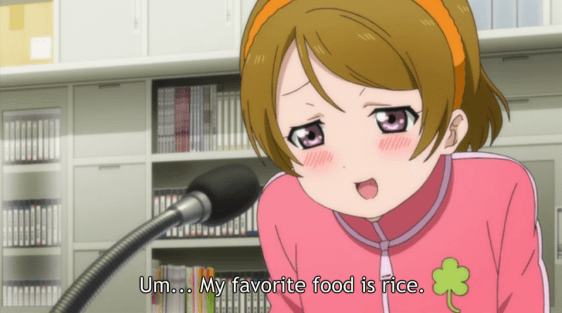
A lot of the time, what makes Love Live! work is that the characters’ key traits allow scenes to practically play themselves out, and this comes across very well in the movie. For example, certain characters have their favorite foods. Kotori loves desserts and sweets, so naturally she would view America and New York as a never-ending wonderland. In contrast, Hanayo loves food in general but reveres plain white rice above all else, and suffers in an environment that emphasizes bread and pastries and considers rice merely a “side dish.” In such a circumstance, the normally quiet and reserved Hanayo would act out. It only makes sense for Umi to be a nervous traveler, for Maki to be flustered by a close interaction with A-Rise’s leader Tsubasa, and so on. It’s moments like these which capture the appeal of the characters so well, while tying them into the story.

IMAG0633

There are a lot of different values carried in Love Live! fandom, and given people’s differing opinions on favorite characters (Hanayo is the best), level of interest in yuri, amount of fondness for idols in general, and more, it occurs to me that one of the strengths of Love Live! is that it has as much or as little “depth” as you want it to. Take the character of Nico, who’s also by far the most polarizing figure among Love Live! fans. Her appeal (or to some lack thereof) comes from the fact that she’s both the most cynical and optimistic member of μ’s when it comes to being a school idol. She’s sort of like a pro wrestling fan who knows all of the behind-the-scenes information behind wrestlers’ real personalities and controversies, but at the same time gets more excited than anyone else (with the possible exception of Hanayo) by the illusory presentation of the performance.

In wrestling terms, Nico would be a “smark” turned pro wrestler. Having all of this enthusiasm and background knowledge and fully believing in its potency is what prompts her coy, girlish persona and her use of her signature catch phrase, “Nico Nico Nii!”, which has been optimized to be the perfect idol moment. And yet, it’s very easy to say that Nico = “Nico Nico Nii!” Hanayo is rice. Rin is meows. Eli is “khorosho.” Both sides, the simple and the elaborate, are represented well in Love Live! The School Idol Movie, and rather than impacting the quality of the movie and Love Live! in general, I think what it serves to do is widen its appeal. Whether that’s a good thing or not is, of course, up for discussion.

IMAG0638

As a final note, I’d like to talk about the present we received at the premiere. Attendees received character signboards as well as codes for the Love Live! School Idol Festival mobile game. It’s the first time I’ve received anything of the sort, and I think it went a long way in making fans of Love Live! feel like they were part of the franchise experience as a whole, even if they couldn’t fly to Japan. As shown above, I received a Nozomi signboard, which I’m happy about, as she is indeed one of my favorite characters. But if anyone has a Hanayo… leave a comment below.

Actually, one last thing: internet fandom in a nutshell.

IMAG0637

If you liked this post, consider becoming a sponsor of Ogiue Maniax through Patreon. You can get rewards for higher pledges, including a chance to request topics for the blog.

The Dream of the Hanayo Team is Here

IMG_0579

Recently I accomplished one of my goals over the past couple of years: I finally created a team of 9 unique Hanayos in the popular mobile game Love Live: School Idol Festival. Seeing as how tomorrow I’m going to see the Love Live! movie, I think now’s as good a time as any to discuss how I play School Idol Festival  as a fan of the franchise, but also as someone who knowingly restricts his exposure to the game, and creates games within games.

There was a time when I didn’t feel as strongly about Love Live! as a whole. All I knew was that I liked the anime quite a bit, and when I discovered the increasingly popular mobile rhythm game, it introduced me to the collector’s mentality that goes into supporting idols, digital or real. What began as a curiosity became an understanding of how involving the rhythm game with its collectible card aspect, character loyalty, and other aspects could be. The game taunts you with the prospect of buying more gems to give you that next gashapon-esque crank of the lever. If you choose to not give the game money, it then becomes the absolute biggest time sink there is. It’s a dangerous combination not uncommon to mobile games, and seeing the potential threat to my free time that the game posed, I knowingly restricted my goals. Thus, the All-Star All-MaddenHanayo Team starring Jerry Rice became my aspiration. I could pick my battles, prioritize certain events over others, and prevent the game from destroying my free (or not free) time.

While I hit my original goal, what’s funny is that somehow I feel that, by aiming for it so intently, it actually got further away from me. What I mean is that in the process of trying to get 9 unique Hanayo cards, I ended up with full teams of Eli and Umi without even trying. I’m sure there are fans of those two characters who would devote their everything to having full squads, but it was merely a stepping stone in my process. Again, it’s a good thing I didn’t approach the game with a completionist mentality, or else I would really be in trouble.

In the end though, I find that the game was merely supplemental to my fondness to the anime, which is why I’m looking forward to the movie far more than my anticipation over getting the final 9th Hanayo on my team. There’s an interesting disparity between the worlds of the game and the anime, and that has to do with the role of men. While players of Love Live! traverse all sexes, genders, and sexual orientations, there’s still the residual effect of idols classically being a point of desire for guys. A lot of the rewards for playing the game are messages from the girls, who will talk about how they want to be alone… with you.

In contrast, men are virtually non-existent in the anime. This is what perhaps makes it yuri fuel for a certain contingent of the fanbase, and certain characters’ actions acknowledge that men exist in a kind of abstract sense (Nico’s behavior, for example), but a lot of the character dynamics and interactions are pointed towards each other rather than the hypothetical viewer/player. The game is where I show my support as an extension of my fondness for the anime, and even if I ever buy a CD (NicoRinPana of course), then that’ll also be supplemental to my fondness for the overall narrative and theme of Love Live!

If you liked this post, consider becoming a sponsor of Ogiue Maniax through Patreon. You can get rewards for higher pledges, including a chance to request topics for the blog.

Turnabout: Genshiken II, Chapter 115

It’s Keiko’s turn for with Madarame, and she uses the opportunity as only Keiko can. At the same time, she shows both some chinks in her armor and her resilience in spite of that. The chapter also ends with a reference to Overman King Gainer, which is never a bad thing.

One thing I’ve neglected when it comes to these recent Nikkou chapters of Genshiken is the potential meaning behind Yoshitake’s historical expositions. One purpose is to show that Yoshitake is indeed a history otaku, and visiting such a culturally significant place as Tokugawa Ieyasu’s tomb would set her off, yet I can’t help but feel that there’s a sense of metacommentary behind it. According to Yoshitake, Ieyasu purposely lied about the true location of his grave in order to mislead his enemies, and similarly it’s possible that Kio Shimoku has been placing one Madarame love interest in front of the others as a kind of red herring. The question is, then, which of the four is actually in the “lead?”

The answer is probably Keiko or Hato at this point, and you could make cases for either. In Chapter 115, Keiko outright states her case. Keiko: The Realistic Choice. It’s not the most inspiring campaign slogan, so to speak, but as I’ve mentioned in the past that is part of the Keiko x Mada pairing’s charm, that they already seem like a married couple, that opposites attract, etc. In certain ways, like a tangent graph, the more Keiko x Mada is a thing, the more it approaches (but never quite reaches) Spotted Flower. It’s realistic in a very specific sense of the word, where it reflects a popular image of how monogamous love and relationships are “behind the scenes.”

As for Hato, Yoshitake makes a comment that Hato has gotten closer to Madarame as a guy than he ever has in his female guise. Whether Yoshitake realizes it or not, she’s directly addressing one of Keiko’s criticisms of Hato, that he’s putting on an act, a performance, to get attention. Is this gender performativity, and is Keiko any less guilty of it?

If Hato is the front-runner, however, then this chapter is possibly the undermining of that, and again it has to do with Keiko. At the end of the chapter, Speaking of that, Keiko defies the standard manga progression, where secrets are unspoken and affect the dynamics of the love polygon, by just telling Hato about Yajima’s feelings for him. Cutting to the chase in that way is very characteristic of Keiko. You’d think it’d perhaps also be Saki-esque, but I feel like while Saki was devious, it’s a different kind of planning and awareness when Keiko is involved. Keiko is “realistic,” and part of her “reality” is that she both shatters illusions while creating others, and is very aware of everything that goes into presenting herself to Madarame. The main thing that throws her off is that Madarame is indecisive beyond her imagination, to the point that she at first interprets his waffling as rejection. There is a great deal of miscommunication because Keiko just perceives the world differently compared to the primarily otaku cast.

Keiko’s reaction to her “rejection” is fascinating in its own way. You can tell just from how shocked she is that Madarame might not be interested in her just how much confidence she had about winning. It actually didn’t occur to her that she wouldn’t be able to do just the right things to get Madarame to fall into her arms. It’s indicative of how she thinks that she feels that Angela is the biggest threat to her but is thankfully stymied by a long distance, and sees Sue as being too reticent for anything to happen, not realizing that this might be part of her appeal. Keiko aims for physical desire, and aims her personality in that direction.

So what does it mean that Hato is aware of Yajima now? It could go in a lot of different directions, but I could see it going for a while where Yajima doesn’t know that Hato knows about her crush. Yajima is fairly observant, but nowhere near on the level of Keiko or Saki, and Keiko is likely going to try and push them together. In other manga, Keiko might be viewed as the scheming villain, but I wonder if Hato and Yajima would be so bad after all. For one thing, characters like Yajima, especially in terms of physical appearance, are kind of a rarity in manga and anime, and to have them together might make for an interesting statement.

As for the red herrings, perhaps neither Keiko nor Hato are as likely choices as they seem.

If you liked this post, consider becoming a sponsor of Ogiue Maniax through Patreon. You can get rewards for higher pledges, including a chance to request topics for the blog.

NASTY NASTY: Ogiue Maniax Talking Yuri Kuma Arashi on The Anime Now! Podcast

yurikawakonomi

I’m back with Sir Brad of Meek to talk about, bears, lesbians, and torrents of highly structured forms of social exclusion.

Check it out!

Senki Zesshou Symphogear and the Question of Genuine Passion

This post was sponsored by Johnny Trovato. If you’re interested in submitting topics for the blog, or just like my writing and want to support Ogiue Maniax, check out my Patreon.

When first approaching the anime Senki Zesshou Symphogear, my view of the show was colored by one experience in particular. A few years ago, I was on the Veef Show to discuss AKB0048, another show from Studio Satelight that also involved singing, battling idols in a science fiction setting (no surprise coming from the studio founded by the creator of Macross). There, Veef informed me that Symphogear was essentially a show made by a relatively inexperienced staff, and it showed. So, I went in with the impression that it’d probably look nice but be fairly discombobulated, lacking the veteran knowledge of Kawamori Shouji or others. While after watching four episodes I certainly can’t say how the series concludes or holds together, what I can say is that Symphogear is very good at conveying passion.

I’m aware that this kind of sounds like a cop-out response. How can any anime, created by teams of people, and often tied in along with a desire to sell and succeed, be any more or less passionate than others? For that matter, how can a series that combines mild yuri, skintight space battle uniforms, idols, mecha, and general fanservice be anything more than a cynical marketing ploy? However, when watching Symphogear, I can’t help but feel that all of those elements are less calculated ploys and more actually the things that the creators themselves wanted to see. I haven’t read any interviews, and I haven’t researched this show heavily, so none of what I say is backed up by hard facts. It’s mainly my impression, and that feeling says to me that there’s something beyond appealing to the lowest common denominator as an external factor in Symphogear.

Being calculated doesn’t make a bad series, and neither does being true to one’s passions result in a good series. I think Love Live! School Idol Project, for example, is a fantastic series, entertaining through and through, with lots of great characters with well-rendered personalities, but it feels on a very basic level to be a product of marketing knowledge. All of the characters, even my favorites such as Hanayo and Nico, are carefully crafted to have just the right balance of traits. It’s just that this has worked out in its favor, and the series is genuinely well-written. Conversely, a series that is genuinely the product of its creator’s vision and interests but might carry an unfortunate message or soapbox situation can also be an issue. Symphogear seems as if it on some level has to go cheesy and get overloaded with all of those otaku interests, because that’s just what the creators think would be enjoyable.

I think the best example might just come from the main character Hibiki herself. Within the first four episodes, she’s shown to be this quiet girl with large, gentle eyes and a petite yet shapely figure who gains a mysterious power almost equivalent to that of a berserker. She’s shown to have a strong sense of justice, a willingness to get her hands dirty fighting, and a childhood friend who seems to be on a Daidouji Tomoyo level of “friendship.”At a distance, she can come across as this amalgam of desirable traits, and even upon looking more closely they still maintain that impression, but through the efforts of the animators and artists, the writers, and her voice actress Yuuki Aoi, her sense of being shines through. All of the elements that might be viewed as schlock when viewed with a cold, critical eye gain an air of warmth, and it feels possible to connect with Symphogear on a deeper level as a result. Perhaps it’s because Symphogear, more than even Kawamori’s own series, is the pinnacle of combining singing idols with space fighting faction, because the girls’ suits are literally powered by their voices.

With three seasons of Symphogear now in existence, I might assume that the series gets better as it goes along, but of course that’s never a guarantee. One thing I’ll be looking out for is, simply, what this inexperienced team ends up doing with the experiences they gather.


Ogiue Maniax Talks Otakon on the Space Opera Satellite Podcast

goldran-hiddencell

I was recently on PatzPrime’s Space Opera Satellite podcast to recap and review the highlights of Otakon from the mecha fan’s perspective. Joining us were also Tom Aznable, Hazukari, and Ashe Blitzen.

Have a listen

Park Romi Can’t Lose: Otakon 2015

I found Otakon 2015 to be something of an unusual beast, in the sense that a normally fierce dragon might seem uncharacteristically docile. At first I thought that this might be due to my unusual circumstances. While in years past I was able to attend Otakon all three days, this year I had to skip out on Friday. However, rather than it affecting my perspective in an adverse way, I realized it actually made a truth all the more clear: attendance was significantly down compared to previous years, from an average of 33,000 over the past five to about 28,000 for 2015. This is why, when I began my Otakon attendance on Saturday, what would normally be the most heavily populated day of the con was…surprisingly easy to navigate.

Given the continuous growth of Otakon prior, this might all come as a surprise. However, after discussing it with some friends and fellow fans, we came up with a few possible reasons. First, the music guests this year were not A-List, and this would mean that the attendees who normally came to Otakon for the concerts might have skipped out. Second, and probably more importantly, Baltimore was in the news not so long ago, and as many anime con attendees are fairly young. It would not be surprising to see parents fearing for their children’s lives, even if they allowed them to attend Otakon in years past.

Thus, less traffic, less tension, though for those who did make it, a relatively more relaxing experience… unless you were going for the Romi Park autograph line. In that case, it was probably a no holds barred slugfest with the winner getting the right to hear Ms. Park recite a line by Edward Elric, Shirogane Naoto, or any of her other famous roles. To the victors, it would of course have been worth it.

Park Romi’s Wild Ride

I was originally not planning on attending the Saturday press conference for Park Romi. At the last second I changed my mind, and it turned out to be the best voice actor press conference I’ve ever seen. Normally, seiyuu tend to give very safe answers. All of their characters are their favorites, they can’t give too many production details or insider secrets, and overall it’s just an opportunity for them to promote themselves in a benign, marketable way. With Romi, her personality gave the impression that she would never be able to play that safe route, even if she tried.

She talked about blacking out while auditioning for Air Master after uttering the most fierce battle cry. She pointed out how she loves Syrup from Yes! Pretty Cure 5 Go Go and the fact that he’s a walking contradiction (a penguin that flies, that’s innocent yet also cynical). She mentioned going to the karaoke box to wear her voice out in order to portray the pain and trauma that drives Edward Elric in every situation (she described him as her most difficult role ever). She even talked about what it was like to grow up Korean in Japan. Throughout the Q&A, what impressed me the most is that we gradually got a well-rendered image of Romi as a person and a voice actor. As someone who’s always felt a little bit on the outside, perhaps due to her upbringing and ethnic background, she’s been able to connect to characters who do feel a little off, or feel like they go against the grain. She mentioned always playing villains as if they’re the heroes in their own mind, and it pretty much all clicked into place.

One thing that many people will probably be talking about for years to come is that “Edward Elric” is a HUGE Adventure Time fan, a show where she voices the main character Finn for the Japanese dub. Normally one might think of this as a promotional ploy, but her passion for it was oozing. I heard at the previous panel on Friday that she mentioned her favorite show she’s worked on is Adventure Time. When asked what show she’d like to do more work on, the answer was Adventure Time. Which characters does she like the most? Finn, and Lemongrab. In her own words, “I like violence.”

I was able to ask her one question, which had to do with her work on the anime Ojamajo Doremi:

Ogiue Maniax: You play the role Majo Ran on Ojamajo Doremi. What was it like working on the show and with Director Satou Jun’ichi?

Romi: It was a fresh-feeling place there. Lots of cute girls!

Satou was a man who was very deep. He put a lot of thought and passion into everything he did. He was like a big brother type. But he did care a lot about details. Details, details, even more details. So you can guess that the recordings took many, many hours. (In English) Many, many hours.

However, the absolute highlight of her press conference was when Alain from the Reverse Thieves asked what it was like to work with director Tomino Yoshiyuki on the series Turn A Gundam. Tomino, who appeared at New York Anime Festival back in 2008, is famous as being a rather eccentric personality, and it’s always interesting to hear stories about him. Romi Park added to the legend of Tomino by describing to us her experience working with him on not just Turn A Gundam but also a previous show, Brainpowered.

During the recording for episode 1, Park recalls delivering the main character Loran’s famous line, “Everyone, come back here!” as he shouts to the moon, imploring his people to return to Earth. After first delivering the line, Tomino BURSTS through the door of the recording studio and begins to shout at her, to put more emphasis into it. “HERE! HEEEEERE!” he shouted, as he had his arms stretched out to the side. In episode 2, when Loran hits his privates accidentally, and Park delivered an unconvincing impression of it (having no direct experience), Tomino came bursting through the door again, exclaiming to her that this particular kind of pain is extremely intense but fades quickly. What was most telling about this was the fact that the Japanese MAPPA staff that was on the sidelines (Romi was here as promotion for the anime GARO) could be seen snickering, unable to fully control their laughter.

A few hours later, I also had a chance to interview Gundam X director Takamatsu Shinji, who had also worked with Tomino before, to add to the bizarre portrait of the creator of Mobile Suit Gundam. You can read that interview here.

Panels

Otakon is famous for its strong programming track, full of passionate fans who do extensive research in preparation for their panels, as well as industry panels aware of the fact that Otakon attendees tend to be savvier. For me, it’s one of the absolute highlights of going to Otakon every year, though this year I was only able to attend a few. And yet, from what I heard, I wasn’t alone.

It turns out most of the panels this year were either mostly full or at max capacity, which is rather unusual because generally only the biggest guests and the well-known, charismatic panelists get that much attention. To give a clearer image, usually the Studio MAPPA panel is sparsely populated. 10, maybe 20 people tops who know what a wonderful guest Maruyama Masao (founder and former head of Studio MADHouse, current MAPPA founder and president) is, and how insightful his responses are, but this year I heard that the MAPPA panel was impossible to get into. Now, keep in mind that this is also the year where attendance was down (early reports say the attendance was over 28,000 whereas Otakon these past few years has seen attendance records of over 30,000), a situation that brings up quite a few questions about the demographics breakdown for Otakon attendees, as well as their behavior.

Could it be that the Otakon attendees who normally would have made that extra 2,000+ wouldn’t be the ones attending panels? Perhaps the less famous music acts also meant people looked for something else to do and filled the panel rooms instead. Maybe the overall audience has been getting older and more appreciative of panels. In the specific case of MAPPA this year, it might be the case that people have begun to appreciate them more after they released two high-quality action/fantasy shows (GARO the Animation and Rage of Bahamut: Genesis), and I’ve heard that the success of SHIROBAKO and its reference to MAPPA founder Maruyama Masao (“Marukawa Masato”) was a significant factor as well.

In terms of fan panels, I attended both of the Reverse Thieves’ panels this year. I consider them good friends, but it’s not simply because I know them that I decided to sit in. They do good work and always capture the audience’s attention. Most importantly, they encourage people to check out anime they had no idea about, and expanding people’s knowledge about anime and manga is something i’m always for. Between the new “I Hate Sports: A Sports Anime Panel,” and their staple “New Anime for Older Fans,” the fact that these panels filled rooms with both people and their delightful reactions shows that fans aren’t stubborn when it comes to looking for shows beyond what’s familiar to them; they just need the right guides to get through the darkness and the seemingly infinite possibilities that come with the new slew of titles every year.

I also attended Mike Toole’s “Bootleg South Korean Anime” panel, though sadly could not attend its spiritual companion ran by another individual, “DPRKartoon: Anime from North Korea” (see above comment about panels filling up more quickly this year). Mike is known for being an excellent presenter, and he showed his chops not only in this panel but also his moderation for the Discotek Industry panel immediately afterwards, though I felt like the South Korean Anime panel wasn’t as tightly tuned as I’ve come to expect from a Mike Toole panel. Nevertheless, it exposed me to the unique history of Golden Bat in Korean animation, a superhero from the pre-manga kamishibai era of Japan, whose later anime was allowed to air in Korea in spite of bans on Japanese media because Korean staff had worked on the show. When a later iteration of Golden Bat appeared in Korea, he resembled a certain much more famous Bat-themed superhero, except that this “Bat-like Man” (though Golden Bat originally looked more like Ghost Rider with a cape) flew, laughed like a maniac, and show lasers from his fingers.

Otakon was the inaugural industry panel for Discotek Media, and I had to attend to know just what kind of minds were responsible for licensing Mazinger Z AND Shin Mazinger. It turns out, the aforementioned Mike Toole works for them, though he cites the owner of Discotek being a fan of good ol’-fashioned violent cartoons as a major contributing factor. The panel reminded me that I need to own Horus: Prince of the Sun, and even though I’m not a huge Gaiking fan or anything, the announcement of its licensing drew me towards it, rekindling my old desire to watch “all of the robot anime.” What was perhaps most impressive about the panel was finding out that they got an artist to faithfully recreate the bad-looking American Street Fighter cartoon art for their DVD box set. Given how badly that often turns out (have you seen the old boxes for the 80s Teenage Mutant Ninja Turtles cartoon?!), I am truly impressed that it looks so great and terrible at the same time.

One set of panels I did not attend due to advice given to me was the panels run by Pony Canyon for their new shows. Bringing directors known for their extensive and storied catalogues, it turns out that questions were restricted to only being about the shows they were there to promote. As someone who loves exploring the history of anime and picking creators’ brains, that was an instant turn-off. I hope that Pony Canyon learns their lesson for next time.

One More Panel: Mine

Last year, due to time constraints and fear of not finishing my thesis, I decided to skip out on preparing panels for Otakon. This year I submitted a couple, and fortunately the one I really wanted to do made it through. That was “Great Ugly Manga,” inspired by my love of 81 Diver, and the fact that the concept of “bad-good” is still relatively foreign to a manga-reading audience (though less so a comics-reading audience in general). I worked with super ultra manga expert Ed Chavez (who also has an appreciation for the awesomely ugly), and together we worked to try and convey the idea that sometimes “bad” artwork enhances the impact of a manga, whether intentionally or not. The panel ran a bit quickly, finishing early, which makes me wish we packed it with more stuff, but that’s a lesson learned for next time. I do really want to do the panel again.

Artist Alley/Dealer’s Room

I came to Otakon this year a little more prepared to spend money on trinkets and goodies, but ended up getting less than I expected, which is probably best for my wallet. Of the purchases I made, the one that sticks out most is an excellent little double-sided charm from Suzuran, which now adorns my recently-purchased smartphone. In terms of official merchandise, most of my purchases actually came from the Pony Canyon booth. I did not go for their extremely expensive bluray sets, especially because $75 per disc sounds absurd to my ears, but I like the shows that they’re involved with a lot, and wanted to support them in a way they might potentially understand. I came away with a t-shirt and poster of Sound! Euphonium, as well as a CD from Rolling Girls, both anime that I highly recommend. As an aside, I also ended up with a free Love Live! School Idol Movie poster for some reason I still don’t quite understand. Will I frame it and carry it with me to the New York premiere of the Love Live! movie? Only time will tell.

The Real Hero of Otakon 2015: Crab Cakes

So anime is cool and all, and Otakon is the largest anime convention on the east coast, but Baltimore is supposed to be known for their crabcakes, and it’s supposed to be a part of the Baltimore experience to eat some awesome ones. Unfortunately, in the past the ones I had were more decent than incredible, but this all changed when a truck decided to carry some of the best crab cakes ever, and parked itself in front of the hotel I was staying at. To describe how good Flash Crabcakes are is to mention that I regret more than ever the fact that Otakon is leaving Baltimore in a couple of years. I also learned that things named Flash tend to be amazing, whether it’s the superhero, the Starcraft player, or indeed the super lump crabcake. The program that spawned Animutations gets a pass for its accomplishments, even if it’s become a bit senile and deranged.

Countdown to the Beginning of the End

Despite the fact that this Otakon didn’t seem quite as outright exciting as previous ones, I came away from it having two of the best interviews/press conferences I’d ever conducted. It was truly a pleasure to pick the brain of two industry veterans, and my only real regret was not being able to attend any Maruyama Masao panels due to scheduling conflicts.

I also left this year’s Otakon aware of the fact that only one year remains in Baltimore. While I think the move to a larger convention center in Washington, DC is probably the right move, I do feel some concern for the city of Baltimore itself. After all, Otakon is a huge money maker for them, and even if attendance was down, there’s a difference between losing 5,000 tourists and losing 33,000, all of whom want to eat in the area. Will there be another convention that tries to fill the vacuum left by Otakon? The battle for MD/VA begins.

Best Duo

Best Couple

Bester Couple, Oooooh Yeahhhhhh

I’m Bad, I’m Cool, You Know It’s True: Genshiken II, Chapter 113

The previous chapter of Genshiken ended with most of the characters pairing off in unexpected ways (none of them romantic), setting up the anticipation that there would be some intriguing interactions that go outside of the normal range that Genshiken has been using as of late. In this regard, Chapter 113 is far from being a disappointment.

After Yoshitake finally reins in her history otaku nature and ceases to be a tour guide through the shrines of Nikkou, all of the groups do their own special thing. For this reason, for this month’s review I think it’s worth talking about each notable pair on their own.

Madarame and Yoshitake

In a lot of harem manga, the characters that act as if they’re stringing the main character along through feigned expressions of affection often fall into the category of the harem as well. Because they show the possibility, they’re part of the fantasy too, even if they’re supposed to be tongue in cheek. Not so with Yoshitake. She drags Madarame away not only to spark the fire among the characters who actually are interested in Madarame, but also slyly manipulates Madarame as well by making it seem as if she’s also into him. Perhaps I’m reading too much into it, but the reaction on Madarame’s face seems less like surprise and more like, “Oh no, not again,” which when you think about it is a far cry from where he was originally in Genshiken.

Yajima and Kuchiki

Kuchiki wants what Madarame has but he’ll never get it because it’s hard to imagine too many girls who would like Kuchiki’s personality (then again he did have a girlfriend once upon a time). At the same time, their mildly venomous conversation has a lot of grains of truth being sifted. Kuchiki mentions the appeal of the girl-boy, which is that you have the physical attraction of a female without the seeming mystery of trying to figure out how they think and feel. This actually isn’t far off from what I’ve read about the appeal of certain, shall we say, “alternative” forms of adult entertainment in anime and manga, and it even reflects something I’ve seen before in an old Ann Landers/Dear Abby, which had to do with a wife questioning if her husband was gay. Long story short, that aspect of being able to directly understand the feelings of another, whether that’s more spiritual or more physical, is something that’s understandable when you think about it. As for Kuchiki almost figuring out Yajima’s feelings for Hato, that probably has less to do with Kuchiki being perceptive and more that Yajima is often an open book (see her first meeting with Yoshitake’s “brother”).

Hato and Keiko

It’s been established that the two don’t really get along, and this chapter I think really shows the foundation of why that’s the case. Essentially, both Hato and Keiko believe that the other is somehow manipulating Madarame. Hato believes Keiko is just stringing him along, while Keiko sees Hato’s personality as an ideal construct, pleasing but artificial. Together, they both open up to each other in an antagonistic manner, giving details as to what transpired in each of their respective close encounters with Madarame. Now they both know the approximate truth, and while it can’t be said that Madarame is a two-timer, I do think Hato and Keiko have bonded in a rather bizarre yet understandable manner. That said, I think their lowered opinion of him comes from somewhat different places; with Hato it’s because of how easily Madarame was enticed, and Keiko because it connects to the whole thing about Madarame being happy about Hato’s chocolates.

And then…

I think there’s something to be said about the way that the characters of Genshiken try to exert their wills in this chapter. Yoshitake temporarily dons the role of a fawning admirer to mess with Madarame, Keiko intentionally withholds the fact that Kugayama was at her club too to make Hato think that Madarame came of his own accord, and Hato throws the events of the previous night in Keiko’s face. Nowhere is this clearer than with the fact that Angela’s time has arrived, and she’s come prepared for bear, so to speak. As soon as she finds out she’s pairing with Madarame, out come her noble familiars, barely constrained and ready to serve their master.

I’m not sure if it’s clear from my previous posts, but I love the idea of Madarame and Angela, if only because to me it’s the most hilarious. This chapter begins to prove why that’s the case, even if she probably has the slimmest chance out of the four. Will next month be the most fanservicey chapter of Genshiken ever?

Speaking of Angela and Madarame, or rather the renewed kujibiki drawingI do find it interesting that Yoshitake’s plan to see the temple Youmeimon, the culmination of her trip to Nikkou, is derailed by construction much in the same way that her original plan to mix the group up into new and exciting pairings also backfired in terms of its original intent. It makes me wonder if this second lottery is going to also be reflected in Yoshitake somehow encountering an even more amazing sight.

Last thing of note: as seen in the first image in this post, this chapter clearly used photo references for its color pages that lend a greater amount of realism to the backgrounds, to the extent that it feels like the chapter is actually promoting tourism for Nikkou. I don’t think that’s actually the case, but Genshiken rarely goes for that look.

Tribe Cool Crew and Kanon’s Interesting Dilemma

tribecoolcrew-kanongrowth

Tribe Cool Crew doesn’t get a lot of attention, at least in English media on anime. Sure, it runs on Crunchyroll, and I won’t deny that every time I tweet about the show I do get a few responses. I know my fellow fans are out there. However, because I mostly tend to talk about a particular series only a few times (the main exception being, of course, Genshiken), I often find that I’m not contributing all that much to the general awareness of a series until it’s, in a sense, too late. While I also strongly believe in giving a show a fair shake before passing a thorough judgment on it (snap judgments are okay if acknowledged as such), Tribe Cool Crew has also hit a point that reminds me more than ever of why I got into the show in the first place. So, I want to talk about it.

In Episode 33 of Tribe Cool Crew, the female lead Otosaki Kanon is having a problem. Even though she’s at this point more than established herself as a skilled and talented dancer, something feels off, as if she’s being weighed down. Over the course of the episode, Kanon is informed by multiple people that she’s not getting worse at all. Instead, she’s getting so good that, in an effort to keep in sync with everyone, and to maintain the presence of the “group” in terms of stage performance, she’s subconsciously restricting herself.

Kanon’s becoming too talented, so to speak, but it isn’t jealousy that lies at the heart of the conflict of the episode. Rather, it’s Kanon’s own desire to keep everyone together. She feels herself to be the outlier in this situation, and as someone extremely self-conscious about her height (yet at the same time cognizant enough of it to use her long limbs to accentuate her dancing), the fact that she’s grown even taller and thus has even greater potential to become a “star” (what Tribe Cool Crew calls individual performers rather than dance crews) is frightening to her. What I find fascinating about all this is, then, is that it’s something of an unusual problem to have in anime.

There are plenty of anime and manga where characters have to overcome personal challenges that are defined by their own history and development within an activity. For example, Masumi in Swan, despite her talent, has to re-learn the basics of ballet because she was taught incorrectly and thus has to undo all of her bad habits before she can progress. Amuro in Mobile Suit Gundam begins to outperform the Gundam itself, but that’s more man overcoming machine. In fact, the closest thing I can think of that resembles Kanon’s predicament in recent memory is actually Aomine Daiki in Kuroko’s Basketball, who finds that his skill level becomes so overwhelmingly untouchable when he puts in actual effort that it makes the opponents give up, thus making the game of basketball itself less enjoyable. However, I find Kanon’s plight to still be unique, because the competitive aspect of street dancing doesn’t play so much into it.

In saying that Kanon might be better suited as an individual dancer, it does make me wonder if the series would ever make her the center of the team, as opposed to the main character Haneru. That would be quite the daring move indeed.