In the narrative of My Love Story!!, Sunakawa is naturally handsome, intelligent, and charismatic to the point that girls from ages 8 to 80 seem to fall in love with him at first sight. However, what makes him truly stand out aren’t his looks or his smarts, but his genuine bond with his best friend, the seemingly brutish Gouda Takeo. Sunakawa’s opposite in practically every way, but the two share one important thing in common: big hearts. Sunakawa sees not only the goodness in Takeo but the petty shallowness of those who judge people only by their looks, which affects him just as much as Takeo himself.
Takeo is also a worthy pick, but it’s the way Sunakawa looks out for Takeo that makes him the Best of 2015. Whether you want to be Sunakawa or have him watch your back, there’s no better best friend in all of anime (except maybe Tomoyo).
BEST FEMALE CHARACTER
Koizumi Hanayo (Love Live! The School Idol Movie)
Last year, Koizumi Hanayo was in the final running for Best of 2014, but ultimately the immensely powerful personality of Kill la Kill‘s Kiryuuin Satsuki won out. Now, with Love Live! The School Idol Movie being the swansong for the original Love Live! girls, I thought it best to call Hanayo Best Female Character of 2015 because there might never be a chance to do it again.
If there’s one word I would use to describe Hanayo, it would be “passion.” It’s her nearly unrivaled love of school idols, along with some support from her friends, that allows Hanayo to take the step from fan to idol in the first place. The fiery look in Hanayo’s eyes and her characteristic “quiet scream” when something big is happening is unmistakable. When Hanayo helps Rin overcome her negative self-image, it’s from a place of genuine care and compassion. And when Hanayo goes on a rant about how rice is the central component of a proper meal and that this is one of America’s most critical flaws, why, it’s only appropriate. Hail to the Rice Goddess.
Final Thoughts
When it comes to determining my favorite characters in anime, I don’t think I’m alone in saying that they often possess either admirable qualities I would like to emulate, or traits that I can directly relate to. Sunakawa’s perceptiveness and compassion are things that my oblivious self would love to have. Hanayo’s devotion to food is a match for my own constant desire to find the latest, greatest things to eat, and her instant switch from shy to fervent fan also reminds me a lot of myself. Of course, these are not their only criteria, and ultimately it is their impact on their friends and loved ones that is in a way much more significant, but there’s something about both Sunakawa and Hanayo that makes them both like quiet fist pumps in anime form.
Yesssss.
—
If you liked this post, consider becoming a sponsor of Ogiue Maniax through Patreon. You can get rewards for higher pledges, including a chance to request topics for the blog.
The term “Mary Sue,” originally meaning a kind of overly perfect self-insert character in fanfiction who would be dropped into a story to solve all of its problems, has been a battlefield of sorts in popular culture. Characters are called Mary Sues if they show even the slightest bit of wish fulfillment, and in response there is a feminist movement to reclaim the term, fueled by the idea that idealized male characters are the norm and similar female characters are unfairly maligned. This is what is fueling discussion concerning the character Rey in Star Wars: The Force Awakens. However, I feel that, as the discussion over which characters are and aren’t Mary Sues due to their perfect (or perfectly dramatic) natures, the fact that the term derives specifically from fanfiction gets lost in the shuffle, and that it is crucial to remember that its origin comes not from big blockbuster movies but from fans of popular culture navigating their chosen works and worlds.
Before I go into greater detail, I want to make a few points clear. First, I do not think wish fulfillment characters are inherently bad, whether they’re male, female, or something else entirely. Second, I believe fanfiction does have merit as a space for active participation, as a source for good and/or interesting stories, and everything else in between. Third, I understand that the meanings of words can change over time. Basically, this isn’t a criticism of fanfiction, or lack of originality, or a stubborn refusal to acknowledge the natural evolution of language.
The earliest known use of the term “Mary Sue” comes from Star Trek fandom, specifically from Paula Smith’s parody of a common trend in Star Trek fanfics at the time. Essentially, many stories would involve a young girl (most Star Trek fanfiction was written by women in the 1970s) who would become the center of attention, would have some unique visual identifier that instantly screamed “unique,” and would have just enough tragedy to emphasize how special they are. While you can think of many characters in fiction who fulfill these categories (Uzumaki Naruto, Bella in Twilight), I think the real key to the “Mary Sue,” and why its fanfic origins are so important to remember, is that by being the center of attention they were viewed as 1) drawing focus away from the world and characters that form the basis for that fandom 2) their idealized natures, rather than feeling universal, felt overly specific to the point of making it difficult to empathize.
To expand on both points, when we look at anime and see the generic shounen hero with a unique and special power, or the generic shoujo heroine who all the boys fall in love with, they can be seen as attempts to have a broader, more general appeal. Even if they end up being cliches, and even if they’re considered by more hardcore fans as being “boring”—though I think this comes from a time when fandoms were more niche and the deepest fans tended to prefer the subversive/evil/morally gray characters—there is a desire for broader appeal. When a character’s quirks or backstory or overall qualities make them wish fulfillment for people at large, that is different from when those same traits make them inaccessible to a reader due to being overly specific. In other words, when a character feels as if they are designed solely to appeal to only the author and no one else, then the term “Mary Sue” comes to light.
Of course, even that criteria is subjective, as different people will connect to different characters, whether they come from fanfiction or not. Also, if the “Mary Sue” was such a problem that Paula Smith had to address it, perhaps it could be argued that there were enough people with that same fantasy that it could be considered a broad enough desire to not be thought of as “overly specific.” It also needs to be pointed out that the Mary Sue derives from an amateur space, where writers do not have editors or marketers or even the need for a coherent narrative. These sorts of stories tend to happen naturally from those who do not consider common “good story rules” such as conflict, character depth, etc., and in a way we all have our Mary Sue stories inside of us where everything just goes right.
However, the idea of the Mary Sue did not originally come from an explicit connection to women, narratives, and society, but rather an implicit one. Because Star Trek fanfiction was the domain of women, it is possible to argue that its values developed in a feminine space, which when expanded to also include men to a large degree made Mary Sues a target for criticism and conflict in ways that trivialized the wish fulfillment of women more than men. Perhaps the biggest issue with the “Mary Sue” is in her name: chosen to be generic, and to reflect a recurring type of character in fanfiction, the doubly feminine nature of the moniker infuses it with gender values. Even though alternatives have been created for males (Gary Stu, Marty Stu), they simply never caught on as much. It’s also interesting to note that criticism of the Mary Sue originally took place between women.
I have one last question to ask: does the term Mary Sue even need to be reclaimed? Have men really seized it as their own, or has it never really left the grasp of women at all?
—
If you liked this post, consider becoming a sponsor of Ogiue Maniax through Patreon. You can get rewards for higher pledges, including a chance to request topics for the blog.
In recent years, diversity in representation of peoples has become a frequent topic of debate among fans of animation and comics. Whether it’s the rise of Steven Universe and its positive portrayals of strong female characters, or the increase in panels on women in comics, minorities in comics, and more at New York Comic Con, there has been a strong move both from fans and creators to make sure that tokenism is never a thing, and that the Rule of Three (see the video below) doesn’t stop any group from finding themselves in cartoons.
In 2014, at a Women in Comics panel at NYCC, one of the panelists mentioned the importance of learning how to communicate with the old, white men who run these companies if people want to make a difference up top. The following year at NYCC, a Diversity in Comics panel had multiple industry members talk about how management across multiple companies are realizing that other groups besides the white, male demographic are customers and are worth appealing to. Ultimately, people are communicating in the language that executives understand most of all: money.
However, while the net result seems to be in favor of a strengthening of cultural diversity, there’s a question that nags at the back of my mind as I see the talk of a changing tide. Are those executives, those old, white men, actually learning why cultural diversity in comics is important, or are they simply seeing it in terms of potential sales? Part of the reason why comics appealed to that white, male demographic for so long, aside from latent racism, was that it was seen as a reliable market, but catering too much to that aging audience has stymied its growth among the population at large. This means more attention is paid to women, LGBT, racial minorities, and more, but does it just all come down to the bottom line?
My fear is that, if diversity is simply seen as the latest ticket to profit, that if comics and animation start to be less successful, will the companies and their heads be just as quick to jettison the desire to bring different groups of people to comics? Are we ultimately beholden to entertainment media as a product of popular culture in a capitalist society?
—
If you liked this post, consider becoming a sponsor of Ogiue Maniax through Patreon. You can get rewards for higher pledges, including a chance to request topics for the blog.
One Punch Man has been a hit, both with the people who have long championed the manga, and with those discovering it through its animated adaptation. The story of Saitama, an invincible superhero who literally finishes most of his fights with “one punch,” the series puts a great deal of emphasis on humanizing its Superman figure. It handily deflects the classic criticism of invulnerable protagonists as “boring” while also drawing from both Japanese and American superhero traditions, and I think it’s worth exploring what it does to make Saitama a sympathetic figure.
To talk about a Superman-type character is to also naturally bring up the Man of Steel himself. Originally conceived with incredible strength and speed and gradually transformed into a being that could move planets and reverse time, much of the past three decades’ stories concerning Superman have been finding ways to make him human. Zack Snyder’s Man of Steel film focused on the psychological and emotional struggle of having to hold back all the time, something shared with selectepisodes of the Justice League cartoon. Superman has been reduced to the point of being not quite so omnipotent, and also turned into a brooding teenager for Smallville. Numerous “what-if” scenarios have made him Soviet, nearing death, old and out of touch with the youth, and alternative takes on Superman-esque figures have dealt with mental problems, become amoral, and more. Even other superhero-themed series such as Tiger & Bunny and My Hero Academia will build in flaws into their Supermen, though the fact that they’re in the distance means that it’s more about how their image and reality compare.
One Punch Man ties Saitama’s ongoing turmoil to the fact that his astronomical power levels have made him unable to fulfill his heart’s desire, which is to be pushed by a powerful foe and go beyond his upper limits. He wants to feel like Son Goku being brought to the brink by Frieza. He wants to be Ryu from Street Fighter, constantly pursuing the next challenge. He draws from that popular tradition in manga and other Japanese media about the thrill of the journey, and yet while Akagi brushes with death before defying it, even that is denied when it comes to Saitama. Even if we’ll never as powerful as that, I think it’s easy to understand why this would be so painful.
Perhaps the more important element is that Saitama is kind of an idiot. The fact that Saitama doesn’t quite think through his position in the world (or perhaps choose to actively ignore it) brings a certain quality that reminds me of the earliest Superman comics and stories, back when he could only leap tall buildings in a single bound. If you look at the very first Action Comics, Superman spends a lot of it bullying the bullies. There’s a certain satisfaction in the fact that Superman’s personality and character aren’t so elaborate, that there isn’t almost a century of material exploring his psyche. One Punch Man achieves something similar by just having Saitama’s morality have good intentions but generally be kind of vague. He hasn’t thought too much about his role as a superhero other than that it’s “fun” (or at least should be), though at the same time it puts a twist on that basic desire to be so powerful that no one can stand in your way.
—
If you liked this post, consider becoming a sponsor of Ogiue Maniax through Patreon. You can get rewards for higher pledges, including a chance to request topics for the blog.
On an October episode of IGN Esports Weekly, the Fighting Game Community’s Mike Ross and Smash Bros. Melee statistician Tafokints briefly discussed the differences between Melee and Street Fighter. It’s an interesting comparison that’s worth watching as a whole, but what I want to focus on are the following two statements (emphasis mine):
Tafokints: A Melee player is going to really focus on mechanics, right? Concepts like stage control and footsies become second nature in the game, because you can get away with just playing fast, and getting to mid to high level. I would say you could even get to Top 32 at a national [tournament] just by being technical, and having little understanding of the fundamental concepts of competitive gaming.
Mike Ross: Learning [Street Fighter] made [Bobby Scar] a way better Melee player…. He didn’t realize how smart of a game Street Fighter was…. He had to think about his opponent so much more in Street Fighter, like you do in Melee…. You’re not running around the stage, you’re really up close to your opponent the whole time, so you’re constantly having a dialogue with your opponent…. Once you answer to yourself what can you do, the next best question is, “What does he want?”
Just to be clear, both parties believe that their respective games have technical requirements and require smart play at the highest levels. While Melee has this large mechanical wall to climb, once you’re at the summit matches between top players can be considered intriguing debates featuring the sharpest of wits. For example, take a look at top Melee player C9 Mang0’s review of a Grand Finals match versus another one of the “gods” of Melee, MVG Mew2King. In it, he goes over the intricate dialogue that occurs at super high speeds and involves rapid-fire decisions:
In this respect, I want to posit the following: if fighting games are like a dialogue or a debate, then learning the mechanics of a game is like learning a language in the first place, and in this respect Melee is an enormously difficult language to learn. It’s like reading written Chinese, or learning Icelandic (which I hear is quite the challenge): certainly within the realm of possibility to become fluent, but mastery requires dedicated study and practice. As you improve at a language, it’s like the world opens up to you. You go from recognizing words to being able to read sentences, then novels and poetry. You discover the intricacies of how to piece thoughts together to form more complex ideas. This, I think, is where much of Melee‘s appeal comes from. To fans, wavedashing, dash dancing, L-canceling, DI, shine canceling, Scar Jumping, and more aren’t just Smash Bros. lexicon but the very grammar and vocabulary that lead to infinite possibilities of expression.
Basically like learning Fox
If that’s the case, however, then many players never truly learn to debate with their opponents. Those who consider the mental aspect of the game from the start will have the opportunity, of course, and that mental interaction is pretty much required at the tip-top level of Melee, but let’s go back to what Tafokints and Mike Ross had to say. Though there’s an upper limit, in Melee you can become a decent competitive threat without ever learning the mind games, but in Street Fighter you are taught to focus on mastering the art of dialogue from the very beginning. In contrast, what Melee will more often amount to is a debate where someone who is fully fluent in its language is overpowering someone who’s still just learning how to string a sentence together.
Again, to a Melee player, this is the charm of their chosen game: it is a complex and difficult yet beautiful language. Melee is a subject worthy of aesthetic appreciation, and those who reject it or see it as unnecessarily convoluted are simply not putting in the necessary work. With that being said, where Melee in a sense falls apart is when a player or indeed a game designer wants the central goal of their game and improvement at their game to be not so much the continual mastery of grammar, but a firm focus on the thrill of the debate or dialogue itself. Even if it is a simpler language, even if it takes less to learn overall, if one is able to immediately engage in the act of dialoguing, then that competitive game has achieved something rewarding. Rather than leaving that aspect to only the most skilled and talented players, it now becomes something that more people can experience. This, indeed, is where games such as Divekick, Smash Bros.Brawl, and Smash Bros.for Wii U come into play.
In the YouTube comments of the non-extended version (I don’t recommend you actually take a look), a lot of the debate descends into whether or not Melee is a “real” fighting game or not. The worn-out arguments of it being a party game without anything in common with “true fighters” are brought out, and in turn many of the defenders of Melee fall into these old traps. They will talk about how Melee is actually this enormously difficult game to learn and master because of its technical barriers, and will wear it as a badge of pride, while simultaneously talking down the other Smash games for lacking in this quality. They have essentially cornered themselves into a position where they are playing by their opponent’s rules. Whether by ignorance or by intentional scheming (most likely the former), Melee‘s detractors attack its integrity, but many of its supporters only know how to respond with, “But look at how intricate our language truly is! Can’t you appreciate that?” while failing to take into account that what some see as the true beauty of a language is when it leads to fruitful conversation.
—
If you liked this post, consider becoming a sponsor of Ogiue Maniax through Patreon. You can get rewards for higher pledges, including a chance to request topics for the blog.
In a 2013 podcast interview, Paul Dini, creator of the DC Animated Universe, described how a stubborn refusal to move away from traditional marketing tactics spelled the end for the popular and beloved Justice League cartoon. Esssentially, because Dini had given the female characters of Justice League equal prominence and strong character development, the higher-ups who had planned their marketing around appealing to boys told the staff to cut it out. Girls should be on the sidelines, and never as good as the boys, because boys were supposed to buy the toys and merchandise, dagnabit. It’s a sad fact that proper marketing, trying to find the demographic that’ll give you the most bang for your buck, can often lead to things like happening, especially when so much money has been invested into a project and having things go not according to plan is seen as a nightmare scenario. Gendered marketing has been around for centuries, and it likely isn’t going anywhere soon.
I began thinking about this idea relative to anime, if only because anime and manga are known for gendered marketing. While anime does on a number of occasions portray strong female characters such as in the Precure franchsie, the primary audience is indeed young girls, even if a sizable male audience is willing to shell out some big bucks to get some DVDs and nice figures. However, there’s another side of anime marketing I’ve seen, one that seemingly both defies and reinforces gendered marketing, by placing idealized male characters for women and idealized female characters for men in the same space.
One such title I reviewed for an Anime Secret Santa a couple of years back: Acchi Kocchi: Place to Place. In it, I described the main couple as consisting of the small, moe girl and the tall, quiet bishounen, resulting in a combination of two popular yet often disparate archetypes in one relationship. Series such as Aquarion EVOL and Tytania have different artists on duty to design the male and female characters separately for maximum appeal/pandering. Perhaps nowhere is this more extreme than in the currently-airing Show By Rock, which takes the cute girl/handsome guy incongruity of Acchi Kocchi to a whole other level:
(This isn’t even taking into account the fact that Show By Rock is already a rather eclectic mishmash of styles that also includes CG cute animal anthropomorphs playing in rock concerts.)
So you have these series with various creative forces involved—Okada Mari (Lupin III: The Women Called Mine Fujiko) wrote Aquarion Evol, while Tanaka Yoshiki (Legend of the Galactic Heroes) is the original author of Tytania, for example—which means that different philosophies and beliefs are involved on various levels of production. Marketing is still at work, the creators are overall looking for you to buy their anime, and if not that, then to buy their products. Focused marketing, gendered marketing is still happening. And yet, why are these anime willing to try and bridge the gap so at least within a single work there are elements that actively appeal to men and women, boys and girls, even if it’s for the sake of hitting some basic desire buttons on the audience? And if the argument is that the merchandise is designed to reflect those gender differences as well, then why were the people responsible able to produce goods in such a way that the executives behind Justice League could not?
Of course, one recent example of a franchise that has tried to appeal to both men and women within the same films has been the Marvel cinematic universe. Thor and Captain America both have looks and personalities that garner admiration from men and women, heterosexual and homosexual, and marketing has capitalized on that. At the same time, there’s also been a bit of an uproar over the fact that what should have been a Black Widow toy became instead a Captain America one. If this were Japan, there would certainly be some figures of Black Widow, but there’s also a fair chance that those examples wouldn’t be targeting girls.
—
If you liked this post, consider becoming a sponsor of Ogiue Maniax through Patreon. You can get rewards for higher pledges, including a chance to request topics for the blog.
Different people will have their own ideas about what helps the design of a character (including myself), but over the past few years I’ve begun to consider more how the elements often described as contributing to character design are a kind of double-edged sword.
Take the idea that a character should have a unique look achieved through simple yet elegant means, and that they shouldn’t be mistaken for anyone else in the cast. This is ideally achieved through stylization, and to some extent exaggeration. For example, I find the character designs in Heartcatch Precure! to be fantastic, and part of this is achieved because the girls are varying heights, and that their distinct personalities come across very clearly in the way they look. However, that same dedication to simplicity and really conveying a character’s particular characteristics through their appearance are the same tools that can be used to, for example, create harmful stereotypes. How do you make a character look more Asian? Give them squinty eyes and buck teeth, because that will immediately communicate their Asian-ness.
Of course, there’s a significant difference between making a character that expresses their uniqueness through their design, and drawing to conform a character to a general stereotype in that one is about individualizing and the other is about generalizing, but I think that the two ideas exist on the same spectrum. Take for example a political cartoon mocking a particular politician through the use of symbols and signs meant to represent that individual. A large hooked nose in this case might become the symbol of a racism against Jewish people in another context. The very tools artists use to express ideas of love, equality, and growth can also be used to spread hatred, discrimination, and regression.
I am pro-freedom of expression, so I do not believe in restricting even the more negative and harmful uses of art, but I do understand that a price is paid as a result. Images persist that can strip young people of confidence, make them feel as if they never have a chance in the world. While one way to combat it is to provide even more positive images, the inevitable difficulty is helping them to navigate all of the disparate messages without necessarily forcing them to be blind to everything that’s out there. When the strategy to helping others out is to block their access to material that might change them, then that itself can become a problem.
I myself don’t entirely know the point I’m trying to get at, but I believe it’s something along the lines of “artists have a lot of responsibility.” Whether you use your art to fight for a cause, against one, or just want to draw things that are cute, cool, gruesome, even actively traumatizing, that is a decision to be made, and to be felt, and you it is good to be prepared for the consequences that arise.
—
If you liked this post, consider becoming a sponsor of Ogiue Maniax through Patreon. You can get rewards for higher pledges, including a chance to request topics for the blog.
Wordplay has always been important in the Aquarion franchise. Generally set in a world where love reincarnates thousands of years in the future, many solutions across both the original Genesis of Aquarion and Aquarion EVOL literally come out of transforming words in order to access a plethora of elaborate giant robot attacks. Even as far as those series go, the latest incarnation, Aquarion Logos, takes this love of language manipulation to a whole new level, positioning it as the most prominent factor. For a lover of puns such as myself it makes for a fascinating series, not only because it’s often quite clever, but because Aquarion Logos looks at the very way in which people perceive words.
In the original Aquarion, the Japanese title was Sousei no Aquarion, where sousei (創聖) means “construct” and “holy.” Hence, its English translation is “Genesis.” When characters combine their robots, they say, “Sousei Gattai,” or Genesis Combination. Already this is where Aquarion Logos takes a different angle. In that series, sousei is written with the Japanese kanji for “construct” and “voice” (創声). Translated into English as “verbalism,” it represents the fact that the main pilots in the series all have a talent for bringing words into reality. Whether they’re aiming to be a politician, a comedian, or indeed a “savior” as the main character Kaibuki Akira does, they believe in the power of language, and can almost literally walk the walk by talking the talk. When characters shout “Sousei Gattai” in Aquarion Logos, it thus takes on a completely different meaning.
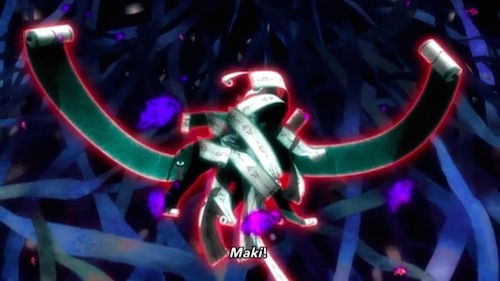
The ways in which words are used becomes the central conflict of at least the first half of the series. The villain, a man named Kenzaki Sougon, is able to travel into the very world where words exist and transform them into creatures called “M.J.B.K.” Pronounced mojibake (literally “word monsters”), these enemies of the week (again, giant robot show) devour the words on which they are based, manipulating their presence in reality. Because of the way kanji works, many other ideas are eradicated as well. For example, in Episode 1 the M.J.B.K. is created from the word maki (巻), which means “roll,” causing things to get twisted into knots, but it’s also the word used to mean “volume” as in “volume 1 of a manga,” which causes that concept to disappear as well.
Sougon believes that people have sadly lost their connection to the origins of words, that the power of words comes from the desire to communicate what exists. Words are in service to reality, and forgetting that means words become useless. In contrast, Kaibuki Akira goes the opposite direction. He draws on the creative potential of words as a way to construct reality. The key example of this is the fact that Akira frequently refers to himself as a “savior,” and tries his best to just constantly save people. When asked why he’s a savior or why he’s so hung up on the idea, it turns out that there’s no particular reason. He takes the meaning of the word itself and makes it into reality through his actions, fulfilling its potential. The Japanese word for savior, kyuuseishu literally means “one who saves the world,” and that’s what Akira aims for.
In Episode 13 the team fights a particularly dangerous M.J.B.K. that represents Mu, or nothingness. Written as 無, perhaps people might recognize it as the symbol used by Gouken in Street Fighter IV. Sougon uses it because the power of nothingness is able to consume other words and concepts, but Akira responds by saying that nothingness also means endless possibilities. At this point, he and his co-pilot Maia utilize the signature attack of the Aquarion franchise, the Mugenken, or “Infinite Punch.” Mu is one half of the word for infinity. At another point, as the world risks being reduced to that nothingness, the word “savior” carries the potential for recovery, as it consists of the characters for “help,” “world,” and “person.” What else is needed to start over other than these concepts?
Aquarion Logos is both a powerful and silly anime, and intentionally so. It’s potentially a difficult series to watch because of how prominent kanji is, making it a bit obtuse for those unfamiliar with Japanese, particularly because English and other languages don’t necessarily utilize symbols in the same way. So far, many of the references are to the original Aquarion, but Episode 13 drops a possible callback to Aquarion Evol, so it’ll be interesting to see how things develop now that the second half has been under way.
I don’t believe all that strongly in “show, don’t tell.” It’s effective as a basic guide to help people understand the power of visual media, or as a helpful rule to teach people that subtlety is a thing, but it runs the risk of being wielded like a sledgehammer, similar to the concept of “character development.” Telling instead of showing has a purpose and can be used well, though effectively doing so is arguably even more difficult.
I recently finished Hanamonogatari, which for those who’ve lost track of all of the different titles is the end (or perhaps extended epilogue/adventure unto itself?) of the second series. Given the characteristically heavy amount of dialogue that this series is known for, and both the criticism and praise it receives for doing so, I had to return to what is perhaps the biggest question to deal with when reviewing or analyzing Monogatari. Is it actually possible for a series that obsessed with words to be follow the idea of “show, don’t tell?”
The Monogatari series, and Nisio Isin in general, revels in long dialogue that tells the viewer or reader what’s going on. There are seemingly endless descriptions by characters about how they’re feeling and fewer expressions and actions that reflect those emotions. It can come across as very long-winded, and I think that finding the series to be unenjoyable as a result is not surprising or exactly a problem. However, Monogatari is frequently about words themselves, and how they can be transformed or carry different meanings, especially through the use of Japanese as an ideogram-based language. Puns and wordplay and general use of homonyms is core to the series, and if a work is that obsessed and built around looking at and examining the occult power of words, how much is lost in a less dialogue-heavy work?
A counterpoint to this is the more recent Aquarion Logos, where the heroes battle monsters that are actually the essences of kanji ripped out and mutated. I think the similarities to Monogatari are quite upfront, and I even jokingly call it Aquarimonogatari myself. Here, rather than engaging in extensive dialogues and conversations, a lot of the action comes from mecha battles and more typical anime character interaction hijinks. Words hold a similar power in Aquarion Logos that they do in Monogatari, but this is usually expressed in scenes where the loss of corruption of a word causes accidents and other horrible changes in the world.
So in terms of the question of “is it actually possible” to make a series that is so focused on the nature of words to be less expository, the answer is “yes,” but then one must ask to what extent it transforms the function and feel of the work itself. Can Aquarion Logos go as deep into exploring the interplay between words in terms of their appearance, sound, and cultural weight as Monogatari when it has all of these surrounding qualities that are more in line with a typical series? Or is perhaps Monogatari just as “guilty” of doing the same because it has this very otaku-focused set of characters that play just as much with the idea of “harems” in anime as they do the power of writing and speech?
—
If you liked this post, consider becoming a sponsor of Ogiue Maniax through Patreon. You can get rewards for higher pledges, including a chance to request topics for the blog.
The question of how much technical skill or physical prowess should play a factor in competitive games is an on-going debate that really puts at the forefront the tension between “games” and “sports.” I’ve discussed this divide previously in reference to Super Smash Bros. with the intent to understand both sides, but a recent comment by Starcraft and Hearthstone community leader Day[9] has me thinking about the extent to which technical refinement can contribute to the competitive viability of a game outside of the environment of competition itself.
While explaining why he believes that Counter Strike: Global Offensive is the best-designed competitive multiplayer game (emphasis on the word “design”), he organizes his argument into four key points that a lot of the best games tend to share: an engine that encourages interaction, room for strategy, variety of content, and some sort of execution skill with clear reward. In elaborating upon the idea of execution skill, Day[9] explains that it can often be difficult for players to feel a sense of improvement if the goal or evidence of improvement is too abstract. In contrast to the difficulty of tracking your decision-making, getting a basketball into a hoop has a clear goal, and the actions you take towards achieving that goal are immediately noticeable (did this help me shoot more hoops successfully or not?).
The reason why I want to focus on this idea of a high technical or execution skill is, first, that I can totally understand what he means from my own experience playing competitive games, and second, that it really opens up the idea of competitive gaming as being about so much more than just “winners and losers.”
In my time playing Japanese mahjong, I’ve run into a number of hurdles that made it difficult to truly gauge whether or not I’d improved. As much as mahjong takes skill, it’s still a game where luck is a significant factor, and when playing opponents who are equal or better than you, it’s not uncommon to go on a serious losing streak that makes you question if your previous wins were due to luck of the draw or if you’ve indeed progressed as a player. It’s only over the course of many games, as well as by facing players of lesser skill, that it becomes more obvious if your skills have improved. You begin to see the mistakes that you made in the past in the actions of other players, and you understand on a more fundamental level what made those decisions mistakes in the first place.
The big issue is that this is a painful way to go about improvement, and it would not surprise me if most people were not this masochistic about finding out whether or not they have become better players. One has to claw in the dark, finding bits and pieces of light wherever they might appear, and eventually find out if they’re now standing on something stable or a worn-out rope bridge.
Abstract thinking and decision-making are difficult to quantify, which is why something like a Training Mode in a fighting game is so appealing to players. As Day[9] mentions, even if you fall behind in terms of strategy, a game with a “high-variance execution skill band” can give players something to aim for (no Counter Strike pun intended) with very clear rights and wrongs. Compare trying to learn a high-damage combo to trying to understand intrinsically the concept of a “neutral game.” Some players are better at technical execution and others are better at grasping deep concepts, but I think both players would agree that the combo, the headshot, the waveshine are all much more tangible than what David Sirlin calls “yomi,” or reading the mind of the opponent.
This can be a problem, as explained by James Chen when he refers to fighting game players who try to master the art of complex attack patterns (mixups) that cause the opponent’s defense to falter (“opening up the opponent”) without actually understanding the fundamental goal is that you’re trying to psychologically intimidate the opponent into not blocking. James makes an important statement, which is that, while many people believe that the “neutral” (the game state where both players are fully in control and have equal dominance on the field) is all about the mixup, in fact the mixup is the reward you get out of winning the neutral. After all, what use is your amazing mixup and combo game if you never actually get to land it? It’s complex, I know, and it’s amazing that James is able to explain it so well.
Back to Day[9]’s point, what I find to be the major significance of this idea of high execution skill is that improvement becomes almost like a salve, a way of reassuring yourself that you’re not that bad, or that you see a clear path towards getting better. Unlike blaming your teammates (common to DOTA 2 and League of Legends), this isn’t merely a placebo; you’ve still gotten better at your game on some level, and the best players marry brains with brawn. When looking at discussions of competitive games, certain communities such as Super Smash Bros. Melee and Starcraft will tout their games’ “high skill ceilings” with respect to technical skill as signs of their superiority as competitive games and as esports, but the presence of a high skill ceiling also becomes a comforting warm blanket. Even if you falter in terms of strategy and abstract thinking, you have the option to continually improve without needing it because you can advance your execution skill.
When I say that this idea seems to bring competitive gaming away from the competitive environment itself, what I mean is that, even though the improvement of skills (be they mental or physical) are generally supposed to accompany you to the moment of competition (whether it’s a tournament or a ladder), the ability to look back at your progress and declare yourself better than you once were is just as important. “I am not what I was yesterday.” Unlike strategy where the personal rewards can be distant and obscure, execution skill is both a short and long-term confidence booster, bringing the competitive game to be just as much about constructing pride as it is about victory or defeat.
—
If you liked this post, consider becoming a sponsor of Ogiue Maniax through Patreon. You can get rewards for higher pledges, including a chance to request topics for the blog.


 In recent years, diversity in representation of peoples has become a frequent topic of debate among fans of animation and comics. Whether it’s the rise of Steven Universe and its positive portrayals of strong female characters, or the increase in panels on women in comics, minorities in comics, and more at New York Comic Con, there has been a strong move both from fans and creators to make sure that tokenism is never a thing, and that the Rule of Three (see the video below) doesn’t stop any group from finding themselves in cartoons.