Potential Changes for the Future: Ogiue Maniax Status Update for June 2016

I’m back from Japan, and I had a blast! Look forward to a number of posts this coming month about my trip.

If you’re part of my Patreon (or even not!), feel free to message me or leave comments below. You can ask me anything about my Japan experience this time around. By the way, if you’re wondering what the biggest trend in Japan is right now, it’s Osomatsu-san.

Speaking of, here are this month’s Patreon sponsors:

General:

Johnny Trovato

Ko Ransom

Alex

Diogo Prado

Sasahara Keiko fans:

Kristopher Hostead

Yoshitake Rika fans:

Elliot Page

Hato Kenjirou fans:

Elizabeth

Yajima Mirei fans:

Machi-Kurada

There is something important I need to discuss, which is that some changes in my life (nothing tragic) are happening that might require me to reduce the amount of posting that I do to Ogiue Maniax. I know that sounds kind of strange after declaring that I would up my post rate not so long ago, but that’s just kind of how it is.

The result is that, while I’m definitely going to try, I might not be able to keep up my twice/thrice-weekly posting schedule. I know that part of the appeal of Ogiue Maniax is its consistency and its fairly high output rate, so if any of my patrons want to adjust their pledges accordingly, I totally understand.

I’m hopeful that I can keep up my current rate or something similar, though. I mean, I’ve done it before!

As for this past month’s post highlights:

As always, there’s the requisite Genshiken chapter review. This one got longer than I initially expected, but that’s just because it turns out that there’s a lot to talk about. One notable aspect of this chapter is how it meta-references the anime version. Strangely, there’s no new chapter of Kimi Nakare out yet.

A couple of posts this month were ones I’ve been ruminating on for a while. The first is a look at the fanservice from Food Wars!: Shokugeki no Soma, and the second is a post about how vital Twitch chat is to the Twitch streaming experience. There’s just a lot to unpack in both, and I hope I’ve done a decent job explaining my points.

There’s also this month’s Patreon-sponsored post, where I look at the BlazBlue anime. While I was passingly familiar with BlazBlue as an anime-style fighting game, one thing I didn’t realize was how many imouto characters are in it. This in some ways sets it apart from similar games, which often deal with only or two little sisters.

The last major post is the first of many inspired by my Japan trip. Check out my report and review of Kansai Comitia 48, a doujin event dedicated to original (as in not based on existing works) doujinshi,

Outside of the blog:

Over at Apartment 507 where I’m currently writing, I’ve started a new series of reviews for Japanese-language manga apps. The first is Shogakukan’s MangaOne. Remember, these are only available on the Japanese app stores. I’ve also started a Vine account because making dumb jokes using anime is what I do, and I recently appeared on a mini-episode of the Reverse Thieves’ Speakeasy Podcast to discuss the Hulu Apocalypse.

So anyway, fire away with the Japan questions! I was only there briefly, so I can’t divulge to you its darkest secrets, but I sure can try.


Original the Comic: Kansai Comitia 48 (Original Doujinshi Event)

kansaicomitia48-doujinshi

Whenever the typical English-speaking anime or manga sees the word doujinshi, a particular image comes to mind. Typically, doujinshi are associated with fan-parodies of titles both popular and niche, the realm of what-ifs that run the gamut from the silly to the sexy. However, many doujinshi are original works, and Comitia is the largest group of “original-only” doujin events in Japan. I attended Kansai Comitia 48 Osaka recently on May 15, 2016, and it was a fun learning experience. Not only could I feel the creators’ passions, but I also have come to view the importance of doujin events in a different light.

Original Doujinshi

kansaicomitia48-sakuralunchbox

While I am certainly a fan of doujinshi based on existing properties, in many ways original doujinshi are more impressive because they cannot rely on drawing in the fan bases of those works. When I think about it, my first exposure to the idea of doujinshi, the anime adaptation of Comic Party, mainly focused on original works. In that TV series, the main character learns an important lesson: making doujinshi is about what you want to do, not simply what sells. Across dozens of creators, that is exactly the spirit I saw at Kansai Comitia 48.

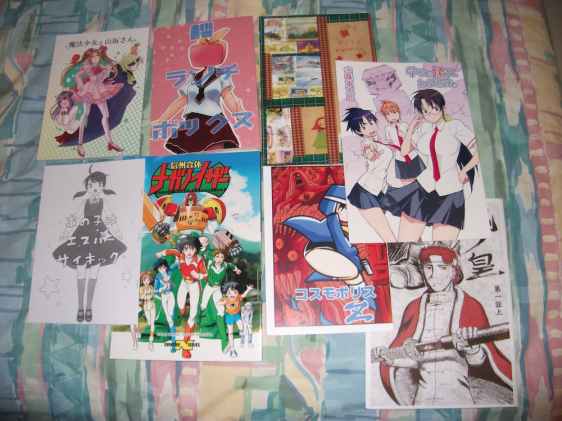
The event site was laid out roughly according to genre, and when you look at the categories listed it becomes easy to see the variety of interests on display. There was the “Fantasy” section, which was by far the largest, but there were also things like Criticism, Travel, Shounen, Shoujo, Seinen, SF/Mecha, Animals, BL, and so on. The first doujinshi I picked up was a record of the author’s trip to Russia, while my favorite had to be a cute romance about a girl with a bentou box for a head. The handkerchief normally used to wrap a bentou box became the ribbon that accentuated her girlish charm. One table was selling guides to girls’ school uniforms throughout Japan, and the circle that was responsible for it consisted of a mix of both men and women.

What About the 18+ Stuff?

kansaicomitia48-futarigurashi

While doujinshi often brings to my pornographic works, the Adult section at Kansai Comitia 48 was rather small. This is not that unusual, because most doujinshi made are in fact not sexual. However, even there the space for doujinshi as a place to explore one’s passions is visible, and one might even argue that it’s where such sentiments are most evident. Many of the 18+ circles were focused on otoko no ko, or boys who look like girls, and one was even solely about handsome bad guys kissing young girls. There was one artist who drew heterosexual josei-style smut, which can be rather uncommon given the sheer amount of BL that exists.

I picked up one adult title at the event, but not necessarily for the reason you might expect. The artist who drew it was actually Kakimoto Kenjirou, a published manga artist in the 1990s whose series, Futarigurashi, ran in Young Jump. It appeared that he was out of the manga game for quite a while, but here he was at Kansai Comitia drawing what he wanted, and the doujinshi I bought was actually a sequel to Futarigurashi. Here was a space where even someone with manga industry experience could continue the stories they wanted to tell, and essentially make “amateur” sequels to their own “professional” works.

A Haven of Lost Drawing Styles

One aspect of Kakimoto’s doujinshi is that, while it didn’t look quite the same as it did in the 90s, he still retained a very 90s style of manga drawing. What’s more, he wasn’t alone. Throughout Kansai Comitia 48, I saw doujinshi with characters that looked like they came from bygone eras of manga and Japanese pop culture. One artist created a giant robot themed after Nagano Prefecture, Naganoizer, and was clearly inspired by 80s anime artists such as Mikimoto Haruhiko (Macross, Gunbuster, Kabaneri of the Iron Fortress). Another artist’s style was closer to 70s shoujo legends such as Hagio Moto and Takemiya Keiko.

In the actual professional manga industry, failing to change one’s styles with the times comes at a risk. While popular creators such as Miuchi Suzue (Glass Mask) or the aforementioned Hagio and Takemiya still draw in the same style as they did in the 1970s, many have clearly made shifts over time that correspond with trends in manga as a whole. For better or worse, events like Comitia are where those older styles can still exist, away from the pressures of having to pick up on what’s popular. While some are able to sell doujinshi at a profit, that is the exception. Most doujin artists make doujinshi purely as passion projects.

Comparing with Artist Alleys in America

kansaicomitia48-cosmopolicez

I’ve been to quite a few Artist Alleys in American anime conventions, and while you can get a good variety of styles, for the most part I tend to see many similarities in how artists approach works there. Perhaps it has to do with the fact that anime fandom has a rather high turnover rate where many grow out of it as they get older. This is not to say that American anime con artists lack variety, or that they all draw in an “anime” style, but the result is you don’t really get those 80s/90s-style holdouts.

A better comparison would be with the artist alleys at places like New York Comic Con, because you’ll often see artists who are inspired by past generations maintain those styles. For example, you’ll often see artists who love Jack Kirby and aim to maintain his style. They will pepper their drawings with Kirby dots, dynamic poses, and other signature characteristics of the King’s drawings. Similarly, at Kansai Comitia 48, you had artists who still believed in those older styles. Whether it’s because they refuse to adapt or can’t, the result is a window into a different world that is not so much experimental as Indie comics in the US tend to be, but are basically different shades of mainstream from older generations.

If you liked this post, consider becoming a sponsor of Ogiue Maniax through Patreon. You can get rewards for higher pledges, including a chance to request topics for the blog.

Discussing Hulu’s Anime Eradication on the Speakeasy Podcast

showbyrock-plasmagica

Hulu is removing hundreds of anime from its catalogue on June 1st, and I hopped onto the Speakeasy Podcast with Alain to talk about it and to speculate about what it might mean for anime streaming in the future.

If your favorite show is on Hulu, there’s a good chance it’s also on other legitimate streaming services, but it’s still notable because of how big Hulu is.

Sadly, this means Hulu viewers might no longer be able to experience the excellent Show by Rock!!


For Their Sake: Genshiken II, Chapter 124

This chapter of Genshiken calls back to one of the earliest moments in Nidaime. Is the story getting back on track, or was it never derailed in the first place?

Synopsis

Under the pretense of celebrating both Risa’s acceptance to Shiiou University and surviving an eventful year, Yoshitake gets together with Yajima and Hato for a night of drinking and laughter. In actuality, now that Madarame’s harem has been resolved, Yoshitake aims to bring Yajima and Hato closer together.

However, Yoshitake’s plan to position Yajima as a hero of sorts backfires. While Yoshitake recalls the time Yajima prevented her from lifting up Hato’s skirt, Yajima (under the influence of alcohol) confesses that she was on the verge of doing the same, and that she saw Hato’s goods.

Wanting to prevent any more awkwardness, Yajima tells the others to go home, especially because Hato’s short skirt is a recipe for disaster. Hato offers a suggestion, but it turns out to be arguably worse: Earlier in the day, Risa had given Hato a pair of short pants to wear in order to feed her fantasies, which causes elder sister Rika to worry about Risa’s future.

Meta-Genshiken

There are a number of things I’d like to elaborate on in regards to this chapter, but the first is a nod and wink by author Kio Shimoku to the animated Genshiken Nidaime, aka Genshiken Second Season aka Genshiken Second Generation.

In Chapter 124, Yoshitake, Yajima, and Hato bring up how minors aren’t allowed to drink in anime adaptations even when it happens in the original manga. Yoshitake then remarks that they will keep drinking because nothing’s stopping them from doing so. This is actually a reference to episode 2 of the anime, where scenes of Yajima and Hato drinking from Chapter 58 were cut.

This isn’t the first time that the Genshiken manga has referenced the anime. The idea that Angela wants to sleep with Madarame comes from the second series, Genshiken 2. Moreover, in a particular 4-panel extra, the manga alludes to the fact that the final episode of the Nidaime anime has a bath scene that didn’t exist in the comic.

Tracks Laid Out

Chapter 124 calls back to one of the original tensions of the new Genshiken, which is the awkwardness between Hato, the club’s very first fudanshi and very first otoko no ko, and Yajima, who for a long time disliked Hato because his very presence made her feel inadequate. Things have changed significantly since then, namely because of Yajima’s gradual acceptance of Hato and the realization of her own feelings for him, but there’s this sense that perhaps this is where the narrative of Nidaime was supposed to go all along. In this sense, it reminds me of the manga Coppelion, where it ended up taking years to reach Shibuya despite the fact that it was mentioned as an early goal.

The Madarame Harem story took up a huge portion of Genshiken Nidaime, and this means it can be seen as both a major narrative of the manga thus far, and as an excessively long detour. In a way, however, both are true. The story of Nidaime is in many ways the story of Hato, and I have to wonder if Hato and Yajima could have developed to the extent it has without all of those tribulations, and without Hato’s affections for Madarame prompting realization in Yajima herself?

The answer is likely neither a full yes or no, mainly because Kio tends to write stories without planning how they’ll turn out. He’s more of a “let the characters move the story forward” kind of author. If you’re more of a beliver that the “author is dead” this doesn’t matter too much, but it can’t be ignored that where the story seems to be heading now is built partly upon the foundation of the Madarame Harem arc, and I think it’ll continue to exert an influence even as the manga goes back to being a little more like how it started.

Death to Misunderstandings

Yajima’s confessions, and the way they finally bring to an end some of the unspoken tensions between the characters, kind of reminds me of the beginning of Kimi ni Todoke. In that series, many potential misunderstandings between characters common to shoujo romance series are squashed before they can fester and it made that particular work refreshing. While Genshiken is nowhere close to this, given that this particular resolution took a few years, it has a similar feeling of release.

Actually, when it comes to Genshiken, I find the resolution of romance tends to be very cathartic. Sasahara and Ogiue consummate their relationship after an intense sharing of secrets. Saki’s rejection of Madarame features a wave of emotion hitting the both of them. Hato’s comment that Madarame will be the first and last man he ever loves comes with a tinge of melancholy that still somehow feels like a huge weight has been lifted.

Yajima’s Secret to Success

While Yajima is discussing why a relationship with Hato isn’t popular at the moment (his feelings lie elsewhere), she mentions that she knows the way to instantly get Hato’s attention. The hint is that she saw it in an instant upon arriving at Hato’s place, which leads me to believe that it has to do with not just comics, but 4-panel gag manga.

If you look at the rough comics pages Hato has left around, they’re all arranged in two sets of 4-panel vertical columns, similar to works like Azumanga Daioh and Hidamari Sketch. Yajima, who turns out to possess a hidden talent for comedic manga, and who basically won the “duel” last time they both drew their own works, could leverage that to her advantage. The reason why she refuses to act on it is likely because of the swirl of emotions and relationships that have entangled the Society for the Study of Modern Visual Culture. Yajima prefers to make things simpler, not more complicated.

Hato and Risa and Clothing

Hato at one point remarks that having his penis seen while dressed as a girl is somehow more embarrassing than being seen stark naked as a boy (which also happened). While a “cute Hato” moment if ever there was one, this particular reveal speaks to a side of Hato’s psychology that has been somewhat unexplored even if it makes total sense.

Hato-as-girl is still very much a performance even if that performance is ingrained in his being. He has taken great efforts to look like a girl without drawing too much attention, has practiced raising the pitch of his voice to sound more feminine, and is just overall very convincing as a woman. This means that perhaps the penis has different meanings when he’s presenting as a man vs. a woman. As a guy, he was embarrassed because he was showing his privates, but as a girl it’s like his secret was revealed.

This is where Risa’s minor obsession with Hato becomes interesting. While most of the fascination with Hato has come from his appearance as a woman, Risa is different because her interest in Hato comes from him being a man, or rather a man with a boyish appearance. Madarame and Kuchiki see Hato’s female appearance in relation to the crossdressing eroge and doujinshi they’ve experienced, and Risa perhaps draws a similar connection between her own interests and super smooth Hato in short shorts. Like Yoshitake, I too am concerned with the potentially dangerous path Risa might be heading down, but I also am intrigued by a new love triangle of Yajima, Hato, and Risa. The question remaining is, can Risa’s view of Hato be considered romantic in the first place?

If you liked this post, consider becoming a sponsor of Ogiue Maniax through Patreon. You can get rewards for higher pledges, including a chance to request topics for the blog.

 

Mascot Analysis: Japanese Moving Company Aggregate “Hikkoshi More”

NOTE: I want to be upfront about what follows in this post. I was recently contacted by a promotional company, asking if I could mention a couple of their websites on this blog for pay. I agreed to do so, knowing that this is part of the SEO game.

While I normally wouldn’t accept an offer to just promote something, what caught my attention was that I was requested to make posts specifically because of their purposeful usage of manga and anime characters in marketing. I’m always fascinated by this topic, especially when it comes to Japan where cute fictional cartoon spokespeople are much more ubiquitous across all age groups. Because the types of mascots used can say a lot about a company and who they’re targeting, I decided it would be worth writing about.

I also want to emphasize that I have not used the service below, Hikkoshi More, so I can neither endorse it or advise people away from it.

I hope this makes everything clear.

In the English-speaking world we have sites like Orbitz and Hotels.com that aggregate various offers and prices and present them in one place, allowing users to choose from hundreds of offers. Hikkoshi More serves a similar function in Japan, except it’s for moving rather than traveling. Hikkoshi More is meant to help users to find the right moving company that suits their needs and finances.

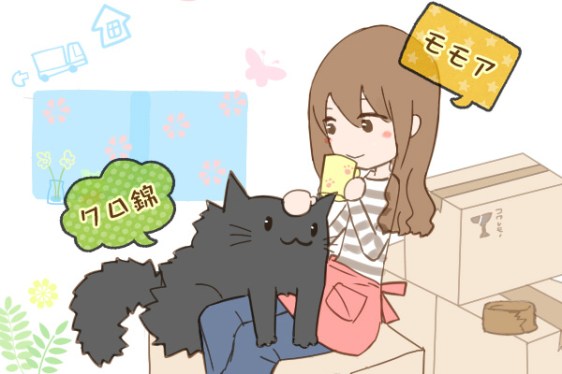
I came to understand the purpose of Hikkoshi More because of the comic on their website, which explains what they’re all about. Sadly, it does not involve shipping the shipping companies, and is instead a parody of the Legend of Momotarou using the site’s mascots, Momoa (the girl) and Kuronishiki (the black cat).

img_peach_kuroneko06

In this story, “Kuronekotarou” is born from a peach and takes it upon himself to defeat the oni of Onigashima Island, but is beaten to the punch by the real Momotarou. The oni are forced off their island, and need to find a new home. Kuronekotarou introduces them (and eventually other character parodies from the Legend of Momotarou) to Hikkoshi More, and they all find homes.

The comic is actually pretty effective for giving an overview of what they’re about, and in my opinion was easier to get through than their actual website.

img_peach_take12

My personal favorite part of this manga is how Momotarou is kind of an asshole. In this panel, it mentions that he not only beat them up, he also took their money and credit cards. The fact that he carries a giant Nippon Ichi flag on his back (not shown above) adds to his ridiculousness. Also, because Momotarou is instantly recognizable to any Japanese person, it becomes an easy target for parody, similar to something like Snow White or Johnny Appleseed for an American.

cat_kuronishiki_move_img_00

When looking at Momoa and Kuronishiki, it’s clear they’re mascots meant for regular adults. They have neither the high moe factor that would draw in more hardcore otaku, nor are they as generically cute as something like Hello Kitty. They’re drawn very simply, and Momoa’s design positions her as anywhere between 18 and 40, giving a sense of youth and vibrancy to the company without making her too young and thus unsuited for representing a site dedicated to a very adult concern of moving. Not that kids don’t care (they arguably care more than anyone), but they’re not responsible for the details of it.

I think people are more used to seeing the Dejikos and Hello Kitties of Japan than what Momoa and Kuronishiki are, which is simply cute and attuned to a more specific, yet not hardcore, demographic. The result is that Momoa and Kuronishiki are charming yet safe, and are perhaps a little more immune to the Erin Esurance syndrome. In that particular case, it was clear that Esurance wanted to use its mascot’s sex appeal to its advantage, only for the whole thing to explode in their face. Momoa might be closer to Flo from Progressive Insurance, if anything, except through that Japanese lens of kawaii.

[Apartment 507] Japanese Manga App Review: MangaOne

shakunetsukabaddi2

The best thing about digital manga is that it’s such a space saver, and it allows you to get manga straight from Japan at a reasonable cost with little hassle. I’ve started up an article series on Apartment 507 where I review various Japanese-language manga apps, and my first is a look at Shogakukan’s MangaOne.

I personally like the app, but that might be because it actually features a sports manga about Kabaddi!

Thoughts on Steven Universe and Anime Influence

Though not always at the forefront of mainstream entertainment around the world, anime and manga have had a significant influence on a lot of artists’ and creators’ work. Some aim to create “anime” or “manga,” while others are show the impact of Japanese popular media in subtler ways, Prominent series such as Avatar: The Last Airbender and the more recent Steven Universe tend to be at the center of these discussions, and all of this leads to questions such as how one defines anime, or whether or not something “counts” as manga.

When thinking about whether or not Steven Universe or Megatokyo can be defined as anime or manga, what I find important isn’t the semantics of definition or how close to a certain truth we need to get, nor is it necessary to have to strictly categorize anime or manga. Instead, it reminds me of something that a classic anime dirctor, the late Ishiguro Noboru (Macross, Legend of the Galactic Heroes, Space Battleship Yamato) had to say about what influenced his own work in Japanese animation. At Otakon 2011, Ishiguro cited as some of his influences Czech puppet shows and animator Norm McLaren, both of which are visually extremely different from Japanese animation both old and new.

While Ishiguro did not state that he was creating Japanese Czech Puppet Theater (OJP Animation instead of OEL Manga?), what I think is more important is understanding that how art influences art does not always result in something visually familiar. How it’s processed from its presentation to the creator who sees it, who then incorporates it in their own work, is unpredictable, and it might end up looking new and different. So, while Avatar: The Last Airbender looks closer to what people think of when they hear the term “anime” and Steven Universe looks a lot closer to an “American cartoon,” both are examples of series that draw influence from Japanese animation, and on some level it should be expected that there would be a transformative process when anime crosses, time, space, cultures, and different artists.

If you liked this post, consider becoming a sponsor of Ogiue Maniax through Patreon. You can get rewards for higher pledges, including a chance to request topics for the blog.

Attack of the Imoutos – BlazBlue: Alter Memory

blazblue-altermemory

Fighting game anime do not have the best reputation. While we’re not at the absolute depths of the 90s and such wonderful stinkers as Tekken and Battle Arena Toshinden, most of the time the individual stories you experience by playing each character one at a time in fighting games are all mashed together into a paste. The result is that characters do not even have enough screen time to properly showcase their already flimsy narratives, and what carries a fighting game anime to any kind of success is enough flair for the characters’ personalities to shine through in their limited actions.

BlazBlue: Alter Memory is not the worst anime in this respect. Based on the popular BlazBlue fighting game series, the fighters themselves are designed to be as bombastic as possible, and while the story is convoluted to no end it seems very intentional. The narrative and presentation of BlazBlue: Alter Memory revels in its anime aesthetic to the point that it ironically suffers from not being as beautiful in the animation department as its source material because they can’t be as meticulous compared with the intricate sprite animations used in the games. I have to admit that I’ve barely played the games, but from what I can read the anime successfully captures the fact that the story involves alternate timelines, powers that are ridiculously vague in their function, and a seemingly endless stream of little sisters.

blazblue-imoutos

Ragna the Bloodedge is our white-haired, Sugita Tomokazu-voiced protagonist with a beefy sword. His little sister Saya was killed in the past, and he swears revenge against the man who did it. However, he keeps coming across girls that appear similar or even identical to Saya. There’s military police officer Noel Vermillion, who is arguably the series’ secondary heroine. There are robots that come possibly from the future (or something?) who have her face. Even one of the main villains turns out to have connections to Ragna’s little sister. I had a passing idea of the narrative of BlazBlue before watching, that time travel was involved, and that it is basically the Guilty Gear series with the anime dial cranked up to 13, but I didn’t realize that the story is basically Super Kyon (from Suzumiya Haruhi) and his deluge of imoutos.

When people use the term “anime fighter,” they’re referring to games like BlazBlue, and while it’s often associated with certain game mechanics such as air dashing and elaborate combos, the aesthetic is also important. BlazBlue, and by extension Alter Memory, takes all of the popular little trends in hardcore anime of the past seven years or so and throws them together to make something gloriously confusing. You have Catgirls and actual cats. There’s a 12-year-old looking vampire girl who’s a fan favorite. Yandere are seemingly everywhere. Angst and ninjas and flourishes of power are presented in such obtuse yet highly cinematic ways that Bleach creator Kubo Tite would blush. The sheer importance of little sisters in BlazBlue is not surprising, then, given just how increasingly prominent they have been in anime, manga, and light novels.

I think if there’s any major flaw of BlazBlue: Alter Memory, it’s from the fact that it’s an anime in the first place. This doesn’t seem like the kind of story you’re meant to experience by just watching. Rather, I think it’s supposed to kind of wash over you as you back in the aesthetic environment of the world and its dynamic characters. Maybe I should play the games more.

You can watch BlazBlue: Alter Memory on Hulu.

This post was sponsored by Johnny Trovato. If you’re interested in submitting topics for the blog, or just like my writing and want to sponsor Ogiue Maniax, check out my Patreon.

The Importance of Twitch Chat

One of the most common pieces of advice when it comes to the internet is simply, “don’t read the comments.” Whether it’s arguments about Justin Bieber on YouTube music videos or angry and insensitive comments on an article about a sensitive topic, comment sections can become minefields. It makes sense that we’re advised to ignore comment sections. However, while that’s generally sound advice, I think that it’s a mistake to believe that comment sections do not matter at all, especially in our current environment where social connections (both strong and weak) are made through online media.

Nowhere is this more relevant than with sites that utilize live chat feeds, such as Nico Nico Douga and Twitch. The difference between watching a game on Twitch with and without chat is basically the difference between watching alone or watching with a crowd. For those who want to share in the excitement of something as it happens (like a virtual crowd at a pro wrestling event), it becomes a vital part of the spectator experience. At that point, it’s not just about wanting to see comments or not, it’s about being a part of a collective bonding.

If you want to know how important the live chat is to Twitch, you only need to look at one of their more recent developments: saved chat logs for VODs. In the past, if you wanted to see what the chat was like for a previously recorded stream, your only hope was that someone captured it with the chat in progress. Now, anyone can step in a week or a month after a broadcast and see what people were saying at the time, and in many ways it enriches the experience. Imagine watching an old football game or something and having the crowd muted out. It certainly wouldn’t be the same, and while I understand that by not watching it live the experience changes anyway, there’s now a middle point.

This brings me to what I really wanted to talk about: the degree to which Twitch chat can become an unwelcoming place, and the potential harm it can cause. For me, personally, I experience this when I watch a Smash 4 tournament, and the chat is inundated with comments about how boring the game is, and how people can’t wait for Melee. It doesn’t matter how interesting the actual game being played is, people are ready to criticize and diminish its value. I think Smash 4 is awesome, and to some extent the trolls are just being trolls, but it results in an inhospitable environment that can turn away people who potentially have interest in a game. Perhaps they see huge portions of the chat calling the game a snooze fest, and think, “If this many people are saying that, maybe it is boring after all.” Or perhaps they just don’t want to deal with all of the nonsense and would prefer to watch another game with a chat that isn’t secretly hoping for the clown from Showtime at the Apollo to drag away what’s currently on.

That’s only a “your game vs. my game” scenario, though. Consider the tendency for Twitch chats to explode with comments whenever a girl appears on stream. I understand, lots of guys are horny, and by connecting to Twitch through one’s own personal devices, be they computers, mobile phones, or whatever, there’s a sense that what you’re seeing is merely an extension of your private space. Talking with your friends about how that girl was incredibly hot isn’t a bad thing, but stream and chat become this nebulous space where private and public intersect, and it’s not surprising that women would choose to hide their identities in chat, or prefer not to participate in the zoo that is Twitch chat (though that zoo can be fun and positive too).

In fact, I think comments online in general are a kind of extension of private space into public territories that can be both welcome and unwelcome. In a way, this blog is doing the same thing, as is Twitter, Facebook, and wherever else people are placing a part of themselves into their words. Social media and the internet as it exists today is not a separate entity from the real world. Ignoring elements of “IRL” space can be done too, but it usually comes with the awareness that it is cutting you off from a certain experience and resonance with others. Doing the same online might be necessary at times, but we shouldn’t act like the solution is to just encourage everyone to turn their eyes away from the problems that exist. The problems themselves need to be addressed too.

If you liked this post, consider becoming a sponsor of Ogiue Maniax through Patreon. You can get rewards for higher pledges, including a chance to request topics for the blog.


[Apartment 507] From Russia with Love Live!: What Makes Ayase Eli Amazing

elifeaturedimage

As we get closer to the premiere of Love Live! Sunshine!! I’ve been trying to get my analyses of the original μ’s girls out for you to check out. This time, I’ve written about Ayase Eli and the way the series utilizes her “Russian-Ness.”

Harasho!