Make Everyone’s Dreams ESPORTS: School Idol Festival Score Challenge & Thanksgiving 2016

IMG_1473

Coinciding with Anime Boston, this weekend, March 25-27, 2016, coincides with the first ever Love Live! School Idol Festival tournament, titled “School Idol Festival Score Challenge & Thanksgiving 2016. Given this occasion, a few questions come to mind. First, how sound is LLSIF as a competitive game (are we indeed “esports”)? Second, how many people will show up? Third, are people actually viewing this more as a tournament, or more of a gathering of like-minded fans?

Rhythm game tournaments have over the years been a staple of arcades and anime cons alike. Right beside the fighting games of Chinatown Fair were the sounds of stomping and eurobeat from Dance Dance Revolution, Beatmania, and other games of their genre. One big difference between LLSIF is that luck is a heavy component of the game, and this potentially hampers its competitive depth.

Not to say that luck automatically precludes or is counter to skill (because it doesn’t), but between being a free-to-play mobile game that encourages you to funnel money into what is essentially a gashapon machine (or a blind booster pack, to take a term from trading cards), and the fact that given cards have effects that trigger at random, a lot is left up to probability.

Compounding the issues of luck, actually, are things that involve no element of chance whatsoever. There is an upper limit to how skilled one can be in School Idol Festival, in the sense that perfect play is simply hitting all of the notes, well, perfectly, and this can be accomplished even with a randomized note distribution. If there are theoretically perfect teams (different for each tournament song, I’d imagine), then it actually all comes down to how often those card effects will trigger for individual players.

Does all of that matter, though? While I have not asked those who are personally attending Score Challenge & Thanksgiving 2016, I have to wonder how many are actually motivated by the desire to win. Perhaps in the backs of their mind they realize that the perfect game is at the same time all but obtainable yet shackled at the feet by that specter of probability. In that case, it becomes more about displaying one’s skills, to show that one has the fingers or thumbs to impress and astound.

In the world of competitive games, “waifu devotion,” that is to say an inclination towards beautiful female characters is very real. Whether the ladies are the best characters in the game or the bottom rung, players will stand by their girls. Love Live!, with its all-female cast of charmingly unique characters, is waifu central, and many who play LLSIF are empowered by this mentality. This does not even fall along heteronormative lines, either. Female Love Livers have their waifus just as male fans do, and the range of their affection goes anywhere from empathic to platonic to lecherous. On some level, I don’t think that hunger for victory is the sole motivating factor behind even LLSIF’s most competitive players.

IMG_0579

Indeed, if I were going, I would not hesitate to use a team of nothing but my favorite character, Hanayo. Did you know that she’s good at origami?

That last question I asked, about whether this will be more of an actual tournament or more of a gathering in the eyes of attendees, is something of a trick question. Aside from a few exceptions, pretty much all game tournaments, big or small, esports or otherwise, inevitably carry with them some degree of a festival-like atmosphere. The larger the total attendance, the more likely this is to happen, because people know that they are in the company of comrades, at least on some level.

In other words, I hope all of you attending have the times of your lives.

[Apartment 507] What’s Up with Anime Characters in Fighting Games?

KarinProfileSFA3Max

This time on Apartment 507, I explore the idea of the “anime fighter” and all of its surrounding meanings and associations. Hope you like air dashing!

The Fujoshi Files 153: Nishina Shima

Name: Nishina, Shima (二科志麻)
Alias: N/A
Relationship Status: Single
Origin: Kiss Him, Not Me

Information:
Nishina Shima is an extremely wealthy cosplayer, fanfic and doujinshi creator, and fujoshi who finds herself attracted to fellow fujoshi Serinuma Kae. As the only girl among Kae’s suitors, as well as the only one who directly understands her taste for yaoi, Shima uses this advantage to get a leg up on her rivals. Like Kae, Shima is a fan of the series Mirage Saga and Katchu Love, but their interests in opposite pairings can cause some tension.

Shima loves beautiful things, though her definition of beautiful focuses on how people are inside. Though Kae believes she met Shima at Comic Market for the first time when Shima rescued her from a creepy photographer, in fact they had met much earlier. Shima had been interested in Kae prior to her weight loss, but was originally unable to recognize her after the fact.

Fujoshi Level:
The quality of Shima’s doujinshi is high enough for Kae (pre-transformation) to buy all of them. In addition, her collection of fujoshi material outstrips even Kae’s.

Murder and Hijinks: The Case of Hana & Alice

hanaalice

This film is part of the 2016 New York International Children’s Film Festival

The Case of Hana & Alice (Hana to Arisu no Satsujin Jiken, or “The Murder Case of Hana & Alice” in Japanese) is an animated film that portrays the developing friendship between two girls in middle school who share a mutual desire to get to the bottom of a rumor about a murder. Arisugawa “Alice” Tetsuko is a tomboy and transfer student who seems to be in the middle of a bizarre and confusing case of bullying. Arai Hana is a hikikomori who hasn’t attended school in over a year and loves to put together elaborate plans. Together, their contrasting personalities are a recipe for disaster but in the most delightful ways possible.

Directed by Iwai Shunji, The Case of Hana & Alice is not a mystery in the traditional sense, and spends most of its time building up its characters and the path they take to solidifying their friendship. In a way, Hana and Alice have a vibe akin to the characterization aspects of th BBC Sherlock series, though in a much more lighthearted environment, and with certain qualities mixed between this film’s “Sherlock” and “Watson.” Whether it’s portraying Alice’s personality as a girl who doesn’t take nonsense from anyone, Hana’s agony as her best-laid strategies dissolve into nothing due to Alice’s act-before-you-think attitude, or even the random people they meet due to misunderstandings, the characters become increasingly endearing to the point that it almost doesn’t even matter how it all ends because there’s the sense and expectation that their combined forces have to lead to something amazing. The film’s pace is like a slowly paced progression of events that can actually feel intense and frenetic through the actions of its characters, which in turn creates a strange yet pleasant feeling of suspense that is both connected to and separate from the mystery at hand.

One of the more prominent and noticeable aspects of The Case of Hana and Alice is its style of animation, which mixes heavy rotoscoping and CG and thus gives the film an aesthetic uncommon to most Japanese animation. However, the consistency between the two elements is surprisingly good, without the jarring sense one gets when switching between animation styles. Although there are clear moments where one is being used over the other, the two sides blend together well. Thus, while something like the Flowers of Evil has a controversial reputation due to its rotoscoping (people either love it or hate it), I wouldn’t say the same qualities are as present in The Case of Hana and Alice even though similar techniques are utilized.

Prior to the start of the movie, the audience was told that the film is actually a prequel to a live action move titled simply Hana & Alice (which was itself based on Kit Kat commercials???), with the note that it uses the same actresses, Suzuki Anne and Aoi Yuu. While watching, I suspected that one of the reasons they decided to go with animation was because The Case of Hana and Alice is a prequel that takes place in middle school as opposed to the live action film’s high school setting, so a live action performance would somehow have to make them younger to fit in. What I wasn’t aware of at the time was that the first Hana and Alice was from 2004, which would make the act of portraying them convincingly as 14-year-olds even more difficult.

Because of this, I actually believe that rotoscoping was the right choice as a way to maintain the specific relationship between its titular characters that (I assume) is present in the 2004 film. While one might argue that just using traditional animation or 3DCG would have sufficed, I believe they really wanted not only Hana and Alice’s voices from Anne and Yuu, but also their mannerisms and overall physical presence.

Because the New York International Children’s Film Festival is dedicated to, well, children’s film, I always enjoy looking at what’s featured and then considering what it means to make a “movie for children.” The obvious answer is that it’s what you get when you create a film with children as the target audience, but that leads to other questions. What are the sorts of elements that resonate with children? What does it mean for a story to be “too adult?” To what extent should a children’s work take into account the adult audience who might likely be watching with their kids? I find that The Case of Hana and balances all of these questions, presenting an atmosphere and narrative that seems to embody both a sense of nostalgia and a sense of discovery, as if viewing the characters’ lives from both the past and the future.

If you liked this post, consider becoming a sponsor of Ogiue Maniax through Patreon. You can get rewards for higher pledges, including a chance to request topics for the blog.

The Open-Ended Nature of Aikatsu’s “Idol Activities”

This post was sponsored by Johnny Trovato. If you’re interested in submitting topics for the blog, or just like my writing and want to sponsor Ogiue Maniax, check out my Patreon.

aikatsu-group

There have been many attempts over the years to dethrone the Japanese children’s entertainment juggernaut that is Precure, but while Precure is squarely in the realm of the “fighting magical girl,” most of its challengers are themed around mahou shoujo’s sister genre: pop idols. This includes Pretty Rhythm, PriPara, Lil Pri, and the subject of today’s post, Aikatsu!

Aikatsu! began in 2012 as a multimedia franchise consisting of games, manga, and anime. The animated television series, created by Sunrise (of Gundam fame), follows Hoshimiya Ichigo, a girl who enters the idol training school Starlight Academy after being inspired by its top star, Kanzaki Mizuki. Together with her best friend and idol fan, Kiriya Aoi, and others she meets along the way, they engage in idol katsudou, or “idol activities.”

aikatsu-obaripose

Sunrise at this point is well known for another popular idol anime, Love Live!, and despite the fact that they don’t share that much staff, the two shows are similar in feel. Both have an overall lighthearted sense of fun and engaging character interactions combined with learning and personal development. Both feature bizarrely comedic moments (the episode where Ichigo gets into an “Obari Pose” and chops down a christmas tree is famous). Both series are also so entertaining in these respects that the actual “idol performance” moments are comparatively less interesting.

aikatsu-helpmeobiwan

However, one curious aspect of Aikatsu! that differentiates it from Love Live! (and many other anime) in terms of narrative is that Ichigo and the other idols don’t seem to have a concrete goal to aim for. The girls in Love Live! want to save their school and then win the Love Live. Naruto wants to become Hokage. Ichigo’s motivation is this vague sense of “becoming an idol,” but by the first few episodes she already is one more or less, and there just seems to be this general sense of forward progress. This is also what differentiates it from other more episodic works, or series such as Hidamari Sketch.

Aikatsu! has just enough on-going threads in the background and pays attention to its characters’ growth that the series carries a nice sense of continuity. Aoi becomes the mascot for a crepe company in an early episode, and after that you can always see a copy of the advertisement poster featuring her in Aoi and Ichigo’s room. The show also drops hints that Ichigo’s mom is a former idol, and as I continue to watch the series I’m just anticipating that moment where Ichigo discovers the truth. Every time her mom appears on screen, I think, “Will this be it?!” That desire to see Ichigo’s realization is actually one of my main motivations for continuing to watch.

dokidokiprecure-phones

There’s one last element of Aikatsu! I want to discuss. More specifically, it’s a theory pertaining to Aikatsu!‘s relationship with Precure. When watching Aikatsu!‘s core cast, I could not help but be reminded of the cast of Doki Doki Precure!, which came out in 2013. While the characters are different enough to not feel like copies of each other, Mana’s blonde hair and pink color scheme in her transformed state resembles Ichigo’s, Rikka (blue) plays the role of the more level-headed and smarter best friend just like Aoi, Alice resembles Arisugawa Otome (orange) not only in name but also in appearance, and Makoto’s occupation as an idol (as well as her serious personality) feels akin to Mizuki. I suspect that Doki Doki Precure! may have taken some inspiration from Aikatsu! but I can’t be certain of this. That said, I recently checked out some of the character design notes for Doki Doki Precure! and noticed that Cure Sword (Makoto)’s design originally had longer hair, which would make her more stylistically similar to Mizuki from Aikatsu!

Aikatsu! has been a series on my radar for a while, that I had only briefly engaged with, but given just how entertained I’ve been by it I definitely want to watch more and talk more about it. Expect future posts, maybe?

SEAUn and the Sheep – Psycho-Pass: The Movie

psychopassthemovie

Combining an Orwellian future with elements of a police procedural, the anime Psycho-Pass is a mix of action, philosophy, and science fiction. With two television series acting as background context, Psycho-Pass: The Movie (written by Urobuchi Gen of Madoka Magica fame) brings the story of police officers in a dystopian society beyond the borders of Japan, asking questions about government, governance, and how much civilized society takes its safety for granted.

In the world of Psycho-Pass, the people of Japan find their emotions monitored and their lives regulated by a complex network named the Sibyl System. The series protagonist is Tsunemori Akane, who begins the story in season 1 as a rookie officer and over the course of Psycho-Pass, Akane learns the terrifying secret of the Sibyl System. Having entered into a deal with the Sibyl System or the purposes of trying to change things from within, four years later Akane is now a veteran of the field. Her mission takes her to the SEAUn (Southeast Asian Union), a nation ravaged by civil wars that is running an exported version of the Sibyl System on a trial basis, in the process reuniting with her old partner and now fugitive from the law, Kougami Shinya.

I watched the film dubbed into English, which threw me off as I had not heard the cast before. Some issues were perhaps just unfamiliarity, such as how Kate Oxley, who plays Akane in English sounds and plays the role extremely different to her Japanese counterpart, Hanazawa Kana. Other issues were just typical English anime dubbing problems, such as stiff delivery of lines and a tendency to pronounce Japanese names just wrong enough to be jarring. Otherwise, the dub did not distract too tremendously from the content of the film.

Given its subject matter, and the fact that many of its characters love to recite philosophy, the similarities between Psycho-Pass and Ghost in the Shell are difficult to ignore. This is only compounded by this film. Just as the television series of Psycho-Pass are closer in feel to Ghost in the Shell: Stand Alone Complex TV, so too does this movie sequel veer closer to the first Ghost in the Shell film. The atmospheres, depictions of teems of people, and the interaction between man and machine all evoke much of what make Ghost in the Shell stand out. That being said, the film is not simply a copy of GitS.

One of the on-going questions about Psycho-Pass is how the people of Japan even allowed the Sibyl System to be implemented in the first place. It may come across as unrealistic that people would so willingly give up their sense of freedom to a system that is shown to be inherently flawed from the first time we see it, but the movie actually hints at an explanation. Describing the world outside of Japan as one of constant war and strife, it becomes easier to see why Japan would accept even an imperfect or potentially dangerous system when every other place is falling apart. The fact that the SEAUn is in an even more precarious position works with the notion that sometimes the Sibyl System is what the people need.

However, the Sibyl System is shown to have its own troubles within the SEAUn, and it becomes difficult to determine to what extent the flaws come from the Sibyl System itself versus the context of the SEAUn and any elements of corruption or abuse that arise from its state of civil war and everyday violence. For example, in the SEAUn “latent criminals” (those shown with a high potential for committing crime) are controlled through the use of collars that can administer anesthetic or even poison. While in Japan such people are kept in facilities in order to have their feelings kept at a safe level, the collars not only provide a perpetual state of slight fear for those latent criminals, but the symbolism that comes from the collars becomes a marker to essentially class people as lesser being.

It’s not quite to the extent of, say, a Star of David in Nazi Germany, but seeing one latent criminal get abused and the attacker (who is considered normal) get away with it hints at the ease by which a visual determinant of one’s status in society can affect people on a deep and mental level. When people are forced into dangerous situations where their lives are on the line, their “latent criminality” will inevitably rise as well, and this can act as justification for continued atrocities.

By the end of the film, Akane learns the truth about the SEAUn, which re-opens one of the questions the anime ask: what happens when the Sibyl System is turned on itself? One solution was provided in the second series, while the movie takes a different angle that acts as a reminder that what works in one society might not work in another because the very conditions for a system or way of governance to take a foothold can be so dramatically different. Another point emphasized by Psycho Pass: The Movie is that the Sibyl System is not evil. It aims for what it believes is best, and in fact it’s an on-going process that is designed to evolve. However, the lack of humanity, as well as the fear of “what might be” hinders it tremendously. At the same time, the Sibyl System, as it is meant to be, is a system of control, but not a system of power. While it is powerful, its end goal is more to remove the threat of power from human beings, protect them from themselves.

Psycho-Pass: The Movie feels noticeably more robust than the television series, but keeps its more action-packed and violent elements of its world and presentation at the forefront. The sophistication demonstrated by the film comes from acknowledging both its loftier ideas and its visceral excitement.

If you liked this post, consider becoming a sponsor of Ogiue Maniax through Patreon. You can get rewards for higher pledges, including a chance to request topics for the blog.

[Apartment 507] Thai Songs in Anime: Anyamaru Tantei Kiruminzoo

KIBA1717_DVD-daisi_CS-OTF

I wrote a post about everyone’s favorite Kawamori Shouji animal detective anime, Anyamaru Tantei Kiruminzoo, over at Apartment 507. What did you think of the Thai music in the show?

Pervert Rising – Kizumonogatari Part I: Tekketsu

kizumonogatariposter

The transformation of the Japanese animation studio SHAFT from b-player to cult sensation is, at this point, old history for anime fans. Ever since director Shinbou Akiyuki became the face of the now 40-year-old studio back in the mid-2000s, it’s come to garner a loyal following and a reputation for highly eccentric aesthetics that revel in both character design and visual design.

Among the shows that carry the SHAFT name, the Monogatari series might be considered its flagship title: based on the light novels by author Nisio Isin, his signature twisting of expectations, eclectic cast of characters including a variety of attractive (fantasy) girls and love for verbose dialogue combined with elaborate wordplay seems almost a perfect fit for Shinbou and SHAFT. And so, the Monogatari anime have continued to come out, most recently with the release of the film Kizumonogatari Part I: Tekketsu.

Kizumonogatari is based on the light novel by the same name. The third work in the series, its story is a prequel that explores how main character Araragi Koyomi became a vampire, and how he first meets both the vampire who the audience would eventually know as Shinobu, as well as his mentor, Oshino Meme. This first film presents Araragi as someone unaccustomed to the occult, and in a way also unaccustomed to the pervert he would become. While he would eventually become a righteous horndog, here he’s only begun to awaken to his true self.

After so many iterations, many of the Monogarari anime’s visual flourishes are familiar territory, such as the use of live footage for backgrounds or sudden changes in visual style. That being said, there is one aspect of Kizumonogatari Part I that I found surprising, which is the relative lack of dialogue in the film. The Monogatari anime is known for mostly being back-and-forth conversations between characters, or inner monologues that get into every little detail possible in Araragi’s head, but here it’s mostly presented in a “show, don’t tell” way that defies the series’ typical behavior. Even when characters speak, the conversations aren’t as laden with Japanese puns or small twists in pronunciation that change the meanings of sentences entirely.

Perhaps the most notable example is an early scene where the character Hanekawa Tsubasa accidentally flashes her underwear at Araragi. In the TV series, there would have been a detailed inner monologue about the exact specs of her panties. In the light novel, the description goes on for three pages. In the film, however, hardly a word is given in reference to that moment, and the degree to which Araragi is so completely turned on by his memory of their encounter is expressed in his sweaty, panicked expressions, heavy breath, and his eventual trip to the convenience store to buy a dirty magazine that happens to feature a girl who resembles Tsubasa. Which is to say, if not for the loving detail they put into this theatrical release, it could be seen as kind of tame for Monogatari.

The film isn’t only about Araragi being horny, of course, but it pretty much sets the stage for what’s to come. I also want to point out that the impressive visuals aren’t limited to just showing off girls. The first few minutes of the film feature a man on fire, and the way he writhes about and the way the flames themselves are animated as they engulf his body is nothing short of impressive.

As of Kizumonogatari Part I, I think the film is capable of standing on its own without prior knowledge, as what we would later learn about the characters has yet to be relevant. Meme is just a mysterious stranger. “Kiss-Shot” the vampire has no other name. Tsubasa is a potential love interest. I doubt that those who never enjoyed Monogatari would change their minds here, but it is worth mentioning that the film is both the least verbose yet most vampire-tastic of all the different Monogatari works.

Two final notes:

First, it’s a shame this film was released after the end of Owarimonogatari, because many of the small details here clearly set up moments in that series.

Second, there’s a Tetsujin 28 reference in Kizumonogtari Part I. Just watch the opening, and keep it in mind when you see the movie:

If you liked this post, consider becoming a sponsor of Ogiue Maniax through Patreon. You can get rewards for higher pledges, including a chance to request topics for the blog.

Learning About Death I Guess? Beyond Beyond Review

beyondbeyond

This film is part of the 2016 New York International Children’s Film Festival

Death can be a difficult concept for children to grasp. Somewhere after the idea of object permanence is learned, the next step is realizing that people can actually cease to exist. The 2014 Danish film Beyond Beyond, directed by Esben Toft Jacobson, acts as an extended metaphor for a small boy learning about and coming to accept the death of his mother. Following a young rabbit as he tries to rescue his mother from the Kingdom of the “Feather King,” the odd thing about this film is that, the more one remembers that the movie is a death metaphor, the stranger it becomes.

Thematically, Beyond Beyond succeeds in making a kids’ movie tackle a fairly mature and important subject, but there are also a number of elements that often appear out of place or maybe even unnecessary. I understand this film is aimed at a rather young audience, and that one should not demand the height of cinematic sophistication from it, but there were just times when entire scenes didn’t seem to contribute much.

I felt that Beyond Beyond‘s message gets muddled in its presentation. I just pictured a small child going, “What does Bill (a character in the film with a lackadaisical attitude whose actions are of great significance to the story) have to do with mom dying?” I also suspected, but could never quite tell, if there was any sort of religious underpinning to its image of death and the beyond. The film is not tightly structured in any way, but I also think it’s possible to look past that and see the desire to help kids through its ideas.

My favorite part of Beyond Beyond had to be the Feather King. His initial appearance only in the shadows renders him an ominous grim reaper, but he turns out to be much more interesting, especially in the way he breathes life into his children/minions.  The Feather King is voiced in the English dub by Patrick Warburton (Brock Sampson from Venture Bros.), which arguably is not the best casting possible, but I was amused by his performance nevertheless.

As an adult, it’s very likely that I just wasn’t going to connect to Beyond Beyond properly. That being said, as the credits rolled I overheard a couple of girls, who couldn’t be older than 9, discussing the film. One of them said to the other, “You have to remember, this is a film for children.”

If you liked this post, consider becoming a sponsor of Ogiue Maniax through Patreon. You can get rewards for higher pledges, including a chance to request topics for the blog.

Death, Rebirth, and the End of Coppelion

coppelion-finalchapter-small

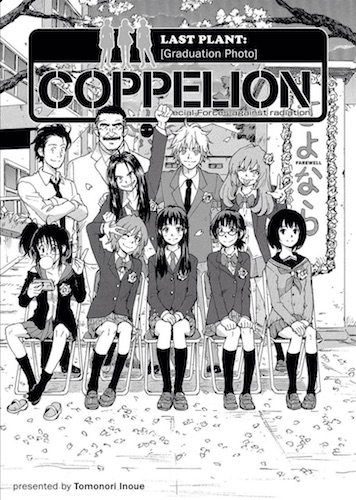
Coppelion, the science fiction manga about genetically engineered clones tasked with finding any remaining survivors in a radioactive Tokyo, finally wrapped up last month on February 20, 2016.

Running since 2008 for over 20 volumes, Coppelion has had a rather turbulent history. Its story about an earthquake that triggers a nuclear meltdown in Japan and changes the course of many lives went from “what if” to “what now” with the Fukushima Triple Disaster on March 11, 2016. Its animated adaptation was canceled, then revived with heavy censorship and a strange modification to its aesthetics. Coppelion has seen multiple tonal shifts over the course of the series that had people wondering if it was a manga about radiation or an excuse to see high school girls fighting.

For all its ups and downs, I believe that its author Inoue Tomonori had the best intentions in mind throughout Coppelion‘s run. Elements that one might assume were there merely to cater to manga readers actually carried with them a great deal of subtlety, and the subject of nuclear power never truly disappeared from the manga. In fact, I suspect that the decision to conclude Coppelion at this point is very deliberate and designed to make a statement.

Not only was the final chapter of Coppelion published in Monthly Young Magazine right before today, the fifth anniversary of 3.11, but the initial disaster that sets the story of Coppelion is supposed to take place this year, in 2016. What better place could there be to bring this narrative to a close?

Though I have no evidence as such, I think it is very likely that this final chapter was planned to land in this time frame, as a symbolic reminder of the potential dangers of nuclear radiation, as well as the problems created when both people and the governing bodies responsible for its regulation become negligent towards nuclear safety.

You can read the Coppelion manga online at Crunchyroll.

If you liked this post, consider becoming a sponsor of Ogiue Maniax through Patreon. You can get rewards for higher pledges, including a chance to request topics for the blog.