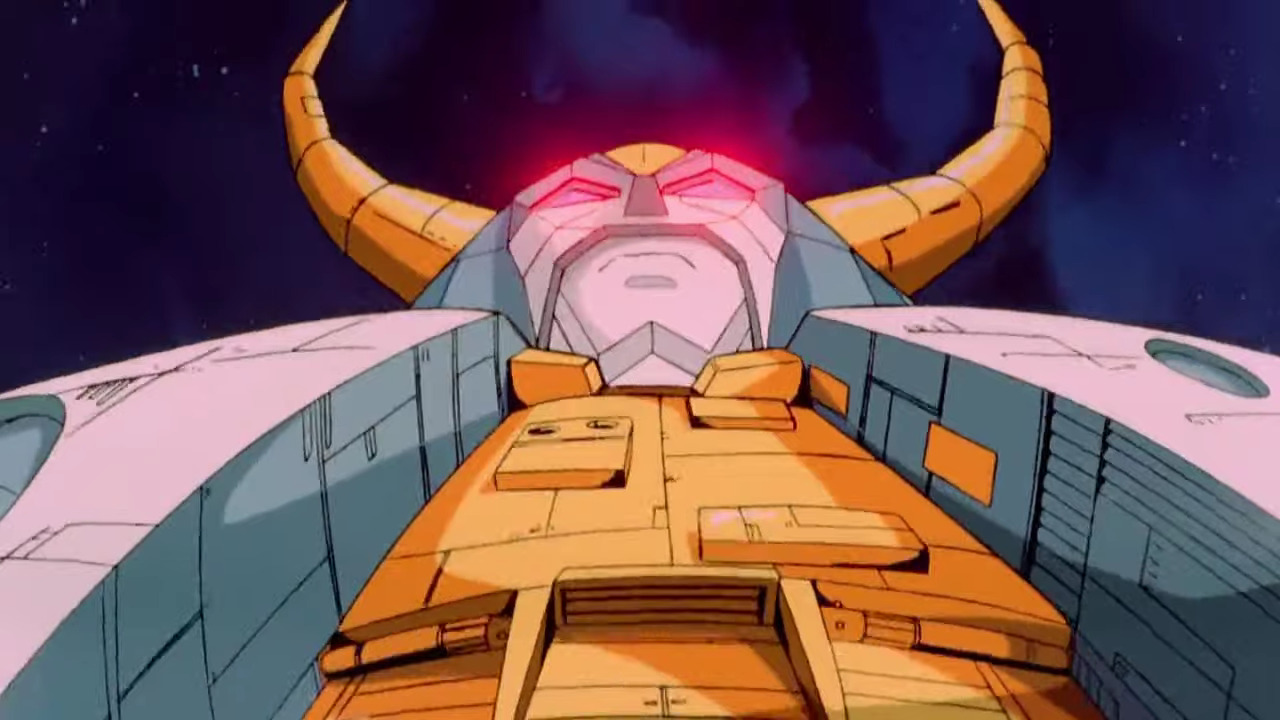
The end-of-the-year holidays are rolling around, and I feel like I’m in a strange place mentally and emotionally. I think it’s tied to the assumption that this year’s Christmas would be a far cry from the feelings of hesitation and dread that came with COVID-19 and hot off of the 2020 US elections, and how history might potentially be repeating itself. Virtually everyone I know is vaccinated, including many kids, but reports of the new Omicron variant make me wonder if I need to temper my expectations. And inevitably, it just makes me think of a certain planet-sized Transformer.
(Speaking of which, I got the new blu-ray recently. I don’t know for sure when I’ll re-watch the movie, but it never fails to disappoint.)
On a lighter note, I haven’t been looking at as much anime and manga lately, but there’s a very good reason for that: Super Robot Wars 30. It’s supposed to be over 100 hours, and I haven’t even scratched the surface. I am enjoying the hell out of getting to use Gaogaigo and the J-Decker squad, though.
I also attended Anime NYC 2021, but due to my blog schedule, my coverage of it will be in December. Look forward to a review of Pompo the Cinephile!
I wish for safe and soul-comforting holidays for everyone, and I’d like to thank my patrons for the month:
An anniversary post turned into a reflection on the site Something Awful in light of its founder’s death.
Hashikko Ensemble
Chapter 46 is more serious than silly, and it provides a window into Jin’s inner turmoil.
Kio Shimoku’s Twitter involves sharing his thoughts on erotic manga artists.
Apartment 507
Six giant robot anime came out in Fall 2021. Here are my basic impressions of all of them.
Closing
The world is ever unpredictable, and I hope we do what we can as people to watch out and care for one another. Get vaccinated if you can, look out for your fellow humans, and understand that no one is free until we’re all free.
Kio promoting Hashikko Ensemble Chapter 46. He doesn’t like how Kurotaki Maki is cut off here, so he retweeted his old drawing of her as a bunny girl. Kio also remarks how he’s noticed that all the girls are pretty stacked (with one exception).
Kio saw the anime film Sing a Bit of Harmony. As the creator of a manga about singing, he noticed the realism with which the main character of the film, Aya, breathes while performing.
Kio drunk-reviewing the latest chapter of Five Star Stories. He doesn’t remember lines or story details, but it made an impression on him—particularly the character Auxo’s expressions.
There are official water-based Gundam model kit paints now, and Kio comments that he’s had cases of the paint going all over the place using water-based acrylics. It was still fun, though. He’s painted a Juaggu and a Z’Gok that way.
Kio finally managed to store a ton of manga in boxes. At least some of the boxes are from 20 years ago, and there are about 25 boxes with 30 books each.
Kio drinks the Japanese energy drink Lipovitan D Super to start working on a new manga manuscript. He also decided to take an outdoor bath because it’s not that cold outside, and finds it’s actually good for work.
Kio has much respect for ero manga artists because of how much they have to master: poses, anatomy, camera angles, etc. Apparently, one thing people say is “If you want to get good at drawing, do porn.” But Kio also respects those porn artists who aren’t trying to make a career and just want to draw horny things. He actually drew some in middle school, but he stopped because he was afraid of his family finding out.
Jin is on one heck of an emotional arc in Hashikko Ensemble, Chapter 46.
Summary
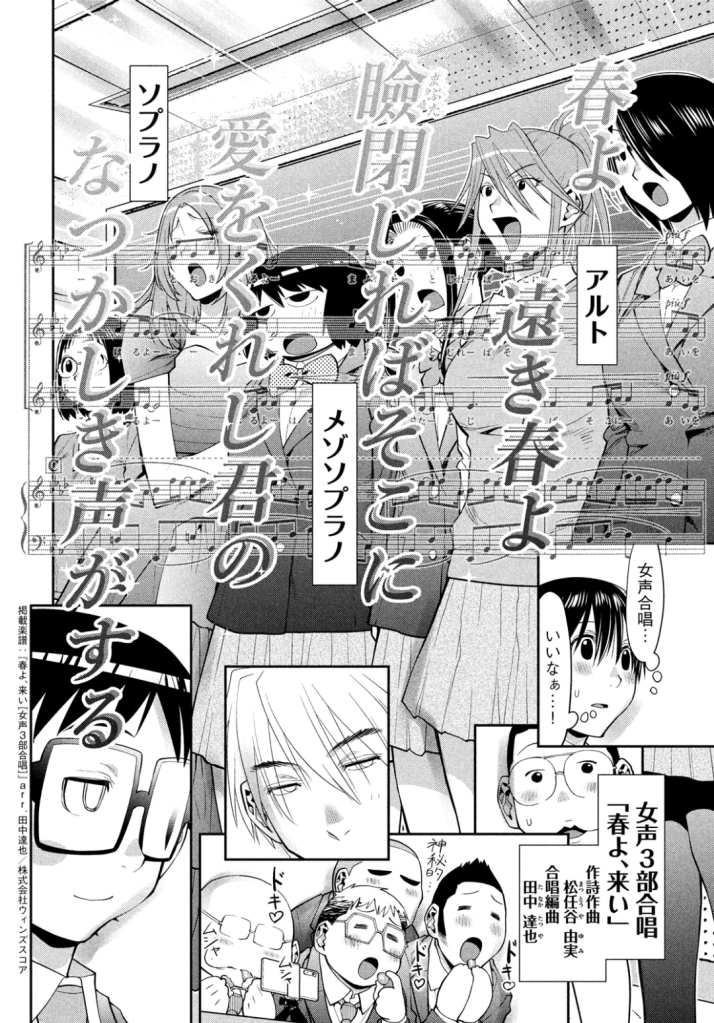
The girls of the Chorus Appreciation Society (plus Yukina and Yumerun) start on their Valentine’s Day mini-concert—Kozue’s idea for bringing Jin out of his musical funk. But within himself, all he can seem to hear are their flaws. Still, while they’re lacking either skill, group coordination, or both, they seem to have the very music in them that he’s lost.
Right before they can start their encore, however, Shion brings out her Valentine’s chocolate for Kousei and makes another confession. Kousei deflects by asking Jin if she has any hope of getting into a music college and having a career (the chances are rough. Kousei further comments that Shion’s not that good with the technical work needed for their high school either—as if to imply that Shion wouldn’t be prepared for the hardship of dating him.
At that point, Yukina cuts in and remarks that Kousei is underestimating Shion, and promises to help Shion with her schoolwork. Yukina actually only has a month until she graduates, which prompts the two girls to leave the concert and get started practicing. Losing its alto in Yukina and its accompaniment in Shion, the concert comes to an impromptu end, to Kozue’s chagrin.
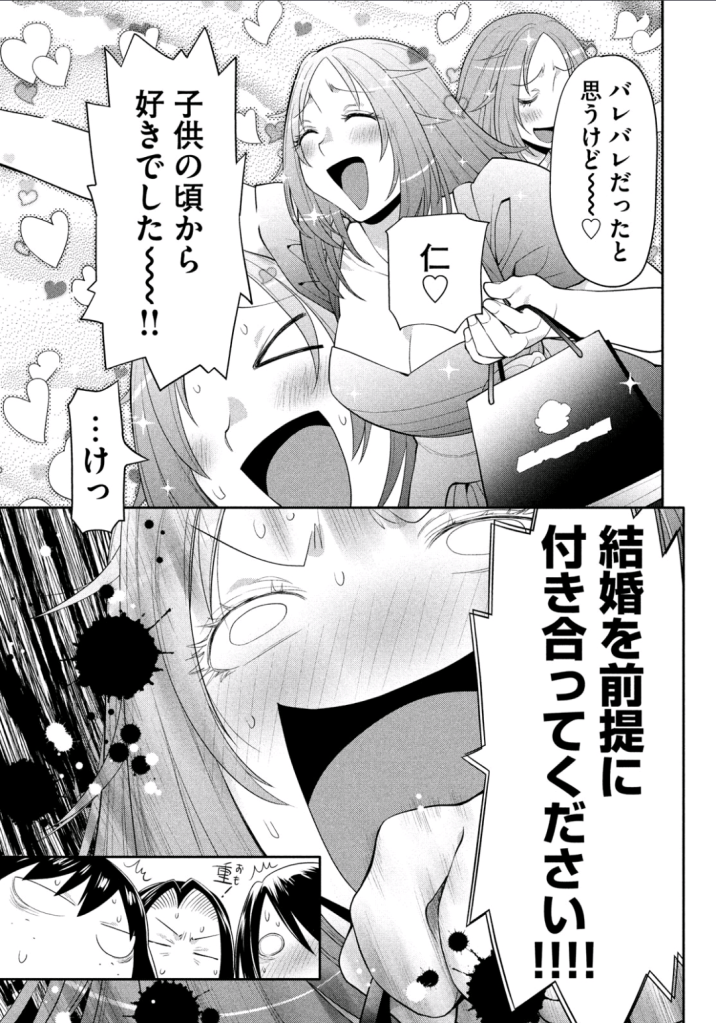
Yumerun tries to brighten the mood by delivering an intense confession of her own to Jin (“Please go out with me with the intent of marriage!”). While she says her feelings for him were likely always obvious, Jin (ever oblivious) mentions that he never even noticed. When Jin asks what kind of feeling “love” even is, Yumerun replies that it’s to treasure someone—while also thinking inside that it’s about wanting to have someone all to yourself—Jin curtly replies, “I don’t think I’m worth that much,” and leaves. Akira immediately gets up to chase, but Kozue stops him, saying that he shouldn’t be the one, and goes off after Jin herself.
The Details of Drama
The above summary is a lot wordier than I would typically prefer, but I felt that the contours of this chapter are important this month—especially because of how serious Hashikko Ensemble is getting. The drama has ramped up in many ways even if there’s still a dose of levity, with the Jin-Yumerun interaction emphasizing that contrast. In some ways, it reminds me of the Karuizawa story in Genshiken (where Ogiue finally pours her turbulent heart out to Sasahara), but the difference is that Ogiue started out full of pain, and Jin’s recent turn is more drastic compared to how we first meet him back in Chapter 1.
Jin and Love
Jin is the main focus throughout here, and I love what they’re doing with his character. The conflict that’s broiling inside him feels so real. Jin’s impressions of the girls’ performance come after Akira’s, and their differences in this moment really drive home how out-of-sorts Jin feels. Akira’s perspective comes from a less experienced place: He can tell how strong Yumerun is, that Kanon sings like it’s karaoke, and how Kozue is uncharacteristically not that great at it. Jin’s analysis, on the other hands, is very cynical and clinical, which feels so unlike what we expect of him. It’s like he’s turned a harsher ear on others as a consequence of becoming harsher on himself.
Then, when he’s asking Yumerun what it means to “love,” I get the impression that he’s not just talking about people. I suspect that he’s doubting whether he truly ever understood what it means to love music. Perhaps he feels that he’s been confusing his highly dedicated study and time poured into singing with genuine passion. When he says he isn’t worth that much, I think it might be because he seems himself as something of a fraud.
Master Yukina
Kousei continues to resist his interest in Shion, but one fun development out of this is Yukina and Shion’s friendship! I’m a fan of how Yukina and Shion quickly lose track of what they were talking about in the first place—It’s like watching a real and genuine friendship grow. Shion starts to call Yukina Shisou (“Master”), and I hope we get more of this in the future.
Jin, Kozue, Yumerun
Given the tiny bit of blushing, I can’t help but wonder if Kozue feels something for Jin beyond his surprisingly muscular body. The fact that she has a thing for that childhood friend of hers already means she’s potentially into multiple guys—a nice change of pace from so many other manga. The story seems to be going towards forging a bond between Jin and Kozue, and I think maybe it’s precisely because Kozue can’t sing all that well that she’s the right person to talk to Jin. Akira might very well drive Jin further down the hole, while Kozue’s lack of skill means that “having the music inside yourself” isn’t necessarily tied to one’s ability.
The fact that Jin was entirely unaware of Yumerun’s love for him is completely unsurprising, and I still wonder if he might be somewhere on the spectrum. Yumerun’s near-yandere romantic emotions are equally unsurprising. If there is some kind of love triangle at work here, I don’t know which I would cheer for. All possibilities are excellent, even the less orthodox ones.
Songs
“Haru yo, Koi” (“Come, Spring”) by Matsutouya Yumi.
“Mugi no Uta” (“Song of Wheat”) by Nakajima Miyuki. The lyrics of this song in particular feel like they’re talking to Jin and his current problems. “Even if the wheat loses its wings, songs have their wings.”
Final Thoughts
Akira refers to Yumerun as “Yumeru” in this chapter, and I can’t entirely tell if that’s actually her name or if Akira is just misremembering it. If it’s the latter, it’s a reminder that they barely met each other.
I don’t necessarily feel obligated to write about every crossover character in the Shinkalion franchise, but when she’s a rendition of one of my favorite heroines from one of my most beloved anime, I just have to say something.
Shinkansen Henkei Robo Shinkalion Z has continued the propensity for surprising cameos by introducing a new character based on the mysterious Maetel from Galaxy Express 999. Given that she comes from a manga that prominently features a space vehicle shaped like an old steam locomotive, Maetel is arguably a more sensible guest character than Shinji from Evangelion or Hatsune Miku. However, the fact that she turns out to be a Shinkalion pilot feels like an even bigger (but still welcome) twist.
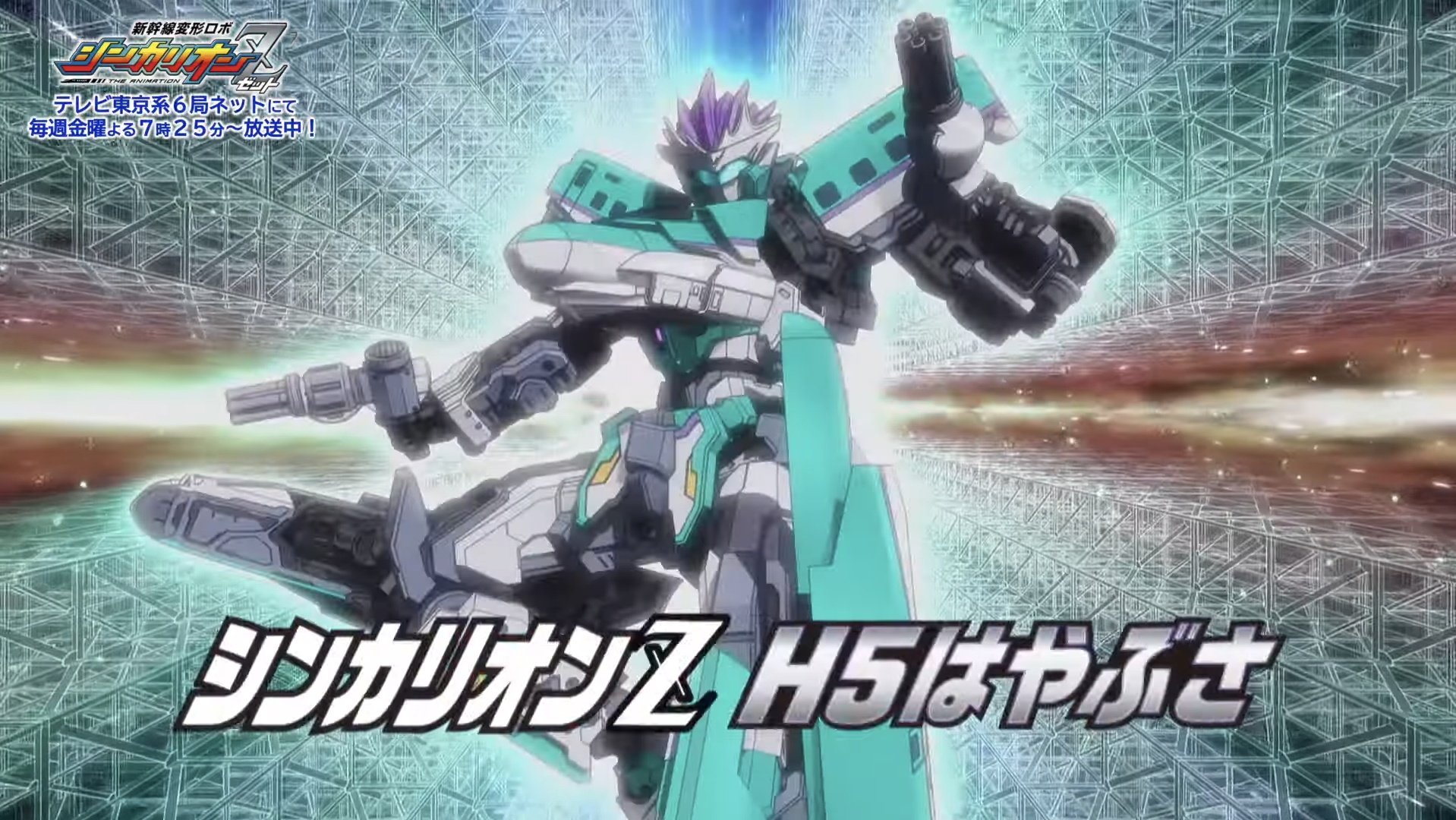
Maetel, in this case, is not the charming and motherly figure who gives an orphan boy a train pass to go on a never-ending journey to the stars. Rather, she’s an 11-year-old from Hokkaido who has trouble talking in person but likes listening to ham radio and 70s enka. In the story of Shinkalion Z, she learns about Shinkalions through a broadcast by a confused and forlorn antagonist from the first series, and discovers the existence of the Shinkansen Ultra Evolution Institute that commands the Shinkalions. Key to this is someone who’s clearly the commander of the Institute from the first series, thinly disguised. Having made a handful of appearances since Episode 20, she reveals her own Shinkalion in Episode 28: The Shinkalion Z H5 Hayabusa.
It’s pretty much impossible for Shinkalion Z to have kept any of Maetel’s original backstory, so I understand why they went a very different route. Her Shinkalion is also the spiritual successor of Hatsune Miku’s, the latter of whom has a connection to Hokkaido through the annual Snow Miku festival—but I’m not sure if there’s any such relationship this time Somewhat like Miku (who uses a different kanji for Hatsu-ne in this anime), her name is slightly off in Shinkalion Z: Her full name, Tsukino Maetel (“Maetel of the Moon”), is a sideways reference to Hoshino Tetsurou (“Tetsurou of the Stars”), the main character of Galaxy Express 999.
While the aesthetic of Shinkalion is quite different from Galaxy Express 999, I hope they can incorporate the latter somehow. The gimmick of Shinkalion Z is that the bullet-train robots can combine with other trains for upgrades—could the H5 Hayabusa get some steam-locomotive arms?
Shinkalion Z episodes are typically only available for free on YouTube for a week or two, so that’s why I’m posting this now. In a rare moment, Episodes 21 through 27 are available until the 30th of November, so if you want to see more of Tsukino Maetel, now’s your chance.
14 years is a strange milestone—it almost doesn’t feel like one. As the date approach, I kept wondering what would I even talk about. Then came the death of disgraced Something Awful founder, Rich “Lowtax” Kyanka. I never knew the man, but I definitely knew his site, and as I reflected on it and my earliest days blogging, I came to a realization.
If not for Something Awful, I might have never started Ogiue Maniax.
I never contributed directly to Something Awful, nor would I say that it gave anything directly to me, but I found a community of fellow anime fans through various unofficial offshoots of the site. Chatting and posting among them were some of the early bloggers and podcasters who helped inspire me to start blogging myself—in my 10th anniversary post back in 2017, I thanked numerous people, and more than a few of them I came to know through these communities. For that, I have to be thankful in some part.
Many words have been written these past few days about how Something Awful’s complicated legacy defined much of the standards of internet humor and discourse we see today. In terms of the good, my favorites include the disastrous video game attempt known as The Zybourne Clock and the man who tried and failed to hike across America, both of which were kneecapped by unbelievable amounts of hubris.
But while the big achievements and the major consequences are more visible, I can’t help thinking about the ironic combination of personal authenticity and endless posturing that defined interactions on that site and its descendants. It’s been a very long time since I looked at Something Awful on a regular basis, and a major part of my walking away was the frustrating degree to which posters there would become increasingly afraid of their own shadows, too eager and desperate to chase the crumbs of a specific kind of “respectability” that would provide at least a moment of respite from endless mockery. Irony was both the sword and the shield, and I assume that’s still the case today, given how the responses to Lowtax’s death turned out.
Something Awful’s community liked to create scapegoats to make its users feel safe and superior. Anime fans were one such group, with furries getting arguably the worst of it. It’s very easy to slip into these mentalities as well, and in hindsight, the fact that the furry community ended up being famous for encouraging inclusive behavior without allowing bigotry to permeate its ranks makes me reflect on how wrong Something Awful got it as a whole.
Even then, the joy of seeing people genuinely communicating their likes and dislikes at length despite an often-caustic environment—a scenario common to more than just Something Awful—made me appreciate when such discussions could occur. Even if someone vehemently hated a particular series, I appreciated when it didn’t come from trying to maintain a position of specific standards of taste one was supposed to have. Part of what motivated my blogging in those early days of Ogiue Maniax was the desire to present myself authentically, and while I hope I’ve changed for the better 14 years later, I’d like to think that desire is still there.
I also find myself reflecting on the fact that writing and communicating in a “real” way is a challenge for so many, and I think about those toxic environments that have and still exist where the toxicity is, in part, a product of defensiveness. Evangelion talks about the “hedgehog’s dilemma,” and so much of the nastier parts of the internet 20 years ago through today is influenced by the degree to which people are afraid to get hurt and expose themselves. In fact, I think many of the problems of today related to discrimination and communities rooted in fascism comes from people taking advantage of those vulnerabilities I mentioned, exploiting the hurt of people to a foul end. Funnily enough, absolute intolerance for Nazis has become a common trait between furries and Something Awful.
I still wish to write and share with little pretense, and I hope that comes across in what I still do. Next year is the 15th year of Ogiue Maniax, and I hope to see you there.
Shang-Chi and the Legend of the Ten Rings has a tricky balancing act it strives to achieve. As the first Marvel film with an Asian protagonist as well as having a majority Asian cast and creative team, it must consider the audience in the US, the audience in Asia, and the Asian diaspora around the world that sits in between and among the first two. As an American of Asian descent myself, I can only speak to two of the three, but I found myself really connecting with the film and its characters’ struggles, while also enjoying it as a high-quality mainstream superhero action film.
Shang-Chi puts a heavy emphasis on family. I think it’s because family is such a common thread that connects Asia to its diaspora, and thus the most surefire way to have a story that resonates across the divides that exist between the two, and even between Asian cultures. It’s the relationships of Shang-Chi—between spouses, parents and children, siblings, and friends—that really spoke to me on a personal level.
My father, who I’m pretty sure is not a thousand-year-old magical conqueror, is nothing like Xu Wenwu (aka the Mandarin)—and I am certainly no Shang-Chi. However, the story of a person chafing against the upbringing his father tried to instill in him feels incredibly real, especially the fact that the characters’ emotions regarding these experiences is so complex. Shang-Chi was raised to be the ultimate deadly martial artist by Wenwu after losing Shang-Chi’s mother, and the situation basically forces Shang-Chi to run away from his home and his family. In a way, Shang-Chi is both the story of an immigrant trying to start a new life and one of someone who has to reconnect with his estranged past, and this makes the character capable of connecting to multiple generations of Asian viewers.
The fight scenes are probably the best we’ve ever seen in the Marvel Cinematic Universe, drawing from a long history of martial arts movies. Their execution is what tells me that the creators have the utmost respect for the films that paved the way and the actors in them, as they’re easy to appreciate on both storytelling and choreography levels. Shang-Chi is supposed to be the “master of kung fu,” and actor Simu Liu makes for a strong performance.
But as solid as Liu is in the role of Shang-Chi, I’m in agreement with virtually everyone who saw the film that Hong Kong legend Tony Leung stole the show. One might even say that it was a very good Shang-Chi film but a fantastic Mandarin film. Leung is so utterly convincing as a multifaceted antagonist with conflicting emotions and a deep sense of pain that it strikes right at the soul. A common criticism of the Marvel films is that the villains tend not to be terribly memorable, but Shang-Chi is practically the opposite. If there’s one thing that lingers in the mind after the film is over, it’s Leung’s Wenwu. Much like Mr. Freeze from Batman: The Animated Series, I wouldn’t be surprised if he has permanently influenced all future portrayals of the Mandarin even in the comics. In other words, we’re quite removed from the entertainingly bombastic yet still kind of offensive Mandarin from the 1990s arcade game Captain America & the Avengers.
Having Wenwu/the Mandarin as Shang-Chi’s father is a significant change from the source material, where his father was Fu Manchu, the face of the highly racist Yellow Peril portrayals in American media. But the Mandarin was not exactly free of that racist tinge, and the steps taken by the film and by Leung go an incredibly long way towards freeing that character—and by extension many of the Asian characters in Marvel—from the stereotypes that plague them. The film even pokes fun at the clumsy results of how the Iron Man films attempted to tie in the Mandarin’s character, and it’s Leung’s delivery of the US’s fear of a pale imitation of the real deal (i.e. himself) that makes this self-referential mockery feel less like a halfhearted apology and more like a genuine understanding of Asian culture.
Shang-Chi also gives a lot of attention to the women portrayed in the film, and while the push to show them as equals to the men of the story can be somewhat hamfisted, it’s still appreciated. Key to this being more than a shallow “girl power” demonstration is the degrees of difference each female characters have in comparison to one another—things that either hint at or reflect specific aspects of how and where they were brought up, and how they see the world.
Overall, Shang-Chiand the Legend of the Ten Rings truly feels to me like a film that tried its very best to be a respectful representation of an Asian hero that celebrates Asian culture without overly burdening it with the need to show everything. The very personal stories that unfold between Shang-Chi, Wenwu, Katie, and all the others already captures so much of the Asian/Asian diaspora experience that it makes everything feel satisfyingly real. This is ultimately what helps make Shang-Chi, a B-tier hero in terms of the Marvel pantheon, feel like a worthy equal to those who came before him.
Nomad is the sequel to science-fiction boxing anime Megalobox. Though the two series differ overall in terms of substance, they complement each other incredibly well. It’s rare that you get a sequel that manages to be both its own thing and connect well to the original, but this is what Nomad accomplishes. That being said, I realize I never actually reviewed Megalobox, so consider this a kind of two-for-one deal. I promise I’ve done my best to not spoil either series.
While writing about both shows together is convenient for me, doing so also helps highlight the strengths of each more clearly in my mind. Megalobox was made to celebrate the 50th anniversary of the seminal boxing manga Ashita no Joe. It’s impossible to overestimate the cultural footprint of Ashita no Joe in Japan, from the general love of cross counters (Joe’s go-to move) to the iconic final moments of the series with the protagonist Yabuki Joe slumped dead in his chair at the ring corner, smiling. What Megalobox does is take the DNA of that all-time classic and tell a similar-yet-different story. Instead of the story of an orphaned street punk who discovers a passion for boxing, it’s about a similar character (also named Joe) doing so in a futuristic setting where technology has become part-and-parcel with the sport—now named “Megaloboxing.” All boxers now where equipment on their arms (known as “Gear”) in order to hit harder and faster, with eventually one notable exception: Joe himself.
Megalobox follows a more conventional route for a boxing story, focused on an underdog who rises through the ranks. If you’ve seen Rocky and the like, it’s of a similar vein, though the SF aspects brought in by Gear and all the money surrounding the technology make the divide between the haves and have-nots far more pronounced. Megalobox is great storytelling from beginning to end, with great artwork and music to boot, and I even liked the way the future setting was incorporated into the narrative. However, a part of me felt like it was more often an aesthetic flourish, and that the story could be told about as well if it were just set in the modern day without all the cybernetics.
Not so with Nomad.
Taking place a few years after the end of the first anime, Nomad sees the characters older and in most cases very different places. Here, not only is the plot less about characters striving to succeed in the sport of Megaloboxing, and more about the struggle of just being alive. Migrant discrimination, drug addiction, and severed bonds among family are among the topics explored in Nomad, where the sense of a world on the brink of dystopia looms large but also feels close to home.
Here, Megaloboxers’ Gear take on a more vital role in more ways than one. More than just being a way to augment one’s skills in the ring, the way each Megaloboxer views and utilizes them tells stories about how they’ve gone through life. Ast the series progresses, one particular Gear is at the forefront of a potential scientific revolution, but the ethical aspects of its development become of central import to the overall story. Whereas Megalobox felt like a boxing story with science fiction elements in it, Nomad is more the other way around in the best way possible. It’s not just SF because it features newfangled technology, but it challenges viewers to think about the influence and repercussions such changes would have on individuals, society, and humanity.
In conclusion, watch Megalobox. Then, once you’re done, watch Nomad. It’s hard to find a one-two combo as strong and as impactful.
After messing around recently in Training Mode in Smash Ultimate, I made an interesting and useful discovery regarding Mewtwo: a simple move I’ve begun to call the “Shifted Teleport.”
How to Do It
In Ultimate, if you dash or run at a ledge or platform edge but let go a little before you actually hit it, you’ll stop at the ledge instead of running off the platform. As your character halts their forward movement, they’ll usually go through a small stopping animation, like a skid or similar.
In the case of Mewtwo, it’ll either start to lean their body up out of a dash, or do a little spinning animation out of a run. During this animation, if Mewtwo performs a Teleport, the game will not consider Mewtwo to be starting the teleport from the ground. Rather, because of how Mewtwo’s body is shifted forward a bit, it’ll be as if Mewtwo is Teleporting from the air, and this influences how Mewtwo exits the Teleport as well.
In the video above, you can see the difference between simply Teleporting when teetering at the ledge (Mewtwo comes out of the Teleport grounded vs. using a Shifted Teleport (Mewtwo is considered slightly above the ground and therefore gets the extra bit of a distance).
The Second Piece of the Puzzle: Teleport Shortening
The extended Teleport is a practical utilization of the Shifted Teleport, but there’s more. First, let’s look at another technique available to Teleport characters called “Teleport Shortening” or “Short Warping,” as demonstrated on Youtube by a user named Kaiser:
Essentially, if you pick the direction of your Teleport using the c-stick instead of the control stick, you exit the Teleport at a slightly shorter distance, no matter which direction you pick. The timing is a little strict, but far from impossible to pull off. As demonstrated in the video guide, this can help with things like ledge canceling, i.e. using Teleports to slip off ledges as an advanced movement technique.
Here’s a video I uploaded showing how Shortened Teleports can help out Mewtwo on Kalos:
Notice how Mewtwo was falling off and dying, but with Shortened Teleports, things turn out differently. Also note that the angle to do these was straight down on the c-stick, 270 degrees. No need for fancy obscure angles or anything, which is a huge boon for players like me who aren’t good at being so consistently precise on the stick.
Shifting + Shortening = Even More Possibilities
Now, what happens when you combine Shifted Teleports with Shortened Teleports? Here’s one result—an easy ledge-trump method from on stage:
If you tried this from a standing position and a normal Teleport, you’d simply stay on the ground. If you do the shifted Teleport but non-shortened, you fall to your doom. It’s only by combining the two that this is possible.
Going back to ledge cancels, Mewtwo has a much more difficult time pulling them off than Palutena, and often risks self-destructing when trying. Part of this is that Mewtwo’s Teleport is much more unforgiving in terms of the precision of angles required to successfully ledge cancel. For someone like me who’s bad at consistently hitting those angles, it can feel too daunting to even attempt. But in the video below, all you have to do is hit the c-stick straight down during a Shifted + Shortened Teleport, and you get this reliable ledge cancel down-air on Battlefield (also works on Small Battlefield).
Advantages of Shifting your Teleport
Shifted Teleports take a bit of time to set up due to the necessity of dashing and stopping, but I think it comes with a lot of benefits even before you factor in all the tech possible.
It allows for easy spacing of these techniques, because all you need to remember is “dash at ledge” instead of “stand at this exact spot, or else.”
Prior to the Teleport, you’re still considered grounded, so there’s less of a risk compared to being in the air or off-stage.
You’re facing forwards (as opposed to backwards), which can be helpful depending on the situation.
If done from a platform, you can safely threaten the ledge from a farther position.
You can always choose not to do the Shifted Teleport and do any number of other options: shield, jump away, etc. It’s fairly non-committal.
More Research Needed
I’ve only tested Shifted Teleports a little bit, so I think there’s a lot more to discover. For one thing, this isn’t exclusive to Mewtwo, and I’ve found that the shift you get from dashing at ledges affects at least Sheik and Pikachu. There are also other stages to practice on.
I’ll be uploading all future Mewtwo clips (including all of the above) into a Youtube playlist, so it should be easy to keep track. In addition all the Shifted Teleport stuff, I even have a couple other things:
In my estimation, Love Live! Superstar!! is the best Love Live! anime from a storytelling perspective. It doesn’t necessarily have my favorite characters, but what it brings is a sense of both personal and interpersonal development that feels satisfyingly cohesive and speaks to real worries that people have.
Superstar!! is the story of Shibuya Kanon, a girl who is a wonderful singer but is constantly held back by severe stage fright. Over the years, her optimism has waned, especially after she failed to get into Yuigaoka Academy’s prestigious music program due to freezing up during auditions. Resigned to enter its general curriculum instead, Kanon thinks singing will only ever be a private thing for her, but that all changes when she’s discovered by Tang Keke, a student from Shanghai. Keke loves school idols (essentially idols who act as mascots for their school), and she thinks Kanon would be perfect for it. However, not only does Shibuya feel that she simply doesn’t have it in her—the school itself forbids school idols as something that would drag down its reputation.
Kanon’s sense of defeat at the start of the series feels all too real, and it’s what makes the generally positive attitude of Superstar!! that much more poignant. Kanon stands out from past Love Live! heroines because her struggle reflects a genuine doubt that comes from believing she is physically and mentally unable to pursue her dreams. But thanks to the friendships fostered with Keke and the other eventual members of the group (not a spoiler because they all appear in the opening), as well as the way they help each other rise to the occasion, her gradual steps to overcoming her situation feel well earned.
All this applies to the other girls as well. Whether it’s Keke’s enthusiasm often running ahead of her ability, Arashi Chisato’s relationship with both dancing and her childhood friend in Kanon, Jeanna Sumire’s frustration with being a former child actor who always seemed destined to never shine, or Hazuki Ren’s conflict between upholding her family’s honor and her own desires, there are challenges each of them face that feel simple yet profound. The hope they give each other fights back against the fear in them, and helps them stand.
The fact that there are only five girls (instead of nine or more) also helps greatly with making the series feel more complete. Not only does it give more time for each character’s story to develop, but there’s a far better sense of how they complement one another. When you have nine-plus like Superstar!!’s predecessors, they often seem like well rounded groups just through sheer brute force. With a smaller main cast, their connections feel deeper without having to delve into ancillary material (drama CDs, etc.). It also results in what I think is the most robust cast overall—it’s hard to pick a definitive favorite, but I lean towards Keke.
Unlike Love Live! Nijigasaki High School Idol Club, which began with character designs more in line with the previous series and then given a different spin for its anime, the Superstar!! designs have been their own thing from the start. This gives this generation a somewhat different visual impression overall, and the animation does a great job of having both that idol sheen and a sense of the personal. The songs are standard idol/Love Live! fare but fun and uplifting, while the physical performances are portrayed incredibly well. They do an especially good job of showcasing Chisato’s superior dance skills compared to the rest of the cast.
Out of all the Love Live! anime, this is the one I would most readily recommend to people unfamiliar or wary of idols and idol-related media. The story of Kanon and the others feels like it exists a little beyond the parameters of idoldom, and thus more accessible while also just being really solid and beautiful overall. While this season ends well, there’s little doubt that a second season is coming. I can’t wait.
Back in January this year, I posted about a crowdfund by the anime studio Nippon Animation to digitally preserve one of their obscure giant robot anime from the 1970s, Blocker Corps IV Machine Blaster, and avoid being left with only the original deteriorating film prints. While it looked to be in danger of not making it, the crowdfund was successful. Now they’re back to raise money to archive another one of their quirky 70s mecha series: Super-Transforming Magic Robo Ginguiser. Unfortunately, I only discovered this crowdfund very recently, and now there’s only 24 hours left to fund it as of this post!
Ginguiser, like Machine Blaster, is not exactly the most timeless anime around. But it’s still a part of anime and mecha history, and I feel it’s important to make sure we make even the possibility of a high-quality release someday a likelihood. I mentioned it briefly in my overview of 1977 for the Golden Ani-Versary back in 2013, but mainly to share the amazing image above. Check out the opening by Sasaki Isao of Space Battleship Yamato and Getter Robo fame!
Readyfor.jp is a Japanese-only site, so it can be tricky to navigate, and it doesn’t make donating from abroad easy. For the convenience of those who want to contribute but hit a language barrier, I’ve provided the same guide to donating as in my previous Machine Blaster post.
First, you’ll have to make an account on the site. At the top-right corner is a red button for logging in and creating an account. From there, you can either choose to register directly with readyfor.jp by clicking the red button on the right, or via Facebook using the button below it.
The blank spaces above, from top to bottom, are “user name,” “email address,” “password,” and “password again.” Then you’ll get a confirmation email, in which you’ll have to click a link to confirm your registration.
From there, if you go back to the Ginguiser project, you’ll see another red button to the right of the main image. That’s the donate button, and it’ll take you to a page where you can choose how much you want to put in. Unlike other crowdfunding sites, you can only select along preset amounts, so the minimum is 3,000 yen, which gets you a thank-you message and updates via email. The most expensive one, at 70,000 yen, is Ginguiser soft-vinyl figures. At the bottom, you’ll have the choice to pay via credit card or bank account. For payments outside of Japan, it’s probably better to use a credit card just because bank info in Japan can be very specific and have aspects that other countries don’t.
This is where it gets tricky. After putting in your credit card info, you’ll have to add your address as well. However, the form is not formatted for non-Japanese addresses, so you’ll have to work around it. Thankfully, if you just kind of fill it in as you would a normal address (and ignore the actual meanings of each form space, in case you can read Japanese), then it works out. Another crowdfund on readyfor.jp has provided a helpful screenshot, which I’ve also provided here. Note how the postal code in Japanese is just filled out as 111-1111. The only blank spaces this image isn’t showing are for your name.
From there, you hit the last button at the bottom and confirm your contribution! You can also write a message in the space provided.
I hope Ginguiser can make it! And if you’re the curious sort, there’s actually a Ginguiser tag on the Japanese art site Pixiv. Warning: Some images are NSFW!









 OGIUE MANIAX