I’ve been playing the heck out of Super Robot Wars T (available via import in English for the Nintendo Switch and PlayStation 4), and as always, I’m into the loving fanfictional goodness that the franchise always entails. When you have all of these different giant robot heroes in the same universe, the interactions are an endless source of amusement and head-nodding affirmation.
Of the many crossover moments little and big, however, there is what I believe to be an unspoken story element that significantly alters the course of one particular series: King of Braves Gaogaigar. This might be mere fan speculation on my part, but I think it also makes total sense.
In the original 1997 Gaogaigar TV series, the main character Shishioh Guy uses an attack called Hell and Heaven to finish off monsters. A little into the series, however, he discovers that using the attack too much does severe damage to his cyborg body, and that overusing it could lead to death. In response to this, his team (known as GGG) creates a new, alternative finisher called the Goldion Hammer, which becomes his default decisive blow through most of the series. It’s only in desperate times when the Goldion Hammer isn’t available that Guy will resort back to Hell and Heaven.
But in Super Robot Wars T, when you meet Guy, the Goldion Hammer is nowhere in sight, despite the story being well past the point in the anime where he was supposed to get the Goldion Hammer. And yet, Guy shows no signs of excessive use of Hell and Heaven. On one level, this is likely a gameplay pacing decision, to keep Gaogaigar from having its strongest attack early on, but I think there’s also an in-story explanation: he simply didn’t have to use it as much in the SRWT universe.
Whereas Gaogaigar and GGG alone fought against EI-01 and the Zonders in the anime, in the game, they occasionally received help from Watta and Tryder G7 (from Muteki Robo Tryder G7), as well as Maito and Mightgaine (from The Brave Express Mightgaine). In other words, in SRWT, Guy had enough assistance in his many battles that, by the time we meet him in-game, he isn’t anywhere near as overburdened as he is in the anime.
It’s considerations like the above which make Super Robot Wars T (and Super Robot Wars in general) such a treat. I’m looking forward to seeing whatever other crazy moments are in store.
Between Avengers: Endgame, Game of Thrones Season 8, and the upcoming Star Wars Episode IX: The Rise of Skywalker—all concluding parts for their respective stories—pop culture has been in prime “spoiler warning” territory. If you’re plugged into any sort of social media, and you don’t have the opportunity to watch things as they’re released, it can be a struggle to avoid any and all information. This also means it’s incredibly easy for a few trolls to ruin other people’s days, but what I’m even more concerned about is a recurring notion I’ve been seeing, about how people’s anger and frustration over being spoiled is some kind of sign that these works are less about art and storytelling and more about shock value and surprise. They might even say something like, “Truly good works are good even when spoiled.”
Perhaps they’re right. Perhaps they’re not. Either way, it still doesn’t mean that a desire to go in relatively “blind” is somehow valueless. In fact, I find it to be quite rude and even a little elitist to value a work over people’s own desires to such an extent that negatively impacting their experience is somehow “okay” because it shows how “limited” both the people and their “shocking” entertainment can be. While it’s true that some things stand the test of time better than others, and that a piece of media that can be enjoyed over repeat viewings is strong in many ways, you still only get one chance to see something for the first time regardless. Just because something is even better the second or third time around doesn’t mean that the initial exposure should be diminished.
Granted, even without spoilers, “going in blind” means different things to different people. Some might have ideas as to what they think will happen, and will be bracing for the moment that their pet theories are confirmed or denied. Others might be looking at character interactions and trying to see if their chosen characters have any romantic developments. Personally, I purposely try to avoid pushing my expectations onto a work as much as possible. But whatever one’s approach, and even if a work holds up after spoilers, being aware of what happens changes the way a work is experienced. You go from trying to navigate the work on your own terms to being aware in the back (or front) of your mind that an Important Thing is going to happen. That’s not necessarily bad, but if you view a work once without spoilers and then a second time with spoilers, it means you get to have both experiences.
Note that there are a few caveats. The choice of spoilers vs. no spoilers is anything but binary, and that something as simple as a movie trailer can be “too much” for some and “not count as spoilers” for others. There’s also a difference between “being okay with spoilers” and, say, people who want advance warning on anything that might trigger them and cause deep psychological pain. And for instances where a work might come from a very unfamiliar time and culture, and not knowing the proper context can mean not catching many of the meanings and signals that are assumed to be “obvious” or “common sense” to anyone from that original time or place. Foreknowledge can be significant, but having it isn’t inherently better than not having it. First impressions can potentially be based in ignorance, but that ignorance can be corrected afterwards. You can’t take back a spoiler.
If all a film, TV show, book, or whatever has is shock value, so be it. If it has more to offer, all the better. That still doesn’t make those who wish to be surprised or who wish to focus on the unexpected somehow symptoms of an ailing entertainment industry, or make their experiences trivial. They can always come back, and if the problem is that people don’t want to revisit after the first go-around, that’s not an issue with anti-spoiler culture—that’s an issue with time and its usage. But ultimately, if people only have enough time to see something once, they should be able to do it on their terms, and not ones set by some externally imposed values rooted in notions of how “true quality” is defined.
Good news for fans of 1990s giant robot fans: plastic model and figure maker Kotobukiya is looking into making plastic models from the Yuusha/Brave series, and they’re holding a survey to get customers’ opinions.
The survey is in Japanese, but for those who can’t read the language but still want to participate, I’ve translated the prompts, which you can see below.
Please select your gender. (Choices are male, female, and no answer)
Please select your year of birth.
Among the options below, please select your favorite work in the Brave series. (Options are in order of release date)
Please select the Brave series products you hope to see. (Pick 3)
Please write any opinions you have pertaining to Brave series plastic model kits
Please tell us your favorite plastic model purchase from the last six months.
Please tell us why the answer in #6 is your favorite.
Please choose any of your favorite plastic model lines from Kotobukiya. (Frame Arms series, Frame Arms Girls series, Hexa Gear series, M.S.G. Weapon Unit series, M.S.G. Heavy Weapon Unit series, M.S.G. Gigantic Arms series, M.S.G. Mecha Supply series, M.S.G. miscellaneous, Other)
So happy survey-filling-out (?)! I for one will be voting for Shadowmaru (J-Decker), King J-Der (Gaogaigar), and Gaogaigo (Gaogaigar vs. Betterman novels). Survey ends May 31.
To tell a story about competitive running is to instantly conjure up images of winners and losers. Even “The Tortoise and the Hare,” with its moral of consistent hard work reaping rewards, is framed as “slow and steady wins the race.” But the anime Run with the Wind emphasizes a lesson different from the old folk tale and even many other sports anime: while there will always be those who are faster and stronger, ultimately the true race is the one you run against yourself.
Titled Kaze ga Tsuyoku Fuiteiru (“The Wind is Blowing Strong”) in Japanese and based on the novel by Miura Shion, Run with the Wind centers around the dream of one Kiyose Haiji. A senior at Kansei University, he wants to win the Hakone Ekiden: a 10-man relay marathon that pushes the limits of its participants. However, the group he’s managed to assemble is about as rag-tag as it gets–from a literal prodigy to a manga otaku who hasn’t experienced a real sweat in his life. Even qualifying for the event seems like a pipe dream, let alone winning.
Because the characters come from such wildly differing circumstances, each has a personal challenge to overcome. Kakeru, the aforementioned savant, is far and away the best of the group, but a troubled past leaves him conflicted about both running and being a team player. The geek, nicknamed “Prince,” is on the far opposite end, and is unable to even imagine running 20 kilometers. There’s practically a 0% chance that Prince could ever catch up to Kakeru even if he trained for a decade, but the series emphasizes an idea: it’s less important to prove superiority over others than to grow as an individual and to help others grow as well. Fujioka Kazuma, a character introduced later as the #1 college athlete, views his running not as an opportunity to triumph over others, but as a way to push himself to greater heights. The use of the Hakone Ekiden in the story itself beautifully reinforces this concept, as individual runners must overcome their own section and the expectations both internal and external set out for them.
Speaking from a personal perspective, I am ostensibly a runner. I go running once a week with a group, though I’m nowhere near the fastest person, and my times haven’t gotten better in a long time, but I can look back at my old self and say, “I thought I could never run this much, but here I am.” “I used to think I couldn’t keep going, but now I know I can do it.” I never finish first, and I doubt I ever will, but challenging myself to keep at it, and then beating it, always tells me I’m going somewhere.
I believe that Run with the Wind’s lessons are extremely relevant to people today, as I increasingly see people both young and old who are paralyzed by the fear of competition and comparison. In their eyes, there’s no point in building up the stamina to climb a hill when others have successfully scaled Mt. Everest, no point to learning martial arts because they’ll never defeat a world champion, no point in working on personal appearance because they’ll never be as handsome or beautiful as movie stars and celebrities. But what Run with the Wind says is that the race to be #1 is not the only race worth running. Those who have given up before even trying, and those who trivialize their own improvement simply because they’re not better than the rest, should take this to heart and find their confidence, however small.
I believe strongly art and entertainment meant for kids that isn’t afraid to challenge them. It shows respect for the emotional complexity and growing intelligence of children, while still understanding that guidance is important. With respect to that sentiment, Okko’s Inn (Wakaokami wa Shougakusei! in Japanese) is an anime film that flits between the light-hearted and the somber, successfully channeling both in ways that resonate with young and old alike.
After a life-changing event, grade schooler Oriko (nickname: Okko) ends up moving in to her grandma’s traditional Japanese inn. There, she discovers that she can communicate with a few local spirits, and winds up becoming a junior innkeeper. Learning and laughing alongside both the ghosts and the humans she meets, Okko matures little by little.
Okko’s Inn is cute and heartwarming both on the surface and deep down to its core, but it doesn’t mean its story is all fluff. While the portrayal of the humble everyday bustle of a Japanese inn provides an almost meditative atmosphere, Okko’s internal and external conflicts are made all the more poignant by the way both joy and sorrow touch her life.
There’s one character who steals every scene she appears in: Okko’s classmate Matsuki, whose family is also in the inn business. Both wealthy and refusing to conform to expectations, she’s a wonderfully gaudy princess-type who is actually anything but shallow. Okko and Matsuki’s rivalry/friendship is a thing of beauty, and one of many relationships that make the film fulfilling.
While Okko’s Inn is an emotional ride, it’s never to the extent that it feels incongruous or conducive to whiplash. Whether you’re 5 or 95, its story, and all the little moments that make that story up, are hard to forget.
The new season is well under way, but I’m still trying to catch up on giving my thoughts about the last season! There’s always a price to pay in terms of trying to keep up with the season, but I prefer the slow and steady approach. Many thanks to my supporters on Patreon and ko-fi for letting me take my time as I have.
General:
Johnny Trovato
Ko Ransom
Diogo Prado
Alex
Sue Hopkins fans:
Serxeid
Hato Kenjirou fans:
Elizabeth
Yajima Mirei fans:
Machi-Kurada
I mentioned last month that I was traveling to Asia, and now that I’ve come back, it’s lit a fire under me to improve my fluency in Chinese. Ogiue Maniax will still ultimately be about anime and manga, but my continued learning and renewed exposure to Chinese culture (including comics and music) might bleed into my posts every so often. I might also write a thing or two that more directly addresses some elements of intersection between Japanese and Chinese pop culture, but I have no concrete plans as of yet.
In this chapter, we see our first school outside of Hashimoto Tech! How will these students react to the eccentricities of the main cast?
Summary
The Chorus Appreciation Society is running into a few walls. This is partly because so many of its members lack experience, partly because of clashes in personality (especially between Orihara and Shinji), and partly because Mimi-sensei herself doesn’t know much about music. Thanks to the reluctant help of music teacher Takano-sensei, however, the Chorus Club gets a chance to do some inter-school practice. They visit Nishigafuchi Private High School, a strong music school with numerous accomplishments in competition and automatic entry into the elite Nankan University. It’s the Hakone Academy of choruses, in Yowamushi Pedal terms, perhaps.
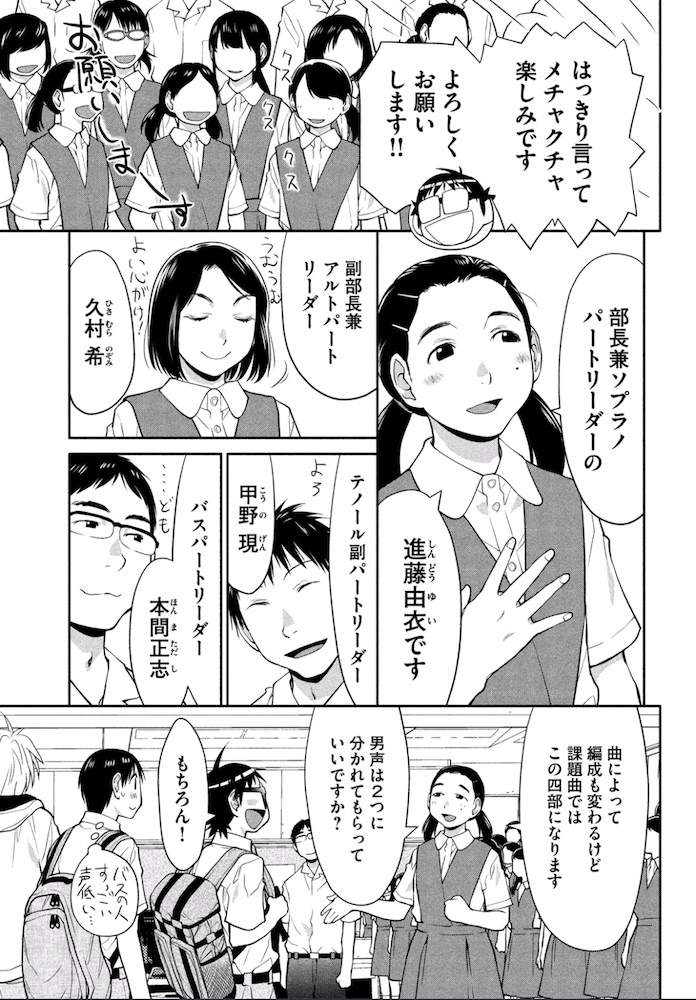
The Nishigafuchi students are surprised at the wildly varying appearances and demeanors of the Hashimoto students. The Hashimoto students split off into their respective vocal sections, but when Akira goes to meet the other bass vocalists, he’s recognized by a student from his middle school days, Kidamoto, who asks what he’s doing there.
Pronunciation 101
There’s an interesting demonstration of some tongue exercises led by Jin. Namely, he shows how while Japanese people are typically taught vowels in the order of “A, I, U, E, O,” the more natural and comfortable order for the mouth would be “I, E, A, O, U.” I rather like how the manga drops bits of knowledge like this, as it both lends an air of authenticity while also making a kind of narrative sense given Jin’s scientific approach to music.
Too Many (?) New Characters
A lot of characters are introduced in this chapter, namely students at Nishigafuchi. Because there are so many, including the leaders of each of their club’s chorus section, I wonder which of them will be important down the line. It’s hard to tell with Hashikko Ensemble, given how we already have some minor characters ascend. I get the feeling that the bass leader, Honma Tadashi, will play a role in helping Akira improve.
As for Takano, she reminds me of the characters from FLCL, and not just in terms of her full lips and pouty face. She has a kind of laid-back slyness that feels like a mix between Haruko and Mamimi.
Kidamoto
Possibly the most important new character is Kidamoto. While he doesn’t stand out at first blush, but I do like how Hashikko Ensemble is utilizing him. At the very beginning of the chapter, his face shows up in one panel (see the top image), but his level of importance is still unknown. Then, when Hashimoto Chorus Club arrives, he reacts to someone’s appearance but it’s not immediately clear who he notices, creating a bit of anticipation in the story. Is it Jin, who’s presumably somewhat infamous in local music circles? Is it Shion, who competed in piano? The fact that it turns out to be Akira is both surprising and intriguing.
So what is the relationship between Akira and Kidamoto? Is it just that Kidamoto knows about how Akira pretended to sing in middle school during class performances? I’m looking forward to getting the answer, as well as seeing how this challenges Akira.
Character Humor Deluxe
There’s a lot of excellent humor this character-based humor in this chapter that I enjoyed immensely. One is Hanyama (the bald student) expressing his sudden urge to join the Chorus Club just from watching Mimi-sensei’s adorable conductor practice. Another involves one of the students at Nishigafuchi wondering if everyone from Hashimoto is going to be delinquents (on account of it being a technical/vocational school), only to have her expectations simultaneously subverted and affirmed by the contrast between Jin and Orihara.
My favorite of all, however, is seeing Shion constantly get distracted in class by Takano-sensei’s piano across the hall. As mentioned by Takano herself, her specialty is the violin, so even as a music teacher she’s not going to be impeccable on the ivory. Seeing Shion jerk her head at every flub Takano makes (summed up entirely in one panel) is such a perfect little character moment for Shion. It not only speaks to her own piano skills, but also hints at the same personality underlying her attitude towards the Chorus Club in the earlier chapters.
Overall, much of Chapter 15 emphasizes what an eclectic hodgepodge of people are at the center of this story. I expect to see Jin upend the Nishigafuchi students’ expectations with his vocal range, as well as other similar surprises.
Songs
The song they’re practicing for competition, “Miagete Goran Yoru no Hoshi o” (Behold the Nighttime Stars) by Kyu Sakamoto, appears again in this chapter. It’s to be expected moving forward.
Another song, one that Shion decides to play on piano (and thus not helping with practice) is Friedrich Bürgmuller’s 25 Études faciles et progressives, Op.100 (25 studies for piano) L’Arabesque. It’s part of a series of pieces designed to help young pianists improve their skills.
Final Thoughts
I often wonder if I’m actually doing this manga justice. There are a lot of little details in the panels that can seem frivolous but also add a lot to the core character dynamics that fuel the series. Hashikko Ensemble grows in fits and starts, but that’s also what makes it so appealing.
I’m unsure of what kids’ marketing research took place, but I doubt it’s a coincidence that both Precure and Aikatsu!—two major girls’ anime franchises—somehow both ended up on a space theme this year. But while Star Twinkle Precure is kind of expected given how every season has a gimmick or three, it’s much more surprising that Aikatsu Friends! Kagayaki no Jewel would establish the concept of “Space Idol Activities” in its own universe. Fitting, perhaps, but surprising nevertheless.
There’s a certain level of absurdity that permeates Aikatsu! as a whole—more than enough to make “Aikatsu in space” not seem like such a bizarre direction. In fact, I think it’s what has allowed the franchise to stand the test of time as a work of art and media, independent of the arcade game it’s based on. Aikatsu Friends! Kagayaki no Jewel leans into that, whether it’s maintaining old traditions (e.g. scaling cliffs) or trying something new. So when the first episode begins with an astronaut entering the stratosphere, the main reaction from me is “sure.” In a way, it feels more fitting than something like, Yu-Gi-Oh!, which now has a history of highlighting card games in different settings—in ancient Egypt, in school, on motorcycles, in space, and so on.
The new season also takes place in a new semester where the Aine and friends are now in the high school division, and I always enjoy seeing the signs of progress that come with such transitions. In this case, it’s seeing the underclassmen pale in terms of aerobic an anaerobic training alike, as well as…idols in spaaaaace.
My only wish is that they push this concept as far as it can go. Why limit it to space-esque idol performances? Why not have an idol school aboard a shuttle? Why not have zero-g dancing? Please take this to the absolute limit, Aikatsu!
P.S. Did you know the best Aikatsu! characters introduce themselves by parachute? It’s true.
—
This post was sponsored by Johnny Trovato. If you’d like to request a topic for Ogiue Maniax (or support it in general), check out the Patreon.
With the first season of The Promised Neverland anime over, and having personally caught up to the manga as it’s throwing around major revelations, I thought it would be a good time to write about why I think Emma is one of my favorite protagonists in recent memory. I’m going to keep details vague to avoid spoilers for both anime viewers and manga readers, so hopefully everyone can enjoy.
By virtue of being a female protagonist in a Weekly Shounen Jump manga, Emma is an exception in a magazine that is, at least on the page, overwhelmingly male-dominated. In this position, it would be all too easy to make her a passive character who supports others, but what she contributes to The Promised Neverland makes her the heart and soul of the series.
Emma’s character is cut from a more traditional shounen hero cloth: she’s idealistic, compassionate, prefers actions over words, and is unusually good at making friends. But while this attitude is often a surface point for a lot of characters, Emma’s attitude runs directly into the central conceits and challenges of her own series. To believe in “helping everyone” in a harsh world can seem hopelessly naive, yet that conviction is what gives her strength.
The important thing, however, is that as much as she seems to possess a “have your cake and eat it too” puppies and rainbows mentality, she’s not unrealistic or devoid of pragmatism. She understands that her path isn’t the easy one, but at the same time believes that being all too ready to sacrifice others “for the greater good” leads down a much darker path. In maintaining this view, she brings those who would otherwise dwell in the murkier areas of humanity into the light.
Because of her outlook, she somewhat reminds me of Eren from Attack on Titan, albeit with a relatively cooler head on her shoulders and less proclivity for violence. Emma, like Eren, prompts and motivates others to go beyond their comfort zones through her actions. Unlike Eren, however, Emma is motivated less by anger and more by love.
Emma doesn’t do the impossible. Rather, by pushing her own limits and maintaining her compassion, she makes clear to herself and everyone around her that their perceived boundaries (whether internal or external) can be challenged. In a world seemingly made up of constant dichotomies, she strives to find a third, fourth, or even fifth path.
Whether by chance or perhaps some broad editorial intent, it’s a curious thing that hip hop culture would be a prominent theme in two currently serialized Kodansha manga in Japan. Change!, running in Monthly Shounen Magazine, is the story of a Japanese poetry-loving girl named Shiori who ends up being drawn into the world of rap battling. Wondance, from Monthly Afternoon, focuses on an athletic boy with a stutter who discovers hip hop dance as a way to express himself. Each series, almost by necessity, takes a very different approach to their respective subjects, and juxtaposing the two highlights the power each work possesses.
Change! naturally places great emphasis on verbal dexterity as a series about Japanese rapping, and there are certain aspects to the language that make it differ from English rapping. Japanese has fewer vowel sounds, which means that many more things in the language can technically rhyme, which in turn means that the rhymes that do occur can be even more varied yet precise aurally. The heavy emphasis on syllables also gives Japanese a certain sense of rhythm, especially because extending those sounds can change the meaning of a word entirely.
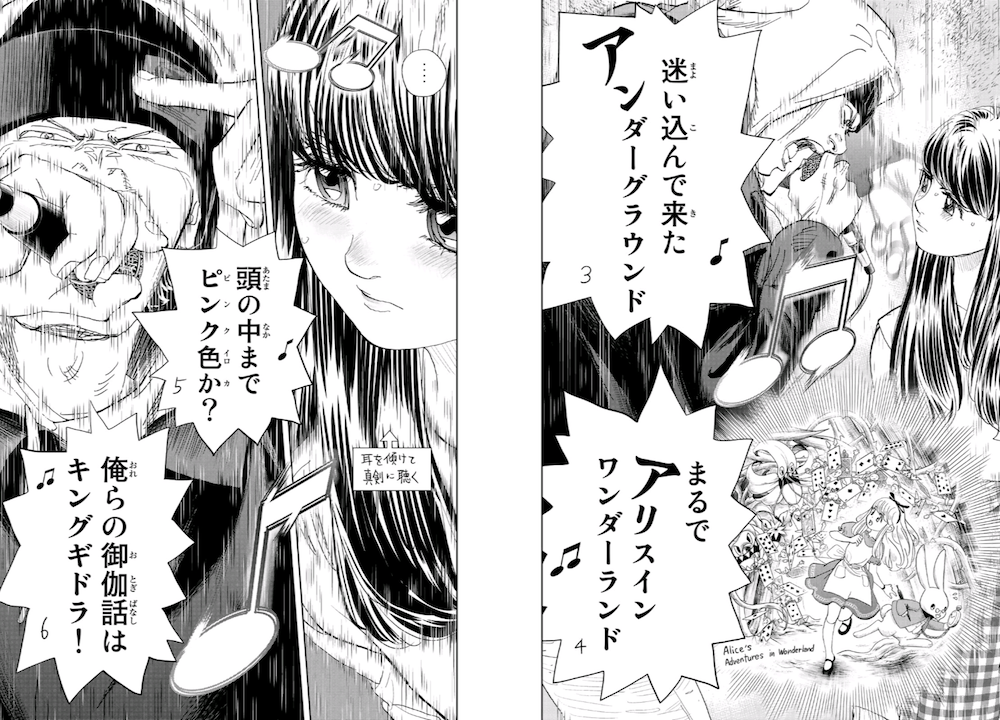
All of this needs to be effectively conveyed in the manga, and the approach Change! takes is to place more emphasis on word balloons than most manga. Words and syllables can appear larger or more erratic in order to highlight what key words in one line are being correlated with in the next line. The classic staple of many manga, furigana to aid in the reading of difficult kanji, take on added importance due to both the sheer number of homonyms that exist in Japanese and to make sure the reader keeps track of what’s being said syllable by syllable.
In the images above, the male rapper connects the word “underground” with “Alice in Wonderland,” working off the fact that andaaguraundo and Arisu in Wandaaraando both start with an “a” and have the similar raundo vs. rando. He then follows up on the next page with Atama no naka made pinku iroka? / Orera no otogibanashi wa Kingu Gidora!, or, “Is even the inside of your head the color pink? / Our fairytale is King Ghidorah!” Pinku iroka lines up perfectly vowel-wise with Kingu Gidora, and the talk of fairy tales follows up to his comparison of Shiori as being as out of her depth as Alice is in her story. While the passionate expressions and the metaphorical imagery shown contribute to the atmosphere and to hammer home the meanings behind the words, the actual word balloons do a great deal of heavy lifting.
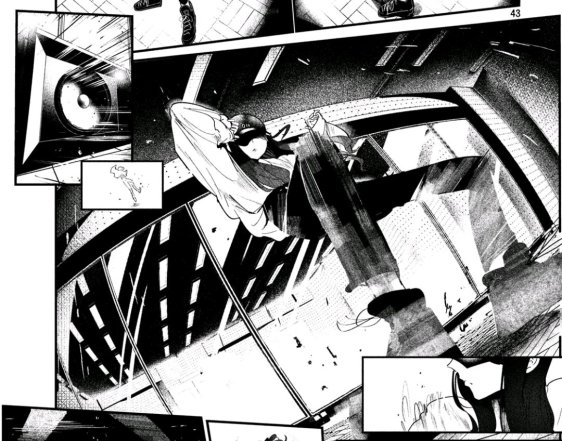
In contrast, although Wondance can be fairly wordy at times, when it comes to dancing, the manga is very much in the “show, don’t tell” category. Characters move with grace and intensity, and panels highlighting their steps litter the pages, turning them into virtual collages that practically crackle with energy. Text is sparse, and primarily brief glimpses into how the characters are thinking in the heat of the moment.
In the pages above, the main character and Hikaru—the girl who brings him into the world of dancing—are dancing together in a class. The paneling supports the character artwork, emphasizing a sense of the two as a duo in sync with each other on some deeper level. This visual approach calls to mind the elaborate paneling of 1970s shoujo manga such as Swan, where panels cascade and climax in beautiful ways. The drawings capture not just the dance but the emotions of the dancers as well, making their moves the central vehicle for storytelling. In a sense, one doesn’t even need to know Japanese (or have a translation handy) to get the essence of Wondance.
Thus, on the one hand, you have a series where the words are of the utmost importance and another where images hold the power. However, they both draw upon the visual language of comics and especially manga in fundamental ways through their particular emphases. Change! and Wondance capture some of the magic of hip hop culture itself as a multi-medium, multi-angle fusion of various ingredients.

 I’ve been playing the heck out of Super Robot Wars T (available via import in English for the Nintendo Switch and PlayStation 4), and as always, I’m into the loving fanfictional goodness that the franchise always entails. When you have all of these different giant robot heroes in the same universe, the interactions are an endless source of amusement and head-nodding affirmation.




 OGIUE MANIAX