Can-do Candy: Dagashi Kashi Full Manga Review

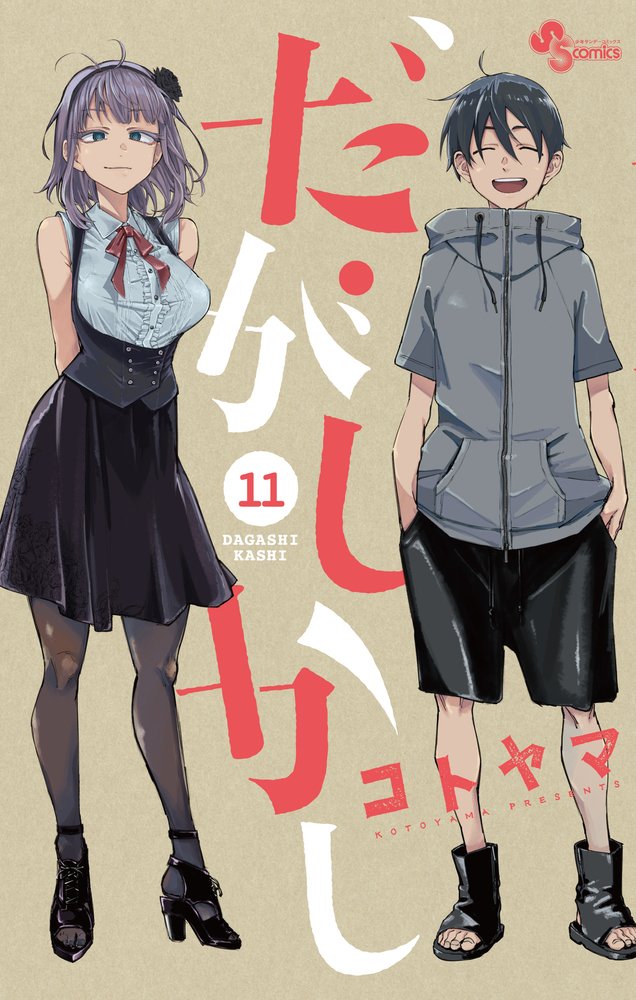
Two years after I declared Shidare Hotaru the best female anime character of 2016, I’ve finally read all 11 volumes of her manga, Dagashi Kashi. Now, it’s time for a full review of this eccentric and wonderful series about Japanese snack nostalgia and the thirstiness of youth

Shikada Kokonotsu is a small-town high school boy who dreams of drawing manga professionally, but his dad wants him to take over the family business—a shop that sells dagashi, a category of Japanese snacks that are made to be cheap so that kids can afford them with their small allowances. One day, the vivacious heiress to the Shidare snack company, Shidare Hotaru, arrives at their store with a mission: to recruit Kononotsu’s dad to her family’s company. However, in order to do that, Kokonotsu needs to take over their shop. Thus, Hotaru takes it upon herself to convince Kokonotsu to embrace the dagashi passion in his blood by making daily visits and challenging Kokonotsu in various snack-related ways.

I love reading reactions to Dagashi Kashi because of how it seems to frustrate many anime and manga fans. At first, it seems to be a fanservice-heavy rom-com/harem work with a veneer of Japanese snack nostalgia, only to quickly reveal itself as the opposite. Sure, Dagashi Kashi is filled with attractive and powerfully charismatic girls, but it’s their passionate and humorous interactions over the snacks themselves (as well as the history lessons provided) that are the true backbone to this series. This might not be what others want out of Dagashi Kashi, but it’s exactly what won me over.

One can hardly call Dagashi Kashi an ultra-complex manga, but it’s endlessly entertaining, and its characters memorable and fully realized. Hotaru is the lynchpin of the series, a whirling dervish of intensity, passion, and mild misfortune, but every character carries their weight in making it a delightful comedy. For example, Endou Saya, a childhood friend who harbors a secret crush on Kokonotsu, is a perfect “normie” character—someone who only has a casual connection to dagashi but rounds out the main cast as a result. Every time a new character is introduced, they also quickly endear themselves. The key example is an employment-challenged character named Owari Hajime, who shows up when Hotaru vanishes for a brief period. While the hole Hotaru creates in her absence can’t be filled by anyonese (a plot point in the series), Hajime differentiates herself by being this adult who’s both more mature than the kids around her yet ill-equipped for the real world.

The humor comes across to me as a kind of manzai battle royal. While manzai comedy classically involves one boke (buffoon) and one tsukkomi (straight man), the classifications are modular within the context of Dagashi Kashi. Most of the time, Kokonotsu is the one who’s reacting to characters’ shenanigans, be it Hotaru, his best friend Tou, or even his dad. But sometimes, Kokonotsu lets himself be carried away by Hotaru’s dagashi antics, and it’s up to Saya or even Hajime to call him out on it. However, Kokonotsu’s casual reactions can be completely disarming to her, which puts her out of the driver’s seat, so to speak. The humor is sort of like a cross between Lucky Star and Sayonara Zetsubou-sensei, and if that doesn’t quite make sense, it’s because Dagashi Kashi is kind of its own thing in the end.

Another interesting aspect of the series is that it’s a very different experience reading it compared to a Japanese audience. For many who grew up in Japan, dagashi are just a part of life, and part of the appeal of Dagashi Kashi is that it’s a trip down memory lane. For foreigners like me, however, it’s more about discovering a little-explored aspect of Japanese culture. In that regard, I love learning all this dagashi trivia, and there’s plenty to go around. In fact, the series can be so information-dense that it’s sometimes hard to believe that Dagashi Kashi chapters are generally only eight pages.

It’s hard to decide which chapters are my personal favorites, but a few stand out upon reflection. First, there are a couple that are meant to celebrate the announcement of the anime (seasons 1 and 2), and they’re intentionally drawn to be dynamic and action-packed, as if to challenge the animators to do something about it. Second, there’s a chapter that features Snickers, of all things. It lets a non-Japanese reader like me sort of get the nostalgic experience that’s expected from Dagashi Kashi. (As an aside, Hotaru actually presents Snickers as an ideal emergency survival food due to its high sugar, fat, and calorie content.) Third, there’s one about red bean ice cream bars. Hotaru, for some reason, essentially asks which would win in a fight: a red bean bar in the summer or a red bean bar in the winter? The question is as nonsensical in the story as it is in this paragraph, and that’s what makes it great.

With a series like Dagashi Kashi, it can be difficult to see how the series ends or whether it’s satisfying. I will say that I enjoy the conclusion, but it more or less resolves in an open-ended fashion. While it’s not entirely ambiguous, be it in romance or the pursuit of dreams, it feel as if the message of Dagashi Kashi is that these characters are still young and have their entire lives ahead of them. In other words, even as the manga finishes, the characters are capable of doing so much more. It’s a nice message to end on, and an appropriate way to send Hotaru, Kokonotsu, and the rest of the crew off.


Good Harems vs. Bad Harems: Morality in Polyamorous Manga

The term “harem” gets thrown around often in anime and manga, but series considered to be part of the harem genre rarely feature actual polyamorous or polygamous relationships. Instead, the purpose of many of these series is pure, carnal power fantasy. However, I’ve noticed that a few series make a distinction being “good harems” and “bad harems.”

Case 1: Tales of Wedding Rings

For the most part, Tales of Wedding Rings is a fairly orthodox harem fantasy series about a boy who gets transported to another world and must wed powerful princesses across the land to defeat an evil entity revived. The girls are all beautiful in different ways, and unlike those works which tend towards having the hero choose a true partner, the implication is that none of the heroines mind a polygamous relationship. It’s no strings attached. Or is it?

More recent chapters have revealed an interesting wrinkle. The hero, Satou, is the new “Ring King,” and for most of the series, his predecessor has been spoken of as a legend savior. But one of his former wives reveals a dark secret: as he continued in his role as the first Ring King, his thirst for for power grew in more than one sense. Knowing that his might relied on his physical and emotional bonds with his wives, he began to abuse and even rape them. The wives endured all they could, but ultimately they worked together to take revenge and kill the Ring King.

Suddenly, a manga about an ideal male power fantasy, the harem of hot and powerful babes, carries a lesson that there’s a difference between genuine love and the desire for control and power that leads to abusive relationships. It’s not enough to have all the women, but to treat them with respect as well. Otherwise, the fate that the first Ring King brought upon himself through his violent behavior might very well befall Satou as well.

Case 2: Mobile Suit Gundam: Iron-Blooded Orphans

The Gundam franchise traditionally doesn’t stray too far from heteronormative relationships, at best teasing about the prospect of other types of attraction and love through its characters. Mobile Suit Gundam: Iron-Blooded Orphans is a major exception to this rule. Its romances feature homosexuality, major age gaps, and yes, actual harems.

The character Naze Turbine commands a ship piloted by his many wives. But while he might appear to be a dubious personality at first, his real goal in marrying so many women is to take them out of dangerous, dead-end situations. He makes them his wives so as to afford them the protection of his yakuza-esque organization, Teiwaz, and he provides training and education for them so they have the skills to survive in their own. He doesn’t even require his wives to actually sleep with him, so some are spouses in name only. Of course, he won’t refuse a physical relationship either, and has fathered many offspring as a result.

Like first Ring King in Tales of Wedding Rings, there is a character who represents the “bad harem” in Iron-Blooded Orphans: Jasley Donomikols. Another member of Teiwaz, he constantly tries to bribe Naze’s wives to his side with gifts of money and power with no success, failing to realize that what they value most in Naze is not riches but love and caring. Eventually, Jasley is murdered out of revenge by Naze’s wives.

Naze’s approach to love ends up influencing even the main love triangle of Iron-Blooded Orphans. At one point, Amida (Naze’s #1) says to a young Atra Mixta that a true man has enough love to go around, a lesson Atra takes to heart.

So What’s the Difference?

In both Tales of Wedding Rings and Iron-Blooded Orphans, a clear distinction is made between a healthy harem and an unhealthy one. The former is based on caring and generosity, while the latter is founded in greed, selfish desire, and the treatment of women like objects. Both the first Ring King and Jasley make this mistake, and end up paying the price for it.

This notion of the “selfless harem” is fairly idealistic and at odds with how harems are generally envisioned. Normally, they are wish fulfillment fantasy for boys and men filled with lust and eyes for many, or for those who don’t want to choose. Institutionalized polygamy (like the kind found among Fundamentalist Mormons) can become a dangerous source of power imbalances in communities, harming both men and women. The irony is that according to the series which champion selfless harems, they can only be truly obtained when one does not greedily desire for them, like some kind of Zen or Taoist riddle.

Darling in the NYCCs: Ogiue Maniax Status Update for October 2018

New York Comic Con is this week. I’m hoping to see Nozawa Masako (the legendary voice of Goku) at the Dragon Ball Super: Broly film showing. I wish she had a signing—she plays Tetsurou in my favorite anime ever, Galaxy Express 999—but alas.

Thank you as always to my supporters on Patreon and Ko-fi, especially the following!

General:

Johnny Trovato

Ko Ransom

Diogo Prado

Sue Hopkins fans:

Serxeid

Hato Kenjirou fans:

Elizabeth

Yajima Mirei fans:

Machi-Kurada

My favorite posts from September:

On Loli Vampires, Fiction, and Morality

A complicated topic I’d been wanting to write about for a while: the complexities of morality when it comes to large age gaps in fiction.

Akira Yuki (Virtua Fighter) for Super Smash Bros.

My interpretation of how Akira would work in Smash!

Please Tell Me! Galko-chan and Portrayals of the Nerd/Bombshell Romance

How does the uniquely insightful, uniquely horny Galko-chan handle one of the classic romance tropes?

Hashikko Ensemble

Chapter 8 puts the spotlight on Koizumi Himari, a childhood friend who’s more than meets the eye.

Patreon-Sponsored

Aikatsu Friends! Choreography Has Won Me Over

The dancing has improved in Aikatsu! and notably so.

Closing

This month is actually my first ever wedding anniversary! It’s crazy to think that I’ll have been married for one whole year. Here’s to love.

Beyond Expectations: Planet With

Imagine a long-running anime series that finally hits its climax, and winds down with an incredible conclusion. It seems like the perfect place to end the story, satisfying and complete yet somehow making you feel like you’d like to dive back into that world someday.

Now imagine if this anime received a follow-up. You love this series, but feel trepidation. After all, sequels are notorious for often failing to live up to the original, and you want your memory to remain untainted. Still, you give it a chance…and it’s even better than the first one! How is this possible? While you’re reeling from having your faith rewarded, you find out that, once again, this isn’t the end. Another sequel has been announced! And another. And another. Each time, you worry that something might go wrong, but it never does. Before you know it, hundreds of episodes have passed, and you can’t help but feel that the world is a different place.

Except you realize it’s only been twelve episodes. All of those years you swore had passed you by were contained within three months. That feeling is essentially what it’s like to watch Planet With.

Based on a manga by Mizukami Satoshi (Lucifer and the Biscuit Hammer, Spirit Circle), Planet With is rare among anime adaptations because the original author actually specifically created the storyboards for the animated version. While the anime and manga apparently do diverge, there’s a certain level of consistency that can only be achieved through such hands-on involvement. If it wasn’t clear from the opening paragraphs, the value this provides comes across in the final work in spades.

Initially, Planet With feels “unstable.” It’s difficult to establish a foothold as a viewer. What are these bizarre, giant totems flying through the air? Who is this seeming hodgepodge of people declaring that they’re here to defend the Earth? Where did they get their mysterious-looking armors from, and are they science or magic? Who is this kid who’s clearly supposed to be the main character, and why is he living with an overly cheerful maid who translates for an eerie bipedal cat that looks related to Chiyo’s Dad from Azumanga Daioh? Who’s a good guy and who’s a bad guy?

The answers come, with time. As the story moves forward, the scope and the stakes expand exponentially, but Planet With never feels emotionless or distant. There’s something very personal about the series, but rather than fighting with the increasingly grandiose scale, those two sides feed off of each other. It’s a work that feels both impossibly large and unfathomably small, as if it took some of the best parts of Shingu: Secret of the Stellar Wars, Brigadoon, Gurren-Lagann, and (of course) Lucifer and the Biscuit Hammer and mixed them all together.

The most pleasant surprise about Planet With is that while it seems to go to the ends of the universe and back both literally and metaphorically, it never stops being an uplifting piece of science fiction. Somehow, it takes even the wackiest possible moments and contextualizes them into gripping scenes that ignite both heart and mind and asks the two to harmonize. From beginning to end, it can practically feel like a lifetime, and I mean that in the best way possible.


Sticky-Fingered: Hashikko Ensemble, Chapter 8

Love is in the air! …Or wait, that feeling might actually be “guilt.” It’s a chance to learn about Koizumi Himari in Hashikko Ensemble!

Summary

Having heard Akira’s deal—if we repair your earphones, you’ll have to join the Chorus Club—Orihara responds with disgust and tries to take a swing. Jin blocks Orihara’s fist, inadvertently breaking his finger (but not seeming terribly bothered by it). Jin wants to fix the earphones regardless of any deal, but he can’t find anyone in class who’s up to the task.

Some days later, however, Himari (Akira’s next-door neighbor) is actually in school for the first time in a while, and she turns out to be (for reasons unknown) a deft hand at soldering. Jin, who’s in the same class as Himari, tries to convince her to help repair the earphones, but she hesitates. After some conversation, mostly revolving around how she hates Akira’s puberty-induced ultra-bass voice, Jin convinces Himari to a deal: if he can show the appeal of Akira’s new voice through song, she’ll help them out.

Shinji sees this scenario as many might: a path to romance between Akira and Himari, but Himari’s initial response to Akira and Jin’s duet is to pull out an old picture book from Akira’s collection instead and apologize. Apparently, she stole it when they were young, and it’s the reason she avoided him for so long. In fact, it turns out that Himari’s really, really good at swiping things in general, which she reveals by showing off the resistors she took from class. She agrees to help, all while showing subtle hints that she might not be so unmoved by Akira’s singing after all…

The Himari Show

As the latest character to join the main cast, Himari is a major part of Chapter 8. Frankly, I think she’s fantastic, but awkward, surly girls drawn by Kio Shimoku are my aesthetic. I find that she bounces off all of the other characters quite well, and it makes me look forward to future interactions involving her.

Himari blushes a lot, but it can be hard to tell what exactly it means at any given moment. Because she seems to have a non-stop chip on her shoulder on top of being socially standoffish, her red face seems to shift from displaying embarrassment towards herself, embarrassment towards others, and maybe some feelings for Akira himself. Based on the brief glimpses of her memories, she appears to treasure her childhood with Akira—though she appears at first glance to not be especially different personality-wise back then.

One aspect of her that intrigues me is her proclivity for five-fingered discounts. It’s such an expected personality trait that she’s instantly memorable in my eyes. Also, I get the feeling that her talents in this area are related to her adeptness with a soldering iron. Something she does outside of class might make her a dexterous girl in more ways than one.

Akira’s First “Concert”

While it’s in a stairwell instead of a hall, and the audience is one childhood friend instead of an audience of many, this chapter’s performance is a huge step for Akira. We may not be seeing every single step of Akira’s development, but it’s clear that Jin’s training has been paying off. The pacing of his progress feels right.

Songs

Two previous songs are mentioned this month, specifically because Himari forbade Jin and Akira from singing them: “Believe” and “Kanade.” The song they do pick is1982’s “Tooi Hi no Uta” [Song of a Far-Off Day] by Iwasawa Chihaya. The song is actually based on Johann Pachelbel’s Canon, with Japanese lyrics added.

Final Thoughts

This is more a personal note, but when Himari pulls out the resistors she swiped, I recognized them from a digital engineering class I took back in high school. Their authenticity makes me feel that Kio is putting his best foot forward researching all aspects for Hashikko Ensemble.

Next chapter is going to focus on the school sports festival, and I’m curious to see how this shakes out at a technical high school. How much of mechanics and engineering is brain and how much of it is brawn? Whatever the case may be, it’s implied that something crazy is going to happen.

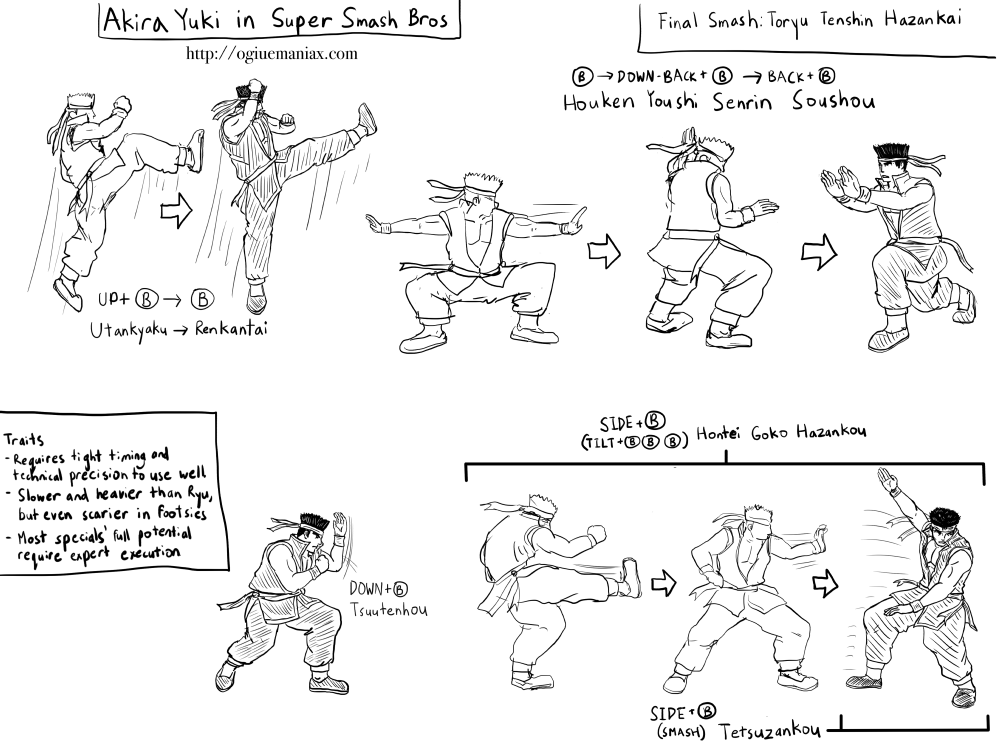
Akira Yuki (Virtua Fighter) for Super Smash Bros.

The day that Ryu from Street Fighter was announced for Super Smash Bros. for 3DS & Wii U was a milestone: the first time a traditional fighting game character would appear in Nintendo’s iconic crossover series. But if Ryu is undoubtedly the most appropriate representative of the 2D fighter, then Akira Yuki from Virtua Fighter would be my pick for 3D fighter’s poster boy. After all, Virtua Fighter was the series that introduced 3D fighting games to the world.

Akira represents a unique challenge in terms of translating his character to the world of Smash. While he has many surface similarities with Ryu—both are short-haired, Japanese, bandana-wearing martial artists focused heavily on their craft—they have almost the exact opposite functions in their respective games. Whereas Ryu is generally considered an ideal beginner’s character who’s easy to learn but whose mastery teaches the fundamental aspects of Street Fighter, Akira is meant for experts alone. The Virtua Fighter character is notoriously unforgiving to use, as it is absolutely necessary to master his extremely tight execution requirements to do any combos or damage. In fact, novices don’t even have the benefit of button mashing and hoping for the best, because his design actively prevents button mashing from being effective.

Capturing this “advanced players only” quality in Akira, as well as the general gameplay and feel of his fighting style in Virtua Fighter, is what I would prioritize when making him into a Smash character. Virtua Fighter itself is considered a game with fairly simple controls (3 buttons, 1 joystick) but whose competitive depth makes it feel like you’re outwitting your opponent first and foremost, even when characters like Akira have such high execution requirements. That’s also why this entry is so much longer than previous Smash character concepts—it’s necessary to show how Akira would embody Virtua Fighter.

Fighting as Akira should feel like you’ve out-thought your opponents, and your reward is a highly refined punish game consisting of short and sweet combos that nevertheless do scary amounts of damage. Fighting against him should make you feel bad for getting called out over and over for your predictability. At the same time, execution shouldn’t be too difficult, as it goes against the spirit of Smash Bros., but should be tricky enough that you can’t just buffer and mash and succeed. In terms of general stats, Akira would be heavier and slower than Ryu, and would of course lack a projectile move. He would be below mediocre in the air, given that Virtua Fighter characters are typically not known for their leaping prowess, and would be vulnerable to edgeguarding. On the ground, however, Akira would be a menace in a way Little Mac isn’t. He would have fast attacks with poor recovery time, rewarding intelligent exploitation of rock-paper-scissor scenarios but punishing Akira for bad decision-making and guesses.

Specials and Other Attacks

The special moves depicted above are meant to show that Akira has multiple options open as one attack flows into the next, but there’s usually a choice that’s 1) more powerful, 2) more difficult to execute, and/or 3) comes at a higher price. Take Akira’s side special, for example. If you tilt the stick, you get Hontei Goko Hazankou, a multi-part attack similar to Marth’s Dancing Blade. It does decent damage, and the initial kick can actually negate the intangibility on rolls and directional air dodges (but not side steps or neutral air dodges). The third part of the attack is Akira’s signature Tetsuzankou body check (and Bayonetta’s forward throw!), which does decent damage and can KO at very high percents. However, if you do a smash side-B, it becomes a raw Tetsuzankou, and like in Virtua Fighter, it is much, much more powerful.

In particular, there is an initial Tetsuzankou hitbox very close to Akira’s body that does massive damage (something like 30%) and can KO at early to middle percents. Even the late hitbox as Akira moves forward can do around 20%, but it’s highly punishable on dodge or shield. Another variant is that if you smash side-B back (as in the opposite direction that Akira is facing), he performs a back-turned Tetsuzankou, which is just as strong as the forward-facing one, only a few frames faster. In other words, roll past him at your own peril.

Perhaps Akira’s most famous technique is the “Houken Youshi Senrin Soushou” combination, known to English-speaking fans as the “Stun Palm of Doom.” In the Virtua Fighter games, this move is notorious for being difficult to execute, requiring precision and timing that could make even some Melee fans recoil. To reflect this challenging element of the move, hitting neutral-B alone would not do the full move. Instead, you need to hit neutral-B, down-forward-B, then back-B in that exact order at a very specific timing for each part. And unlike with Akira’s Tetsuzankou, you want to perform this whole thing successfully every single time, though stopping at Youshi Senrin (the second part) can open up certain options that can potentially lead to more damage. Also, the move is extremely unsafe on block, so you can’t just spam it and hope the opponent will get hit. You need to be confident that the Houken is going to land, because you pretty much need to execute the rest before the first part has even landed.

Ironically, his Final Smash, Toryu Tenshin Hazankai actually does less damage overall compared to Houken Youshi Senrin Soushou.

As for Akira’s other moves, Utankyaku is pretty bad as a straight-up recovery move (but it has its merits on offense) and Tsuutenhou is a unique “counter” move of sorts. Hitting up-b once makes Akira do a leaping kick called Utankyaku. Hitting the b button again results in a second kick, turning the move into Akira’s Renkantai. Both parts are capable of KOing, and the question as to whether it’s going to be one kick or two can mix up opponents. As for the down-B Tsuutenhou, it’s an upward strike that can knock opponents off balance if it’s used to interrupt an attack, and can lead to devastating follow-ups, but it’s sort of a backwards counter as it’s more effective against quick attacks than slow ones. If Akira can’t do a powerful punish in time, he can hit down-B again and default to Moukou Kouhazan, a simple palm strike. Akira also has a crouching dash like in the Virtua Fighter games, though in this case it’s performed by just smashing down-forward or down-back.

Akira actually has one other “hidden” special move that’s an Easter egg of sorts for Virtua Fighter fans. By hitting B and shield and letting go of shield after exactly 1 frame, Akira can perform Teishitsu Dantai, a quick knee strike that pops the opponent up and makes them vulnerable to combos. And for the sake of keeping this already long description from being more unbearably wordy, I’ll briefly say that most of his most iconic moves will be found in his normals. His smash attacks, for example, would be Byakko Soushouda, Chouzan Housui (negates side steps and neutral air dodges and does heavy shield damage if charged), and Youshi Saiken. Certain attacks (such as Tetsuzankou) would be able to power through projectiles uninterrupted, making playing keep-away fairly effective against Akira but not a guaranteed success by any means.

Overall

The resulting character is one that would really rewards players who love challenging execution and challenging mind games alike. If there are heart, body, and brain players each representing different tendencies in approaching fighting games, Akira Yuki would reward the body player who can also master the intuition of the heart and the disciplined research of the brain.

Please Tell Me! Galko-chan and Portrayals of the Nerd/Bombshell Romance

When the anime for 3D Kanojo (aka Real Girl) first started airing, my review of the manga by Nanami Mao would see an influx of hits. The story of an otaku boy who ends up in a relationship with a girl with a reputation for dating around, it’s a charming romance where two people genuinely connect on a deeper level. However, in response to that review, I’ve been getting the same question over and over again: “Is the girl, Iroha, a virgin or not?!” The answer is “most probably not,” but the fact that viewers feel so strongly about Iroha’s virginity saddens me a little. Part of the appeal of 3D Kanojo in the first place is that it eschews that whole obsession with virginal purity and the girl having to be someone’s “first,” something that permeates not just Japanese society but much of the world too. The message that audiences of 3D Kanojo should be taking away is “it doesn’t really matter if Iroha’s a virgin or not if they love and care for each other.”

It’s my hope that the idea gets across to viewers and readers, especially to those who judge a woman’s worth by their sexual behavior. But if it isn’t clear that virginity isn’t the be-all, end-all, a different (and perhaps unexpected) manga provides an interesting perspective on this type of virgin nerd/experienced babe relationship: Please Tell Me! Galko-chan by Suzuki Kenya.

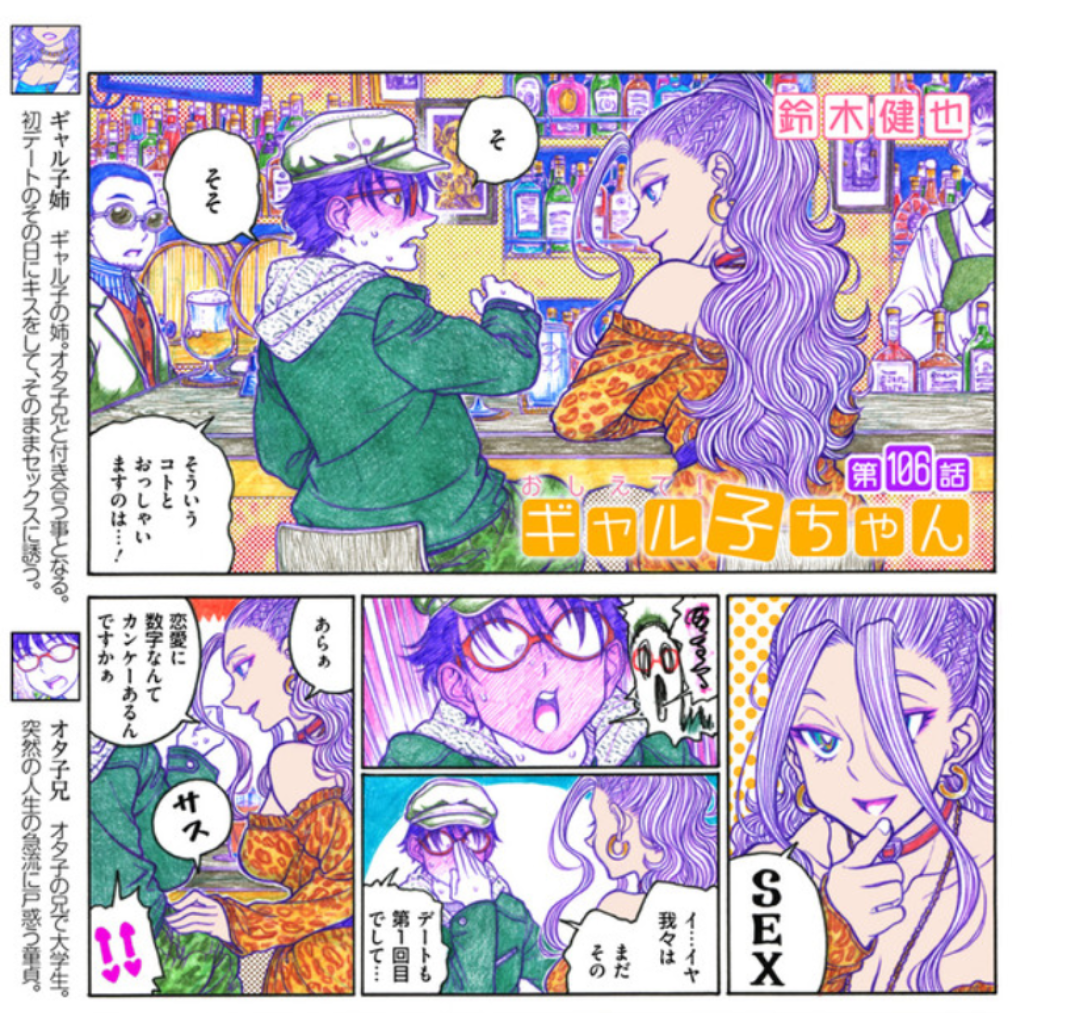
Galko-chan is primarily known for its attractive female characters talking frankly about sexual topics which they actually have no idea about, but there’s at least one character who’s extremely, unabashedly sexually active: Galko’s big sister. College-aged unlike the teenage Galko, the big sister isn’t afraid of getting down and dirty, to the extent that she’ll even “borrow” Galko’s school uniform for some guy she’s dating. However, while she’s comfortable sleeping with lots of guys, the most recent storyline in the manga concerns a burgeoning romance between Galko’s sister and the otaku brother of Galko’s best friend Otako.

What starts out as Galko’s sister wanting to rock some nerdy virgin’s world for kicks turns into something greater. Galko’s sister agrees to go on a date with Otako’s brother, and during it makes her intentions crystal clear. She directly brings up the topic of sex and even nibbles on his ears during dinner. But as much as Otako’s brother wants to sleep with her so very badly, he doesn’t want to be treated like a mere conquest. Instead, he wants their relationship to be something special, and if he’s just another tally for the “virginities taken” box, then he wants no part of it.

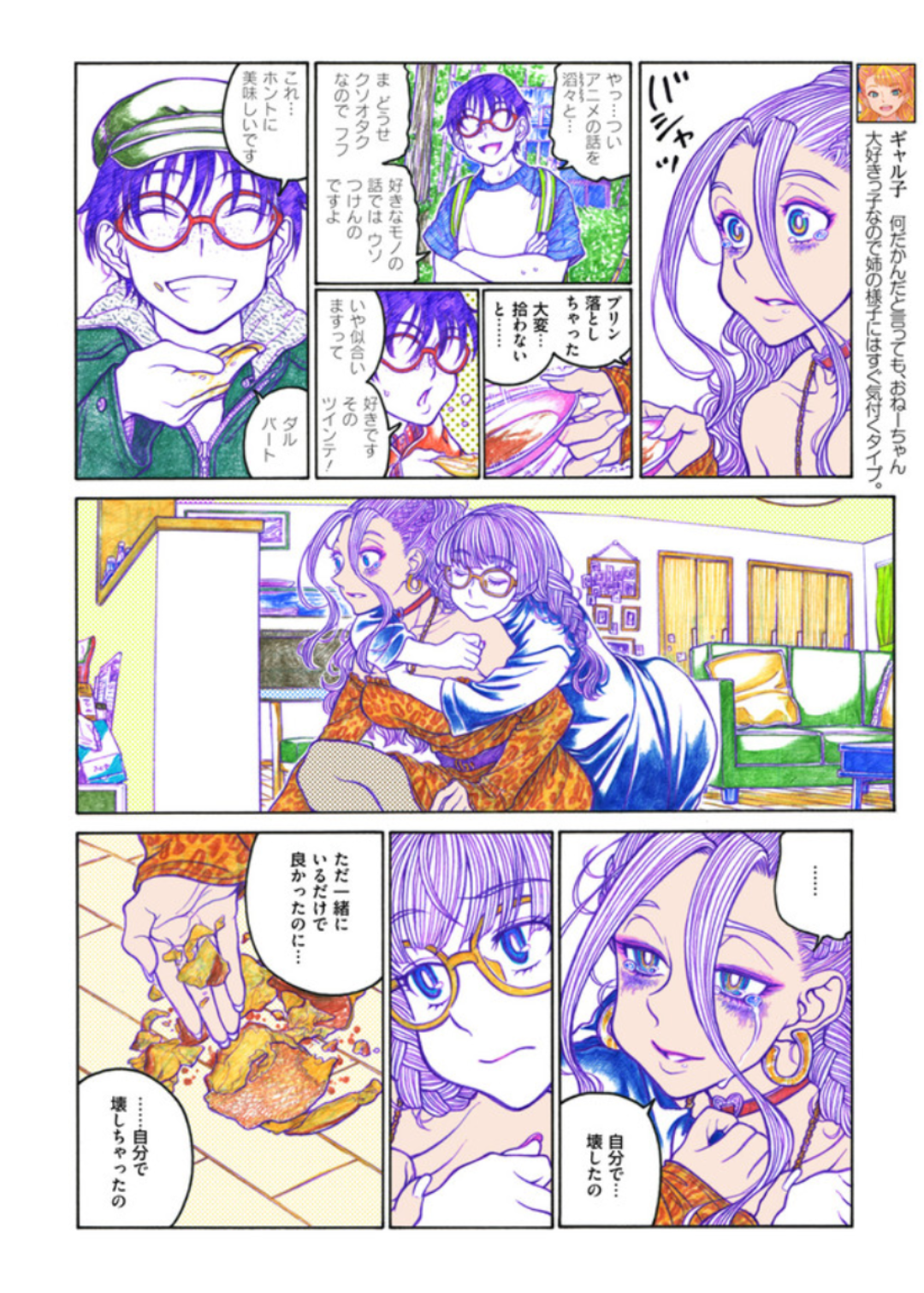
This hits Galko’s sister harder than she expects, because she genuinely began to fall for him, and realizes she took the absolutely wrong approach. Which is to say, lust and love certainly overlap, but they’re not the same thing.

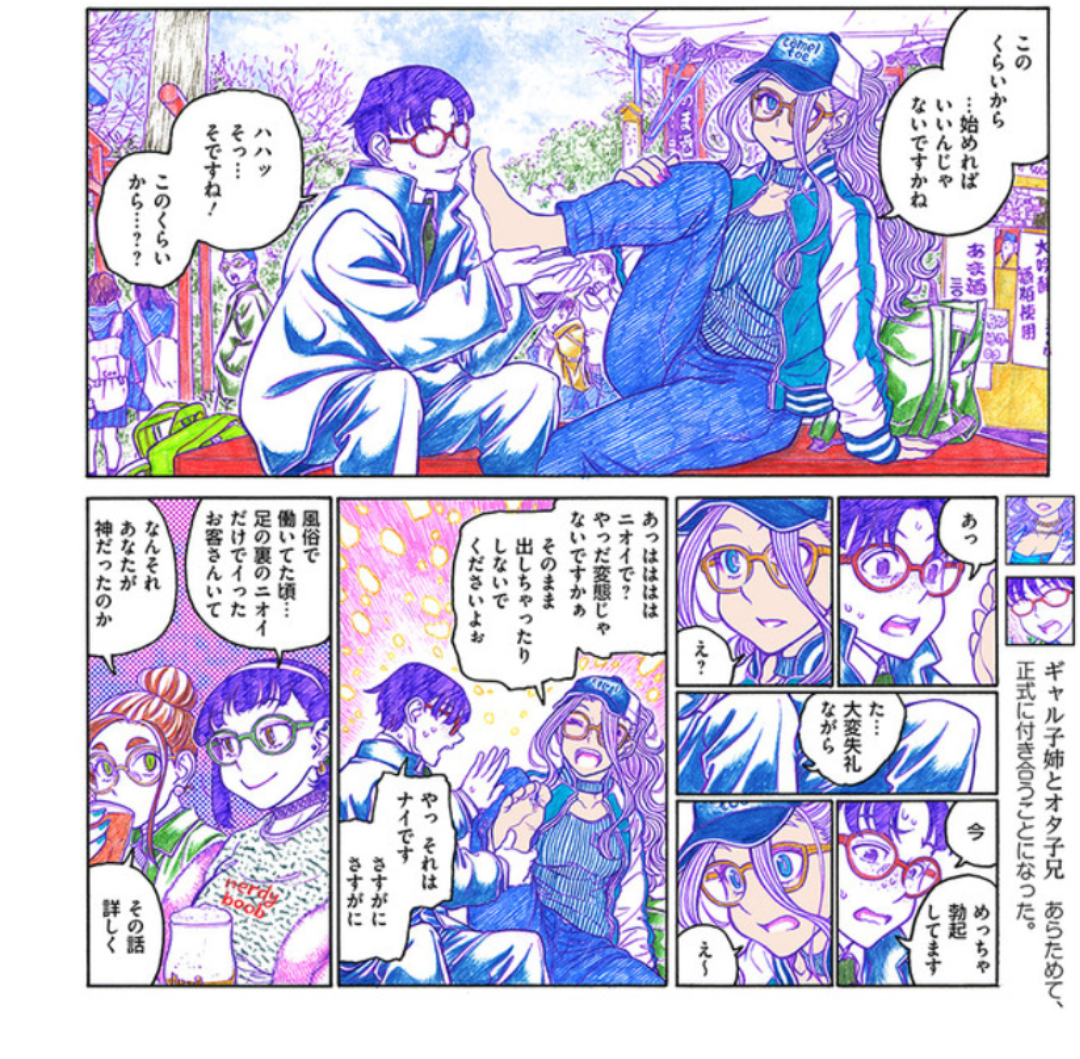
And then Galko’s sister tries to show her feelings for Otako’s brother by letting him in on a secret—that she has athlete’s foot—which in turn causes him to get visibly turned on. Romance successful! That’s Please Tell Me! Galko-chan for you. I said it provided an interesting perspective, not that it’s ultra-classy.

I think the big takeaway here is that the struggles between Otako’s brother and Galko’s sister on their date don’t come from the idea that Galko’s sister should have been a virgin, or that virginity should matter all that much for men or women. Instead, it’s about what sex means to each of them, and coming to a mutual understanding of what it takes to make their relationship potentially work. It’s sweet, it’s hot, and it displays something unique for this classic nerd/beauty trope.

Aikatsu Friends! Choreography Has Won Me Over

I generally enjoy the AIkatsu! idol anime, but one aspect of it that never really hits me the way I think it’s supposed to is the idol performances at the end of each episode. As I watch Aikatsu Friends!, however, I feel like that’s finally changed for me.

I’m no expert in song and dance choreography, but the impression I get is that Aikatsu Friends is better at integrating those performances into the show itself. To some extent, I think this has to do with the improvements to the 3DCG that have happened to the franchise over time, but I don’t think it’s just about technical progress. Instead, I find that the performances themselves give a far better sense of who each character is, and what makes them tick.

Yuuki Aine

Protagonist Yuuki Aine is new to being an idol, and it shows. She’s not the best singer, and her dance moves are pretty simple, but they highlight her natural authenticity, and the friendliness that is her most outstanding quality.

Minato Mio

Minato Mio, her partner, is known for a kind of perfectionism that isn’t overly obsessive, which is reflected in the subdued music that accompanies her performances, as well as her simple yet graceful movements.

Asuka Mirai

Where it stands out to me most is the fact that Asuka Mirai, one of the top idols in the series, performs differently alone compared to when she’s a part of the duo Love Me Tear. As one half of a whole, she and her partner Kamishiro Karen exude elegance and maturity. When she’s by herself, however, Mirai is all about a kind of wry playfulness—the quality she exhibits when she’s trying to help Aine get comfortable acting for television.

The song and dance routines in Aikatsu Friends! encapsulate what we’ve learned about the character, or what the characters themselves have learned during the episode. Somewhat similar to how a different kind of show might take all the lessons presented during the episode and boil them down to a conclusion by the end, these performances leave a lasting impression about who these individuals are and why they strive to be idols.

This post was sponsored by Johnny Trovato. If you’re interested in submitting topics for the blog, or just like my writing and want to support Ogiue Maniax, check out my Patreon.


Highlight Clips and the Loss of Context

On the internet in the early 2000s, the short, 5-second-at-most animated gif reigned. Before high-speed internet became ubiquitous, the gif was a low-commitment way to share snippets of your favorite show. While gifs are still used frequently, things have changed with the advent of YouTube, Twitter, the webm format, and more. Where once gifs were ideally super short, super-optimized for size, and often made to loop smoothly, now clips can go for minutes on end to showcase exactly what’s necessary to impress and astound. But as fandom and even online cultures in general have grown into an environment of instant gratification and moving snapshots, I find that it can influence how people view a given work or performance.

Highlight reels are nothing new, and I think they fulfill a useful role. Speaking from personal experience, they help me understand things that I can’t quite make time to fully delve into. For example, I’ve never been a big basketball fan, but seeing highlights of Michael Jordan’s famous “flu game” (where he managed to lead the Chicago Bulls to victory despite being incredibly ill) helps to drive home to a novice like me the sheer significance of Jordan’s feat. However, not everything boils down easily to small, digestible clips, and there’s increasingly a risk that people will judge the clipped version as if it speaks for the whole product.

Here are three examples that I think encapsulate this dilemma:

On the wrestling subreddit /r/squaredcircle, one fairly common topic is the WWE wrestler Finn Bálor. In multiple instances, Bálor is criticized for being a boring wrestler whose offense lacks weight and pizzazz. However, I’ve seen another sentiment in response: Finn Bálor is impressive when viewed over the course of an entire match. His moves might not leave a deep impression individually, but he weaves them together into a story. Every dropkick, every stomp from the top rope means something, and viewing the moves in isolation fails to tell the whole story.

Starcraft is a series of competitive video games known for pushing players to the limits. Occupying the real-time strategy genre, it will have the occasional flashes of brilliance that can be captured in highlight clips, but more often what makes people fans are the stories told over 20-60 minutes of adversaries trying to outwit and out-muscle each other. It’s often the case that written essays more accurately capture the strength and tactical brilliance of a player than a minute-long Twitch clip. As a result, games that are conducive to highlight reels, like fighting games or MOBAs, tend to go viral much more often.

On a personal note, when creating the “Precure Party” panel for AnimeNEXT 2015 with Alain from Reverse Thieves, I tried to find the best clip to convey the quality of my favorite, Heartcatch Precure! In my opinion, the show’s greatest strength is how it delivers very profound and considerate messages using the depths and quirks of its characters. What I ultimately decided on was to combine two clips: one showing Kurumi Erika (Cure Marine) being jealous of her older sister, and then another showing her older sister Momoka being jealous of Erika in contrast. The point was to show how it threads together those two episodes two make a stronger point about how Erika’s sense of inferiority isn’t the entire story, but the short highlight reel didn’t hit as effectively as I’d hoped. It just wasn’t as effective as showing transformation sequences, dramatic character development scenes, or easy-to-understand gag scenes. If I were to do it over, I would pick something with a lot more impact, but I’d still be a bit sad that I couldn’t properly convey in that instance the X-factor of Heartcatch.

I care little for complaints about shrinking attention spans; I’ve been hearing them since I was a kid. While there is a lot of desire out there for immediate satisfaction (see commenters online who write gigantic replies based purely on the title of a video or article), I can only put so much blame on the viewers and readers when it’s the people making the ads and videos to exploit their customers’ tendencies. What’s more important to me is that I hope people who see short clips or highlight reels for more complex subjects understand it’s just a taste of whatever they’re looking at, and that it’s not always the best or most ideal representation.

The Fujoshi Files 181: Momose Narumi

Name: Momose, Narumi (桃瀬成海)
Alias: N/A
Relationship Status: Dating
Origin: Wotaku ni Koi wa Muzukashii!

Information:
Momose Narumi is a 26-year-old OL (office lady) who comes to date her childhood friend and co-worker, Nifuji Hirotaka. Cheerful and hardworking, she supports and is supported by Hirotaka through their mutual understanding and love of otaku subculture (Hirotaka is a gamer while Narumi is a fujoshi). Narumi is also friends with her co-workers Kabakura Tarou and Koyanagi Hanako, the latter being a fellow fujoshi.

Fujoshi Level:
A closet fujoshi at the workplace, Narumi was once so visibly shaken by the fact that her favorite manga character had died unexpectedly that it affected her ability to concentrate on her job.