Geek Reference Culture vs. Rap Reference Culture: A Personal and Meandering Comparison

Introduction

Geek culture has a conflicted relationship with making references. It can be the lingua franca of geeks—reciting lines wholesale from Star Trek, Monty Python, The Simpsons, Mystery Science Theater 3000, and other nerd favorites has long been a way to identify like-minded individuals, especially when those interests might not have been considered popular in a schoolyard or office. But that same geek culture, once characterized by references to living in family basements, is now integrated into mainstream culture. It’s to the point that the distinction between hardcore and casual is blurred, inviting never-ending debates about whether that line truly exists, let alone where it might fall. The most successful sitcom ever is The Big Bang Theory, a show about a bunch of brainy dorks who hit every stereotype this side of Steve Urkel.

In this environment, reference humor in geek culture is now being criticized in popular culture as overly insular, perhaps even symptomatic of gate-keeping out women and certain ethnic groups. References are seen as a crutch, a way to siphon off the value and humor of others in absence of one’s own. Unfavorable reviews of the book Ready Player One may be justified in pointing out its misogynistic themes and awkward prose, but it’s also viewed as a prime example of reference subculture gone too far in its arrogance and alienation.

Yet, there’s another example of a once relatively small cultural movement that has established itself in mainstream culture, one that also thrives on references to itself in ways that can seem inaccessible to outsiders: rap and hip hop. In that respect, I find it fascinating that both geek and rap cultures share a lot of similarities. In addition to the heavy focus on references, they’re also grappling with the fact that while they have helped to provide voices to the voiceless, they’re also avenues for misogyny and racism to rear their ugly heads. Despite their stereotypes being virtual opposites of each other—the 98 lb. pasty white nerd living in soul-crushing suburbia vs. the hard-edged gangsta in the life-threatening inner city—there’s a good deal of resonance between the two, and that’s before taking into account the fact that nerd references actually do show up in rap on a regular basis. However, while the use of references in hip hop seems to elevate it in the eyes of the general public, it’s considered something of a strike against geek culture. The question is then, what causes this difference in perception?

Hip Hop’s Reference Culture

The spark for this essay came to me thanks to a book I recently read: Original Gangstas: Tupac Shakur, Dr. Dre, Eazy-E, Ice Cube, and the Birth of West Coast Rap. Among other informative things for someone unknowledgeable about the subject like myself, one aspect it points out about west coast rap and hip hop is that it grew partly out of the rappers’ desire to make songs that spoke to their lived experiences, as opposed to what they were getting from New York City, where rap originated.

The key example the book gives of this desire to express west coast authenticity comes from a line in Eazy-E’s “Boyz-n-the-Hood”: Cruisin’ down the street in my ’64. Westhoff himself describes his youth, listening to this song and dreaming of riding a “Six-four” without knowing what that actually was. But to a certain audience, especially those who grew up in areas like Compton, Eazy-E was quite obviously talking about a 1964 Chevy Impala. Though more a way to speak to those on the streets, there was perhaps another inadvertent takeaway for those who weren’t familiar with this experience: “This is a west coast thing. You probably wouldn’t understand.”

Information like what “six-four” means might be taken for granted by those intimately familiar with rap and hip hop. But speaking personally, my relationship with these genres was, for the longest time, largely limited to memories of what my siblings would listen to. It’s why I found Original Gangstas so potent, as it helped give me perspective on things I only tangentially understood: the significance of Dr. Dre’s “The Chronic” in popularizing the style known as G-Funk, the old differences between east coast and west coast styles, etc. As a relative outsider, I’ve long found that the propensity for rap to throw out references to culture without explanation, couch them in rhythm and lyrics, and use callbacks to other songs (whether in praise or as an insult) made it difficult for me (who grew up not terribly music-inclined in general) to make heads or tails of. I didn’t reject it as music I was supposed to “hate,” nor did I believe that “rap isn’t real music.” Rather, I felt that it was the popular kids’ music, and that it spoke of things I, as an out-of-shape Asian kid who couldn’t win a fight against a hamster, perhaps wasn’t “supposed” to be able to connect to.

That was the past, and I now feel more open and receptive to hip hop, thanks in part to David Brothers, who writes about the connection between geek culture and rap on a regular basis. Yet, I still feel that time away has affected me by stunting not just the potential knowledge of hip hop that’s in my head, but also the potential feeling of it in my heart and soul. With respect to this complicated sensation, one song I keep coming back to is Jay-Z and Alicia Keys’s “Empire State of Mind.” It’s about as famous and popular a rap song as it gets, but as someone who was born and raised in New York City, there are references in it I intrinsically understand and some that I had to look up. I know that going from Harlem to Tribeca is essentially traveling from the top to the bottom of Manhattan. I know that being so “Spike’d out I can trip a referee” is referring to Spike Lee’s propensity for getting front-row tickets to Knicks games while simultaneously talking up Jay-Z’s swagger. I had no clue what “paying Lebron” and “paying Dwyane Wade” meant, having next to no knowledge of drug culture, nor did I know that “BK” being from Texas is about Beyoncé, Jay-Z’s wife. Listening to the song feels somehow both deeply familiar and unusually foreign.

Contemplating “Empire State of Mind” relative to other rap songs, it makes me wonder if this is how many people feel similarly about nerd reference culture. If there’s enough to chew on, it becomes a relatable experience. If there isn’t, it might be downright alienating. “It’s a geek thing. You probably wouldn’t understand.” Whether by accident or by intent, this can transform into “You’re not supposed to understand.” But unlike west coast rap, which was originally tied to a certain region and its surrounding cultural and economic situation, the fuel for geek culture was all over the place. I was surprised to find out (thanks again to Original Gangstas) that a young Snoop Dogg and Warren G were in a group called Voltron Crew. (There’s also a video of Snoop Dogg reminiscing about playing with Voltron toys and pretending they could move.) Moreover, at a panel at New York Comic Con 2018, DMC (of Run-DMC) talked about how he was inspired to express through his rap the entertainment culture he saw: Godzilla, Bela Lugosi and Boris Karloff movies, etc. One gets the impression that geek culture was never truly rooted in those pasty white suburbs, and with each passing generation that image gets reclaimed and transformed.

Rap’s references don’t just end with talking about the streets or various aspects of pop culture, either. There’s also a tradition of calling back to previous rap songs, which rewards those fans and listeners who avidly follow the genre. Original Gangstas describes how “Hit ’em Up,” the infamous diss track that is just five minutes of venom directed at the Notorious B.I.G., Tupac makes numerous references to the enemy camp’s music, twisting them into dark parodies such that anyone who recognizes the originals can feel the vitriol hitting even harder. Notably, the line “Grab your dick if you love hip hop” from “Player’s Anthem” by Notorious B.I.G. and Junior Mafia becomes “Grab your glocks when you see Tupac.” You don’t need to know the specific references to pick up on the sheer anger Tupac has for Biggie, but it helps.

The Desire to Affirm Geek Identity, and the Hurdles Created in Consequence

Geek reference culture still carries a legacy of wanting to legitimize one’s own experiences, and in that respect it mirrors a lot of what rap and hip hop have done. However, where I find the key dissimilarities begin to manifest is in how attached the purveyors and fans of geekdom and rap get to their source materials. While plenty of creators allow their influences to show through in subtle ways—Steven Universe clearly has the DNA of Sailor Moon in it—the most visible parts of geekdom are those whose umbilical cords have never fully detached from the things they reference. Many of these works, while excellent in their own right, fall apart almost completely when divorced from their immediate contexts. The ones most absolutely dependent on showing off their callbacks, i.e. the Ready Player One‘s of the world, are too busy showing themselves as “nerdy” to build towards anything more. There’s a kind of clumsiness that makes people bristle.

In contrast, rap, even when one doesn’t get all of the in-jokes and shout-outs, still tend to convey enough meaning in other ways that those songs don’t live or die by the number of references contained within. But that might just be because referencing and remixing have been a part of hip hop since day one, before rappers even rose to prominence. In the earliest days, it was the DJs who commanded all the attention, and their craft is based in mixing together bits and pieces of various existing soundtracks. When Grandmaster Flash talks about getting rid of the “wack parts” to make a more enjoyable experience, he’s recalling making those old vinyls into his own. Incidentally, in this same video, he talks about the science of DJing being this incredibly geeky thing, but that he couldn’t express it as such back then because it wasn’t cool to be a geek. Hip hop has a legacy of creators not being afraid to take what’s out there and put it directly into a song, but also trying to transform them for their own unique purposes.

One point of convergence and then divergence is how nerd references get into rap and hip hop. Along this vein are two general categories: nerdy rapping and nerdcore rapping, i.e. songs with nerdy callbacks in them vs. songs where geek culture is the primary subject matter. Before I proceed, however, I want to make one thing clear: What I’m discussing is not a matter of talent of performer or quality of song; I have neither the musical expertise nor the familiarity with hip hop to cast that kind of high-and-mighty judgment. It would also be quite unfair to pit a small-time YouTuber against Snoop Dogg literally doing a song for Tekken and expect the former to live up to the latter in terms of raw ability and experience.

However, if we look beyond talent or quality and just at subject matter, nerdcore’s reputation (for better or worse) is that it’s hyper-focused on celebrating nerdiness. In contrast, nerdy rapping is about incorporating those geek references to make a point. MC Frontalot is not considered to be unskilled as a rapper, but “I’ll Form the Head” mainly requires the listener to be in on the joke—that it’s a parody of Voltron. On the other hand, when Soulja Boy raps, “Bitch I look like Goku,” he’s likening himself to the Dragon Ball protagonist to instantly communicate his power and confidence. Even if you don’t know who Goku is, the delivery tells you that it’s someone who’s a big deal. The same song (titled “Goku” of course) also references the 1964 Chevy Impala, as if to equate their cultural symbolism. It’s not a matter of “reality” vs. “fiction,” either. A lot of non-nerdy hip hop is about presenting fictionalized versions of oneself, such as Eminem’s Slim Shady.

A Crucial Difference?

One major disparity might be that while references in hip hop convey a sense of mutual understanding and experience to often self-aggrandize, traditional geek culture places much of its subcultural cache in the accumulation of nerdy knowledge—i.e. nerd cred. It’s one thing for Jay-Z to talk about how he “made the Yankee hat more famous than a Yankee can,” or for Snoop Dogg to explain, “I got the Rolly [Rolex] on my arm and I’m pouring Chandon [an expensive sparkling wine].” It’s another to operate as Ready Player One does, and tie the hero’s success to his mastery of 80s pop culture. This even extends to how hip hop and geek cultures try to suss out “fake” fans. In hip hop, like with other forms of music, a lot of it has to do with taste. If you like Macklemore or Vanilla Ice, you’re supposedly not a “real” fan because you can’t handle the hard stuff. However, it’s not like hip hop fans expect everyone to have encyclopedic knowledge of rap. In contrast, when someone is accused of being a “fake geek” or a “fake geek girl,” it’s more to do with the idea that their kung-fu isn’t strong enough—that they lack the extensive study of trivia and information that’s long been expected of nerds. For hip hop and rap, references are the doorway. For geek culture, it can often feel like the destination, and as long as that reputation persists, there will always be a sense of impermeability between geek and non-geek cultures.

The Final Smash Ultimate Direct and the Cost of Following Leaks

For the past month or so, much of the online Smash Community was consumed by the so-called “Grinch Leak,” whose promises of revealing new characters dominated conversation. Then the November 1 Smash Bros Nintendo Direct revealed the last tidbits of information before launch (new playable characters, DLC on the way, a story mode, etc.), dashing the hopes of many of the leak’s believers. Given the sadness and rage expressed by those who trusted the leak, it makes me wonder about why people continue to set themselves up for disappointment through following Smash leaks, and the only answer I can think of is that they consider it worthwhile. In a way, researching leaks and getting invested in them is almost a form of emotional gambling.

I understand that people are different when it comes to spoilers—some even readily welcome them. But the Grinch Leak interacted with the Smash community in an odd way that goes beyond just knowing something in advance. First, it came at a time when some fans felt starved for information, despite Isabelle from Animal Crossing being announced less than two months ago. It was as if people were so desperate for news that they’d glom onto anything convincing, and to spice it up, the Grinch Leak dropped a bunch of “reveals” for characters with very vocal and loyal fanbases. It’s not just that people thought the leak to be believable—many clearly wanted to believe.

And then the Direct hit, and the characters shown were not what Grinch supporters were expecting. In came the comments. “How could the final Smash Direct be this anticlimactic? Ken? Incineroar?! PIRANHA PLANT??!!” The Smash community has always had problems with getting excessively overhyped, and this was no exception. But I also wonder about the way fans seem to actively trying to to hit these dramatic emotional highs at the possible risk of plummeting into equally drastic lows. After all, one doesn’t necessarily need to pay attention to these leaks, and one can simply hope for their favorite character to be added to the roster without the additional backup of some “inside scoop.” That’s what makes it feel akin to gambling, albeit a much safer, cost-free form. There’s a risk and a payoff for wanting to believe.

It also reminds me of how popular conspiracy theories can be. “Some employee leaked information about a game that’s not out yet” is nowhere close to “the United States government faked the moon landing,” but there is a similar idea at play here: there’s inside information they don’t want you to know about, and by having the real info, you have the edge over the others. And much like conspiracy theories, the fact that some leaks actually turn out to be true only adds fuel to the fire.

In a certain sense, following leaks and getting into arguments over them is another form of community interaction, and it’s largely harmless fun. Even so, because of how they monopolized the Smash community’s general consciousness, I do have to wonder if there might be a better use of people’s time and emotional energy.

VOTE NOVEMBER 6!: Ogiue Maniax Status Update for November 2018

The blog is doing just swell, and I’m grateful as always for my supporters on Patreon and ko-fi, who are below:

General:

Johnny Trovato

Ko Ransom

Diogo Prado

Sue Hopkins fans:

Serxeid

Hato Kenjirou fans:

Elizabeth

Yajima Mirei fans:

Machi-Kurada

But the more important thing, namely for any United States citizen 18 and up, is to vote. People might think their votes don’t matter, but over and over we see how apathy lets those with more extreme agendas weasel their way. We have literal killers who feel motivated by our current political climate to emerge out of whatever sewers they crawled out of. I will be at the polls, and I hope you’ll decided to go too.

My favorite posts from October:

Can-Do Candy: Dagashi Kashi Full Manga Review

At long last, a full look at everyone’s favorite candy comic.

Beyond Expectations: Planet With

A review of a fantastic anime from the past season.

The Significance of the Classic Anime Devilman in Devilman Crybaby

How does the uniquely insightful, uniquely horny Galko-chan handle one of the classic romance tropes?

Hashikko Ensemble

Chapter 9 finally starts to pull the veil back on the life of Orihara.

Patreon-Sponsored

Aikatsu Friends! Choreography Has Won Me Over

The dancing has improved in Aikatsu! and notably so.

Closing

See you next month. I’m hopeful for a better tomorrow. Remember: November 6.

The Significance of the Classic Anime Devilman in Devilman Crybaby

Devilman Crybaby made quite a splash when it was released earlier this year on Netflix, introducing Nagai Go’s classic series to a new generation of anime and manga fans. While there are stylistic differences stemming from both difference in era and the aesthetic of director Yuasa Masaaki, Devilman Crybaby is largely the same as the original 1972 Devilman manga at its core, showing that the series’s story of a human who uses demonic powers to fight other demons and its themes of human strength and ugliness are still culturally relevant.

While Devilman Crybaby is hardly the first adaptation, spin-off, or sequel, it does do one thing that most other Devilman works try to shy away from: it incorporates elements of the kid-friendly 1972 Devilman anime TV series. In that cartoon, Devilman is closer to a superhero than a brutal demon in appearance and demeanor. Even his theme song calls him a “hero of justice” while listing all of his special ability (Devil Wing, Devil Eye, Devil Beam, etc.).

It’s so different from every other iteration of Devilman, and Devilman Crybaby repeatedly uses it in such specific scenarios, that I believe TV anime Devilman has special significance in Crybaby beyond providing an addictive remix of the classic theme song, which can be found below.

Whenever that song, “Devilman no Uta” is used, there’s an element of innocence or human compassion attached. It’s often paired with an actual image of the TV anime Devilman himself, who shows up on television screens or on YouTube videos and the like. It’s especially prevalent in Ryo’s flashbacks, where a young and orphaned Ryo can be seen staring at the green, heroic Devilman on TV. Ryo appears to be drawn towards it.

There’s a third symbol too: Devilman’s actual design in Crybaby. Devilman adaptations tend to draw more from the manga than that old anime series, and this extends to the aesthetics of Devilman himself. In almost every version, Devilman feels more like a beast than a man, and Crybaby’s is generally no exception. However, there are times in Devilman Crybaby when Devilman himself feels more reminiscent of the “hero of justice.”

Devilman the character can be thought of as having two original strains—the Nagai manga original and the classic TV version—with different iterations veering towards one or the other. If a work wants to hint at a more hyper-violent Devilman, they portray him along the lines of the manga. If, however, it wants a cleaner and friendlier Devilman, then the TV version is the way to go. Crybaby Devilman strikes a very interesting middle ground. While he has the fur, the facial features, and the overall demonic appearance, he takes aesthetic elements from the TV version. Namely, he has those distinct stripes on his shoulders, and he’s often portrayed with a blue/greenish tint to his skin. It’s unclear if his skin is actually supposed to be green, or if the creative lighting of the series just makes it look that way, but there’s a clear commonality between Crybaby Devilman and TV Devilman, at least in part. What’s also noticeable is that the green skin seems to be most noticeable in scenes where Akira is trying to defend the innocent, like when he protects a group of innocent people from being stoned to death out of fear that those poor souls “might” be demons.

In other words, the incorporation of elements of the TV anime Devilman into Devilman Crybaby isn’t merely for referential purposes, or a clever wink and nod—It’s actually important to the themes and symbolism of the series. While Crybaby largely follows the plot of the original manga and not the TV anime, the presence of the superheroic Devilman is ongoing, and it hints at Akira’s inherent goodness. He struggles with himself and the devil inside, but Akira ultimately wants to fight for what’s right and just, whether his foes are human or demon. The old anime Devilman is who he aspires to be, even if he ultimately cannot live up to that ideal.

Life on Repeat: Hashikko Ensemble, Chapter 9

Orihara’s hard to understand, but it might not be for the reasons anyone assumed.

Summary

It’s the Sports Festival at Hashimoto Technical High School, but the biggest spectacle isn’t any event—it’s Orihara on a rampage. Another classmate has played a prank on him by messing with his music player, so Orihara responds by going berserk and tossing him around like a ragdoll. Jin and the others suspect that the only thing that can calm him down is his music and his noise-canceling earphones, but (as revealed in a flashback), they’ve been having trouble fixing the earphones, even with Himari’s help. However, Himari reveals that she’s spent extra time to repair them. In a mad dash, the Chorus Club and the Rugby Club work together to successfully subdue Orihara.

As Orihara listens to his music player and falls unconscious, he remembers the parental abuse he and his little brother suffered as children. He remembers hearing screaming, but can’t remember if it was his or his brother’s voice. But as the police came to take away his mom and her boyfriend, he remembers thinking it was his brother’s. In fact, Orihara can still hear his brother’s voice today.

They Laughed, They Cried

This chapter kind of reminds me of the infamous soccer episode of the anime Eureka Seven, which contained, in the same episode, both athletic filler hijinks and a plot-crucial coup d’etat. The situation in Hashikko Ensemble isn’t quite the same, as what happens at the Sports Festival contributes directly to the main story, but the contrast is potent. The general wackiness of this chapter makes the dramatic reveal of Orihara’s situation much more impactful.

As comedic as Hashikko Ensemble can be, I really don’t think this reveal is an absolute tonal shift for the manga. There’s a recurring theme of among the characters of trying to deal with the emotional and physical setbacks of their pasts, and it even creeps through in Jin’s vague descriptions about his relationship with his dad. Orihara’s story seems to be the most serious by far, and I have faith that it’ll be executed well. I mean, this is the guy who wrote Ogiue from Genshiken‘s story, after all.

Orihara’s Abuse

The exact circumstances of Orihara and his little brother’s abuse is kept vague. The manga mentions that his little brother was unable to move, and the arrival of the cops clearly implies that this was not the result of illness or accidental injury. It’s unclear if the abuse was primarily physical, emotional, sexual, or any combination, and I don’t have any hypotheses at this moment. More information will likely be revealed to us over time, but the degree to which Kio holds back will be interesting to see. Whatever the case might be, the chapter is a crucial piece of the puzzle that is Orihara. He’s not just a loner, and he’s not just temperamental—his past is complicated, and having him open up to others (let alone join a club) is going to be about understanding his issues.

Himari’s Personality

Himari works hard to restore Orihara’s earphones, but I don’t get the sense that she’s doing this out of either sympathy for the guy, or out of a desire to uphold her end of the deal with Akira and Jin. She seems to me like someone who either values the technical skills needed or who has a sense of pride in her own abilities—like it’s a challenge she wants to overcome. Nothing says this more than her pantomiming the hand motions necessary to make the complicated earphone repairs. In that respect, she might make a good team with Jin, whose audio expertise potentially supplements her own strengths. His explanation of the complexities of noise-canceling earphones (like how you need to get through the urethane coating that’s meant to prevent short-circuits before you can even begin to fix them) is a perfect example in this regard.

Songs

What Orihara’s been listening to this whole time is Gabriel Fauré’s “Requiem Op.48: In Paradisum.” It’s used in Catholic church funerals, which probably means that Orihara’s little brother didn’t make it.

Final Thoughts

There’s a brief mention at the beginning that Hashimoto Technical High School switch to holding their Sports Festivals on weekdays because in the old days, delinquents from rival schools would come over to pick fights on the weekends. While the culture has changed since then, they keep the scheduling. Just having this little hint at the yesteryear of the high school (as well as the fact that the one older female teacher still remembers those days) gives this funny sense of history to the school setting of Hashikko Ensemble.

Also, Hasegawa is excellent as always. I can’t help but laugh every time I see her now.

A Look Back at an Aikatsu! Halloween

In the spirit of the month, I was asked by Patreon sponsor Johnny Trovato to look at one of the Halloween episodes of Aikatsu! I chose episode 106 of the original series, which takes place after Akari has become the new main character. It’s a fun episode characteristic of all that is good and enjoyable in Aikatsu!, though a few elements stood out in particular.

Whenever the characters say, “Trick or treat!” they immediately follow by explaining in Japanese what exactly that means: “If you don’t give me candy, I’m going to play a trick on you!” It’s a redundancy that not only has to make up for the language barrier—a little kid might not know the English words—but also speaks to the fact that Halloween as a concept is still relatively new in Japan. If you look online, you’ll find articles talking about how it didn’t get any traction until the 21st century, and now it’s featured in multiple anime.

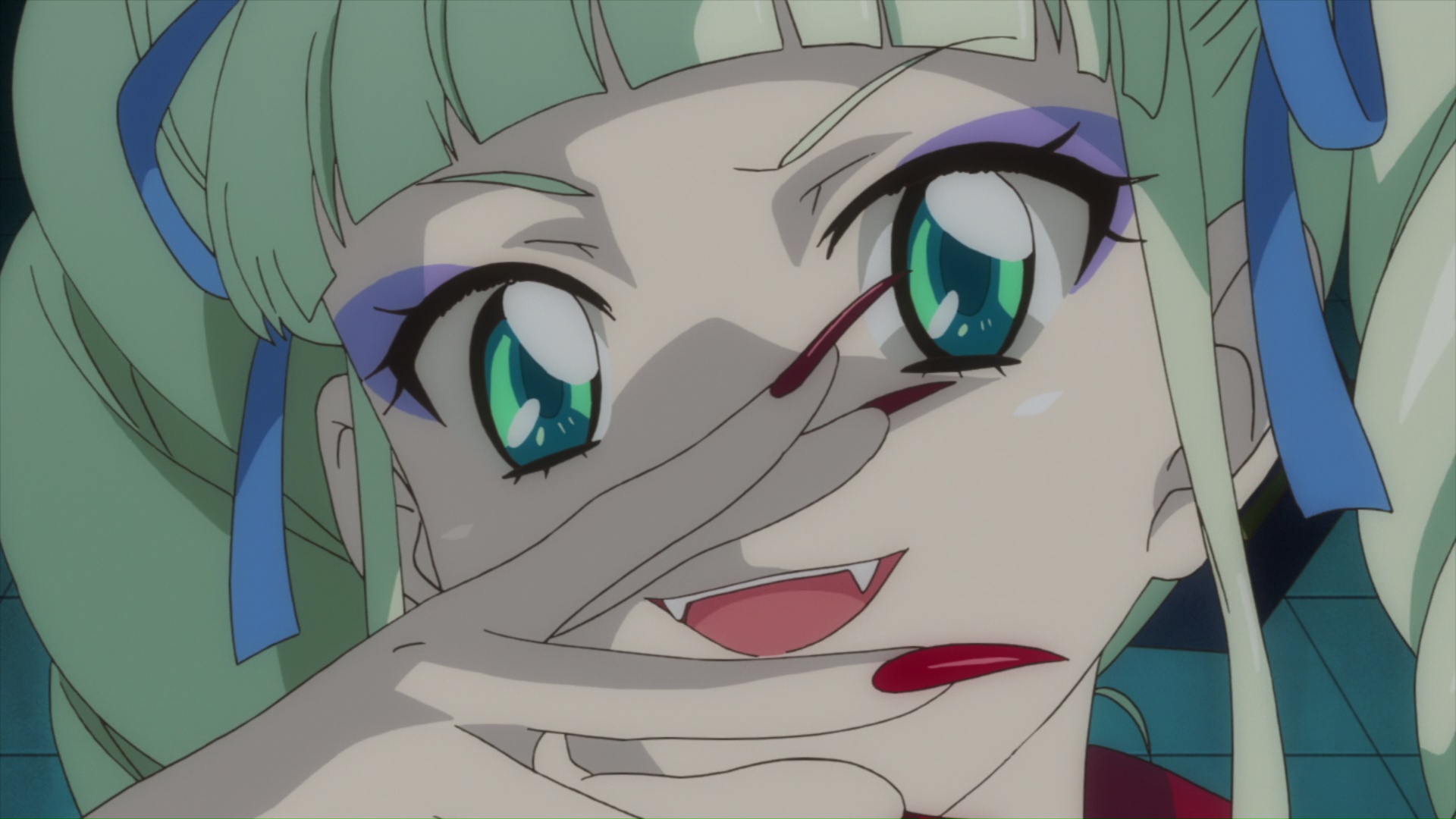
I wouldn’t read too deeply Aikatsu!‘s interpretation of Halloween—I reckon it’s as much tinged with the Idol Activities spirit as anything else. If the episode didn’t feature some wacky game that highlights all of the characters lovable quirks, then I would’ve been shocked. That’s where Aikatsu! consistently shines, though. You just know that if they’re doing a Halloween episode, vampire-style Idol Toudou Yurika is going to have a moment. They even make the expected (and desired) joke that Yurika wearing a cape and fangs while exclaiming that she’ll suck your blood isn’t that different from how she normally behaves.

“The day Yurika visited your Halloween party was the most important day of your life. But to me, it was Tuesday.”

I watched this episode semi-isolated from the rest of the series, so I don’t know exactly what has transpired beforehand. However, it reinforces something I’ve felt about Aikatsu! in general, which is that the first season’s characters seem to have the most clear-cut personalities, which makes it easier to do these silly one-off episodes. I still don’t always quite get what Akari and her friends are supposed to be like. They seem a tad more subdued, which can work better over the long term but maybe isn’t as attention-grabbing at first sight. https://www.youtube.com/watch?v=sOnqjkJTMaA#t=9m5s

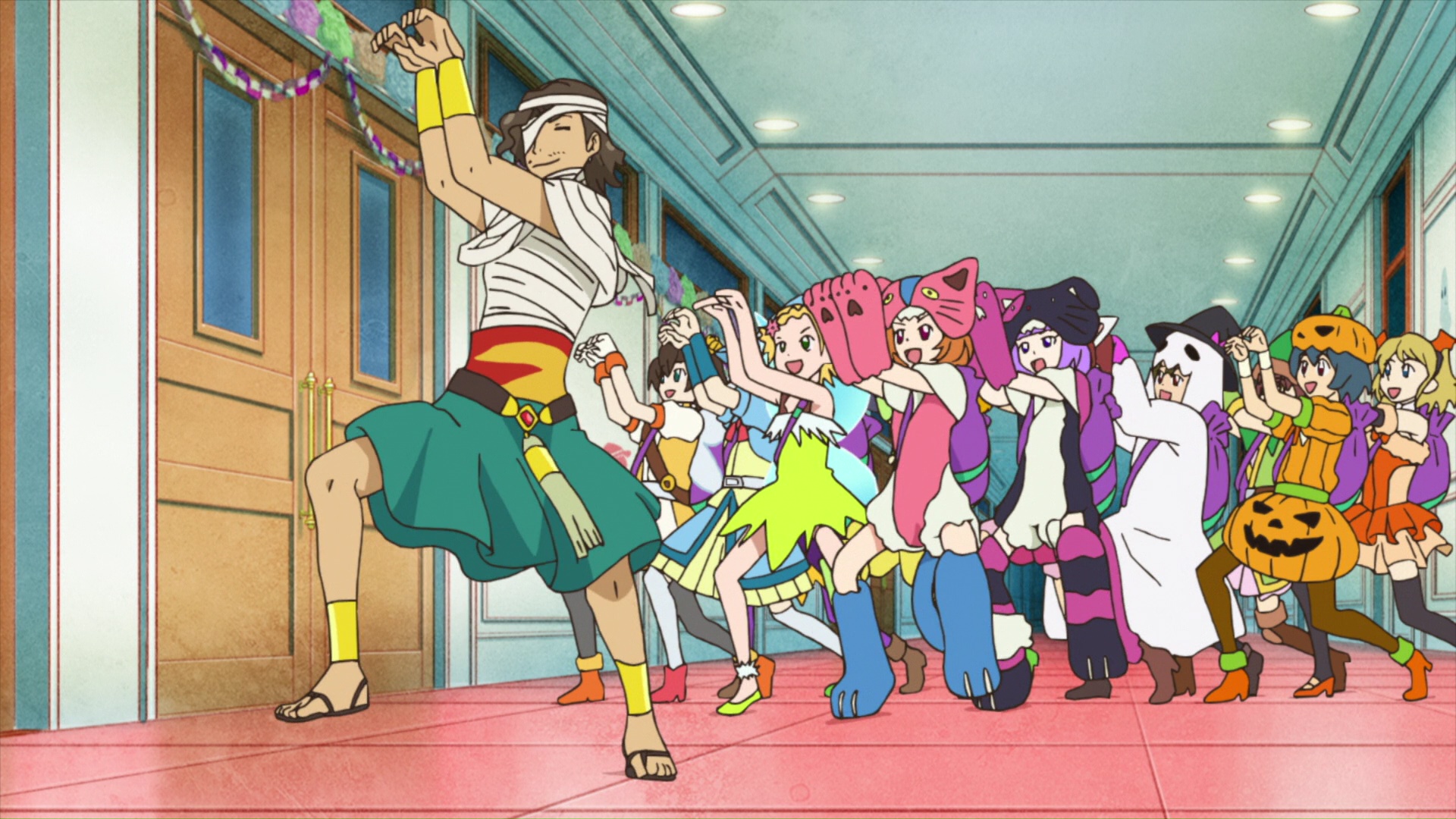
It would be remiss of me to end this post without mentioning the teacher, Johnny Bepp, and his unnamed homage to Michael Jackson. With a vaguely “Thriller”-esque piece playing in the background, Johnny-sensei encourages the students to do the famous zombie dance (or whatever it’s called), which exhausts every student around—except Akari. I would think that a dance sequence from one of the finest performers ever would be absolutely grueling for even the girls at an idol academy, though in hindsight I guess this is actually a bit of characterization for Akari as a girl with immense stamina. In this case, I don’t know if it’s the “obvious” gag per se, but the payoff is again reliably satisfying. Kudos, Aikatsu!

Given that this episode is quite a few years old at this point, I am curious to see how the Aikatsu! Halloween episodes have evolved as the holiday itself has become more popular in Japan. Maybe that’ll be something for next year!


Gaogaigar vs. Betterman Manga Chapter 1: Go Read It!

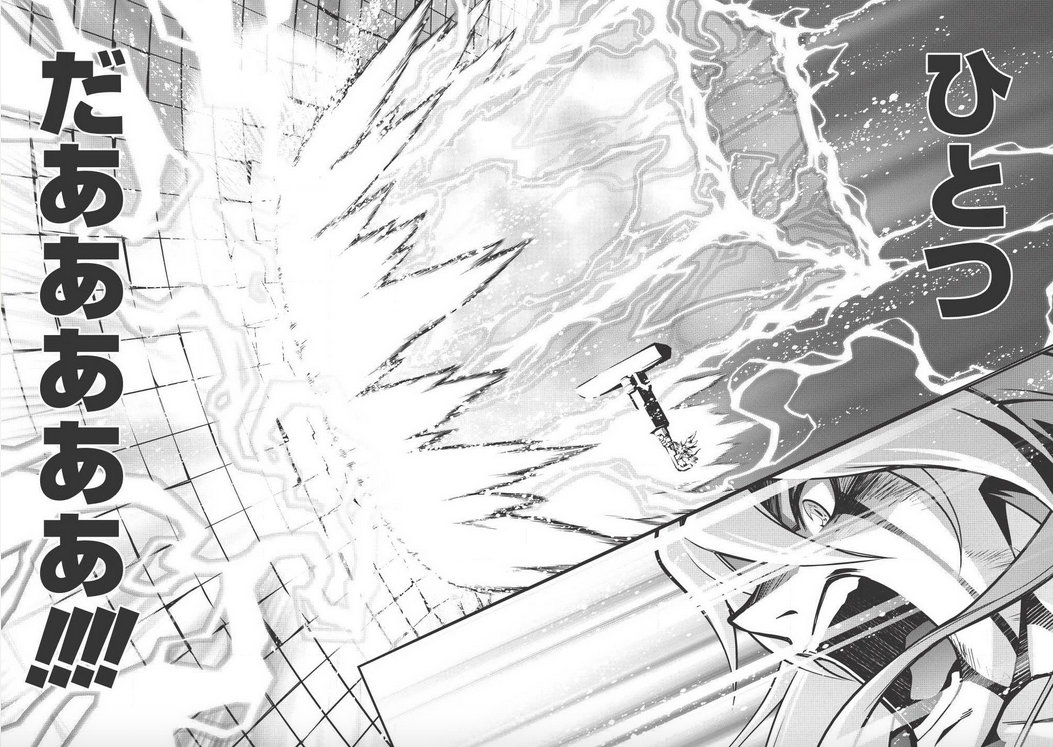
Us Gaogaigar fans had long waited for a new sequel, a call that was answered this past year through the Hakai-Oh: Gaogaigar vs. Betterman novel series. In more recent news, Sunrise announced a manga adaptation, and the first chapter has been available online for the past month or so.

Having read through the first novel, this manga seems to be adapting the contents pretty faithfully. This might go without saying, but the key advantage of the manga version is that it’s more visual—a welcome thing given that Gaogaigar as a whole thrives on visual spectacle.  It’s also a lot easier to follow if your Japanese language proficiency isn’t especially strong.

I’m not sure what the schedule is for this manga, but I’m hoping that having it so easily accessible means that Gaogaigar fans will be able to rally around it, and really give it the attention it deserves.

The Fujoshi Files 182: Koyanagi Hanako

Name: Koyanagi, Hanako (小柳花子)
Alias: N/A
Relationship Status: Dating
Origin: Wotaku ni Koi wa Muzukashii!

Information:
Koyanagi Hanako is a 27-year-old OL (office lady) who cosplays in her free time. In and out of the office, Hanako is generally cool and collected, though she often butts heads with her co-worker and boyfriend, Kabakura Tarou. An avid cosplayer (especially of male characters) and a fan of Takarazuka, she’s also friends with her fellow fujoshi, Momose Narumi, and her boyfriend, Nifuji Hirotaka.

Fujoshi Level:
Koyanagi will often read BL right in front of her boyfriend, partly to tease him, partly because she aggressively doesn’t care.

Harsh Lessons in Teamwork: Eyeshield 21‘s Kongo Agon

One of my favorite characters to think about is Kongo Agon from the football manga Eyeshield 21. He’s not a favorite in the sense that I would put him on a top 10 or even top 100 best characters list, but what he does provide is an entertaining and exciting role as an antagonist whose presence allows a more complicated story about what it means to be a successful teammate.

In Eyeshield 21, Kongo Agon is the undisputed best high school American-football player in Japan. His reaction time is unmatched. While others might be stronger or faster, no one has the optimized combination of both like him. Anything you can do, he can probably do better. Agon isn’t even one of those characters who is strong individually but is especially bad at teamwork. He knows how to work within a group, at least to a certain extent. The fact that he’s so superior to everyone else, however, lands him into a classic trap for someone of such extraordinary talent: he finds less worth in those who can’t keep up with him.

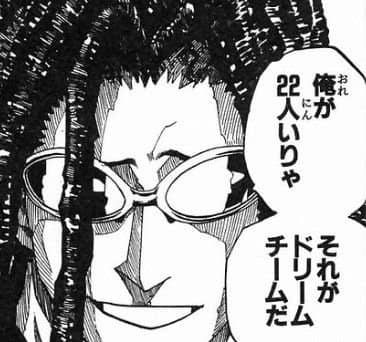
When mentioning what his ideal team would be, Agon describes a hypothetical team that’s 21 of himself + one teammate who has a few unique skills. And in a way, he’s right. An All-Star All-Agon team would probably beat every other team around. However, that team fundamentally cannot exist (Eyeshield 21 is not a science fiction series), and this is where Agon begins to falter. He may be perfect, but no one else is, and his inability to truly accept that is what opens up the cracks in his armor and leads him on the road to defeat.

One of the most famous athletes in history, Michael Jordan, ran into a similar problem. Jordan in his rookie days was a once-in-a-generation talent, but felt he couldn’t trust his teammates. What turned it around was his coach, Phil Jackson, who pushed Jordan to assume the role of a true leader, and to motivate his teammates into believing that Jordan trusted them. No small part of this was Scottie Pippen, who could mediate between Jordan and the rest of the bulls and lead by example in the process.

A lot of what made Jordan able to overcome his over-reliance on himself are the very things that Agon ends up failing to learn for a long time. Agon, despite being the best player around, is not an effective leader for a team; he’s closer to a tyrant than a captain. Moreover, the man who could be his Pippen, his brother Kongo Unsui, is shown little if any respect by Agon. Because he views everyone else as so beneath him in talent, he can’t even fathom the relatively minuscule accomplishments of opposing teams as matter at all—only for such an “insignificant” change to hand him a devastating, skin-of-his-teeth loss. Agon is decent at teamwork, but if only he respected his teammates and his opponents more, he could have been invincible.

Perhaps the biggest character development moment for Agon in Eyeshield 21 is the day that he finally bothers to train. Much like Frieza in Dragon Ball: Resurrection F, Agon is begrudgingly pushed to the point that he has to actually try, only Agon’s storyline predates Frieza’s in this particular sense. That realization by Agon, that he has to work at maintaining his dominance, is the ultimate blow to his being. He’s forever transformed, unable to ever go back to thinking that he, by simple virtue of being himself, is enough to defeat everyone.

New York Comic Con 2018 and Thoughts on the Asian-American Experience

New York Comic Con is the only non-explicitly Japan-focused convention I typically attend. In that respect, it gives me an opportunity to explore in greater detail the aspects of comics and media fandom that I normally prioritize less. This year, while I did my fair share of anime and manga-related activities—namely see Son Goku’s esteemed voice actress Nozawa Masako—my main takeaway from NYCC 2018 was that the shifting cultural landscape beneath the United States at this moment is of the utmost importance in comics and entertainment.

I went to many events during the convention, but the main stand-out was Super Asian America. A Q&A and discussion about Asian-Americans in comics, animation, and related media, the panel featured a bevy of guests: comics writer Marjorie Liu (Monstress), actor Ryan Potter (Hiro in Big Hero 6), comics writer Greg Pak (creator of Amadeus Cho), Kickstarter publishing’s Camilla Zhang, comics creator Nidhi Chanani, and host Mike Le. Much of the discussion was about the surprisingly good year that Asian-Americans have experienced in the entertainment industry between the successes of Crazy Rich Asians, To All The Boys I’ve Ever Loved, and Searching. The main takeaway was that this is a good step, but that convincing the Hollywood machine that falling back on its old racist and conservative mindset for “safety” reasons is going to take a lot more. Moreover, the United States as it currently stands is a troubling place for non-white ethnic groups, and this fight extends to more than just movies and TV shows.

I’ve long struggled with an unfortunate truth: many Asians, especially from older generations, are extremely racist. Readers might be wondering what this has to do with New York Comic Con, but my view of my fellow Asian-Americans is not always charitable. It always saddens me to see a kind of “we Asians need to get ahead” mindset that seems to come at the expense of others, the kind of attitude that encourages ingratiating ourselves to white people and avoiding association with other ethnic groups. So for years, I’ve seen those struggles for better representation in Hollywood and such, and felt myself being a bit skeptical. “How many of these people are really thinking about equality and opportunities for all?” Now I realize I’ve been conflating more than a few things that should be considered separate yet loosely related.

It is true that many Asians living in the US have been racist, and have tried to emulate “white success” to some degree. It’s also true that the Asian communities often focus on themselves to almost a deleterious degree, ignoring the reality of the politics surrounding us. However, the fight for better representation of Asians and Asian-Americans on screens and pages big and small is itself a fight against the racism that lingers within our communities among fellow Asians. There are generations of stereotypes that Asians have to fight against, like being weak and ineffectual compared to rugged European folk (unless we’re doing martial arts), and the sooner we remove the seeming need to graft the problematic elements of white privilege onto our own identities, the sooner we can make all Asian-Americans feel like they don’t have to conform to others’ ideas of who we can be.