Kio Shimoku’s First Audio Interview Is with a Virtual Youtuber!

Kio Shimoku has historically been a very private person, not even revealing his face until 2018. Shockingly, the Genshiken author had his very first audio interview, and it was by a Virtual Youtuber to boot! Luis Cammy is apparently a big fan of Kio’s work, and talked with him for a whopping 80+ minutes.

Translating the whole thing would be a whole endeavor in itself, but you’ll find all the notes I’ve taken from the interview. There’s a lot of it that’s all-new information and insight into Kio’s creative history.

Note that Kio has a remarkably deep voice. Personally, he reminds me a bit of Kugayama from Genshiken.

Also, as a final disclaimer, it’s possible I misunderstood some of the things spoken about. If anyone has corrections, feel free to leave comments!

Introduction and Miscellaneous

Luis has been a fan of his work since Gonensei (“The Fifth Year”), an early Kio manga and dark sequel to his prior work, Yonensei (“The Fourth Year”).

As part of their collaboration, Luis sang a cover of the Kujibiki Unbalance opening, and Kio provided drawings of Luis cosplaying as Ritsuko Kübel Kettenkrad for a music video. The video

It’s meant to resemble late 1990s to early 2000s galge/dating sim intros. Luis looks like Saki from Genshiken/Ritsuko already, so it was a challenge to differentiate her.

Kio learned about VTubers from manga author gatherings. He doesn’t watch YouTubers much, let alone VTubers.

When asked if he knew how popular his work was at the time, Kio said he didn’t really look at comments online, but felt he rode the wave of the era.

The very beginning of Genshiken was Kio wanting to draw otaku as normal people. He want to madk what he himself wanted to read.

Luis mentions that otaku and their status have changed drastically since the days of Genshiken (when otaku were picked on and persecuted), like how there are light otaku now. Kio says his daughter is in middle school right now, and to her, she doesn’t get the whole otaku-as-negative thing. A group of popular kids in her class have Demon Slayer: Kimetsu no Yaiba merch. Kio responds, “Times have changed, huh?”

Luis talks about how even regular folks say they like her, and it’s like the wall between normies and otaku isn’t there. Madarame has become a popular representative of otaku (to the extent that he’s Kio’s visual stand-in for this interview).

Genshiken

Luis mentions how fans by Nidaime love Madarame, and that he’s like a dating sim protagonist in Genshiken Second Generation/Nidaime.

Kio talks about how, in the very earliest planning stages, the first idea he sent to editorial was about the relationship between Madarame, Kousaka, and Saki. The love triangle was inspired by Ping-Pong Club, the nose-hair chapter in particular. That scene was thought up very early on, back when Genshiken was a mere chick. In a sense, Madarame and his romantic relationships were a part of Genshiken from the start.

Luis talks about her mahjong teacher, Saito Go (a professional player and mahjong VTuber), likes Genshiken. He especially remembers that scene with Madarame and Saki eating sushi together, and then not talking afterward on the train ride home.

Luis points out that Kio likes to use silent panels, which Kio agrees with. However, he thinks overdoing it with those types of panels isn’t good either. The nose-hair chapter ends in silence too. Luis says a lot of information can be conveyed in such panels. Kio says it can convey a sense of realism.

Luis points out that the recording was the day of Saki’s birthday!

When creating character profiles for the compiled manga volumes, Kio had to come up with birthdays. He actually used Gundam Horoscopes to think them up. [This has been mentioned in other sources before, like the Japan-only Genshiken Official Data Book.] Actually, it was sort of like a backwards horoscope, in that he picked a mobile suit that would fit Saki well, and decided the birthday based on that. Sasahara is a Ball.

Personal Questions and Family Life

Kio is into Gunpla. He got into it when he was a 6 thanks to his bigger brother. Plamo-Kyoshiro (the 1980s precursor to Gundam Build Fighters) was his “bible.” He would categorize himself as a plastic model otaku above all else. He still wants to continue it as a hobby, but he’s busy. In Plamo-Kyoshiro, the way they used cardboard boxes in the manga really sparked his imagination as a kid.

Luis asks if Kio’s daughter ever says, “Why is our home filling up with more [otaku] stuff?” Kio says that his workplace is different from his home, so it’s his workplace that gets filled up instead. Doesn’t think his daughter is an otaku, but can’t say for sure. Luis jokes about Kio’s daughter showing up on the live recording and telling him not to say so much. Kio mentions that she doesn’t know about this, so Luis responds that she could come in saying, “It sounds like you’re doing a broadcast with someone from Nijisanji.” Kio comments that she might actually know what VTubers are.

Kio’s daughter has always walked in while he’s drawing manga, so she’s been reading manga for a long time. Kio still reads current manga. Luis says that manga has become like a “communication tool” these days, like, “What? Do you know this title?” as a conversation starter.

Genshiken More In-Depth

Luis describes the first Genshiken as being about ancient otaku. She asks Kio, if there was a Genshiken Third Generation, would it have VTubers and stuff in it? What kinds of characters and what sort of content would it include?

Kio concurs that they’re ancient otaku. His thinking was, “If I try to draw something totally new, it’ll quickly date itself. But if I make them feel older, than it’ll age better.” He doesn’t consider himself to be on the cutting edge. Genshiken came from whatt he personally wanted to draw. As it continued, it progressed into fujoshi stuff.

As for VTubers, once they become old, maybe then they’d show up in Genshiken. Kio says that plenty of current manga have VTubers in them already.

Luis asks if Kio is happy to have ended Second Generation when he did, and Kio says yes. “It felt like, ‘That’s about where it should stop.’” He explains how the sequel started out as a one-shot, but he’s not good at doing extra stories and the like, so he kept on working on it. Kodansha editorial (the publisher of Genshiken) said he should do enough to fill one volume. It was originally supposed to be a short serialization. 

Kio began with the thought of “How would Ogiue and the others continue the club?” and of course, it would end up with a bunch of fujoshi. But would it be all girls? What about guys? Hence, Hato.

Kio really went back and forth about whether or not to include a character like Hato. When he was drawing the manuscript, he kept having the feeling of “Is this really okay?” Coming up with the idea of Hato purposely using a more feminine voice is when he finally thought he could make it work. Fujoshi and otoko no ko (boys who dress convincingly as girls) are the main aspects of Second Generation. Kio didn’t want to put Hato through so much hardship, but as the story progressed, he felt that’s what should happen—though he did worry over it. 

The original Genshiken was supposed to be in real time, and things moved quickly. But it stopped being that way during the Ogiue story at Karuizawa. At the time, Ogiue was a “problem child” when it came to drawing the manga, as he didn’t know if he could resolve her backstory.  It’d be difficult to do that and still maintain the “real-time” thing, and he would’ve selfishly wanted to end the series in the Spring if it had stuck to being in real time. But it took multiple months to get through the Ogiue story. 

The series was supposed to end at Volume 8, but then there were plans for the second special official doujinshi [the first one was included with Volume 6]. Because of that, they decided to continue the series up to Volume 9. The original Genshiken features Ogiue’s turmoil, and Second Generation features Hato’s turmoil.

Luis comments how there are the Ogiue fans, and then there are Hato fans. Kio responds, “The Ogiue fans really are somethingl…” and then trails off. [Ogiue Maniax note: I feel attacked.] 

Spotted Flower

There are things that were hard to put into Genshiken, like sexual stuff. That’s where Spotted Flower comes from. From here, the two jokingly pussyfoot around Spotted Flower’s similarities to Genshiken.

Luis talks about how Spotted Flower is a different world (tongue-in-cheek), but it has kind of a crossover feel. Kio responds that they’re ostensibly different characters. Luis replies that the series is like a “what-if” universe (if-sekai in Japanese).

Kio says it’s not supposed to be them, but through it, he can do what he couldn’t in Genshiken.

Luis says, “What-If Madarame has a ‘Why youuuu!’ feeling.” Kio laments the husband as well.

Spotted Flower was supposed to be just a few short pages for Rakuen: Le Paradis magazine. The resemblance to other characters was originally not planned, but is actually something he noticed after the fact. He didn’t explain the meaning of the title to them when he submitted it [madara means “spot” and saki means “bloom”], so they probably didn’t realize at first. So he figured, “Why not keep going?” and it developed along the way.

“And now there are four volumes,” says Luis..

Kio’s feelings: “It’s not a book that comes out often, but if it interests you, I’m grateful.”

It was one thing when it was just the husband and wife, but then he added the Hato-like character, and the Kousaka-like character, and so on. He still can’t really say for sure that it’s them.

Hashikko Ensemble and Kio’s Overall Career

Luis finds the Hashikko Ensemble main character Akira cute. Kio says that he began with the idea that Akira would have that gap between his very deep voice and his shy personality.

Volume 5 of Hashikko Ensemble should be coming in September. 

Kio says he’s been in the manga business for 25 years. Luis thinks all his works are great, in terms of information provided, emotion, and atmosphere all being wrapped up in them. “It’s no small stuff.” To Kio, he sees all the things she mentioned as his shortcomings Luis comments that she enjoys seeing Kio reflect on his work.

Kio is the type to regret not saying this or doing that. Luis remarks that this is a live broadcast—is Kio okay?

Kio doesn’t recognize his own voice when recording. Luis said she never thought of her voice as anything special but the fans would say it’s cute. Luis compares Akira’s voice to Kio’s. Kio never had any experience with singing or choruses, but figured, why not give Akira a deep voice like himself?

He thinks people who can come up with characters purely from imagination are amazing.

Hashikko Ensemble a story of the passion of youth, but Kio didn’t originally plan it that way. Like Genshiken, he wanted the story to be something ridiculous and fun, and landed on “chorus club high schoolers.”

Luis loves stories about the passion of youth (seishun), like Yowamushi Pedal and Big Windup. Kio replies that he’s never drawn manga in that vein—like Chihayafuru—but thought, “If I put all I had into it, could I draw one?” The characters in Genshiken are all pretty mellow. He wasn’t that good at drawing the kind of youthfulness that appears in Hashikko Ensemble, at first.

Luis makes the argument that the original Genshiken is a “passion of youth” story, because it’about figuring out what club to join and what to do? Like, Kugayama’s waffling on whether or not to draw, or Ogiue’s decision to go, “I guess I’m gonna draw.” 

The kinds of “passion of youth” stories Kio enjoys are a little strange—not so much “hot-blooded stuff.” Luis describes Madarame as a hot-blooded otaku. As for being a passion of youth story, what about that story with Saki mentioning Madarame looks good in his new glasses?

Originally, Genshiken was supposed to be a club that doesn’t put anything out. One of the things that made Ogiue tricky is that she wanted to draw herself, so Kio had no choice but to make a story about her trying to get into Comic Festival [the Genshiken in-universe equivalent of Comic Market].

Doujinshi???

Luis says Genshiken is what made her want to attend Comic Market as part of a circle. She asks Kio if he ever participated as an artist. Kio says yes!

Kio released a doujinshi at Comic Market in 2003 (Luis points out that 2004 was the year of the first Genshiken anime, which Kio totally forgot about).

Kio did not use the name “Kio Shimoku” for Comic Market. He sold 200 books, which impresses Luis. For reference, Luis says that 100 is considered a lot, and she herself sold 50 copies of her own doujinshi at a Comitia [a major doujin event primarily dedicated to original, non-fan works].

The doujinshi was indeed pornographic, and an original work. It bears resemblance to Kujibiki Unbalance and Genshiken.

Luis talks about how big sister loves Kujibiki Unbalance, to the extent that she put out a pornographic doujinshi starring Ritsuko. Luis helped her a lot with it, including stapling it together. 

“Putting out a Kujibiki Unbalance-esque doujinshi yourself is like actually being in Genshiken,” says Luis.

Kio also participated at Comic Market a second time—in 2010. It was a doujinshi based on a “certain space opera that uses Episodes,” flipping around the genders of the character roles involved. The inspiration was that with some wordplay, the title resembled the phrase “Sister Wars.” He drew what was supposed to just be a manuscript based on Episode 1, but it ended up being 350 pages. Kio wanted to draw up to six.

“Please complete it!” Luis says.

“But I wouldn’t be able to sell it!” Kio replies.

[Ogiue Maniax note: One of Ogiue’s characteristics is prolific output, just like Kio here.]

Luis asks if there’s anything he’s watched lately, old anime or new anime. Kio doesn’t have anything, and Luis says his free time to just sit down and watch without moving must have decreased. Kio agrees.

Kio wants to absorb more shows, but just doesn’t have the time.

Questions from Kio for Nijisanji

As future reference for manga, Kio asks if VTubers wear sensors to track movement. Luis responds that it uses 3D tracking. She quickly “corrects” that the animated figure you see is the real her.

Luis says that Kio’s participation in Comic Market makes his manga feel more real.

The two talk more about the Kujibiki Unbalance music video they collaborated on. Kio says it’s like a doujin-style fan work. Luis talks about how she has Genshiken and Kujibiki Unbalance merch. Luis has the Kujibiki Unbalance Ritsuko school swimsuit clear file drawn by the light novel artist, Yagumo Kengou. Kio mentions that the image was a request from him [Ogiue Maniax note: Not 100% sure about this last sentence].

Kio mentions that he gets some harsh comments, but others will say “That’s the kind of author he was all along!” But he doesn’t want to remember himself from the Gonensei era.

What an Interview!

There’s a lot to unpack in this interview. I hope to follow up with an analysis.

Also, I can’t believe there’s a Virtual Youtuber who’s into Genshiken, Kio Shimoku, and mahjong! It’s like someone designed a VTuber especially for me.

I guess the Ogiue Maniax VTuber pantheon is now Sugomori Tenkomori and Luis Cammy.

The Importance of the Song in the Final Episode of Wave, Listen to Me!

Wave, Listen to Me! is a great manga and anime about a woman who unexpectedly becomes a radio host—a mature comedy that is about five genres away from author Samura Hiroaki’s most famous work, Blade of the Immortal. I recommend everyone check it out. For those who have recently finished the anime TV series, I’m here to point out that the song played in the finale has a special kind of relevance to the episode.

SPOILER WARNING, of course.

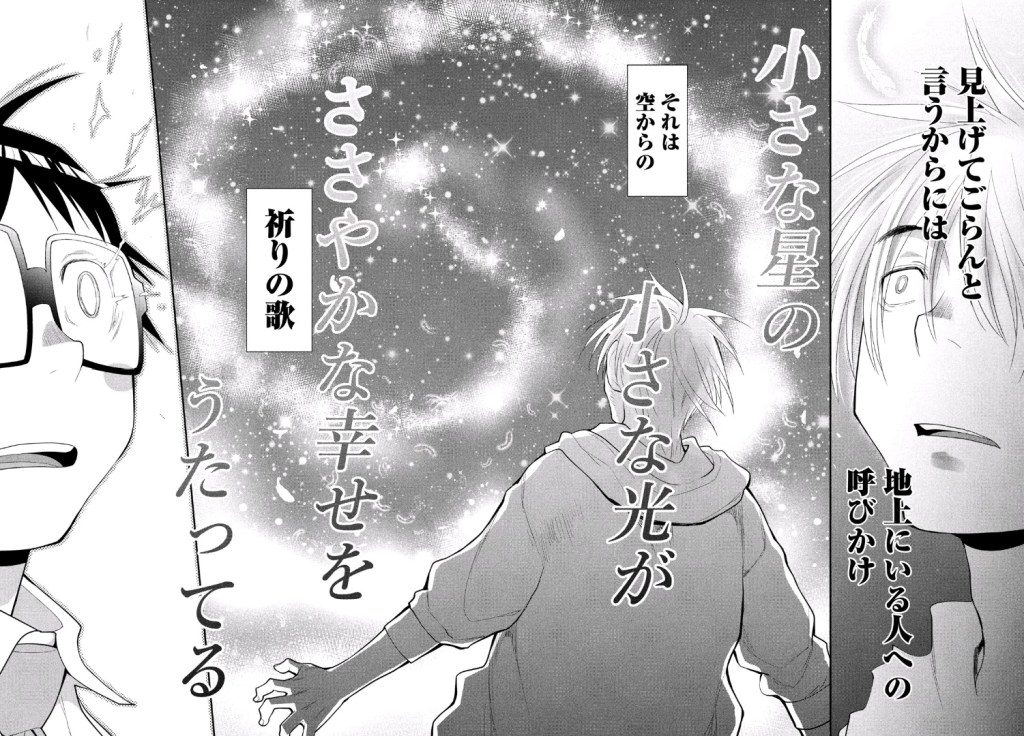
In episode 12, an earthquake hits Hokkaido, causing blackouts. As the characters look up at a starry night sky, a song plays: Kyu Sakamoto’s “Miagete goran, Yoru no Hoshi o” or “Behold the Nighttime Stars.” This song originally came out after the Great Kanto Earthquake of 1923, and it responded to the fact that the lack of light pollution made the stars more visible than normal. A common interpretation of the song’s lyrics is that the stars are also the souls of those who died in the disaster. In short, having “Miagete goran, Yoru no Hoshi o” play was an active choice with a specific meaning to Japan.

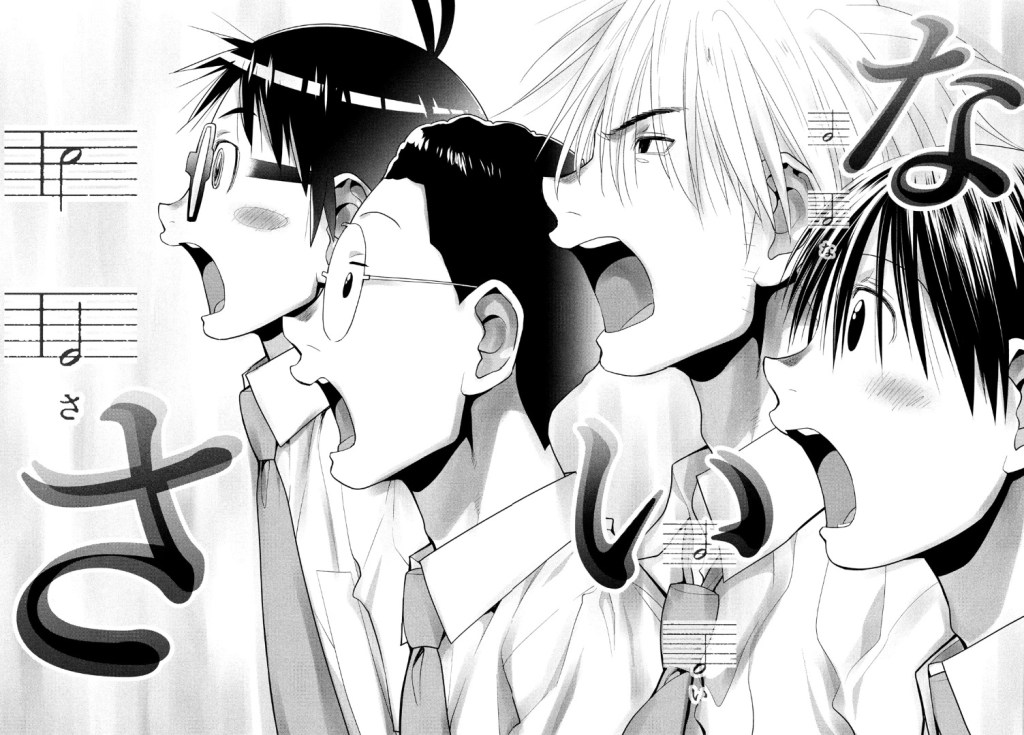
Incidentally, I actually only learned about the song and its significance because I’ve been following Kio Shimoku’s current manga, Hashikko Ensemble. The tune has a central role in the narrative up to this point, and one of the characters goes as far as to explain everything I mentioned above. I find it a little funny that these two streams dovetailed so nicely together.

Both Wave, Listen to Me! and Hashikko Ensemble run in the magazine Monthly Afternoon, so maybe this synergy isn’t totally out of the question. Most likely, however, is that they’re both referencing the same major moment in Japanese history.

Dissenting Voice: Hashikko Ensemble, Chapter 29

Akira vs. Jin?! It’s Chapter 29 of Hashikko Ensmble!

Summary

The Hashimoto Chorus Appreciation Society arrives at the site of their training camp, which is packed with seemingly all the audio equipment they’ll ever need. But as Jin is living in audiophile paradise, Akira is still thinking about seeing Jin at Himari. Jin explained that he was there to help Himari build her own speaker, but it still doesn’t sit well with Akira. 

Hasegawa (who has declared her intent to join the club proper as conductor—and drag Kanon in along as well) reveals to Akira that having Jin help Himari was all her idea. In fact, she purposely timed things so that Akira would be on the previous castle trip. Hasegawa also prods Akira about his obvious feelings towards Shion.

Jin talks about his next plans for the group, which involves having the guys all sing a capella for the school festival. His motivation seems a little off somehow, but what’s even more unusual is Akira vehemently disagreeing with the decision—a first “fight” for the two. The group later goes outside to look at the stars and to practice harmonizing, only for the debate about the school festival to continue. However, the argument is suddenly interrupted when everyone realizes that Shion is missing!

Feelings and Tensions

It feels harder and harder to write chapter summaries for Hashikko Ensemble. Whether it’s the burgeoning (?) romances or the friction that exists between the characters, everything feels important and frivolous at the same time. Jin and Himari could just be as innocent as they claim, seeing as Jin is not one for deception, but maybe there’s still something sparking there. Akira’s crush on Shion seems to only grow stronger, and it’s clear that his reluctance towards doing a capella is that Shion (who’s only just recently healed from her hand injury) wouldn’t be able to play. Meanwhile, I suspect Jin’s eerily forceful desire to do a capella comes from wanting to further defy his mysterious mother.

Orihara seems especially tense, but I can’t really tell for sure what the reason could be. He seems like he’s trying to work through something possibly related to Shion, but I feel like the series is trying to use him as a red herring romantic rival. Orihara’s a complex yet simple character, so it’s hard to peg what he’s about, even when knowing his tragic past.

Sound Training

I like seeing Jin nerd out about audio electronics, even if I don’t fully understand everything that’s going on or how it’s supposed to all fit together. To be fair, that’s something I share with most of the characters in this chapter. Still, I at the very least learned that Accuphase is a manufacturer known for its power amps, and that with sufficiently good equipment, you can even hear where the singers were positioned in a room. 

There’s also an interesting little training regimen shown in this chapter, meant to strengthen your voice and your muscles at the same time. In fact, the manga itself points to the original source, “Muscle Voice Training,” which can be found on Yamaha’s official Youtube channel!

As for its portrayal in this manga, one thing I find curious is that Shinji is able to generate more force in his “He!”s than the bigger and stronger Orihara. I think either Orihara is just not trying very hard (possibly out of embarrassment), or there’s something about Shinji’s castle-exploring cardio that gives him a slight edge.

Songs

You know the drill by now. It’s“Miagete Goran Yoru no Hoshi o” by Kyu Sakamoto. Most likely, things will change now that we’re seemingly moving into a new arc.

Final Thoughts

Kanon joining the club seems inevitable, but I have to wonder what role she’ll end up in.

Also, this series being a manga and all, I often picture Akira’s voice in my head as something soft and light, only to remember that he’s supposed to have a  serious bass to his voice. It’s so unlike what’s typical that I want even more to see it in anime form.

Boy, Become Mythology: Hashikko Ensemble, Chapter 28

It’s Shinji’s turn to live his passion in Chapter 28 of Hashikko Ensemble.

Summary

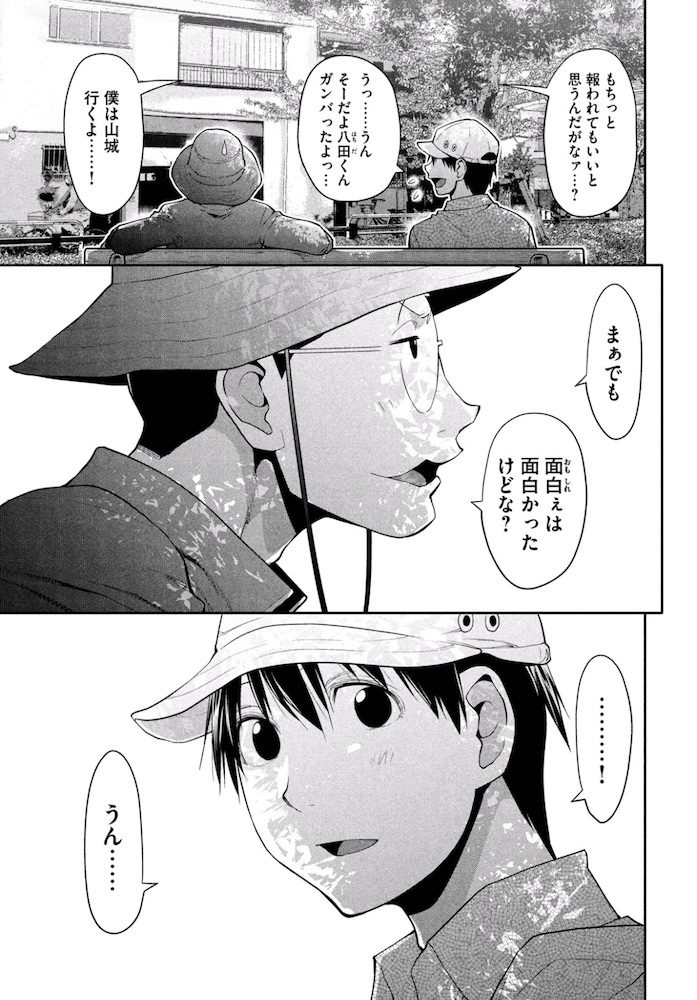
Now that M-Con is over and the rest of summer break is left, Shinji decides to do what he’s been wanting to this whole time: visit a castle! After all, his original plan in high school was to make a Mountain Castle Club, before he got roped into singing. He wanted to bring the other members along, but only Akira and Hasegawa ended up joining him. Also, it’s technically a valley castle and not a mountain one, but that’s better for amateurs like the latter two anyway, according to Shinji.

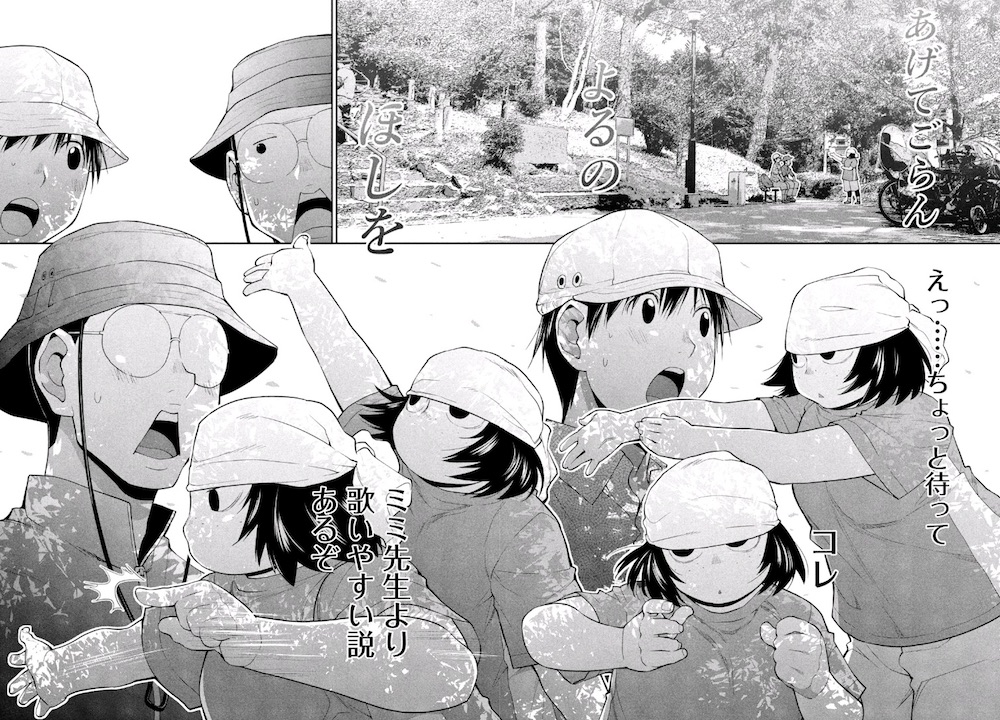
As the three take a break, Akira expresses his desire to sing more, while Shinji admits that even he got into it more than expected. Hasegawa surprises the both of them when she suddenly starts conducting, and the two guys start singing. She reveals that she’s been practicing in secret while watching Mimi-sensei, and the two immediately realize that she’s actually better at it than their club adviser.

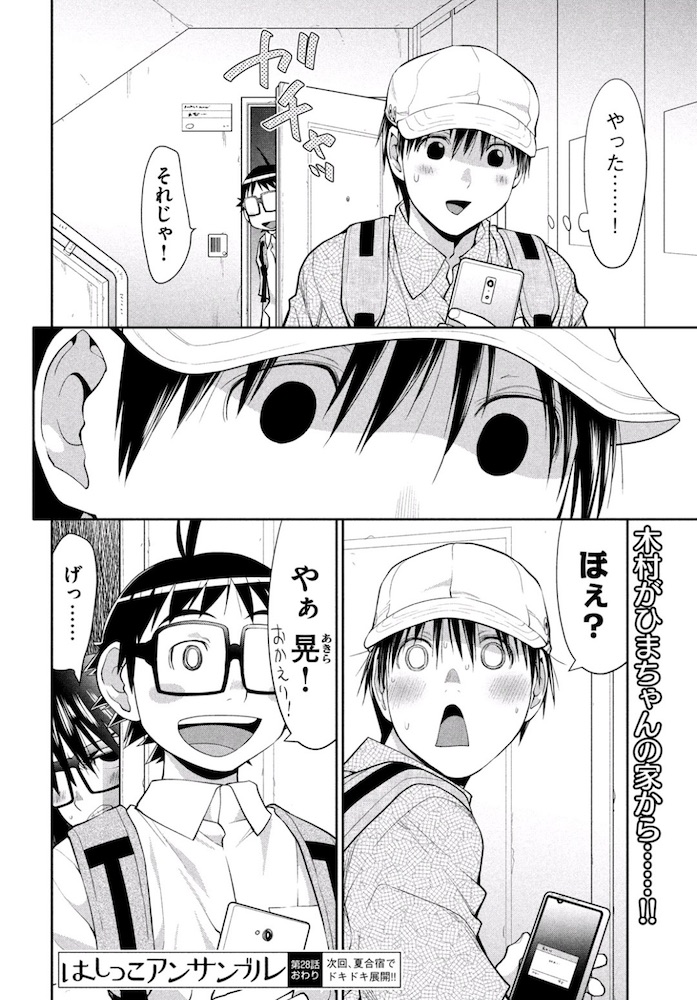
The singing draws the attention of an old man walking around, who explains that he’s a member of the Suns—the chorus they had visited when they were trying to figure out Orihara’s “hearing issues.” The old man, whose name is Yoshinaga, is himself a castle enthusiast, which thrills Shinji. During their conversation, he mentions having a vacation home in a nice outdoor area they could use for a training camp. After some calls, most of the club is into the idea, including Jin, who responds to Akira last. However, just as Akira is leaving his place, he sees Jin exiting Himari’s apartment while greeting Akira with a smile!

Oh Castle, My Castle

I had been wondering if Shinji’s love of castles would forever remain on the back burner in Hashikko Ensemble, so I’m happy that he finally gets to enjoy his true passion. Unfortunately, we don’t actually get to see the castle they visited, which is a reminder that this is indeed a manga primarily about music. I hope he eventually gets a true mountain castle.

I wonder if we’ll end up seeing more of Yoshinaga, if only because this would give a real mentor to Shinji—someone who can foster his love of castles and his burgeoning interest in singing. It could be something unique to Shinji among all the characters, and it might be the key to leveling him up really quickly for the next time the Chorus Appreciation Society performs.

Jin x Himari…?

In all likelihood, Jin stepping out of Himari’s family apartment (along with Himari’s angry grunt at being discovered) is going to just be some innocent misunderstanding on Akira’s part. Still, if i were to entertain the notion that something happened between the two during summer vacation, I have to admit that I think they’d be a cute couple. There’s something about the contrast between Jin’s overwhelming cheer and Himari’s curmudgeonly attitude that would appeal to me if they were an item, and one can only imagine how awkward everything about their relationship would be.

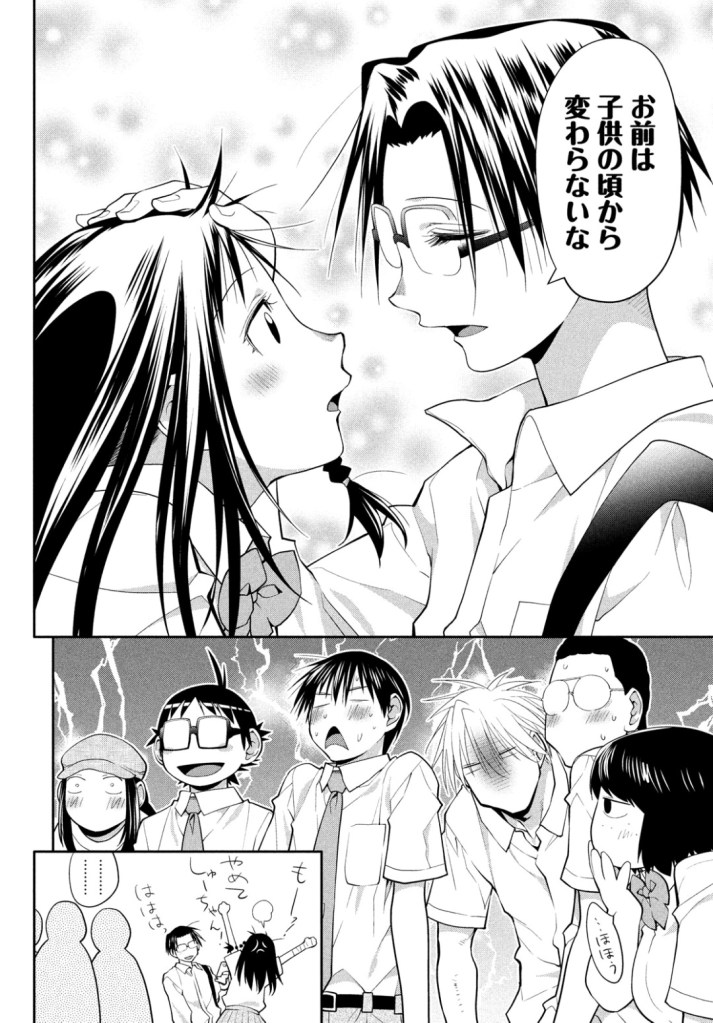
But putting that aside, the real purpose of that last-second shock is to highlight that Akira has romance on the brain to a certain extent. He’s been thinking about Shion a whole lot, even feeling continued jealousy toward Shunsuke after finding out that Shion’s been visiting Shunsuke’s home to practice piano now that her hand has healed. Now that Hasegawa is aware of the truth, her teasing is getting stronger, though it’s interesting that Hasegawa isn’t being protective of Shion. Instead, she seems to be encouraging it.

The innocence of the romances in Hashikko Ensemble is such a contrast to Spotted Flower, I must say.

Conductor Hasegawa

I figured at least a few of the characters not directly involved in the music would eventually join the club in a more involved capacity, but certainly didn’t expect Hasegawa to start working towards a role as conductor. I have to wonder how the others might eventually reach this point, and if this is the real reason behind Jin being at Himari’s home.

Then there’s Kurotaki Mai, the girl with the deep voice. I still think she’ll come in for a more prominent role eventually.

Songs

As Hasegawa conducts, Akira and Shinji sing “Miagete Goran Yoru no Hoshi o” by Kyu Sakamoto—the same featured song as the last handful of chapters.

Final Thoughts

Given that M-Con is in the past now, I can only assume they’ll be practicing some new songs to add to their repertoire. I wonder where they’ll go next. I personally don’t have any must-see songs, but something far off from “Miagete Goran Yoru no Hoshi o” could be a nice change of pace.

Seduction of the Innocent: Spotted Flower Babies

Spotted Flower has long been a bizarre, twisted version of Genshiken, but a couple of side chapters posted (temporarily) for free on the Rakuen: Le Paradis website reveal an extra wrinkle to its story. Portraying two groups of parents, it shows their actions inadvertently corrupting their children.

In Chapter 33.5, the wife (not-Kasukabe) is trying in vain to get her infant daughter, Saki, to raise her head. When the husband (not-Madarame) drops his phone by accident and it shows an old picture of him getting his necktie pulled (much like that famous moment in Genshiken), Saki’s eyes go wide with excitement. When the husband picks his phone back up, Saki’s head follows, and voila, she’s able to lift her head up under her own power. In that one moment, a fujoshi is born.

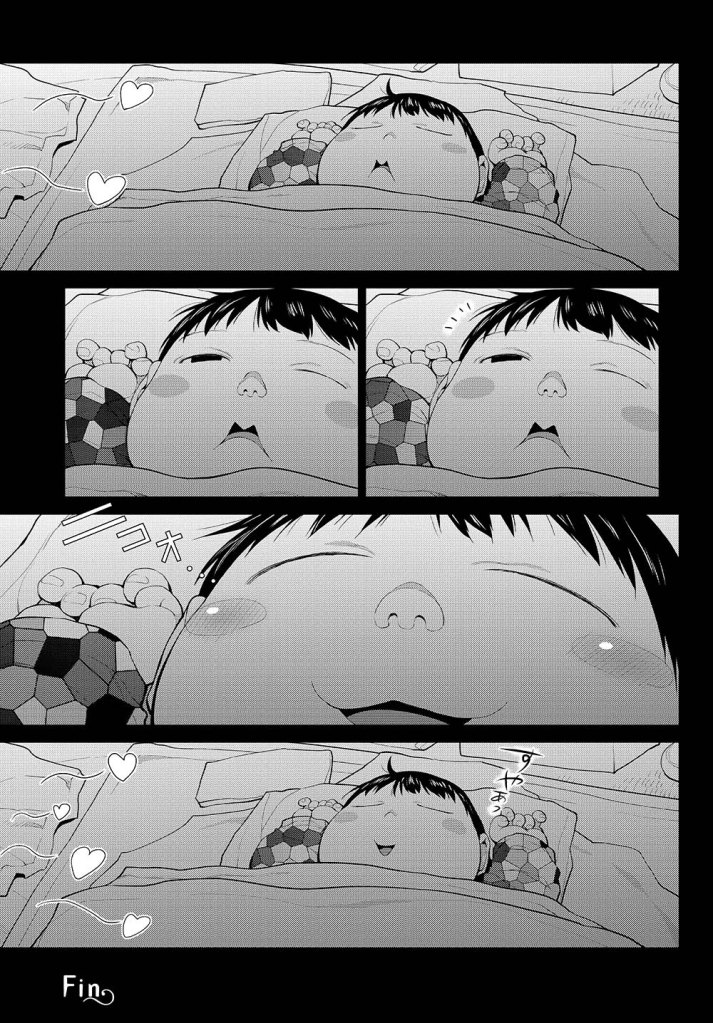
Then, in Chapter 34.5, not-Ohno has put her two kids, Shin (three years old) and Yuu (one year old) to bed alongside her. On her other side, however, is her husband (not-Tanaka!!), and she’s in the mood for some intimacy.. Not-Tanaka notices that she’s actually wearing pantyhose from a Kakegurui cosplay, which clearly shows that she’s been wanting this, but when she also tries to put on a Yumeko wig, he nixes that idea. The mini-chapter ends with them having sex off-panel, with Yuu being woken up and then lulled back to sleep by the sound of his parents knocking boots next to him.

The idea of seeing these geek parents influencing, even if accidentally, the next generation of degenerate pervy otaku is an intriguing one. What makes it all the more…special…is specifically that it’s the Spotted Flower characters doing this instead of the Genshiken ones. What will the future hold for these kids…?

M-Pros: Hashikko Ensemble, Chapter 27

It’s the Hashikko boys’ first real test: performing at the M-Con!

Chapter Summary

The Chorus Appreciation Society is up at the M-Con, and their performance impresses at least one of the judges. While they’re part of the “free” section—i.e., participation only—Akira and the rest take it very seriously. In a powerful moment, members of the audience could swear they heard an angel, thanks to the harmonizing by the four on stage. In the final moments, Jin’s thoughts are about proving how great choruses are.

Afterwards, many congratulations are had, including from Shion’s mom and the Nishigafuchi club members who attended. Nishigafuchi’s message is loud and clear: you’re good enough to compete. Elsewhere, Yumerun is observing from a distance, and seems upset about Jin to the point of tears. Hasegawa spots her and, mysteriously, offers to exchange Line account info with Yumerun.

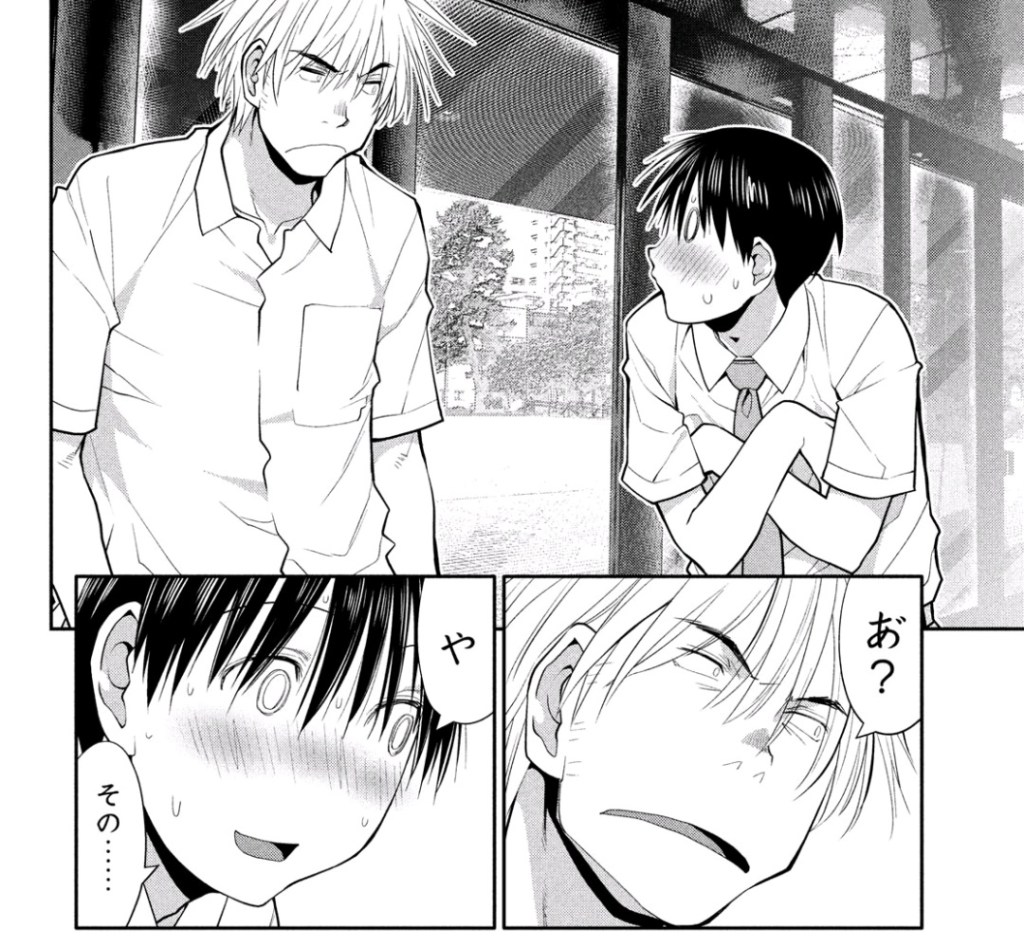
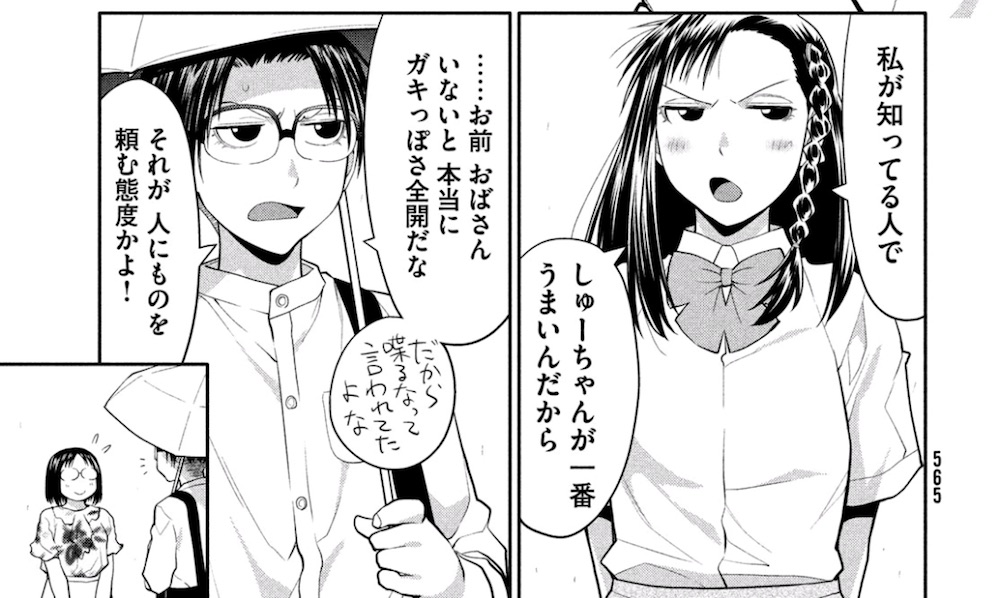
Shuusuke, who was on piano due to Shion’s injury, offers to take a photo of the club (plus associated classmates). However, when Shion tries to assert that she’ll be the one playing for them next time, she trips and falls into Shuusuke’s arms in a repeat of a childhood moment between the two. The situation seems ripped straight out of a romance manga, which causes a great deal of shock and blushing, albeit for different reasons. While Akira very clearly has feelings for Shion, Kousei is just mad that Shion’s nickname for Shuusuke, Shuu-chan, is what he used to call his deceased little brother. In the end, they manage to take a rather awkward but hilarious group photo, while also giving (Mashino) Shuusuke a new nickname: Masshie.

The Judge’s Thoughts

I found the aforementioned judge to be an interesting part of the chapter because it showed how an expert would see a fairly amateurish club and still recognize in them some potential. In my view, the key is when he describes what proper harmonizing is: It’s not about thinking, “I will try to let my voice out in a way that matches up with the others,” but rather, “If I let my voice out, it will match up with the others.” 

He also expresses being impressed by the way they transform into tenuto in their performance, which is a musical direction meant to convey “holding a note for its full length.” (I’m not sure I’m using that term correctly, so feel free to correct me!) Jin actually reaches him for comments afterwards, and he encourages them to get more members so they can participate in different types of competitions.

I hope this isn’t the last we see of him.

Romance in the Air?

I’ve written a good deal about the potential for romance and love triangles in Hashikko Ensemble, but I’ve tried not to focus too much on it because I didn’t want these reviews to overly emphasize that side to the extent that people might assume this was a primary focus of the series. That being said, it’s now crystal clear that Akira has a thing for Shion, and that it wasn’t just him being somewhat naively overprotective. There also might be something going on with Yumerun too, but those tears are kind of ambiguous. 

I still wouldn’t quite classify Hashikko Ensemble as a romance manga, though. Rather, it’s a story about human connections through the world of music, of which love is one possibility. It’s exactly the kind of story Kio Shimoku excels at, and why I continue to be such a big fan of his.

Back to the subject of Yumerun, I would think that everything about this chapter—the encouragement Jin got to find more members, Yumerun’s reaction, Hasegawa’s gesture—would lead to her joining them. However, that would first require her to transfer to Hashimoto Technical High School, an environment likely unsuited for her implied musical talents overall. It would be a hell of a move, and if it happened, it would signal some very clear intent on Yumerun’s part.

I also got a kick on the little swerve we got in terms of Kousei. It seemed like he had some feelings for Shion, but it turned out to be something about his little brother instead. It’s a bit of dark humor that ironically lightens the moment.

Songs

Naturally, the only song this month is (once again) “Miagete Goran Yoru no Hoshi o” by Kyu Sakamoto. 

Final Thoughts

It’s clear from previous reviews that I didn’t quite understand what the “free” part of M-Con meant. I took it more as like, an “open competition,” as opposed to being the distinction between “For Fun” and “For Glory,” to use Smash Bros. terms. 

I think this is probably inevitable with my writing about Hashikko Ensemble because of how music is not my forte. It makes me want to see someone who does know a thing or two about music read and review this series!

A Different Way of Seeing: Hashikko Ensemble, Chapter 26

Jin reveals an important part of himself while Akira shows his kind heart in Chapter 26 of Hashikko Ensemble.

Summary

It’s the Hashimoto Chorus Appreciation Society’s turn at the M-Con competition, but before they go up, Jin has a question for Akira: how does Akira interpret the lyrics to “Miagete Goran Yoru no Hoshi o” (Behold the Nighttime Stars)?

It turns out that while Jin can read up on the history of a song to understand what went into it, he can only ever understand lyrics at face value. After some hesitation, Akira explains in private to Jin that he picked the song while thinking about Kousei, who lost his little brother when they were young. To Akira, it sounds like a song of prayer—an explanation that seems to awaken something inside of Jin. Right after, Jin blabs to Kousei, causing some embarrassed tension, threats of violence, and teasing accusations of Kousei being a tsundere.

That little moment resolved, the guys start their performance, with Kousei drawing the most attention with his delinquent attitude in this more formal concert hall space. As they sing, they impress one of the judges in particular, but in the stands, Yumerun (Jin’s childhood friend) looka extremely annoyed for some reason.

Is Jin Neuroatypical?

Jin has always come across as a huge nerd who’s really into music as a kind of scientific phenomenon. However, based on what we’ve learned over the past two chapters, I’m genuinely starting to wonder if Jin might be somewhere on the autism spectrum, or is perhaps neuroatypical in some other way. 

Not only have we learned that he has trouble with making his singing feel more expressive, but now he’s explained that he’s basically incapable of interpreting lyrics on his own. I’m not very familiar myself, but I’ve known people who have Asperger’s, and from what I understand, people on the autism spectrum often have difficulty grasping the emotional meaning behind how things are said, or even sarcasm and the like. Hashikko Ensemble itself hasn’t said anything explicit, but I think it would explain a lot about the character, including how he approaches social interaction.

Akira and Kousei

The fact that Akira showed such concern for Kousei further fleshes out his character. There’s something about his trying to help Kousei out, as well as his interpretation of the lyrics, that reminds me of his childhood friendship with Himari and his love of children’s picture books. Akira is a kind soul, and I increasingly like him as the central protagonist of this manga.

Yumerun’s Anger

Part of the imagery of Yumerun grinding her teeth is that it “rhymes” with the panel of Shion doing the same out of frustration over not being able to play the accompanying piano. But beyond that, I really can’t seem to figure out why Yumerun is expressing some dismay over seeing Jin sing there. Their mutual past might be even more complicated than I first thought, and I wonder if maybe Yumerun is actually there on behalf of Jin’s mother. If not, maybe Yumerun sees chorus singing as somehow painfully common. I’m sure there’ll be more information in the coming months, but for now, this has me fascinated.

Songs

It’s just “Miagete Goran Yoru no Hoshi o” by Kyu Sakamoto again this time, but given that it’s front and center in this chapter, I think it’s worth it to go into greater detail about it.

As Jin explains, the song in question was written after the Great Kanto Earthquake of 1923  when the lack of light pollution made the starry sky visible. The stars are a metaphor for people’s souls, and the song itself functions as a song for repose of the soul. Akira’s interpretation as a song of prayer approaches it from a different angle. To him, the lyrics seem like they’re calling out to the souls of those who have been lost, but the second half makes the name of the song sound like a comforting call to those left on Earth. 

Final Thoughts

If Kio Shimoku is indeed writing Jin as having some sort of neurotypical mind, it would be new ground for him. Genshiken has a lot of eccentric characters, but that series always came across as just a bunch of fanatical dorks who really like anime and manga. Jin’s obsession with music seems driven by something different. 

What a Dream Boat: Hashikko Ensemble, Chapter 25

Another new character brings further insight into Jin’s history in Hashikko Ensemble Chapter 25.

Summary

The Hashimoto Tech Chorus Appreciation Society has arrived at M-Con, nervous about competing. Day One is just for observation, though, and they see Nishigafuchi (the school they visited previously) succeed. They’re also worried about Shuusuke not showing up after he tore down Jin so thoroughly, but luckily, he arrives. However, another figure appears as well: a girl named Shouji Yumerun, a classmate of Jin’s when they were kids, and when she looked very different.

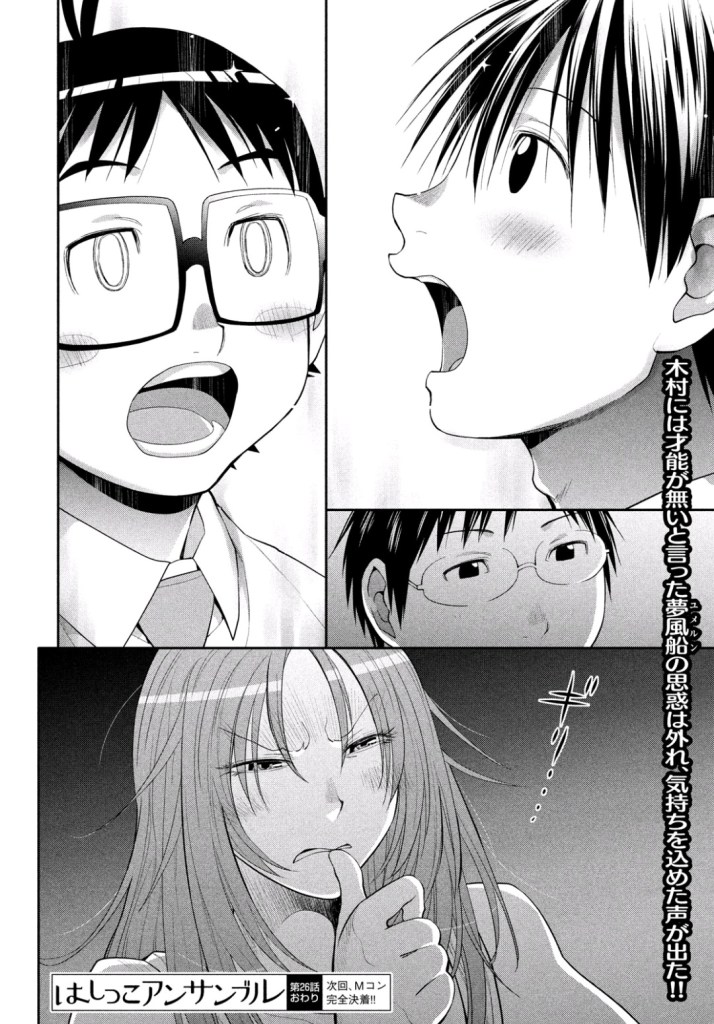
Yumerun mentions becoming a pupil of Jin’s mom, and that this means Jin doesn’t have to worry about being talentless anymore—words meant to comfort, it seems, but which have the opposite effect. Jin begins to think about why it is he’s so unable to be naturally expressive, and how he gathers people who make up for this weakness. The chapter ends with him getting ready to ask Akira a question.

Jin’s Intuition

I’m actually surprised to discover that Jin sees himself as talentless, and that all of his singing ability comes from hard work and study, if only because he has come across as such a natural in previous chapters. In Naruto terms, he’s the Rock Lee everyone thinks is a Sasuke, and it makes him more relatable in some ways.

Another character Jin reminds me of is Mike from Monsters, Inc. Like Mike, Jin has the theory down but can only take it so far due to a lack of natural ability. The fact that Jin has such an eye for talent further reinforces this image while also adding an extra wrinkle to his character. He finds people with the raw potential he himself lacks, almost to an intuitive degree.

Yumerun

We get another new character in Yumerun, who drops some hints about Jin’s past and his relationship with his mom. Apparently, Jin and Yumerun were classmates, and he helped bring her into music. Now, she’s studying under Jin’s mom, and she thinks this means Jin doesn’t have to worry about being talentless anymore—implying perhaps that Jin felt pressure to succeed his mom, and that maybe Yumerun has a thing for him?

I’m struck by Yumerun’s words, particularly when she says to Jin, “You won’t be told anymore to stop escaping into the chorus just because you lack talent.” What I interpret this to mean is that Jin likes singing in a group because it better hides his deficiencies. Rather than just being a passion, it’s also a defense mechanism.

In the Mind But Not in the Heart

Every chapter review, I record all the music terms that crop up, partially because they’re in Japanese and not necessarily common knowledge even for fluent speakers. But it’s also because I have little to no musical knowledge or ability, so I feel the need to try and understand. The fact that Jin has a somewhat similar struggle makes these sections take on a new meaning of sorts. As someone not musically inclined, it’s hard for me to tell if these flaws of his are really that basic or if it’s the difference between being decent and being elite, though the fact that no one at Nishigafuchi said anything makes me think the latter.

In this instance, Yumerun brings up all the things Jin has trouble with: enunciating s, k, and z sounds; the nuances of syncopation;  and techniques for emotional expression. Apparently, he can understand it on paper, but has trouble doing it himself. Syncopation is “a shifting of the normal accent, usually by stressing the normally unaccented beats.”

Songs

No songs this month, but the fact that the previous storyline is officially known as the “Spitz arc” amuses me.

Final Thoughts

The Chorus as a place where people who lack in certain areas can support one another feels like the story of a team sports manga, as opposed to ones about individual competitors. Hashikko Ensemble might not have the attractive characters or the pizzazz to attract regular sports manga readers, but I wonder if this possible theme of “the sum being greater than the parts” might resonate still.

You Are, All of a Sudden, a Mechanical Man: Hashikko Ensemble, Chapter 24

A new character flips everything upside down in Chapter 24 of Hashikko Ensemble.

Summary

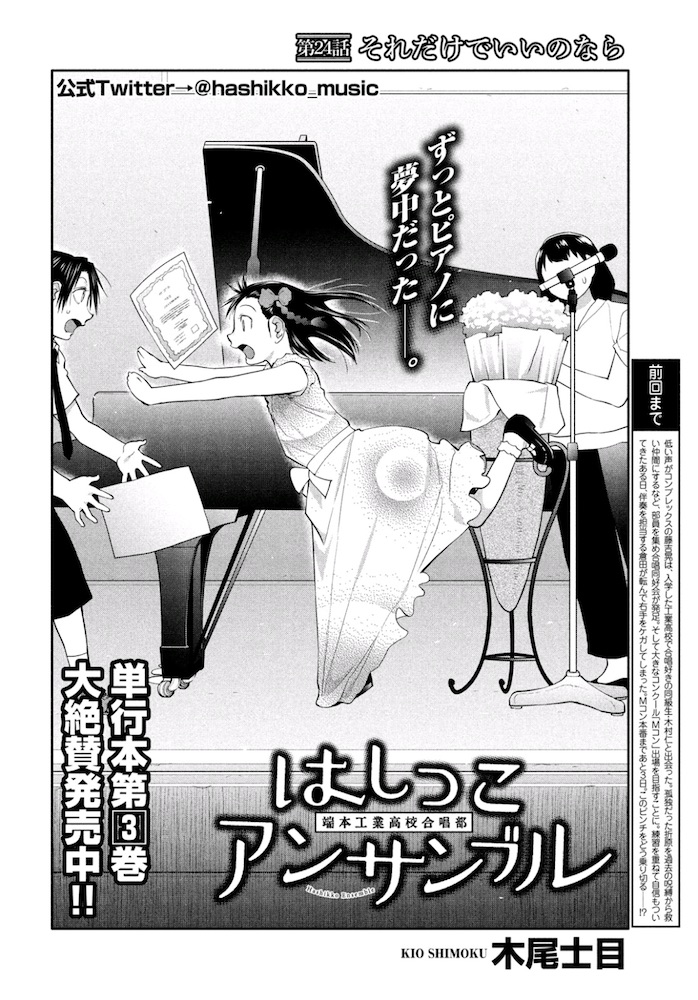
Shion has sprained her wrist, and the Chorus Appreciation Society is forced to do something about it. Given a few options, they ultimately land on getting an alternate pianist to accompany them, though Akira expresses that he doesn’t think anyone could really replace her. Shion pulls a favor with her mom, and gets an old acquaintance/friend to take her place: Mashino Shuusuke, a guy who carries around a sun umbrella and who just has an aura that screams “elite.”

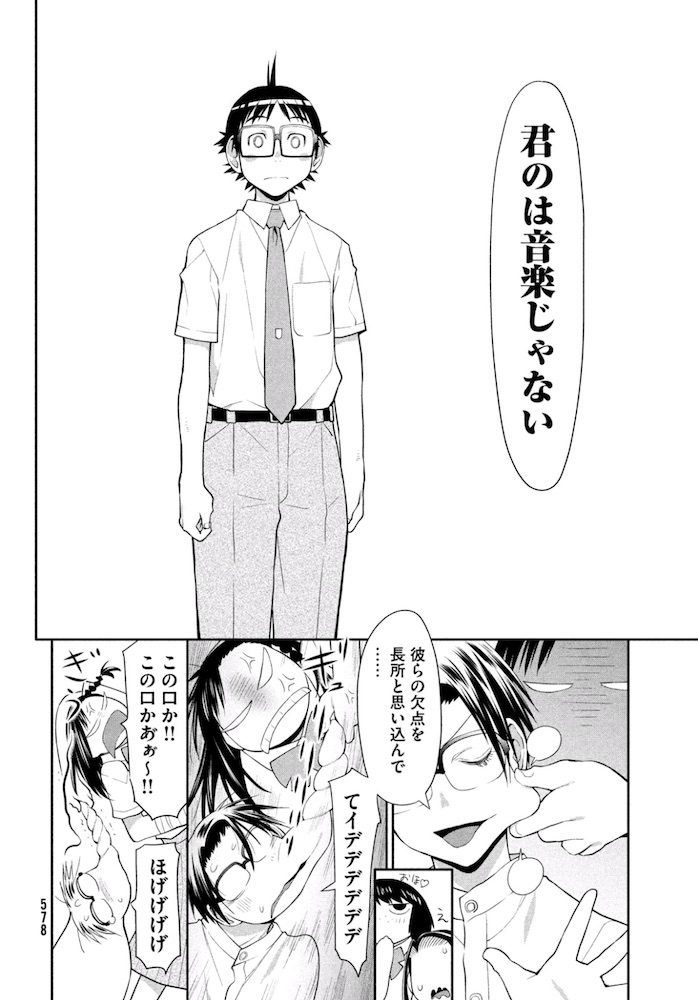
However, after just one song, Shuusuke finds the Hashikko boys to be fundamentally inadequate. He critiques each of their weaknesses one by one—and actually declares Jin to be the most hopeless of all! While the rest of the group is eager to prove Shuusuke wrong, Jin seems uncharacteristically glum.

Their Unique Problems

It’s interesting to see where each character’s singing flaws are, as pointed out by Shuusuke. It’s not easy to convey in comics, so the exposition is welcome. Also, it might be a hint at how the characters might develop over time.

Akira is trying too consciously to sing low, and his enunciation is suffering. He’s pushing his vowels out at the expense of his consonants.

Kousei doesn’t sing with purpose. According to Shuusuke, Kousei comes across as someone who thinks passion and feeling can make up for that, but it can’t.

Shinji is a total beginner, so there’s not much to be done there. Shuusuke says this as if there’s nothing specific he could say to help, which makes Shinji all the angrier

Jin knows how to “sing,” but what comes out of him isn’t “music.” In terms of criticisms, this one hits the hardest.

A Hurdle for Jin

I find the introduction of Shuusuke to be one of my favorite story developments so far because it’s the first time that Jin has been challenged as a character. Up to this point, Jin has always been the fount of knowledge who knows more about sound and music than anyone else. To have that called into question, to have someone say that Jin’s singing is merely technically proficient, is a major change-up. Adding to this is the fact that Shuusuke is clearly a legitimate talent at the piano.

The only times in the past that Jin has looked even remotely that taken aback is when he mentions his mom. We have the sense that there’s something messy underlying his interest in music, and I have to wonder if Shuusuke’s comments are related in any way.

Shuusuke and Shion (and Akira?)

As implied by the chapter’s title page, there’s a history between Shuusuke and Shion dating back to their piano concert days (Shion, as we see, has always been herself). There’s a clear frustration he has over her choosing to go to a technical high school–my best guess is that he saw her as a rival, or at the very least, someone who’s wasting her talents. There might not necessarily be any romantic sparks (or at least not reciprocal ones), but the “childhood friend” history is a reliable, if not as common a trope as it used to be. Given Akira’s bit of blushing early in the chapter when he comments on Shion being irreplaceable, there might be some tension there.

Songs

“Miagete Goran Yoru no Hoshi o” (Behold the Nighttime Stars) by Kyu Sakamoto make another appearance here.

Final Thoughts

In frustration, Shion says that it’s actually Shuusuke’s fault that things aren’t going well, and that they’re much better when she plays. It’s hard to tell if she’s just being stubborn or if there is some merit to her words, so I’m looking forward to seeing what the answer is in the end.


Hammerman, Hammer: Hashikko Ensemble, Chapter 23

 Summary

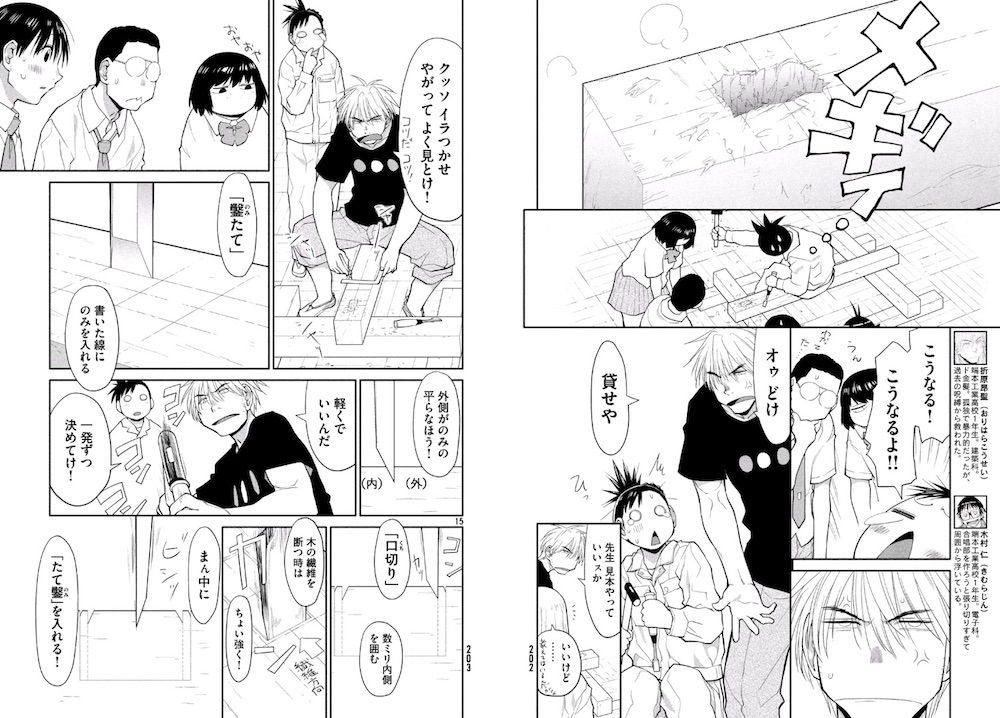
The Chorus Appreciation Society has emerged triumphant over Tsuyama’s group, and now the M-Con competition is only one week away. But while that ought to be everyone’s highest priority, Shion is still trying to complete a hammer-and-chisel woodworking assignment she just can’t seem to figure out. Meanwhile, everyone else is wary that the group’s only pianist is potentially putting her own fingers in harm’s way.

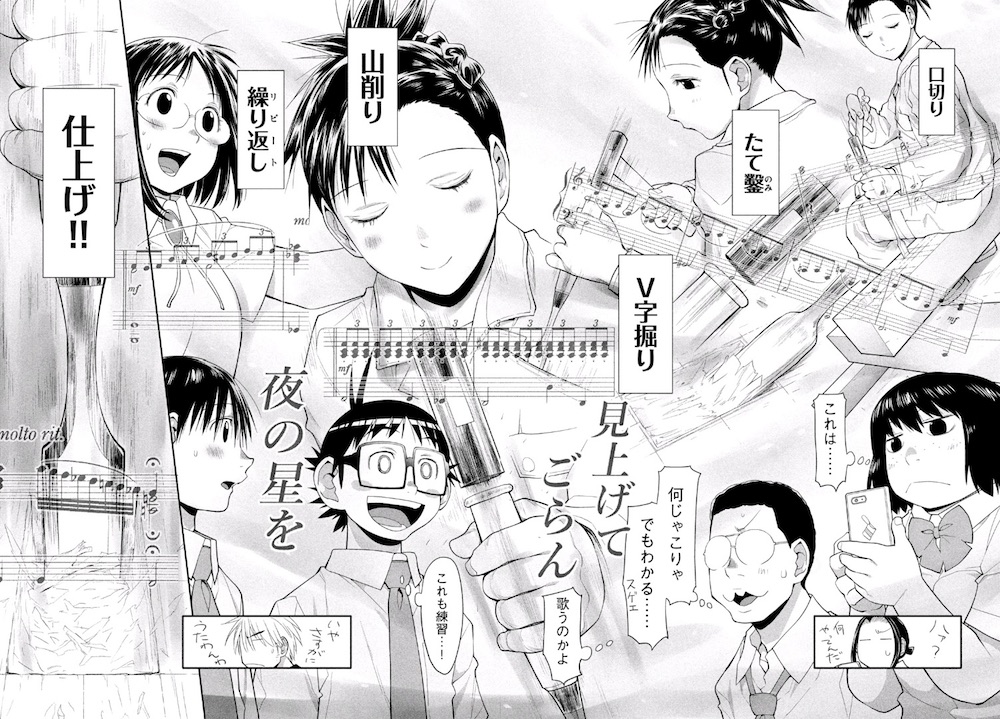
Thanks to a handy demonstration by a surly Orihara and an idea from Jin and Akira to treat the process like playing piano, Shion manages to get it done. However, Shion accidentally bumps into a storage locker and sends a bunch of chisels crashing down towards her hands, only to be saved by Orihara, who accidentally grabs her chest. After a bit of awkwardness, things seem resolved…only for Shion to later fall while changing out of her workshop clothes and appear to sprain her wrist anyway.

Working to Music

Hashikko Ensemble is all about the contrast between the characters’’ vocational classes and the songs they’re singing, but most of the time, it’s the science and engineering side facilitating learning about music. This time, it’s more the other way around. The chisel work that Orihara demonstrates shows a kind of softer and more meticulous side to him as well, especially in how shaving off the wood in layers is this gradual process.

It’s also interesting to see where the different characters in this series can and can’t relate to one another. It’s Jin who suggests likening different degrees of taps of the chisel to piano terms–forte, mezzopiano, etc.–but it’s Akira who brings it all together by wondering if Shion could literally do it to a specific song. It’s like it took all three guys here to eventually connect to her way of thinking.

When Anime Haircuts Die

After Tsuyama’s group loses, they all shave their hair in preparation for finding internships, all while taunting Orihara that this is likely his head’s fate as well. Could that actually happen in this manga? Could the main characters end up losing all their nice-looking anime hair if Hashikko Ensemble goes on long enough? It would certainly be something different.

Shion Is Great

I don’t know if this is what Kio always intended, but Shion is really stealing the show at this point. From the beginning of the chapter and Shion’s Ito Junji-esque expression as she declares Akira to be a traitor to just the overall antics that follow, she’s becoming one of the most memorable parts of this series. There’s a point in the chapter

The wrist sprain is very akin to Madarame’s from Genshiken’s (he fell while at a doujin event), and it makes me wonder if Shion is actually supposed to be the Madarame of this series, only less self-aware. She has a sort of ponkotsu quality, but it’s not like she’s untalented or constantly failing. You could call her moe, but she’s less endearing and more exasperating. There’s a point in the chapter when Shion is describing how she doesn’t understand how anyone could do keep track of all the different subtleties in how hard to tap, nor how anyone could do two completely different things with their left and right hands, only for the rest of the characters to yell at her about how that’s a perfect description of playing piano.

It’s like Shion does what she wants and pushes the story along as a result, but perhaps hat describes most of the characters in Hashikko Ensemble.

Songs

The song Akira suggests Shion tap along to is the one they plan to perform for M-Con: “Miagete Goran Yoru no Hoshi o” (Behold the Nighttime Stars) by Kyu Sakamoto.

Final Thoughts

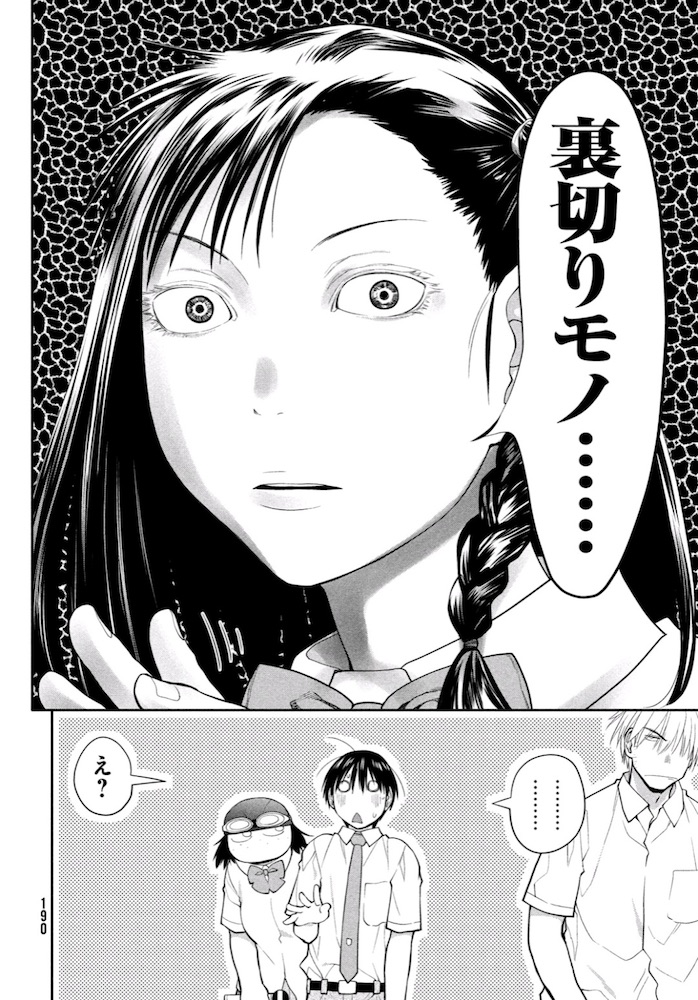
Orihara plays a major role in this chapter, and in it, he keeps expressing that he really hates girls. The way he says it, however, seems to speak to something deeper. Could it be that he’s expressing his anger towards the mother that let him and his deceased little brother be abused for so long? It can be hard to tell, given how Hashikko Ensemble can move between the serious and the comedic in such striking ways.