I’m 20 years late, but I finally finished Ghost in the Shell: Stand Alone Complex, which I first started watching all the way back in 2002 (!). Its detective-story approach to the GitS franchise allows it to deliver its cyberpunk world in a fairly straightforward manner that doesn’t necessarily require an inherent love of science fiction. At the same time, it still explores the central concepts of GitS (like the question of identity in a world where fully artificial bodies are ubiquitous) effectively.
But watching SAC has me thinking about just how different each iteration of Ghost in the Shell is. It makes me feel that almost everyone will naturally and firmly gravitate towards a particular flavor of GitS, even though they’re thematically of the same realm. The original manga by Shirow Masamune revels in the slick aesthetic of its futuristic technology (and dials up the horny to 11). The films by Oshii Mamoru famously dwell on the philosophical implications of its world, with the second film, Ghost in the Shell 2: Innocence, being even more heavily geared in that direction to the point that one can argue that there’s a breaking point at that sequel. I haven’t watched Ghost in the Shell: SAC 2045, but I have noticed disappointment, and I wonder if it’s because SAC 2045 is yet another noticeably different interpretation.
Though I say that people are likely to pick one version as their absolute favorite, I actually have trouble deciding for myself. I think this has to do with each GitS delivering a substantially different experience, and I find a type of fulfillment in each. Maybe I’m one of those folks who just loves science fiction as a whole.
Let’s say you’re watching an episode of Raven of the Inner Palace in Japanese. Or maybe it’s Thunderbolt Fantasy. A new character appears and introduces themselves, but the voice seems to say one thing and the subtitles another. Is the eponymous heroine Raven “Ryuu Jusetsu” or “Liu Shouxue?” Is the hero of Thunderbolt Fantasy “Shang Bu Huan” or “Shou Fu Kan?”
They look kind of similar but also not. It feels discordant to read and hear two different things that are supposed to be the same, so you might be wondering why such a decision was made.
What you’re running into is the legacy of how the Chinese language came to influence the Japanese language.
I am no expert when it comes to to Chinese-Japanese linguistic history, but I believe I can sum it up very briefly as follows. The Japanese language originally did not have a writing system, eventually began importing Chinese between the 3rd and 7th centuries AD to deal with that problem despite the fact that the language structures are dramatically different. Japanese began to use Chinese written characters (kanji), in some cases choosing to adopt Chinese pronunciations of words as well. Yet, because the languages are so far apart in fundamental ways, these pronunciations had to be approximated. The word for wood (木) was pronounced as muk in Chinese (specifically what’s called Middle Chinese by linguistic scholars), but due to the lack of ending consonants in Japanese, this became moku. Such onyomi, as the Chinese-approximate pronunciations came to be known, were codified into Japanese and are still used today.
But the Chinese languages continued to transform in China, and many pronunciations changed over the centuries. Various factors, from the rise and fall of dynasties to physical barriers creating pockets and enclaves of peoples meant that not only did the language end up different from its 7th century form, but also resulted in regional variations that can often be mutually unintelligible. While the Cantonese word for “wood” retains the “k” sound at the end (similar to how it was said in Middle Chinese), Mandarin Chinese (what is today the official language of China and the most common throughout the world) pronounces it as mu. This is because most of the ending consonants disappeared from Mandarin.
So when you have a hero or heroine with a Chinese name in an anime, that name can generally be written in Japanese through kanji. But when it comes to pronouncing these kanji, the default in Japanese is to use the old onyomi pronunciations. This is why Sun Wukong becomes Son Goku, and why Kongming (like in Ya Boy, Kongming!) becomes Koumei. But then, if these characters are ethnically Chinese or have origins in Chinese stories, might it be better to write their names out as if they were being pronounced in Chinese? The question is whether an anime based on Chinese culture should go Chinese -> Japanese -> English with names, or make it Chinese -> English. And if it’s a manga or novel, and there is no issue of text and audio disagreeing, is it still an issue?
There are many other factors that can complicate this decision. While many anime and manga are set in China, some series take place in a world that is merely Chinese-folklore-inspired. Twelve Kingdoms, for example, is a fantasy series where all the countries have names that would make sense in China, but would translating the names into Chinese be too far removed from the source material, given that the series is originally Japanese and the world of the Twelve Kingdoms isn’t technically China? And even if a story is set in China, what if it takes place in the 5th Century AD or any other time when even “official” Chinese sounded substantially different from its modern form? Or what if a story takes place in a region of China where Mandarin Chinese isn’t the dominant form? What if there’s a Chinese character living in Japan, and everyone pronounces their name as if it’s Japanese but they refer to themselves internally with their Chinese pronunciation? In English, we’re increasingly at a point where the right thing to do is to respect the person’s own desire for how to pronounce their name, but the context of onyomi in Japanese complicates that decision.
The toughest thing is that there is no right or wrong answer because it’s not even a matter of Japanese vs. English but rather Japanese vs. English and the point at which to insert the inherent Chinese cultural aspect into a translation. Whatever choices are made, it‘s important to understand that “accuracy” and “faithfulness” are not so simple.
Last month, another Genshiken side character analogue finally appeared in Spotted Flower: the editor’s sister, Not-Keiko. I’m not sure if her having a kid (named Mani) should come as a surprise, but I am definitely not shocked that her husband appears to be an older wealthy dude named Michiaki.
The funny thing about Not-Keiko is that she seems to run counter to the common trends of Spotted Flower: illicit affairs, open relationships, and general promiscuity. In fact, this same bonus chapter features Not-Keiko asking Not-Sasahara about when he’ll finally settle down with Ogino-sensei (Not-Ogiue)—the latter of whom is living with Not-Sue in a very close and intimate way. Somehow, Keiko is the mellow and monogamous one. This story is an unpredictable one for sure.
In recent tweets, Kio has expressed a desire to draw porn manga, and apparently has been putting some practice in. I wonder if we’ll actually see his work come to fruition, and whether the lewder moments in Spotted Flower set the precedent for this.
By the way, Spotted Flower Volume 6 will be out in Japan in March! I’m not sure if it’ll include Not-Keiko, but at least it’ll have a lot of Ogino drama.
It was almost 10 years ago when I discovered Love Live! and by extension the School Idol Festival mobile game. Koizumi Hanayo quickly became my favorite character, and so I set out with a simple goal: Make dedicated all-Hanayo teams while also avoiding whaling. It was both a way to show my fandom and to set a fairly concrete goal that I could dedicate my gacha pulls to.
In 2015, I achieved the first step in a long road: a Hanayo Team consisting of all unique versions. Now, in 2023, I have crossed what I consider to be my final finish line: Three all-Hanayo teams with every member an idolized and legit Ultra-Rare (as opposed to free-giveaway URs that have less power as a result).
I have, in my own way, “beaten” Love Live! School Idol Festival, and can finally lay this game to rest—at least until the recently announced Love Live! School Idol Festival 2 shows up. Will I even play the sequel? And if I do, will I maybe dedicate myself to a different character, like Love Live! Superstar!!’s Wakana Shiki? Whatever the case, it’s the end of an era.
Happy Birthday, Hanayo. It’s been fun to cheer for such an intensely passionate character of contrasts, and it’ll continue to be amazing.
WARNING: SPOILERS FOR SEASON 1 OF GUNDAM: THE WITCH FROM MERCURY
I know I probably shouldn’t do it. Sunrise is notorious for fucking up a good thing by meddling midway, and Mobile Suit Gundam: The Witch from Mercury has been good. Yet, even if I regret in the long run giving this show praise, I want to lay out my thoughts now, especially after an intense and shocking season finale.
Gundam: The Witch from Mercury is the first major Gundam anime to feature a female protagonist. While there have been heroines before like Christina Mackenzie in 0080: War in the Pocket and Hoshino Fumina in Gundam: Build Fighters Try, no one has been as prominent as Suletta Mercury. It’s a milestone that can easily be mismanaged, but the creators have done an amazing job not just with her portrayal, but also constructing a world that is a significant departure from typical Gundam while also feeling true to the spirit of Gundam and addressing modern concerns.
One of The Witch from Mercury’s biggest adjustments to the lore of Gundams-as-mecha is simple but profound: In this universe, Gundam technology was not originally designed for war. Rather, it was meant to help people with disabilities, and was only made into weapons through the greed of others. The world is dominated by corporations operating from space at the expense of those on Earth, touching upon a very relevant concern about the unchecked power of the moneyed.
It’s within this context that Suletta stands out in contrast to her peers as she enters school for the first time. When we first see her (outside of the traumatic childhood events of Episode 0), she’s a nervous mess of a teen who has never interacted with kids her age, and whose only friend is her Definitely-Not-a-Forbidden-by-Law-Gundam, the Aerial. She seems to have the power to persevere in spite of her anxiety, carrying an innocent-yet-powerful sense of right and wrong. She wants to both make friends and do good, and the wrench she throws into the systems in place at her school is a big one.
The school setting is also something of a first for a main Gundam series, and the way it’s handled is beautiful. While on the surface it makes The Witch from Mercury look like it’s trying to mimic a popular trend, the show successfully does two things to make this work.
First, it presents the school as an unusual place with unusual rules: a place to train students in the use and management of mobile suits, which also features a formalized mecha-dueling system that participants can use to wager and settle disputes. It seems silly, but it’s also contextualized as a kind of sheltered space to protect/mold the rich kids of the corporations running the world and give them advantages to further leverage their positions. This is precisely what Suletta gums up by becoming the “groom” for the “bride” of the school, Miorine Rembran—the daughter of the CEO who owns the school.
Second, it takes those setting elements of the school and uses them to drive home certain themes and metaphors. The Witch from Mercury has often been compared to Revolutionary Girl Utena, and while the abstract symbolism and allegories aren’t as robust and dominant here, they still carry a lot of weight. Not only are the yuri vibes undoubtable and a more overt step into that territory, but the duels are very revealing about each character and their motivations. The balance is very reminiscent of G Gundam.
So when the other shoe drops in Episodes 11 and 12 as a real battle begins, it really highlights what an isolated environment the school really is. Duels are playtime and ways to establish hierarchy. Combat is where lives are lost. The competition between corporations is only one factor when the tensions between Earthians and Spacians can lead to such death. And when Suletta emerges as being surprisingly okay with murder (for the “right” reasons, like saving people), her lack of hesitation is downright frightening. It’s why Miorine’s reaction at the end is so powerful. She and Suletta worked out their emotional differences and trust issues, but now here’s an unexpected side called “Suletta can literally smash someone into a bloody stain and not bat an eye.” It really is like Utena and Anthy switched spots.
A few weeks ago, I wrote about the similarities between Suletta’s mom and Char Aznable, and how they go beyond the masks. I was mostly thinking about their presentations and mannerisms, but this has made me realize there’s a vital aspect of Char’s character I didn’t look at enough: the unwavering desire for revenge. And so it begs the question—what would Char do of he has a child? The likely answer is “shape them into a bringer of vengeance.”
I hope The Witch from Mercury can live up to the greatness we’ve already seen. Please let this one get through okay. The next time I write about this series, I imagine it’ll be as a Gattai Girls entry.
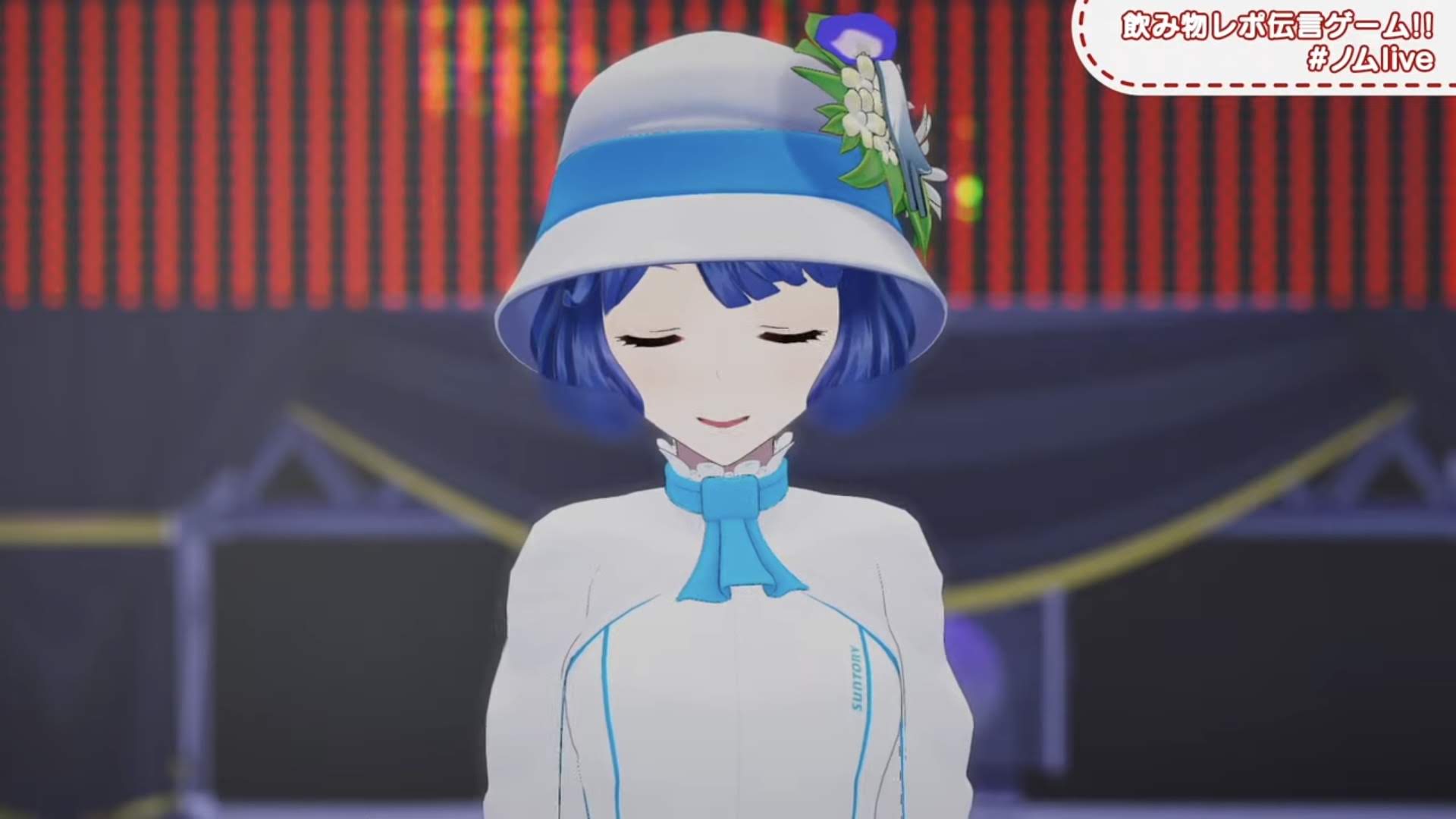
There’s a 50/50 chance that saying “the Japanese beverage company Suntory has their own official Virtual Youtuber” would come as a surprise. But the blue-haired “Suntory Nomu” is real (in a sense), and I actually like her design quite a bit. What really stands out about Nomu’s appearance, relative to other VTubers, is how simple and subdued it is. A white dress with blue highlights stands in sharp contrast to the vast majority of Hololive and Nijisanji, who seem to be created with a maximalist philosophy. This latter approach brings to mind broader discussions about character design in media.
(Side note: I’m not sure I need to mention this, but in case it matters, I am not endorsing Suntory products in any way. I generally like their drinks well enough, but that’s about it.)
When looking at Nomu relative to the Hololive members she’s streamed with, the difference is clear. While both have attractive designs, Takane Lui and Aki Rosenthal have all these details, adornments, and colors, resulting in rather complex/complicated appearances. There are practical reasons to make them this way, of course: They need to be immediately distinct and visually appealing to prospective viewers. Rigging/modeling them for animation is a one-time thing, as opposed to needing to draw them anew every time in the vein of anime or manga. And the expectation is that people will stare at them for extended periods. VTubers need to communicate a good portion of who they are immediately, as viewers can’t be expected to dive into an extensive backstory—and often VTuber backstories are helpful suggestions, at best.
The decision to go maximalist reminds me of fan discussion surrounding fighting game characters. Fighting games, especially ones not based on an existing property, share a number of similarities with VTubing. There’s no prior context for people to get attached to (as they might with an animation or comic), so having characters catch the eye right away while also communicating how they play is important. There’s still quite a bit of range—Compare Ryu or Chun-li from Street Fighter to Sol Badguy or Dizzy from Guilty Gear (especially pre-STRIVE)—but criticizing a fighting game character for being “boring” is typically more about looks and presentation of attacks. That’s actually a big difference with Virtual Youtubers: It does ultimately come down to personality.
But it makes me wonder if significantly simplified designs like Suntory Nomu couldn’t thrive despite the general trends against them. Maybe it’s because so many designs take an “everything but the kitchen sink” approach that Nomu’s aesthetics stand out more. Could there be a trend back down to relatively more minimalist designs in VTubing, fighting games, and other similar areas? It’s something I’d like to see, if only because I’m curious how it would all play out among the fans themselves.
There’s a general arc to the films of Hosoda Mamoru. Over time, they have been increasingly concerned with family and the raising of children, to the extent that his early works can feel like a distant memory. His latest work, Belle, feels like both a return to older titles like Summer Wars and The Girl Who Leapt Through Time that comes by way of his decade-long focus on parenting.
Belle (whose Japanese title translates to The Dragon and the Freckled Princess) is actually an incredibly difficult work to summarize, as it tries to be so many things at once. It’s the story of Suzu, a teen girl who inadvertently becomes the biggest music sensation in an interactive virtual community after being unable to sing due to childhood trauma. It’s also heavily inspired by Disney’s Beauty and the Beast, with the aforementioned Dragon being an online version of the Beast who picks fights with everyone and has to run from a Gaston-equivalent with the power of doxxing. But Suzu also struggles with the cruelty of social ostracization at school, a self-inflicted strained relationship with her dad, relationship woes, and much, much more.
I believe the way Belle harkens back to Summer Wars is obvious enough (virtual worlds and community), but when it comes to the teen aspect, I think Hosoda basically looped all the way back around. If works like Wolf Children and Mirai come across as explorations of how the feelings of small children influence how they behave and grow, then Belle is smack-dab in the tumult of puberty. Rather than entirely centering the world around teens, there’s a sense that the story is about watching over them as adults.
Belle is a lot, especially when you get into its various topics, including but not limited to: the Internet as a place to find oneself vs. the judgmental eye of social media, the way media facades can bring out positive qualities but also obscure dangerous ones, and the particular ways in-group vs. out-group dynamics run counter to the greater good, among others. At times, Belle seem like it’s going to burst at the seams, which makes it a full and rich experience but also at times thematically convoluted. The rich visuals and stunning musical performances help to tie everything together, keeping the package from falling apart at the end and delivering a complexity that has more merits than faults.
I don’t say this often, but I wonder if Belle would have actually been better as a long-format series. As 13 episodes or maybe more, all its components could be given more room to breathe, and the journey Suzu herself takes could have benefited from the real passage of time. The lack of a film-level budget might have meant a less exquisite presentation, but I think the themes could have rung truer.
I like my social media to be text-focused. I’m not camera shy, but I don’t like that to be my primary form of exposure to the world. TikTok isn’t for me, and fair disclaimer: I still have no experience with it. However, when I reflect on my preferences, I remember one significant difference between the internet experienced by Zoomers vs. previous generations: the sheer deluge of disinformation that proliferates in more recent times. In this respect, the desire for a social media platform that emphasizes personal-feeling videos might allow for a slightly better (but inevitably imperfect) defense against bad actors.
One of the challenges of appealing to younger people on TikTok is that they value authenticity. It’s a nebulous term to be sure, but sleek traditional marketing campaigns can fall short for people who feel distrust when things look a little too polished. This is not to say that TikTok is free from scam artists and propagandists—far from it—but when I began to think more about the nature of text-based online communication, I recall the sheer number of fake accounts that are created to spread false information.
A white supremacist can grab a stock photo of a black person and then engage in digital blackface to share harmful political and social messages. Bots use artificially generated profile pictures to create entirely fake personalities to amplify some poisonous ideology, and if people aren’t looking carefully, one can be fooled into thinking they’re authentic. In contrast, it takes a lot more work to pretend to be black on a video platform than it is on one where all you need is a stolen or fabricated headshot. Deepfakes are an issue, but they’re not at the point where they’re nigh-impossible to spot—at least not yet.
Of course, TikTok is not immune to disinformation. It just disseminates differently, and adjusts itself to an online culture that is not only more video-based but also focused on being “short and sweet”—little nuggets of “wisdom” and “knowledge” that are anything but. I have my concerns about the way TikTok’s algorithm might be even better at sucking people down rabbit holes. That said, I think the difference in this moment in time might be that the imposter who’s claiming to be someone they’re not has to at least put in more effort to pull the charade off.
1998’s Princess Nine is the kind of sports anime with an instant hook: What if a Japanese all-girl baseball team competed against the boys in pursuit of the national championships? It’s a series I’ve seen get praise from professional reviewers and personal friends alike, and as a fan of the similarly premised Taisho Baseball Girls, I came in assuming I’d enjoy it. While that was indeed the case, what I find especially intriguing watching it now is how this 1998 anime feels like both a time capsule and anomaly whose style and particulars haven’t persisted in more recent sports series, be they shounen or shoujo.
Hayakawa Ryo is a talented female pitcher who helps out with her neighborhood’s small-time baseball team, when she gets scouted by a prestigious private all-girls’ school to be the foundation for an inaugural baseball team—not softball—with the aim of getting to Koshien, the vaunted stadium that symbolizes the romanticism of Japanese high school baseball. Along the way, she helps recruit new teammates, develops a budding romance, learns the secret past of her deceased father, develops a rivalry with a teammate that’s also a love triangle, and plays plenty of baseball.
The drama of Princess Nine takes place both on the diamond and adjacent to it, and that is what makes the anime so unusual relative to so many sports-genre titles. Oftentimes, an anime will use sports as either a central axis or a starting point. The primary conflict of Kuroko’s Basketball, for example, is how Kuroko’s cooperative philosophy fares against his self-centered former teammates from the Generation of Miracles. In contrast, a series like Touch! uses baseball as the backdrop to a portrayal of nuanced human relationships. But in Princess Nine, you’ll have episodes dedicated to mastering the Lightning Ball alongside ones focused on romance, and ones where feelings interfere with baseball and vice versa. The resulting juxtaposition can often be a double-edged sword, generally making the show more gripping but sometimes feeling a bit too overwrought.
If there’s anything that approach reminds me of, it would be old-school shoujo sports titles like Attack No.1. I have to think this is intentional, especially because of how one character, the aforementioned rival Himuro Izumi, is very much an archetypal descendant of Ochoufujin from Aim for the Ace!—her long and luxurious hair, the way she has the adoration of her fellow students, and even her literal tennis skills are cut from that cloth.
While Ryo and Izumi feature most prominently, the rest of the team showcase distinct personalities that really gives the sense of them being a motley crew where opposites attract, in a sense. One thing that does feel like a quality from a bygone era is how long it takes for the team to fully assemble. Early episodes are basically devoted to gradually bringing in each girl and showing both what makes them tick and the specific hurdles they face (from lack of confidence to family obligations and more). The fact that it was clearly planned for 26 episodes as opposed to 13, all without being based on a long-running manga, is the kind of thing you rarely see anymore. They don’t even play a game of 9 vs 9 baseball until almost halfway!
The looks of the girls themselves also embody a specific period aesthetic for female character design. With the notable exception of Daidoji Mao, the stocky ex-Judo player turned catcher, all of the girls have a particular kind of “narrow hips and even thinner waist” look that I don’t often see these days. Anime isn’t exactly a bastion for diverse body types, but I definitely notice a difference in beauty standards for contemporary anime characters compared to the at-the-time typical appearances of Princess Nine, even when you discount the changes to face design that have occurred in the decades since.
I realize that I couldn’t have gotten this exact perspective if I had watched Princess Nine back when it was first being recommended to me around the mid to late 2000s. At the same time, the fact that this show seems to draw so heavily from a bygone era of anime at that time might also mean that I wouldn’t have appreciated its old-school flavor.
I also don’t know if Princess Nine was ever intended for a second series, but it definitely feels like it could have gotten one and thrived in the process. I have my doubts that a sequel will ever see the light of day, but more unlikely things have happened.
Yesterday, I watched the Hololive COUNTDOWN LIVE 2022▷2023. It involved 3D concert performances by a variety of members including two of my faves, the currently COVID-stricken Haachama and the on-hiatus La+ Darknesss. I highly recommend it, especially the crossover sections between the girls of Hololive and the boys of Holostars. This clearly takes some inspiration from Japan’s long-standing end-of-year musical event, Kohaku Uta Gassen, but I’ve never actually watched it.
Looking back, it didn’t hit me how long the past year felt until I saw Kio Shimoku mention that Hashikko Ensemble concluded back in January of 2022. At times, it’s like the days move by all too quickly, and other times, it’s like they slow to a crawl. I can’t tell at this point how much of it is the prolonged funk of the pandemic and how much is just me getting older.
But here we are at the start of 2023 and the Year of the Rabbit, at least if we’re going by the solar calendar. Whenever I think about it, I find myself remembering a certain old flash video from the 2000s. Thankfully, someone uploaded it to Youtube, so I can inflict it on a new generation.
January’s Patreon subscribers are looking good. Thank you, everyone, and here’s to another fine (?) year.
This is partly an analysis of how different fans have different expectations for their VTuber faves, and partly an excuse to post more videos of La+ Darkness’s amazing dancing skills.
At the start of the year, I feel myself wondering if I should be doing more both with Ogiue Maniax and outside of it. One thing I’ve thought about is starting a Substack, but I have no idea how I might divide my writing. In my head, there’s no real differentiation between “regular” posts and “premium” ones, and I’d probably have to figure out some way to make it worthwhile. One possibility is to break off the VTuber stuff into its own dedicated area in case it’s becoming too intrusive, but I don’t think it’s that bad currently.
I could also do premium posts on Patreon, but that sort of runs into the same issue. If anyone wants to see that sort of content (or if you even hate the idea), feel free to leave a comment. I think I care less about the money at this point and wonder more about how to promote Ogiue Maniax in 2023. All the old ways seem to be vanishing (and Twitter is constantly on the verge of collapse because of its moronic new boss), and I still haven’t caught up.
Whichever ways things go, though, I hope you’ll keep reading.


 OGIUE MANIAX