Splatoon 3 was recently announced for 2022, and one question I have about the new sequel is: who will be the new musical mascots, and what will their style of music be? I have a hope/prediction: I believe that Splatoon 3 should have a sound that incorporates Cantonese pop.
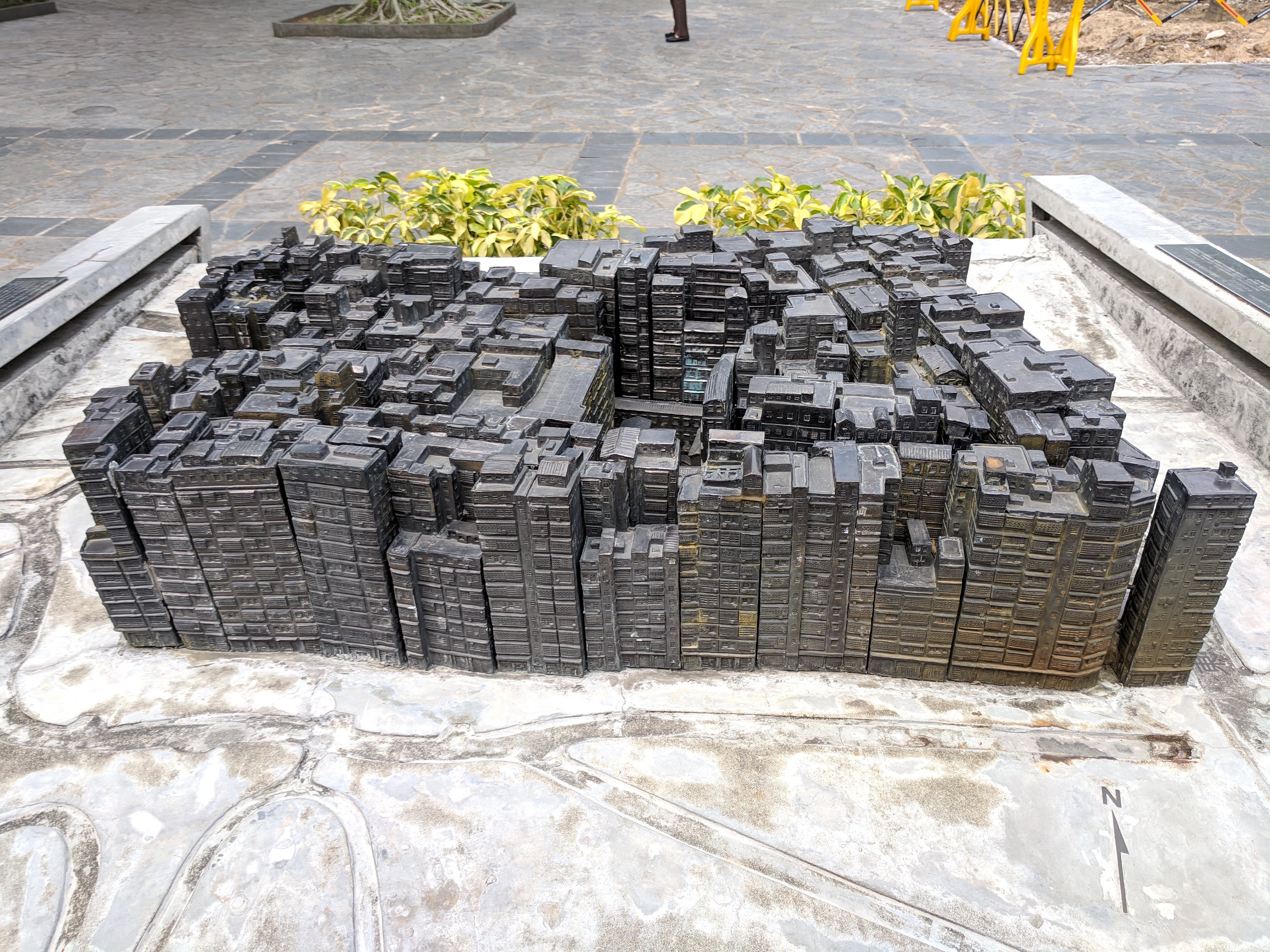
One of the big changes compared to the previous games is the shift away from sleek urban environments and towards what seems to be a more post-apocalyptic one. This can even be seen in the central hubs of all three games. Splatoon’s Inkopolis Plaza is based on the trendy Shibuya area in Tokyo, Splatoon 2’s Inkopolis Square is Times Square in New York City, and now Splatoon 3’s Inksville greatly resembles Hong Kong, particularly the Mong Kok area of Kowloon—the busiest urban center in the world. Given the current controversies going on in the area, I’m actually kind of surprised they went this angle, but the densely packed and awkwardly placed buildings have evoked dystopia in the imaginations of many. It acted as the basis for Ghost in the Shell’s setting, plays a central role in G Gundam, and in terms of the cultural legacy, the lawless nature of the Kowloon Walled City is rather infamous.
A model of Kowloon Walled City located at its former site
The musical mascots of the first two games reflect their urban spaces. The Squid Sisters are patterned after Japanese idols. Off the Hook is a rapper-DJ combo, and NYC is the birthplace of hip hop. Therefore, if Splatoon 3 were to have characters to represent that Kowloon-like setting, few things would fit better than a squid-and-octopus-garbled take on Cantopop. While its star has waned in recent years, Cantopop was once the premier form of Chinese popular music throughout Asia, and Hong Kong was the center of it. And if they wanted to capture both the retro and futuristic aspects of Hong Kong through Splatsville, perhaps they could even take from different eras of the genre.
One potential problem with this approach is that a lot of classic and modern Cantopop songs don’t exactly “feel” like Splatoon, as the genre is primarily known for its love ballads that wouldn’t quite fit the high-pace gameplay. Still, I think there are examples of high-tempo songs that could be inspiration for a soundtrack that captures the spirit of Cantopop and the Kowloon setting without necessarily feeling dated.
“Ji Guang Zhong” by Roman Tam
“Journey to the West” by Dicky Cheung
“Miss Similar” by G.E.M.
Is it a bit of a long-shot to expect Cantonese pop in Splatoon 3? Maybe. I also wouldn’t expect the composers to wholly abandon the sound it’s known for, as the music is one of the best parts of the series. Even so, I think it’d be more than possible to draw influence from one of Asia’s most popular genres of the last 50 years and make something that comes across as unmistakably Splatoon-esque. Most importantly, it would perfectly complement the Mong Kok, Kowloon visual aesthetic that Splatoon 3 is going for.
Attending the New York International Children’s Film Festival has been something of a tradition for myself, and many of my reviews over the years on this blog have come from it. Due to COVID-19, NYICFF 2021 is a virtual festival, with individual tickets and two all-access passes available at extremely reasonable prices.
As someone who loves cartoons, my usual focus at NYICFF is on animated features including but not limited to those from Japan. For whatever reason, there’s no anime this year, but we’ve got the next best thing: a live-action film about Japanese pro wrestling. My Dad is a Heel Wrestler stars actual New Japan Pro-Wrestling veteran megastar Tanahashi Hiroshi as a washed-up wrestler named Omura Takashi whose son Shota discovers that Takashi is a “bad guy” called Cockroach Mask. The film was previously temporarily available on NJPW’s own streaming service, but I had missed my chance to see it then, so I’m glad that NYICFF brought me this opportunity.
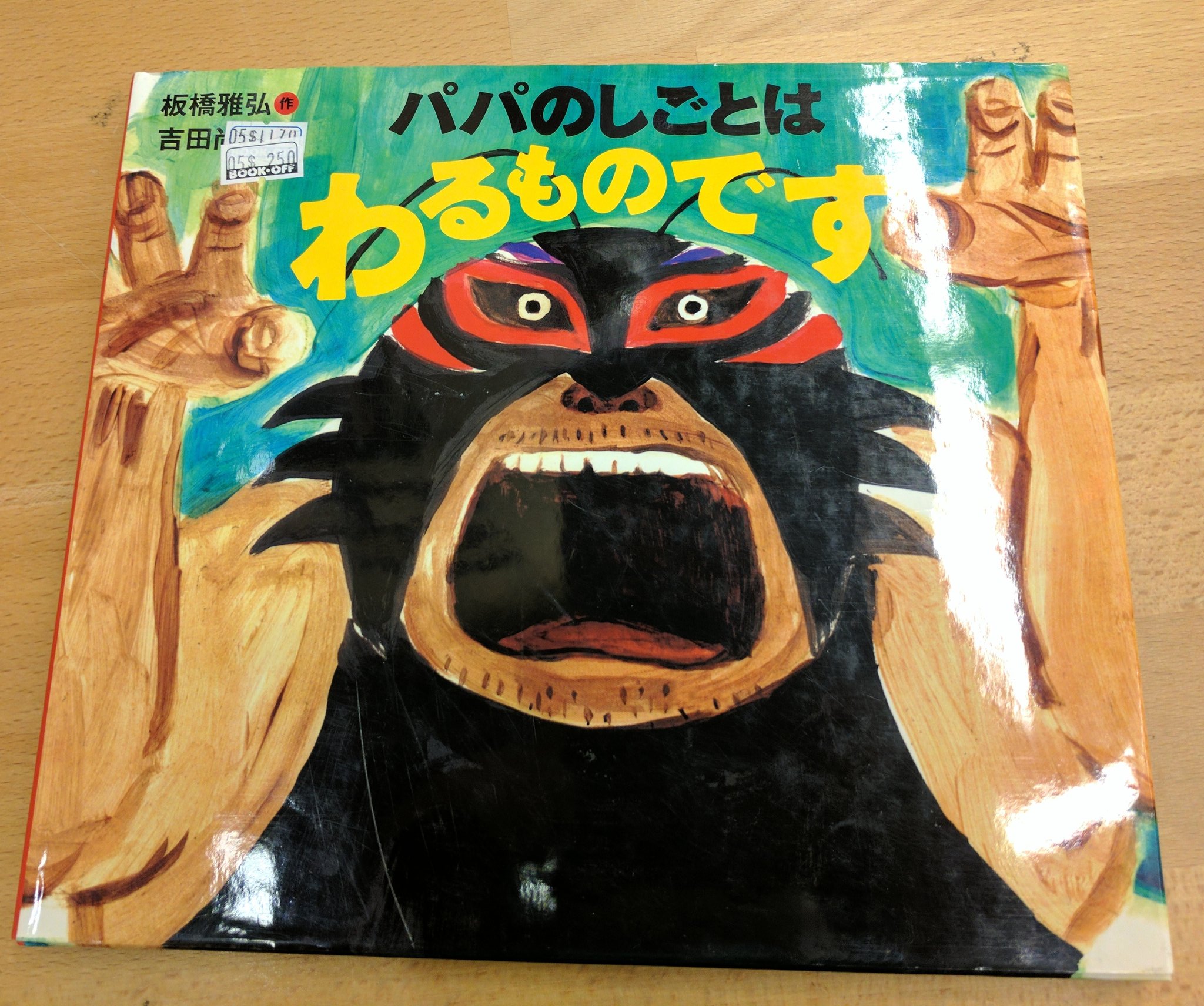
My Dad Is a Heel Wrestler is based on a Japanese children’s picture book, and by amazing coincidence, I actually happened upon a copy while at Bookoff years ago before the film was announced. Both versions follow the same basic premise described above, but the difference between 32 pages of large text with illustrations and a feature-length movie inevitably means changes and additions. In this case, the film is fleshed out with a greater exploration of both Takashi and Shota’s feelings about Takashi’s role as Cockroach Mask. For Takashi, his passion for wrestling is juxtaposed with the knowledge that his heelish gimmick is the only way he can continue his career. Shota meanwhile has to reconcile his image of his father as a caring man with the scheming and cheating he sees in the ring.
A larger cast of characters—Takashi’s wife Shiori, Shota’s classmates, Takashi’s fellow wrestlers, and a hardcore fangirl who lives and breathes pro wrestling—also help to establish a greater world. The fangirl, Michiko, speaks to the fact that Japanese wrestling has managed to pull in a serious female following in the past ten years (known affectionately as pujoshi), and her love of Cockroach Mask/Omura is a reflection of Tanahashi’s own popularity among the ladies.
The film does a great job of showing Shota’s complex emotions from his perspective as a small child, and how Takashi struggles with the desire to both be a dad his son can be proud of while doing what he can to extend his career in spite of chronic injuries. Tanahashi playing an older wrestler is naturally in his wheelhouse, so this role isn’t exactly challenging his acting range, but he pulls the character off quite convincingly.
One of the main messages of the film, as stated by Michiko, is that pro wrestling is about more than winning and losing. Much like that one scene in Wreck-It Ralph, it’s about Shota realizing that just because Takashi is a bad guy “doesn’t mean he’s a bad guy.” Curiously, however, in the world of My Dad Is a Heel Wrestler, the gimmicks are fake but the actual wrestling is real—a kind of semi-kayfabe where wins and losses are legitimate but the wrestlers’ personas themselves are primarily performance. The film uses a lot of other NJPW stars to fill out the ranks, including Okada Kazuchika as the world champion, and the feeling I get is that a film with so many actual wrestlers wants to maintain some semblance of the “realness” of pro wrestling even in a fully acknowledged fictional setting like a movie. Speaking of wrestlers, I was actually most impressed by the acting of Taguchi Ryusuke, who plays Cockroach Mask’s henchman Blue Bottle. Taguchi in recent years has been more of a comedy wrestler in NJPW, and his ability to be serious and silly is a great asset to this film.
While the film uses a lot of wrestling terminology, My Dad Is a Heel Wrestler is a very accessible film that has a lot of interesting things to say about many different topics—from aging, to doing what it takes to keep a dream alive, to how theatricality is in itself a valuable quality that brings people excitement. From beginning to end, it feels like a production where everyone involved both respect the subject matter of pro wrestling and want to tell a heartfelt story to which anyone can relate.
The newest DLC characters for Super Smash Bros. Ultimate are Pyra and Mythra (also known as Homura and Hikari in Japanese) from Xenoblade Chronicles 2. I’ve never played any Xenoblade games (or, for that matter, any games beginning with the prefix “Xeno”), so my impressions of these two characters are purely from an aesthetic and Smash gameplay standpoint.
Aesthetics
In terms of visual designs, Pyra and Mythra are probably the most “anime” of all characters thus far in the Smash Bros. franchise. Now, I fully understand that anime as a style is extremely diverse and that saying something is “anime” doesn’t reveal much on its own. Here, however, what I specifically mean is that their aesthetic is the kind that appeals to otaku primarily in the same vein that something like BlazBlue does—and at the possible expense of appealing to a wider and unfamiliar audience.
Speaking personally as someone who devotes numerous hours per week to anime and manga, I don’t mind their look, but I fully understand why others would turn their noses at these two. There’s no mystery that these designs are pretty thirsty, and that they traffic heavily in anime tropes. If you listen to the Japanese in the video “Mr. Sakurai Presents Pyra/Mythra,” the Smash Bros. series director summarizes their respective demeanors as dere and tsun—what the official subtitles translate as “sweet” and “headstrong.”
Ultimate also gives the ability to listen to the characters’ voices in Japanese and English, and the differences in performance have convinced me that there’s an aspect of many Japanese characters that gets lost between characters. Namely, when performing special attacks, I think the differences in Pyra’s and Mythra’s personalities aren’t as prominent in English as they are in Japanese. There’s a certain lack of aggressiveness I sense in Pyra even in her more passionate lines in Japanese that isn’t quite there in English.
Gameplay
Much like Zelda and Sheik prior to Super Smash Bros. for 3DS & Wii, Pyra and Mythra are two characters in one, with players being able to swap between the two of them as a special move. The basic breakdown (as explained by series director Sakurai) is that Pyra has power and Mythra has speed, but I wasn’t quite prepared for how fast Mythra is.
Just moving around with Mythra reminds me of my earliest days playing Super Smash Bros. Melee and trying out Fox McCloud. Throughout the Smash Bros. franchise, Fox is known for being extremely nimble on the ground, and also dropping like a rock when falling. It’s not uncommon for new players unfamiliar with Fox to just fall off accidentally and die. Mythra sports a similar combination along with a somewhat limited ability to get back to the stage that makes self-destructs likely, and in a game like Ultimate where recoveries are generally strong, it’s quite a glaring weakness.
That being said, Mythra by herself easily feels like one of the best characters in the game because that level of agility never goes out of style in Smash. She’s fast on the ground, fast in the air, and she has attacks that either start up quickly or cover a lot of space instantly. Her side special, Photon Edge, reminds me a bit of Sonic’s game plan in general. If you’re caught slacking from even half a stage away, Mythra can punish even an empty hop—the drawback being that some of her more damaging attacks like Photon Edge are easy to punish themselves.
In contrast, Pyra is markedly slower in every way and her recovery is even worse, but her reach and kill power easily outdo Mythra’s. Traditionally, Smash has favored speed over strength, and that’s still likely the case here, but Pyra’s ability to net KOs is actually kind of frightening. Many of her attacks are actually relatively fast for how early they can take stocks, and her superior reach compared to Mythra means that you can mess up an opponent’s spacing and neutral by switching between the two characters. Playing against Pyra, there were many occasions where I assumed I was at a safe distance, only to get forward smashed and lose the game. So while Pyra is likely the weaker of the two, her upsides complement Mythra quite well and actually appear to shore up each others’ flaws, unlike how Sheik is far and away a better character in Melee and Brawl to the point that Zelda only ever comes out in extremely niche situations.
Given the inherently advantageous properties of Mythra combined with having Pyra as a wild card, I feel like the chances of this character being top tier are very high. There’s just so much they have that classically works well in Smash that it’s hard to imagine them having any weaknesses that could truly limit them.
Overall
I don’t know Pyra and Mythra, but I think they’re welcome additions to Smash Bros. Their characters don’t bring any wild or unorthodox new mechanics to the table, but they ooze personality in everything they do. While I’m expecting the two of them to be very popular competitively, and I suspect that there might be a backlash against them coming,I think it’s a good idea to enjoy the ride for now, whether you’re a fan of them already or you’re just discovering them for the first time.
Healin’ Good Precure might be either one of the best-timed anime ever or one of the worst. With themes of environmentalism, medicine, and even personal wellbeing, the anime began in February 2020 right as the threat COVID-19 was starting to increase. As a result, the series lost about a month’s worth of episodes (ending at 45 instead of around 50), and the pandemic only further increased the importance of its message. As it came back from the production delay, I myself wondered if the series would change anything to directly address COVID-19, like facemask equipment or social distancing beams.
The answer, it turns out, is “not really.” In hindsight, however, this might not be such a bad thing. Although often fairly simplistic in its messaging, Healin’ Good Precure focuses less on harsh and gritty truths, and more on the idea of trying to take care of both people and the planet together, with a few surprisingly insightful gems along the way that I hope the kids watching take to heart.
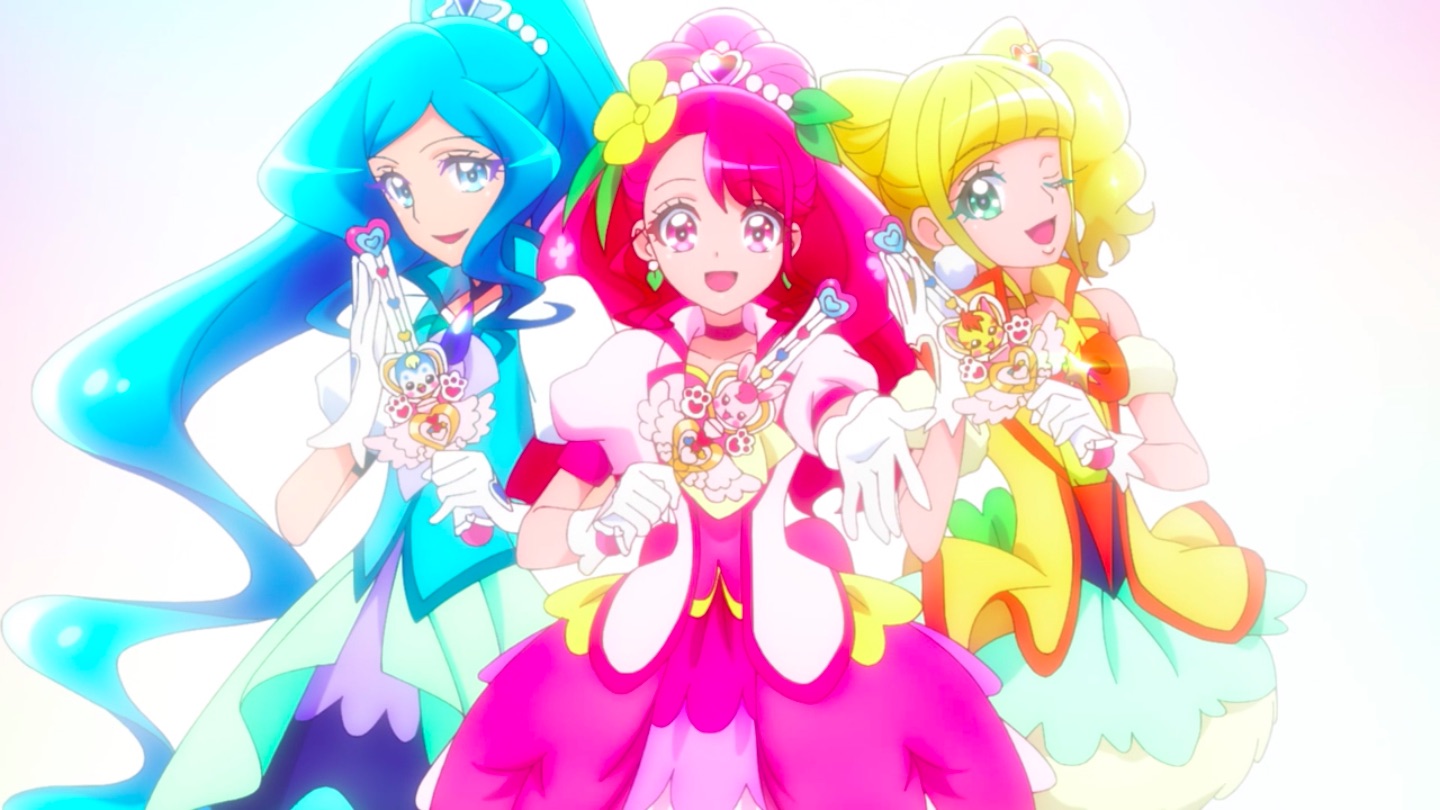
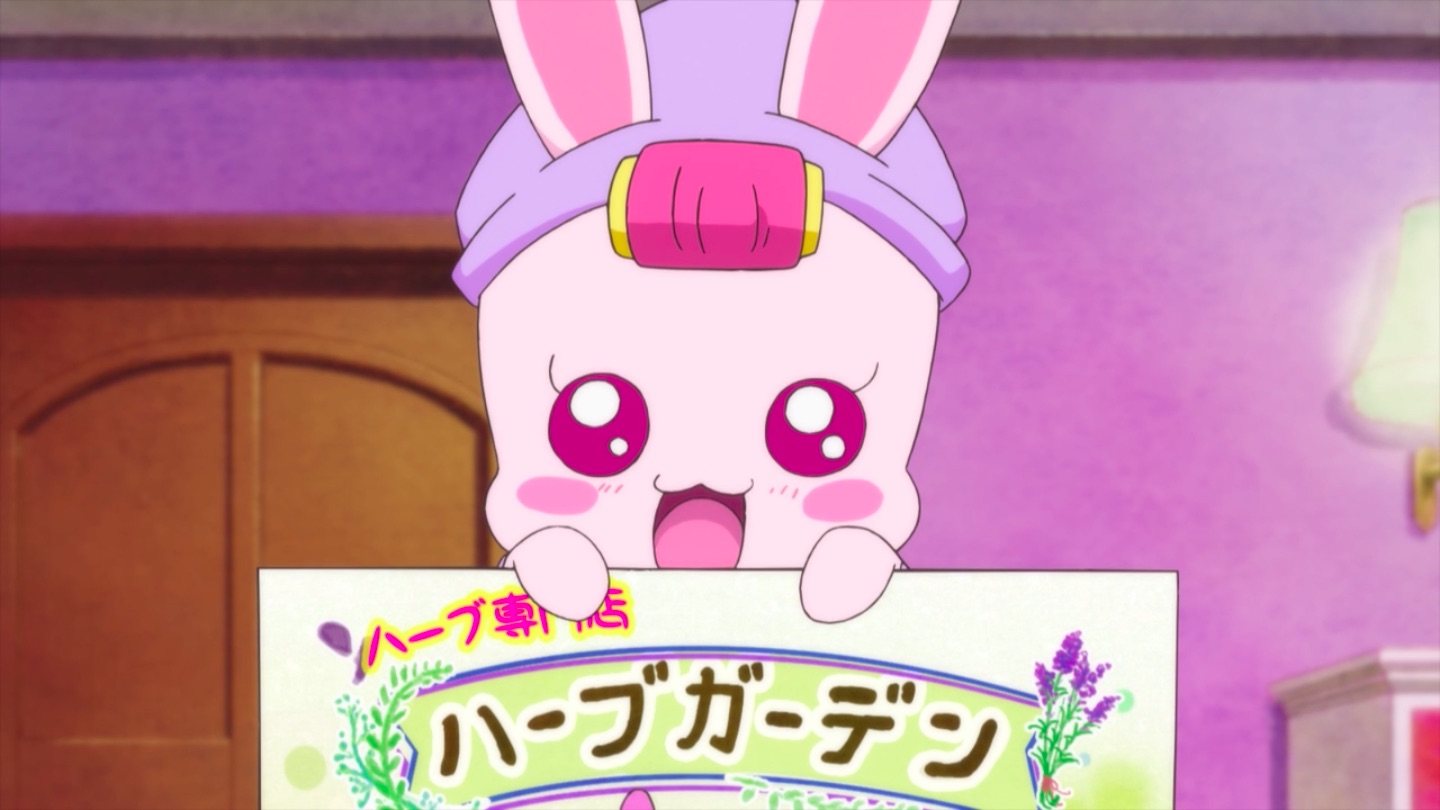
The premise: Hanadera Nodoka is a kind and gentle middle school girl who, not long ago, was hospitalized with an unknown illness. Having finally recovered and now moved to Sukoyaka City with her parents, she looks forward to doing all the things a healthy person does, but her life changes when she encounters a magical rabbit. The rabbit, named Rabirin, is one of three “healing animal” trainees who have escaped from the Byo-gens, virus-like invaders whose goal is to “undermine” everything they infect. Bonding with Rabirin to protect the healing animal princess Rate, Nodoka becomes Cure Grace, one of the legendary warriors known as Precure. Soon, she’s joined by other girls at her school who also bond with healing animals, and they fight to treat the Earth’s maladies.
In terms of overall cohesive storytelling, Healin’ Good is not one of the strongest Precure entries. It takes a mostly episodic approach with major narrative developments at mostly abrupt and expected intervals, and some of those developments are actually kind of bizarre if you think too hard about them—like something that could be read as a pregnancy metaphor but probably isn’t supposed to be.
That said, the series sports some impressively expressive animation, and the fights often feel like the characters have some real heft to them—not always the case in Precure. The main cast of characters are also interesting, relatable, and inspiring enough to make the watching experience enjoyable overall. The contrasts between the three main Cures—Nodoka, Chiyu, and Hinata—mean that each girl has their own challenges they need to face and overcome, though the amount of attention paid to each of them can feel weirdly lopsided. More episodes seem to be devoted to Chiyu’s more ambitious goals of becoming a competition high-jumper and family innkeeper, though I don’t know if that’s just a result of losing those five or so episodes to the production delay.
Another factor to its credit is that I think Healin’ Good has not only some of the least annoying mascots ever, but they’re also some of the best support characters Precure has ever seen. Rabirin, along with her companions Pegitan and Nyatoran, act as both foils and complements to their human partners, and their desire to get stronger in order to keep the Earth from experiencing a fate similar to their own world feels genuine. Moreover, Rate gets a surprising amount of development that’s actually welcome rather than overshadowing the Cures.
While the series takes a fairly kid-gloves approach to the challenges it presents (not surprising from a kids’ show), there are aspects of Healin’ Good that I think are meant to teach the young viewers to face up to a world that’s increasingly headed towards multiple disasters both potential and real. When the Byo-gens infect an area of the city, failing to stop the infection only makes the monsters stronger. In this, I can see a metaphor for climate change and the need to slow it down as soon as possible, because while keeping the Earth from warming up to the point of substantial environmental change is a monumental task, it’s a lot easier than trying to bring the Earth back from that point. Additionally, all the doctor imagery strewn throughout Healin’ Good, from parents’ professions to the idea of “treating’ the planet to even the girls’ transformation lab coats might encourage more girls to go into pursuing careers in medicine and fight the sexism that pervades medical schools in Japan. In that sense, I think it builds on some of the positive messages found in its immediate predecessor, Hugtto! Precure.
It’s also notable that those very same kid gloves start to come off towards the end. There is a moment late in the anime where Nodoka is faced with the dilemma of trying to help an injured enemy who is responsible for much of her pain. But where many past stories would make its heroine some kind of saint, Healin’ Good emphasizes the need for self care, and that there is no requirement to lend a hand to someone who has harmed you, especially if you only end up feeling more hurt as a result. In other words, kindness is not a resource that should be exploited, and girls should not be expected to sacrifice their well-being because they’re supposed to be “caring.” Similarly, the environmental message calls out the complicity of humanity by the end, though is ultimately positive, as expected.
As much as I would have found it interesting, I realize now that Healin’ Good Precure did not need to tackle COVID-19 head-on. Face masks are already commonly accepted in Japan, so there’s no need to encourage people to wear them. The infection rate, although a real concern, is not nearly as bad in Japan as it is in other parts of the world (especially the good ol’ US of A). And as for not emphasizing social distancing, the series was probably created with the hope and expectation that we’ll eventually be able to return to some semblance of our former life, and that kids should be able to see what normal social interaction looks like.
Instead, we have a Precure anime that aimed to tackle some of the biggest issues facing the world through an approachable lens of the familiar magical girl tropes. Although the final product doesn’t have the riveting and finely tuned narratives of some of its predecessors, that’s not the only measure of an anime’s success—and no, I don’t mean toy sales. What Heain’ Good Precure has in spades is ambition to make improve society by encouraging a positive and humanitarian spirit in its audience. The world thirty years from now will hopefully be a better place.
Here we are: roughly a year since coronavirus basically forced the world to change course. I seriously could not have imagined all that has happened since, and it feels like ten years have passed in the span of one. I’m losing my grip on time a bit, but this makes me wonder if doing these monthly blog updates actually helps in some way. I can see the days and weeks go by.
In happier news, the Blocker Corps IV Machine Blaster crowdfund to digitally archive the series was successful! I talked about it in a post to drum up support, and it actually didn’t make it until literally the 11th hour by crossing the finish line with only 11 minutes left in the all-or-nothing campaign. It’s not going to be on anyone’s list of best anime ever, but knowing I helped to keep an anime alive makes me feel good.
After all, I know what it’s like to have the support of others. Thank you to March’s Patreon sponsors:
My favorite anime convention might not survive another year due to the Coronavirus. Consider supporting them!
Hashikko Ensemble
Chapter 37 has the most intense musical performance yet.
Closing
The 2021 New York International Children’s Film Festival starts this Friday! Unlike previous years, it’s a virtual festival this time around, and the $40 two-week all-acesss pass is an incredibly good deal. If you live in the US, it might be worth checking out.
Also, how about that Pyra and Mythra in Smash Bros. Ultimate, huh? I’m thinking about writing something in regards to fanservice in character designs, hopefully providing a nuanced perspective.
Stay safe, get vaccinated. I wish you good health.
An electrifying performance dazzles the audience in this chapter of Hashikko Ensemble.
Summary
Hot off another victory, the Chorus Appreciation Society moves on to the semifinals of the school’s Cultural Festival music competition. This time, having experienced some kind of epiphany, Kousei reacts to Shion with a powerful blush, leading everyone to respond with a mix of confusion and curiosity. A heart-to-heart of sorts with Yukina helps him see what he wants, and at the moment, it’s to sing with Shion.
While the remaining groups are impressive in their own right, the Society’s fierce rendition of the song “Etupirka” bowls everyone over. However, Jin’s mom fails to see this performance too, as she and Yumerun are stuck in traffic.
Yukina’s Maturity and Kousei
After Kousei heads outside by himself, Yukina comes up to him and drops some heavy statements in a surprisingly casual way by discussing a possible future with Kousei, including who would work and how many kids they would have (two or three!). Kousei doesn’t seem bothered in any way by this conversation, though his response is “Right now, I’m having plenty of fun singing with her”—a rejection, at leat for the time being.
This whole conversation is full of unexpected words and responses, and while I don’t know if “realistic” is the right word, the dialogue between Kousei and Yukina has a kind of depth and dimensionality to it because of how they seem to be thinking about the concept of time relative to their wants and desires. Kousei essentially has a choice between the rough-and-tumble girl who’s more like him or the classy girl who’s his complete opposite, and his feelings about it are rooted in the possibility of stepping into a world he long thought cut off from him due to his upbringing. But Yukina takes the long view, and appears to be thinking, “Even though Kousei’s all about the cute girl now, there’s always a chance he’ll come back around eventually.” I find Yukina’s particular brand of maturity interesting, like she’s somewhere between Saki and Keiko in Genshiken.
Kousei’s “Right now” is an interesting choice of words. What I think it implies is that, rather than being about love and seeing oneself with someone for a long time, it’s about Kousei figuring out his emotions in the moment. Does he value the ability to connect with Shion through song more than the inherent mutual understanding he shares with Yukina? The way Shion seems to instantly know what Kousei has on his mind when he hesitates to communicate what he wants out of her piano-playing for the next song, it speaks to a potential deeper connection through music. But whether that bond goes beyond music is something I’m looking forward to seeing.
ETUPIRKA! ETUPIRKA! ETUPIRKA!
Just like in the last chapter, we have an amazingly drawn scene of a Chorus Appreciation Society performance. What stands out to me about their “Etupirka” is that even if you don’t know what the song actually sounds like, Kio’s artwork conveys its sheer intensity. It’s not just the trembling line effects throughout the performance, but the way the characters are drawn with such dynamism even while they’re standing still, as well as the choice to use that initial extreme angle to depict Shion’s piano-playing (as seen in the top image) makes it seem like the ground is trembling. It borders on a more exaggerated representation that one might find in an action-packed shounen manga that uses music as its gimmick the way Yakitate!! Japan and Food Wars: Shokugeki no Soma approach food.
(And if you want to hear a performance of “Etupirka,” it’s in the “Songs” section below.)
Hanyama’s “Tone Deafness” Isn’t
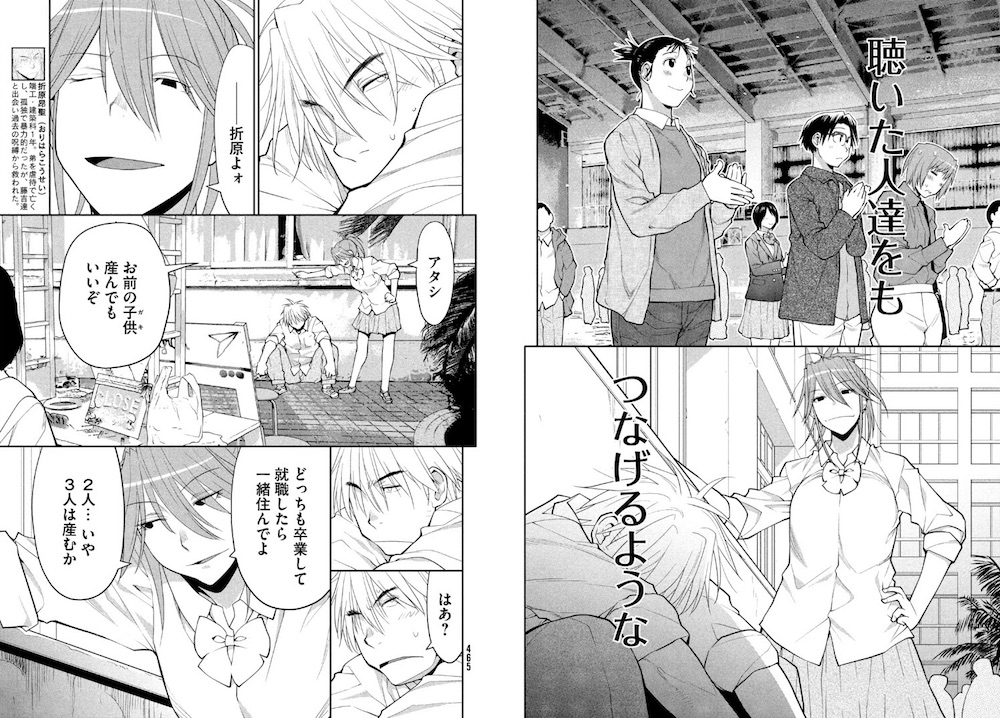
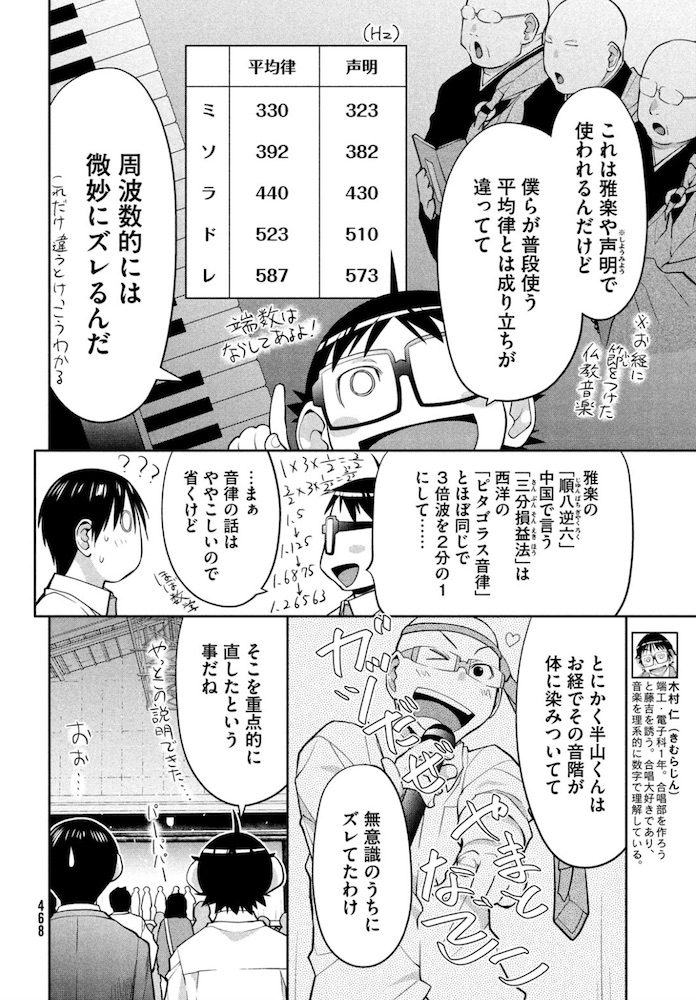
At one point, the subject of Hanyama’s inability to sing on-key comes up, and Jin reveals that what everyone assumed to be a case of being tone deaf is actually something else entirely. He recounts having tested Hanyama, and it turns out that the guy unconsciously sings on a scale different from the traditional Western music scales due to his family running a Buddhist temple. Instead, Hanyama sings according to what the Japanese calll junpachi gyakuroku(“upward eight, lower six”) or sanpun son’eki ho, which is also known as the Chinese 12-tone musical scale—which coincidentally is also the same as Pythagorean tuning. It results in the kind of music you get from Buddhist chants (shoumyou) and Japanese imperial court music (gagaku).
If this is all Greek to you, you’re not alone. Akira in the manga is completely baffled by everything Jin says, and so am I. But the gist of it—as much as I can understand, anyway—is that Hanyama has internalized that particular understanding of music, and it makes his attempts to sing more conventional popular songs go awry. Even if I don’t fully grasp everything, I find that pretty fascinating, and I’m glad Hashikko Ensemble goes into it, however briefly.
Songs
Half Monks: “Guts Daze!!” by Ulfuls. This is the song in a flashback to Hanyama’s singing in the competition while they’re explaining the quirks of his musical sense.
Electrical First-Years A Capella Group: “Racing into the Night” by YOASOBI
This is noted as being a Vocaloid song performed using six voices. While there’s no available equivalent online, there are Vocaloid covers of this song.
Wind Instrument Club: “The Galaxy Express 999” by Godiego
Chorus Appreciation Society: “Etupirka” composed by Hirose Ryouhei
Final Thoughts
Though we only got brief glimpses of them this chapter, I quite enjoyed the presence of both Akira and Jin’s mom. I’m still entertained by Akira’s mom and her delight over her son having friends, and I’m further anticipating the arrival of Jin’s mom at the school. I do get the feeling nothing Jin does will impress her, and I wonder if Yumerun will have any role to play in terms of bridging their strained mother-son relationship.
Also, Volume 6 of Hashikko Ensemble comes out next month! I wonder what store-exclusive bonuses we’ll get this time.
A review of the comedy manga Nichijou: My Ordinary Life by Arawi Keiichi has been long overdue. I’ve referenced the series off and on since 2011 when the anime debuted, but it’s only in the past year that I finally completed my Nichijou manga collection. Thus, while it’s a few years later than I would’ve preferred, I’m here to lay down my final verdict:
It’s so goddamn funny.
Well, that took a load off. Until next time!
In all seriousness, reading through all of Nichijou had me laughing uncontrollably on multiple occasions, interspersed between joyful chuckles and lip-puckering smiles. Plenty of anime and manga are wacky, subdued, over-the-top, subversive, and heartful, but rarely do they find themselves packaged in such a perfect package. The main joke of the series is its title—the series is indeed the exploration of the everyday lives of its characters, but their personalities, experiences, and interactions are simultaneously so mundane and bizarre that they play with your expectations at all turns. When you expect them to go zany, you’re hit with a reality check. When you expect something subtle, they might deliver something so hyper-subtle that it loops back around to absurd.
The core characters of Nichijou come in two groups. The first is a trio of high school friends: the energetic but somewhat dim Yuuko, the powerful closet fujoshi Mio, and the intelligent master troll Mai. The second is a robot named Nano who wishes to have the conspicuous wind-up key removed from her back so she can better pass for a normal girl, and her creator, a child genius called “Professor” who is as immature as she is brilliant. In both cases, the bonds between these characters are equal parts caring support and mind-bending frustration, and it only gets more extreme in both respects as the series continues.
About the closest thing that comes to mind in terms of humor is actually the old webcomic Perry Bible Fellowship in the way that both series are capable of delivering humor and anti-humor with laser-like precision, and you don’t necessarily know which one you’re going to get. One big difference with Nichijou is that it tries to build a fairly consistent world for its comedy to build upon, and this only gets more elaborate as the series goes on. Three of my favorite examples are as follows:
There’s a dog who shows up whenever someone is in a sorry situation whose only purpose is to lay its paw on the hapless individual as a show of pity. At some point during the series, it’s revealed that the dog doesn’t show up out of nowhere—it has an owner who is always extremely confused whenever his pet seems to suddenly start running away with a sense of purpose.
Mio’s sister, Yoshino, and Mai are both known for their pranks. For most of the series, they don’t really interact, and their forms of humor are similar yet different—Yoshino’s trolling is all about teasing, whereas Mai’s is about defying expectations. Their jokes sometimes cross paths, such as when an attempt to share sides for lunch results in a “Sucks to be you!” sign in Mio’s bentou, and Mai reveals her bentou container to have nothing more than a pre-packaged energy jelly drink (which she then starts to squeeze onto Yuuko’s rice). When Yoshino and Mai finally interact for an extended period, it’s like a glorious clash of the titans.
One of the side characters in the story invents a fake sport named go/soccer so he can start a club and slack off in its clubroom. However, he later discovers that go/soccer actually exists (thanks to a new student who was his middle school’s MVP), and that one of the high school’s teachers was a champion back in his youth. But rather than go/soccer being something in the vein of chess boxing—a combination sport that involves taking alternating rounds between the chess and boxing—go/soccer is completely inscrutable in every facet imaginable, like a serious version of Calvinball from Calvin & Hobbes.
One last thing worth talking about is how the manga compares to the anime that introduced so many (including myself) to Nichijou. There are the more obvious things: the manga continues past where the anime left off, and some of the jokes in the anime come from another series by the author: Helvetica Standard. The most major change, however, comes from the fact that the Nichijou anime was done by Kyoto Animation, whose excellent animation is gorgeous and polished in just about every scene. Ironically, that can sometimes work against the humor of the series, and this can be seen in moments of the manga where the slightly crude art style makes the same joke three times funnier. That being said, I hope that KyoAni can someday come back to animate the rest, despite the tragic setback they’ve faced.
Nichijou: My Ordinary Life is only 10 volumes long, and it’s so very worth reading. I know I’m extremely late in getting this review out, and that it might be a distant memory for many anime and manga fans, but for those who have yet to discover this magnificent gut-busting manga, there’s a real gem waiting.
Mobile Suit Z Gundam is a classic anime series, a successful sequel and a template for other 80s robot anime. One aspect of it that really sticks in my mind but is less talked about is the sound design. In particular, the sound of beam rifles in Z Gundam is rather iconic, as it’s noticeably different compared to every Gundam anime before and after.
I basically never hear that distinct Z Gundam beam rifle sound anywhere else (that’s not just featuring the Z Gundam itself), with one big exception: the fighting magical girl franchise Precure.
I can’t recall exactly when I first heard the use of the Z Gundam beam rifle sound in Precure—I think it might have been in Kira Kira Precure a la Mode—but ever since then, I can’t help noticing it. In Episode 32 of Healin’ Good Precure, the monster of the week makes pretty much that exact sound when firing a blast of energy (see 17:43 in the link).
It’s so strange to me. Of all the places for the beam rifle to show up, why Precure? There’s no studio connection (as Gundam is from Sunrise and Precure is from Toei Animation), so they’re not necessarily working from the same stock library. You won’t even find the sound in other mecha series—though maybe hearing it in a giant robot anime would bring up too many comparisons? I wonder if the sheer genre distance between the two allows Precure to use the SFX? Or could there be some Gundam fans in charge of sound production at Toei who like to incorporate the beam rifle into episodes. For that matter, I think I’ve even heard the classic Newtype flash on occasion while watching Precure.
More broadly, this all makes me want to know why the Z Gundam beam rifle sound just never really went anywhere beyond that one series. Personally, I think it has a great tone that sounds like a powerful yet precise weapon. Perhaps it was too iconic for its own good, but I guess for now, it’ll live on in the battles of modern anime’s most prominent transforming heroines.
Today’s a Nintendo Direct, so why not get excited with some Smash Bros. Ultimate character speculation?!
Treasure is a great video company that has a reputation for making games that cater to a more hardcore audience looking for difficult yet rewarding gameplay. As fond as I am of Treasure, however, I only recently got to learn about what is arguably their most difficult title ever: Alien Soldier. A largely one-man labor of love, it’s basically a gigantic boss rush, and as someone who adores boss fights, it’s in many ways the perfect game for me. It’s also mindbendingly unforgiving on a level that is all but unmatched—a combination of difficult controls and giant enemies designed to exploit the awkwardness that results from cumbersome movement. It’s fun, but cruel.
The peculiar nature of Alien Soldier’s gameplay kind of reminds me of the precision required to play Smash Bros. Melee at a high level. That thought then led to the obvious one: what if Epsilon-Eagle, the protagonist of Alien Soldier, was in a Smash Bros. game? Granted, there’s nothing that would automatically make him more deserving than even other Treasure heroes like Red and Blue from Gunstar Heroes, Marina Liteyears in Mischief Makers, or Serena in Guardian Heroes—except maybe that hardcore legend status. Still, I want to entertain the notion.
The key thing about translating Epison-Eagle to Smash Bros. is that the character’s game philosophy stands in philosophical opposition to the Kirby franchise. Where Kirby is all about gentle, beginner-friendly learning curves, Alien Soldier is punishing to the unfamiliar. Everything about controlling Epsilon-Eagle is supposed to feel like a chore at first. He should have awkward acceleration while running, jumps that are kind of a pain in the ass for the user, and weapons that both have limited ammo and get worse the more you use them. He should also be feared at low percents thanks to the ridiculous might of Phoenix Force.
In Alien Soldier, Phoenix Force is an extremely powerful dashing attack that does a ton of damage, is invincible, and hurts the user. In Smash, it would be like a combination of Charizard’s Flare Blitz and Banjo-Kazooie’s Wonderwing on steroids, albeit with an even more serious downside than Wonderwing’s limited ammo. Much like Link’s sword projectile, Phoenix Force would only be available when Epsilon-Eagle is under a certain amount of damage (let’s say 0-25%). The recoil from Phoenix Force would itself inflict 26% damage on the user (while dealing 50% to the opponent), meaning that unless you heal, there’s no way to use it again.
The catch here is that Epsilon-Eagle would be the only character in Smash who can heal by parrying attacks, somewhat akin to a “Just Defend” from Garou: Mark of the Wolves. In Alien Soldier, there is a move called “Counter-Force” that effectively acts as a parry, but which also creates health drops to collect. In Smash, having parry bring down the damage percentage would be a rough replication of that. It also makes the character good at dealing with projectiles (aside from Epsilon-Eagle also being a ranged character) and overly safe and predictable gameplay, as you wouldn’t want to accidentally give him back enough health to gain access to Phoenix Force.
In terms of special moves, Phoenix Force would be the side-special. While it’s executed as “down + jump” in Alien Eagle, I think it would be okay to at least give players the luxury of more intuitive directional controls. When Phoenix Force isn’t usable, the attack would simply be Zero Teleport, a horizontally traveling no-damage invincible dash reminiscent of Fox Illusion mixed with a bit of Pichu’s Agility. While it would indeed be impossible to hit, it would also travel the exact same distance and direction every time, limiting how much it can be abused.
Neutral special would be Shot, i.e. firing your currently selected projectile weapon (Buster Force, Flame Force, Lancer Force, etc). Up-special would be Hover, which like in Alien Soldier, freezes you in place in the air. In Smash, it would be more for temporary midair stalling to mess with the opponent’s timing, but this would also mean Epsilon-Eagle’s recovery is highly reliant on Zero Teleport. Down-special would be Weapon Select, and much like Min Min’s Arms Change would cycle through different projectiles to use for the neutral special. Special + Shield would switch him between stationary shooting and running-and-gunning modes, giving him the ability to do both a moving shot a la Mega Man/Min Min or the ability to change direction of fire while standing still, but not both at the same time. It’s another intentional execution barrier in Alien Solder, and it would be here as well.
As for normal attacks and throws, they would have to be mostly made up from whole cloth, with a few perhaps utilizing ammo, akin to how Robin’s can deplete his Wind or Fire tomes depending on what version of jab he throws out. Something cool and spacey would be nice, but the important thing would be to not have him utterly hosed by reflectors.
A character like Epsilon-Eagle should probably be high-tier or top-tier to justify his absurdity, but having someone so finicky could likely land him in mid-tier or worse. Moreover, the sheer strength of Phoenix Force would be tricky to balance, as even the slightest tweaks to it could result in a busted and aggravating character to use or fight against (or both at the same time!). Even so, wouldn’t it be amazing to see Epsilon-Eagle be up two stocks through clever gameplay, and then devastate the opponent’s last stock with a well-timed Phoenix Force?
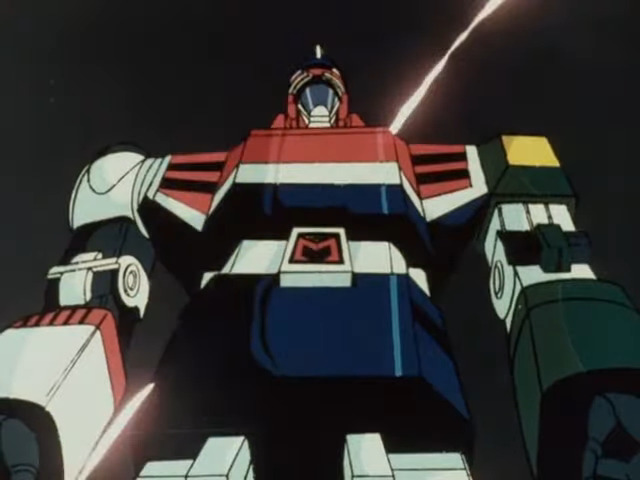
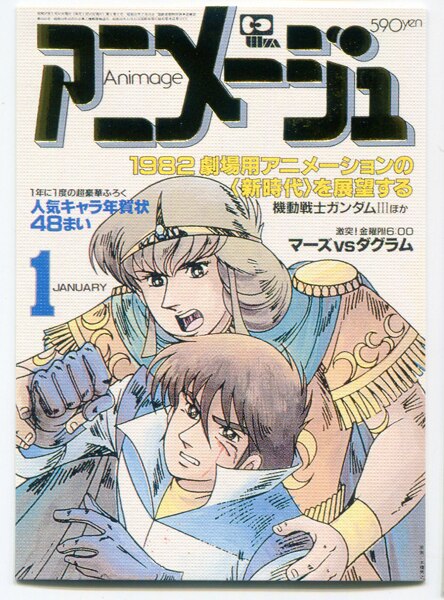
There are two success stories to tell about the 1981 giant robot anime Six God Combination God Mars. The first is about a combining giant robot that was better as a toy than as an animated figure in motion: toy sales were strong enough to extend the series beyond its first year, but the awkward stiffness of the titular God Mars itself is something of a running gag (as seen in the YouTube comments here). The second, and I think the one that should get more attention among English-speaking anime fans, is about the tremendous influence of God Mars on Japan’s female anime fandom and doujinshi scene. In a time when pairing same-sex characters from your favorite series was not yet the full-on cottage industry it is today, God Mars was a cornerstone title alongside Captain Tsubasa.
I personally came to know about God Mars twenty years ago, although knowledge about the two aspects of the series came at different times. It was a collection of giant robot anime openings around 2001 that introduced me to the show and its impressive-looking mecha, but it was actually 2004’s Genshiken Official Data Book (of all things)that first brought to my attention God Mars’s popularity with women. Years later at Otakon 2010, voice actor Mitsuya Yuji mentioned among his most popular roles a character from God Mars named Marg. Now, I have the entire series on physical media thanks to Discotek (with 25 episodes up for free on TMS’s Youtube channel), and I’ve finally come to understand what made God Mars one of the granddaddies of fandom pairing in Japan.
Simply put, it’s Marg. Once you know about him, it becomes crystal clear why a female fandom around God Mars developed.
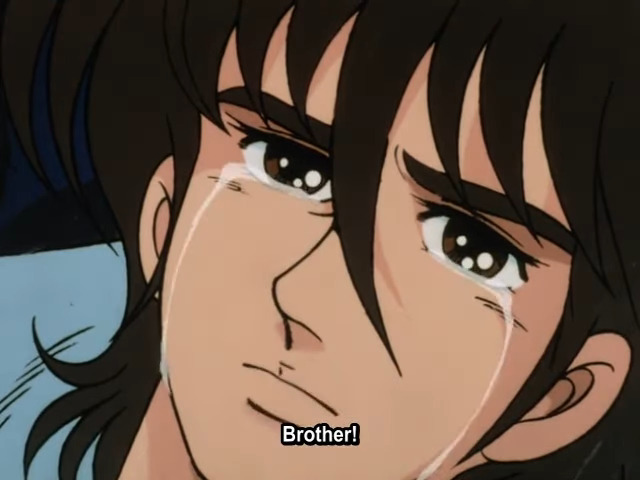
Marg is not the main character. That honor goes to Myoujin Takeru, a guy with psychic powers who discovers that he is actually an alien named Mars sent from the planet Gishin to destroy Earth. However, Takeru manages to defy the evil Emperor Zul and use the very weapon originally meant to eliminate Earth to instead form God Mars and beat back the Gishin Empire. Along the way, he discovers many truths about his original home world, including that he has a long lost brother—Marg—in Zul’s clutches. The dramas that emerge from their familial relationship include attempts to reunite, the pain of separation, and even the crossing of swords due to various plot contrivances.
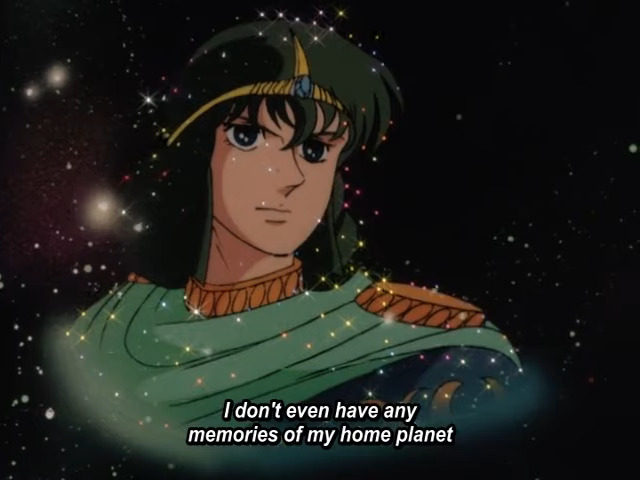
Marg is ridiculously beautiful both inside and out. He has lush locks of long green hair, and eyes that can express the deepest kindness but also the most fervent passion. His voice is gentle yet powerful, and his forlorn communications with Takeru express a longing and desire to see Takeru—unless he’s being brainwashed into being the enemy, of course, at which point his anger is spine-tingling. Whenever Marg shows up, he becomes the most captivating figure on screen.
Given that we’re talking about shipping and coupling, it’s not entirely accurate to pin it all on Marg. The popularity of a series among female fans traditionally hinges on the relationships between characters rather than singular personalities, and Takeru himself is no slouch. Not only does he look like a more handsome version of many a 70s robot protagonist, but he is perhaps the angstiest hero ever to grace a giant robot anime. Sure, Shinji from Evangelion is traumatized and depressed, and Heero Yuy from Gundam W is dark and brooding, but they don’t angst the way Takeru does. Naturally, more often than not, that anguish has something to do with Marg. And yes, they’re brothers by blood. Whether that was an additional awakening for fans in 1981, I’m not sure. I wouldn’t be surprised.
Even before God Mars, there were plenty of good-looking and charismatic secondary characters in mecha anime. Between directors Tomino Yoshiyuki and Nagahama Tadao, they all but cornered the market: Prince Sharkin (Reideen), Garuda (Combattler V), Prince Heinel (Voltes V), Richter (Daimos), and both Char Aznable and Garma Zabi (Gundam). The key difference between these major rivals and Marg is that the latter is so many things in one. He’s an adversary at some times, but at other times he’s basically a damsel in distress.
There is something I need to make clear: Unlike so many later anime, which could be constructed from head to toe with a female audience in mind (or at least pay regular lip service to that side of fandom), God Mars is still built on the foundation of a toy-shilling kids’ anime. It is 65 episodes long, and not every episode is exactly compelling. There’s an unsurprising inconsistency in terms of the show’s quality with respect to storytelling and animation quality. In addition to the notorious stiffness of God Mars the robot, the anime is rife with fights between characters with psychic powers that revolve around dramatic poses in still shots in lieu of actual movement—a style of action scene the book Even a Monkey Can Draw Manga mocks for its laziness. And dashing canon hopes of brotherly love, the series pairs Takeru with a female character, albeit one with a connection to Marg. In other words, back in 1981, fujoshi had to walk uphill both ways to get their BL shipping fix.
Even so, a girls’ fandom emerged out of God Mars, and plenty of evidence exists that the creators became aware of this audience eventually. The TV series keeps finding ways to bring him back in different forms. A 1982 movie recap of the first 26 or so episodes reduces the screen time of other supporting characters in favor of more Marg, and the poster advertising the film even features him prominently (see above). A later OVA released in 1988—well after God Mars’s heyday—centers around Marg entirely. A look at God Mars merchandise reveals both official and unofficial works where Marg takes up a lot of real estate.
When I was going over my own prior history with God Mars, I omitted one thing: the game Super Robot Wars D for the Gameboy Advance. God Mars is one of the titles included, and in the game, you can manage to not only recruit Marg to your side but also have him pilot an alternate God Mars from that 1988 OVA in which he’s the star. Once together, Takeru and Marg can perform combination attacks like the “Double Final God Mars.” I can’t help but wonder if there were both kinds of God Mars fans working on this game, bringing together the hopes and dreams of those whose lives were changed in some part by God Mars and its two successes.