Thoughts on Left-Wing YouTube

Recently, I was surprised to discover that an “edgy gamer” streamer I was familiar with from a decade ago had transformed into a notable left-wing figure on YouTube. Steven Bonnell II, known to the internet as “Destiny,” got his start with StarCraft II and gradually becoming a prominent personality with a loyal following and detractors alike. He would argue against policing language, and that the common slurs gamers use were no big deal. And yet, here he is now, not only arguing against using such language, but also being noticeably effective at debating alt-right YouTubers who have risen to prominence on the wings of racism and intolerance.

It’s not just that he makes good points or that he knows how to dissect arguments, but that he hits right-wing figures where it hurts most: in their desire to appear strong to their followers. Regularly, he reveals that the emperor has no clothes, and I think it in part comes from him being so familiar with gamer culture and the things that leave it so vulnerable to alt-right personalities. When others on the left retreat, he’s willing to confront while also not falling prey to their debate traps. It’s something the left needs to learn.

This is also why I was not caught off guard by seeing his name listed in a New York Times article discussing the growing strength of left-wing YouTube as an answer to the hatred spewed by alt-right and manosphere personalities. Like ContraPoints, another major left-wing YouTuber, Destiny addresses the other side’s use of memes, pop culture, and opportunistic arguments head on, exposing their tools and often disarming their tactics without resorting to them. The key is that Destiny, ContraPoints, and the main subject of the article, Faraday, know how the alt-right thinks, and they aren’t afraid to use that knowledge to their advantage.

If I have any criticism for progressives online, it’s that people’s radars are often overtuned. Any slight whiff of conservative political views seemingly sets off alarm sirens in their heads, and there’s an annoying tendency to cannibalize potential allies because they’re not right at the vanguard of progress. Of course, it’s impossible to have a perfect radar, and people I thought to be more moderate in their views have turned out to be disturbingly right-wing. But I truly believe that residing in a left bubble, while good in some ways, can often fail to inoculate people against the disingenuous tactics of the alt-right. It’s important that Destiny and ContraPoints don’t have beliefs that overlap 100% yet are still able to see accomplish similar things.

De-platforming harmful individuals—taking away their ability to communicate en masse—is often a good thing because such people usually hide behind free speech without acknowledging that they’re doing the political equivalent of shouting “FIRE!” in a crowded theater. At the same time, I increasingly wonder if “avoid the other side entirely” is creating a kind of frailty in the left that plays right into the goals of the alt-right. Destiny, Natalie, and others like them provide examples of what can be done to avoid that fate: to engage and to understand the other’s goals, and to win the debate in a way that makes the other side look bad to their followers both real and potential.

Adhering to Conventions: Ogiue Maniax Status Update for July 2019

It doesn’t happen every year, but this July is going to see Anime Expo and Otakon. If you’re into anime cons, this is a double-edged sword. As I get older, I’m worried I might not have the energy for both.

Many thanks to my sponsors on Patreon and ko-fi.

General:

Johnny Trovato

Ko Ransom

Diogo Prado

Alex

Sue Hopkins fans:

Serxeid

Hato Kenjirou fans:

Elizabeth

Yajima Mirei fans:

Machi-Kurada

Highlights from June:

I’m Bad at Understanding Rhythm, but the Manga “Wondance” is Changing That

More love for an interesting manga, especially what it taught me personally.

Dark-skinned Precure: The Importance of Cure Soleil

The significance of Star Twinkle Precure‘s Mexican heroine.

Banjo-Kazooie, Dragon Quest, and the Precariousness of Nostalgia

Looking at how Smash Bros. as a “history of video games” can run up against its role as a vehicle for personal nostalgia.

Hashikko Ensemble

Chapter 17 puts the S in Soprano.

Patreon-Sponsored

The Pros and Cons of $20 Anime Figures

What do you think of these symbols of budget anime merchandise?

Closing

I have two panels at Otakon this year, and I hope you’ll be able to make them. I’ll make another post closer to Otakon so that it’s fresher in people’s memories, but make sure to mark “Star-Crossed Alien Lovers…in Robots” and “Genshiken and Beyond: The Works of Kio Shimoku” on your Otakon schedules!

His Master’s Voice: Hashikko Ensemble, Chapter 17

We learn a lot—maybe too much—about Nishigafuchi’s students in Chapter 17 of Hashikko Ensemble.

Summary

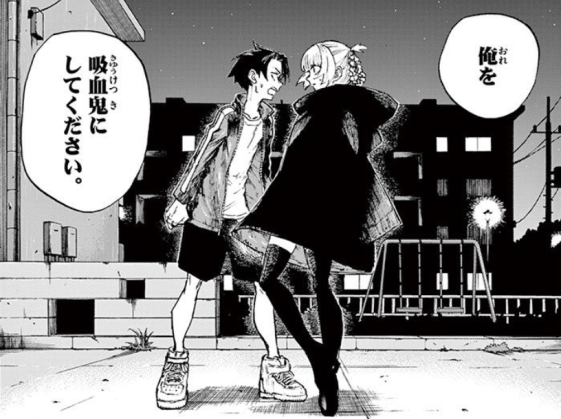
Nishigafuchi lead tenor Saiga (first name Shinnosuke) is in a funk, and the reason is that Shindou Yui, the lead soprano. Shindou mentioned that she sometimes doesn’t want to thing about how they’re breathing in the same space, and that with the way he keeps panting, he should just run around outside like a dog. To prove himself, he plans on challenging Jin to a competition, but gets punched in the mouth by Orihara instead. Shinji wonders if Orihara did it to defend Jin, but Orihara claims it was because he wanted to sing more Brahms. The punch actually makes Saiga want more because it reminds him of Shindou’s sadistic behavior.

Instead of competing, Jin actually helps Saiga with his singing and breathing (so he didn’t have to breathe the same air as her!), and the results are noticeable. Even Shindou is impressed, though she’s no slouch herself. Afterwards, Saiga goes up to Shindou and asks her…if she can be his master. Shindou happily gives him commands like a dog, everyone is confused (especially Kurata), and the Nishigafuchi adviser awkwardly comments that there are all kinds of relationships these days.

As they’re singing, however, Akira doesn’t, and his old middle school classmate Sadamoto notices again. But before he could say anything, Jin asks if the Hashimoto Chorus Club could perform for everyone on their own. Will Shinji finally sing here?

All Kinds

In the last chapter, Nishigafuchi student Andou described Shindou as appearing gentle but actually having a nasty tongue, and she certainly lives up to reputation. I figured that would be the case, but she far exceeds my expectations. I have to wonder if it’s like an entire club of masochists who enjoy the verbal lashing.

Meanwhile, Orihara’s punching Saiga (potentially) in defense of Jin is kind of a serious tsundere move by way of delinquent behavior. Maybe Orihara really does see him as a friend.

Great Teacher Kimura

According to Jin, Saiga tries too hard to keep his head from lifting up and tries to create too much space in his mouth—things that are generally considered good form in singing, but an area where Saiga overcompensates. The consequence is that the surrounding throat muscles to be overly tense and rigid, and this results in him breathing oddly while performing. To Jin, this might be why Shindou made her dog comment.

To help all of the tenors with this, Jin has everyone do an exercise where they “play catch” with their voices. The idea is that they breathe out like you’re trying to form a parabola, and like it’s coming out the top of your head—like they’re “throwing” their voice to the other team.

Jin is thus portrayed as someone who can teach even an elite singer from an elite school, and it furthers the idea that he’s on another level when it comes to understanding sound and music. It’s not clear what his power level is, but when Saiga challenges him, I was expecting a shounen manga moment where Jin can show his stuff and make clear the size of the disparity between them, but it didn’t happen. Yet.


Songs

Referenced last chapter too, they sing Johannes Brahms’s “O Heiland, reiß die Himmel auf, Op. 74, No. 2.”

Final Thoughts

Is Jin purposely requesting a Hashimoto-only performance so that Akira will feel more comfortable singing, or does he have a different motivation?

Also, Kurata’s utter bewilderment over the Saiga-Shindou thing is the cutest thing.

The Pros and Cons of $20 Anime Figures

I was asked by my long-time Patreon sponsor Johnny Trovato about my thoughts on “The effect of budget figurines (like Banpresto sells for $20 each [2,000 yen]) on the anime figure scene.” My first reaction to this was simply, “Figures are expensive, man.” That pretty much sets the stage for my opinion on the subject. They fulfill a necessary space in the grand scheme of anime merchandise, but they could always be better–not in terms of quality but rather honesty.

Personally, I prefer to get higher quality figures even if it means I have fewer overall. The Banpresto figures tend not to have the best paint jobs or face sculpts, and pricier figures just have more attention to detail that I appreciate. I don’t typically go for the most costly ones, though, unless I really, really want it.

But the balance between quantity and quality is different from person to person, and figures can end up being an absurdly expensive hobby. I’ve known people like that, and I’ll be upfront when I say that I don’t think I’ll ever make enough in a year to comfortably keep that up. So in that respect, Banpresto figures are a nice compromise. They’re not going to be the best, but they’re not supposed to be. They’re a valid option for people who want figures but simply can’t or won’t pay for more. And unlike trading figures, which is designed to be a bit of a gamble (you never know which one you’re gonna get!), you know what the figure is going to be.

The problems with $20 anime figures  come from two things, both related. First, their true purpose is as prizes for crane games in Japan. While there are apparently ways to master crane games and obtain them for reasonable prices, most people will probably end up spending more, perhaps even without success. Second, one of the big differences between more expensive figures and less expensive ones is whether you can look at the actual figure itself. Higher quality merchandise has clear packaging that lets you see what you’re buying, whereas the Banpresto stuff is hidden in opaque boxes covered in promotional photos that try to hide the flaws as much as possible. This is intentional but also disingenuous, as it potentially tricks people into getting a figure they wouldn’t have otherwise. In a sense, seeing them unboxed and on display at an anime con is a better thing, but in those cases they’re often marked up.

Ultimately, I don’t think Banpresto’s $20 figures are inherently a bad thing, and they definitely serve a part of the anime fandom that should be catered to. I just wish there wasn’t a degree of deception baked into the whole thing.

Dark-skinned Precure: The Importance of Cure Soleil

In terms of representation, the Precure franchise has always been in an interesting place. To say that it’s all about reinforcing gender stereotypes isn’t true, but neither is claiming that the series has no stereotypes at all. The girls fight on their own terms, dream big, and the importance of romance waxes and wanes from one series to the next. However, they’re also often in “girly” colors like pink, they have a tendency to wear high heels, and pale skin has been the default for every prominent Cure since the very beginning. Change has occurred over the years, mostly for the better, but there’s a constant push and pull between challenging social norms and following them for mainstream appeal.

As the very first dark-skinned major Cure in franchise history, Star Twinkle Precure’s Cure Soleil (real name Amamiya Elena) is in an interesting position. Not only is Japan still a country where the mainstream beauty standards assume whiter skin to be better (though this is by no means universally agreed upon), but more conservative sections of Japan view “Japanese-ness” as a unique and special phenomenon. In their eyes, even if you were born and raised in Japan, being Korean, Nigerian, or anything else disqualifies you from being “truly Japanese.”

In contrast to these views, Cure Soleil is presented as having partial ethnic origins from Mexico, her family flower shop “Sonrisa” and her cathphrase (“Chao!”) being the primary indicators. She also isn’t talked about like she’s a foreigner. Elena was born in Japan and has lived there all her life, and she’s not exoticized by her friends or the show itself. Further, having dark skin and being considered one of the most beautiful and popular girls in school sends a strong message to those growing up in Japan who don’t look like the assumed default. This is a far cry from the previous attempt to have dark-skinned Cures, as the briefly shown Wonderful Net Precure from Happiness Charge Precure! are barely tan to the point that it’s hard to tell that they’re Indian at first glance.

As a country where its well-known ethnic homogeneity is reflected in its media, stereotypes about foreigners are unsurprising. In that context, I have to wonder if the reason Cure Soleil is a part of Star Twinkle Precure is because dark-skinned women have made an impact in recent years. There’s Miss Japan 2015, Miyamoto Ariana, who is half-Japanese and half-African-American. More recently, professional tennis player Naomi Osaka (half-Japanese, half-Haitian) has been taking the world by storm and has even appeared in commercials in Japan. Whatever the actual case may be, I hope that characters like Elena can help normalize acceptance and celebration of girls and boys who look like her.

Dragon Quest’s Hero: A Unique Strength and a Unique Weakness?

By now, many sharps minds in the Smash Bros. Ultimate community have analyzed the trailer for the new “Hero from Dragon Quest” DLC character and have noticed a couple of interesting properties. First, the Hero appears to have much more than four special moves, and unlike the case with the Mii Fighters, he does not appear to have a customizable move list. Second, at one point he’s shown pulling up a menu of magic spells, and the ones displayed on the menu aren’t the only spells he uses in the trailer.

This has led to speculation that the Hero might have more available special moves than any other character in Smash Bros. history—possibly up to 16! What this means is that the character has a diversity of options unlike any other. But characters aren’t only designed with advantages. What could balance out this strength?

The most obvious drawback of the Hero’s wide array of spells is that he has an MP gauge: if he doesn’t have enough MP, he can’t use a spell. There’s no word yet as to how the Hero might gain back MP, so that could be another mitigating factor. However, there’s another potential flaw in how the Hero plays that is largely unseen in Smash: the risk of completely telegraphing what special move he’s about to use.

The only characters who come anywhere close to having such a weakness are Shulk and Olimar. Shulk’s Monado Arts clearly display which mode he’s in, and thus roughly what the opponent should be looking out for. Olimar uses his Pikmin in the order they’re plucked, and can only change which Pikmin is used next by either attacking or using his whistle. In Olimar’s case, identifying which Pikmin he’s trying to use (and therefore what attacks to be wary of) is also easier said than done due to their small size. But even Shulk’s giant “this is the Monado I’m using” tell is not the same as having literal menus pop up that show what move the Hero wants to use next—menus the opponent can easily see as well. There’s no clear indication of any shortcuts, either.

With a character that’s not even out yet, it’s impossible to accurately say how good or bad a character is going to be. However, based on this potential prospect—the unique strength of 16 (?) spells tempered by the unique weakness of showing your cards—I’m looking forward to both the strategy and counterplay that will develop with the Hero. I can’t wait for him to be available.

I’m Bad at Understanding Rhythm, but the Manga “Wondance” is Changing That

For the life of me, I’ve always had trouble with musical concepts like rhythm and beats. Even though I was in a couple of band classes as a kid, and even when I’ve tried to read up on it or look up videos, I just couldn’t wrap my head around these things. But recently, I think that’s starting to change, and I actually have manga to thank.

I recently began reading a new hip hop dancing-themed series called Wondance. Because that genre of dance is likely unfamiliar to many readers, the manga uses its main character as a way to introduce ideas. Kotani Kaboku is a basketball player with a speech impediment who discovers that dancing might just be a way for him to express himself, and he even applies some of his b-ball knowledge to his new interest.

In Chapter 4, titled “After-Beat,” Kaboku’s dance teacher talks to her class about a crucial difference between the music they might be accustomed to (J-Pop, anime songs, etc.) and the kind they’re dancing to now (hip hop, R&B, and funk)–what part of the beat the music (and thus the dancing accompanying it) emphasizes. If a basic beat is “1-2, 3-4,” then pop music tends to emphasize the “1” and the “3” while hip hop emphasizes the “2” and the “4.” The “2” and the “4” are called the “after-beat. To put it differently, if the beat track of a song goes “bumm-chh, bumm-chh,” the “chh” is the after-beat.

For anyone who’s into music and dance, this is probably child’s play, but this one page was actually the catalyst for me to actually “get” ideas that I knew of but could never actually understand. That simple explanation above, as well as the demonstration of dance moves at the bottom of the page, opened up a window I thought would be forever inaccessible. I listened to both anime songs and hip hop, my ears now aware of that difference in emphasis. When I watched videos teaching about beats, I had a better notion of what they were saying.

There’s even a moment from Chapter 3 of Wondance that subtly introduces these ideas, and in hindsight it’s actually brilliant. Kaboku notices something about the rhythm of hip hop dancing, and he compares it to dribbling in basketball: if the rhythm of the basketball is down-then-up, then hip hop feels like the “up” is being emphasized, and it’s the prime moment to make a steal. In other words, the ball hitting the floor is the “bumm” and the ball returning to the hand is the “chh.” When I remembered that scene, it hit me like a sack of potatoes.

While I highly doubt that I can ever truly feel the beat as so many others can, or apply it to something like rap or dance, I feel like a new world has opened up to me. It’s almost like learning a new language. I also think it might say something about me that it took reading a comic in a foreign language to finally comprehend something as pervasive as music, but maybe that’s part of the beauty of comics. And between Wondance in manga and Tribe Cool Crew in anime, I hope we see this genre continue to grow.

Banjo-Kazooie, Dragon Quest, and the Precariousness of Nostalgia

The dual Smash Bros. Ultimate character reveals of the Hero(es) from Dragon Quest and Banjo and Kazooie have gamers abuzz with excitement. While I didn’t quite get the DQ villain I wanted, I’m no exception when it comes to riding the hype train. However, seeing some of the negative reaction among English speakers online over the Hero’s entry into Smash makes me realize something: a lot of fans care less about video game history as a whole and more about their own video game history.

This is not unexpected, nor is it inherently bad. The games we grow up on and love are going to get a stronger reaction than things we only have a more academic understanding of. Nostalgia is a powerful thing, and when people engage in hype, they’re not necessarily engaging their intellectual side. Even the Japanese fans who are freaking out over Dragon Quest are doing so because of emotional attachment. DQ crosses generations and is an indelible part of Japanese pop culture on a scale that few things can compare to. If Banjo-Kazooie fever is a combination of 1990s gaming nostalgia and the return of a prodigal icon, then Dragon Quest in Smash is just plain nostalgia for a perennial favorite, transcending gaming and any specific time period. It popularized the RPG as a genre in Japan, and its simple gameplay made it accessible to audiences young and old in ways few games ever have.

Where I take umbrage with some of the reactions I’ve seen from some vocal Smash fans is a combination of entitled behavior and the seeming inability to engage that intelligent side of their brains that can allow them to appreciate things that aren’t necessarily connected directly to them. Just because there’s no deep, emotional bond doesn’t mean it’s not worthy of attention or fanfare. Smash Bros. is in many ways a celebration of video game history, so to see fans willfully reject that history is sad to see.

Dragon Quest has the potential to expand the reach of Smash Bros. far beyond what anyone has seen. Few characters can reach literal sixty-year-old Japanese businessmen the way DQ can. World-famous manga artists like Kishimoto Masashi (Naruto) have written about their experiences with the RPG. Toriyama Akira (Dragon Ball) has been responsible for the art since the franchise’s inception!

Banjo-Kazooie and Dragon Quest are both important new titles for Smash Bros., and I hope as many people as possible appreciate that.

PS: The Japanese trailer for Hero actually has him saying the names of his spells, so a silent protagonist he is not. I wonder if this might change the impression people have of the character if this difference sticks.

The New Ojamajo Doremi Comedy Shorts Hit Exactly Right

To celebrate the 20th anniversary of Ojamajo Doremi, Toei Animation has been putting out little flash shorts called Ojamajo Doremi Owarai Gekijou (Comedy Theater). Drawn super-deformed (but also as high school students as per the light novel sequels), the art is simple but in the current style of character designer Umakoshi Yoshihiko—vibrant and full of energy.

While seeing the light novels animated would be great and all, what I love about these little gag shorts is how the voice actors sound like they haven’t lost a step. All five of the core Ojamajo are here—Doremi, Hazuki, Aiko, Onpu, and Momoko—and they play their parts perfectly. If anything, Aiko sounds even more Osakan than ever. Hearing them again, there’s just something so special about Ojamajo Doremi that the magic even comes out in something this innocuous.

There are currently six episodes out, albeit untranslated. Still, I think even those who don’t know Japanese can get a sense of the fun in them.

This 20th anniversary celebration is also just the right time to get lots of choice Doremi merchandise. I know I’m eyeing that Nendoroid Aiko.


Why Are There So Few Recent Titles in Super Robot Wars T?

When a series gets into a Super Robot Wars game, for the first time, it’s a momentous occasion, especially when the game in question is one of the “mainline” iterations. The mecha (or even spaceships these days!) can be from old and obscure works, cult favorites, and even the new hotness. When playing through the recent Super Robot Wars T, however, I noticed that there’s a significant dearth of recent series, and I’m using that term loosely—out of every anime included, only two are from the past 13 years.

Even that number doesn’t tell the whole story. One of the anime referred to above is 2018’s Mazinger Z: Infinity, a film sequel to the original Mazinger Z anime franchise. While technically “modern,” it’s meant to be a nostalgia work. That leaves only Expelled from Paradise, a 2014 film. The next one after that is Gun x Sword from 2005. It’s not inherently a bad thing, and there are a number of welcome surprises in SRWT like Magic Knight Rayearth, Cowboy Bebop, and Captain Harlock. In a Famitsu interview, the director, Terada Takanobu, mentioned that one of their decisions for including new titles was a desire to have something for every age group. So in the sense of newcomers alone, it’s a pretty even split. However, the heavy lean towards the old is still noticeable, and I think a number of factors go into this.

First, as the years go by, what is considered an “old” title vs. a “new” one widens. Second, mecha anime just isn’t the bustling industry it once was, at least not in the same way. Third, I think that, as much as they tried to pull in fans of all ages, their core demographic seems to be working adults somewhere around 25-39, given both the themes of the game and the title selection itself.

For many younger anime fans, a span of five years might very well cover their entire fandom, let alone the now five decades that have elapsed since the original Mazinger Z anime debuted. For Super Robot Wars, this goes double, as it often takes quite a few years for a hot new mecha title to get the spotlight. Back in the early 2000s, Gaogaigar (1997) and Shin Getter Robo Armageddon (1998) were considered fairly young upstarts when they appeared. Now, in Super Robot Wars T, they’re grizzled old veterans. Outside of Super Robot Wars specifically, it’s always fascinating to see a title like Cowboy Bebop (1997 debut but aired on Adult Swim in 2001) go from being the hot new thing in the US to being a virtually canonized masterpiece that’s sometimes more discussed than viewed.

The relative oldness of the entries in SRWT is in part a consequence of how giant robots are simply not the industry juggernaut that they once were. Long gone are the endless number of children’s mecha shows, and the robot anime that do remain know that their audience will often skew older. Super Robot Wars, given its nature as a crossover celebration of what is increasingly a niche genre, is sort of tailor-made for nostalgia, compounding the sense that its appeal does not lie in attracting newer, younger anime fans, but those with a lot of experience watching and loving mecha anime. There are newer titles to pull in, but will they have the same draw as these assumed childhood/youth favorites?

In that sense, it’s interesting to note just where the nostalgia hits hardest for SRWT. Many of the titles are squarely in the 1990s without being made as sequels or reimaginings—Cowboy Bebop, Magic Knight Rayearth, Nadesico, G Gundam, Gaogaigar, and Might Gaine—while plenty of other titles are late 80s or early 2000s. Director Terada mentioned that international fandom was a consideration for which titles to include, and while not the case with every country, I think that the 90s is an especially strong time for fan nostalgia now—or at least the 90s anime they may have seen years later because anime distribution wasn’t nearly as speedy back in the days of VHS tapes and Real Media Player.

It’s also telling that the gimmick of the main heroes is that they’re salarymen, i.e. full-time working adults around ages 25 to 39, instead of teenagers. In some sense, it works as a gimmick, but when past original characters have been decidedly less mundane in their basic premises, the idea of “loyal company employee” stands out. There’s something to be said about how the notion of the salaryman as the default position for adults in Japan has been shattered for many years now, but I won’t go much into it except to say that while a heroine who just really likes a steady paycheck might have seemed like the most milquetoast thing once upon a time, in our current global economy, that idea almost borders on escapist fantasy.

Or maybe the team just really wanted to do a story with Jupiter as a focal point. Between Shin Getter Robo Armageddon, Nadesico, Crossbone Gundam, Aim for the Top!, Gaogaigar, and Cowboy Bebop, the fifth planet from the sun gets major play.

There’s one last possible reason the series is lacking anime titles from recent years: they’re saving them for a direct sequel. While there’s no news yet of a true follow-up to Super Robot Wars T (as opposed to just another game with a completely different cast and universe), there are enough loose threads in this game that a continuation would not be surprising.