Do It, Akirapella: Hashikko Ensemble, Chapter 21

The delinquent fans of Mimi-sensei are here to show their singing chops, and they have some unexpected help. Is it a defection or something else in Chapter 21 of Hashikko Ensemble.

Summary

In a shocking turn, Akira has seemingly joined the enemy as he provides the bass line for Tsuyama and friends’ a capella rendition of Spitz song “Cherry.” A flashback shows the amount of work that went into this, including a couple of the guys learning to sing falsetto and the fruits of Ouga’s practice with Jin and Akira. Takano-sensei is the one responsible for introducing the idea to sing a capella, but it needs at least five people—hence Akira’s actions.

Unsurprisingly, Jin is completely okay with this development, but now Orihara is unusually raring to go. The other group’s performance impresses Mimi-sensei (the judge for this competition), but the Chorus Appreciation Society has come prepared with their own Spitz number.

Takano-sensei’s Lessons

Takano-sensei apparently taught a lot in very little time. This includes the history of “a capella” and its shift from religious use to just “voice-only performance.” She also gives a few tips on how to sing falsetto: try to imitate Michael Jackson’s “Hooo”s and “Heehee”s, and also practice speaking in falsetto. She’s not nearly as technical as Jin in her explanations, but that’s probably a good thing. It speaks to her character and her role as a music teacher.

It’s still not clear why Takano-sensei is helping out, but based on her personality, I don’t suspect anything remotely malicious. Perhaps she wants to teach the students a lesson on life. Perhaps she wants to just shake things up a bit. Perhaps she’s just indirectly teasing Mimi-sensei. I know I want to see more of her, though.

Akira’s Doo-Wops in Art

It’s hard to convey differences in music through art alone, especially if there is little visual iconography to latch onto. The help of the text element in comics and manga makes it a little easier, however, and I love the way that a capella is portrayed in this chapter. Not only are there notes with accompanying percussive “lyrics” to show the a capella, but Akira’s portrayal in particular is great. I can practically sense the deep, deep bass in the image above. It also shows Akira with a sense of purpose rarely if ever seen from him.

Songs

“Viderunt Omnes” was going to be the Chorus Appreciation Society’s song of choice for this competition. Instead, both sides are using Spitz songs to try and win Mimi-sensei’s favor. As mentioned in the last chapter, it’s like her favorite band.

“Cherry” by Spitz

“Sora o Toberu hazu” (“You’ve Gotta Be Able to Fly”) by Spitz

Final Thoughts

I really liked that this chapter was dedicated to one performance (with some backstory accompaniment). It’s not often that Kio does such a straightforward chapter, and I think that gives it more impact.


Ooh, Where Does This Door Go?: Aikatsu on Parade! Early Thoughts

Seven years is more than enough time for a franchise like Aikatsu! to do an anime mega-crossover. However, it’s one thing to do the occasional crossover movie or TV special, and it’s another to make an entire series about it. Having watched the first couple of episodes, I can feel a genuine desire to celebrate and respect all aspects of Aikatsu!, but I have to wonder if they’re letting the genie out of the bottle.

The Aikatsu on Parade! Anime (based on the arcade game) ostensibly takes place in the same world as the previous season’s Aikatsu Friends! Kiseki Raki is a transfer student to Star Harmony Academy, where she dreams of becoming a great idol fashion designer. Unbeknownst to her, Raki’s sister has engineered a special school pass for her that in addition to allowing her to transform for performances, gives her access to “doors” that open up to other Aikatsu! series settings.

There’s a lot of care put into this new series to not make Raki seem like a subordinate fangirl to the previously established stars. Her fashion path, more akin to numerous side characters, doesn’t put her in as direct a  “competition” with the older heroines. Also, her personality (basically Dee Dee from Dexter’s Laboratory with a little more common sense) is strong enough to not get outshined by the characters she meets. That being said, she’s still yet to meet the titan that is Hoshimiya Ichigo, which will be the real test. I recently watched the premiere of WWE Friday Night Smackdown, which had The Rock on as a guest, and his charisma is so strong that it overshadowed even one of the biggest current stars in that company.

Perhaps the easiest place to tell that the creators are being thoughtful and considerate as to how the Aikatsu! characters would cross over is the first episode’s ending, where you see practically every significant character ever walking together. They’re grouped in rough categories according to a combination of personality and story purpose, and you can really see that it’s not shallow or haphazard.

Of course Mizuki and Elza would be with each other, and you can imagine each one firmly believing she’s the best. Given that the new series is also going to be having characters from different series singing and dancing together, it’s a golden opportunity for some dream collaborations.

I’m curious as to why they decided to make each of the Aikatsu! series distinct…universes? Timelines? Whatever it is, they establish early on that all these idol schools aren’t just in different parts of Japan—they exist entirely apart from one another, as if they’re wholly separate existences. There’s no wrong approach here, but I’d still like to know the creators’ reasoning for going this route.

Aikatsu on Parade! is on track to being a fun, excellent series that gives Aikatsu! as a whole its proper due. Still, I can’t shake the feeling that this is precarious territory for a franchise to go. Is there really any going back after this? What will it mean for the future of Aikatsu!? There’s no way to tell at the moment, but hopefully everyone in charge knows what they’re doing.

This post is sponsored by Johnny Trovato through Patreon. Top patrons can request specific topics on Ogiue Maniax.

Pump Up the Jam: How Heavy Are the Dumbbells You Lift?

Sports anime have been a pillar of Japanese animation since its earliest days, but very rarely, if ever, have any shows focused specifically on exercise. In comes How Heavy Are the Dumbbells You Lift?, a series that emphasizes actively pursuing fitness, whether it be at the gym, at home, or on the beach.

Dumbbell follows Sakura Hibiki, a high school girl who wants to lose weight and attract guys. Surprisingly, on a visit to a local gym, she runs into her rich classmate, who turns out to be an absolute fitness enthusiast. Together, with the deceptively handsome gym trainer Machio, they go through different exercises and approaches for achieving one’s fitness goals—and learning about the role weightlifting can play.

The series has a clear focus on the girls, and there’s no denying that sex appeal is a  fundamental part of Dumbbell. However, there’s an important distinction to make, and the best way is to compare it with another anime that puts focus on exercise: Issho ni Training: Training with Hinako. That short has the viewer watch a lightly dressed girl named Hinako, who goes through her exercise routine as the voyeuristic camera ogles her from multiple angles. But while Training with Hinako uses exercise as an excuse for fanservice, Dumbbell instead uses fanservice to promote exercise. To that end, it actually gives tips on weightlifting and other areas. In fact, the opening theme specifically points out what muscles are worked out by common and popular lifts.

Also, while the body diversity in the series is somewhat limited—the girls don’t have literally the same exact body, but they all fall along conventional ideas of attractiveness—each of them have their own reasons for going to the gym. The main character, Sakura Hibiki, wants to lose weight and look good, i.e. the most expected reason. Soryuin Akemi is obsessed with muscles (both on herself and others) to a fetishistic extent. Uehara Ayaka is the daughter of a retired boxer-turned-coach, and so exercise is as natural to her as breathing. Gina Boyd is a Russian who competes in sambo and arm wrestling, so strength training is just her way of staying fighting fit. Tachibana Satomi, their teacher, is a secret cosplayer who wants to look good for photos and fight the aging process. At the very least, the series promotes the idea that weight loss is not the sole reason to work out.

As one last aside, I once wrote that I’d be interested in a competitive bodybuilding manga because of how the posedown has a heavy psychological element. There is actually a competitive bodybuilding episode of Dumbbell, though it doesn’t quite go as far as I have hoped. Still, it’s forward progress.

How Heavy Are the Dumbbells You Lift? is not going to upend people’s understanding of weight and diet culture, but it also makes a sincere effort to teach people to exercise in ways that fit their specific situations. It’s as if the show is saying, not everyone can do everything, but as long as you’re moving and sweating, it’ll work out.

Burn to Fight: Promare

Promare, the new anime film from Studio Trigger (Kill la Kill, Inferno Cop) and director Imaishi Hiroyuki (Gurren-Lagann) is a visual spectacle that encapsulates everything that makes the studio stand out among its peers.

Starting from its announcement all the way to its release, there had been a deliberate vagueness around what Promare is even about. The only things available to potential audiences were some character designs that seem to draw inspiration from previous Trigger anime, a very basic plot outline, and the sense that the creators themselves weren’t always entirely sure what the premise was. Even the meaning of the title, Promare, is kept secret. But rather than this ambiguity being a weakness, it has actually ended up being a strength. There’s a certain degree of “feel, then think” that Promare emphasizes, and the result is an energizing work that comes across as a kind of full-body experience.

Promare takes place thirty years after a great disaster. One day, random people around the world suddenly began to spontaneously combust and gain the ability to control games, causing significant changes to society. The protagonist, Galo Thymos is a brash but courageous fellow who believes strongly in the firefighter spirit, and who works for the group Burning Rescue. As he deals with the flames, he begins to discover that everything he knows about the flames and the people who create them, is far from the truth.

The beginning of the film can be challenging to comprehend because it’s so visually overwhelming. The art style largely eschews black outlines, and the heavy use of flat, vibrant color planes along with the constant emphasis on action makes it initially difficult to even know what to concentrate on. However, this assault on the senses acts as an introduction to the aesthetic of Promare, and by the middle of the film, it was like my eyes had fully adjusted to the world. By then, virtually everything, particularly the fighting, was a treat—somehow artistically daring yet also comfortably familiar, like avantgarde pro wrestling.

This is not to say that the film is all pizzazz, without any worthwhile storytelling. While wrapped in a package of flashy action scenes and detailed animation, there is a strong message about taking the steps to understand more of the world around you, including those you’ve misunderstood, and unjust actions you may have previously ignored. The characters are similarly simple yet multifaceted.

Without spoiling too much, the film is packed with the things people come to Trigger for, and as someone who resonates with the Studio’s themes and aesthetics in general, it was right up my alley.

So in conclusion, abolish Freeze Force.

Trick and/or Treat: Halloween in the Aikatsu! Franchise

Note: This post topic was requested by Johnny Trovato through Patreon. If you’d like to see a particular topic on Ogiue Maniax, consider becoming a sponsor.

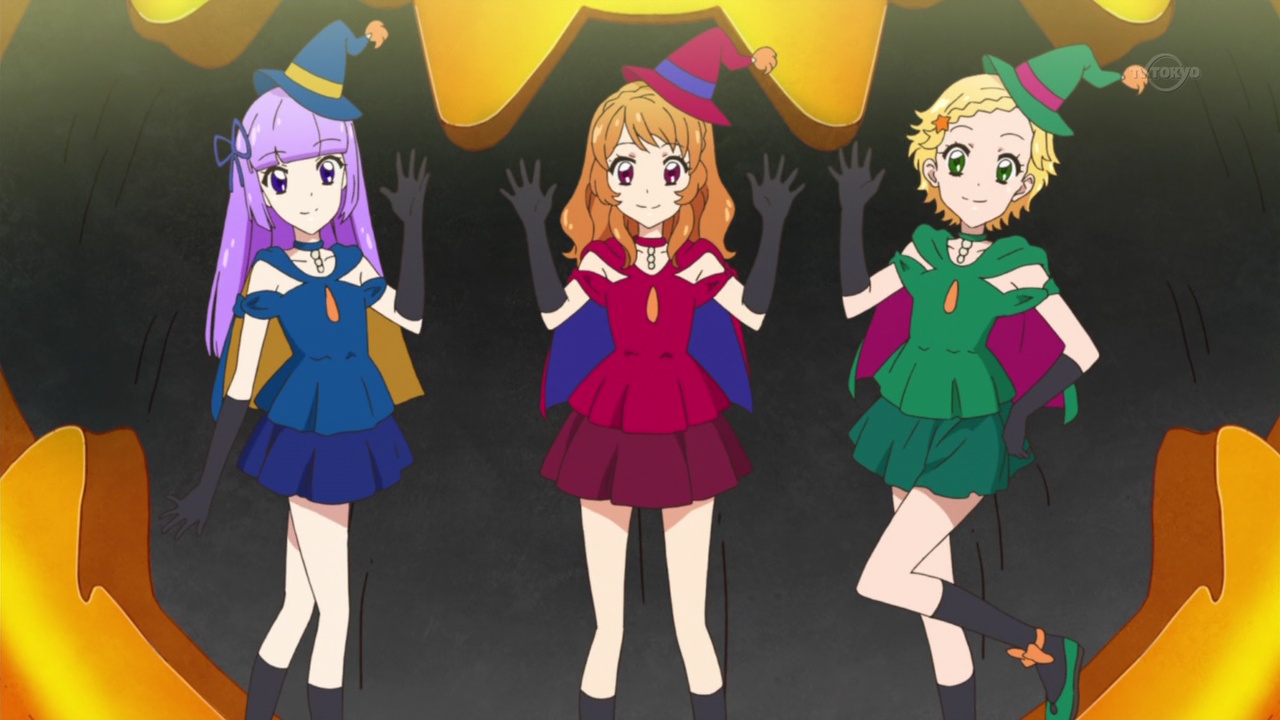
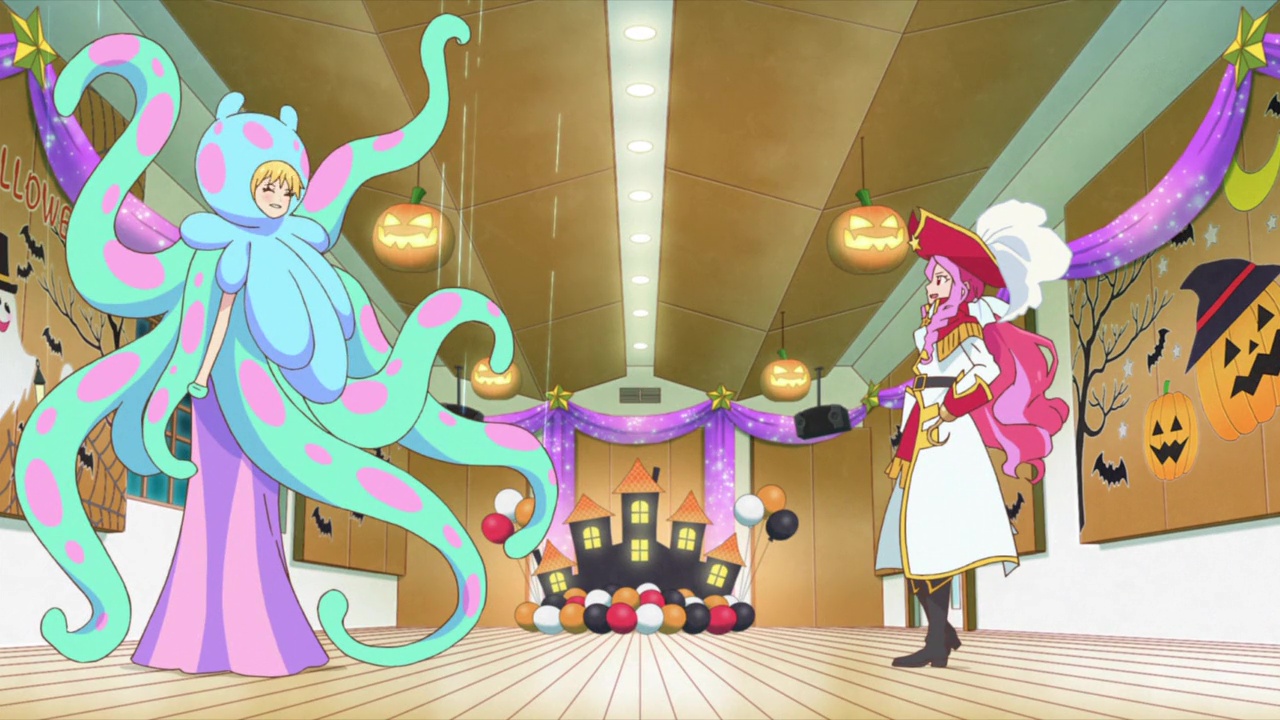
One of the interesting things about the 2014 Aikatsu! Episode “Halloween Night Party”  is how it showed that the holiday was relatively new in Japan. Characters repeatedly translate the English “trick or treat” into a Japanese explanatory sentence as if to hammer home the concept. The first few seasons of Aikatsu! didn’t even have Halloween episodes. But it’s been five years since then, and while it hasn’t been a straight line, the concept of “Halloween” is integrated into Aikatsu! pretty thoroughly. At the same time, the degree to which they embrace Halloween varies significantly, as if it’s unclear from year to year how much they should push for Halloween.

2015’s “YOU! GO! KYOTO!” perhaps barely qualifies as a Halloween episode. Instead, the focus is on a trip in Kansai, where the main trio gets together with Hattori Yuu, a friend of Akari’s who’s made a name for herself as a “tour guide idol” of sorts. The girls help her out with a Halloween special, and they do a themed performance as a follow-up. The lack of “trick or treat” is noticeable.

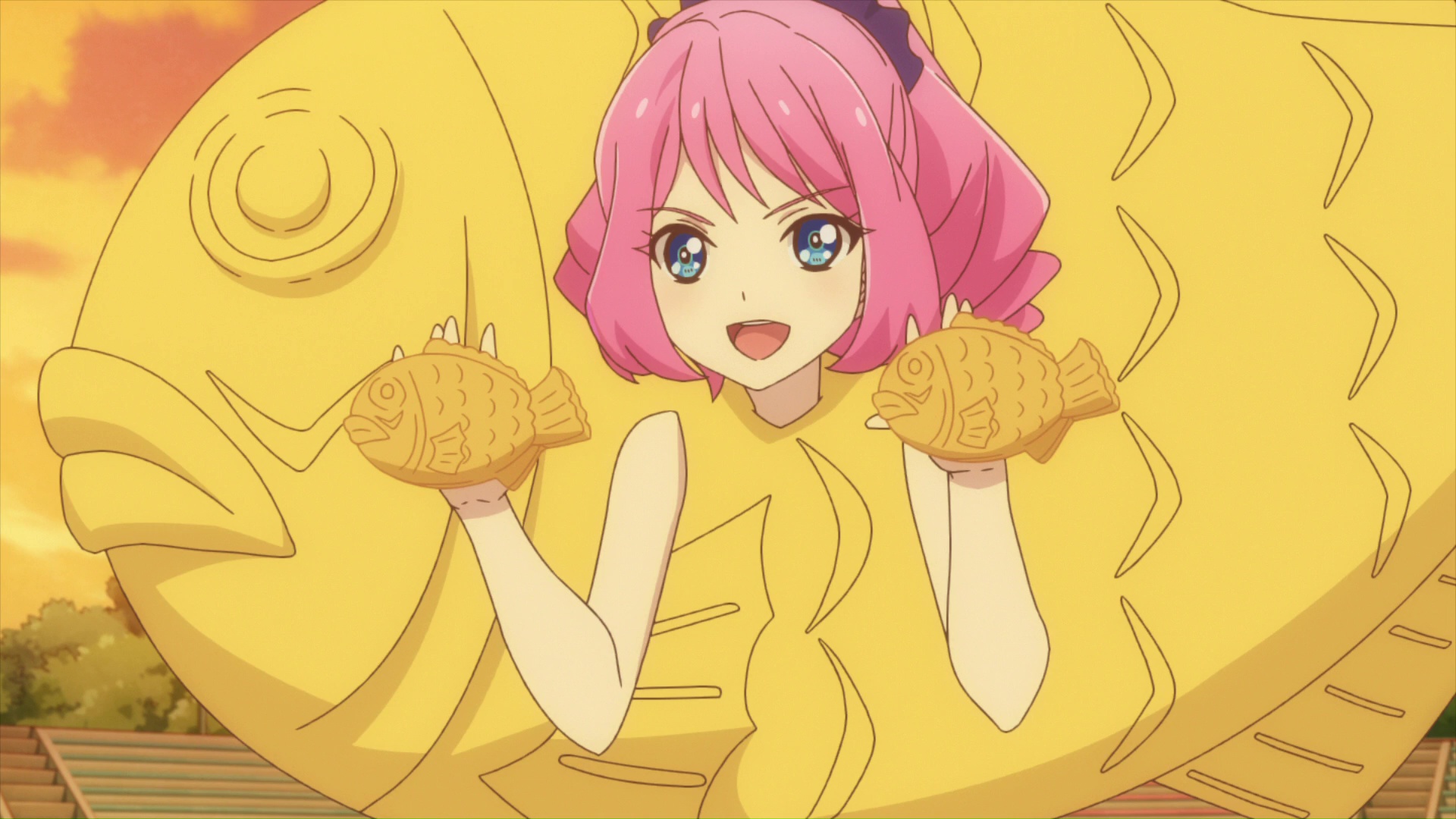
2016’s “Halloween Magic” returns to the Halloween episode format from 2014, albeit with an entirely different cast of characters in Aikatsu Stars! Not only do they bring back explaining what “trick or treat” means, but they even include a special competition just like in “Halloween Night Party.” This episode stands out to me more than any of the others simply because of Rola’s taiyaki outfit, seen above. Taking a relatively serious character and having her go around in the most ridiculous getup without even batting an eye speaks to her character having a certain charming roundedness. I have to wonder if maybe the concept of Halloween needs to be introduced again for newer, younger viewers coming in. Also, while “Halloween Night Party” made a reference to Michael Jackson’s “Thriller,” “Halloween Magic” has one of the characters moonwalk while doing MJ-style “Whoo!”s, as if to say that the King of Pop is as much a part of Halloween as pumpkins and candy.

2017’s “Halloween Surprise” from Aikatsu Stars! places extra emphasis on the “trick” in “trick or treat,” albeit without actually using the words. The second half of this particular series involves a rivalry with another idol school, so the idea of competing takes on a new dimension in this Halloween episode compared to previous ones. Here, participants lose when their heart rate goes over a certain level, so the two sides have to try and scare or surprise one another. It’s kind of a twist on the original formula, and it does a decent job of acting as the stage for a bit of character growth on the character Koharu’s part. There’s a greater emphasis on using Halloween as an opportunity for pushing storylines compared to previous years. Also, for some reason, they reuse the costumes from the previous year. Could it be out of convenience (they already have the character designs laid out), or perhaps the costumes were just that popular?

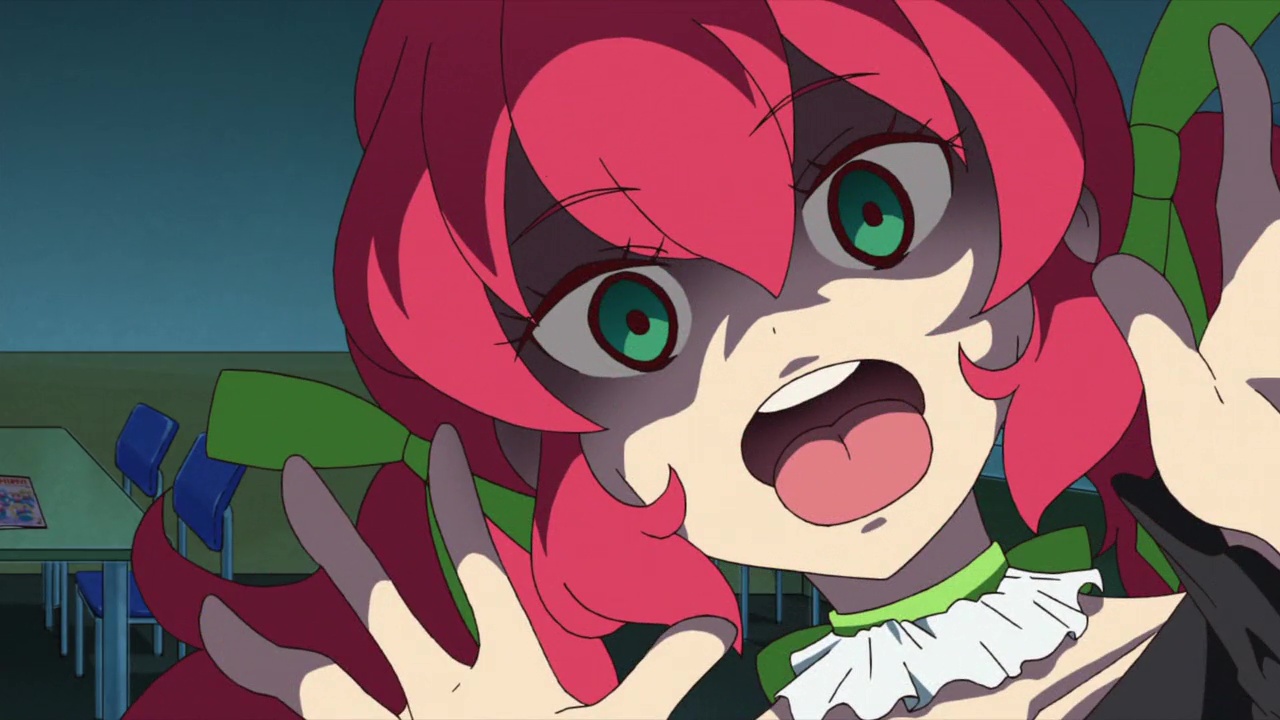
2018’s “Aine’s Halloween Panic” from Aikatsu Friends! Incorporates Halloween into the show pretty thoroughly without drawing a ton of attention to it. Aine, the most recent heroine, has split off from her Aikatsu partner Mio so that they can train separately and come back stronger than ever. For this purpose, she plays the part in a TV special of a girl who discovers her senpai is a witch. The magical focus is the clear tie to Halloween, but once again there’s no “trick or treat.” In fact, there’s only one trick, as Mirai (seen above) tries to scare a couple characters during the episode. They treat Halloween as the most natural thing—is it a sign that it’s approaching Christmas in terms of cultural integration in Japan?

Looking at all these episodes, a couple things stick out to me.

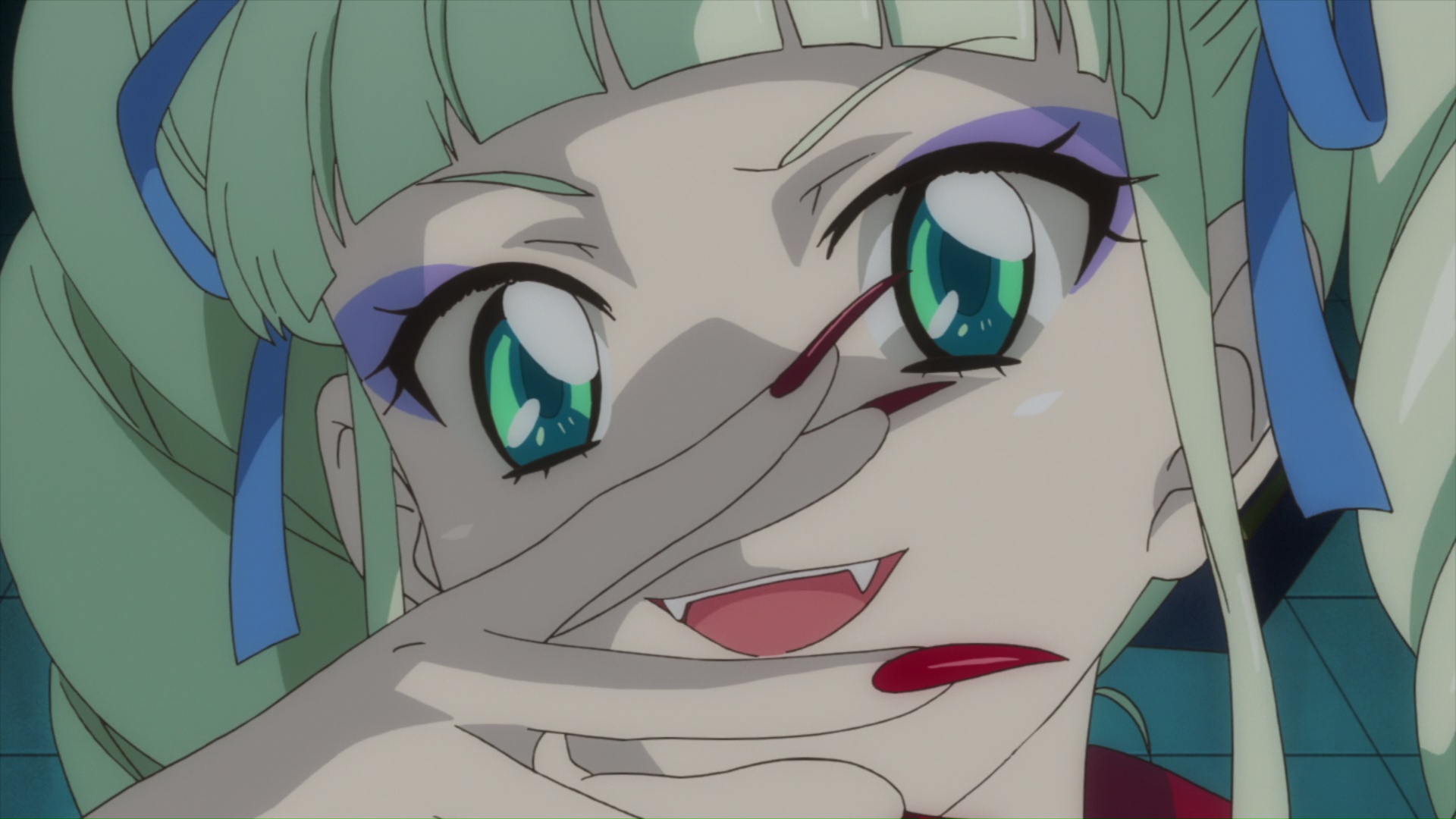
First, it really is a shame that Yurika, the vampire-inspired idol from the first series, didn’t get any Halloween episodes when she was a more common character due to the relative lack of exposure for the holiday.

Second, the notion of “trick or treat” as a package deal seems to ebb and flow, but its constituent parts, i.e. pranks and candy, remain. One thing worth pointing out is that the tradition of going door to door to trick or treat never took hold in Japan, so maybe it’s no surprise that it would end up as something less codified. That being said, I’m aware that even in the US, trick or treat (especially in big cities) is more organized these days for safety purposes.

So what remains is the aesthetics of Halloween, costumes and all, with a cultural twist. That includes a taiyaki costume, and there’s even one girl in Aikatsu Friends! who dresses as a jiangshi (Chinese hopping ghost popular in Japan). Also, I guess Michael Jackson is part of that aesthetic as well.

Given that the pattern for Aikatsu! Halloween episodes exists, but that each year puts its own spin on the idea, I’m curious to see what direction this year’s takes. Because 2018’s Aikatsu Friends episode took a less upfront approach, could this one be more in the classic style? And with the new giant crossover series Aikatsu On Parade! on its way in 2020, Halloween Idol Activities might very well combine the styles of all previous shows.


Cure Marine is Evergreen: Thoughts on NHK All-Precure Poll Results

The NHK All-Precure Poll announced its results on September 14th, and I’m happy to say that a lot of the things I voted for did quite well. My favorite show (Heartcatch Precure!) and one of my favorite songs (“Pretty Cure 5, Full Throttle GO GO!”) both got 2nd in their respective categories. But there’s one thing that stands out to me above all else, and that’s how Cure Marine, alias Kurumi Erika, aka my favorite Precure character, is the 3rd most popular Precure.

Last year, I made a post about some other Precure polls I found conducted through the website Naver. These polls weren’t as extensive or far-reaching as NHK’s, which ended up receiving over 600,000 votes, and some of the rankings were very different. For example, Cure Beauty was often at or near the top in Naver’s polls, but in NHK’s she’s at a somewhat less impressive 15th place. The OGs, Cure Black and Cure White, took the top 2 spots of the NHK poll but didn’t even get into the top 10 of the Naver ones. Yet, somehow, Cure Marine placed 2nd, 3rd, and 3rd on Naver and 3rd with NHK. While I’m no statistician, to me that consistency seems remarkable.

What appeals to me about Cure Marine is that her infectious energy, her humorous attitude towards life, and the fact that she’s anything but perfect. Her positivity doesn’t come from just being inherently optimistic all the time, and it’s something she clearly actively works at. Marine has a heart as big as her voice and attitude, and her sheer expressiveness seems to make her a hit with both kids and adults. Really, when you’re right behind the prototypical Precures in terms of popularity, I think it says a lot about how the character has affected fans of the franchise and how well she persists in the memories of those who’ve had the privilege to watch Heartcatch Precure! 

10 years later, Kurumi Erika is still unforgettable.


C’mon, Get SERIOUS About Terry Bogard in Smash Bros Ultimate

The fourth Super Smash Bros. Ultimate DLC character has been announced, and it’s SNK posterboy and fighting game icon Terry Bogard from the Fatal Fury franchise. The overall response was mixed, from die-hard SNK fans cheering at his arrival to comments to the effect of “I’ve never even heard of Terry Bogard.”

While I understand that not everyone has had exposure to Terry’s games or even the three Fatal Fury anime that came out in the 1990s, a part of me still feels perplexed at the latter reaction. It’s as if I unconsciously consider awareness of Terry Bogard to be the most common and natural thing, like hearing the name “Frank Sinatra” and at least knowing vaguely that he was a famous singer. The logical side of me gets that Terry isn’t a household name, especially for the younger generations of gamers, but the emotional side of me asks, “But why not?”

In terms of what Terry Bogard brings to Super Smash Bros., he’s clearly not the most iconic fighting game character ever. That would be Street Fighter’s Ryu, who’s already been in the game since Smash 4. Still, Terry matters a lot. He represents SNK, the company behind the Neo-Geo. He represents both the Fatal Fury games and the King of Fighters games, and unlike Street Fighter’s relationship with its offshoot franchises, FF and KoF are both majorly important, with the latter reaching heights of popularity in Latin America and Asia in ways few series ever did. Terry Bogard is a symbol of a company, a console, and two connected video game franchises. He’s like Sonic and Ryu rolled into one.

Terry is one of the coolest, most charismatic fighting game–and video game–characters ever. Even if you don’t know his backstory, he just exudes a kind of charm and attitude that make him hard to forget once you’ve seen him in action. Even his signature victory pose, where he turns his back to the screen and tosses his cap in the air while exclaiming, “OK!” screams personality, whether it’s 1990 or 2019. When you learn about his quest to avenge his dead father by defeating evil corporate tycoon/martial arts master Geese Howard, who’s equally amazing as a character, it just makes everything better.

My image of Terry is also no doubt shaped by the Fatal Fury anime I watched as a kid. In a time when the golden rule was “all video game anime are terrible,” the Fatal Fury 2 OVA was a stark exception. Watching it on fansub repeatedly back in the 1990s (shout-outs to S.Baldric), Terry’s story of hitting rock bottom after losing to the mysterious German warrior Wolfgang Krauser only to crawl his way back up by rediscovering his love of fighting is simple yet memorable.

Even in terms of meme culture, Terry Engrishy quotes are a staple of old fighting game forums. “Pawaa Wave!” “Pawaa Geezer!” [Geyser] “Are you OK? BUSTAA WOLF!” “Hey, c’mon, c’mon!”

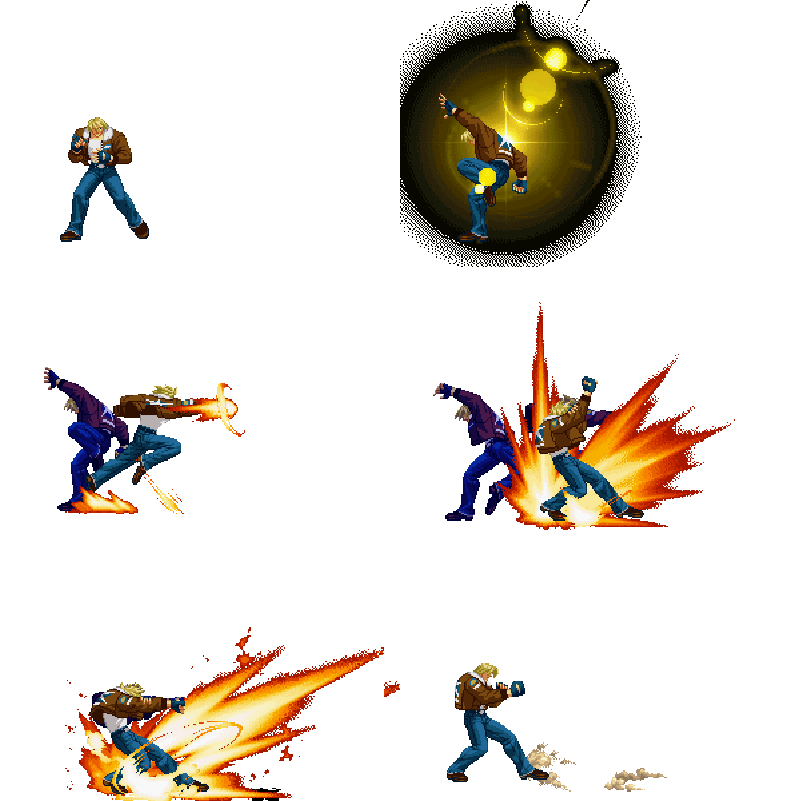
As for how Terry will play in Smash, I assume he’s going to be like Ryu and use command inputs, but he’s also perfect for Smash in that his special attacks map perfectly to B moves. Neutral B has to be Power Wave, Side B Burn Knuckle, Up B Rising Tackle, and Down B Crack Shoot. He’s already a very mobile character, and that fits in well with a platform-fighting game in ways that Ryu and Ken never could.

November isn’t that far away, but it still seems like forever. I’m looking forward to Terry Bogard balance debates and all they entail. Also, I saw someone on Twitter suggest an Obari Masami-style costume for Terry based on his look from the anime, which I’m all for. Between that and Mark of the Wolves bomber jacket Terry, and we have a heck of a presentation.

Girls und Panzer and the Potential for Propaganda

What I’m about to say might sound like I made up the whole thing, but I swear it’s true.

It was at a screening of the Love Live! Sunshine!! film that I struck up a conversation with a young mother. Although she was there in part to accompany her daughter, she was clearly an anime fan herself. At some point, the series Girls und Panzer came up, and she expressed skepticism over the tank-battling anime. From the tone of her voice, I could sense her concern over glorification of the military, and the potential role of the series as propaganda for something more sinister.

I tried to assuage her fears and present the anime as more of a sports series with a plot close to that of Love Live (save the high school from shutting down by winning a big competition). I don’t know whether or not she ultimately believed me, but I understand her hesitation, especially given today’s political climate. Although I consider myself a fan, in a world where guns are glorified and strongman politicians try to create cults of personality built around violence, I sometimes grapple with my fondness for Girls und Panzer.

I’ve argued before that Girls und Panzer separates a love of tanks and strategy from a love of warfare and nationalist loyalty, and I still believe this to be the case. In the anime’s setting, tanks are considered purely for friendly competition, and all ammunition is designed not to kill. There’s even a team of characters introduced in the first film who are basically a criticism of meaninglessly charging toward defeat out of a sense of “honor.” But it’s not as if the series is impossible to interpret as pro-military, especially if one takes only a surface glance at it. And in this world, sometimes a surface glance is all anyone has time for.

Girls und Panzer is not entirely devoid of concerning elements, as I think it’s hard to actually fully decouple tanks from their origins—especially because all the tanks in the series are from around World War II. As an individual viewer who tries to stay open yet critical, I feel that I’m able to stay open but at least somewhat skeptical. I can see what the series does well and the positive messages about keeping things in the realm of mock combat, and at the same time, my radar goes up for more alarming aspects. However, I’m aware that it’s possible someone more naive or predisposed to enjoying the glorification of military violence might take from Girls und Panzer what they want, and in the process twist the friendliness of the series into a “cute girls tell me war is good” message. It’s the old Gundam problem, where toy sales of cool giant robots obfuscate the anti-war message. As to whether or not Girls und Panzer is anti-war, it at least portrays a world where true war no longer exists.

Having the heroines use the minds and tools available to them to overcome opposition and achieve their goal is simple and effective storytelling. Couching it in historic military hardware makes it a near-endless pool for nerds to deep-dive into. But while I truly think that the series is not made to push people towards a militaristic patriotism, I can’t deny that some of the ingredients are there. It sounds odd to say that supervision is necessary to watch Girls und Panzer, but I think there’s a certain truth to it. If someone can’t provide their own voice of reason and caution, it can be treacherous territory.

Masaka Fall in Fall Dato?!: Ogiue Maniax Status Update for September 2019

As autumn comes around once more, and the summer hear theoretically wanes (oh, that climate change), I’d like to say “thank you” to my supporters on Patreon and ko-fi.

General:

Johnny Trovato

Ko Ransom

Diogo Prado

Alex

Sue Hopkins fans:

Serxeid

Hato Kenjirou fans:

Elizabeth

Yajima Mirei fans:

Machi-Kurada

Highlights from August:

At Otakon 2019, got the opportunity to interview with two Japanese voice acting greats, Furuya Toru and Inoue Kikuko. Both of them went great, and I highly encourage everyone, but especially Gundam fans to read them.

And I guess it was a very Gundam month, as I also wrote a piece about my intersecting thoughts between G Gundam and the current state of Hong Kong.

Hashikko Ensemble

Chapter 19 introduces a bunch of new and possibly antagonistic characters, expanding the Hashikko universe a little more.

Patreon-Sponsored

My Favorite Switch Games is pretty self-explanatory.

Closing

This month’s blog coverage is kind of dominated by Otakon, but that’s sort of an inevitability with it being such a big event, and one where I feel that I get the best coverage for interviews and the like. My plan is to do more anime and manga reviews/analyses, as well as a few unexpected topics.

I’m also considering simplifying my Patreon sponsor tiers, as the number gags I introduced to reflect Genshiken fandom might make the whole thing too unwieldy for newcomers. If anyone has thoughts on this, I’d like to hear.


Amuro and Aina’s Excellent Adventures: Otakon 2019

Otakon has long been the anime convention I look forward to most every year. I like how it’s always had an great balance between fan and industry where neither side feels neglected, as well as a panel track that encourages in-depth exploration of topics. This year was no exception, with both great guests and a variety of interesting fan panels. Otakon has also settled into the Walter E. Washington Convention Center quite comfortably at this point, and I have few if any complaints about the logistics of the actual location. The only gaffe I will point out is that there’s still a good deal of miscommunication when it comes to autograph lines, but other than that, it was pretty smooth sailing.

With that said, on to the rest of the con report!

Interviews

I conducted interviews with two voice actors at Otakon: industry veteran Inoue Kikuko (Belldandy, Aina Sahalin, Kazami Mizuho) and legend Furuya Toru (Amuro Ray, Tuxedo Mask, Pegasus Seiya). They’ve been getting some traction on Japanese Twitter, which I find thrilling.

As an aside, I love the press area at Otakon in DC. Not only is it a prime cosplay photography space, making it a lively aspect of the con, but it’s so much more convenient than the old one, and makes it significantly easier to schedule activities.

Panels

Frequent Otakon guest and anime industry super veteran Maruyama Masao had a couple of panels where he went through pretty much every anime he’s ever produced. Most of it was fairly mainstream work from his three studios—Madhouse, Mappa, and M2—but there were a few rare gems like a short by Rintaro and Otomo about them bicycle racing each other. He also mentioned at what point he first started working with various directors and creators. Another thing I came away with was how the sex-and-violence-laden Kawajiri Yoshiaki OVAs of the 80s and 90s had hilarious trailers that would abruptly shift from non-stop action to claiming a beautiful love story was in there, complete with cheesy romantic pop.

Anime in Non-Anime was a fun and entertaining panel from Anime World Order‘s Gerald. Not only was it full of laughs, especially when it came to the news coverage of the Naruto run for the Storming Area 51 Facebook group, but it put into perspective how deceptively large the anime industry really is in terms of reach.

Am I Too Old for This? was a pleasant surprise. Rather than being nostalgic commiseration or an empty pep talk, the panel was an informed look at how the concept of adulthood can coexist with the seeming childishness of fandom. The main takeaway was that managing responsibility, whether that’s taking care of yourself or others (or acknowledging when you need help from others), is the contemporary benchmark of adulthood, and that fandom is compatible with this. There was also an important point about not revealing your power level immediately to uninitiated acquaintances, because you have to deal with the reality of how anime fans are perceived in general society.

Animation in Anime by Evan Minto and Nate A.M. was a varied look at both the history and implementation of conveying the illusion of movement in Japanese animation. I think the panel did a good job of dispelling the notion that there is only one good way to animate, and detailing how the particular challenges of animating in Japan (primarily budget and labor issues) resulted in creators having to do more with less. I wonder how many people came out of it eager to learn about legendary animator Kanada Yoshinori, whose distinct style lives on in the likes of Obari Masami, Studio Trigger, and others.

In 20 Years Ago: Anime in 1999 Daryl Surat of Anime World Order looked back on the year 1999, and the fact that it’s been twenty years alarms and frightens me. Regardless of my own insecurity over the passage of time, it was an effective panel at putting anime’s history into perspective. Some tech hiccups interfered with the panel somewhat, but it didn’t impact the overall enjoyment. He also showed a willingness to not put creators on an unnecessary pedestal, as he called out a famous director who likely exploited one of his voice actors.

My Panels

Nine years ago, I did a panel about this blog’s namesake, Ogiue from Genshiken, and since then, I hadn’t touched my favorite manga as a panel topic prior to Otakon 2019. But thanks to a series of rereleases of Kio Shimoku’s older manga, I was inspired to do a panel that didn’t just cover Kio’s most famous title but his entire manga career. Thus was born Genshiken & Beyond: The Works of Kio Shimoku.

Creator spotlights are not the most popular panels, so there wasn’t a large audience at first, and the next panel being JoJo’s meant those seated at the end weren’t necessarily there to see me, but I think I accomplished what I wanted in going over Kio’s varied and daring manga works. To my pleasant surprise, I even won over a harsh critic on the Otakon feedback forums.

I had a second panel as well, Star-Crossed Alien Lovers…in Robots! with Patz from The Cockpit and Alain from Reverse Thieves. It was a more relaxed panel than my Kio one, and was built around looking at various robot anime that highlight romance amid conflict. My hope is that the panel got people thinking, even a little.

For those who attended my panels, thank you, and I hope to see you next year. I’ve got some ideas in the works…!

Bradio Concert

Having watched the anime Death Parade and enjoyed its high-energy opening theme, I was looking forward to Bradio’s live performance at Otakon, and it delivered in spades. Their attitude and presentation drew me in, and their unique jazz/funk/disco-fusion style is hard not to enjoy. I loved the hell out of every song, and it’s clear the crowd did too, as I could see people practically compelled to dance to the groove. Bradio’s irresistible music is made all the better by the singer’s excellent vocals and sheer range—he pretty much did one song entirely in falsetto without losing any power.

I would see Bradio again, no doubt.

As an aside, I stopped in briefly for the Nujabes Tribute Concert, but wasn’t able to stay long enough to get a good idea of it overall.

Other Notes

I briefly stopped by the Saturday Morning Cartoons subtitled video room. Along with the dubbed video room, the idea was to replicat watching anime from the 90s with commercials. I watched Sailor Moon in Japanese, and like with so many other shows with a merchandise engine behind them, there were tons of Sailor Moon commercials during the actual show. I also got to see a commercial starring the best video game mascot ever: Segata Sanshiro. If I had more time, I would’ve liked to stay there a bit more.

Also, shout-outs to the dealer’s room booth that was selling Precure, Doremi, and classic magical girl stuff I got this fine piece of Princess Comet/Cosmic Baton Girl Comet-san merchandise, and I was definitely tempted to get more. A rare find!

And lastly, some cosplay.