Love Live! Sunshine!! and Improved CG

Animating nine girls dancing onstage is hard work. It’s why the Love Live! anime usually reserves 2D animation for moments with three girls or less, and has 3DCG do the grunt work when showing the entire ensemble. One consequence of this is that, throughout the original Love Live! anime’s run (as well as the music videos made prior to the anime), the transition to 2D and 3D would look fairly awkward. However, what I’ve noticed from the first and especially the second season Love Live! Sunshine!! is that its CG portions are a lot better at removing the kind of “plastic” feel from the characters.

While I think the CG has just generally gotten higher in quality, making the models just look better overall, one major change I noticed that I think goes an extra long way in smoothing the switch between 2D and 3D is how the eyes are portrayed. In the 2D sequences, the girls’ eyes have a kind of soft glow that gives them an appearance of liveliness, of soul and depth. In the two Love Live! openings, when the CG switches occur, their expressions just look much blander, as if they’re puppets in the shape of the characters. With Love Live! Sunshine!!, the girls of Aqours have very pronounced and bright eyes even in the CG portions of their performances. In the second Sunshine!! season, the performance scenes keep the angles of backgrounds more consistent to make the transitions much less jarring.

This reminds me of a talk I went to at Japan Society in New York City, where anime writer Sato Dai (Eureka Seven, Battle Spirits) was giving a presentation on 3DCG in anime. One of the things he mentioned was that capturing “kawaii” in 3DCG was a major step in its implementation in Japanese animation, and I think we’re seeing the fruits of it. If the appeal of characters approaches appealing to the inner feelings of its viewers, then having eyes that appear to reciprocate emotionally would serve that direction quite well.

Ogiue Maniax Discusses Anime NYC on the Speakeasy Podcast


In addition to my con report of Anime NYC, I also sat down with Kate and Al from the Reverse Thieves to discuss New York’s latest anime convention

Teikoku State of Mind: Anime NYC 2017

When a brand-new convention decides to call itself “Anime NYC,” it’s practically asking to have the deck stacked against it. Running a first-year convention is no small task, doubly so if it’s in the heart of Manhattan. And with no reputation to go by, potential attendees may feel reluctant to try things out. Small attendance numbers can mean a lack of overall interest and the inability to justify the high costs of NYC, while large numbers means a greater chance of disaster striking if mismanaged. As a longtime resident of New York City, I’ve seen cons come and go, but somehow, someway, Anime NYC went so swimmingly that I almost can’t believe it was real.

General Impressions and Exhibitor’s Hall

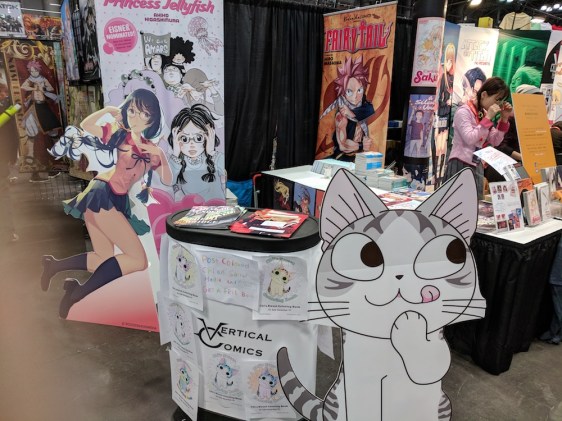
Those who attended New York Anime Festival and the first few New York Comic Cons might recall what it was like to go through the Jacob Javits Center without feeling like sardines. Walking through Anime NYC felt reminiscent of that environment, as the con was fairly heavily populated but with plenty of elbow room to spare. Panel rooms were right next to the Exhibitor’s Hall, making transitions between checking out the goods and listening in on industry and fan talks. Special events were held in a Main Event Hall that was a fair distance away, though nowhere near as disorienting as, say, the Baltimore Convention Center where Otakon used to take place.

Because it was so easy to navigate (without the space feeling overly empty), I came out of the three-day con feeling satisfied yet unstressed. Usually one comes with the other due to the hustle and bustle of trying to get everything done, or because there’s so little to do at the event itself that boredom and lethargy set in. Anime NYC struck a Goldilocks-type balance with a schedule that thrilled but did not overwhelm body and mind.

A major contrast between Anime NYC and NYCC is that the latter is focused on being a general comics pop culture event, with a film and television presence that all but overshadows the “comic” in comic con. Anime NYC, on the other hand, is first and foremost concerned with anime and manga. A few features branched out from that core, such as the presence of Overwatch voice actors who were there to meet the fans and sell autographs, but this was certainly no “anime ghetto,” as fans took to calling New York Anime Fest when it began to be dissolved into NYCC.  For those who love anime and love a big convention feel but think New York Comic Con’s a bit too much, Anime NYC has potential to be a gathering point for anime fans in the tri-state area.

Concerts

Anime NYC featured two concerts that shone in different ways. The first was Anime Diva Night, while the second was the Gundam Thunderbolt Concert.

At Anime Diva Night, three Japanese musical guests performed as part of the Anisong World Matsuri. Two of the singers, Ishida Yoko and TRUE, are amazing vocalists in their own right, but the third, Yonekura Chihiro, was the reason I wanted to attend. She’s the voice of so many amazing anime themes over the years that it almost doesn’t compare. Notably, she sang the opening and ending themes to Mobile Suit Gundam 08th MS Team.

While having Yonekura alone would’ve sufficed in my case, all three did a wonderful job. Some singers sound significantly better in the recording booth than they do onstage, but this was not the case for the Anime Diva trio, who sounded incredible even though the makeshift Main Events Hall did not have ideal acoustics.

The concert had a somewhat unusual format. Rather than move from one act to the next, each performer would do a few songs, perform a duet with another, and then the newer singer would take over before the next duet. There were two rotations in total, with all three singers performing together at the start and end of the show. All of the group performances were cover songs of popular anime themes—”Cruel Angel’s Thesis,” “Moonlight Densetsu,” “God Knows,” etc.—while the solo acts were their signature songs. Yonekura did indeed sing the Gundam 08th MS Team opening, but also an old favorite of mine in “Will” from the anime Hoshin Engi (aka Soul Hunter). Highlights from the other two singers included TRUE performing the first Sound!! Euphonium opening and Ishida doing arguably her most famous song, “Otome no Policy” from Sailor Moon R.

There were a couple of songs that didn’t make the concert that I was hoping for: Yonekura’s “Yakusoku no Basho e” from Kaleido Star and Ishida’s “White Destiny” from Pretear, but it was a small loss for an otherwise amazing concert.

The Gundam Thunderbolt Concert was highly unusual compared to what typically happens at an anime con performances. Generally, they’re closer to Anime Diva Night, sounding like the j-pop or j-rock one expects out of anime. To have the Gundam Thunderbolt composer Kikuchi Naruyoshi lead a jazz band himself on saxophone was a truly rare treat, and it’s one of the most unique experiences I’ve had at an anime con. The closest equivalent I could think of was Kanno Yoko’s concert at Otakon 2013.

I am no jazz aficionado, but thanks to the concert, I felt as if I began to understand the almost primal appeal that jazz holds for listeners. As I listened, an analogy popped into my head: jazz is like constructing a human being from music. They can be loud one moment and quiet the next. They can be a mess of contradictions, yet still function. I’m unsure if this will send me towards checking out more jazz in the future, but my curiosity is definitely piqued.

I’ve been more or less referring to the Gundam Thunderbolt Concert as a “jazz performance,” but that’s not entirely accurate. To everyone’s surprise, the concert also included performances by the singers of some of the 50s/60s-style pop songs from the Gundam Thunderbolt anime. In the context of the series, the two main characters, Io and Daryl, are two soldiers on opposite sides of a war who each listen to music as they battle. Io is an intense man who loves equally powerful jazz, while the handicapped Daryl prefers softer ballads.

At the Gundam Thunderbolt panel, Kikuchi mentioned that these are basically his two favorite genres of music, and he thought both fit the characters well. Interestingly, while the Gundam Thunderbolt manga included jazz already, Kikuchi composed entirely new songs that he felt fit Io’s character better.

One funny coincidence of sorts when it comes to Kikuchi’s choice to add a golden oldies aspect to the Gundam Thunderbolt score is that one of the biggest names in classic mid-20th-century American pop, Neil Sedaka, once composed the theme songs to Mobile Suit Z Gundam in the 1980s. I’d be curious to know what Kikuchi would think about this.

Artist Alley

More than Exhibitors’ Halls, Artist Alleys at cons can be affected heavily by the space they occupy. Regardless of the artists’ skills, or the amount of people in the alley, a bad space can make an attendee want to leave as quickly as possible, while a good space encourages more browsing and exploring.

Anime NYC’s is probably the best I’ve ever seen. Held on the top floor of the Jacob Javits Center, natural light shined down on the entire Artist Alley from an entirely windowed roof. At times, it almost felt like an outdoor European boutique, which made it just a pleasant place to peruse.

I purchased a few items at the Artist Alley, mainly from Japanese artists (something of a rarity even at anime cons). One booth was ran by the wife and assistant (pictured above) of manga artist Ohno Junji, creator behind the manga for obscure titles Mobile Suit Gundam: Missing Link and Mobile Suit Gundam The Origin MSD: Cucuruz Doan’s Island. Unfortunately, the artist couldn’t attend himself. They were selling art packages from Ohno himself and his assistant, Ally Suwabe:

Ohno Junji

Ally Suwabe

Axel Rex is Ohno’s original web comic he drew for Kodanasha/Yahoo!! Comics from 2008 to 2009.

The other Japanese artist attending was Tatsuyuki “Mikey” Maeda, who’s worked for the past 10 years as a manga assistant. In a way, while manga artists themselves only attend cons sparingly, their assistants are even rarer. Maeda was selling a short guide called “Secrets of Manga: Basics of the Tools & Trade.” In it, he gives various technical tips to aspiring manga creators, the kinds of things that often get glossed over in favor of “character design” and “how to draw mecha.” The guide talks about differences in pen nibs (such as what you should use if you have a light touch vs. a heavy hand), how to effectively use white-out, and more. I highly recommend it.

Panels

Gundam Thunderbolt Panel

Panels are an important part of the con experience for me, though due to my schedule I could not attend as many as I would have liked. Still, the Gundam Thunderbolt panel was highly informative, as were the Inifini-T Force and LeSean Thomas panels.

Infini-T Force is a current 3DCG anime series crossing over the classic heroes of Tatsunoko Production—Gatchaman, Casshan/Casshern, Hurricane Polymar, and Tekkaman. The fact that Tatsunoko, one of the most influential anime studios ever, had a con presence at all was the main reason I decided to attend their panel. Overall, it was a fairly basic introduction to Tatsunoko, but I like that they conveyed a bit of the studio’s historical significance. They’re one of the most influential studios ever, pushing the limits of animation in Japan since their inception in the 1960s. They were also willing to discuss a bit of the reception Infini-T Force has received in Japan, such as the fact that the primary female character is a little contentious to Japanese audiences. This is also somewhat unusual for Japanese companies, and was somewhat refreshing.

The LeSean Thomas panel was a general Q&A, but was one of the highlights of Anime NYC. It was inspiring to see attendee after attendee express how Thomas inspired them to keep working at their art, and how his success as a creator of color gave them the courage to never give up. I previously interviewed him at Otakon 2016, and he does make for an excellent role model.

Cosplay

In this case, I’ll let the pictures speak for themselves:

In Conclusion

Given how much I’ve praised Anime NYC, it might seem like I’m a paid shill, but I assure my readers that this is not the case. The con was actually executed so smoothly that there’s little I can complain about that would be the fault of the convention itself. While I attended for free as press, even the weekend ticket was affordable, especially compared to New York Comic Con ($60 vs. over $200 to buy four 1-day NYCC passes).

At approximately 20,000 attendees, Anime NYC has already become one of the larger anime cons in the US. The convention appears to have done a sound job of attracting locals, and I’m curious to see how much more it can grow. If the convention keeps up this level of quality, I’d be happy and proud to call Anime NYC “home.”


Aikatsu Stars! and Nikaido Yuzu, the Ultimate Kouhai/Senpai

At first glance, Nikaido Yuzu in Aikatsu Stars! is not an especially unique character. She’s an energetic, bubbly character in a show filled with energetic and bubbly characters, in a genre (idol anime) conducive to energetic and bubbly characters. One or way or another, however, she comes to stand out over time, especially with the slight shift in her role between seasons from kouhai to senpai.

I previously wrote a little about how the heroine of Aikatsu Stars!, Nijino Yume, undergoes a similar transition. At the start of the series, Yume’s the new girl aiming for the top. By the time Season 2 rolls around, Yume’s at the apex as a member of the elite idol group S4. In contrast, Yuzu starts off already a part of S4, going from the youngest member to the oldest between seasons. But unlike Yume, who has to get used to being looked up to, Yuzu’s personality and approach to life transitions almost seamlessly.

To the former members of S4 who graduate, Yuzu is a bundle of youthful enthusiasm. But to the younger members of S4 who come in after her, Yuzu is an eccentric wise man of sorts, her decisions seemingly bizarre but ultimately with some underlying purpose or reasoning—even if Yuzu herself doesn’t quite know what that is herself. This balance is on display in episode 67 of Aikatsu Stars!, when Yuzu sets up an elaborate treasure hunt on Aikatsu Island.

Yuzu tells the participants, many of whom are her underclassmen, to find a treasure that’s so well hidden that even she can’t remember its true location. As one hint after another comes up to help the hunters along, there’s a certain sense that they’re not just clues, but philosophical ideas about what it means to live. In a twist straight out of “The Purloined Letter,” the actual treasure is revealed to have been disguised as an overly obvious giant treasure box-shaped prop at the very beginning, and the treasure within is…friends. Literally. Out of the enormous box comes the three former members of S4. In that moment, between S4 girls new and old, Yuzu is simultaneously the wide-eyed “kid” and the experienced “adult,” so to speak.

Compare this to Yazawa Nico from Love Live!, a character known for being older but acting younger. Nico’s cutesy behavior is meant to contradict the fact that she’s a third-year in high school, and lets her act as a foil to the young-but-mature Nishikino Maki. Yuzu, on the other hand, isn’t really a “contradiction”; she just “is.” Her actions and behavior fit, whether she’s dispensing advice or giving it, because they reflect a generally positive approach to life that’s all about excitement without being beholden to “newness.”

Aikatsu Stars! is generally a fairly lighthearted show bordering on the wacky, and Yuzu fits well within that universe. Energetic and bubbly she may be, but those are surface qualities that open up to a sense of loyalty and adventure, rendering her a unique figure. She’s the kind of character who could thrive in any degree of prominence, whether main, side, or even background figure.

This post was sponsored by Johnny Trovato. If you’re interested in submitting topics for the blog, or just like my writing and want to support Ogiue Maniax, check out my Patreon.

Ukiyo-e and the Concept of Anime Sameface

One of the common criticisms of character designs in anime and manga is that characters often have the same face with variations in hair, clothing, and accessories to set them apart. This is viewed sometimes as lazy, or a sign of a lack of skill or talent, in other words a crutch in lieu of true character proficiency. However, in a number of instances it can be argued that “samefaces” aren’t the same at all, that subtle variations such as the angle of the eyes can suggest enormous differences between two characters.

While sameface certainly isn’t absent outside of Japanese pop culture, I’ve begun to wonder if Japan’s own art history has contributed to not only its presence but also its acceptance. I’ve taken a cursory look at ukiyo-e recently, and one thing that strikes me is that portrayals of both men and women, especially attractive individuals, tend to use very similar kinds of faces, with greater attention paid to—you guessed it—hair, clothing, and accessories.

I’m well aware that there’s a tendency to try and force a connection between ukiyo-e and manga, and I don’t intend to go that route. Stylistically, the two are very different, even if ukiyo-e is a kind of predecessor in terms of being a popular, mass-produced art that emphasized reveling in momentary pleasures. Hokusai manga doesn’t really have anything to do with manga, and the panel progression of manga isn’t really present in ukiyo-e. Also, there is actually quite enormous variation in the depictions of people in both ukiyo-e and manga when you look at the broader picture. That being said, in terms of character design and the priorities present in ukiyo-e I suspect that there’s some lineage at work that seeps into manga on some level.

Utamaro_(1793)_Three_Beauties_of_the_Present_Time.jpegUtamaro (1793): Three Beauties of the Present Time

What stands out to me about portrayals of women in ukiyo-e is the amount of attention paid to the hair. While the faces remain absolutely unrealistic (much like manga and anime but in the opposite direction in terms of proportions and what is aesthetically appealing), women’s hair in ukiyo-e prints are frequently rendered with such loving detail to the point of being in some ways hyper-realistic. Similarly, kimono are given bold colors and patterns, and so at first glance what distinguishes two women is everything but their faces.

There are a couple of other things that crop up when reading about ukiyo-e that wouldn’t sound out of place if the discussion were anime or manga. First, while many women in ukiyo-e were portrayed similarly, what was considered the image of the “ideal woman” changed as the years passed by. Second, small variations in facial features and expressions could mean all the difference between a “stereotypical” design and a “realistic” one.

How does this relate to an idea such as kyara moe, where characters’ stories are told almost entirely in how they look and through collectively accepted meanings behind visual elements? When looking at a series like Love Live!, it can seem to an outsider like the girls are just the same template, but those unique features relative to each other make a world of difference.

Of course, all of this is a very preliminary impression. Feel free to prove me ignorant in the comments!


10 Years After: Ogiue Maniax 10th Anniversary

10 years. What kind of fool keeps blogging about anime for an entire decade? It’s a milestone, but not the end of the journey. Still, looking back on my time here, there’s a lot to reflect on. That’s why I’m devoting this celebratory post to writing a not-so-brief history of Ogiue Maniax.

The Birth of Ogiue Maniax

Back in 2006, I had already been interacting with my fellow anime fans online for years. Long, essay-style forum posts were the norm in my communities, and it was just fun to read and write them. However naively, it felt like we were pushing critical thinking about anime and manga. However, the spaces in which I wrote began to dry up, or saw a new generation of moderators too afraid of what outsiders thought, shrinking beneath the judgment of their peers. I wanted a place where I could write what was on my mind.

At first, I didn’t think to start my own blog, and tried my hand as a “guest contributor,” a charitable term for “asked friends if I could post stuff to their sites.” The otaku news blog Heisei Democracy agreed to post an odd essay I had originally wrote for class, titled “Moe as Commodity”-—perhaps more relevant a topic today than ever before. Shiro, who ran the blog Toward Our Memories, offered me a chance to write about Gurren-Lagann and its connections to giant robots of years past. It was thanks to these opportunities that I thought maybe, just maybe, I could go off on my own.

I did not write the first anime blog, of course. The “scene” was well established when I started, with many more cropping up alongside my own. However, as I began to write in those early days, I noticed a tendency for other bloggers to slow down. Sometimes it had to do with real life—something I understand more than ever 10 years later. But in other cases, I heard a common refrain that there simply wasn’t enough to write about. Too many anime were too similar. Yeah, there’s some good stuff, but how much is much is out there, really?

I saw this as a challenge. I truly believed that there was always something worth writing about when it came to Japanese pop culture, and I wanted to see if I could keep it up. My ideal was to publish at least one post, long or short, once a day for seven days a week. It was an odd thing to get stubborn about, looking back.

While I’m no longer writing every single day of the week (I simply don’t have that amount of time or mental energy to devote to Ogiue Maniax), I think I’ve kept the flame of that original desire alive. Sure, I’ve sometimes talked about things that aren’t strictly anime or manga—esports theory, fandom and politics, and mahjong—but I see those topics as an extension of how I’ve grown as a writer, scholar, and human being. Anime isn’t isolated from the rest of the world, and even the decision to draw back and “heal” through media interaction carries effects and consequences.

Blogging as Blessing

Reaching a greater level critical thinking and expressing it through Ogiue Maniax is itself the product of the good fortune that has come from blogging. Back when I first started to gain some traction among online fans, I actually ran into one reader named Erin. At the time, she and her boyfriend (now husband) Noah had their own anime podcast called Ninja Consultant. While I’m naturally introverted and loathed the act of networking, meeting Erin and Noah was enormously beneficial. I didn’t even really consider it networking; it was just meeting new people. That encounter helped set me on a path to working various media jobs over the next few years, and was a catalyst for positivity in my life.

Not long after, I met through my blogging the woman who would one day become my wife. While writing Ogiue Maniax had been beneficial for a number of reasons, I never considered myself a particularly good writer. I just saw myself as someone who wanted to think more deeply about entertainment and media, with the blog being the conduit through which my thoughts are shared. But my wife helped foster in me an unusual, unfamiliar feeling: confidence. She told me that my ability to make complex and difficult ideas accessible and comprehensible to a wider audience was an admirable skill that reflected both my writing ability and my outlook on life. Last year, I decided to take a Harry Potter Sorting Hat test online and it put me in Hufflepuff, the school focused on humanity and providing opportunities for all. In hindsight, it makes sense.

Eventually, this led me to actually living abroad in Europe and taking my academic interest in manga and anime to the next level. For four years, I poured hours and hours of research into manga to an extent I didn’t even think possible, and it filled both my waking hours and my dreams. Even during this time, however, I still blogged. I looked at all that Ogiue Maniax had allowed me to achieve, and I loved the site too much to want to abandon it, even if might have preserved my sanity more effectively. This is the point at which I had to dial back my daily posts into something more manageable: two to three entries per week. Even with the reduced schedule, the constant swirling of ideas and readings and attempts to articulate labyrinthine thought processes brought about a change in Ogiue Maniax. I found myself compelled to delve deeper into my musings on anime and manga as it relates to not just pop culture or subcultures, but human culture in general. It forever changed the way I approach Ogiue Maniax for the better (at least in my opinion).

A Measured Success

More recently, I started my Patreon, and I make a modest amount every month. It’s not enough to make a living, but it supplements my existing income quite nicely. I’ve never had the largest readership around, and it’s even declined as anime blogging itself has dropped off. The Ogiue Maniax path is certainly not what you should try if your goal is to make writing your career, but I think my modicum of success is a reflection that I’ve held onto those core beliefs that originally fueled this blog at its inception even as I, the anime industry, fandom, and the world have changed. More than ever, I believe that there’s always something worth saying about anime and manga, and I hope that I’m able to inspire others to think the same as well.

Focused practice is supposedly the ideal way to improve a skill; knowing your weaknesses and drilling them into strengths is how one should approach the honing of a craft. I did no such thing. I brute forced it by making myself adhere to a schedule and making myself put out something—anything—on a regular basis. While I don’t always produce the best-edited pieces (a string of typos over the years can attest to that), I like to think that it’s made me unafraid of putting my thoughts and feelings out there in the world. Courage is a flower that needs to be nurtured.

Shout-Outs

Seeing as Thanksgiving is around the corner, I’d like to express my gratitude to the following:

Kio Shimoku: Although I know you’ll never read this, thank you for creating Genshiken. It’s been an inspiration in more ways than one, and has helped me grow as a human being. キオ先生は多分読まないけれど、本当に先生の事、感謝します。『げんしけん』のお陰で人として成長しました。

My fellow Genshiken fans: Whether early on in the blog’s life, or later as I did my chapter reviews, I’ve received much love for my Genshiken musings. Thank you for reading.

MrShadowAnt: My friend for many, many years, you were one of the first people I could truly nerd out with. Thank you.

6th Floor: There are fewer times I look back on more fondly than those afternoons and lunches spent playing games, talking anime, and just being friends. I believe those conversations became a major cornerstone of how I approach the world and my writing. Thank you.

Alain: Thank you, Al, for being someone to bounce ideas off of, and for providing a measured perspective on things.

Anime World Order: To Daryl, Gerald, and Clarissa, thank you for providing a template for how to talk about anime and manga while being entertaining and informative. You’re one of the reasons I even considered starting Ogiue Maniax at all.

Arco: When I think of ridiculously long posts, I think of you. Thank you for writing.

Jeff Lawson: Although you’ve long since left the aniblogging game, thank you for linking to Ogiue Maniax way back. It was the first boost in views I ever got, and I consider it a major cornerstone in the blog’s history.

Shiro: When I first felt that itch to blog about anime, you were one of the first to give me a platform to tackle my ideas. Thank you for providing me that opportunity. That Gurren-Lagann post became one of the two pivotal moments that prompted me to start Ogiue Maniax.

Shingo: Thank you, Shingo. I wrote the article “Moe as Commodity” many years ago at this point, and I think it stands as a precursor to what Ogiue Maniax would become. Also, I want to give an even more personal thank-you for showing me around Akihabara in 2005. I still haven’t forgotten!

Johnny Trovato: Thank you for believing in me and my Patreon more than anyone. I look forward to your requests every month.

Dave Cabrera: It’s funny how we met years before seeing each other in person without realizing it. You’re definitely one of the funniest writers I know, and as you strive to get out there and make yourself known, it inspires me to push ahead. Thank you, and Rosa GIgantor forever.

Veef: Thank you for being an ally in measured mecha fandom, eager for dialogue and civil even in disagreement. I always look forward to podcasting with you.

Patz: Another robot ally, thank you for helping to show the world that robot fans can be more than their stereotypes. Let’s do more con panels together.

KRansom: Whether we’re working together professionally or just for fun, it’s always great to get your thoughts on goings-on in Japanese pop culture and scholarship. People still read the Nausicaa article we translated. Thank you.

David Brothers: We first met on a fighting game forum, but at some point I began to see you not just as a friend, but also as a writer whose strength of voice and desire to do good in the world was something to aspire to. Thank you for making me want to better myself.

Divine: Thank you for having my back in the Netherlands. I do not underestimate how much it helped to have a familiar face abroad.

My friends and colleagues in Europe: Thank you for challenging me and pushing me to improve how I construct and express ideas.

Mitch: I know life has you busy, but I’m still grateful for when you’d take the time to catch any typos in my posts. Thank you.

Erin and Noah: Thank you for reaching out to me. I still owe you a lunch or dinner or something.

Ed Chavez: You’re still the smartest person I’ve ever known when it comes to manga, and I value our conversations. It’s always a pleasure to pick your brain. Thank you.

My wife: You saw something special in me, and encouraged me to recognize it. We’ve been through some interesting times together. Thank you.

Rendou World: The Official Term for the Houkago Play Universe

One of my favorite manga artists today is Kurosaki Rendou, who’s known for lanky characters and a bizarrely sensual drawing style. Unlike a lot of manga, Kurosaki’s work actually cross over each other. For example, the main character of Receptacle is the big sister of his arguably most famous work, Houkago Play. In the past, I referred to it as the “Kurosaki Rendouverse,” but I recently found out (according to Amazon!) that there’s actually an official name: “Rendou World.”

There really isn’t much else for me to say. Kurosaki Rendou still has more new manga coming out, so I’m looking forward to seeing more characters from different stories intersect. Will we get cameos from the cast of Chou Nettaiya Orgy?


Should We Think of Light Novels as Genre Fiction?

Light novels, especially those adapted into anime, are infamous for their tropes. Their stories often involve characters trapped in games or sent to fantasy worlds. The cast frequently includes a large number of female characters, many of whom are in love with the protagonist. The main character himself ranges from aggressively passive to do-it-all wish fulfillment. Little sisters who see their big brothers as more than just siblings are a dime a dozen. 
Given how frequently these elements are used, one common criticism is that light novel stories would be so much better if they would just not include them, but I wonder if that thinking is putting the cart before the horse. The way the light novel industry works, it might be better to approach it almost as genre fiction: the tropes are the starting point, and it’s what you do with them that counts.

Many series do not try to directly defy the tropes, but will twist and bend them. My Youth Romantic Comedy is Wrong, As I Expected (aka My Teen Romantic Comedy SNAFU) has a wimpy protagonist in a prominent love triangle, but he is forced to reevaluate his way of thinking thanks to the genuine friendship that forms between the three. Is It Wrong to Try to Pick Up Girls in a Dungeon? is actively modeled after a game-like world (with levels and experience and monster spawn points) and includes a hero practically every female character is in love with. Yet the personality of this main character, Bell Cranell, sets him up as someone whose childhood dream of having his own harem is offset by his gentle nature and kind heart. In a sense, these titles play by the rules first, as if part of the challenge is trying to work the same old materials into something new. The Monogatari series constantly changes up what we thought we knew about its female characters, rendering that harem into an ever-shifting enigma.

Not every work becomes a winner, of course. Some try in vain to differentiate themselves, only to be unrecognizable from the rest of the pack. Even so, within a given formula, there are subtle permutations that might not register with an outsider, but could be just the thing that causes the avid fan to choose title A over Title B. Perhaps this is part of why light novel titles get so excessively long at times. Not only is it a stylistic trend, but it might just be the most efficient way tell potential readers what this title has to offer. I Don’t Like You at All, Big Brother might not seem all that different from My Little Sister Can’t Be This Cute, but the former title implies a couple of things. First, it takes the younger sibling’s perspective into account more. Second, given that both titles are patently untrue, it hints at the little sister character as being more honest with herself.

Light novels (and works based on them) also should not be immune to outside criticism. Just because certain qualities and ideas are accepted by the fans doesn’t mean that nothing is ever structurally wrong. It’s the difference between evaluating a shooter-style video game from within the context of its own genre versus looking at the ways in which the genre as a whole depicts and glorifies violence. Both conversations can happen, and it’s possible to meet somewhere in the middle, as with Splatoon, which keeps shooter mechanics but de-emphasizes grit and death.

Light novels are not inherently the tropes described above, and many go well beyond the limitations associated with the format. But for those that choose to stay within those bounds, either due to personal desire, economic pragmatism, or market forces, those tropes might be better viewed as the cornerstones from which their stories are spun. Just as shooters necessarily must include guns, and vampire stories need vampires, genre light novels cannot simply be stripped of their well-worn tropes. They can be stretched and molded into new shapes, but getting rid of that core transforms them into something they aren’t and likely never try to be.

“Lagrange: The Flower of Rin-ne” and the Transformation of Lies into Truth

One of my favorite moments in the anime Lagrange: The Flower of Rin-ne is when we find out the truth about the Jersey Club, the seemingly do-anything, help-anyone group that the main character Kyouno Madoka leads. What we find out is that, whether or not Madoka realizes it, the club was created from a lie. In a time when a young Madoka was suffering from a traumatic event in her life, a local high schooler who happened to be jogging at the time created the idea of the Jersey Club on the spot, facetiously claiming that her exercise sweats were some kind of uniform in order to cheer Madoka up. The story of the Jersey Club, then, is one about how lies became truth, as Madoka took the kindness and altruism shown to her, and actually transformed it into a life philosophy. By the end of the series, it’s become almost literally a universal philosophy.

This idea of lies transforming into the truth through honesty and determination feels to me like a recurring theme in Japanese visual media. Fate/Stay Night‘s “Unlimited Blade Works” arc famously makes the claim that there’s no reason a copy has to be inferior to the original. Even knowing the origins of something, even when aware that something is a sham, it’s as if sincerity is the key ingredient to bend reality and perception.

It reminds me also of something I heard recently, which is that a sequel to Harper Lee’s To Kill a Mockingbird was published, which reveals Atticus Finch, the noble lawyer who defends a black man in a racist town, is actually revealed to be quite racist himself. The main character of the original book, Scout, turns out to have been looking at her father from the perspective of a child, only to realize his limitation as she grows into adulthood. It’s a controversial sequel, which was actually the prototype for To Kill a Mockingbird, but here we see too a “lie” becoming beneficial. Scout takes the ideals she sees from Atticus’s message and way of life, and transforms it into something even greater than the person himself.

Granted, this “bending” of reality is not necessarily without its problems. This is evidenced by the manipulation created by “fake news,” and the skewing of television news audiences, where viewers will gravitate towards the channels that cater to their beliefs almost regardless of the veracity of their reporting. The vital factor in determining whether an action is “good” or “bad” comes from what we’re seeing as “reality.” Is reality a construction of assumed cultural standards that resist change because of inertia? Or is it the foundation of truth that risks being chipped away by inaccuracies meant to exploit biases? The transformation of lies into truth can be heartfelt or diabolical, a risky double-edged sword that needs conscious tempering by both audiences and creators alike.

Ten! Ten! Ten!: Ogiue Maniax Status Update for November 2017

This month is the tenth anniversary of Ogiue Maniax. I’ll have a special post for that occasion. In the meantime, I’d like to thank my Patreon sponsors, especially the following:

General:

Johnny Trovato

Ko Ransom

Alex

Diogo Prado

Viga

Sue Hopkins fans:

Serxeid

Yoshitake Rika fans:

Elliot Page

Hato Kenjirou fans:

Elizabeth

Yajima Mirei fans:

Machi-Kurada

My favorite posts from last month:

The Precarious Balance of Tradition and Progress: Sakura Quest

A review of the unique P.A. Works anime

Love Live! Sunshine!! and the Complexities of Anime Tourism

A follow-up post of sorts to the Sakura Quest review, this one looks at the relationship between anime and influencing the movement of populations

Gattai Girls 7: Shinkon Gattai Godannar and Aoi Anna

The latest Gattai Girls is actually one of my favorite anime ever. (It was also a somewhat subtle hint towards me getting married.)

Patreon-Sponsored


Halloween Means Precure!

I was asked to write about my favorite Halloween anime, only to realize that most of them are Precure episodes. Go figure.

Closing

I’d like to end this month on a more serious note.

This past Halloween, there was a terrorist attack in lower Manhattan. While I did not know any of the people who were hurt or injured, my condolences go out to their friends and families. I went to school in the same area back in 2001, when 9/11 occurred, and hearing about the attack brought me back to what I felt then: the confusion, the need to evacuate, the unsettling feeling that the world will never be the same. Circumstances were different this time around, but I know the fear and unease that can linger over New York City in the face of such a crime. At the same time, just as then, I’m always surprised by the resilience of New Yorkers to just get back up and go about their day. On some level, it’s a product of being accustomed to the hustle and bustle of such a crazy metropolis, but I also think that it’s a semi-conscious effort to not let fear cower us into submission, or make us doubt each other as human beings.

Hate does not defeat hate. Trust, education, and openness to new ideas are the key ingredients to a better tomorrow.

Save

Save

Save