How Evangelion References Ideon

This post is dedicated to Anime World Order‘s Daryl Surat, who over 10 years has pointed out repeatedly that people will bring up the relationship between the anime Neon Genesis Evangelion and Space Runaway Ideon without knowing exactly how they connect.

Love it or hate it, Neon Genesis Evangelion, is one of the most influential and well-known anime ever. The story of youths with crippling psychological problems who must fight to save the Earth resonated with many, and anime came to copy, challenge, and rethink Evangelion in the years since. However, Evangelion itself carries its own influences from shows of yesteryear. For this post, I’m going to be writing about one of the major progenitors of Evangelion, Space Runaway Ideon, because it’s often brought up as evidence against Evangelion‘s originality and innovation, without thorough understanding as to what Ideon did and did not do relative to Evangelion.

Evangelion is just a rehash of Ideon,” the argument goes, but structurally they don’t have very many things in common. The city structure, otherworldly invaders, time limits, and the sense of scale when the titanic EVAs fight the similarly enormous Angels all come from Ultraman. In fact, if you want to see just how much Ultraman influenced director Anno Hideaki, check out the manga Insufficient Direction, drawn by his mangaka wife, Anno Moyoco (Hataraki Man, Sugar Sugar Rune). The escalation of trauma and the mistrust between humans comes from DevilmanIdeon, while bearing a few minor similarities to these series, brings something else to the table.

To understand Ideon, it’s useful to start at the beginning. Its story takes place in an era of space exploration and colonization. A group of archaeologists discover three ancient vehicles, which they find out can be brought together to form a giant robot called Ideon. During this time, they also encounter an alien race of conquerors called the Buff Clan, who possess legends about Ideon as a mighty god of ancient times. Though they take a number of casualties, the humans escape with Ideon, and spend the rest of the series fending off attacks from the Buff Clan with the help of the Ideon.

This sounds pretty par for the course for the time in which it was airing (early 1980s), but one thing made Ideon, as a mecha, different: it didn’t like to behave. The pilots from the very beginning are even unsure as to how to rouse Ideon from its dormancy. It powers up and powers down seemingly with a mind of its own, as indicated by a mysterious display called the Ide Gauge. If there’s a pattern as to how strong Ideon will be in any given fight, it is utterly unclear to the humans responsible for it. It is ancient alien technology that they are unable to fully grasp.

Then, deep into the series they find themselves cornered and at the brink of death. Suddenly, the Ideon achieves a power greater than anything seen before, and wipes out the enemy in an instant. Though they’re happy to have escaped with their lives, one important detail looms over their thoughts: it was not by the humans’ actions that they were rescued. Rather, they were at the seemingly serendipitous whims of the Ideon itself. As they continue on their journey, and as they continue to fight the Buff Clan, the heroes are made increasingly aware of the fact that the Ideon is powerful enough to destroy entire worlds, rend galaxies into nothingness, and wipe out civilizations… and they have absolutely no control over it. In the Super Robot Wars games, the power of the Ideon’s strongest attacks, Ideon Sword and Ideon Gun, are labeled as having infinite range as a reference to this, though the mechanics are gamified into something manageable).

If you’ve seen Neon Genesis Evangelion, you probably know where this is going. Some of the most iconic scenes in Evangelion are when the EVA-01, the protagonist Shinji’s mecha, goes berserk. During these pivotal moments, Shinji somehow falls unconscious or is unable to fight, and the EVA roars to life with a mind of its own. It fights like a beast, clawing, biting, and tearing. Its chilling cry becomes a wake-up call to the human characters who believed that they could control all of this technology and power. In the cases of both Ideon and Evangelion, the power granted to the heroes ironically creates a sense of helplessness because of the loss of control. Unlike older giant robot anime, such as Mazinger Z or even Reideen the Brave which featured a similarly sentient super robot, the spirit of the hero, or indeed all of humanity, is made to feel small and insignificant in Ideon and Evangelion. Where Evangelion differs is in its deeply introspective focus, of characters and the deep, torturous labyrinths of their psyches, and so it would be incorrect to say that Evangelion simply copied Ideon.

The Ideon TV series ends more abruptly than almost any other anime you will ever see, and a proper finale would be provided in the form of two movies, one recap and one conclusion. In the movies, the secrets of the Ideon are explored, and it’s through those secrets that further connections to Evangelion can be seen. The second movie, Be Invoked, reveals what causes Ideon to awaken and gain power: life energy. The Ideon throughout the series appears to respond better to children than to adults, and even better to babies. Though there is nothing explicitly written as to why this is the case, and I’m inserting my own interpretation into this to an extent, I believe that it has to do with the fact that children are both more full of life, and are not as warped by their experiences as the cold, cynical adults.

As the fight between the humans and the Buff Clan rages on, it turns out that meteors have been raining down on both planets, wiping out their homes. The implication behind these mutual apocalypses is that the Ideon itself and its Id energy have been testing the two sides to see if they can reach some sort of peace. Because the two sides refused to understand each other and just kept on fighting, the Ideon basically decided that both civilizations are not worth saving as they are. Hence, meteors. Ultimately, even as this is all happening, the Ideon fights the Buff Clan’s ultimate weapon, the Ganda Rowa. The two destroy each other, triggering a massive explosion that wipes out life on the surrounding planets. The spirits of those who died, both human and Buff, gather together as if all is behind them.

A few similarities to Evangelion appear here. First, the effectiveness of children as a source of “power” for the Ideon is similar to how the Evangelions appear to only function when piloted by 14-year-olds. Second, the protective element of the Ideon towards those children resembles how the EVAs have souls within them that (for the most part) are the mothers of the pilots themselves, who go berserk to save their children. Third, the Ideon’s desire to bring these two warring civilizations, and the final moments of Ideon itself, resemble the Human Instrumentality Project at the center of Evangelion. The Human Instrumentality Project is the idea that, by having all of humanity merge together, we will be free from the problems caused by people being unable to properly communicate their feelings. When we are all as one, there will be no suffering. Again, however, even if you factor out the newer works (the Rebuild of Evangelion movies, the manga’s alternative ending), Evangelion does not say the same things because of the greater focus on individual characters and their personal emotions. Ideon thinks on more of a macro scale than Evangelion‘s micro approach, despite the fact that both series involve the death of humanity.

Overall, the influence of Ideon on Evangelion can be summarized as the exploration of humans having to deal with powers beyond their control, and the apocalyptic consequences of those who continue to make mistakes even with this knowledge in mind. I hope this has been useful to you, and if there is anyone who would like to add new points, expand upon the existing ones above, or even argue against them, I welcome you to make a response.

If you liked this post, consider becoming a sponsor of Ogiue Maniax through Patreon. You can get rewards for higher pledges, including a chance to request topics for the blog.


Realism: Gundam Thunderbolt vs. Gundam Iron-Blooded Orphans

As the progenitor of the “real robot genre,” every time a new Gundam series comes out the question of its realism comes up. Even though its robots tend to be brightly colored and increasingly full of weird weapons, the simple formula of mecha as tool of war endures. Just this past year, we’ve had both Mobile Suit Gundam: Iron-Blooded Orphans, which follows a group of child soldiers, and Gundam Thunderbolt, which combines a gritty feel with a more hard science fiction feel. Which is more realistic? Does it matter?

I don’t intend to actually answer these questions. Rather, I’m bringing them up to try and start a discussion about the ways in which we try to position the idea of realism in something like Gundam. It’s not the first time I‘ve talked about it on this blog, either. With the first episode of Gundam Thunderbolt available, however, I can’t help but feel that it’s probably the Gundam a lot of the fans who revel in a certain image of realism have been looking for. One might call it the Macross Plus of the Gundam franchise in this respect. Its hard SF aspects, both in terms of presentation of technology and its expected character types, provide an interesting contrast to Iron-Blooded Orphans, which has a more contemporary “anime” look, cute girls and handsome boys and all. One can almost detect a generation gap in Thunderbolt vs. Iron-Blooded Orphans in terms of anime fandom; Thunderbolt feels like it came out of the science fiction conventions from which anime cons originally grew from.

In turn, Iron-Blooded Orphans seems more divisive in terms of what it tries to do with its realism, its young boys trying to carve a place in the world because of their circumstances as child soldiers. Of course, child soldiers aren’t new to Gundam. One could argue that the earliest protagonists of Gundam were child soldiers, but in this case it’s more the young guerilla archetype, seen also in Gundam 00. I do see Iron-Blooded Orphans get a bit more flack, and though my sample might be skewed by the fellow fans I interact with and observe, I think it has to do with how Iron-Blooded Orphans, unlike Thunderbolt, carries a kind of more “feminine” aesthetic that does not jive with more traditional images of realism as gritty.

Of course, grittiness does not automatically equal realism, but I think we’re trained to believe it. It’s one of the biggest trends of modern video games, and while there are plenty of games that push against it, many kids are growing up being taught by games and media that this is what “real” looks like. That said, Gundam Thunderbolt still has elements of the fantastic, and perhaps in the space between it and Iron-Blooded Orphans we can find versions of “realism” to satisfy all of those looking for it.

If you liked this post, consider becoming a sponsor of Ogiue Maniax through Patreon. You can get rewards for higher pledges, including a chance to request topics for the blog.

Aquarion Logos, or “Words Can Hurt”: Ogiue Maniax on the Veef Show Podcast

aquarionlogos-nishikinomaki

Years ago, I appeared on the Veef Show to talk about the anime Aquarion Evol, so it’s only natural that I would make a return for its sequel, Aquarion Logos. We go over just how strange the show is, even compared to its predecessors, as well as the merits of its unorthodox nature.

Though I think we forget to mention it, I think it’s important to note that the show stands on its own: no need to watch the prequels! In fact, they’re pretty much unrelated (aside from that first episode, which is more of a 0 episode).

Drifting Along: Ogiue Maniax Status Update for December 2015

Whenever I think of Christmas and anime, my mind immediately goes to Initial D: Third Stage. Does that count as a Christmas anime? I’m going to say yes, and try to make it official.

Here are this month’s Patreon supporters. As always, I’m happy that they have my back.

General:

Ko Ransom

Alex

Anonymous

Yoshitake Rika fans:

Elliot Page

Hato Kenjirou fans:

Elizabeth

Yajima Mirei fans:

Machi-Kurada

We even have a new Yajima fan aboard! Seeing as how the character’s been developing in Genshiken as of late, I wonder if more will join.

It’s a pretty subtle change, but one thing I’ve been trying to do over the past month is put out content three times a week. I used to do at least two posts a week, with a Fujoshi File every other week, but I felt that it wasn’t quite enough.

Speaking of the Fujoshi Files, at the moment they’re on a brief hiatus as I use that time to indulge in my love of Super Smash Bros. After the recent announcement that Cloud Strife is going to be a playable character (!), I’ve gone back to an old love of mine and have been designing movesets for what-if Smash characters. So far I’ve done Pitfall Harry from Pitfall and Zoma from Dragon Quest III, and there will be at least a couple more on the way.

I have more reviews this month, though as always they toe the line between review and analysis. Of course, there’s the requisite Genshiken chapter, and if you’re a Sue fan this is the one for you. I also wrote something about the use of kanji and words in Aquarion Logos, and then there’s my review of the new Digimon anime. If you haven’t heard about that last one, it’s actually a sequel to the original, with all of your favorite characters in high school. If you like giant robots, I also appeared on the Cockpit podcast to talk about Gaogaigar. I even made a new 1 Minute Review to celebrate the release of Girls und Panzer der Film!

As with every month, if you’re interested in requesting topics for me, it’s a reward for those who pledge $30+ on my Patreon. I of course don’t mind coming up with my own topics (and in many ways it’s actually kind of easier),  but I do miss being “forced” to look at something I might not have otherwise. In the meantime I’ve replaced the Ogiue Maniax Skype group reward at $2.00 with a new feature: I will include a link to whatever you want (within reason) in a special section in my sidebar. Remember, if you’re pledging already, you already have access to this, so send those requests my way!

The last thing I’d like to talk about is the whole social media thing. In the past, I’ve tried to make it so that each site I used had a different specialty. My tumblr, for example, was mainly for video clips. However, I realized that many people only look at their favorite social media platforms and rarely venture outside of them. That’s why I’ve been getting a bit more redundant with posts across different sites, to reach more people. My question is, are you someone who sticks to just one, or someone who sees different value in Twitter, tumblr, Facebook, etc.? I’d like to have a better idea of how to interact with my readers, so that I can foster interesting or even delightfully frivolous discussion.


Hammer Connect!: Ogiue Maniax Discussing Gaogaigar on the Cockpit

As a long overdue follow-up to our discussion on Brave Police J-Decker, I was invited along with the Reverse Thieves‘ Kate to talk about King of Braves Gaogaigar on Space Opera Satellite’s “Cockpit” series. Many have called it the best show in the Brave franchise, and it’s been 10 years since I first finished Gaogaigar, when that sentiment was at its strongest.

For your reference: Silverion Hammer

The real question is, why are there so few King J-Der toys?

Ogiue Maniax Talks Otakon on the Space Opera Satellite Podcast

goldran-hiddencell

I was recently on PatzPrime’s Space Opera Satellite podcast to recap and review the highlights of Otakon from the mecha fan’s perspective. Joining us were also Tom Aznable, Hazukari, and Ashe Blitzen.

Have a listen

Otakon 2015 Interview: Takamatsu Shinji

This is an interview with director Takamatsu Shinji from Otakon 2015. Takamatsu as worked on many anime including Gundam X, the Brave (Yuusha) series

First question. Most Gundam series had romance but didn’t have it as a strong focus. Gundam X is a series that put the romance at the very forefront, and it was in some ways the main focus. Why was this decision made for this series?

It’ll be a long story!

I wanted to make something that was Gundam but not Gundam. One rule of Gundam X was to get out of Gundam and to be meta about Gundam, to do things that were not like “Gundam.

Before that, about a decade prior, you worked on Z Gundam and Gundam ZZ. What was your director Tomino Yoshiyuki, and how would compare his style to yours?

Well, I did grow up watching Gundam myself, and by the time I started to work at Sunrise Mr. Tomino was in the position of being a great director, so it was a scary prospect working with Tomino.

During Z Gundam I was production management, so I reported directly to him, and I was scolded by him every single day. There were days when I was scared about everything.

Romi Park is also at this event, and she gave a similar description of Tomino that is not inaccurate compared to yours.

However, Ms. Park worked with Mr. Tomino much later than I did, and if you look at Mr. Tomino at the time of Z Gundam, he really was off the wall.

You’re also very well known for your work on the Brave series, and you worked on many of them. What was the main reason you returned to the Brave series for so many years?

The first director of the Brave series, Yatabe [Katsuyoshi], brought me onto production for the show, and I worked on a little bit of Gundam in between. So, there was a hiatus for me, but otherwise I started from beginning to end for the entire series. And I got my debut as a director from the Brave series, so I am very much fond of the Brave series.

Might Gaine was my debut as a director, so I am particularly fond of it.

In that case, I have an interesting question to follow up with.

The Brave series is known for being very toy and merchandise-heavy but also having good storytelling, as well as in some cases the staff resisting the merchandising aspects of the Brave series. Two famous examples I know are a hidden cel in Goldran which sarcastically talks about it’s supposed to be a robot that’s easy to make into toys, and how Might Gaine’s ending is a criticism of the toy industry.

What were your and the staff’s feelings at the time, and how did the toy companies such as Takara react?

That’s a very deep and vexing question!

So when I was getting started with Might Gaine, I was told that there’s just supposed to be good and bad, and all I had to do was to have toys that featured good guys and bad guys who would just battle. The staff really felt we need to show some kind of resistance, and that that wouldn’t just be the end of the show. And by staff, I mean myself.

You did not work extensively on Gaogaigar, but I have to ask this question. Do you have any details you can share as to why Project Z never got off the ground?

That I don’t know about!

That’s okay! Moving on, another similar series you worked on was Chousoku Henkei Gyrozetter, which was based on an arcade game. How would you compare working on Gyrozetter vs. working on the Brave series?

Gyrozetter was based on a video game, so while the look and feel of the show may be similar to a giant robot show, production of the show was otherwise completely different.

Unlike previous shows, the robots came from video games, so it wasn’t really needed as a tangible object, and I thought we could have done more with that.

I did grow up watching toy merchandise-based shows and I did think about what if the robot were a toy, but that wasn’t reflected in the show. That would be my regret. I talked about the resistance to merchandising intent of the toy companies for your earlier question but I actually love toys.

Last question. In regards to Cute High Earth Defense Club Love!, people have talked a lot over the years about the idea of a magical boy series. Whenever anyone brings up magical girls, someone asks, what about magical girls? What was the motivation behind finally putting that into reality?

The producer pitched it to me, and I thought, wouldn’t it be fun to work on something no one’s ever done before? And it turned out to be fun. (laughs)

Thank you!

Thank you.

See Ogiue Maniax Panels at AnimeNext 2015!

After a five year hiatus due mostly to not be in the United States, I am making my triumphant return to AnimeNext in Somerset, NJ from June 12-14. I also have two panels I’ll be running alongside the Reverse Thieves’ Alain.

Precure Party

Friday 2:15pm -3:15pm BW Panel 6

We’ll be talking about the crazy enormous Precure franchise that’s now 11 years old and even more popular than Sailor Moon ever was in Japan. Whether you’ve never heard of Precure or you’re a die-hard fan, we think you’ll have a great time seeing magical girls punch monsters in the face.


Giant Robot Romance: Boy Meets Girl Meets Mecha

Sunday 11:15-12:15pm BW Panel 6

Love triangles and star-crossed lovers are a common trope of giant robot anime, but this panel focuses on the series where romance is of central importance to the story. See how love has evolved over time in the world of mecha. We’ll be featuring shows such as Macross, Aquarion, and more!


Also, I’ll definitely be at this panel if you want to chat in person


Kill la Kill, Inferno Cop, and [Redacted] with Studio TRIGGER

Saturday 9pm-11pm Panel 1


See you there! I hope we can all sing the Inferno Cop theme together. Also, if you’re cosplaying Fight Club Mako, I’ll give you a high-five.

Super Robot Wars BX: How ‘Bout Those Obscure Titles

A new Super Robot Wars game is coming to the Nintendo 3DS, and at this point people know the drill. A bunch of old favorites come back, a few new series make their debut, and because it’s not on a “main” system they can be a little more daring with their choices in terms of which new anime to bring along.

Returning Series

-Aura Battler Dunbine
-Story of Aura Battler Dunbine
-Zettai Muteki Raijin-Oh
-King of Braves Gaogaigar
-Mobile Suit Gundam Unicorn
-Mobile Suit Gundam 00 the Movie
-Macross Frontier Movies
-Shin Mazinger (Mazinger Edition Z: The Impact!)
-Mazinkaiser SKL
-Martian Successor Nadesico

New Series

-Panzer World Galient
-SD Gundam Gaiden
-Mobile Suit Gundam AGE
-Giant Gorg
-Macross 30

While the new series at a glance might not seem that unusual, I think a second look actually brings home how bizarre the newcomers are. In some cases, it’s because they lend themselves well to the crossover nature of Super Robot Wars. Panzer World Galient and Giant Gorg are two series fans probably thought would never join SRW, yet it’s odd that this would be the case because both of their settings involve disparate levels of technology and a greater dedication to an almost more philosophical sense of science fiction that potentially lets them connect various generations together. Gundam AGE is at this point one of the black sheep of the Gundam franchise, yet its generational story can be the glue that holds similar yet different series together (Shin Mazinger and Mazinkaiser SKL, for example).

On a personal note, I’m looking forward to hearing the instrumental version of the Galient opening.

sdgundamgaiden-card

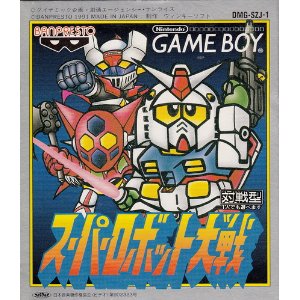
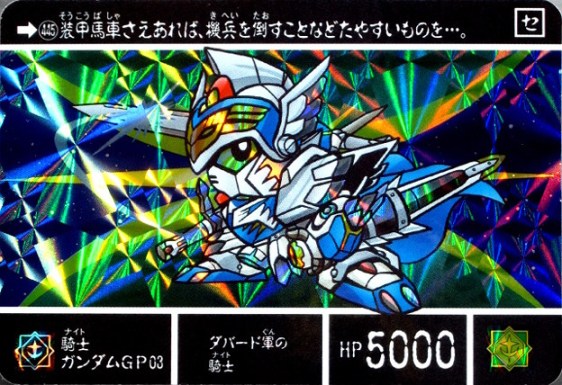
Then you have SD Gundam Gaiden, and I think to appreciate its inclusion we have to go back to the beginnings of Super Robot Wars.

71qRIQ6pxXL._SL500_AA300_

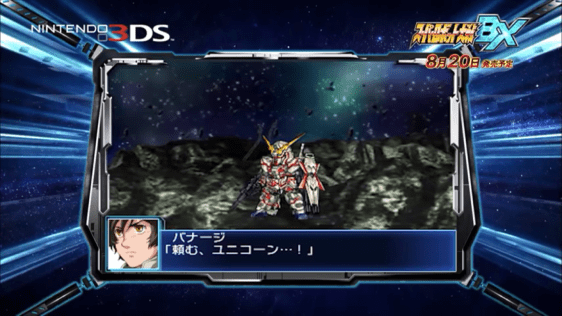
In the early iterations of SRW, the Gundam units took their designs and aesthetics from the popular SD Gundam franchise. This meant mobile suits looked extra cutesy, with large expressive eyes that future pupils. As SRW progressed this changed: pupils disappeared, robots became not quite as squat, and the old-fashioned SD look became a relic of the past. By having a series that actively celebrates that more cartoonish look, it’s almost like a piece of SRW history is returning. It’s all the more notable then that the Unicorn Gundam from Gundam UC is probably the least chibi-looking Gundam in SRW history; its proportions are practically realistic.

Screen Shot 2015-05-22 at 11.00.20 PM

As for Macross, that franchise is fairly common in Super Robot Wars, but Macross 30 is actually a Playstation 3 game devoted to celebrating the Macross metaseries as a whole. So, in a game dedicated to bringing together multiple giant robot anime, one of their inclusions is a video game all about celebrating decades of one series in particular. Does this mean that all of the Macross characters across history will show up, or is the intention more to focus on the original characters of Macross 30?

So, while it’s not as wild as throwing in Jushin Liger or Iron Leaguer, Super Robot Wars BX might have just enough twists to the formula to make things interesting.

If you liked this post, consider becoming a sponsor of Ogiue Maniax through Patreon. You can get rewards for higher pledges, including a chance to request topics for the blog.
Ogiue Maniax on the Veef Show Reviewing M3: The Dark Metal

m3mainvisual

Once more I’ve joined up with mecha fan and toy collector Veef to review a Satelight anime. This time we’re talking about M3: The Dark Metal, a show which presents the combination of Sato Jun’ichi as director (Sailor Moon, Ojamajo Doremi, Kaleidostar) and Okada Mari as writer (Lupin III: The Woman Called Mine Fujiko, Aquarion EVOL, Anohana). It’s an interesting show with some…mixed results.

Podcast