
I’ve written an article over at Apartment 507 talking about the latest Precure. There aren’t any major details yet, but if you want a quick rundown of Precure as a whole, and want to know how I’d like the series to go, head on over.

I’ve written an article over at Apartment 507 talking about the latest Precure. There aren’t any major details yet, but if you want a quick rundown of Precure as a whole, and want to know how I’d like the series to go, head on over.

A sequel is a curious thing, beholden to the expectations created by the original. If you stay too close to what came before, then the work runs the risk of being a pointless retread. Stray too far, and the spirit that made the work special can fade away. Across multiple year-long seasons, the magical girl anime Ojamajo Doremi, managed to never grow stale. Between its lived-in world, genuine respect for its young audience, characters both central and supporting who truly grow as human beings, and a sharp sense of both drama and humor, it’s an example worth holding up.
But what happens when the next sequel is not only removed from the elementary school days of the anime, but also in another medium entirely? That question is what brings me to the main topic of this review: Ojamajo Doremi 16, the first in a series of light novels that shine the spotlight on Harukaze Doremi and her friends in the exciting new world of high school.
At the end of Ojamajo Doremi Dokkaan!, Doremi and her classmates graduate from elementary school. However, rather than continuing on into middle school together, Doremi and her closest friends all go their separate ways in pursuit of their dreams or in support of their loved ones. At the same time, while they had spent the last four years as witch apprentices, they ultimately decide to forego their abilities as they stood on the cusp of becoming full-fledged witches, preferring to live as humans. Three years have passed, and now high school is on the horizon. Doremi discovers that her old friend Senoo Aiko is in town, having moved back from Osaka, and together with Fujiwara Hazuki have reformed their original trio. Not surprisingly, their reunion also becomes a new encounter with the Witch World they had left as kids.
One of the challenges of the light novel comes in how to convey that these are the same characters as the ones from the anime, only older. To this end, the vocabulary of the first-person narrative of the light novel, Doremi’s that is, effectively conveys the idea that she’s matured quite a bit. At the same time, it is clearly Doremi speaking, as her voice sounds very close to the same girl from back then, whose clumsiness belied a special talent for inspiring others. The other characters share similar changes. It can be hard to imagine them as their current selves and not just picture their smaller selves from the anime, though the updated character designs from Umakoshi Yoshihiko (who worked on the Doremi anime originally) certainly help.
Another sign of this change comes in the form of romance. Love for the main cast was never much of a focus for the Doremi anime, and even in this light novel it doesn’t play the most major role, but it underlies many of the other stories that take place. Hazuki’s close friendship with misunderstood delinquent and (bad) trumpet player Yada from their elementary school days has blossomed into a full-on relationship. Aiko is mentioned as having had some boyfriends, but is currently single. Kotake, the boy who began the series picking on Doremi but clearly fell for her by the final TV series, has grown tall and handsome, as well as becoming the star of the high school soccer team, and their being 16 potentially allows them to communicate in ways that they could not as immature kids.
While there are plenty of differences, the actual feel of Doremi 16 in terms of how its stories are told feels right at home. Rather than try to tell one grandiose plot in the span of its 300-odd pages, the light novel tells many smaller stories that both stand alone well and build off of each other to varying degrees, creating the sense of connection between characters that Doremi as a series is so good at. One of Doremi‘s greatest strengths was its excellent side cast, and in Doremi 16 you get to find out how they’ve also grown, whether because they’re the focus of these new stories, or because they simply exist as part of the world.
Fiction-loving Yokokawa Nobuko became a successful manga creator in middle school alongside artist and friend Maruyama Miho. Segawa Onpu, idol and former magical girl antagonist, has struggled with the transition from child star to full-blown actress. Doremi 16 brings you right back into their stories, and it feels immensely satisfying catching up with them, and it never gives the impression that the light novel is simply asking its readers to wax nostalgic purely for its own sake.
At the same time, however, I have some doubts as to whether someone could approach Doremi 16 without any prior experience with the series. I do think it’s excellently written in general, but it relies heavily on a cast of characters that have been previously established through years of anime. While I believe that the light novel quickly sums up its characters well so that you can get an immediate sense of who they are, I’m not sure how much it would matter to a complete newbie to the Doremi universe that Nagato Kayoko, who once suffered from a crippling fear of going to school, has now actually won awards for academic excellence. New characters are established, but the return to the town of Misora where Doremi and the others live is a significant factor in this book’s appeal.
That might appear to contradict the notion that Ojamajo Doremi 16 isn’t just for nostalgia, but it would only truly be a nostalgia-focused work if its story simply dwelled on the good times of the past. Instead, Doremi 16 actively builds on the paths that the girls of Ojamajo Doremi take towards the future, and it encourages readers to similarly reflect on their own lives. Although the three years from elementary school to high school isn’t nearly as long of a wait as the seven-year lull prior to the light novel, I can imagine that the high school world of Doremi 16 is a reminder that time brings about change, and that friendship and discovery are on-going processes whose magics are well worth exploring.
—
If you liked this post, consider becoming a sponsor of Ogiue Maniax through Patreon. You can get rewards for higher pledges, including a chance to request topics for the blog.

A few months ago at Otakon, I was talking with Alain from the Reverse Thieves, who had attended a panel about magical girls and feminism. He had described how the presenter went through the various series she’d be discussing, but made specific mention that she’d be omitting Precure from the discussion, citing the fact that she wasn’t particularly impressed. Although I did not attend the panel myself, I found that to be unfortunate, not because of the dismissal of Precure by the presenter in isolation, but because this stance on the long-running magical girl franchise is not that uncommon. Among many fans, presenters, and even scholars, Precure is assumed to be bland and generic and not worth discussion.
In my opinion, that kind of thinking is a mistake. Precure is not only the biggest and most popular magical girl property of the past ten years, eclipsing even Sailor Moon in certain ways (sales, longevity on TV, etc.) and therefore worth observing for its cultural footprint, but it is also a fount of positive imagery for girls. While there are certain elements that can remain issues, such as the increasing ubiquity of pink as the only possible color for the main heroine and the fact that a lot of the magical girl outfits have high heels, Precure utilizes strong female characters by default, rather than making a big deal out of their existence. What’s more, because the series refreshes itself every year or two, its variety results in different approaches to characterization of female characters and themes pertaining to feminism. You have weak girls who become strong over time (as well as a nuanced exploration of what it means to grow), heroines who are more ideals of human potential, and even characters who try to reclaim the term “princess” to mean something more than “demure.” Even the very first series is significant due to its portrayal of girls having aggressive, hand to hand fights (in a show for young girls, no less), and the fact that its two main characters are more about their life goals than pining at the boys around them.

I have my suspicions as to why Precure has ended up with this reputation, and a lot of it has to do with Sailor Moon. It was the first of its kind, the sentai-inspired battling magical girl genre of which Precure is a part. In terms of cultural influence around the world, Sailor Moon has crossed the barrier from niche interest for anime fans only to seminal work, and is frequently cited as a pivotal show in the development of many young artists. Just the fact that it portrays these mature-looking girls who fight and win is on a basic level empowering and inspiring, and so any similar series gets compared not only to Sailor Moon but also its presence as a kind of nostalgic defining moment where any weaknesses it possesses as a series are forgiven. It’s also very important to point out that, especially in the US, Precure is just plain hard to come by. As a result, for English speakers it has much less potential of becoming part of the fabric of one’s upbringing, with the possible exception of Smile Precure!, which has been loosely adapted to become Glitter Force on Netflix.
I get the feeling that, when the Sailor Moon generation typically sees Precure, a common process occurs. First, they see that Precure is similar, and that its story (depending on which version they watch) is often more lighthearted initially. Second, they see that the character designs are younger-looking, and so it seems less mature as well. Third, they might do a bit of research and become aware that the franchise is also popular with adult men, lending a sort of “creepy pervert” vibe to their impressions. Finally, they fill in the blanks, and without watching much more, jump to the conclusion that the franchise can’t possibly do things so differently from Sailor Moon that it’d be worth looking into more, or that it’s only for sad otaku (unaware that Sailor Moon was the show for doujinshi in its heyday). Moreover, because Precure doesn’t have the more immediately apparent dark appeal of a Revolutionary Girl Utena or a Madoka Magica, it’s further assumed to be generic kiddie fare. That’s not to say that the series isn’t for children, but that the type of maturity it carries is more in how it approaches the task of trying to show strong images for a female audience. As discussed above, I believe Precure does this to great success, and to see it brushed aside saddens and angers me.
I like Sailor Moon, and I don’t mean to paint fans of that series with the same brush. However, because it is a defining magical girl show for a lot of people, it gets written about as if it is the be-all, end-all of its particular brand of mahou shoujo. The reputation of Sailor Moon surpasses what is actually in the series in a certain way, and it casts an unfair shadow on Precure when Precure does many things that I would argue are improvements or directions that Sailor Moon never goes. This is especially the case with its feminist qualities. My hope is that, when people think about progressive portrayals in anime and the magical girl genre, they not only remember that Precure exists, but are aware of all that it offers.
—
If you liked this post, consider becoming a sponsor of Ogiue Maniax through Patreon. You can get rewards for higher pledges, including a chance to request topics for the blog.

In 2010, I found what would become one of my favorite anime ever. Ojamajo Doremi, at one point brought to the US as Magical Doremi, is a magical girl series targeted at young children, but with such great character development and genuine respect for children’s intelligence that it is easily one of the strongest works of fiction I’ve ever seen, let alone anime or kids’ material.
While I never really reviewed the series beyond the first season, my verdict on the sequels more or less amount to “more or less just as good,” so I didn’t feel it necessary to say the same thing four times. Now that I’ve finished Ojamajo Doremi Dokkaan!, which concludes the original series (there’s an OVA that takes place in Seasons 3 and 4, as well as canon light novel sequels featuring the cast in high school), it gives me a chance to rwhat eflect on I think makes this series so special, but now within the context of having followed the cast over 200+ episodes.
Doremi follows a group of young girls who become witch apprentices, and with their newfound abilities they use their magic to help others out. What makes this series remarkable from the very beginning is that they often cast magic in order to solve people’s problems for them, but rather utilize it in a way that lets people help themselves. Unlike the current Toei magical girl franchise, Precure, each season of Doremi is a direct continuation of the previoust, so we follow the girls from third to sixth grade. Doremi and the others meet a ton of characters and encounter a vast number challenges, so it’s easy to assume that all of the events would kind of blend together in one’s memories. However, the biggest testament to how strong Doremi is in general that the series is filled with characters both major and minor that create lasting impacts.
In the second season, Ojamajo Doremi # (pronounced “Sharp”), where Doremi has to take care of a magical witch baby named Hana. As a 4th grader in elementary school, Doremi cannot handle actually taking care of a baby, and Hana makes her life a living hell. However, when Doremi runs to her mom for comfort because she can’t stand being reprimanded for messing up, her mom instead of offering her a hug actually slaps her. While this might seem harsh, Doremi’s mom is trying to get a message across: while Doremi’s feelings might be hurt for making a mistake, Hana is a baby and utterly helpless. If Doremi isn’t there for her, she could die. Right at this point, the series teaches a valuable lesson: being a mother is no small responsibility, and it’s not to be taken lightly.

In the third season, Motto! Ojamajo Doremi, Doremi meets a girl named Kayoko, who loves to read but has a deep fear of attending school. The show successfully portrays Kayoko’s fear as something convincingly terrifying to her, and perfectly understandable: at some point, the pressure she felt from both herself not being able to keep up and the perception of her classmates’ seeming disappointment in her became too much. What’s more, in the episode that introduces Kayoko, the show initially creates the expectation that Doremi has solved her problem already, only for her to turn away at the last second. It’s not until a number of episodes later that she’s able to overcome this psychological turmoil and go to school, and then another few before she can even attend class (as opposed to study in the nurse’s office). What’s more, it’s also with the help of another minor character (who also undergoes a good deal of growth) that Kayoko finally recovers.
Then in Dokkaan!, many of the episodes explore the life of a former Queen of the Witch World. Though at first they seem to show individual happy memories from her time in the Human World, gradually they build up to a significant plot point: if the girls truly want to become witches, they must be aware that it might forever divorce them from being unable to fully empathize with their families, friends, and other humans. Life spans, ways of thinking, everything changes.
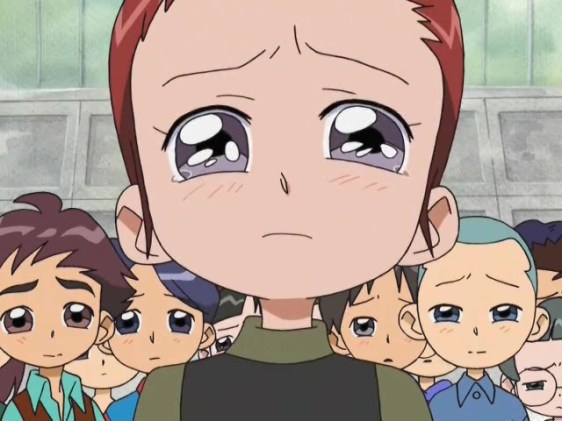
So when the final episode of Dokkaan! features many of the characters Doremi helped coming back to help her, I found it rather amazing that I could remember so many of them. It made me aware that, though they appeared countless in number, they each stood out in their own ways. Each of their stories were so special, so filled with emotions and the rewards of having been able to work through their problems with Doremi’s help, that they both individually and collectively speak to how tremendously strong Doremi is as a while.
Doremi creates an incredibly robust world from just the simple wish fulfillment concept of girls gaining magic powers, and does so without veering into either coddling over-optimism or grim pessimism. The franchise is mostly full of positive energy but will temper it with an awareness of the doubts and worries that children possess, and is not afraid to show them that life isn’t without is challenges. Whether people are young, old, famous, nobodies, from foreign countries, or right next door, everyone has a story and their own circumstances to work through, and Doremi encourages us to help however we can.
—
If you liked this post, consider becoming a sponsor of Ogiue Maniax through Patreon. You can get rewards for higher pledges, including a chance to request topics for the blog.

I love the dumb, yet incredibly clever humor of gdgd Fairies–style humor. Typically combining incredibly cheap animation with a cleverly absurd dialogue, a splash of improv comedy, and willful ignorance over their own premises, these anime always bring a smile to my face. The team behind gdgd Fairies has since gone on to do a variety of shows in that vein, including one about robot girls trying to discover humor, a Transformers series, one about personified Sega consoles, and now we have come to their most daring (and perhaps low-budget) work: Mahou Shoujo? Naria Girls.
Though technically a background story exists, it really doesn’t matter. Three young girls get magic powers to rescue a far-off magic kingdom, but it just so happens that every monster of the week’s scheme “coincidentally” resembles an improv skit like what you’d find on Whose Line Is It Anyway? It’s the kind of show where the girls transform from their school uniforms… to their school uniforms, with no discernible difference.
Unlike the other series mentioned, which are very simply animated using programs such as Miku Miku Dance and Flash, Naria Girls actually uses motion-capture, directly translating its actresses’ motions onto 3D anime-style models. Motion capture can be a finicky thing, and it can take a lot of careful work to not make character movement appear unnatural or to avoid tiny mistakes that come from trying to automate such a process. Naria Girls does not care. Its use of mocap is very rudimentary and constantly exposes its flaws, but then I think that blatant disregard for what is supposed to be a “professional quality work” is what makes the show kind of charming in the first place.
The other appealing quality of the series, though I must warn that it is paradoxically what makes it difficult to watch as well, is that it takes the improv element of the gdgd Fairies-style show to the extreme. If Seha Girls is one end of the spectrum, where all the jokes are scripted and planned out, then Naria Girls is the opposite. From start to finish through each 8-minute episode, all of the jokes are clearly made up on the spot. If that wasn’t enough, the show was revealed in June for a July broadcast, and they were still auditioning for cast members.
The result is that the show can be funny, but often times isn’t, namely because the actresses themselves are not particularly good at improvising. Even eight minutes is hard to maintain if the comedians themselves aren’t experts at it. However, the Russian Roulette element of watching Naria Girls, where you truly cannot tell if the show will be amusing from one moment to the next, is why I enjoy it. When a joke works, it’s a cause for celebration. When a joke falls so utterly flat that it’s like humor itself has been sucked into a black hole, it somehow comes out the other side still being an interesting artifact.
Naria Girls isn’t as good as its predecessors, but it is its own exciting experiment and adventure. That’s why I’m on board.
—
If you liked this post, consider becoming a sponsor of Ogiue Maniax through Patreon. You can get rewards for higher pledges, including a chance to request topics for the blog.

I’m generally not a fan of yandere characters, but I feel that I can understand why some people love them.
In a lot of my favorite characters there is a kind of intensity that emanates from them. Whether it’s Ogiue from Genshiken‘s withering stare, or Urabe Mikoto’s eccentric behavior in Mysterious Girlfriend X, it’s like their very beings pierce my soul and linger there for a while.

From there, it’s a hop, skip, and jump towards tsundere, and then eventually yandere as well. In other words, yandere characters exist on a spectrum where powerful emotions (sexual or otherwise) are valued, and their feelings are so overwhelming that it warps their minds. “Deep love” they call it.
This intensity has gotten me to think more broadly, past the typical labels, such as yandere, genki girl, Kansai native, etc. What I’m beginning to form is a theory of character attraction that takes a lot of these categories and places them into two distinctions: “push characters” and “pull characters.”
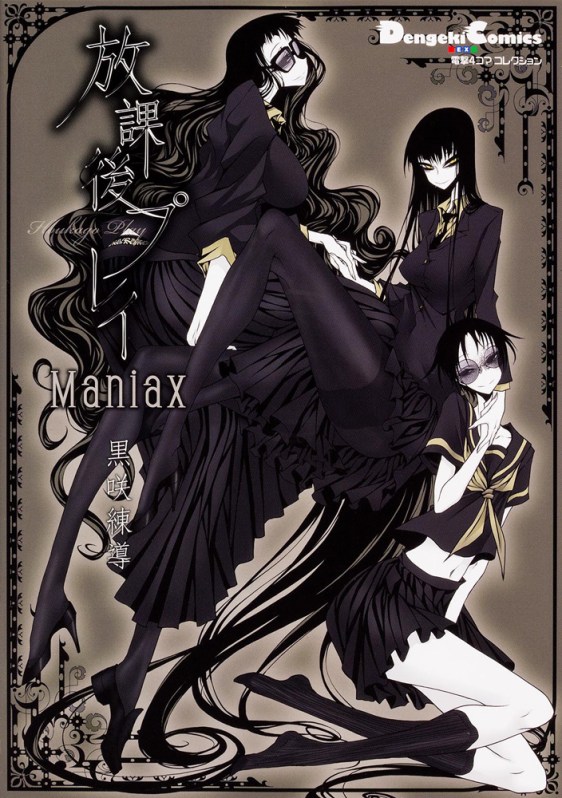
Push characters are like many of the ones stated above. It is as if the characters’ attitudes, visual look, and other qualities invade your space. They pierce and break down the barriers in your heart. Kurosaki Rendou, creator of Houkago Play and other racy titles, specializes in this type of character for both guys and girls. Akashi from Kuroko’s Basketball is also what I’d call a “push character.” They can perhaps be called aggressive characters as well, but I don’t think that it fits entirely neatly. Rather, in shounen terms, it’s more like they’re the “strong fists” of Rock Lee from Naruto or Raoh from Fist of the North Star.

Pull characters, then, are more like the “gentle fists” of Hyuuga Hinata (Naruto) or Toki (Fist of the North Star). Rather than striking actively, their auras are passive and receptive. It is as if they have a gravity or magnetism that draws you to them. Softer, kinder characters would fall into this category, such as Daidouji Tomoyo from Cardcaptor Sakura, Maetel from Galaxy Express 999, or Teppei from Kuroko’s Basketball. It’s as if their warmth envelops your being.
Now there are a few aspects I’m thinking through as I bring out this half-formed way of considering characters. The first is that, many characters probably don’t fall into one category or the other. Sort of like a Myer-Briggs personality test, the “lesser” quality still exists. For example, I’d consider Koizumi Hanayo from Love Live! to be a “pull character” because of her typically shy personality, but the excitement of her two main loves—rice and idols—is enough to transform her into a “push character.”
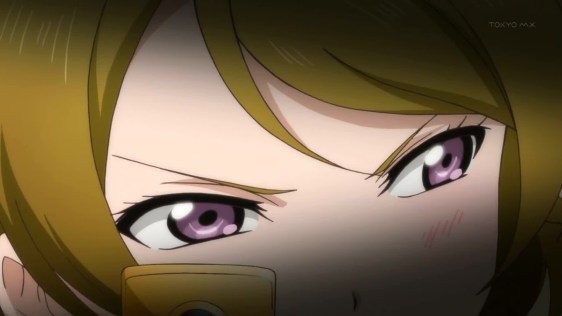
Second, perhaps this distinction is actually entirely subjective, and one person’s “push character” is another person’s “pull character.” Does this render the terms meaningless, or is it more like moe where a broader understanding exists but the minutiae can get incredibly personal?
Lastly, to what extent do these terms match up with the idea of “seme” and “uke” characters in BL. Would “push characters” be those who tend to be seme, while “pull characters” are more commonly uke? If that’s the case, could this be a way to translate those terms to other types of relationships, such as heterosexual, yuri, or whatever other combinations can exist?
—
If you liked this post, consider becoming a sponsor of Ogiue Maniax through Patreon. You can get rewards for higher pledges, including a chance to request topics for the blog.

When it comes to stories about witches, it’s quite common (and perhaps even expected) to have magic be prominent. Whether it’s American sitcom classic Bewitched, Archie’s Sabrina the Teenage Witch comic, or an anime and manga like Witch Craft Works, the influence of spells and sorcery is, if not grandiose, at the very least quite large. The anime Flying Witch is a much mellower series in comparison. As a show where just the lightest of touch of the supernatural appears, it makes for a most delightful series.
Adapted by J.C. Staff from the manga by Ishizuka Chihiro, Flying Witch follows the daily life of Kowata Makoto, a teenage witch who moves in with her cousin Kuramoto Kei’s family as part of her coming of age. Residing in Aomori Prefecture in the Tohoku region of Japan, the people there still have a fairly strong connection to nature, and just going back and forth from school is enough to take in the greenery. For the most part, magic doesn’t make much of an impact, but when it shows up it’s just enough to make their world feel a little bit more unusual, and a little bit more wonderful.
Though the show consistently succeeds at its sparse but effective interaction between the human and witch cultures, the most memorable example has to be in the very first episode. Makoto is walking home from school with her new friend, Nao, when she sees an unusual plant. For anyone who’s familiar with stories about witches and wizards this is a red flag. Sure enough when she gives it a hard tug a mandrake pops out and gives its shrill cry.
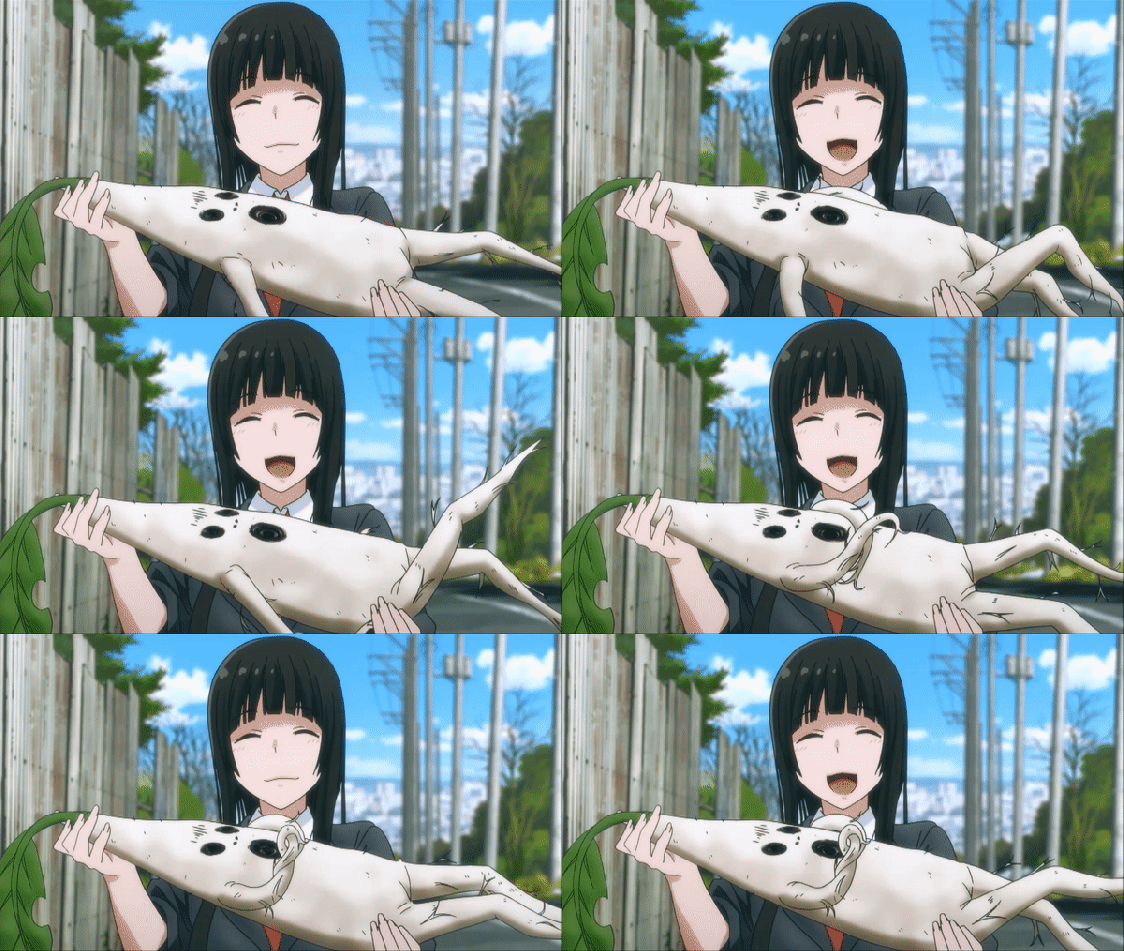
As Makoto cradles the demon plant, she cheerfully explains to an aghast Nao that it’s a good thing that they found a young Mandrake because an adult one can literally send people to the hospital or worse. The anime doesn’t stop being this fairly laid-back series, but the result is that the tiniest bit of magic feels that much more amazing.
What also helps Flying Witch is that all of its characters, guys and girls, are extremely charming. Makoto’s older sister Akane is a more experienced witch whose penchant for mischief contrasts delightfully with her younger sibling. The Kuramoto family is entertaining all around, whether it’s the dad’s thick Tohoku accent being indecipherable for Makoto or Kei trying to get his little sister Chinatsu to try more vegetables.
The fanservice in this show also has a deft touch akin to its use of magic, to the point that it might not even be right to call it fanservice. Just to be clear, generally speaking the female characters in this series are all extremely attractive, but Flying Witch never goes out of its way to show them off. When it focuses on Makoto or anyone else, the anime just lets the audience see how nice they look without lingering or leering.
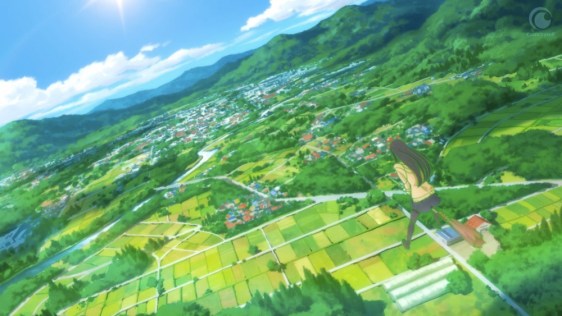
Another notable aspect of Flying Witch is its focus on Aomori, because it at times feels like a promotion for the prefecture. In fact, it makes me wonder if this is one of the reasons it was adapted from manga to anime. The Tohoku region has in recent years been known more for the Fukushima disaster, and a lot of effort has been put into reviving the region in terms of agriculture, tourism, and more. A series like Flying Witch might be just the thing to really get people to visit Aomori and Tohoku again.
Overall, because of how delightfully mellow yet powerful the show’s humor and characters are, Flying Witch has become one of my favorite anime of the year. When I get the opportunity, I’m definitely going to pick it up, possibly in multiple formats. If you want to check it out, you can find the entire anime on Crunchyroll, and Vertical Comics is releasing the manga in 2017.
—
If you liked this post, consider becoming a sponsor of Ogiue Maniax through Patreon. You can get rewards for higher pledges, including a chance to request topics for the blog.
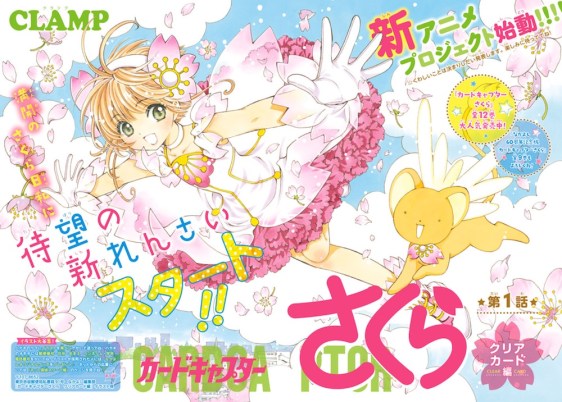
There’s a new Cardcaptor Sakura manga in town—Cardcaptor Sakura: Clear Card Saga—and I practically tripped over myself in excitement to get it. The series is one of my favorite anime and manga of all time, and its charming characters, light yet dramatic story, and cute aesthetic make it a classic of the magical girl genre. But it’s been a long time since we last saw Kinomoto Sakura and the rest of the cast proper (meaning no weird Tsubasa Reservoir Chronicle alternates!), and CLAMP, the creators of Cardcaptor Sakura, have also changed a lot since the late 90s when the original manga debuted.
Thus, while reading I had two questions in mind: in what ways does this new iteration try to capture the old CCS charm, and to what extent does it reflect a more contemporary sensibility?
The Story of Cardcaptor Sakura
The original Cardcaptor Sakura follows Kinomoto Sakura, a 10-year-old girl who is tasked with collecting mystical cards known as Clow Cards. As she retrieves them, the cards give her magical abilities such as flight, and command over the elements. Eventually obtaining all of them, Sakura soon discovers that she must also transform them into her very own “Sakura Cards” and become their new master. After much hardship (and a developing romance between her and Chinese rival/friend Li Shaoran), she succeeds, leaving her to be quite possibly the most powerful magician on Earth.
The Clear Card Saga takes place during the same timeframe as the epilogue of the original manga, when Sakura is in middle school and reunites with Shaoran, who has transferred back from Hong Kong so they could attend school together. In this chapter, we see many familiar faces, including Sakura’s family, her best friend (in fact the best friend in all of anime and manga) Tomoyo, and her magical guardians, Kero and Yukito. The first chapter is mainly there to re-introduce the cast and to set up a reason for Sakura to take up her magic wand once more, and in that respect it is a welcome homecoming.
No Pasta
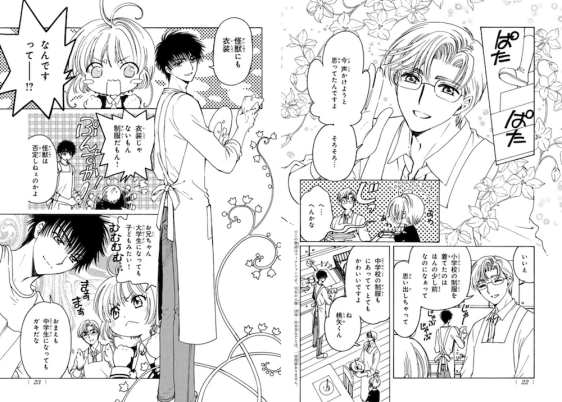
One of the most immediately notable aspects of the new series is that it lacks any signs of current CLAMP’s “noodle people” style that has permeated their works over the past decade and change, wherein characters have unusually long and distended-looking proportions. All aspects of the series seem to be geared towards reviving the original Cardcaptor Sakura look, albeit refined with many more years of experience.
One Card Girl
In one scene, Sakura mentions that she hasn’t had to use magic in a long time, and I find it to be a striking moment for a couple of reasons. First, while it’s impossible forget that Sakura is indeed a magical girl series, I almost didn’t notice that there was little mention of magic prior to her staring fondly at her old wand. Cardcaptor Sakura is well grounded not just in its fantastic elements but also its human relationships (both platonic and otherwise), and the series draws much of its strength from them. Second, while she doesn’t state it herself, she can indeed be argued to be the strongest magician there is, but she still behaves like an innocent young girl with a heart full of love and energy. Would it be strange to compare her to Saitama from One Punch Man?
Tomoyo: Return of the Queen
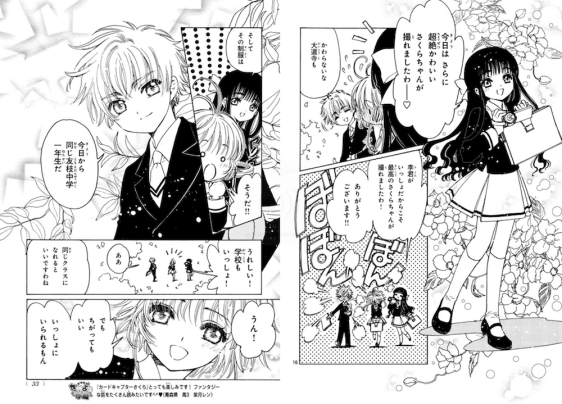
I don’t think I’m alone in saying that, as fond as I am of Sakura herself, Daidouji Tomoyo is the one I’ve been most looking forward to seeing again. For years, she was my favorite anime and manga character, and it actually wasn’t until I discovered Ogiue that this changed. Even so, Tomoyo is still my #2 because of her warm heart, support of Sakura, and series of minor eccentricities. Her grand return is nothing short of spectacular, and I look forward to seeing more of her and her ridiculous wealth (and bodyguards).
Her role in this first chapter is mainly to get Sakura to blush profusely as she takes candid video of Sakura reuniting with Shaoran. Tomoyo is the kind of person who wouldn’t mind just recording Sakura in her daily life, but I’m confident that she’s going to be the most excited of all that Sakura’s going to have to sling some magic again. I can just picture the inevitable stars in her eyes in the coming chapters.
Another interesting point concerning Tomoyo is that she’s no longer in the same class as Sakura. While most of the old Tomoeda Elementary crew has gone on to Tomoeda Middle School, many of them have been split up into different classes. It’s actually a common technique to try and mix things up in a number of series that take place in school.
This means that Tomoyo will possibly be interacting much more with other characters. While it’s not like Tomoyo only ever showed up when Sakura was around, or didn’t talk to other characters on her own, it’s still a significant shift in the dynamics of interaction in Cardcaptor Sakura.
A Premonition for the Future
I want to mention that I probably won’t be chapter reviewing this new Cardcaptor Sakura just because I’m already doing two different series now (Genshiken and Kimi Nakare), and I think three series starts to be a bit too much. However, I might make a post every month or two as a way to look in and see how everything’s going.
Thus far, it’s a great start, and even if this chapter mostly treads familiar territory it does so in a way that gives me faith that the series will turn out well.

As a final side note, there’s a character poll at the beginning of this issue of Nakayoshi, to vote for who should appear on the cover, and Sakura is #2. While there’s no indication that placement equals popularity, I have to wonder, or perhaps hope. After all, #3 is Momoka, the morally bankrupt protagonist from Sabagebu!
If the young readers of Nakayoshi are fans of Momoka, I am both looking forward to and dreading the future. Sakura might be a safer bet overall, though I wonder if she is still as timeless as she seems.
—
If you liked this post, consider becoming a sponsor of Ogiue Maniax through Patreon. You can get rewards for higher pledges, including a chance to request topics for the blog.
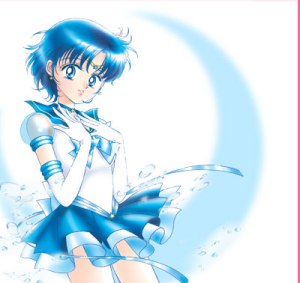 Sailor Moon was one of the seminal shows of my anime fandom. I recall the joy of waking up every weekday morning to see what would happen next just as much as the embarrassment of being a Sailor Moon fan (I was a dumb kid for sure). However, as formative as that series was in certain respects, one thing I had only heard about but never directly experienced was the Sailor Moon manga. Now, 20 years later, thanks to Kodansha Comics’ re-translation of not only Pretty Guardian Sailor Moon but also its predecessor Codename Sailor V, all of that’s changed.
I don’t think Sailor Moon needs much of an introduction at this point, but just to cover my bases: A young girl named Tsukino Usagi discovers that she has magic powers that lets her transform into a costumed fighter named Sailor Moon. Along with her allies whom she gathers over time, the Sailor Guardians, she fights against numerous forces threatening the Earth. What makes Sailor Moon so memorable is its ever-continuing story of twists and turns, the powerful image of strong female characters fighting without needing to be rescued by a man (though occasionally a man will show up to give some moral support), and just the way it sparks imagination in audiences young and old.
The manga is no exception, though if there’s anything that stands out immediately about the Sailor Moon manga, it’s the relatively brevity compared to its animated counterpart. Instead of a 200-episode TV series, we have instead a 12-volume manga (15 if you count Sailor V and some additional side stories). While this typically implies a great deal of filler or extra stories to pad out entire seasons, and this is indeed true of Sailor Moon, it’s rarely to the degree seen here. Kenshiro in Fist of the North Star takes 26 episodes to reach his first major adversary, Shin, but only one volume of manga to do the same. The Sailor Guardians fight Jadeite in the anime for 13 episodes; he lasts only 3 chapters in the manga. Sailor Moon cuts through villains and entire story lines like a hot knife through butter, and covers most of the major arcs that the anime does in a fraction of the time.
This is a significant change of pace compared to the anime, which is based around a kind of episodic peek into the world of Sailor Moon. Each week, there would be a monster to fight and a problem to solve, and while the overall story would gradually move along, it’s sort of like visiting some friends. The feel of the show is slower, and I don’t mean that necessarily in a bad way. With the manga, however, everything moves forward at such a fast clip that I feel as if the dynamism of the characters themselves, as heroic figures, as beings with style and physicality, progress the narrative through their bodies and the actions they take with them. There’s a kind of connectivity from panel to panel that’s achieved through the statuesque shoujo designs of the characters and their fights that can’t be found to quite such a degree in the anime, even when taking into account the elaborate transformation sequences.
By the time Sailor Moon finishes, I get the sense that Usagi herself has changed tremendously. However, I’m not entirely sure if her maturation is entirely convincing. There are moments when Sailor Moon seems to have learned important lessons about doing what’s right/right for her, and then there are others where the manga tells you that she’s grown, or she suddenly shows a greater sense of compassion and responsibility, but it seems to have come from out of nowhere. In a way, having the story move as quickly as the manga does can make some events feel a little too rushed, and Usagi’s character development might just be one of those aspects. On the other hand, some of the weirder aspects of Sailor Moon (Chibi-Usa’s entire story) come and go just as quickly.
As a final note, I’d like to just give an aside about my favorite character, Sailor Mercury. It’s funny to think about what drew me (and a lot of other boys growing up on Sailor Moon) to the character. To put it simply, I was a nerd, and she was a nerd too, one who prized knowledge and study and interest in books and science. These days, that’s the norm for a lot of characters, and specific attention is being given to encouraging more girls to get into math, science, and the highest of higher education. Nerd girls are so expected of the world that they’ve entered the realm of stereotype. That’s how much things have changed since I first saw Sailor Moon, but the admirable qualities of its characters, whether in manga or anime, are what help make it timeless.
—
If you liked this post, consider becoming a sponsor of Ogiue Maniax through Patreon. You can get rewards for higher pledges, including a chance to request topics for the blog.
This post was sponsored by Johnny Trovato. If you’re interested in submitting topics for the blog, or just like my writing and want to sponsor Ogiue Maniax, check out my Patreon.
—

There have been many attempts over the years to dethrone the Japanese children’s entertainment juggernaut that is Precure, but while Precure is squarely in the realm of the “fighting magical girl,” most of its challengers are themed around mahou shoujo’s sister genre: pop idols. This includes Pretty Rhythm, PriPara, Lil Pri, and the subject of today’s post, Aikatsu!
Aikatsu! began in 2012 as a multimedia franchise consisting of games, manga, and anime. The animated television series, created by Sunrise (of Gundam fame), follows Hoshimiya Ichigo, a girl who enters the idol training school Starlight Academy after being inspired by its top star, Kanzaki Mizuki. Together with her best friend and idol fan, Kiriya Aoi, and others she meets along the way, they engage in idol katsudou, or “idol activities.”

Sunrise at this point is well known for another popular idol anime, Love Live!, and despite the fact that they don’t share that much staff, the two shows are similar in feel. Both have an overall lighthearted sense of fun and engaging character interactions combined with learning and personal development. Both feature bizarrely comedic moments (the episode where Ichigo gets into an “Obari Pose” and chops down a christmas tree is famous). Both series are also so entertaining in these respects that the actual “idol performance” moments are comparatively less interesting.

However, one curious aspect of Aikatsu! that differentiates it from Love Live! (and many other anime) in terms of narrative is that Ichigo and the other idols don’t seem to have a concrete goal to aim for. The girls in Love Live! want to save their school and then win the Love Live. Naruto wants to become Hokage. Ichigo’s motivation is this vague sense of “becoming an idol,” but by the first few episodes she already is one more or less, and there just seems to be this general sense of forward progress. This is also what differentiates it from other more episodic works, or series such as Hidamari Sketch.
Aikatsu! has just enough on-going threads in the background and pays attention to its characters’ growth that the series carries a nice sense of continuity. Aoi becomes the mascot for a crepe company in an early episode, and after that you can always see a copy of the advertisement poster featuring her in Aoi and Ichigo’s room. The show also drops hints that Ichigo’s mom is a former idol, and as I continue to watch the series I’m just anticipating that moment where Ichigo discovers the truth. Every time her mom appears on screen, I think, “Will this be it?!” That desire to see Ichigo’s realization is actually one of my main motivations for continuing to watch.

There’s one last element of Aikatsu! I want to discuss. More specifically, it’s a theory pertaining to Aikatsu!‘s relationship with Precure. When watching Aikatsu!‘s core cast, I could not help but be reminded of the cast of Doki Doki Precure!, which came out in 2013. While the characters are different enough to not feel like copies of each other, Mana’s blonde hair and pink color scheme in her transformed state resembles Ichigo’s, Rikka (blue) plays the role of the more level-headed and smarter best friend just like Aoi, Alice resembles Arisugawa Otome (orange) not only in name but also in appearance, and Makoto’s occupation as an idol (as well as her serious personality) feels akin to Mizuki. I suspect that Doki Doki Precure! may have taken some inspiration from Aikatsu! but I can’t be certain of this. That said, I recently checked out some of the character design notes for Doki Doki Precure! and noticed that Cure Sword (Makoto)’s design originally had longer hair, which would make her more stylistically similar to Mizuki from Aikatsu!
Aikatsu! has been a series on my radar for a while, that I had only briefly engaged with, but given just how entertained I’ve been by it I definitely want to watch more and talk more about it. Expect future posts, maybe?
 OGIUE MANIAX