OGIUE MANIAX

Anime & Manga Blog | 50% Anime Analysis, 50% Ogi

‘Tis the Seasoning: Ogiue Maniax Status Update for December 2016

Is it December already?! It actually feels like I just got done writing the update for November, and now we’re at the end of the year. Much love to all of my sponsors on Patreon for being with me for the entire year!

General:

Johnny Trovato

Ko Ransom

Alex

Diogo Prado

Viga

Yoshitake Rika fans:

Elliot Page

Hato Kenjirou fans:

Elizabeth

Yajima Mirei fans:

Machi-Kurada

November was the 9th anniversary of Ogiue Maniax, so I wrote my thoughts on how the blog’s been going and where I think it’ll head next. I’ve since reflected a bit further on what I said there. While I primarily look at Ogiue Maniax as a place to share thoughts and ideas, I think I’ve been a little sparse in terms of denser, heavier content as of late. I’m looking to write better and with greater insight as I move forward, but also balancing it out with shorter, lighter posts, much like a three-course meal.

It was a long time coming, but I finally posted my feelings on the dismissal of Precure as insignificant because it’s not Sailor Moon. As a fan of both I feel like this is a recurring issue, and I hope that magical girl enthusiasts and just anime watchers in general can come to appreciate Precure better.

I also began my pseudo-series of posts about characters I love, with Inukami Kyouko from the volleyball manga Shoujo Fight. As Ogiue Maniax was built on a foundation of character appreciation, I felt that it was kind of a nice return to my roots, so to speak.

This month’s Patreon-sponsored post sees me tackle the third season of Aikatsu!, which passes the baton from heroine Hoshimiya Ichigo to young upstart Oozora Akari. I mostly talk about the idea of switching protagonists and how the series handles it.

Finally, I want to give attention to something I wrote the day before the US presidential election. Even after all the chaos that has ensued, I want people to read it and perhaps take it to heart. I think it is all too easy to want to silence others if one believes others to simply be hateful and ignorant, but that merely creates greater animosity in my opinion. It’s ostensibly an anime-related post because I talk about Legend of the Galactic Heroes!

Look forward to the rest of December’s posts! I’ve got a new Anime Secret Santa review on the way, my annual “best characters of the year” post, and more!

The Fujoshi Files 163: Angel

Name: N/A
Alias: Angel (エンジェル)
Relationship Status: Dating?
Origin: Girls Saurus DX

Information:
A member of the Manga Study Club at her high school, Angel works as an assistant for the club president Maria on her BL manga. In particular, she works on a manga based on the student Chiryuu Shingo, who is known for avoiding women. Angel claims she has a boyfriend, though this boyfriend is supposedly in a parallel universe.

Fujoshi Level:
Angel is considered to be a peer to her fellow club members in terms of being a fujoshi.

Save

The Fujoshi Files 162: Kitty

Name: N/A
Alias: Kitty (キティ)
Relationship Status: Single
Origin: Girls Saurus DX

Information:
A member of her high school’s Manga Study Club, she acts as an assistant for the club president Maria on their popular BL manga based on one of the students at her school, Chiryuu Shingo. At one point she argues about how many times Chiryuu should orgasm in a specific scene.

Fujoshi Level:
Kitty gets into a fight with one of her fellow club members because she supports a pairing of characters named Keith and Mike, in that order.

Save

Amae Koromo and Her Weird Japanese Speech Patterns

Amae Koromo, demon of the high school mahjong world, is the first major opponent in the manga Saki. Able to oppress her opponents using the power of the moon, her physical appearance is deceptive: though she’s a year older than Saki herself, she resembles a small child, which causes her grief to no end. Those of you who’ve seen the anime and read the manga, however, might not be fully aware of just how much Koromo’s strange mix of naivete and maturity also comes across in her speech.

When Koromo speaks, the two main elements to notice are that 1) she often mispronounces words and names like a child would, but that this is contrasted with 2) she uses a heavy, heavy amount of classical Japanese idioms and obscure, old-fashioned vocabulary. So just as often as Koromo will call Nodoka “Nonoka,” and act like a spoiled brat, she’ll throw in phrases like 黄壌 (koujou, afterlife) and 神算鬼謀 (shinsan kibou, ingenious scheme). Her Japanese is so dense and difficult at times that Japanese people themselves have trouble. If you do a search for many of her lines, you’ll find even Japanese speakers asking, “What in the world is she saying?”

The result is that Koromo comes across as a girl who is very well-read and intelligent, but also sheltered and unaware of what the commoners enjoy. This, as readers of Saki know, is exactly what she’s like.

This site collects Koromo’s idioms up to Volume 8 of the manga, while this one has some other examples of her strange vocabulary. And as always, may the Haitei Raoyue be with you.

Ogiue 009: Ogiue Maniax 9th Anniversary

Today marks nine years of Ogiue Maniax. Normally, this would be a post reflecting back on just the blog itself, but the world is in such a crazy spot at the moment that the times of a small anime blog seem to pale in comparison. Still, while a huge part of me wants to do more to help my fellow human beings, I still plan on keeping up with all the anime and manga out there.

Nine years is not that far from eight, but somehow it feels like so much more. Maybe it’s because the big “10” is on the horizon, and that’s a pretty crazy place to be. Most anime blogs last maybe two to three years, and somehow I’ve been chugging along. I attribute it to stubbornness, perseverance, and a willingness to let half-baked and flawed ideas get posted (sometimes typos and all). A friend recently told me a famous quote: “Perfect is the enemy of good enough.” I think, when it comes to the things I’ve accomplished in my life, especially this blog, that accounts for a good deal of my success.

Perhaps the biggest topic of the entire year for Ogiue Maniax is the end of Genshiken itself. In my final chapter review, I wrote about all the good times I had with the series, and how it impacted the blog, and the takeaway from all of that is simply, Genshiken changed and so did Ogiue Maniax. What it means to be a fan or an otaku, the cultural associations with these ideas, has morphed significantly over the course of nine years. In a recent episode of Anime World Order, they discussed the increase in the number of fashion designers as guests at Anime Weekend Atlanta (and cons in general). Just thinking about how we live in a world where fashion is a big deal to nerds says to me that we’re in a very different place.

Genshiken reflected these changes well, which makes me want to go back and take another look. For that reason, I am making an announcement:

Starting next year (most likely January 2017), I will be re-reviewing the original Genshiken manga. Rather than going chapter by chapter, I am going to be looking at it one volume at a time on an approximately bi-monthly schedule. I already reviewed the series a long time ago (for my first anniversary!), but I expect to get a new perspective on an old friend, especially with knowledge of Nidaime.

Another sign that Ogiue Maniax is nine years old is that the blog itself looks like it comes from nine years ago. I’ve considered changing the design at some point, but I’m just not sure. Blogging itself in this format seems to have left the lands of trendiness long ago as well, and perhaps I’ve stubbornly refused to adapt to changing times in that regard. YouTube will never be my medium, but I wonder if it’d be worth it to really mix things up.

While not exactly a stylistic change, in light of recent events in the world I’m considering something. I might make more posts that veer towards political thought, though not in a way that takes over Ogiue Maniax or makes it any less of an anime blog. One can argue that just about any action can be political (including actively tried to avoid it), but what I’m thinking about is writing more about the goings-on of politics with respect to the US, Japan, and elsewhere, and how they potentially impact fans, production, and the on-going conversations we have about respect, anger, diversity, and so on. However, I am aware of how much the strength of my writing comes from trying to see all sides of a situation and I wish to not get so embroiled in thinking of “sides” that I don’t challenge my own viewpoint on a regular basis, so I don’t wish it to become too much a part of any “cause.” It’s a balancing act that I’m still trying to figure out as a person, and I still fully intend on maintaining my love of anime’s sheer variety.

That was a bit of a ramble, but those are my genuine thoughts and feelings. I hope you’ll hang on with me as we jump into 2017 and reach a decade of Ogiue Maniax.

I Heart Volleyball Captain Inugami Kyouko

inukamikyouko

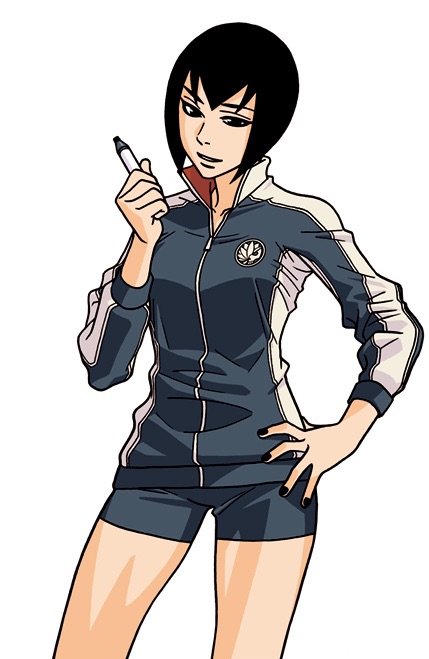
I recently found another favorite manga character: Inugami Kyouko from the volleyball manga Shoujo Fight by Nihonbashi Yoko. As captain of the Kokuyodani Girls’ Volleyball Team, she’s a trusted leader whose insight and sense of caring for her teammates are as impressive as her talent for the game itself. However, she’s also a huge troll always eager to set up a practical joke, and having those qualities all wrapped up into a single awesome package is what wins me over as a fan and admirer.

Looks-wise, Inugami has deeply piercing eyes, a limber physique, and almost always sports a grin that belies her fondness for ribbing others. It’s that smile which draws my attention most of the time. This is because it’s either setting up a moment where she’ll do something out of the kindness of her heart for one of her teammates, or is the precursor to one of her pranks. The fact that it’s hard to tell which is which is part of the thrill of her character.

Inugami’s jokes come in two forms. The first is a verbal quip, where she’ll nonchalantly comment about something that embarrasses one of her teammates. For example, when their new coach puts the entire team on a fast, one of the other girls comments that it shouldn’t be necessary because all of them are in good shape and can hardly be called overweight. Inugami then suddenly appears behind them to try and correct them: one of her fellow third-years has trouble keeping off the weight. For her trouble, she gets smacked upside her head. This isn’t to say that I think fat jokes are funny, but rather that Inugami’s delivery is where the humor lies.

inukamikyouko-basketvolley

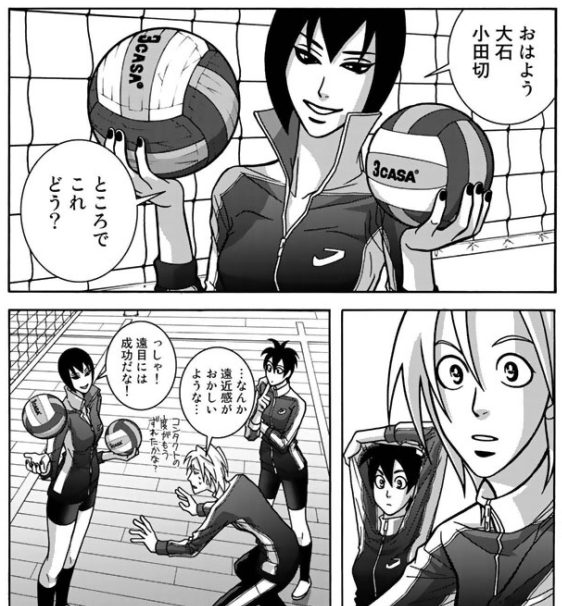
The second joke type is a prop gag. Inugami’s hobby is constructing items and scenarios that will aid her trickster attitude. She’ll paint a basketball to look like a volleyball and then try to deceive the first-year students into playing with it. She’ll make an entire fake souvenir gift box of volleyball mascot manjuu. She constructs round tables in the vein of King Arthur’s. Once, she even tried to get the girls to play a game in a pool just because it’d be funny. In most cases, she again usually gets socked for her efforts.

miyako-rollingarms

mai_yuuko_buddha_pose_ep4

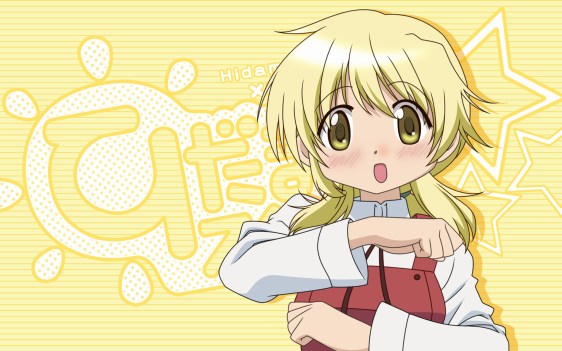
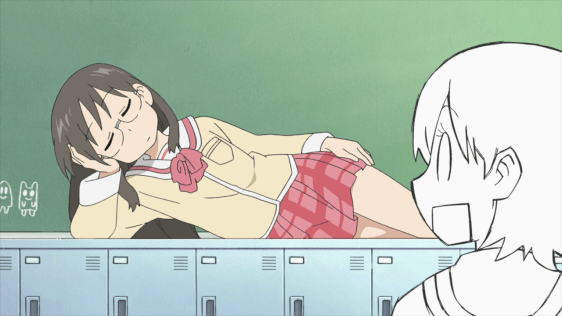
If there are any characters I might compare Inugami Kyouko to, it would actually be a mix of Miyako from Hidamari Sketch, who similarly makes weird objects that no one else would think up, and Mai from Nichijou, who is the most supreme troll in existence. The fact that she ends up being the “boke” to other characters’ “tsukkomi” roles is what I think keeps her charming. She isn’t really getting away with her trollish behavior, so she never feels cruel. If anything, Inugami it speaks to a kind of strange innocence in her character, that she’s always interested in having fun.

Save

Yowamushi Pedal: Brains, Heart, and Body

yowamushipedal-firstyears

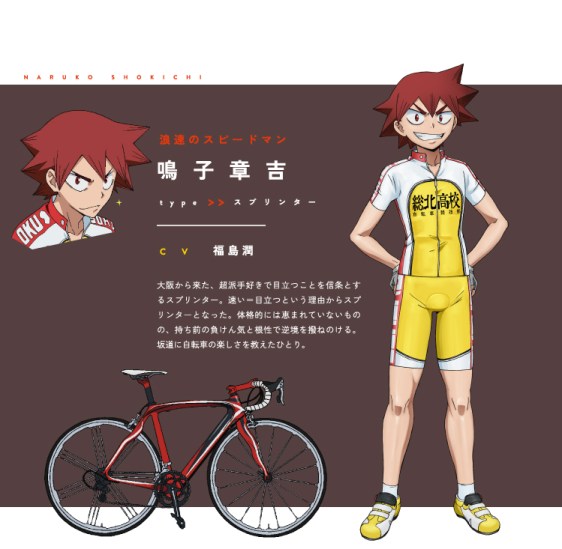
As a sports manga and anime with an enormous cast, Yowamushi Pedal is home to a variety of characters designed to contrast with each other in terms of personality and approach to competitive bicycle racing. This certainly applies to the first-years when the series begins, as all-rounder Imaizumi Shunsuke, speedy Naruko Shoukichi, and high-cadence protagonist Onoda Sakamichi are all differ from one another significantly. In looking more closely at these three characters, however, I find that they resemble professional fighting game player Laugh’s theory of the Three Fighting Game Player Archetypes. My aim here is to elaborate why I believe this to be the case, and which archetypes apply to these three.

As described by the video above from Core-A gaming, the three categories of players are brains, heart, and body. While this distinction is not exclusive to fighting games or even gaming or competition in general, I find that Yowamushi Pedal with its theme of cycling has a lot of parallels with fighting games. Although fighting games are typically 1-on-1 matches and bicycle racing is shown to be a team sport on the biggest stages, the emphasis on how a human being competes through the use and fine-tuning of their equipment is a point of commonality. At one point, a character in Yowamushi Pedal even talks about how, unlike other sports, you don’t need to be the biggest or the strongest because what matters is how you work with your bike. Replace that with “joystick” or “controller,” and the similarities start to become clearer.

In the training camp arc of Yowamushi Pedal, where the characters compete to see who will represent Sohoku High School in the Inter-High National Tournament, club captain Kinjou purposely messes with the first-years’ bicycles in order to challenge them to work on their major weaknesses. In doing so, he reveals the archetypes that Imaizumi, Naruko, and Onoda embody.

imaizumi-shunsuke-full-1565241

Imaizumi is a “brains” type, or someone who relies on superior knowledge and study to win. When Kinjou removes his ability to shift gears, it initially throwsImaizumi for a complete loop. Just as a brains-based fighting game player knows frame data like the back of their hand, Imaizumi had up to that point relied on his optimal knowledge of gear shifting to tackle any level of slope while cycling. Although he eventually overcomes this flaw during the training camp, his sheer joy when he’s finally able to reunite with his cherished gear shifters shows just how much the “heady” part of bicycle racing factors into Imaizumi’s approach to the sport.

naruko-shoukichi-full-1565240

Naruko, then, is a “heart” type, who prefers to “feel” things out. In fighting game terms, this is someone who is confident they can outmaneuver you in unorthodox situations and “mind game” you. His advice to Onoda to surprise Imaizumi with a technique in a previous race, as well as his own “Sprint Climb” maneuver, are indicative of a similar quality. At the training camp, Kinjou removes his lower handle bars, thus limiting Naruko’s ability to adapt and be as creative as he’d like. Unable to do things “in the moment” as a result, Naruko is forced to work around it.

onoda-sakamichi-full-1565236

That leaves Onoda as the “body” type. While this might not make sense given how Onoda is the “heart” of the team, that’s a different kind of conception of heart as a spiritual center. Instead, the reason why Onoda is a “body” cyclist is because of the fact that his high cadence is the linchpin of his riding style. Just as a “body” type in fighting games always has things like technical precision and perfectly executed high-damage combos to fall back on, Onoda’s ingrained ability to raise and lower his cadence like the pedals are an extension of his body lets him overcome situations where he might be “strategically” beaten. And just like the other two, when his ability to freely pedal as quickly or as slowly as he’d like is interfered with, he starts off feeling utterly helpless.

Imaizumi the brains, Naruko the heart, and Onoda the body. Together, they create a complete being, which is perhaps why they work so well together. What about the other characters, then? I’ll leave you to figure them out.

If you liked this post, consider becoming a sponsor of Ogiue Maniax through Patreon. You can get rewards for higher pledges, including a chance to request topics for the blog.

Giver of Thanks: Ogiue Maniax Status Update for November 2016

November is anniversary month for Ogiue Maniax, but I’ll be saving that for its own dedicated post (if I remember, that is. Someone please remind me!).

A big thanks to this month’s Patreon sponsors. You might not understand how much I appreciate your help, but I’ll explain at the end:

General:

Johnny Trovato

Ko Ransom

Alex

Diogo Prado

Yoshitake Rika fans:

Elliot Page

Hato Kenjirou fans:

Elizabeth

Yajima Mirei fans:

Machi-Kurada

Before going into an overview of my favorite posts of the month, I want to talk a bit about my appreciation to my readers for being curious as to what I have to say. As I go through life, I meet more and more anime and manga fans of different tastes and philosophies, but often I feel it can be difficult to engage in conversations about the nitty-gritty of anime and manga as ways to explore thought, society, emotion, and more. Talk about anime and manga floats at the surface, or, if it delves deeper, is often connected to value judgments or inside looks at the mechanics of industries. I know my audience isn’t especially large, but I am grateful that the topics I’m interested in at least pique your curiosity.

That being said, I know I’m really bad at responding to comments on a frequent basis, and I intend to work harder at fostering actual conversation on Ogiue Maniax. Also, because I’ve been more review-heavy as of late, I’m wondering if this is steering away from the strengths of the blog.

As for this month’s post highlights…

First, at long last, is a final review of one of my favorite manga in recent memory: Mogusa-san. If you love food manga, this is right up your alley.

Second, out of the many films I watched over October, Miss Hokusai has to be the one I enjoyed the most. ALso, check out Kizumonogatari Part II and Shin Godzilla.

Third, I took a different approach to covering New York Comic Con this year, and have been writing response essays to things that caught my attention. If you like giant robot toys, check out my thoughts on Soul of Chogokin Voltron and Megazord.

Lastly, I wrote a bit about Star Ocean EX, and just how 2003 it is.

I’m not sure what I’ll have in store for November, but I’m thinking of devoting a significant chunk to talking about some of my favorite recent characters.

Third Time’s the Charm?: Kimi xxxru Koto Nakare, Chapter 6

kiminakare6-hayatoshingo Whenever I read a chapter of Kimi Nakare, it always feels like the next chapter might be the end of the story. Chapter 6 not only follows this, but the vibe is stronger than ever.

Summary

In spite of whatever hopes might be lingering, WARP’s days as an idol group are numbered. As a final farewell to their fans, their manager has arranged one last massive meet ‘n’ great with the fans.

Not long after, Hayato and fellow WARP member Shingo are having a bath time discussion about their futures. While Hayato believes himself to be ill-suited to the idol path, especially because his initial motivation was just so he could meet Nobuko, Shingo responds that Hayato’s attitude (and idiotic qualities) are what make him a natural idol.

In a flashback to Shingo’s high school days, we see a conflicted Shingo unsure of whether the idol path is for him, not least of which is because his hospitalized father is very much against it. Shingo ends up bumping into a girl at the hospital who turns out to be a fan of idols. Accidentally revealing that he’s an idol from the same agency as her favorite, Shingo listens to her story of how idols helped her to keep living in spite of her illness, which strengthens Shingo’s determination to continue his idol career no matter the odds.

The next day, Hayato is discussing the upcoming meet ‘n’ great with Nobuko and Natsumi. When Nobuko promises that she’ll defend him from all of the fangirls, Hayato confesses his feelings for her once more—this time in front of the whole class!

Urgency

kiminakare6-3rdconfession

As I briefly mentioned in the introduction, Kimi Nakare often feels like it’s moving at a breakneck pace in terms of typical romance manga developments. It’s one thing to have a confession in Chapter 1, but it’s another to have three confessions in six chapters. Not only that, but each of them raise the stakes more and more, because now it’s not even a secret among close friends anymore. While I could see the class not taking it seriously, especially because Nobuko has made a running gag out of her on-screen obsession with Hayato, I think they’re going to realize what’s going on sooner or later.

The sense of urgency isn’t limited to just the main romance, either. Just the fact that a scandal has already dissolved Hayato’s idol group and put him on a slightly different path is the kind of development that would usually occur late into a manga’s life. In some ways, it feels like early Kimi ni Todoke, where every time you think the story would move one way, it would swerve in the other direction, and usually for the better. Can Kimi Nakare keep up this pace? It’s something I welcome, and while I hope the series does well, I also hope that it wouldn’t fall into the trap of becoming increasingly meandering if it reaches major success.

The Side Cast is Growing on Me

kiminakare6-hospital

In my review of Chapter 5, I mentioned that the side characters aren’t nearly as interesting as Hayato and Nobuko. While I still stand by that statement, I think the other characters are starting to come into their own. I actually previously had trouble keeping track of all the guys in WARP, but now I have a firmer grasp of Shingo as a character. We’ve yet to see more characters on Nobuko’s side of the story, so I’m curious as to what might be in store there.

The Irony of the Natural Idol

After reading Shingo’s comments to Hayato about he’s a natural-born idol, it made me think about how idols are presented to the world, and in turn how idols are presented in Kimi Nakare. Idols, male or female, often project an image of both innocence and sensuality, and this quality is central to the story of this manga. There’s the scandal with WARP member Jirou and his having a girlfriend, but there’s also the idea that the idol business has a dark side. In the real world, idols are often controlled day-in and day-out by their agencies, and it’s what leads to the criticism that idols are just a way to make money off of gullible fans. For me, I think that it can be healthy as long as there’s a tacit understanding that it’s a shared fantasy, something akin to pro wrestling.

If Hayato is a natural idol, it means that he achieves that innocent sensuality without effort, through both appearance and attitude, and it’s exactly that kind of demeanor that you’d expect to get subsumed by the idol engine. To be in the right spot, he has to be just strong enough to never stop being himself, but also just “dumb” enough to stay naive. It’s a precarious position that is preserved in part by his love for Nobuko. That, of course, is also the other irony, that what makes him a natural idol is also what is liable to get him kicked out of the business.

One might also say that his masturbation scene in Chapter 4 represents that combination of innocence and sensuality perfectly. Here is this handsome yet goofy guy who just can’t hold back his very real passion for the girl of his dreams. Her being not beautiful by conventional standards only adds to that rather special moment of characterization.

Last Thoughts

Idols are all well and good, but I want to see more of Nobuko!

If you liked this post, consider becoming a sponsor of Ogiue Maniax through Patreon. You can get rewards for higher pledges, including a chance to request topics for the blog.

Mogusa-san: The Joy of Superhuman Eating 

mogusasan-unajuu-small

I love to eat. Just thinking about all the varieties of cuisine out there in the world, with dishes for the rich and the poor, gives me pure joy. That’s why one of my favorite manga over the past few years has been a food-themed series called Mogusa-san. The simple story of a cute and gluttonous girl who has mastered the art of stealth eating, I’ve already written two posts praising the series up and down. I recently picked up the most recent volumes and was surprising to learn that Mogusa-san as I originally knew it had come to an end. Volume 10 actually marks the conclusion to Mogusa-san, but it turns out that there’s already a sequel (more on that later). In any case, this gives the perfect opportunity to write an overall review of the manga.

Mogusa-san follows Mogusa Minori, a seemingly normal girl with a seemingly normal appetite. However, one day her classmate Koguchi Torao notices something odd: while Mogusa appears to be writing in class, she’s in fact snacking on a pretzel stick. The reason no one notices is that her pantomime is so convincing that most people assume she’s just using a normal pen. It turns out that Mogusa’s appetite is near-insatiable, and that she sustains herself by eating constantly, hiding her food in plain sight. After Koguchi reveals that he’s aware of her secret, the two of them become “food buddies,” visiting snack shops and other food establishments to bask both in the quantity and quality of various foods.

mogusasan-popsicles-small

Generally speaking, there are two different types of food manga. There are the series that bask in portraying the simple joy of eating and drinking, such as Sweetness and Lightning. These works portray characters with wide-eyed expressions as food brings them true joy, resulting in “food responses” that are intense but not especially over-the-top. Then there are the manga that make eating and drinking the most powerfully dramatic and sensual experiences possible. These are the Yakitate!! Japan-type series, where tasting and creating foods becomes a religious experience fueled by impossibly superhuman abilities. One thing I love about Mogusa-san is that it possesses elements of both worlds.

When Mogusa has to engage in covertly satisfying her never-ending munchies, the series emphasizes the physical limits that Mogusa pushes in pursuit of eating. Whether it’s eating a stick of dango in 1/60 of a second, hiding candy inside the corners of her jaws in case of emergencies, she always has a trick (or a pastry) up her sleeve. However, when she’s allowed to just eat without feeling any sense of shame, especially when she’s with Koguchi, the look on her face as she bites into a succulent piece of meat or slurp some delicious ramen carries the same joy as a tamer degree of food manga. While Mogusa’s expressions are near-orgasmic at times, they’re not “actually orgasmic” as one would find in Food Wars!

mogusasan-kabayakitarou-small

While the concept might seem like it overstays its welcome, and a part of me expected that might be the case, Mogusa-san actually provides both enough narrative development and a sufficiently robust supporting cast that the series never gets tiresome. Koguchi and Mogusa bond over the course of the ten volumes in a beautiful way. Characters like Taira Chigumi (Mogusa’s opposite in that she has developed ways to hide the fact that she has the palate of a 10-year-old) and Tabe-chan (a professional competitive eater who considers Mogusa her life-long rival) add a surprising amount of variety to the theme of eating. Because these characters grow as well, Mogusa-san shows itself to be remarkably heartfelt while still remaining true to its core themes. Although there’s clearly a decent amount of experimentation in order to keep the concept in motion, the entire manga ends in an extremely satisfying way that leaves little room for disappointment.

mogusasan2-splash

So where does that leave the sequel? For whatever reason, it was decided that Mogusa-san would take on a new form, and it has now been replaced by a new series called Mogusa-san wa Shokuyoku to Tatakau (“Mogusa-san Fights With Her Appetite”). Taking place after a short timeskip, Mogusa is now a college student in Tokyo, and because she no longer has her family to support her regularly, she’s trying her best to refrain from eating all the time. The result is that Mogusa-san desperately tries to stick to “only” three meals a day that, while enormous in quantity for the average human being, are clearly signs of Mogusa trying to practice willpower and diligence when viewed in the context of the previous series.

One of the two most notable changes in this new setting is that Koguchi is no longer the perspective character, and readers are instead more privy to Mogusa’s own inner thoughts. The other big change is that there appears to be less of the shounen-esque “wacky stealth eating,” giving the sequel a somewhat mellower feel. A part of me definitely misses the old style, but I am quite curious about how college life is going to treat Mogusa.

You’ll know in just one chapter if you’re going to like Mogusa-san. For me, I think it took about four pages. It’s just a food manga that has never let me down, and I’m more than happy to keep reading it with the awareness that Mogusa Minori is a kindred spirit.

If you liked this post, consider becoming a sponsor of Ogiue Maniax through Patreon. You can get rewards for higher pledges, including a chance to request topics for the blog.