Nahuel and the Magic Book is a 2020 Chilean-Brazilian co-produced animated film whose down-to-Earth yet wondrous approach to fantasy I really enjoyed. In certain ways, it reminds me of The Lord of the Rings, despite the markedly different setting of a more contemporary real-world setting.
Nahuel is a young boy afraid of the sea, which causes problems for his fisherman father. Worried that he’ll never be of help to his dad and will always be seen as a screw-up, he desperately wants to overcome his phobia. When he discovers the Levisterio, a magic book said to be the most powerful of all, he steals it in order to use the bravery spell contained within. However, bringing the book out into the open makes it a prime target for an evil sorcerer who has been seeking the tome for a long time.
Likening anything to The Lord of the Rings might seem trite and a little meaningless, but the reason I make the comparison is because of the humble qualities of each story’s protagonist. Frodo is characterized as being no one special, especially not compared to the figures who accompany him on his quest, but it’s that lack of remarkableness that makes him suitable to deliver the One Ring to Mount Doom. Similarly, Nahuel’s ambitions are anything but grand—overcome a fear of the sea and help his father—but that’s also what makes him the right bearer of the Levisterio. Where others would abuse its near-limitless powers, his desires are from a simpler and kinder place. Anybody can imagine themselves as Nahuel, and his story and characterization are no lesser for it.
I don’t know much about South American folklore and religion other than that magic and witchcraft are such a part of the region that they’re even incorporated into the way Christianity is practiced. From that perspective, the way the magical and fantastical are portrayed in Nahuel and the Magic Book feels very natural and almost effortless—which is usually a sign that a great deal of effort was involved. There is a sense that magic is indeed far removed from Nahuel’s normal life, but is also just there and ever-present if only one looks.
Although I’m not a kid, I feel that Nahuel and the Magic Book has real potential to resonate with young viewers. That worry of being a disappointment to one’s parents is also a powerful and relatable fear for children as well as adults, and the world it portrays is one where love shines through even when things get dark and scary.
A new chapter shows Jin’s mom, Reika, in all her glory. But before I dive into the review, a few important pieces of news:
First, Volume 6 of Hashikko Ensemble is currently on sale in Japan. This volume doesn’t appear to have any limited edition extras, which is good for my wallet.
Second, Kio Shimoku is finally on Twitter! Follow him @kioshimoku1. In addition to posting art on occasion, he also tweets stories about his life both past and present. For example, did you know his family only had Betamax instead of VHS growing up, and he used the money from winning the Afternoon Four Seasons Award in college to buy a VCR? I’m thinking of making occasional posts summarizing interesting tweets from Kio.
Third, today is Ogiue’s birthday! Happy birthday to the best girl ever.
Now, on to Chapter 38!
Summary
Despite a fantastic performance by Mai and her group, Noi Majo, the Chorus Appreciation Society beats them and moves on to the finals of the School Culture Festival tournament. Stepping away from the stage to take a break, Jin’s mom (with Yumerun) finally arrives at the high school. Shuusuke immediately recognizes her as the world-famous soprano, Kimura Reika, who has sung in operas across the globe. She’s also infamous for her selfish attitude that has earned her the nickname “Breaker”—a portmanteau of burei (rude) and Reika. The members see a lot of her qualities in Jin.
Jin is bothered by his mom’s attitude, feeling that she allows her immense talent to be her excuse for poor behavior. Jin tells a story from middle school, about Reika agreeing to sing with his boys’ and girls’ choir—only to never come to practice until the very last day, put on an astounding performance at rehearsal, recognize Yumerun’s ability, and then skip out on the actual day of the recital in order to perform for an Italian conductor.
While Reika explains that she 1) called to cancel rather than bail without warning 2) ended up making way for Yumerun’s rise 3) didn’t want to take away from a performance that was supposed to focus on the kids, Jin still can’t accept how much she inconveniences others because music is something people create together. Reika responds that music is about self-expression and the passion of the moment, and points out that there are no “chorus majors” at any music colleges, showing how important individuals are in the field. But when she questions the usefulness and motives of Jin joining a technical high school just to form this group, Akira comes to his defense to talk about how much discovering singing thanks to Jin has helped him change and grow. Reika then decides on a deal: if they can win the entire competition, then she will let Jin go to a music college. Jin seems more confused than pleased.
Giga Drill
Reika was introduced two chapters ago, but her “true” debut (i.e. meeting Akira and the others) exceeds my expectations in nearly every way. This manga has great moms, and I don’t mean it in that way.
In my Chapter 36 review, I mentioned how I had originally imagined Reika as much more strict and demanding, but everything about her screams the opposite. She’s like pure “id,” doing whatever she wants whenever she wants. And while she seems to have this in common with her son, the finer details of their respective approaches and philosophies regarding music do reveal a profound divide between the two.
Jin sees music as a product of effort, and cooperation; Reika sees it as spontaneous artistic expression. Whereas Jin has broken down music scientifically in order to master its ins and outs, Reika utilizes intuition and natural sense. There’s a part in the flashback where Jin thinks, after hearing his mom sing with the group during rehearsal, “Why couldn’t I have inherited that talent?” To put it in Naruto terms, it’s sort of like if Neji had a Rock Lee for a kid.
(Though, incidentally, Rock Lee’s actual situation in Boruto is the opposite of Reika’s. His son, Metal Lee, is a born genius. But I digress…)
I really love this conflict in the Kimura family because it’s simple on the surface yet has so many layers in terms of the characters’ respective personalities and views of the world. Neither of their respective views on music are necessarily wrong, but they’re clearly a product of what does and doesn’t come naturally to them. Yet, while Jin is trying to make up for what he lacks and doesn’t have that innate understanding of song, his ability to thoroughly analyze and break down music can be considered a talent in and of itself. Jin’s forcefulness doesn’t fall far from the tree, further highlighting the ways Kimura is influenced by his mom both consciously and subconsciously.
I also am beginning to wonder if I should reevaluate my thoughts that Jin might be somewhere on the autism spectrum. It’s not been stated outright at all, but Jin’s personal admission to not being able to interpret song lyrics without outside help, his scientific breakdown of music, as well as his seeming ignorance about social mores all seemed to point in that direction. However, now that we’ve seen Reika on full display, there’s a chance that he’s comparing himself to the ridiculous standard set by his world-renowned operatic soprano mother. Of course, there’s a chance he could be neuroatypical and also have to deal with a genius mother, so the jury’s still out.
Romance Odds and Ends
While Reika dominated the chapter, Akira does get some small moments. When seeing Mai perform, he’s in awe of her ability to sing both boy’s and girl’s roles. He even blushes a little, but he seems to blush all the time. And when Akira begins to defend Jin in front of Reika, Shion can be seen enthralled by Akira’s passion, giving him more courage as well. I don’t know how that love web is going to end up, but I hope they’ll all be happy.
Songs
Noi Majo: “Zenryoku Shounen” (“All-Out Boy)” by Sukima Switch
Electrical First-Years: “Moonlight Densetsu” (aka the Sailor Moon opening)
Greatest M ~Mahjong Tournament of Eminent Figures~ is a manga about Helen Keller playing Japanese mahjong co-written by one of the creators of Kakegurui. No, seriously.
If that’s not enough, it’s actually about Helen Keller competing against other famous historical figures in order to determine who will become the next God, as the current Almighty has decided to retire and needs a successor. The solution, provided by other deities: use a test of luck, i.e. gambling, to determine who is best suited for the role. Also, contrary to mainstream conceptions, He is actually a She, and basically acts like a Japanese idol—it’s unclear if that last bit of irony is intentional.
Over-the-top mahjong manga is not all that uncommon. Saki is about yuri and ridiculous mahjong feats. Mudazumo Naki Kaikaku: The Legend of Koizumi is about superpowered politicians instead of superpowered lesbians playing the game. Greatest M is no exception, and indeed bears considerable resemblance to Mudazumo in many ways. But while the essence is very similar, this particular manga presents its players’ abilities as only seemingly magical. No one’s bending reality to cheat—they’re just so impressive that it looks that way.
For example, one of Helen’s opponents is the Japanese artist Katsushika Hokusai (famous for “The Great Wave Over Kanagawa”), and while it seems like he can see what every tile is going to be, it’s actually because he’s such a master of capturing everything in a single moment that his observational skills allow him to metaphorically “freeze” time. As for Helen herself, her life spent both deaf and blind makes her skilled at navigating tricky table situations, owing to the strength she possesses to move forward in total darkness.
I should mention that I’m merely assuming that Helen Keller is the main heroine of the story because she’s on the cover of Volume 1, and it’s been promoted on Japanese manga news sites as the series featuring Helen Keller playing mahjong. Given the tournament format of the story, it might very well be Zhuge Liang who goes ahead. Because Helen would be the most intriguing protagonist, my hopes are that she remains in the spotlight, not least of which is because the manga’s portrayal of Helen’s teacher Anne Sullivan is absolutely perfect.
Greatest M is a fun manga and I like the not-too-serious matching of wits and deception that comes part and parcel with a manga that depicts both theatrical competition and the game of mahjong. I’m not sure how those with disabilities might regard Helen Keller’s portrayal—both in terms of her being a cute anime girl and how her blindness and deafness is depicted in the series. Nothing seems especially offensive to me as of yet, but it is curious to see her drawn like a blind girl you’d see in an older visual novel. Also, while the first volume is a wild ride, I’m not certain that this series can maintain its momentum before the gimmick runs a little dry. I’m going to keep up with it in the hopes that it goes somewhere interesting, even if it doesn’t include Super Saiyan Hitler as a final boss.
Sometimes I watch an anime where I think, “Man, that would make one hell of a video game.” Id: Invaded is one such title. It’s a kind of Inception meets Minority Report, where the main character’s ability to jump into a serial killer’s vague subconscious sets up the story as a series of “puzzles” that bring a different flavor to the idea of a “psychological profile.”
The basic premise of ID: Invaded is that an advanced form of technology allows the police in Japan to pick up psychic traces of a serial killer’s mind, and to send someone in to try and figure out the culprit’s identity. This task is given to Narihisago Akihito, who enters these “id wells” and transforms into an alternate persona known as the brilliant detective Sakaido. The major caveats of this process are that entering these mindscapes means you do not have memories of your real self, losing your life inside feels as bad as actual death, and you cannot retain what you’ve experienced in between sessions. It’s up to the officers on the outside to process the information they receive from Narihisago, and to make moves in reality. Underlying all this is Narihisago’s own traumatic past and the ways he attempts to atone by working through this bizarre system.
What got me hooked onto ID: Invaded is that the mystery is not just the identity of a given serial killer, but trying to figure out how their mind works from within without any direct signs as to who they are. The limitations of the system, as described above, are like a crueler version of a Rogue-like, where you don’t just lose all your material progress but the things you learned in the previous session. I also like that it involves having two tracks working side by side: the “subconscious game-like world” and the world of flesh-and-blood detectives. The character of Hondomachi, a young rookie on force, grows in interesting ways as she increasingly toes the line between the two realms.
But fantastical elements or not, a mystery series comes down to how well it sticks the landing. I In the case of ID: Invaded, I think it does adequately but there are some downsides. For one, I think the series escalates a little too quickly from one storyline to the next, and the big case that defines the later episodes makes it hard to imagine what could top it in the potential sequel that seems to be implied by the end. Also, the second half starts to break some of the rules established in the first half as another way to show how the stakes have gotten higher, but it stymies that excellent puzzle game-like quality established early on. The rules of detective fiction aren’t iron-clad, and I wouldn’t mind it down the road, but it just feels like it came too soon.
Still, the characters, the basic conception, and the overall story of ID: Invaded are excellent. I’d love to see more; I just don’t quite know how they’re going to keep the “boundaries” intact enough to let the logical limitations presented by the narrative shine through stronger than before.
This is a review of a film in the 2021 New York International Children’s Film Festival. This year’s virtual festival technically ended on the 14th, but there’s still time to buy tickets or an all-access pass—a $100 pass extends the viewing time to March 21st.
I’m by no means an expert on Chinese film, animated or otherwise. However, when I’ve watched animated features from China at the 2021 New York International Children’s Film Festival, I’ve often gotten the sense that they were trying to prove something, e.g. China’s ability to do mainstream animation all self-contained within itself, and not as outsourced work from other countries. It’s a situation where that desire can end up interfering with the pacing of a film, as if creators are producing demo reels disguised as movies.
The Legend of Hei (2019) largely does not fall into this trap. It’s a visually impressive work whose splendor in the form of large environmental backgrounds and quick-paced supernatural action ultimately does not end up sabotaging its own narrative effectiveness.
The main character of the story is a young spirit resembling a cat named Hei (or Luo Xiaohei), who winds up away from its home and who ends up getting picked up by another spirit named Storm’s End (Fengxi), who offers Hei a new home. When a human “enforcer” of the Spirit Guild named Infinity (Wuxian) shows up, Hei ends up being taken by Infinity. Forced to travel together with his captor, Hei learns that notions of “good” and “bad” are not as simple as he assumes. For much of the film, it can be kind of hard to tell where exactly everything is going, especially because it’s easy to confuse the many similarly handsome-yet-stoic characters for one another, but it all ends in a satisfying manner.
While watching, I kept thinking, “This really has a Line/Naver Webtoon aesthetic.” It’s a somewhat broad generalization, but the flat colors and rounded designs make for a look that resembles many of the comics on the online platform. Combined with numerous brief appearances by characters who seem like they’re supposed to be recognizable to a knowledgeable audience, and I began to wonder if the film was based on some existing work. I later found out that it was originally a flash animation by Chinese creator MTJJ and, indeed, a later webtoon. The fact that The Legend of Hei has such humble origins lends credence to my feeling that this film had some real passion behind it that keeps it honest.
As mentioned, the fight choreography is downright amazing, and is one of the film’s best features. The action is never confusing or feels bogged down by too much flourish or not enough, and everyone moves with a sense of purpose. Everything flows very well, and if you’re someone who enjoys having lots of battling from beginning to end, it really doesn’t disappoint. More importantly, the fighting also doesn’t come at the expense of the narrative, with the two weaved together well.
The NYICFF’s showing of The Legend of Hei is dubbed in English, and the English names provided above are all used within the film itself, with the exception of Hei. It’s an interesting choice, to give the viewers the understanding that the characters’ names mean something, as media from China and Japan will often do the opposite for English translations—how many people know that “Naruto” means “Maelstrom”? Also worth nothing is that the English cast features many Asian voice actors, an action that flies in the face of the marginalization of Asians in Hollywood and mainstream entertainment media. As for the acting itself, it was overall decent, but I couldn’t shake the feeling that listening to the original Chinese voices would convey noticeably different impressions of the characters despite not being able to hear them until later. When I later looked up the Chinese trailer, it confirmed my suspicion. There’s something about the delivery that makes them almost feel like different people, whether it’s Hei himself sounding more Steven Universe-ish in English than kitten-like, or how the delivery among the more stoic characters seems to convey a greater emotionality in Chinese.
I also found out that there’s a Japanese dub version, and they really pulled out the big guns for that voice cast: Hanazawa Kana, Miyano Mamoru, and Sakurai Takahiro all headline the film in Japan, and I suspect it makes for another interesting and slightly different experience.
While I don’t think The Legend of Hei is the total package, the film has a lot of merits that bring it all together into a satisfying and rewarding experience. It’s the best Chinese animated film I’ve seen yet, and it comes across as a work that, rather than trying to prove the worth of Chinese animation, wants to tell a story all on its own. The Legend of Hei exudes a confidence that avoids the pitfalls of arrogance and desperation, resulting in a strong and accessible work.
Attending the New York International Children’s Film Festival has been something of a tradition for myself, and many of my reviews over the years on this blog have come from it. Due to COVID-19, NYICFF 2021 is a virtual festival, with individual tickets and two all-access passes available at extremely reasonable prices.
As someone who loves cartoons, my usual focus at NYICFF is on animated features including but not limited to those from Japan. For whatever reason, there’s no anime this year, but we’ve got the next best thing: a live-action film about Japanese pro wrestling. My Dad is a Heel Wrestler stars actual New Japan Pro-Wrestling veteran megastar Tanahashi Hiroshi as a washed-up wrestler named Omura Takashi whose son Shota discovers that Takashi is a “bad guy” called Cockroach Mask. The film was previously temporarily available on NJPW’s own streaming service, but I had missed my chance to see it then, so I’m glad that NYICFF brought me this opportunity.
My Dad Is a Heel Wrestler is based on a Japanese children’s picture book, and by amazing coincidence, I actually happened upon a copy while at Bookoff years ago before the film was announced. Both versions follow the same basic premise described above, but the difference between 32 pages of large text with illustrations and a feature-length movie inevitably means changes and additions. In this case, the film is fleshed out with a greater exploration of both Takashi and Shota’s feelings about Takashi’s role as Cockroach Mask. For Takashi, his passion for wrestling is juxtaposed with the knowledge that his heelish gimmick is the only way he can continue his career. Shota meanwhile has to reconcile his image of his father as a caring man with the scheming and cheating he sees in the ring.
A larger cast of characters—Takashi’s wife Shiori, Shota’s classmates, Takashi’s fellow wrestlers, and a hardcore fangirl who lives and breathes pro wrestling—also help to establish a greater world. The fangirl, Michiko, speaks to the fact that Japanese wrestling has managed to pull in a serious female following in the past ten years (known affectionately as pujoshi), and her love of Cockroach Mask/Omura is a reflection of Tanahashi’s own popularity among the ladies.
The film does a great job of showing Shota’s complex emotions from his perspective as a small child, and how Takashi struggles with the desire to both be a dad his son can be proud of while doing what he can to extend his career in spite of chronic injuries. Tanahashi playing an older wrestler is naturally in his wheelhouse, so this role isn’t exactly challenging his acting range, but he pulls the character off quite convincingly.
One of the main messages of the film, as stated by Michiko, is that pro wrestling is about more than winning and losing. Much like that one scene in Wreck-It Ralph, it’s about Shota realizing that just because Takashi is a bad guy “doesn’t mean he’s a bad guy.” Curiously, however, in the world of My Dad Is a Heel Wrestler, the gimmicks are fake but the actual wrestling is real—a kind of semi-kayfabe where wins and losses are legitimate but the wrestlers’ personas themselves are primarily performance. The film uses a lot of other NJPW stars to fill out the ranks, including Okada Kazuchika as the world champion, and the feeling I get is that a film with so many actual wrestlers wants to maintain some semblance of the “realness” of pro wrestling even in a fully acknowledged fictional setting like a movie. Speaking of wrestlers, I was actually most impressed by the acting of Taguchi Ryusuke, who plays Cockroach Mask’s henchman Blue Bottle. Taguchi in recent years has been more of a comedy wrestler in NJPW, and his ability to be serious and silly is a great asset to this film.
While the film uses a lot of wrestling terminology, My Dad Is a Heel Wrestler is a very accessible film that has a lot of interesting things to say about many different topics—from aging, to doing what it takes to keep a dream alive, to how theatricality is in itself a valuable quality that brings people excitement. From beginning to end, it feels like a production where everyone involved both respect the subject matter of pro wrestling and want to tell a heartfelt story to which anyone can relate.
Healin’ Good Precure might be either one of the best-timed anime ever or one of the worst. With themes of environmentalism, medicine, and even personal wellbeing, the anime began in February 2020 right as the threat COVID-19 was starting to increase. As a result, the series lost about a month’s worth of episodes (ending at 45 instead of around 50), and the pandemic only further increased the importance of its message. As it came back from the production delay, I myself wondered if the series would change anything to directly address COVID-19, like facemask equipment or social distancing beams.
The answer, it turns out, is “not really.” In hindsight, however, this might not be such a bad thing. Although often fairly simplistic in its messaging, Healin’ Good Precure focuses less on harsh and gritty truths, and more on the idea of trying to take care of both people and the planet together, with a few surprisingly insightful gems along the way that I hope the kids watching take to heart.
The premise: Hanadera Nodoka is a kind and gentle middle school girl who, not long ago, was hospitalized with an unknown illness. Having finally recovered and now moved to Sukoyaka City with her parents, she looks forward to doing all the things a healthy person does, but her life changes when she encounters a magical rabbit. The rabbit, named Rabirin, is one of three “healing animal” trainees who have escaped from the Byo-gens, virus-like invaders whose goal is to “undermine” everything they infect. Bonding with Rabirin to protect the healing animal princess Rate, Nodoka becomes Cure Grace, one of the legendary warriors known as Precure. Soon, she’s joined by other girls at her school who also bond with healing animals, and they fight to treat the Earth’s maladies.
In terms of overall cohesive storytelling, Healin’ Good is not one of the strongest Precure entries. It takes a mostly episodic approach with major narrative developments at mostly abrupt and expected intervals, and some of those developments are actually kind of bizarre if you think too hard about them—like something that could be read as a pregnancy metaphor but probably isn’t supposed to be.
That said, the series sports some impressively expressive animation, and the fights often feel like the characters have some real heft to them—not always the case in Precure. The main cast of characters are also interesting, relatable, and inspiring enough to make the watching experience enjoyable overall. The contrasts between the three main Cures—Nodoka, Chiyu, and Hinata—mean that each girl has their own challenges they need to face and overcome, though the amount of attention paid to each of them can feel weirdly lopsided. More episodes seem to be devoted to Chiyu’s more ambitious goals of becoming a competition high-jumper and family innkeeper, though I don’t know if that’s just a result of losing those five or so episodes to the production delay.
Another factor to its credit is that I think Healin’ Good has not only some of the least annoying mascots ever, but they’re also some of the best support characters Precure has ever seen. Rabirin, along with her companions Pegitan and Nyatoran, act as both foils and complements to their human partners, and their desire to get stronger in order to keep the Earth from experiencing a fate similar to their own world feels genuine. Moreover, Rate gets a surprising amount of development that’s actually welcome rather than overshadowing the Cures.
While the series takes a fairly kid-gloves approach to the challenges it presents (not surprising from a kids’ show), there are aspects of Healin’ Good that I think are meant to teach the young viewers to face up to a world that’s increasingly headed towards multiple disasters both potential and real. When the Byo-gens infect an area of the city, failing to stop the infection only makes the monsters stronger. In this, I can see a metaphor for climate change and the need to slow it down as soon as possible, because while keeping the Earth from warming up to the point of substantial environmental change is a monumental task, it’s a lot easier than trying to bring the Earth back from that point. Additionally, all the doctor imagery strewn throughout Healin’ Good, from parents’ professions to the idea of “treating’ the planet to even the girls’ transformation lab coats might encourage more girls to go into pursuing careers in medicine and fight the sexism that pervades medical schools in Japan. In that sense, I think it builds on some of the positive messages found in its immediate predecessor, Hugtto! Precure.
It’s also notable that those very same kid gloves start to come off towards the end. There is a moment late in the anime where Nodoka is faced with the dilemma of trying to help an injured enemy who is responsible for much of her pain. But where many past stories would make its heroine some kind of saint, Healin’ Good emphasizes the need for self care, and that there is no requirement to lend a hand to someone who has harmed you, especially if you only end up feeling more hurt as a result. In other words, kindness is not a resource that should be exploited, and girls should not be expected to sacrifice their well-being because they’re supposed to be “caring.” Similarly, the environmental message calls out the complicity of humanity by the end, though is ultimately positive, as expected.
As much as I would have found it interesting, I realize now that Healin’ Good Precure did not need to tackle COVID-19 head-on. Face masks are already commonly accepted in Japan, so there’s no need to encourage people to wear them. The infection rate, although a real concern, is not nearly as bad in Japan as it is in other parts of the world (especially the good ol’ US of A). And as for not emphasizing social distancing, the series was probably created with the hope and expectation that we’ll eventually be able to return to some semblance of our former life, and that kids should be able to see what normal social interaction looks like.
Instead, we have a Precure anime that aimed to tackle some of the biggest issues facing the world through an approachable lens of the familiar magical girl tropes. Although the final product doesn’t have the riveting and finely tuned narratives of some of its predecessors, that’s not the only measure of an anime’s success—and no, I don’t mean toy sales. What Heain’ Good Precure has in spades is ambition to make improve society by encouraging a positive and humanitarian spirit in its audience. The world thirty years from now will hopefully be a better place.
An electrifying performance dazzles the audience in this chapter of Hashikko Ensemble.
Summary
Hot off another victory, the Chorus Appreciation Society moves on to the semifinals of the school’s Cultural Festival music competition. This time, having experienced some kind of epiphany, Kousei reacts to Shion with a powerful blush, leading everyone to respond with a mix of confusion and curiosity. A heart-to-heart of sorts with Yukina helps him see what he wants, and at the moment, it’s to sing with Shion.
While the remaining groups are impressive in their own right, the Society’s fierce rendition of the song “Etupirka” bowls everyone over. However, Jin’s mom fails to see this performance too, as she and Yumerun are stuck in traffic.
Yukina’s Maturity and Kousei
After Kousei heads outside by himself, Yukina comes up to him and drops some heavy statements in a surprisingly casual way by discussing a possible future with Kousei, including who would work and how many kids they would have (two or three!). Kousei doesn’t seem bothered in any way by this conversation, though his response is “Right now, I’m having plenty of fun singing with her”—a rejection, at leat for the time being.
This whole conversation is full of unexpected words and responses, and while I don’t know if “realistic” is the right word, the dialogue between Kousei and Yukina has a kind of depth and dimensionality to it because of how they seem to be thinking about the concept of time relative to their wants and desires. Kousei essentially has a choice between the rough-and-tumble girl who’s more like him or the classy girl who’s his complete opposite, and his feelings about it are rooted in the possibility of stepping into a world he long thought cut off from him due to his upbringing. But Yukina takes the long view, and appears to be thinking, “Even though Kousei’s all about the cute girl now, there’s always a chance he’ll come back around eventually.” I find Yukina’s particular brand of maturity interesting, like she’s somewhere between Saki and Keiko in Genshiken.
Kousei’s “Right now” is an interesting choice of words. What I think it implies is that, rather than being about love and seeing oneself with someone for a long time, it’s about Kousei figuring out his emotions in the moment. Does he value the ability to connect with Shion through song more than the inherent mutual understanding he shares with Yukina? The way Shion seems to instantly know what Kousei has on his mind when he hesitates to communicate what he wants out of her piano-playing for the next song, it speaks to a potential deeper connection through music. But whether that bond goes beyond music is something I’m looking forward to seeing.
ETUPIRKA! ETUPIRKA! ETUPIRKA!
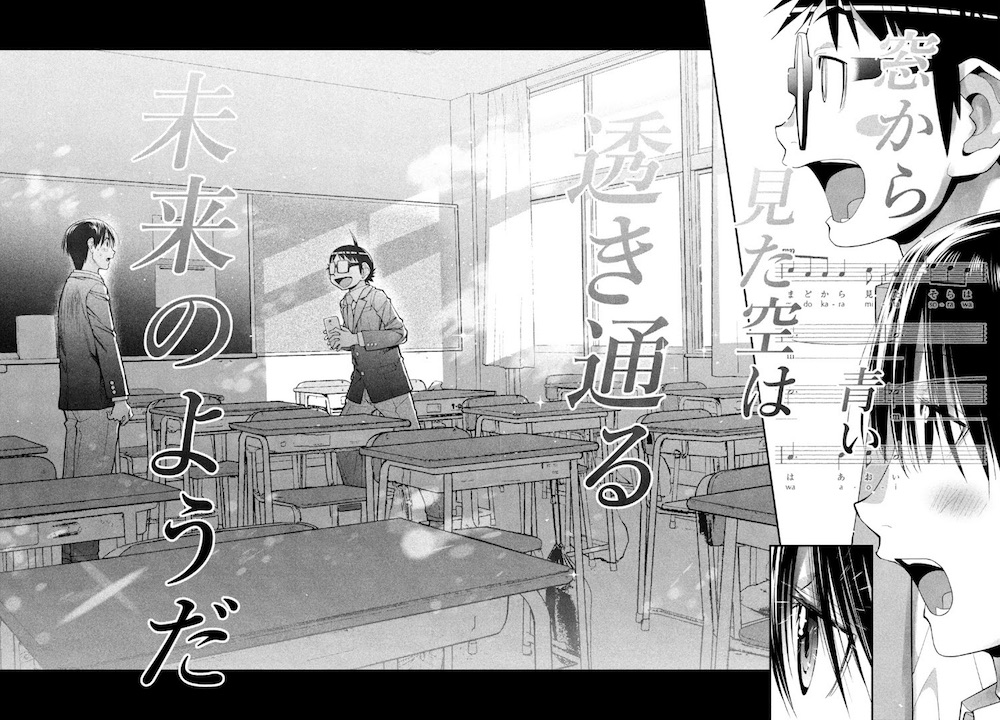
Just like in the last chapter, we have an amazingly drawn scene of a Chorus Appreciation Society performance. What stands out to me about their “Etupirka” is that even if you don’t know what the song actually sounds like, Kio’s artwork conveys its sheer intensity. It’s not just the trembling line effects throughout the performance, but the way the characters are drawn with such dynamism even while they’re standing still, as well as the choice to use that initial extreme angle to depict Shion’s piano-playing (as seen in the top image) makes it seem like the ground is trembling. It borders on a more exaggerated representation that one might find in an action-packed shounen manga that uses music as its gimmick the way Yakitate!! Japan and Food Wars: Shokugeki no Soma approach food.
(And if you want to hear a performance of “Etupirka,” it’s in the “Songs” section below.)
Hanyama’s “Tone Deafness” Isn’t
At one point, the subject of Hanyama’s inability to sing on-key comes up, and Jin reveals that what everyone assumed to be a case of being tone deaf is actually something else entirely. He recounts having tested Hanyama, and it turns out that the guy unconsciously sings on a scale different from the traditional Western music scales due to his family running a Buddhist temple. Instead, Hanyama sings according to what the Japanese calll junpachi gyakuroku(“upward eight, lower six”) or sanpun son’eki ho, which is also known as the Chinese 12-tone musical scale—which coincidentally is also the same as Pythagorean tuning. It results in the kind of music you get from Buddhist chants (shoumyou) and Japanese imperial court music (gagaku).
If this is all Greek to you, you’re not alone. Akira in the manga is completely baffled by everything Jin says, and so am I. But the gist of it—as much as I can understand, anyway—is that Hanyama has internalized that particular understanding of music, and it makes his attempts to sing more conventional popular songs go awry. Even if I don’t fully grasp everything, I find that pretty fascinating, and I’m glad Hashikko Ensemble goes into it, however briefly.
Songs
Half Monks: “Guts Daze!!” by Ulfuls. This is the song in a flashback to Hanyama’s singing in the competition while they’re explaining the quirks of his musical sense.
Electrical First-Years A Capella Group: “Racing into the Night” by YOASOBI
This is noted as being a Vocaloid song performed using six voices. While there’s no available equivalent online, there are Vocaloid covers of this song.
Wind Instrument Club: “The Galaxy Express 999” by Godiego
Chorus Appreciation Society: “Etupirka” composed by Hirose Ryouhei
Final Thoughts
Though we only got brief glimpses of them this chapter, I quite enjoyed the presence of both Akira and Jin’s mom. I’m still entertained by Akira’s mom and her delight over her son having friends, and I’m further anticipating the arrival of Jin’s mom at the school. I do get the feeling nothing Jin does will impress her, and I wonder if Yumerun will have any role to play in terms of bridging their strained mother-son relationship.
Also, Volume 6 of Hashikko Ensemble comes out next month! I wonder what store-exclusive bonuses we’ll get this time.
A review of the comedy manga Nichijou: My Ordinary Life by Arawi Keiichi has been long overdue. I’ve referenced the series off and on since 2011 when the anime debuted, but it’s only in the past year that I finally completed my Nichijou manga collection. Thus, while it’s a few years later than I would’ve preferred, I’m here to lay down my final verdict:
It’s so goddamn funny.
Well, that took a load off. Until next time!
In all seriousness, reading through all of Nichijou had me laughing uncontrollably on multiple occasions, interspersed between joyful chuckles and lip-puckering smiles. Plenty of anime and manga are wacky, subdued, over-the-top, subversive, and heartful, but rarely do they find themselves packaged in such a perfect package. The main joke of the series is its title—the series is indeed the exploration of the everyday lives of its characters, but their personalities, experiences, and interactions are simultaneously so mundane and bizarre that they play with your expectations at all turns. When you expect them to go zany, you’re hit with a reality check. When you expect something subtle, they might deliver something so hyper-subtle that it loops back around to absurd.
The core characters of Nichijou come in two groups. The first is a trio of high school friends: the energetic but somewhat dim Yuuko, the powerful closet fujoshi Mio, and the intelligent master troll Mai. The second is a robot named Nano who wishes to have the conspicuous wind-up key removed from her back so she can better pass for a normal girl, and her creator, a child genius called “Professor” who is as immature as she is brilliant. In both cases, the bonds between these characters are equal parts caring support and mind-bending frustration, and it only gets more extreme in both respects as the series continues.
About the closest thing that comes to mind in terms of humor is actually the old webcomic Perry Bible Fellowship in the way that both series are capable of delivering humor and anti-humor with laser-like precision, and you don’t necessarily know which one you’re going to get. One big difference with Nichijou is that it tries to build a fairly consistent world for its comedy to build upon, and this only gets more elaborate as the series goes on. Three of my favorite examples are as follows:
There’s a dog who shows up whenever someone is in a sorry situation whose only purpose is to lay its paw on the hapless individual as a show of pity. At some point during the series, it’s revealed that the dog doesn’t show up out of nowhere—it has an owner who is always extremely confused whenever his pet seems to suddenly start running away with a sense of purpose.
Mio’s sister, Yoshino, and Mai are both known for their pranks. For most of the series, they don’t really interact, and their forms of humor are similar yet different—Yoshino’s trolling is all about teasing, whereas Mai’s is about defying expectations. Their jokes sometimes cross paths, such as when an attempt to share sides for lunch results in a “Sucks to be you!” sign in Mio’s bentou, and Mai reveals her bentou container to have nothing more than a pre-packaged energy jelly drink (which she then starts to squeeze onto Yuuko’s rice). When Yoshino and Mai finally interact for an extended period, it’s like a glorious clash of the titans.
One of the side characters in the story invents a fake sport named go/soccer so he can start a club and slack off in its clubroom. However, he later discovers that go/soccer actually exists (thanks to a new student who was his middle school’s MVP), and that one of the high school’s teachers was a champion back in his youth. But rather than go/soccer being something in the vein of chess boxing—a combination sport that involves taking alternating rounds between the chess and boxing—go/soccer is completely inscrutable in every facet imaginable, like a serious version of Calvinball from Calvin & Hobbes.
One last thing worth talking about is how the manga compares to the anime that introduced so many (including myself) to Nichijou. There are the more obvious things: the manga continues past where the anime left off, and some of the jokes in the anime come from another series by the author: Helvetica Standard. The most major change, however, comes from the fact that the Nichijou anime was done by Kyoto Animation, whose excellent animation is gorgeous and polished in just about every scene. Ironically, that can sometimes work against the humor of the series, and this can be seen in moments of the manga where the slightly crude art style makes the same joke three times funnier. That being said, I hope that KyoAni can someday come back to animate the rest, despite the tragic setback they’ve faced.
Nichijou: My Ordinary Life is only 10 volumes long, and it’s so very worth reading. I know I’m extremely late in getting this review out, and that it might be a distant memory for many anime and manga fans, but for those who have yet to discover this magnificent gut-busting manga, there’s a real gem waiting.
There are two success stories to tell about the 1981 giant robot anime Six God Combination God Mars. The first is about a combining giant robot that was better as a toy than as an animated figure in motion: toy sales were strong enough to extend the series beyond its first year, but the awkward stiffness of the titular God Mars itself is something of a running gag (as seen in the YouTube comments here). The second, and I think the one that should get more attention among English-speaking anime fans, is about the tremendous influence of God Mars on Japan’s female anime fandom and doujinshi scene. In a time when pairing same-sex characters from your favorite series was not yet the full-on cottage industry it is today, God Mars was a cornerstone title alongside Captain Tsubasa.
I personally came to know about God Mars twenty years ago, although knowledge about the two aspects of the series came at different times. It was a collection of giant robot anime openings around 2001 that introduced me to the show and its impressive-looking mecha, but it was actually 2004’s Genshiken Official Data Book (of all things)that first brought to my attention God Mars’s popularity with women. Years later at Otakon 2010, voice actor Mitsuya Yuji mentioned among his most popular roles a character from God Mars named Marg. Now, I have the entire series on physical media thanks to Discotek (with 25 episodes up for free on TMS’s Youtube channel), and I’ve finally come to understand what made God Mars one of the granddaddies of fandom pairing in Japan.
Simply put, it’s Marg. Once you know about him, it becomes crystal clear why a female fandom around God Mars developed.
Marg is not the main character. That honor goes to Myoujin Takeru, a guy with psychic powers who discovers that he is actually an alien named Mars sent from the planet Gishin to destroy Earth. However, Takeru manages to defy the evil Emperor Zul and use the very weapon originally meant to eliminate Earth to instead form God Mars and beat back the Gishin Empire. Along the way, he discovers many truths about his original home world, including that he has a long lost brother—Marg—in Zul’s clutches. The dramas that emerge from their familial relationship include attempts to reunite, the pain of separation, and even the crossing of swords due to various plot contrivances.
Marg is ridiculously beautiful both inside and out. He has lush locks of long green hair, and eyes that can express the deepest kindness but also the most fervent passion. His voice is gentle yet powerful, and his forlorn communications with Takeru express a longing and desire to see Takeru—unless he’s being brainwashed into being the enemy, of course, at which point his anger is spine-tingling. Whenever Marg shows up, he becomes the most captivating figure on screen.
Given that we’re talking about shipping and coupling, it’s not entirely accurate to pin it all on Marg. The popularity of a series among female fans traditionally hinges on the relationships between characters rather than singular personalities, and Takeru himself is no slouch. Not only does he look like a more handsome version of many a 70s robot protagonist, but he is perhaps the angstiest hero ever to grace a giant robot anime. Sure, Shinji from Evangelion is traumatized and depressed, and Heero Yuy from Gundam W is dark and brooding, but they don’t angst the way Takeru does. Naturally, more often than not, that anguish has something to do with Marg. And yes, they’re brothers by blood. Whether that was an additional awakening for fans in 1981, I’m not sure. I wouldn’t be surprised.
Even before God Mars, there were plenty of good-looking and charismatic secondary characters in mecha anime. Between directors Tomino Yoshiyuki and Nagahama Tadao, they all but cornered the market: Prince Sharkin (Reideen), Garuda (Combattler V), Prince Heinel (Voltes V), Richter (Daimos), and both Char Aznable and Garma Zabi (Gundam). The key difference between these major rivals and Marg is that the latter is so many things in one. He’s an adversary at some times, but at other times he’s basically a damsel in distress.
There is something I need to make clear: Unlike so many later anime, which could be constructed from head to toe with a female audience in mind (or at least pay regular lip service to that side of fandom), God Mars is still built on the foundation of a toy-shilling kids’ anime. It is 65 episodes long, and not every episode is exactly compelling. There’s an unsurprising inconsistency in terms of the show’s quality with respect to storytelling and animation quality. In addition to the notorious stiffness of God Mars the robot, the anime is rife with fights between characters with psychic powers that revolve around dramatic poses in still shots in lieu of actual movement—a style of action scene the book Even a Monkey Can Draw Manga mocks for its laziness. And dashing canon hopes of brotherly love, the series pairs Takeru with a female character, albeit one with a connection to Marg. In other words, back in 1981, fujoshi had to walk uphill both ways to get their BL shipping fix.
Even so, a girls’ fandom emerged out of God Mars, and plenty of evidence exists that the creators became aware of this audience eventually. The TV series keeps finding ways to bring him back in different forms. A 1982 movie recap of the first 26 or so episodes reduces the screen time of other supporting characters in favor of more Marg, and the poster advertising the film even features him prominently (see above). A later OVA released in 1988—well after God Mars’s heyday—centers around Marg entirely. A look at God Mars merchandise reveals both official and unofficial works where Marg takes up a lot of real estate.
When I was going over my own prior history with God Mars, I omitted one thing: the game Super Robot Wars D for the Gameboy Advance. God Mars is one of the titles included, and in the game, you can manage to not only recruit Marg to your side but also have him pilot an alternate God Mars from that 1988 OVA in which he’s the star. Once together, Takeru and Marg can perform combination attacks like the “Double Final God Mars.” I can’t help but wonder if there were both kinds of God Mars fans working on this game, bringing together the hopes and dreams of those whose lives were changed in some part by God Mars and its two successes.