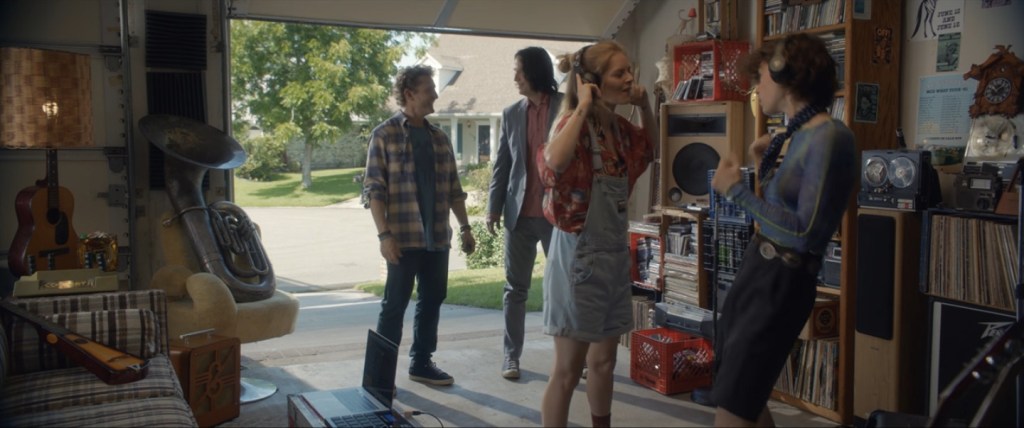
Wyld Stallyns’ Greatest Triumph: Bill & Ted Face the Music

Bill & Ted’s Excellent Adventure and its sequel BIll & Ted’s Bogus Journey are two of my favorite films ever due to their absurd premises to their even more ridiculous climaxes. Bill S. Preston, Esquire and Ted “Theodore” Logan epitomize what people today call “himbos”—dim yet sincere dudes, and the two are great watches even today. Now, 30 years later we have a new movie in Bill & Ted Face the Music, and it’s a great sequel that captures the spirit of its predecessors. But as much as I enjoyed the film, I’ve also come to realize that it has an underlying story about how great Bill and Ted are as parents.

Because this is going to be discussing the ending to Bill & Ted Face the Music, be warned that there will be HEAVY SPOILERS involved.

The basic plot of the film is that metalheads Bill and Ted, aka Wyld Stallyns, have not been able to live up to their potential. They’re supposedly destined to write the song that ushers in a centuries-long age of peace and harmony, but they’ve spent the last 25 years failing to accomplish what should be their moment of greatness. Bill and Ted aro longer young, perhaps best shown by the fact that their daughters, Billie Logan and Thea “Theadora” Preston, have gone from babies at the end of Bogus Journey to 24-year-olds in Face the Music. After many time travel shenanigans (par for the course with Bill and Ted), Bill and Ted realize that they’re not the ones who are meant to write the ultimate song, but their daughters. What results is a song that is not only heard across time and space but also literally played by every person ever simultaneously.

There is a clear passing of the torch aspect to Billie and Thea being the true “destined ones,” in case any future films are to happen. However, I  see Billie and Thea as more than just replacements, and that’s because of something heavily implied throughout Face the Music: the daughters are able to succeed in creating the ultimate song because they were raised by Bill and Ted to love and appreciate music. It’s thanks to their dads’ support that they’re able to build on and surpass what the original duo achieved.

At the beginning of the movie, Bill and Ted perform their latest attempt at the song that will unite all, and it’s an extremely bizarre and experimental piece. Their audience, Ted’s brother’s wedding party, is not having it. But when the two talk to their daughters, they express how impressed they were by Wyld Stallyns’ use of the theremin and Tuvan throat singing—far, far cries from their rock and metal origins. What’s not said outright in these scenes is that Bill and Ted, in their attempt to write the ultimate song, have greatly expanded their musical horizons over the year. This pursuit of all forms of music, in turn, has rubbed off on Billie and Thea. The daughters are also portrayed as much more intelligent than their fathers, and might very well be musical geniuses.

Thus, when Billie and Thea go on their own time travel adventure to recruit the greatest band in history, they pick famous figures from across many musical genres: Jimi Hendrix, Louis Armstrong, Ling Lun, Mozart, and a cavewoman named Grom. And while a young Bill and Ted wondered who “Beeth Oven” was, Billie and Thea know exactly who Mozart (and everyone else) is. Another notable difference is that, whereas rock and metal have traditionally been dominated by white performers, most of these artists are non-white, showing greater respect for music from other cultures. When Face the Music gets to its climax and Wyld Stallyns make way for Billie and Thea’s production and DJing skills to thrive (and save the space-time continuum), Bill and Ted are doing more than just stepping aside for their daughters—they’re allowing their greatest triumphs to fulfill their own destiny.

The support shown by Bill and Ted towards their kids stands out all the more when remembering the upbringing they themselves had, especially Ted. Rather than fostering Ted’s dreams of becoming a rock star, Mr. Logan is a police captain who cares more about instilling discipline and making his son “do something” with his life. The threat of a future at the military academy hangs over Ted in both Excellent Adventure and Bogus Journey. It’s not until Face the Music that Mr. Logan finally accepts all that Ted has gone through (time travel, going to heaven and hell). In contrast, Ted has likely been behind Billie from Day 1. 

Although Isaac Newton has never appeared in the Bill & Ted films, his famous quote about standing on the shoulders of giants is highly relevant here. Bill and Ted are the unlikeliest of heroes, but the ground they cover thanks to their adventures allow their daughters to take things to the next level. Sure, BIllie and Thea are much more astute and sharp by comparison, but father and daughter alike appreciate the other on a deep and fundamentally important level. It’s that love and respect, the fact that their relationships embody the dual mottos of “be excellent to each other” and “party on, dudes” that ultimately allows them to save the universe. 
Creator Chemistry in A Whisker Away

The Japanese anime film A Whisker Away caught my attention early on due to its writer-director combination of Okada Mari and Sato Jun’ichi. Okada has worked on some of my favorite anime, including A Woman Called Mine Fujiko and Aquarion EVOL. Sato has helmed numerous masterpieces, especially in the magical girl realm—Sailor Moon, Princess Tutu, Kaleidostar, Ojamajo Doremi, Hugtto! Precure, among others However, this is not the first time they’ve worked together, and their last collaboration, M3: The Dark Metal, was mixed at best. Their strengths as creators are total opposites in a certain sense, which can make for a brilliant chemical reaction or an explosive mess. In the case of A Whisker Away, the combination succeeds.

A Whisker Away follows a girl named Sasaki Miyo, whose crush on her boy classmate Hinode Kento only seems to irritate him. What Kento doesn’t know, however, is that the stray cat he loves so much, Tarou, is actually Miyo in disguise through the power of feline magic. Key to the film are the desire to understand and to be understood.

When I say that Okada and Sato have opposite strengths, what I mean is that the two specialize in very different expressions of emotion. The writer’s works are all characterized by melodramatic floods of powerful emotions (especially at the climax), while the director’s greatest strength is conveying small and intimate emotions whether the setting is humble or grandiose. It is a challenge for both types of emotional expression to exist in the same space without smothering each other, and as I discussed years ago on the Veef Show podcast, this is one of the problems with M3: The Dark Metal

I think what makes the newer work click in contrast to their previous title is that both Okada-style and Sato-style emotional expression are able to coexist. The film has moments for both styles to shine, especially given the numerous scenes of quiet introspection and frustration juxtaposed with loud and bombastic outbursts from the heart. It also doesn’t hurt that cute but trying teenage romance is the wheelhouse of both creators.

Given this long trend of two whole films, I am eager to see what comes from the next Okada-Sato joint effort. Now that I know this team can pull it off, I have high hopes that the third time around will be spectacular. In the meantime, A Whisker Away is worth a watch.

Gattai Girls 11: “Granbelm” and Kohinata Mangetsu

Introduction: “Gattai Girls” is a series of posts dedicated to looking at giant robot anime featuring prominent female characters due to their relative rarity within that genre.

Here, “prominent” is primarily defined by two traits. First, the female character has to be either a main character (as opposed to a sidekick or support character), or she has to be in a role which distinguishes her. Second, the female character has to actually pilot a giant robot, preferrably the main giant robot of the series she’s in.

For example, Aim for the Top! would qualify because of Noriko (main character, pilots the most important mecha of her show), while Vision of Escaflowne would not, because Hitomi does not engage in any combat despite being a main character, nor would Full Metal Panic! because the most prominent robot pilot, Melissa Mao, is not prominent enough.

— 

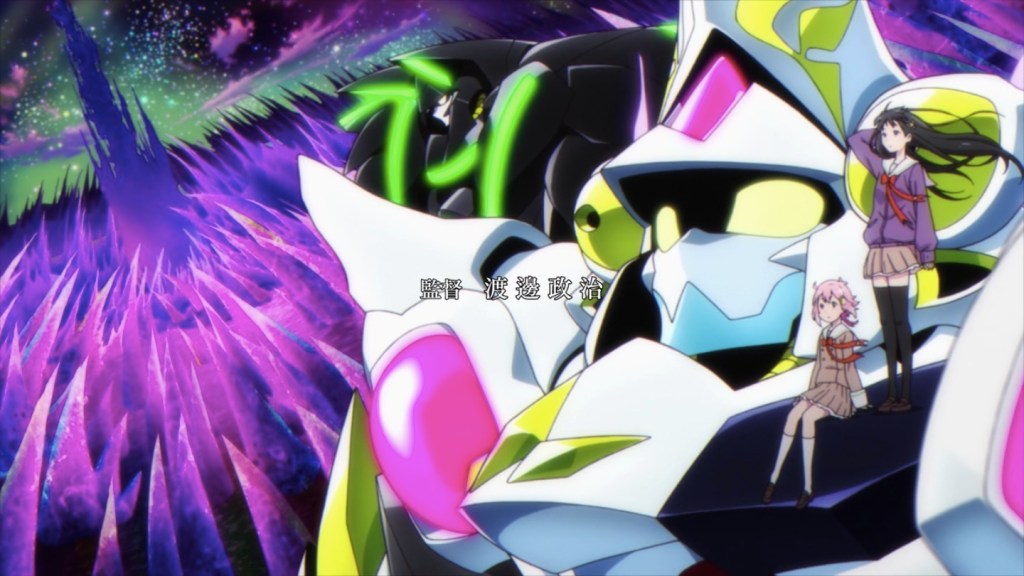
Granbelm is a series that feels both modern and retro at the same time. The cute all-female cast is standard for current anime. Its premise, which pits these girls against each other in a Highlander-esque scenario to inherit the Earth’s magic, screams “early 2010s anime.” The story is straight-up early 2000s sekai-kei, a genre where the relationship between two characters determines the fate of the world. The mecha designs come straight out of a tradition of cutely proportioned robots from the late 1980s to early 1990s. Yet, while Granbelm isn’t shy about making its influences known, it’s also not ruled by them.

Female mecha protagonists are uncommon, which is why the lack of men in the series stands out all the more. That being said, this is not all that unusual, as there was an industry realization at some point in the industry that the total or near-total absence of male figures in anime could be a selling point to male and female audiences alike. In this sense, Granbelm follows in the footsteps of franchises like Love Live! and Puella Magi Madoka Magica, with the general mood of the show being more towards the darkness of the latter.

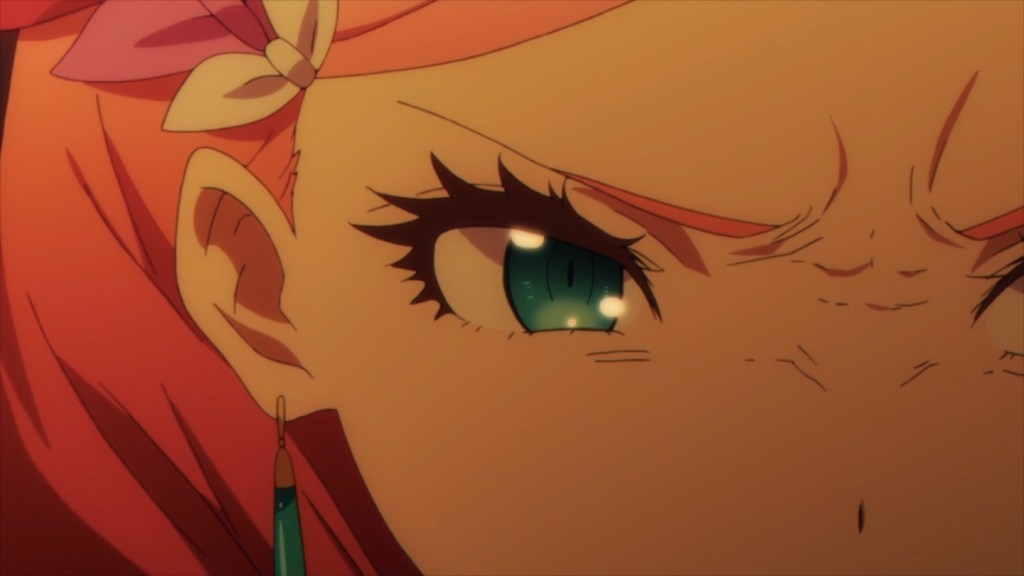
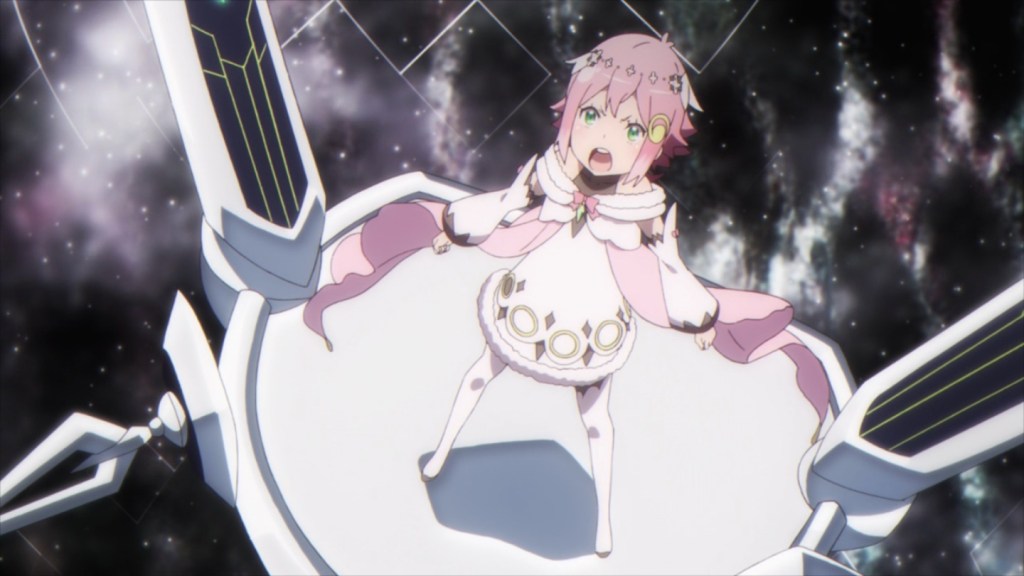
While having a predominantly female cast and thus passing the Bechdel test practically by default is by no means a mark of inherent feminism, these characters are varied in their personalities, motivations, strengths, and flaws in ways that emphasize their sheer presence on the screen. Whether it’s Anna (above) and her obsession with living up to her family reputation or Shingetsu and her guilt over her own power, the characters are convincing in their convictions. All the more impressive is the portrayal of the heroine, Kohinata Mangetsu (below). Although she comes across initially as a very generic protagonist, the series takes her naivete and exuberance and juxtaposes them against the others so as to highlight essential truths about her character in a manner most reminiscent of Selector Infected Wixoss

Moreover, it’s Mangetsu’s relationship with Shingetsu—their names meaning “full moon” and “new moon,” respectively—that is central to Granbelm. The way it plays out, similar yet profoundly different to Madoka and Homura’s in Madoka Magica, could only work with such strongly defined characters.

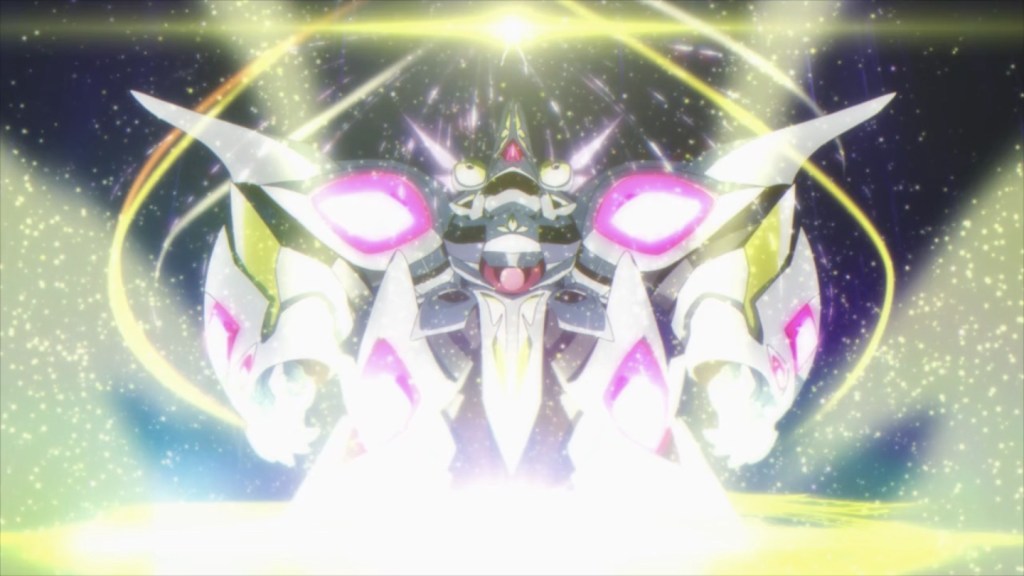
Given the general angle of Granbelm, the mecha might initially seem like an afterthought, but the series’s staff have worked hard to make them a vital part of the show in ways I appreciate a lot. Not only does the series wear its influences on its sleeve, with visual references to Gundam and even Space Runaway Ideon, but the way that characters argue with each other over heated personal and philosophical issues is right out of the playbook of Tomino Yoshiyuki, director of the original Mobile Suit Gundam and Ideon. Each robot—or “ARMANOX” in the anime’s parlance—reflects in form and function the personalities and fighting styles of each contestant. Whether it’s stealth, agility, or even emotional manipulation, you can sense through how they fight just what kinds of individuals they are. Mangetsu’s unit, White Lily, is fueled by her enthusiasm at the notion that she can be special in ways that elude her self-perception of mediocrity, and it comes across in the limit-shattering power and energy White Lily can generate.

Aesthetically, the ARMANOX draw from a very specific genre of giant robots: the chibi-fied robot tradition that began with SD Gundam and came into prominence in the 1980s to early 1990s anime thanks to titles like Mashin Hero Wataru, Mado King Granzort, and NG Knight & Lamune 40. Currently, the only modern anime that shares this look is the current 20th anniversary sequel to Wataru, which actively draws upon that visual nostalgia and carries a more straightforward good vs. evil story common to its original’s peers. The use of these mecha, with their squat and rounded appearances not only makes the visuals of Granbelm memorable against the backdrop of current anime, but also helps contribute to the cute yet foreboding feel of the anime as a whole. 

Granbelm takes cues from many anime trends over many decades, but it ends up synthesizing them all in an emotionally satisfying and thought-provoking manner. Vital to this success is the series’s portrayal of both its female characters and the giant robots they use to fight as reflections of each other and of the world they occupy. 

One-Track Minds: O Maidens in Your Savage Season

I recently finished the anime O Maidens in Your Savage Season, a charming but emotionally raw look at the girls of a high school literature club struggling with discovering their own romantic and sexual desires. It’s based on a manga by the same name, but the adaptation process has a bit of an unusual wrinkle to it. The manga is written by Okada Mari—an anime scriptwriter (The Woman Called Mine Fujiko, AnoHana: The Flower We Saw That Day)—and the anime’s scriptwriter is, well, Okada Mari. 

Rarely does something like this happen, and the closest example I can think of is Yasuhiko “Yaz” Yoshikazu, who went from being the character designer on Mobile Suit Gundam to adapting the anime to the Gundam: The Origin manga to seeing the The Origin adapted into an anime. What this means is that O Maidens in Your Savage Season is built from the ground up by Okada, and that it is essentially a distillation of the very narrative structure she’s built her career on.

Without going into any major spoilers, nowhere is this more evident than the final episode, when after grappling with their messy emotions episode after episode, all of the major characters gather in one place and let all their true thoughts out loudly and passionately. This sort of climax is the very essence of Okada’s work in anime across genres and themes. AnoHana: The Flower We Saw That Day (heart-wrenching teen drama), The Woman Called Mine Fujiko (surreal feminist character re-imaginging) M3: The Dark Metal (brooding psychological mecha), Anthem of the Heart (a story of processing childhood trauma), Aquarion EVOL (over-the-top mecha series as sex allegory), and Mayoiga: The Lost Village (uhhh…still not sure?) can be very different from one another, but they all head in a similar direction by the end.

There’s a certain beat-you-over-the-head obviousness with this approach, but at the very least, Okada’s stronger works incorporate that blunt firehose spray of pent-up feelings in more creative and satisfying ways. O Maidens in Your Savage Season builds up to that point successfully, and reminds me a bit of Anthem of the Heart, which I love and hold up as peak Okada.

Because so many of these works wind up with all the central players in one place shouting how they feel at one another, it can sometimes come across as contrived, unrealistic, or perhaps even condescending. However, like in O Maidens in Your Savage Season, these series often feature characters who spend the vast majority of their stories avoiding uncomfortable confrontation, whether to spare their own feelings or the feelings of others. Having these forces all clash together can be very cathartic beyond simply that emotional release, as you get to see a bunch of anime teenagers be direct for once. 

O Maidens in Your Savage Season is far less fantastical than many of Okada’s other series, but it makes those small-stakes anxieties both entertaining and suffocatingly real. It’s both light and heavy at the same time, and this contrast makes for a memorable and creative work.

More Like “Protoculture Festival”: Hashikko Ensemble, Chapter 31

After months of focusing on the same song, the musical possibilities explode.

Summary

Still at their summer training camp (of sorts), the Chorus Appreciation Society decides that they will do four songs for the school culture festival. The only catch is that they’re having trouble narrowing down a final list, even after listening to a wide variety of options.

Ultimately, the group decides that the songs will be chosen by three of the singers plus Hasegawa choose, with Orihara abstaining. To everyone’s surprise, despite his previous objections, Jin actually chooses a song with piano. What’s even more surprising, then, is that Akira doesn’t. While the gentle and harmonious tunes of Akira’s pick resonate with the whole group, Shion is clearly upset and calls Akira a traitor for the second time, despite having forgotten about the first incident.

Songs They Didn’t Choose

Normally, I leave the song list to the end of the review as a bit of extra fun. However, since there’s so many this time and they’re such a central part of this chapter, I thought it best to list them all from the beginning, to split the list up, and to make it the main focus of this review.

Part of the fun is also in looking up what all of these sound like to get a better understanding of why they were or weren’t picked. There’s also the inevitable hurdle of manga being a non-audio media, and I think Kio still hasn’t figured out a way to make the visualization of each song feel different, so it can make the reading experience feel a bit incomplete.

“Daitokai” by Crystal King, aka the Fist of the North Star singers. I actually wish they picked this one!

“Ame” (“Rain”) composed by Tada Takehiko

“Gekkou to Piero” (“Moonlight and Clown”) composed by Shimizu Osamu

“Composition for Men’s Chorus” composed by Mamiya Michio

“Kareki to Taiyou no Uta” (“Song of the Withered Tree and Sun” Ishii Kan

“Kotoba Asobi Uta 2″ (Song Playing with Words 2” and “Kabe Kieta” (“The Wall Disappeared”) composed by Niimi Tokuhide

“Koi no Nai Hi” (“A Day Without Love”), “Itsu kara Ya ni Tatte”, and “Hakobune” (“Ark”), composed by “Kinoshita Makiko” 

“Mizu no Inochi” composed by Takata Saburou

Gabriel Foure’s “Requiem Op. 48” (This wasn’t a choice, just a song Orihara wants to listen to on top-of-the-line audio equipment.)

The Four Culture Festival Songs

What I find interesting about these is how the reasons behind each pick clearly reflect the characters themselves.

“March 9” by Remioromen 

Shinji purposely picks a song that everyone is familiar with, given that the established goal is to attract new members and become a full-fledged club. It has a soft pop rock feel, and I think it speaks to the fact that Shinji has gotten into singing but is still all about exploring castles. Even though I personally didn’t know this song, it just comes across as the most conventional choice.

“Do You Remember Love?” by Iijima Mari (cv. Lynn Minmei)

Last chapter, I predicted that Hasegawa would go for a Ghibli song, but she hit me with the curviest of curve balls, instead opting for the main theme of the film Macross: Do You Remember Love? Incidentally, it’s the only song besides “Daitokai” that I’ve actually heard before. Hasegawa has already shown her otaku side numerous times, but this really clinches her geek status, especially with her infodump about the historical significance of Macross as the first idol anime and the importance of Iijima Mari. I would love to see this animated, just so I could hear a men’s chorus version of this iconic anime song.

“Etupirka” composed by Hirose Ryouhei

While Jin’s song is not a capella like originally intended, it’s still technically difficult and speaks to his desire to show his mom that she’s wrong about him. Even my amateurish ears can tell this song is tough, given its pace. In addition to how “Etupirka” really seems to carry Jin’s will, one of my favorite moments in this chapter is seeing Shion get serious about figuring out how to play it. 

“Kokoro no Tsubasa” (“Wings of the Heart” composed by Kitagawa Noboru

Akira explains that he picked this song because the melody, lyrics, and harmony are all soft and gentle but also supportive. It makes sense, seeing as he also picked “Miagete Goran Yoru no Hoshi o” for the M-Con. It’s certainly a shock that he would not pick a song that includes a piano given how hard he fought for it and his feelings for Shion, but to me, it feels like the song itself was strong enough to him that it actually overrode his prior convictions. There’s a certain strength to Akira, even if it’s not always obvious. Either that, or he did it because he’s still feeling awkward when it comes to Shion.

Fun fact: For this chapter, the team behind Hashikko Ensemble actually got help from the composer Kitagawa Noboru!

Final Thoughts

First, I really want to see this series become an anime now.

Second, check out Shion with the Ogiue hair.

Saint Snow’s Dazzling White Town Is From Another Time

Saint Snow, the rival characters in the Love Live! Sunshine!! anime, just released their much-deserved debut single, Dazzling White Town. While I’ve only been able to hear the online preview, and I’m not a music expert by any means,  I find that it further solidifies my high opinion of the sister duo.

One of the best things to come out of the Love Live! franchise, Saint Snow’s aesthetic and musical style tend to be more aggressive than Aqours, which is something I generally prefer. As the counterparts to the main heroines, Saint Snow are allowed to take their music to places Aqours largely doesn’t go. Kazuno Sarah (voiced by Tano Asami) has an elegant yet powerful voice, and I like the incorporation of rap brought by Kazuno Leah (Satou Hinata), as it introduces something otherwise absent in the Love Live! universe. In my view, their performance of “Believe Again” is the absolute highlight of Love Live! Sunshine!!: The School Idol Movie

Previews of all three songs

Something I find interesting about this single is how all three songs encompass different genres. “Dazzling White Town” is an EDM tune that reminds me of groups like Snap! and M.O.V.E. “Lonely Snow Planet” takes cues from heavy metal like pre-2000 Metallica. “After the Rain” sounds like pop rock akin to Vanessa Carlton and Alanis Morissette. All three songs come across to me as coming out of the 1990s to early 2000s, with “Dazzling White Town” being my favorite of them. I also love the retro game aesthetic and fashion found in the music video.

While it’s unlikely for anything within Love Live! to get extremely experimental, I do think one of the advantages of being associated with a multimedia franchise grounded in fictional characters (as opposed to being solely a musical act) is that there’s greater latitude for them to go into different genres. When a regular band tries something different, they risk alienating their fans. For Saint Snow, their followers care about Sarah and Leah, and I think it potentially allows for the composers, lyricists, and performers to travel stylistically.

I think Dazzling White Town is capable of reaching people well beyond the expected Love Live! fandom, and I would even dare say that it’s capable of standing alone without the association. I hope Saint Snow also eventually gets a full album to call their own, and that the group continues to have a life even as Love Live! Sunshine!! has winded down.

That said, I wouldn’t mind seeing a Saint Snow anime spin-off either, as I think they have the look and feel to be the stars of their own show. At the very least, a Ruby+Leah special would be great.

This post is sponsored by Ogiue Maniax patron Johnny Trovato. You can request topics through the Patreon or by tipping $30 via ko-fi.

Otakon in 2020 Was Fun but Strange

Whether it was in Baltimore or DC, part of the Otakon experience for me has always been the trip there and back, for better or worse. It could be smooth sailing, or a train could break down and leave the passengers stuck for hours (this really happened). That’s why this year’s Otakon was such a pleasant surprise. Rather than the three-plus hours it would normally take, the total travel time from bed to convention was approximately 20 seconds. From the start, I could tell there was something very different about this 2020 version of Otakon.

Unlike previous years, Otakon this year was a Saturday-only event on August 1st, which had its ups and downs. For one, while I do like immersing myself in the con environment for an extended weekend, I didn’t have to take time off to attend. And although the food in DC has been great, it usually was a bit of a trek to get anything to eat (even inside the Walter E. Washington convention center). This time, amazing home-cooked meals were just a few steps away. 

Panels and Workshops

Unfortunately, I did not have any panels accepted, so I was purely a spectator. This year, panels were significantly shorter, clocking in at 30 minutes per panel as opposed to the traditional one hour, but I saw it as a way to fit more presenters into the one-day event, making it a net benefit. Notably, the audience for every panel I saw was quite impressive, not only because they often numbered in the hundreds, but also because there was no trouble in getting into the panels despite such large attendance numbers. While there were some audio and video hiccups in some of the panels, they were fairly quick to resolve.

30 Years Ago: Anime in 1990

The first panel of the day I saw Daryl Surat’s “30 Years Ago: Anime in 1990,” which went through some of the highlights of anime from that time. It gave the sense of being a really transitional year, and I appreciated his highlighting of Brave Exkaiser, the first entry in the Brave franchise. He ended the panel with loving praise of the infamous Mad Bull 34, and tied its story of a rule-breaking, trigger-happy cop to current events in a manner humorous yet critical.

Carole and Tuesday

From there, I stepped into the Carole & Tuesday panel. The panel was already in progress, having started with a viewing of the first episode, but because I’d already seen the entire series, I thought it safe to skip. Amazingly, the travel time between Daryl’s presentation and this one was near-instantaneous, so I didn’t miss much. The panel started off with a beautiful musical performance by Celeina Ann (the singing voice of Tuesday Simmons), and led into an interview with her, director Watanabe Shinichirou, and (I believe) producer Makoto Nishibe. One thing I learned was that Alba City, the main setting of the show, is also a city in Cowboy Bebop. They also showed a vide of the recording and animation process, and seeing the amount of effort and collaboration that went into the show gave me a very positive impression.

Chibi Chibi Drawing Time

I normally don’t attend workshops at Otakon, but with things being so convenient this year, I decided to check out Chibi Chibi Drawing Time, which taught people how to draw super-deformed characters. It’s been a while since I scratched my art itch, and I used this opportunity to follow along with the spirit (though not always the letter) of the presenter’s guides. You can see the results below:

Into Another World: A History of Isekai

It’s the big genre that’s been sweeping the anime industry for a while, and thanks to this panel, I got to learn a little more about isekai. My main takeaways are that the introduction of gaming-oriented isekai helped to bring forth non-isekai anime in gaming-heavy settings (think Goblin Slayer and Is It Wrong to Try to Pick Up Girls in a Dungeon?), and that the number of shows seem to multiply exponentially. 2019 looked to have about three times as many isekai anime as in previous years, and I have to wonder when the juggernaut will finally slow down.

Godzilla, Kaiju Eiga and the Amazing Toho Studios

This was perhaps the best panel I saw of the entire convention, as it was meticulously researched and gave a lot of insight into the making of Godzilla as well as the kaiju movies that propelled Toho to additional fame. I was intrigued to learn about all of the different players of this time, including Godzilla director Honda Ichiro and Ultraman creator Tsuburaya Eiji. If you have the chance to see this panel, either in person or via recording, I highly recommend it.

Bootleg Anime from South Korea

I’ve attended this panel by Mike Toole before, but I always welcome an opportunity to see more “creatively appropriated” giant robots. It reminds me that, around the world, you really can’t decouple animation fandom from bootleg products, and it results in interesting products and cultural output nevertheless. I’m still waiting for that Soul of Chogokin Taekwon V.

Overall

I appreciated how different Otakon was for 2020, and the heavy focus on panels appealed to me a lot (I truly think they’ve always been the best part of the con). At the same time, I think I’m still a bigger fan of the regular version. The unusual format meant there were no autograph signings or big live concerts this year, and I didn’t really get to spot any unique or unusual cosplay. I also miss doing interviews.

I wouldn’t another Otakon like this, but I’m hoping 2021 provides a return to the tried and true classic.

Healin’ Good Precure and the Age of Coronavirus

In recent weeks, many of the anime that were on hiatus due to COVID-19 have begun returning, and one question that arises is how these series might be affected by the delay going forward. Many, like Demon Slayer: Mugen Train and The Millionaire Detective, are adaptations, and so wouldn’t be affected content-wise. Similarly, historical fiction like Appare Ranman! can easily ignore current events. But there is one series I’m looking at as potentially being deeply impacted by coronavirus on a story level, and that’s Healin’ Good Precure.

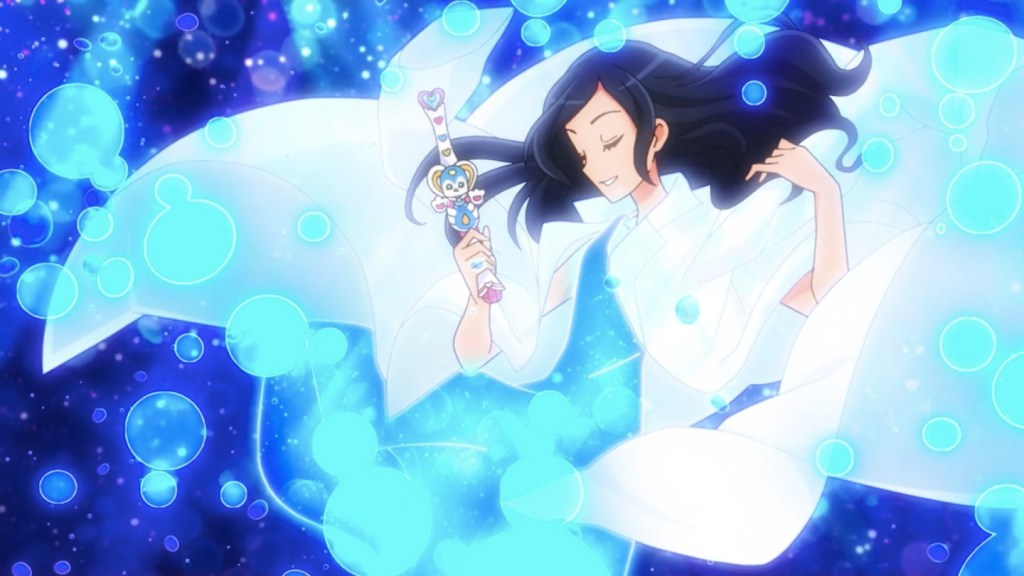
The main motifs of Healin’ Good Precure are healthcare and the environment. The girls essentially act as doctors trying to heal different Earth spirits when they fall ill, their interactions with their fluffy mascots take a veterinary angle, and their magical dresses briefly resemble physician lab coats during transformation. It’s an incredible coincidence that this would be the Precure series we have in the middle of a global pandemic, but here we are.

The Precure franchise as a whole does not have any source material—the anime are the original works. Everything else, from manga to video games, are subordinate to it. What this means is that there’s no source material to reference or adhere to, so it likely has a degree of flexibility in terms of potentially changing its story. The fact that Precure shows are typically around 50 episodes also means there’s plenty of time to pivot and try to take into account current trends and real-world concerns. Also, while the series was on hiatus, the official Precure LINE channel actually had videos featuring Precure stuffed dolls talking (via the voice actors) to kids and playing games with them, so i think there is an awareness that children are feeling the effects of self-quarantine and the like.

While I don’t think Healin’ Good Precure is going to do anything as drastic as explicitly introduce coronavirus into the show, I do wonder if they’re going to try and incorporate some of the good behavior into the girls’ special moves or equipment. For example, what if one of the mid-series upgrades are special magical masks that give the Precures enhanced powers? What if the girls learn a special attack that requires them to stand six feet (or two meters) apart from one another? Of course, it’s also possible that the show will keep ignoring the environment created by COVID-19 in the hopes of giving young kids an image of how things are “supposed to be.”

Regardless of how far Healin’ Good goes to address current events, Precure’s general positivity and supportive messages are very welcome. I’m just waiting to see how far it goes.

The Sincerity of Tokusatsu

I have watched a lot of anime, but I’m far less experienced with tokusatsu stuff. When Toei launched their official worldwide tokusatsu channel on Youtube a few months ago (despite a major hiccup where they accidentally banned themselves), I originally saw it as a way to legitimately watch more obscure giant robot anime such as Lightspeed Electroid Albegas and Space Emperor God Sigma. However, thanks to the sheer range of shows available—stuff leading back to even the black & white era of television—I thought it was high time I made a more concerted effort to watch tokusatsu and form my own opinions.

What I’ve come to notice is that I enjoy these series a lot more than the adapted tokusatsu works I’ve seen over the years in the US—Power Rangers, VR Troopers, Super-human Samurai Syber Squad, etc.—and I think I know why. When it comes to Japanese tokusatsu, there is a greater degree of earnestness that makes these shows more enjoyable overall. They might not have much of a budget, as shown by their threadbare special effects, but everything feels somehow more sincere.

Sure, the localized shows have their own merits, and there have been memorable storylines over the years that lend at least an air of seriousness and compelling storytelling to their worlds. In Power Rangers alone, there’s the original Green Ranger storyline from Mighty Morphin’ and the bond between Astronema and Ecliptor in Power Rangers in Space that revealed the two as more than just evil villains. However, they feel more like exceptions to the rule—-chances for otherwise very non-serious stories to reveal an edge.

With Japanese tokusatsu on the other hand, even the very first episodes feel like they’re working hard to get viewers emotionally invested. They’re also still ultimately kids’ shows as well, but their presentation is such that they expect the young viewers at home to enjoy drama and tension in their entertainment. When you hear the ending theme to Janperson, even if you don’t know Japanese, there’s a strange yet heartfelt sense of passion. It’s definitely cheesy, but it’s a convincing kind of cheesy. The difference is akin to the kind of pro wrestling that easily makes you suspend your disbelief versus the kind that takes you out of the magic.

Anyway, if anyone has recommendations, I’m all ears. A part of me wants to check out Space Ironmen Kyodain and Akumaizer 3 just because of Konata’s fiery karaoke from Lucky Star, but I’m down to keep exploring.

Idiots: Hashikko Ensemble, Chapter 30

Emotions run hard and Hasegawa gets to the heart of the matter in Hashikko Ensemble, Chapter 30.

Before we get into the review, I have a couple things to share, for those that missed previous blog posts:

The final episode of the anime Wave, Listen to Me! features “Miagete Goran, Yoru no Hoshi o,” the song that the Hashikko characters have been singing and practicing up to this point. I talk about it here.

Also, I took extensive notes from a recent interview with Kio Shimoku by Virtual Youtuber Luis Cammy. It’s long, but I recommend you all check it out! There’s a whole lot of insight into Kio’s life and career, and it’s his first ever audio interview! If you ever wondered where Akira’s ultra-deep voice comes from, it’s a reflection of the author himself.

Summary

Shion is lost somewhere in the woods, but Orihara manages to be the one to bring her back to safety. The image of him carrying Shion on his back haunts Akira to such a degree that he dreams of the two in a loving embrace. This awkwardness persists through breakfast the next morning.

Later, Hasegawa tries to get all four of the Chorus Appreciation Society’s singers to resolve the question of whether to do an a capella performance for the school festival (Jin’s stance) or to involve Shion on piano (Akira’s stance). In order to coax Jin’s true motives out, Hasegawa brings out a live video chat of Yumerun, Jin’s condescending childhood friend). Her casual conveyance of the dismissive words of Jin’s mother causes Jin to reveal the truth: he wants to do something musically impressive to show his mom up, knowing that she’ll be watching. 

However, just as it seems consensus has been reached and a capella is the way to go, Hasegawa turns around and declares everyone to be idiots. She explains that Jin is so caught up in trying to prove his mother wrong, he’s forgotten their actual goal: to attract new potential members in order to graduate from appreciation society to full-fledged club. With everyone now on the same page and their eyes on the prize, Hasegawa is poised to reveal the popular, catchy, possibly anime-related song they’ll be doing next.

It’s Ghibli, Isn’t It?

In Chapter 14, Hasegawa goes ballistic when she discovers that multiple members don’t know Studio Ghibli and its famous music. GIven that their goal is to try and do something that’ll have wide appeal to students at a technical high school who likely don’t know much about music, this seems to be the natural choice. 

The question, then, is what song (or songs) has Hasegawa decided on? I have my own favorites (“Carrying You” from Laputa: Castle in the Sky, “Hikoukigumo” from The Wind Rises, “Always with Me” from Spirited Away), but what’s tricky is that most of the Ghibli songs are performed by women. One hint might be Orihara’s interest in harmonizing, but given my limited musical knowledge, I don’t think I’d know what a “good song for harmonizing” would even be.

Hasegawa is the Saki of Hashikko Ensemble

By cutting through all the reticence, the veiled reasonings, and the personal hang-ups, Hasegawa fulfills a role akin to Kasukabe Saki in Genshiken. She’s direct, keeps her eye on the prize, and seems more insightful when it comes to human relationships compared to the others. Granted, she doesn’t seem to have the social grace of Kasukabe. In that sense, Hasegawa reminds me of something akin to Hikigaya from My Youth Romantic Comedy is Wrong, as I Expected (aka My Teen Romantic Comedy SNAFU)—good at finding solutions but willing to play dirty in the process. I wonder if her contacting Yumerun is just for this, or if she’s actually formed a friendship with the strange girl.

Jin himself comments on Hasegawa’s effectiveness, telling her that he’s glad she’s on board as their conductor. Jin also uses Hasegawa’s first name—Kozue—for the first time, which she herself points out is quite the milestone. Jin calls people by their first name extremely easily (including Orihara!), so it’s interesting in the first place that he had previously avoided doing so with Hasegawa.

Love Triangle Man

Everything seems to be pointing towards both Akira and Orihara liking Shion on a romantic level. A part of me still suspects that Orihara’s and maybe even Shion’s reactions are being misread by Akira, but it could really be that obvious. Whatever the truth may be, the important thing is how self-conscious Akira is about the whole situation, and that it’s likely going to get worse. Akira’s overactive imagination even comes into play a second time (the first was with Shion and Shunsuke). There’s a chance Hasegawa (or maybe Kanon?) will find some way to untangle this mess, but I think it’s going to get crazier and crazier.

I still want to hear from Akira at some point what he likes so much about Shion. I know people shouldn’t necessarily have to articulate their feelings, but I’m genuinely curious.

Songs

No songs this month.

Final Thoughts

I’m looking a few chapters ahead and thinking if any new faces will join the appreciation society after the upcoming school performance. I’ve still got my eye on Kurotaki Mai, the deep-voiced girl who helped Akira, and the possibility of a girls’ vocal group starting up. If Yumerun somehow ends up at Hashimoto Tech, that would be wild.