In a pre-recorded interview for FunimationCon, writer Sato Dai was asked how he came to work on the anime Listeners. His response: the original creator, Jin, specifically sought him out due to his work on anime like Eureka Seven. But for anyone who’s watched even a little bit of Listeners, that much is crystal clear. Everything about the series—from the heavy music references to the mecha to the boy-meets-girl-in-a-nowhere-town science fiction plot— attests to that influence. While I at first wondered why they would try to, in spirit, remake such a classic anime, it occurred to me that Eureka Seven is actually 15 years old. How time flies.
Echo, a teenage boy, lives in the town of Liverchester, where people are taught to be content with staying in town forever and leading uneventful lives. Echo believes this to be his fate as well, but he has dreams deep down, thanks to his idolization of “Players,” individuals who fight mysterious creatures known as the Earless by commanding giant robots known as “Equipment.” An encounter with an amnesiac girl he finds in a scrap heap takes him far off the predictable track and towards discovering the true secret of his town and its history.
One big difference between Listeners and Eureka Seven is that the former is only 13 episodes in contrast to the latter’s 50, and this inevitably leads to very different storytelling. Eureka Seven is a relatively slow burn that very gradually and powerfully escalates its drama. Listeners, on the other hand, has more of a travel-show vibe that’s layered with unambiguous music references. When you see characters who are literally Prince and Kurt Cobain parodies, it goes a step beyond just “subtle nods.” Because of this, Listeners often comes across like Eureka Seven by way of Xam’d: Lost Memories (for its 1:1 world-building to plot reveal ratio) and Rolling Girls (for the “town to town” episodic feel), but isn’t really greater than the sum of its parts.
I do think Listeners is a decent series with plenty going for it. The characters, particularly the main duo of Echo and Mu, give a very “authentic” impression in that they aren’t overly “perfect” in design. Similarly, the aesthetics of the series have this sort of messy and put-together feel, and I like how the main robot doesn’t look terribly “heroic.” However, I really think that 13 episodes is too short for the story it tries to tell (even Xam’d has 26), and the music references are much more tied into the appeal of the show compared to how Eureka Seven utilizes them.
What I’m actually looking forward to most from Listeners is seeing it someday debut in Super Robot Wars. Can you imagine the interactions with the cast of Eureka Seven or Macross 7? That would, well, rock.
Fierce (?) competitors lie in wait in Chapter 34 of Hashikko Ensemble!
Summary
The school’s cultural festival has suddenly turned into a battle of the bands, and the Chorus Appreciation Society is in a 16-band bracket to see who comes out on top. Among the groups participating are a number of familiar faces: Kurotaki Mai (the deep-voiced girl who once saved Akira), Tsuyama’s crew, Mimi-sensei and a group of teachers (with Takano-sensei on piano), and even the Rugby Club that tried to recruit Kousei.
During this, Shion is visibly bothered by Yukina’s presence and closeness with Kousei, all but confirming her having romantic feelings for him. But when Kozue asks why Yukina’s into Kousei, her answer absolutely flabbergasts Shion: “Cuz he’s cute.”
Mai’s band wins, and the teachers forfeit their match because all they really wanted to do was put on a single performance. The Rugby Club is going directly against the Chorus Appreciation Society in the first round, and to everyone’s surprise, one of the players, Sora, asks Kozue to go out with him if the Rugby Club wins. She agrees but only as a form of rejection—she actively encourages the audience to reject their opponents and Sora’s convenient love story in the making. However, the Rugby Club turns out to be better singers than she anticipated, meaning it might not be such an easy win after all.
A School Tournament?!
It’s not surprising to see tournaments happen in Hashikko Ensemble. After all, if they’re going to eventually be in bigger events, the Chorus Appreciation Society is going to have to see some long competitions. However, this is quite different from the more refined environment and structure of the M-Con, the inter-school event they had previously they participated in as an exhibition.
I really like this direction, particularly that the series has suddenly become more about music in an interesting way by having music fever take over the school and generate all this excitement and energy. Also, while it’s indeed looking to be a tournament arc after all, “winning” seems less important than having all the characters reach their personal goals. Looming overhead is the powerful shadow of Jin’s mom (despite the fact that she hasn’t even shown up yet), and in a sense, she’s the real boss fight.
Love Bonanza
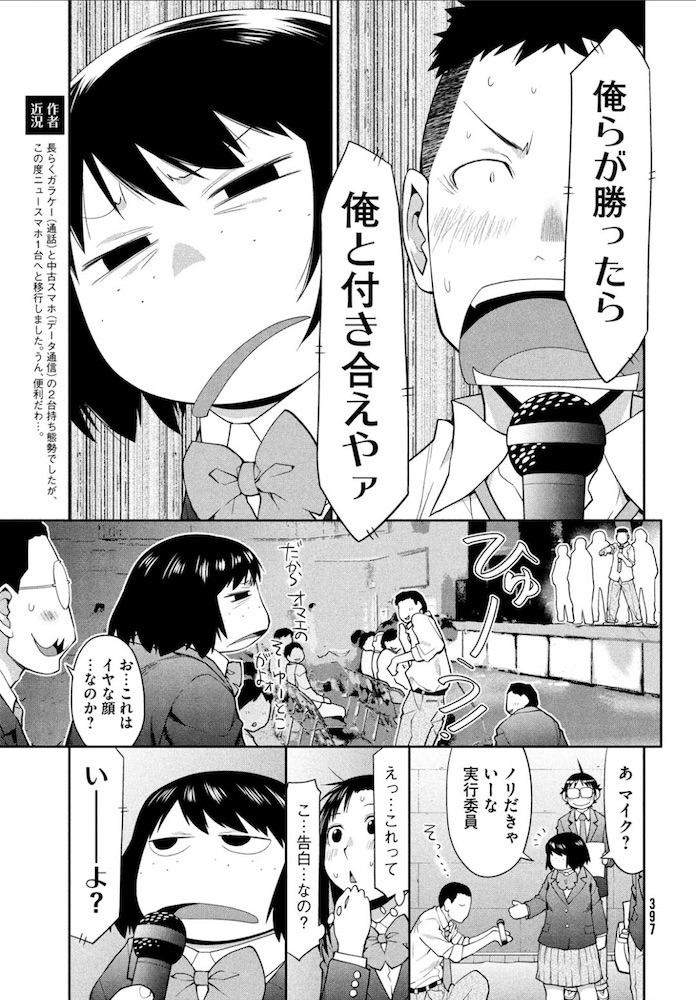
The increasing presence of romance in Hashikko Ensemble is all but undeniable. It’s not even that Shion’s interest in Kousei is clear as day now, but also the strange love polygon that now exists between her, Akira, Kousei, Yukina, and maybe even Mai. What’s more, there’s also the lovey dovey couple team (Yukio feat. Mayomyon) metaphorically tossing hearts into the air, and a public confession to Kozue from the kid who tried to warn his classmates about her judo skills?! And the latter’s going to be the most pressing plot point leading into Chapter 34?!
It’s not nearly as messy a relationship web as good ol’ Spotted Flower, but it sure is getting increasingly complicated.
Knowing this manga, I could see Kio swerving the readers by having the Chorus Appreciation Society lose in Round 1, and having Kozue reluctantly start dating Sora. There’s maybe one path of hope for the rugby player, which is that a person can earn Kozue’s respect through skill and power. In this chapter, she basically gushes over Yukina’s high proficiency in a huge array of industrial skills (including gas and arc welding, crane operating, etc.), so if the poor guy can show similar prowess (in singing or otherwise), maybe he can impress her. That said, it’s probably more realistic to see Kozue be into Yukina.
Divergent Feelings
I was thrilled to see Mai show up again in this chapter—doubly so to see her singing. All signs have pointed to her becoming a more important character as the series went on, and while it’s still uncertain that she’s going to join the Chorus Appreciation Society, I’m still rooting for it. There’s also the matter of her previous interactions with Akira, and while he has Shion on the brain currently, I could see a future where these two get together instead.
I think Hashikko Ensemble has been emphasizing how different potential relationships can potentially end up being in terms of interpersonal dynamics. Chapter 33 highlights this by the ways that Shion and Yukina each view Kousei; the former sees him as brave, cool, and strong, while the latter looks at him like a cute underclassman. When picturing those two possible couples, they’re just so fundamentally different. But this is also the case imagining Akira with Shion versus Akira with Mai, which has a similar dynamic of two very different individuals on the one hand, and two very similar people on the other.
Songs
This time, I’ve included each of the groups participating in the tournament this chapter, followed by what song they perform.
Nighttime Festival Club 2.1:“Itoshii no Ellie” (“Beloved Ellie”) by Southern All Stars
Noi Majo (Kurotaki Mai’s quartet):“Hakujitsu” (“White Day”) by King Gnu
Yukio feat. Mayomyon: “Shibuya at 5 o’clock” by Suzuki Masuyuki and Kikuchi Momoko (You might recognize Suzuki as the singer of the opening to Kaguya-sama: Love Is War)
Teachers’ Angel (Mimi-sensei + other faculty): “Boku no Koto” (“About Me”) by Mrs. Green Apple
Rugby Club A Capella Group: “Zenzenzense” (“Past Past Past Life”) by RADWIMPS (as heard in Your Name)
Final Thoughts
Back in the pre-pandemic times, I used to go karaoke somewhat often. One of the most common songs among one of the groups was actually “Zenzenzense.” This chapter makes me want to learn all these other songs and bring them out someday. May there be a future where we can karaoke to our hearts’ content.
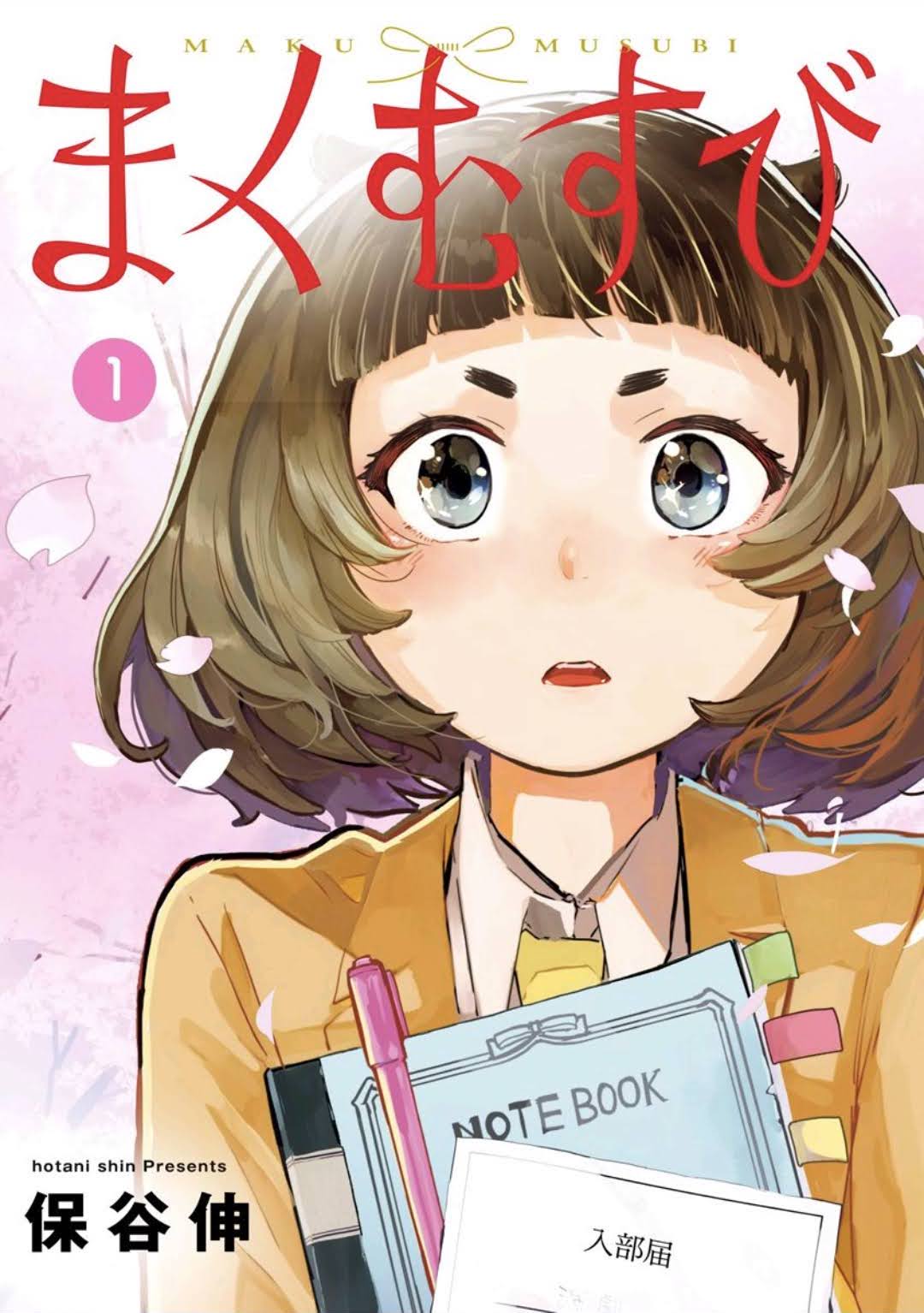
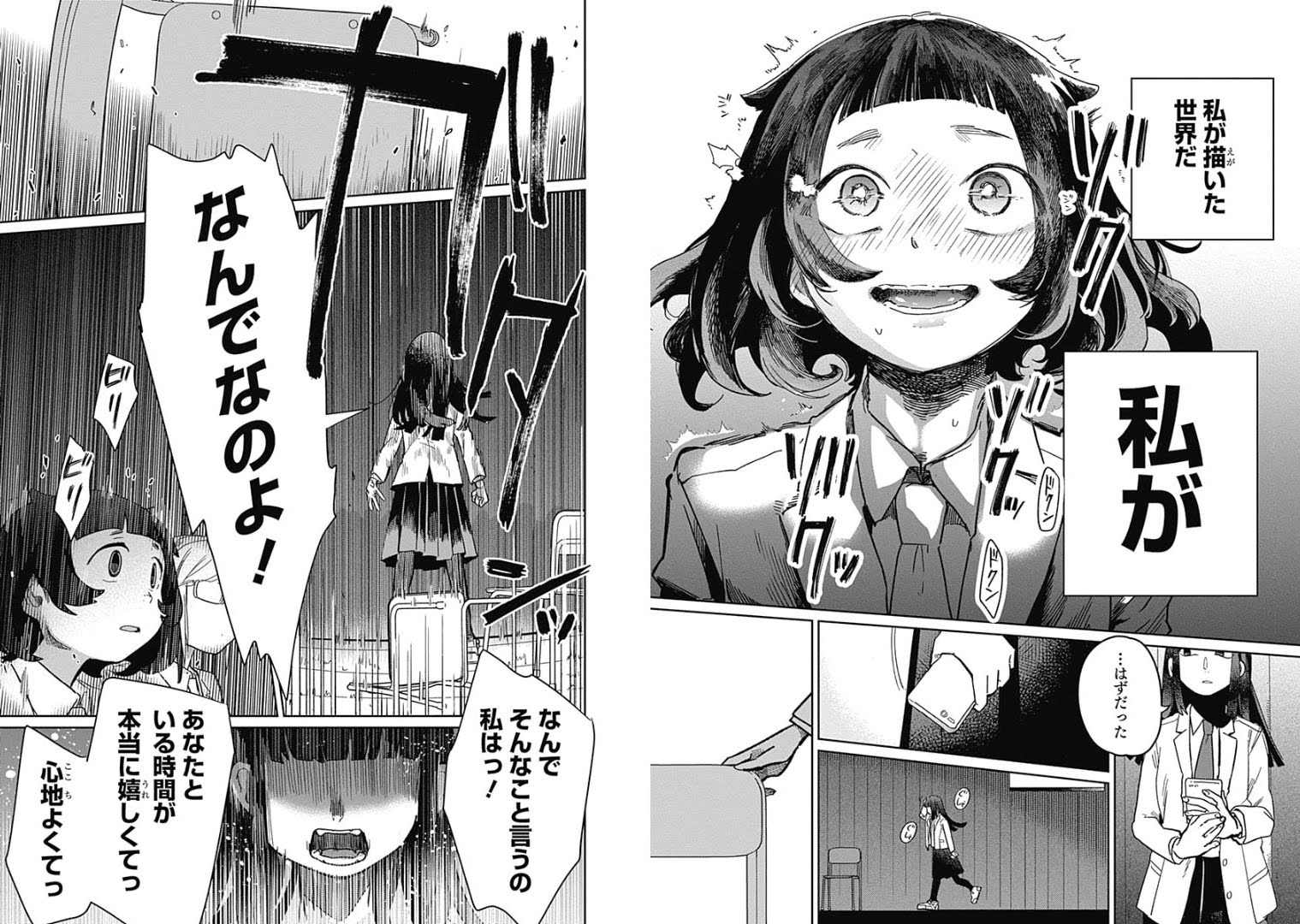
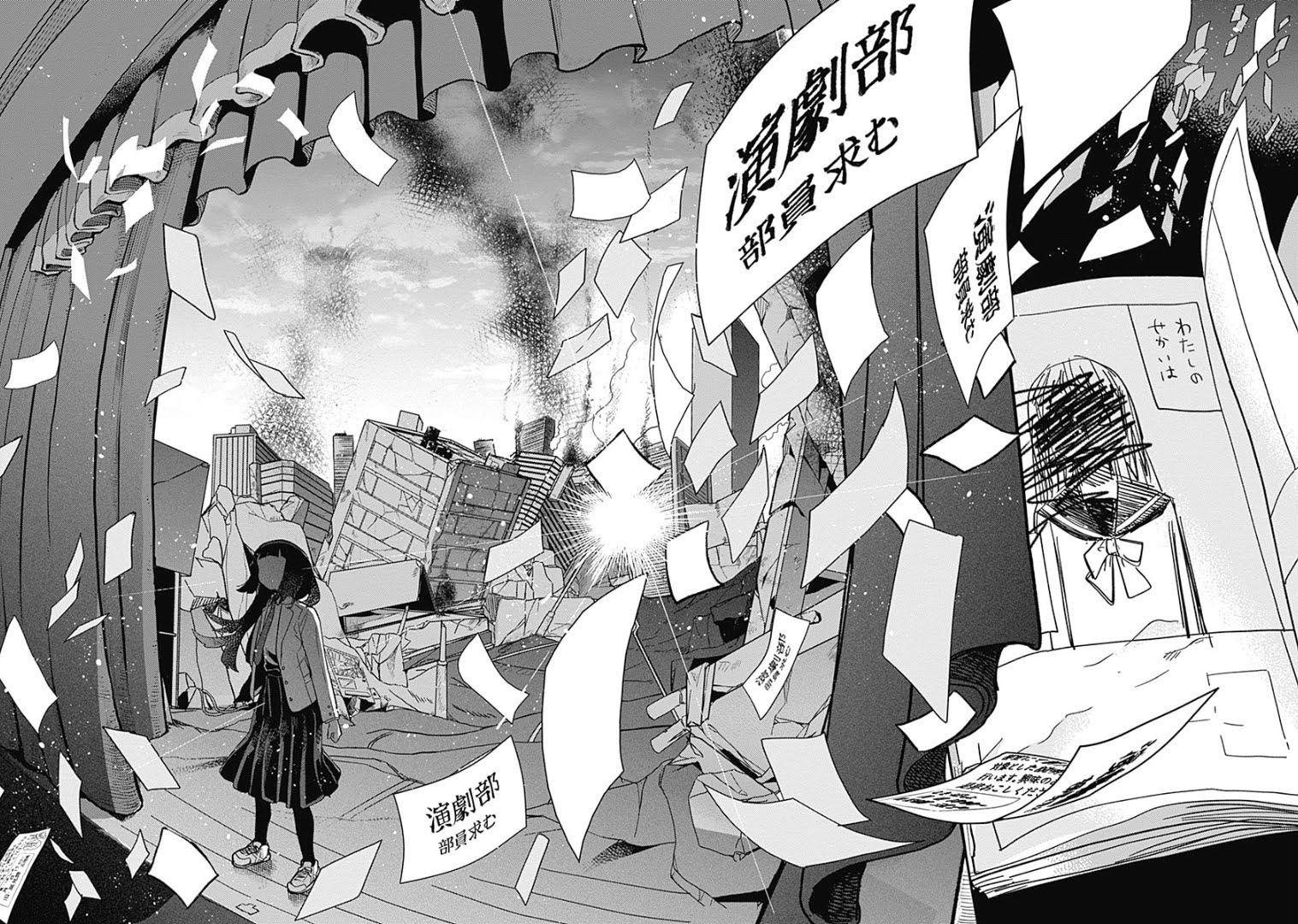
Whether it’s Glass Maskor Beastars, there’s something exciting about seeing theatrical performances in manga. Perhaps it’s because we’re viewing a medium that thrives on ingenuity in presentation and strongly projected emotions through the lens of another that emphasizes dynamic page composition and intense closeness. A recent genre work, Maku Musubi by Hotani Shin, stands out because of how it delves deeper into the process of creating a play, told from the perspective of a girl discovering her potential as a scriptwriter.
The plot: When she was little, Tsuchikure Sakura loved to draw manga. But now, as she starts high school, Sakura sees her childhood art as a hurtful and embarrassing part of her past. When one of her old drafts inadvertently ends up in the hands of the school’s drama club, Sakura gets drawn into their world. While her drawings don’t make for the best manga, they might just be the perfect material for theater.
It’s always a little heart-wrenching to see someone’s dreams get shattered, and Maku Musubi goes in depth on just how much drawing manga meant to Sakura. It was her way of letting her imagination flourish, unbeholden to the judgment of others, but it’s also due to past criticism that she feels unable to keep making comics. This is not uncommon in stories both fictional and real about creators, but I find the angle about Sakura’s pivot towards theater to be filled with storytelling potential.
Many works would keep her on a path towards pursuing a career in manga with a “never give up” theme. Maku Musubi instead presents the interesting notion that its heroine isn’t necessarily untalented as an artist, but rather just hasn’t found the avenue of expression that best fits her. Although a story about teenagers, I think it has the power to resonate especially with adult readers, who might look at their own lost childhood aspirations with a bit of regret, but who could find inspiration in channeling those dreams in a different but still fulfilling direction.
This mangaalso has a great cast of supporting characters, especially the members of the drama club. A mix of experienced but eccentric upperclassmen and newcomers looking for change in their own lives, it greatly reminds me of the club aspects of Sound! Euphonium and even Kannagi to some extent. The introduction of a nationwide competition between school drama clubs also brings it away from a slow-paced slice-of-life feel and towards challenging its characters to change and grow.
Maku Musubi was actually on my radar for a while, and I’m actually kind of mad that I didn’t get around to it sooner. As of Volume 1, Hotani’s work really appeals to my taste and aesthetics, especially with its cute yet striking depictions of both inner and outer human emotions. Consider me a fan, and I can’t wait to see these characters on a bigger stage.
The impossible has happened once again as Steve (and Alex) from Minecraft joins an increasingly unthinkable roster in Super Smash Bros. Ultimate. While I’ve never touched Minecraft, I appreciate its creativity and the joy it has provided so many people young, old, and virtual. Having now played (and played against) him for the past few days, I would say that in both visual style and gameplay, Steve from Minecraft is likely the most bizarre character in franchisehistory.
Where most characters end up having their appearances updated or at least rendered in finer detail, Steve joins Mr. Game & Watch in having a look deliberately hyper-faithful to his source material to the point of incongruity with the rest of Smash. In terms of his skill set, Steve moves differently, attacks differently, and his block-formation + resource-mining mechanics only have the loosest similarities to other fighters. He’s a little bit Olimar (gathering resources), a little bit Robin (resource management), and some degree of Mega Man (movement while attacking), but also far beyond being a simple chimera of those three. His blocks also kind of resemble what Kragg in Rivals of Aether and Olaf Tyson in Brawlout are capable of, but Steve’s version exists as more than just an unusual recovery move.
I have quickly come to the conclusion that I’m not a good Steve player (and likely never will be), so I can’t offer any tips or hints as to how to best play the character. I can, however, talk about how it feels to struggle with and against Steve.
With Steve, moving around feels counterintuitive to what I’m accustomed to in Smash. For example, in Ultimate, one common way to avoid attacks is to jump. Unlike in previous games, all characters take the same amount of time to leap, so you can go above a lot of things, especially grabs. Steve, however, has one of the worst first jumps in the roster, and so he can actually get grabbed in situations where others wouldn’t. Steve needs to burn his second jump instead, which would be a bad idea for most other characters—except unlike everyone else, he can create a block underneath and restore his jumps instantly. You have to literally approach concepts like being grounded and being airborne in a new way compared to everyone else, and for me, it is taking a lot of time to get used to.
In addition to not having any ups, Steve has some of the worst mobility stats in the game—roughly bottom 10 in nearly everything. He feels sluggish when I’m in control of him, but when I play against him, he somehow feels incredibly squirrely. I believe this is because of a combination of qualities Steve possesses.
First, he can attack while walking in a fashion akin to Mega Man and Min Min, so he can retreat and advance with ease, even if he’s slow.
Second, he has a deceptively thin hurtbox that makes spacing moves against him difficult. “Hitting” his arms doesn’t do any damage, and often attacks that seem like they hit will whiff easily when combined with his ability to move back and forth easily.
Third, it’s very hard to tell what he’s doing based on his animations because so many of them overlap or look extremely similar. His walk, dash, run, roll, jump, and even his getting-hit animations all have the same ramrod-straight stance with arms and legs flailing, and his other actions aren’t far off. The fact that he remains “standing” while getting hit in the air also means he sometimes lands on platforms where others wouldn’t.
Fourth, his actual attacks are surprisingly fast, and the ability to rapidly throw out simple moves means it’s hard to tell when he’s vulnerable and when he isn’t.
When Steve is at full strength—plenty of resources to burn and diamond tools for early kills—he seems very strong. He lets a player be as creative as they want, and already, people are discovering unique combos, techniques, and glitches (that will likely get patched out). What he lacks in movement, he makes up for in fast, strong, and useful attacks, somewhat like Luigi. The Minecart looks like one of the best moves in the game at the moment, as it protects Steve from attacks, and the ability to stay in the cart (for an attack) or jump out (turning the cart into a grab) is a scary mixup. It’s basically Diddy Kong’s Monkey Flip on steroids, and I’m unsure of whether it’s the online setting that makes the move frustratingly difficult to react to, or if it’ll be just as potent online. I do feel that the character benefits a lot from lag, but it’s very possible that his quicker properties would be of greater benefit offline.
I’ve still yet to fully decide which characters I think do especially bad against Steve, but Little Mac’s reliance on ground movement means that blocks mess him up pretty easily, and his recovery is rife for exploitation by Steve’s crafting blocks and down-tilt (a descending fire attack). Big-body characters get comboed to hell and back by him, but I can see certain ones doing better or worse. I can’t quite figure out if Mewtwo does well against Steve or not, but I think the online environment plus the strength of Minecart is skewing my perceptions.
As for which characters seem to demolish Steve, it’s likely characters who can either outcamp him, or who can quickly get close and overcome his attacks with better range. Zelda’s Din’s Fire can be a pain for Steve because its properties let it circumvent block placement. Marth and Lucina have the speed, strength, and long pointy swords to make life difficult. Shulk’s Monados may be hard to contend with as well. Also, the rigid hurtbox of Steve comes with a potential drawback: it looks strangely easy to hit him with sweetspot attacks, like Zelda’s lightning kicks and Marth’s tipper sword attacks.
Of course, that’s all speculation on my part. Steve is such a decidedly non-cookie-cutter character that it’s going to be months or even years before he’s even halfway understood. If Smash Bros. is about bringing together all these different video game legends and showing off their unique qualities, then Steve feels like they imported an entirely new game engine into that universe. He’s both fun and annoying at the same time, and I suspect we’re going to be seeing a whole lot of him for a long while.
If there’s any recent series that I think is capable of uniting disparate parts of the anime fandom, it’s My Life as a Villainess: All Routes Lead to Doom! By design, it’s an isekai series that draws upon many of the familiar tropes that have the genre so popular and arguably overplayed: reincarnating to another world, having unique knowledge or gifts no one else does, and having every other character fall madly in love with the main character. However, it also bucks the trend in many ways.
The Appeal of My Life as a Villainess
In a genre that has recently been dominated by male heroes, My Life as a Villainess stars a female protagonist, Catarina Claes, who defies her character archetype of the antagonistic rich girl. The series is very positive and uplifting, while also avoiding a lot of the sexism and occasional homophobia that permeates popular isekai work. Here is an anime that can appeal to those who love a good power fantasy and those who want something heartwarming as well.
Arguably, this puts My Life as a Villainess in the same territory as a lot of older isekai shoujo series such as Fushigi Yuugi, but one thing that works in its favor is that Catarina is extremely charming. Somehow, her near-perfection comes across as endearing due to her enthusiasm, energy, and the fact that she’s both cunning and naive at the same times. When it comes to harem (or reverse harem) series, my belief is that they work best when you can see why so many people would fall in love with the main character. Catarina passes this test with flying colors.
The Tip of the Villainess Iceberg
The specific term translated as “Villainess” is akuyaku reijou—literally “the eldest daughter in a villainous role.” It describes a type of character seen throughout the long history of shoujo anime and manga, as well as all that it has inspired. A 2016 Japanese blog post attempts to go through the history of akuyaku reijou from 60s shoujo manga all the way to the present day, and the archetype is ubiquitous. The first otome game, Angelique, features just such a character and some of the most memorable faces in anime, e.g. Naga from Slayers and Nanami from Revolutionary Girl Utena, fall within this archetype. The Japanese title for My Life as a Villainess is Otome Game no Hametsu Flag Shika Nai Akuyaku Reijou o Tensei Shita… (“I Reincarnated as a Villainous Eldest Daughter Who Only Triggers Demise Flags…”), specifically emphasizing that it takes place within a girls’ visual novel.
The reason I put specific emphasis on akuyaku reijou and not just antagonistic female characters is because “reincarnating into an akuyaku reijou” has actually become a huge trend in light novels and related media. Searching for it in Japanese on Bookwalker returns 251 results (some being multiple entries within a series), and a significant number of them feature the exact term in their very titles. The oldest entry is Akuyaku Reijou Victoria from 2009, which puts it five years before My Life as a Villainess.
To a Future of Villainy?
If My Life as a VIllainess is as successful as I hope it is, this could mean seeing other titles in the genre adapted into anime and manga as well. The tricky thing here is that whereas the English title is meant to be fairly snappy, it ironically might make it harder for other titles to distinguish themselves. I don’t think “Villainess” is that bad translation for akuyaku reijou—merely a somewhat imprecise one that trades accuracy for efficiency. Because of that, I’m curious if other English translations are going to willingly adopt the term as a clear genre identifier, or if they’re going to try to avoid getting crowded out by bigger titles. As with so many other trends, we’ll probably get a combination of forgettable misses and memorable hits, but I don’t think I’d mind the process at all.
Anime based on gacha games generally have one overarching goal: get you to play the original mobile game. It’s unclear whether this approach is lucrative, and if anything, it comes across more as a serious flex to say, “Look at how much money we can put into making these gorgeous-looking anime adaptations. In this arena, Cygames is one of the kings. Between strong anime versions of Granblue Fantasy and Rage of Bahamut, among others, it’s exceedingly clear just how much money they have to throw around, given the gorgeous animation, strong writing, and excellent direction seen.
In this respect, Princess Connect! Re:Dive is another success story. Despite the fact that it’s clearly meant to lure viewers into spending their paychecks, there’s no denying the ridiculously high production values and effort, as it ends up being one of the best-looking and most enjoyable anime of 2020.
Princess Connect! Re:Dive takes place in a fantasy world and centers around an eclectic group of adventures who end up forming the Gourmet Guild, which is dedicated to trying out delicious foods all across the land (and not afraid to slay a monster or ten to get some grub). Leading the charge is Pecorine, an ultra-strong princess knight with a bottomless appetite, and joining her are white mage Kokkoro, the cat-eared black mage Karyl, and the strangely amnesiatic human boy Yuuki—the last of whom is clearly the “player character” from the game.
I went into the Princess Connect! Re:Dive without any foreknowledge of the original game, and only with a faint awareness that it was getting high praise from animation buffs. I don’t know how much is based on the source material and how much comes from the anime staff putting in their own spin on things, but there were two main impressions I came away with:
First, the general world and premise are standard fantasy-mobile-game fare—a setting that ostensibly has an overarching ongoing story, but is more a vehicle for you to fall in love with the characters (and want to roll for them once you play the game). Second, the character work is so strong and consistent that it makes the first point more palatable. Major and minor characters alike are ridiculously charismatic, and well-traveled tropes like the moeblob, the tsundere, the yandere, and even bland male lead are portrayed in fun and refreshing ways. Yuuki’s characterization in particular is impressive, as the anime leans so hard into the concept of him being a potato that it falls through the ground and ends up on the other side of the world.
It might just be because I’m an adventurous eater and that I love food-themed anime and manga, but the very idea of the Gourmet Guild holds a lot of appeal to me. It gives plenty of opportunity to animate some amazing-looking dishes, and there’s a certain heartwarming vibe that comes with basing an adventuring team on “eat tasty things.” That innocence also becomes a narrative point, as the day-to-day pursuit of something so simple and pure connects with the motivations and inner conflicts of different characters. Sure, the big-picture story is pretty convoluted, but I still want to see Pecorine and the others succeed within that ridiculous world.
After I finished the anime, I looked up the original game, which is actually the second iteration of the Princess Connect! mobile game franchise—hence the Re:Dive appellation. Apparently, the two versions are tied together in some way, and the anime itself hints at this heavily. It’s not particularly clear what the connection is, and feels more like an attempt to simultaneously introduce Princess Connect! newbies like myself and inform veteran players alike of what’s going on. Ultimately, I don’t think it matters too much.
There’s a lot that’s pretty typical of the Princess Connect! Re:Dive anime, and by the time the final few episodes hit, you’ll know which of the countless numbers of cameos are probably the fan favorites. Still, even as the show is driving its sales pitch at you at full throttle, it’s still a superbly well done anime that fires on all cylinders. In a sense, efforts like these not only shatter the age-old stereotype that anime based on video games are terrible, but it’s even possible that anime like Princess Connect! Re:Dive are better than the games.
The anime studio P.A. Works generally follows a consistent formula: establish an interesting setting such as an old-fashioned hotel (Hanasaku Iroha), an animation studio (SHIROBAKO), or a small town in decline (Sakura Quest), and then place front and center a cast of primarily cute girls with lots of emotion, humor, and drama. That’s why the recent Appare-Ranman!—a show starring a primarily male cast about a transcontinental race across the United States in the late 19th century—caught my eye. It’s in many ways the total opposite of the studio’s standard output. While the title is not entirely what I initially hoped for based on the premise, Appare-Ranman! turns out to be both an inspired and inspiring anime.
Appare-Ranman! stars Sorano Appare, an eccentric Japanese guy whose love of engineering and invention puts him at odds with his traditional merchant family. A series of strange events (largely of his own making) takes him and a samurai named Isshiki Kosame to the US, where Appare decides to compete in the Trans-Atlantic Wild Race. Competitors range from heroes to nobles to criminals, but unlike the rest who are using gasoline-powered cars, Appare aims to take the win with his own steam-powered creation.
Racing shows are usually about, well, racing. Whether it’s the classic Speed Racer/Mach GoGoGo,the insanely energetic Redline, the technical Initial D, or even Hanna-Barbera’s slapstick Wacky Races, one expects emphasis on three things: what the vehicles can do, who will come out on top, and how each of the competitors go about trying to win. Appare-Ranman! does highlight all those aspects to a degree, but half the time it feels like those things take a backseat to both more personal character stories and more conventional action outside of their vehicles.
This shifting of priorities is by no means a sign that Appare-Ranman! is a bad anime, and it benefits a lot from exploring its characters through their relationships with violence, adversity, and ambition. Jing Xialang is a female Chinese racer who’s had to overcome sexism and racism to find a place in the racing world. Appare himself is a great protagonist whose creative genius and flouting of cultural standards is shown to have both its strengths and limitations, and while it’s not outright stated, I get the impression that he’s non-neurotypical. In certain ways, this series reminds me of the fantastic Mobile Fighter G Gundam. That being said, the comparison to G Gundam goes beyond the multicultural cast and competitive setting. Appare-Ranman! ramps up the martial-arts-action gunfights to such a degree that, as the series reaches its climax, you begin to wonder where the heck that transcontinental race went.
Appare-Ranman! kind of swerves a bit, but it’s ultimately an entertaining anime that starts off strong and finishes well, even if it goes to some odd places. The main character’s car being steam-powered also makes the story feel like some kind of reverse-steampunk because of its portrayal as being on the way out historically. Now, what I find funny is that the focus away from racing at times actually brings to mind what I mentioned at the very start of this review: the fact that P.A. Works anime tend to use their settings as background for the real story they want to emphasize, and in a sense, Appare-Ranman! fits that bill perfectly. Only, istead of romantic drama, it’s wild shootouts.
My Teen Romantic Comedy SNAFU (aka My Youth Romantic Comedy Is Wrong, as I Expected) is the modern light novel anime that reminded me to never judge a book by its cover. While on the surface it looked to be another series about a cynical protagonist who ends up surrounded by attractive girls, it quickly became clear that what the series is selling is less a fantasy and more observations of reality—namely the ups and downs of growing mentally and emotionally in the messiest yet sincerest ways. Now, the final anime season has arrived, and what we’re left with is a satisfying conclusion that stays true to the series’s identity.
My Teen Romantic Comedy SNAFU Climax! once again revolves around loner Hikigaya Hachiman, bubbly Yuigahama Yui, and no-nonsense Yukinoshita Yukino as they run the Service Club: a group dedicated to problem-solving for any student who asks. All three are very different in personality, which makes their views on how to fix a given issue very different, but they complement one another well. This season, their main obstacles are pulling off an American-style prom, dealing with Yukino’s impossibly perfect mother who maps out her daughters’ lives to the letter, and the three main characters (at long last) resolving their feelings.
All three storylines come down to battles of words and wills, and it’s this angle that highlights just how important language is to SNAFU. This series loves its wordplay—it’s why all the character names sound like superhero alter egos—but it doesn’t end there. SNAFU absolutely revels in both utter verbal ambiguity and extremely precise word choice that the Japanese language is so frustratingly good at.
Take a couple of the keywords that showed up in the second season and present themselves here in full force: tasukeru and honmono. Tasukeru can mean “to help” or “to save,” and the ambiguity between the two gives a certain weight to Yukino’s words when she says it. But it’s also precisely because the characters can be so roundabout that they find a certain kinship. Honmono, introduced by Service Club faculty advisor Hiratsuka-sensei, can be translated as “genuine article,” “real deal,” “something real,” and so on. What exactly that means can change with context (is it more physical or more abstract?), and it’s not even clear whether Hachiman himself quite understands—other than it might just be worthwhile even while the fear of losing what you already have (even if it’s built on lies) is ever-present. Each character is both hurt and helped by how they utilize language, and it’s their strong friendship that brings them both smiles and tears.
The title of this series was originally about how the kinds of teenage romances celebrated in media are a lie, and that Hachiman’s life is anything but picturesque. By the end, but the meaning has morphed into the idea that it might not have been what the cool and popular kids get, but it’s something just as special. In a way, it’s perfect that SNAFU Climax! puts such emphasis on a prom, that classic symbol of Hollywood and American rom coms. The fact that the battle over the prom is more important than the event itself is especially fitting.
I’m happy to see this series to the end, but it also makes me aware of how different my own life and perspective has become since I watched the first season seven years ago. Back then, the sinews of high school and college social interaction still felt somewhat fresh in my mind, and I could see pieces of myself and friends I knew in Hachiman. Now, my interaction with SNAFU has transformed from relatable experience to nostalgia. It’s as if I started as Hachiman the student and became Hiratsuka-sensei.
A new story arc begins in Hashikko Ensemble, Chapter 32!
Summary
Summer is over, and the students at Hashimoto Tech are back to school. While things seem mostly the same, there are some differences. For the Chorus Appreciation Society, they can now use the music room to practice. Tsuyama’s crew, the Mimi-sensei-obsessed guys who had previously competed against the Chorus Society, now all have girlfriends. And for some reason, there seems to just be a lot more singing at school overall. It turns out that the latter two things are related: Tsuyama and co.’s performance in front of the school is the reason they got girls, and now all the boys think a capella is the key to popularity.
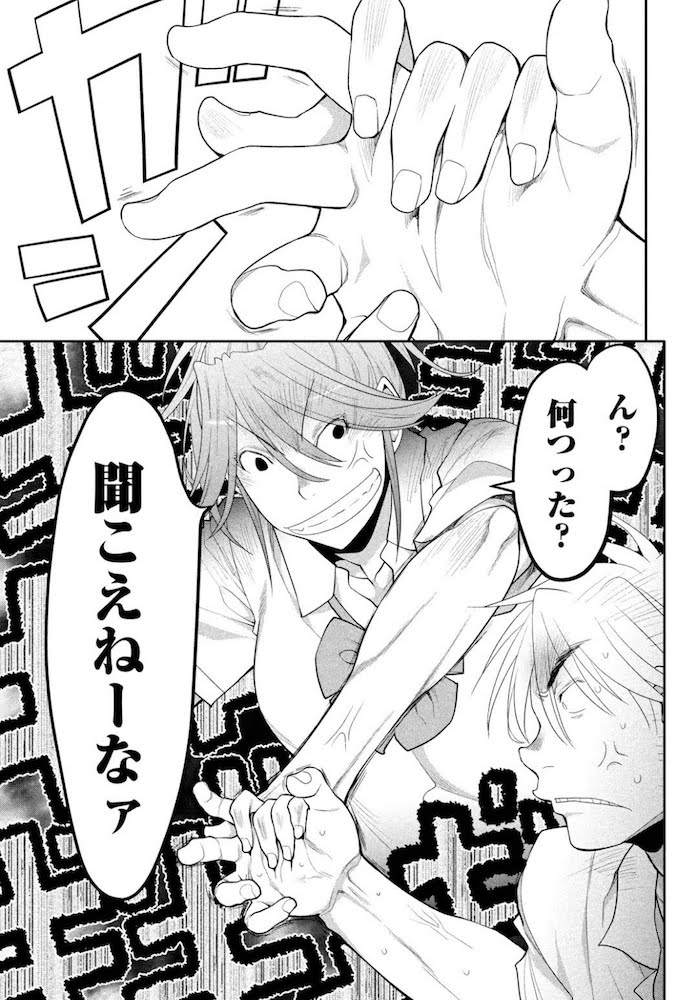
Back with the main characters, Jin is naturally beyond excited about more singers at school, Mimi-sensei is having a bit of a crisis over losing her place as conductor to Hasegawa Kozue, and Shinji wonders why the girls aren’t coming to them. Right then, a tough-looking girl shows up next to Kousei, and when he tries to shoo her away (assuming that she doesn’t care about music), she puts his hand in a death grip and overpowers him. Kozue identifies her as Kawamura Yukina, a third-year construction major and the school’s reigning arm wrestling champion—a title she won by beating both guys and girls.
The chapter ends with students remarking about how many damn a capella clubs are springing up. It all looks to be headed in one direction: a singing tournament!
Excitement
I love this chapter.
I thought I knew where this manga was going, with Jin trying to prove his mom wrong and Akira fretting over Shion. However, the way the school has changed feels like a subtle yet still seismic shift, as if they’re entering a new environment where the rules are different. What’s more, this all stems from their singing! This series is delightfully hard to predict at the best times.
It’s typical of an action or sports series to up the stakes or expand its scope, and this feels similar yet noticeably different in terms of fallout. Genshiken didn’t really do story arcs in the traditional sense, and I find Hashikko Ensemble to be somewhere in the middle in a good way.
Mama Mimi
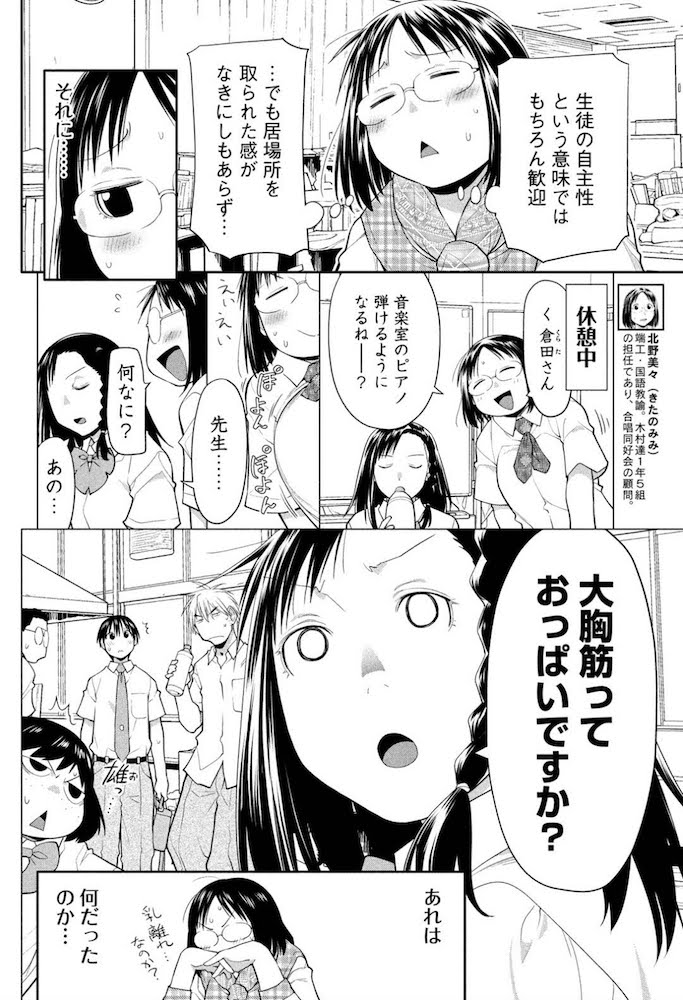
I do feel for Mimi-sensei, but what I’ll probably remember more about her in this chapter is her hilarious interaction with Shion. No longer conductor, she tries to let Shion be comforted by her, but Shion responds by asking, “Are pecs boobs?”
Later, Mimi wonders if this like a child being weaned from their mother’s breast.
The ridiculousness of Shion’s question followed by the wordplay from Mimi is top-notch.
Yukina is a Badass
Yukina is technically not a new character, but might as well be. It’s not 100% certain if Yukina is a delinquent, but she certainly has that energy.
I really want her to join the group.
While she’s not the only physically strong girl around (Hasegawa is a skilled judo player), Yukina adds a certain level of cool. Not only would she be the oldest among the students, but her connection to Kousei—whatever it may be—seems intriguing. At the very least, we haven’t seen anyone treat him so lightly
Is there an element of romance between the two? The characters are certainly entertaining the possibility. Akira thinks Shion might have a crush on Kousei, so he immediately tries to see how Shion reacts to Yukina, but it’s not entirely clear. I can practically feel Akira’s incredible self-consciousness, though I still think he’s somehow mistaken.
Songs
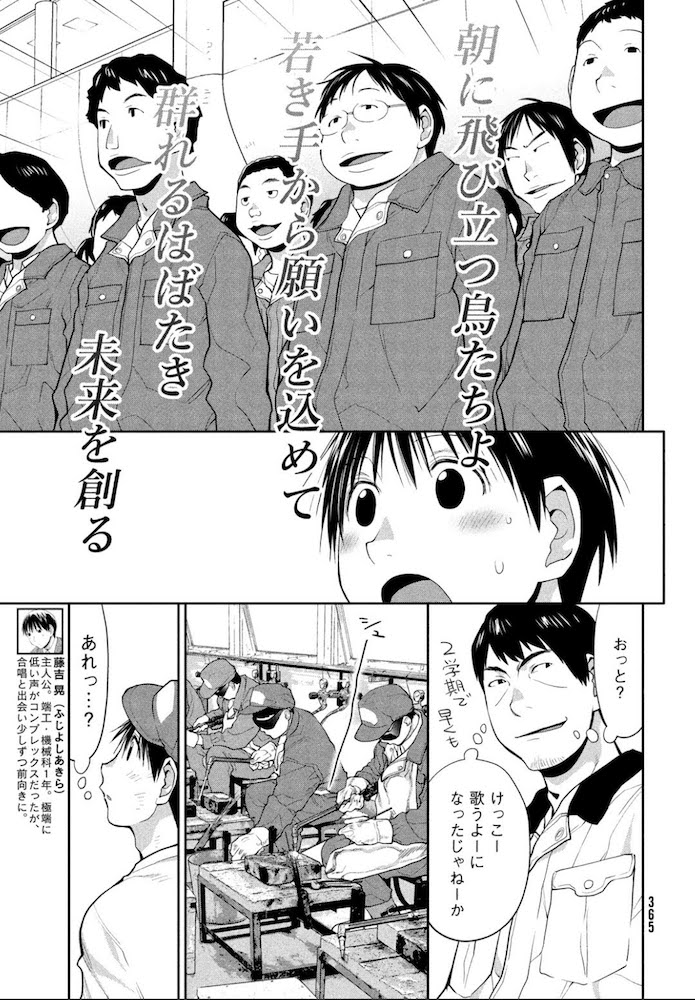
In this chapter, they practice “March 9” by Remioromen, which is Shinji’s pick for the Festival.
They also sing the official school song, though there’s no audio resource for that.
Final Thoughts
When Shinji asks why they’re not getting any girls, Kanon responds that 1) the Society already has girls and 2) a capella is cooler. It makes me think about how I’ve been translating gasshou as “chorus,” but “glee” could work just as well. And one particular TV show aside, it’s true that glee clubs are not exactly considered exciting. I do wonder if I should have been translating it as glee all along, but I can live with my choice.
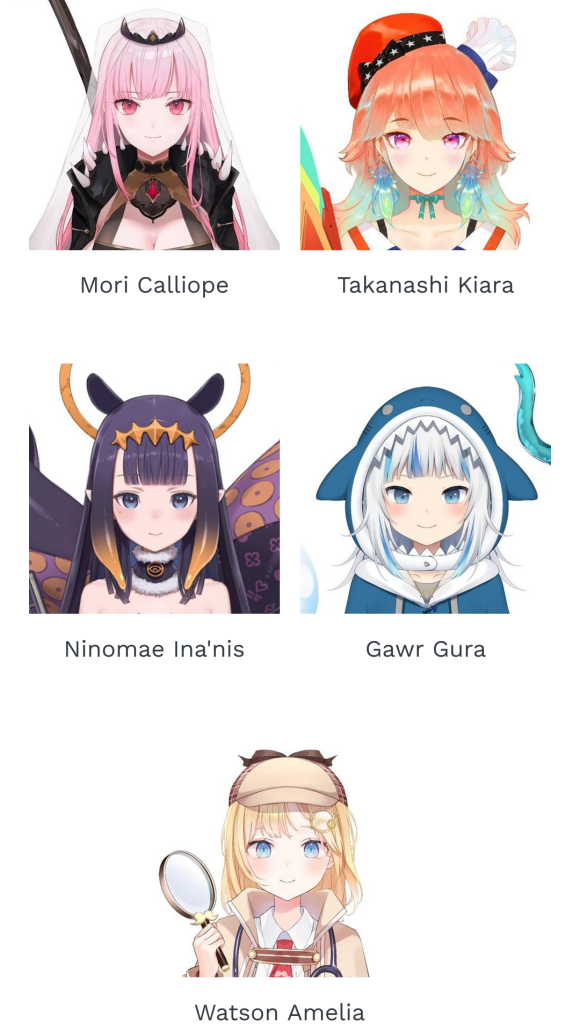
Virtual Youtubers continue to be a tour de force, reaching beyond Japan to worldwide recognition. Given this success, as well as the crossover appeal of certain English-fluent VTubers (such as Fujima Sakura, Pikamee, and Kiryu Coco), it was only a matter of time before one of the big VTubers agencies would try to make an active effort to court an English-speaking audience. Thus is born Hololive EN, and with it five new streamers.
The tricky thing with something like Hololive English is striking the right balance in terms of audience desire and accessibility. Speaking in the target demographic’s native tongue does wonders for directly engaging with viewers, and offers an experience closer to what the Japanese viewers typically enjoy. Rather than Inugami Korone’s amusing struggles with English, little gets lost in translation. However, it’s also possible that part of the appeal is the existence of a culture gap—that there’s an element of exoticism found in both the language barrier and the moe idol aesthetic. Veering too far in one direction might alienate certain fans.
The route that Hololive English appears to have taken is to feature VTubers with decent degrees of spoken Japanese fluency—enough to interact with the Japanese fans as well. Their true identities remain unknown (as is standard), so it’s unclear if they’re natively multilingual or if they achieved it through study, but the result either way is that there isn’t a complete disconnect with the Japanese origins of Hololive. The style of English seems to differ from one to the next, whether it’s the cutesy affectations of Gawr Gura or the more natural-sounding speech of Mori Calliope. I think this probably a good way to hedge their bets in terms of figuring out what will garner the most fans, though I don’t know how intentional that is.
While all of them are able to speak Japanese fairly well, written fluency varies significantly between the Hololive English members (unless it’s somehow all an act). Case in point, Takanashi Kiara’s language skills are very strong to the extent that she self-translates, Ninomae Ina’nis appears to have a solid handle, and Amelia Watson can struggle with the basics. Kiara’s advantage is obvious, but I think the ones who are less fluent actually have a certain appeal themselves. Not only do they resonate with those of us who grew up speaking our parents’ languages but never became properly literate, but they’re also relatable to those currently learning Japanese or who want to learn Japanese—no doubt a common occurrence among Virtual Youtuber fans.
For now, I don’t really have a favorite, but I wish all of them the best of luck. If they find success, I wonder if other Vtuber groups will push harder to have an active international presence.
This post is sponsored by Ogiue Maniax patron Johnny Trovato. You can request topics through the Patreon or by tipping $30 via ko-fi.





 OGIUE MANIAX