World Shaking: Anime Expo 2019 Love Live! Sunshine!! Concert Review

For the past few years, I’ve been attending Anime Expo (AX) in a limited capacity, and it means I often don’t get to see everything I want to. In this respect, the AX Love Live! Sunshine!! concerts have been something I’ve wanted to see but regrettably kept on missing. But this time was different, and I finally, finally saw Aqours live. While it wasn’t my first time seeing a Japanese idols concert—I saw Morning Musume as part of a multi-act performance at Anime NYC—it was the very first time I had specifically sought out anything even resembling an idol group. It was an enlightening experience in terms of both performers and fans, and a unique experience thanks to a strange AX weekend filled with literal seismic activity.

The adventure that was attending LOVE LIVE! SUNSHINE!! Aqours World LoveLive! in LA ~BRAND NEW WAVE~ (how’s that for a mouthful?) began a couple of months before Anime Expo, when it came time to purchase tickets. I’m no stranger to being part of a massive online crowd trying to buy tickets for the same thing. However, difficulties I had never seen arose. After waiting in the queue, the ticket page would open, but every time I tried to select a ticket and check out, it would say that the ticket I selected was no longer available. This would happen no matter what I selected, be it general, VIP, or the mysterious balcony option that would appear and disappear randomly. I think the issue was that, as the site was trying to choose a ticket for me, it would somehow immediately get snatched up by someone loading the page a split second earlier. I can only assume all this was because of Love Live!’s sheer popularity, Los Angeles being a convenient location for fans in both the U.S. and Asia, and the Showclix website being not fully equipped to handle this level of demand.

In other words, I already had it in my head that an overwhelming amount of people wanted to see Aqours. I managed to get a general admission ticket, and then counted the days. There were two Aqours concerts at AX, but I wasn’t quite hardcore enough to attend both.

I flew to AX the day before the concert, and luckily the plane had free Wi-Fi, so I could see what was going on in the outside world. As the plane was getting ready to descend, I saw that Southern California had just experienced a roughly 6.5 magnitude earthquake—one of the strongest in a long time—and attendees on social media were talking about it, wondering if the tremors would keep coming.

Friday came, and after taking the time to rest my feet (the general admission ticket was standing only), I went to the Novo in downtown LA. The doors opened at 5:30pm and the concert started at 7:00pm, so there was plenty of time to kill. Some new information came out during that time—like the release date of the film Love Live! Sunshine!! Over the Rainbow, an accompanying trailer, and details about the Love Live! Sunshine!! x Shadowverse collaboration—but most of the lull was spent waiting in anticipation. Eventually, the crowd started pulling out the glow sticks and singing along with almost everything on the speakers as a way to pass the time.

Then, at last, out came Aqours to raucous applause, a trend that would continue throughout the concert. I had about as good a spot as possible without being in the VIP section, and I was pretty close to the of the speakers, but there were times when the un-mic’d crowd was louder than the singers.

One of the nine members, Komiya Arisa (aka Kurosawa Dia), could not make it to the concert due to health issues, so I had wondered what they would do in her stead. Would they change the choreography at all? Would they adjust the songs to have other people take her parts? They decided to basically just leave a gap where she would have been, and have a recording of Dia for her parts. I don’t know if this was the intent, but it gave the feeling that they wanted to convey her being there in spirit.

I’m not well-versed in all Aqours songs, especially not compared to that of μ’s from the original Love Live!, so I was surprised by the heavy bass that seemed to show up out of nowhere during one performance. After the song finished, however, a message came in over the loudspeakers: the concert was put on hold, and what I thought was “bass” was actually an earthquake. At first, I was confused, because we were on the 7th floor and I didn’t notice a thing. But then I looked up and saw a set of lights swinging back and forth, clear evidence that the voice wasn’t kidding.

Impressively, Aqours had danced through the earthquake, and to my untrained eyes, they didn’t miss a step. After a few minutes of waiting, the concert was deemed safe to continue, and they went straight into the next song with little issue. Given that Japan is no stranger to earthquakes, I wonder if this is familiar territory to them.

A little before the earthquake, a guy standing nearby handed me a spare glow stick, perhaps taking pity on my merch-less self or wanting to make sure we as an audience looked as good as possible. This was also my first time with an official Aqours “Blade”—one of at least three he had on him—and I had no idea that these things were so complicated. A Blade comes with nine colors (one for each girl), and adept fans have all of them memorized, quickly shifting to the proper one given the song and point in the performance. The only one I could figure out immediately was Yohane’s, thanks to the Yohane cosplayer in front of me with two lights permanently set to white. I actually looked up the color for my have Aqours, Matsuura Kanan (CV. Suwa Nanaka), and taking a hint from the aforementioned cosplayer, kept it on “emerald green” for most of the rest of the concert, making a few exceptions when I could figure out what to do. At one point, the guy who lended me his spare light got so into a song, he pulled out two additional generic glow sticks and accidentally elbowed me in the gut hard. He didn’t apologize, but I honestly think he was so entranced by Aqours that he didn’t even notice.

After a fun and exciting main performance, they followed with a whopping four-song encore, which included a song where the performers would encourage everyone to bring out their official Love Live! Sunshine!! towels and swing them around. It was about the most “buy our stuff” moment of the concert to me, but I didn’t mind all too much.

When all was said and done, my only regrets were my aching feet (I had to do a lot of standing that day, concert aside), and the fact that they didn’t perform “Happy Party Train,” the song led by Kanan. It turns out that they actually did “Happy Party Train” the second day, whereas we on the first day got “Koi ni Naritai Aquarium” and its focus on Watanabe You (CV: Saitou Shuka). I’m sure some You fans wish they could’ve switched places with me, so in the end it was simply luck of the draw. Also, seeing Suwa’s pouty face during the performance was a treat in itself.

If I have the opportunity next year, I’d be interested in seeing Aqours again. At the very least, it would give me a reason to use the Aqours Blade I purchased the next day. And even if I don’t attend, I’ll still have the memories of an earthquake concert. However, given that there’s a mega live event in January that will bring together the old and new school idols of Love Live!, maybe Anime Expo 2019 will do something special as well. And if it so happens that the girls of Nijigasaki or μ’s show up and render my Blade obsolete, then so be it. I’ll be glad to see them too.
His Master’s Voice: Hashikko Ensemble, Chapter 17

We learn a lot—maybe too much—about Nishigafuchi’s students in Chapter 17 of Hashikko Ensemble.

Summary

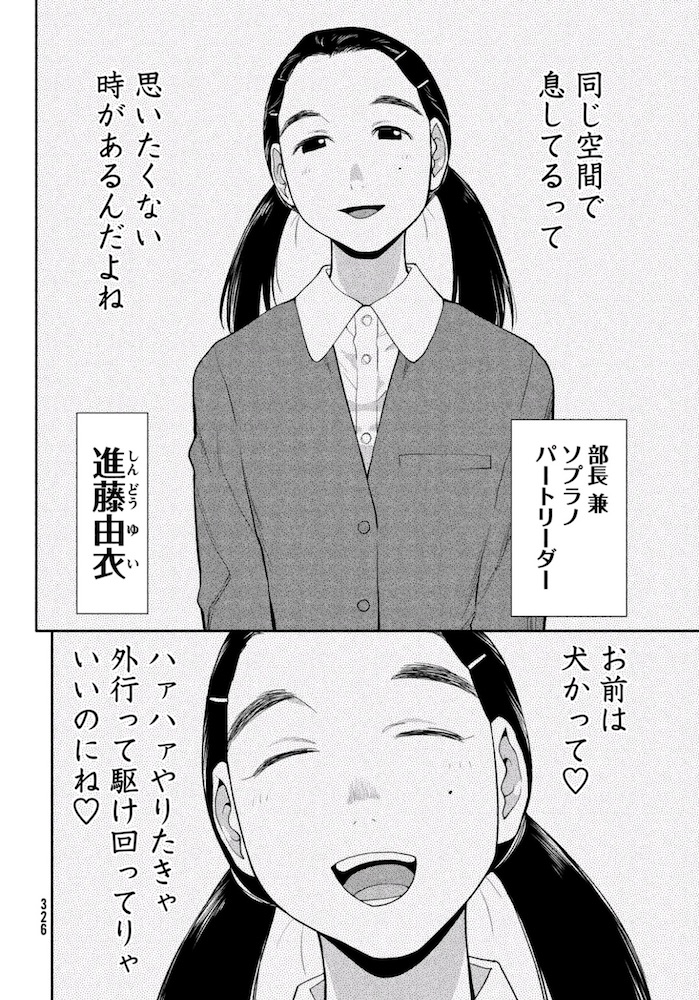
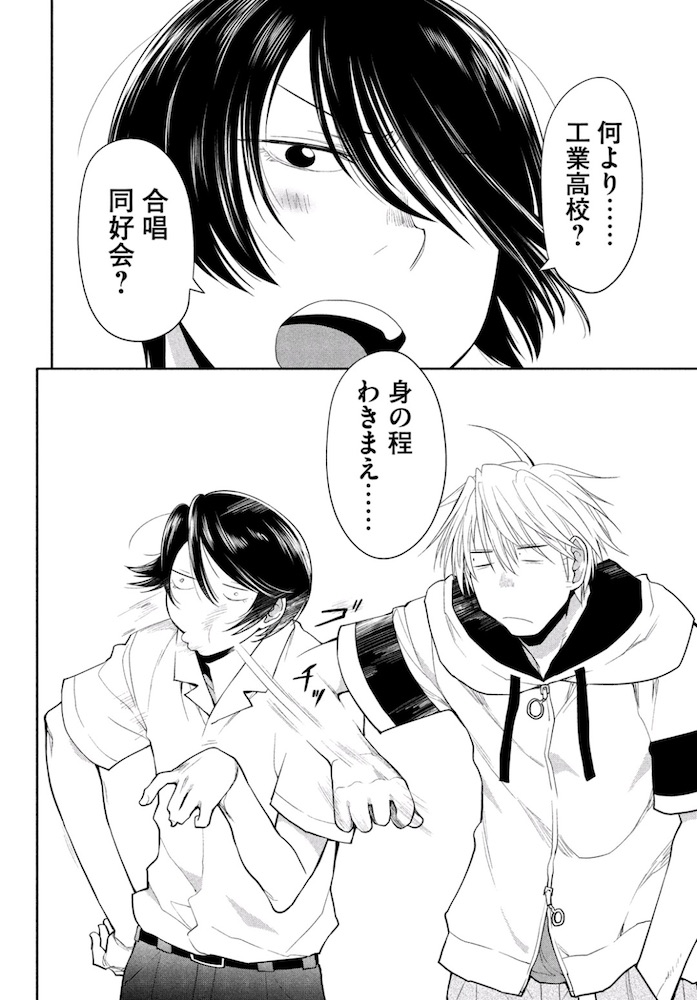
Nishigafuchi lead tenor Saiga (first name Shinnosuke) is in a funk, and the reason is that Shindou Yui, the lead soprano. Shindou mentioned that she sometimes doesn’t want to thing about how they’re breathing in the same space, and that with the way he keeps panting, he should just run around outside like a dog. To prove himself, he plans on challenging Jin to a competition, but gets punched in the mouth by Orihara instead. Shinji wonders if Orihara did it to defend Jin, but Orihara claims it was because he wanted to sing more Brahms. The punch actually makes Saiga want more because it reminds him of Shindou’s sadistic behavior.

Instead of competing, Jin actually helps Saiga with his singing and breathing (so he didn’t have to breathe the same air as her!), and the results are noticeable. Even Shindou is impressed, though she’s no slouch herself. Afterwards, Saiga goes up to Shindou and asks her…if she can be his master. Shindou happily gives him commands like a dog, everyone is confused (especially Kurata), and the Nishigafuchi adviser awkwardly comments that there are all kinds of relationships these days.

As they’re singing, however, Akira doesn’t, and his old middle school classmate Sadamoto notices again. But before he could say anything, Jin asks if the Hashimoto Chorus Club could perform for everyone on their own. Will Shinji finally sing here?

All Kinds

In the last chapter, Nishigafuchi student Andou described Shindou as appearing gentle but actually having a nasty tongue, and she certainly lives up to reputation. I figured that would be the case, but she far exceeds my expectations. I have to wonder if it’s like an entire club of masochists who enjoy the verbal lashing.

Meanwhile, Orihara’s punching Saiga (potentially) in defense of Jin is kind of a serious tsundere move by way of delinquent behavior. Maybe Orihara really does see him as a friend.

Great Teacher Kimura

According to Jin, Saiga tries too hard to keep his head from lifting up and tries to create too much space in his mouth—things that are generally considered good form in singing, but an area where Saiga overcompensates. The consequence is that the surrounding throat muscles to be overly tense and rigid, and this results in him breathing oddly while performing. To Jin, this might be why Shindou made her dog comment.

To help all of the tenors with this, Jin has everyone do an exercise where they “play catch” with their voices. The idea is that they breathe out like you’re trying to form a parabola, and like it’s coming out the top of your head—like they’re “throwing” their voice to the other team.

Jin is thus portrayed as someone who can teach even an elite singer from an elite school, and it furthers the idea that he’s on another level when it comes to understanding sound and music. It’s not clear what his power level is, but when Saiga challenges him, I was expecting a shounen manga moment where Jin can show his stuff and make clear the size of the disparity between them, but it didn’t happen. Yet.


Songs

Referenced last chapter too, they sing Johannes Brahms’s “O Heiland, reiß die Himmel auf, Op. 74, No. 2.”

Final Thoughts

Is Jin purposely requesting a Hashimoto-only performance so that Akira will feel more comfortable singing, or does he have a different motivation?

Also, Kurata’s utter bewilderment over the Saiga-Shindou thing is the cutest thing.

I’m Bad at Understanding Rhythm, but the Manga “Wondance” is Changing That

For the life of me, I’ve always had trouble with musical concepts like rhythm and beats. Even though I was in a couple of band classes as a kid, and even when I’ve tried to read up on it or look up videos, I just couldn’t wrap my head around these things. But recently, I think that’s starting to change, and I actually have manga to thank.

I recently began reading a new hip hop dancing-themed series called Wondance. Because that genre of dance is likely unfamiliar to many readers, the manga uses its main character as a way to introduce ideas. Kotani Kaboku is a basketball player with a speech impediment who discovers that dancing might just be a way for him to express himself, and he even applies some of his b-ball knowledge to his new interest.

In Chapter 4, titled “After-Beat,” Kaboku’s dance teacher talks to her class about a crucial difference between the music they might be accustomed to (J-Pop, anime songs, etc.) and the kind they’re dancing to now (hip hop, R&B, and funk)–what part of the beat the music (and thus the dancing accompanying it) emphasizes. If a basic beat is “1-2, 3-4,” then pop music tends to emphasize the “1” and the “3” while hip hop emphasizes the “2” and the “4.” The “2” and the “4” are called the “after-beat. To put it differently, if the beat track of a song goes “bumm-chh, bumm-chh,” the “chh” is the after-beat.

For anyone who’s into music and dance, this is probably child’s play, but this one page was actually the catalyst for me to actually “get” ideas that I knew of but could never actually understand. That simple explanation above, as well as the demonstration of dance moves at the bottom of the page, opened up a window I thought would be forever inaccessible. I listened to both anime songs and hip hop, my ears now aware of that difference in emphasis. When I watched videos teaching about beats, I had a better notion of what they were saying.

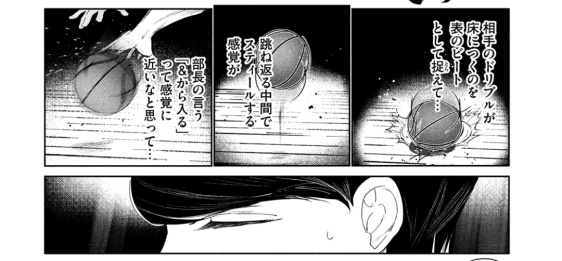
There’s even a moment from Chapter 3 of Wondance that subtly introduces these ideas, and in hindsight it’s actually brilliant. Kaboku notices something about the rhythm of hip hop dancing, and he compares it to dribbling in basketball: if the rhythm of the basketball is down-then-up, then hip hop feels like the “up” is being emphasized, and it’s the prime moment to make a steal. In other words, the ball hitting the floor is the “bumm” and the ball returning to the hand is the “chh.” When I remembered that scene, it hit me like a sack of potatoes.

While I highly doubt that I can ever truly feel the beat as so many others can, or apply it to something like rap or dance, I feel like a new world has opened up to me. It’s almost like learning a new language. I also think it might say something about me that it took reading a comic in a foreign language to finally comprehend something as pervasive as music, but maybe that’s part of the beauty of comics. And between Wondance in manga and Tribe Cool Crew in anime, I hope we see this genre continue to grow.

“Very East-Coast Avengers.” War of the Realms: New Agents of Atlas

Every year, New York Comic Con is a torrent of color and energy squeezed into a space that will barely fit everyone inside. But I’ve gotten fairly accustomed to it after so long, and at this point it’s basically an annual ritual. But eight months removed from the last NYCC in 2018, I still think about the Asian-Americans in Comics panel held there. Discussing everything from the success of Crazy Rich Asians to the challenges of portraying Asians in media in a landscape eager to work off of old, exotic stereotypes, it made me more invested in a fight I’ve had a stake in all along, even as this blog has concentrated primarily on anime and manga.

So when I read that Marvel was debuting a comic with an all-Asian team, I decided to break my years-long hiatus from traditional superhero comics and purchase the first issue of War of the Realms: New Agents of Atlas. But without even seeing a single image or piece of dialogue, I instantly sensed who the writer for this brand-new series was, or perhaps hadto be: Greg Pak, a long-time champion of introducing Asian characters to comics who was also one of the biggest names on that NYCC panel. Joining him on art is Gang Hyuk Lim, and on color Federico Blee.

The first issue opens up with a very familiar problem in Asia: a territorial dispute. Wave, a Filipino superhero, is chasing after a disturbance only to run afoul of a Mainland Chinese superhero named Aero, who tells her that she shouldn’t be outside the Philippine Sea. The comic instantly frames the level of detail the series aims to have by not only touching upon the ongoing disagreements over borders between Asian countries but also implies that the Filipino and Chinese heroes have different levels of connection to their respective governments.

From there, the series introduces the main Agents of Atlas team, which consists of Asian characters from all around the world, with some established Marvel characters and some all-new. Here, while also showing individual character motivations, the comic also highlights something important: they may all be Asian and raised Asian, but they’ve all been brought up in different ways with different values and assumptions based on the countries of their respective people and where they call home. For many Asian-Americans, there’s often a bit of cultural dissonance when going back to Asia because of the Western values they’ve grown up with. In other words, the first issue specifically emphasizes that just because they’re all “Asian” doesn’t mean they can be painted by the same brush.

The comic goes on to show various other heroes, including a number of Korean ones, as if to imply that superheroes have really taken off there. Amid attack by an outside enemy (from another REALM!), confusion ensues, and a lack of communication and a whole lot of jumping to conclusions leads to heroes fighting one another rather than their common foe.

What impresses me about this first issue is how much it respects both the similarities and differences of Asian cultures around the world while also pointing at the sensitive topics endemic to Asia and its diaspora. It’s the classic and universal idea of “we have to put aside our differences and work together to overcome this obstacle” but through the lens of Asian characters. There’s no exoticizing of any of the heroes, not even the older ones who came about in a time of exoticization.

While I know Greg Pak values and pushes for Asian characters, I have to wonder if part of the reason why Marvel as a business has gone ahead with New Agents of Atlas and its all-Asian team (and non-affiliated Asian heroes) is due to the success of the Marvel movies in China especially. The afterword suggests this, such as when it mentions how stories featuring Aero and Swordmaster can be found on NetEase, a Chinese comics site. As China exerts influence on entertainment and media, companies increasingly try to cater to the country and it’s government’s values. At the same time, however, if appealing to a Chinese audience potentially means more portrayals of Asian characters are respectful, is it a net positive? I don’t really have an answer myself at the moment.

So War of the Realms: New Agents of Atlas is off to a good start more or less. Here’s to hoping it keeps its momentum.

Growing Step by Step: Run with the Wind

To tell a story about  competitive running is to instantly conjure up images of winners and losers. Even “The Tortoise and the Hare,” with its moral of consistent hard work reaping rewards, is framed as “slow and steady wins the race.” But the anime Run with the Wind emphasizes a lesson different from the old folk tale and even many other sports anime: while there will always be those who are faster and stronger, ultimately the true race is the one you run against yourself.

Titled Kaze ga Tsuyoku Fuiteiru (“The Wind is Blowing Strong”) in Japanese and based on the novel by Miura Shion, Run with the Wind centers around the dream of one Kiyose Haiji. A senior at Kansei University, he wants to win the Hakone Ekiden: a 10-man relay marathon that pushes the limits of its participants. However, the group he’s managed to assemble is about as rag-tag as it gets–from a literal prodigy to a manga otaku who hasn’t experienced a real sweat in his life. Even qualifying for the event seems like a pipe dream, let alone winning.

Because the characters come from such wildly differing circumstances, each has a personal challenge to overcome. Kakeru, the aforementioned savant, is far and away the best of the group, but a troubled past leaves him conflicted about both running and being a team player. The geek, nicknamed “Prince,” is on the far opposite end, and is unable to even imagine running 20 kilometers. There’s practically a 0% chance that Prince could ever catch up to Kakeru even if he trained for a decade, but the series emphasizes an idea: it’s less important to prove superiority over others than to grow as an individual and to help others grow as well. Fujioka Kazuma, a character introduced later as the #1 college athlete, views his running not as an opportunity to triumph over others, but as a way to push himself to greater heights. The use of the Hakone Ekiden in the story itself beautifully reinforces this concept, as individual runners must overcome their own section and the expectations both internal and external set out for them.

Speaking from a personal perspective, I am ostensibly a runner.  I go running once a week with a group, though I’m nowhere near the fastest person, and my times haven’t gotten better in a long time, but I can look back at my old self and say, “I thought I could never run this much, but here I am.” “I used to think I couldn’t keep going, but now I know I can do it.” I never finish first, and I doubt I ever will, but challenging myself to keep at it, and then beating it, always tells me I’m going somewhere.

I believe that Run with the Wind’s lessons are extremely relevant to people today, as I increasingly see people both young and old who are paralyzed by the fear of competition and comparison. In their eyes, there’s no point in building up the stamina to climb a hill when others have successfully scaled Mt. Everest, no point to learning martial arts because they’ll never defeat a world champion, no point in working on personal appearance because they’ll never be as handsome or beautiful as movie stars and celebrities. But what Run with the Wind says is that the race to be #1 is not the only race worth running. Those who have given up before even trying, and those who trivialize their own improvement simply because they’re not better than the rest, should take this to heart and find their confidence, however small.

Small Town, Small Girl, Big Feels: Okko’s Inn

I believe strongly art and entertainment meant for kids that isn’t afraid to challenge them. It shows respect for the emotional complexity and growing intelligence of children, while still understanding that guidance is important. With respect to that sentiment, Okko’s Inn (Wakaokami wa Shougakusei! in Japanese) is an anime film that flits between the light-hearted and the somber, successfully channeling both in ways that resonate with young and old alike.

After a life-changing event, grade schooler Oriko (nickname: Okko) ends up moving in to her grandma’s traditional Japanese inn. There, she discovers that she can communicate with a few local spirits, and winds up becoming a junior innkeeper. Learning and laughing alongside both the ghosts and the humans she meets, Okko matures little by little.

Okko’s Inn is cute and heartwarming both on the surface and deep down to its core, but it doesn’t mean its story is all fluff. While the portrayal of the humble everyday bustle of a Japanese inn provides an almost meditative atmosphere, Okko’s internal and external conflicts are made all the more poignant by the way both joy and sorrow touch her life.

There’s one character who steals every scene she appears in: Okko’s classmate Matsuki, whose family is also in the inn business. Both wealthy and refusing to conform to expectations, she’s a wonderfully gaudy princess-type who is actually anything but shallow. Okko and Matsuki’s rivalry/friendship is a thing of beauty, and one of many relationships that make the film fulfilling.

While Okko’s Inn is an emotional ride, it’s never to the extent that it feels incongruous or conducive to whiplash. Whether you’re 5 or 95, its story, and all the little moments that make that story up, are hard to forget.

Menagerie, Menagerie: Hashikko Ensemble, Chapter 15

In this chapter, we see our first school outside of Hashimoto Tech! How will these students react to the eccentricities of the main cast?

Summary

The Chorus Appreciation Society is running into a few walls. This is partly because so many of its members lack experience, partly because of clashes in personality (especially between Orihara and Shinji), and partly because Mimi-sensei herself doesn’t know much about music. Thanks to the reluctant help of music teacher Takano-sensei, however, the Chorus Club gets a chance to do some inter-school practice. They visit Nishigafuchi Private High School, a strong music school with numerous accomplishments in competition and automatic entry into the elite Nankan University. It’s the Hakone Academy of choruses, in Yowamushi Pedal terms, perhaps.

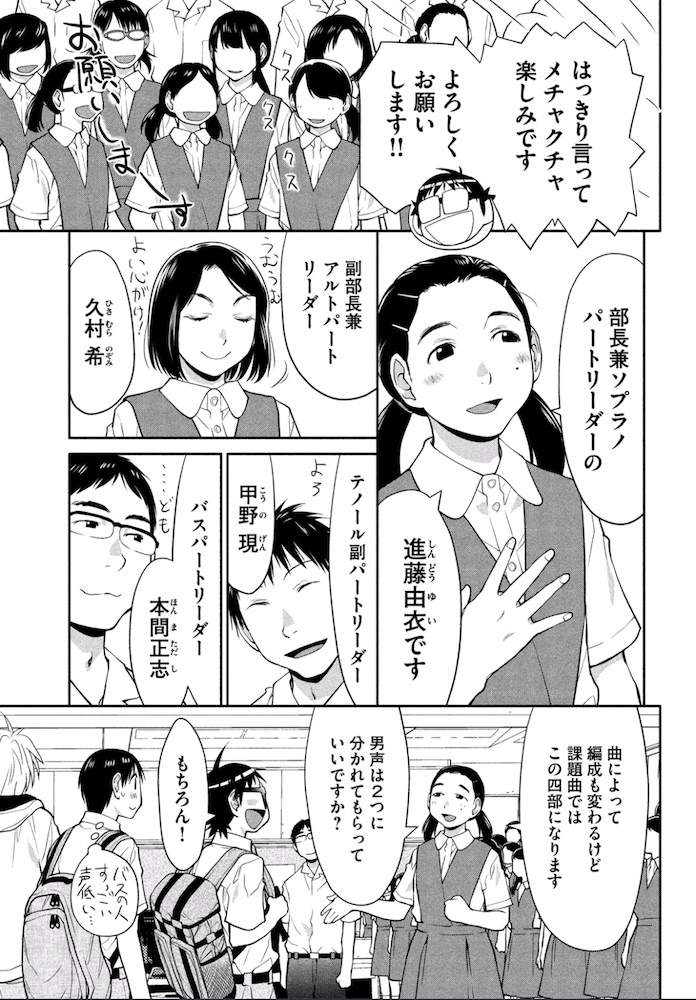
The Nishigafuchi students are surprised at the wildly varying appearances and demeanors of the Hashimoto students. The Hashimoto students split off into their respective vocal sections, but when Akira goes to meet the other bass vocalists, he’s recognized by a student from his middle school days, Kidamoto, who asks what he’s doing there.

Pronunciation 101

There’s an interesting demonstration of some tongue exercises led by Jin. Namely, he shows how while Japanese people are typically taught vowels in the order of “A, I, U, E, O,” the more natural and comfortable order for the mouth would be “I, E, A, O, U.” I rather like how the manga drops bits of knowledge like this, as it both lends an air of authenticity while also making a kind of narrative sense given Jin’s scientific approach to music.

Too Many (?) New Characters

A lot of characters are introduced in this chapter, namely students at Nishigafuchi. Because there are so many, including the leaders of each of their club’s chorus section, I wonder which of them will be important down the line. It’s hard to tell with Hashikko Ensemble, given how we already have some minor characters ascend. I get the feeling that the bass leader, Honma Tadashi, will play a role in helping Akira improve.

As for Takano, she reminds me of the characters from FLCL, and not just in terms of her full lips and pouty face. She has a kind of laid-back slyness that feels like a mix between Haruko and Mamimi.

Kidamoto

Possibly the most important new character is Kidamoto. While he doesn’t stand out at first blush, but I do like how Hashikko Ensemble is utilizing him. At the very beginning of the chapter, his face shows up in one panel (see the top image), but his level of importance is still unknown. Then, when Hashimoto Chorus Club arrives, he reacts to someone’s appearance but it’s not immediately clear who he notices, creating a bit of anticipation in the story. Is it Jin, who’s presumably somewhat infamous in local music circles? Is it Shion, who competed in piano? The fact that it turns out to be Akira is both surprising and intriguing.

So what is the relationship between Akira and Kidamoto? Is it just that Kidamoto knows about how Akira pretended to sing in middle school during class performances? I’m looking forward to getting the answer, as well as seeing how this challenges Akira.

Character Humor Deluxe

There’s a lot of excellent humor this character-based humor in this chapter that I enjoyed immensely. One is Hanyama (the bald student) expressing his sudden urge to join the Chorus Club just from watching Mimi-sensei’s adorable conductor practice. Another involves one of the students at Nishigafuchi wondering if everyone from Hashimoto is going to be delinquents (on account of it being a technical/vocational school), only to have her expectations simultaneously subverted and affirmed by the contrast between Jin and Orihara.

My favorite of all, however, is seeing Shion constantly get distracted in class by Takano-sensei’s piano across the hall. As mentioned by Takano herself, her specialty is the violin, so even as a music teacher she’s not going to be impeccable on the ivory. Seeing Shion jerk her head at every flub Takano makes (summed up entirely in one panel) is such a perfect little character moment for Shion. It not only speaks to her own piano skills, but also hints at the same personality underlying her attitude towards the Chorus Club in the earlier chapters.

Overall, much of Chapter 15 emphasizes what an eclectic hodgepodge of people are at the center of this story. I expect to see Jin upend the Nishigafuchi students’ expectations with his vocal range, as well as other similar surprises.

Songs

The song they’re practicing for competition, “Miagete Goran Yoru no Hoshi o” (Behold the Nighttime Stars) by Kyu Sakamoto, appears again in this chapter. It’s to be expected moving forward.

Another song, one that Shion decides to play on piano (and thus not helping with practice) is Friedrich Bürgmuller’s 25 Études faciles et progressives, Op.100 (25 studies for piano) L’Arabesque. It’s part of a series of pieces designed to help young pianists improve their skills.

Final Thoughts

I often wonder if I’m actually doing this manga justice. There are a lot of little details in the panels that can seem frivolous but also add a lot to the core character dynamics that fuel the series. Hashikko Ensemble grows in fits and starts, but that’s also what makes it so appealing.


Infinite Potential: Aikatsu Friends! Kagayaki no Jewel

I’m unsure of what kids’ marketing research took place, but I doubt it’s a coincidence that both Precure and Aikatsu!—two major girls’ anime franchises—somehow both ended up on a space theme this year. But while Star Twinkle Precure is kind of expected given how every season has a gimmick or three, it’s much more surprising that Aikatsu Friends! Kagayaki no Jewel would establish the concept of “Space Idol Activities” in its own universe. Fitting, perhaps, but surprising nevertheless.

There’s a certain level of absurdity that permeates Aikatsu! as a whole—more than enough to make “Aikatsu in space” not seem like such a bizarre direction. In fact, I think it’s what has allowed the franchise to stand the test of time as a work of art and media, independent of the arcade game it’s based on. Aikatsu Friends! Kagayaki no Jewel leans into that, whether it’s maintaining old traditions (e.g. scaling cliffs) or trying something new. So when the first episode begins with an astronaut entering the stratosphere, the main reaction from me is “sure.” In a way, it feels more fitting than something like, Yu-Gi-Oh!, which now has a history of highlighting card games in different settings—in ancient Egypt, in school, on motorcycles, in space, and so on.

The new season also takes place in a new semester where the Aine and friends are now in the high school division, and I always enjoy seeing the signs of progress that come with such transitions. In this case, it’s seeing the underclassmen pale in terms of aerobic an anaerobic training alike, as well as…idols in spaaaaace.

My only wish is that they push this concept as far as it can go. Why limit it to space-esque idol performances? Why not have an idol school aboard a shuttle? Why not have zero-g dancing? Please take this to the absolute limit, Aikatsu!

P.S. Did you know the best Aikatsu! characters introduce themselves by parachute? It’s true.

This post was sponsored by Johnny Trovato. If you’d like to request a topic for Ogiue Maniax (or support it in general), check out the Patreon.

Hip Hop Manga: “Change!” and “Wondance”

Whether by chance or perhaps some broad editorial intent, it’s a curious thing that hip hop culture would be a prominent theme in two currently serialized Kodansha manga in Japan. Change!, running in Monthly Shounen Magazine, is the story of a Japanese poetry-loving girl named Shiori who ends up being drawn into the world of rap battling. Wondance, from Monthly Afternoon, focuses on an athletic boy with a stutter who discovers hip hop dance as a way to express himself. Each series, almost by necessity, takes a very different approach to their respective subjects, and juxtaposing the two highlights the power each work possesses.

Change! naturally places great emphasis on verbal dexterity as a series about Japanese rapping, and there are certain aspects to the language that make it differ from English rapping. Japanese has fewer vowel sounds, which means that many more things in the language can technically rhyme, which in turn means that the rhymes that do occur can be even more varied yet precise aurally. The heavy emphasis on syllables also gives Japanese a certain sense of rhythm, especially because extending those sounds can change the meaning of a word entirely.

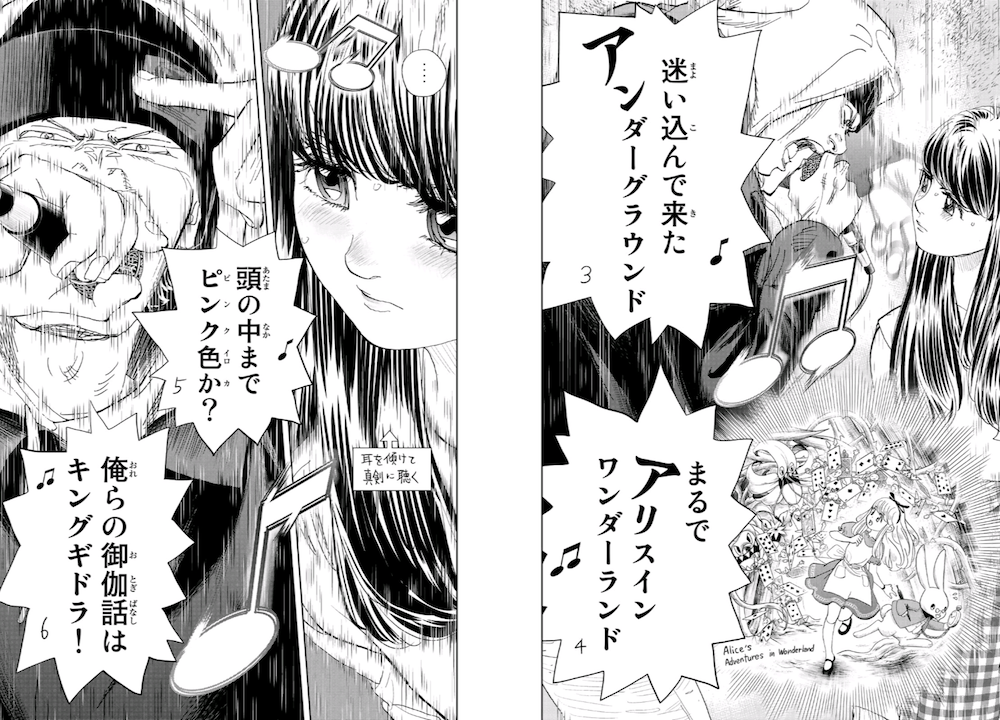
All of this needs to be effectively conveyed in the manga, and the approach Change! takes is to place more emphasis on word balloons than most manga. Words and syllables can appear larger or more erratic in order to highlight what key words in one line are being correlated with in the next line. The classic staple of many manga, furigana to aid in the reading of difficult kanji, take on added importance due to both the sheer number of homonyms that exist in Japanese and to make sure the reader keeps track of what’s being said syllable by syllable.

In the images above, the male rapper connects the word “underground” with “Alice in Wonderland,” working off the fact that andaaguraundo and Arisu in Wandaaraando both start with an “a” and have the similar raundo vs. rando. He then follows up on the next page with Atama no naka made pinku iroka? / Orera no otogibanashi wa Kingu Gidora!, or, “Is even the inside of your head the color pink? / Our fairytale is King Ghidorah!” Pinku iroka lines up perfectly vowel-wise with Kingu Gidora, and the talk of fairy tales follows up to his comparison of Shiori as being as out of her depth as Alice is in her story. While the passionate expressions and the metaphorical imagery shown contribute to the atmosphere and to hammer home the meanings behind the words, the actual word balloons do a great deal of heavy lifting.

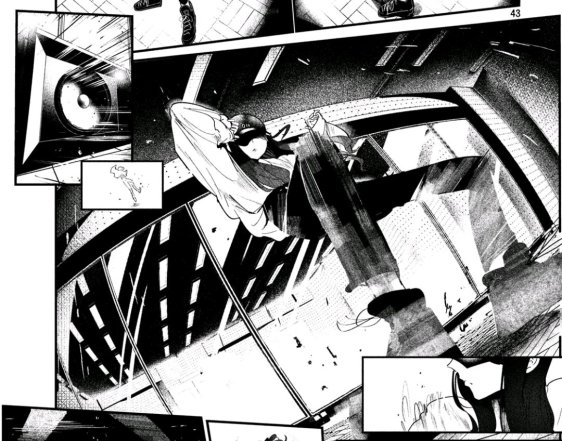
In contrast, although Wondance can be fairly wordy at times, when it comes to dancing, the manga is very much in the “show, don’t tell” category. Characters move with grace and intensity, and panels highlighting their steps litter the pages, turning them into virtual collages that practically crackle with energy. Text is sparse, and primarily brief glimpses into how the characters are thinking in the heat of the moment.

In the pages above, the main character and Hikaru—the girl who brings him into the world of dancing—are dancing together in a class. The paneling supports the character artwork, emphasizing a sense of the two as a duo in sync with each other on some deeper level. This visual approach calls to mind the elaborate paneling of 1970s shoujo manga such as Swan, where panels cascade and climax in beautiful ways. The drawings capture not just the dance but the emotions of the dancers as well, making their moves the central vehicle for storytelling. In a sense, one doesn’t even need to know Japanese (or have a translation handy) to get the essence of Wondance.

Thus, on the one hand, you have a series where the words are of the utmost importance and another where images hold the power. However, they both draw upon the visual language of comics and especially manga in fundamental ways through their particular emphases. Change! and Wondance capture some of the magic of hip hop culture itself as a multi-medium, multi-angle fusion of various ingredients.

“Tales of Eternia: The Animation” and the Adapting of RPGs

I was asked via Patreon to look at the Tales RPG series, which I have very little experience with. Given time constraints, I decided to focus my energy on an anime version, knowing full well that such adaptations often do not fully capture what makes the source material appealing. With that in mind, I chose to go in blind on the earliest Tales anime: Tales of Eternia.

My immediate feeling from the first couple of episodes was that the core cast is a fun and likable bunch, and that they stood out above all else. My favorite is Farah Oersted, the martial arts tomboy with an oddly familiar an appropriate voice—turns out she shares a voice with Videl from the Dragon Ball franchise. The show at times felt beholden to its RPG origins, especially during fight scenes, which is not helped by the roughness of the early-2000s digital animation.

But as I kept watching, I wondered just how much ground they were covering from the original Tales of Eternia. Halfway in, it seemed more like they were on their very first missions, when you’re still kind of learning the ropes. By the time a major plot twist comes in, it feels strangely paced—like either the story was moving too slow for something like this, or it had been skipping over too much. At this point, I decided to look at just how this anime maps onto the game.

The answer is that it doesn’t—at least not exactly. The central characters are more or less the same, except drawn in an early-2000s anime style as opposed to the softer designs of the game (or its squat sprites), but the story of the Tales of Eternia anime does not take place anywhere in the actual RPG. Suddenly, it made sense, and the feeling I was getting from the anime version was all too familiar: the Tales of Eternia anime is basically a filler arc.

The challenge of adapting an RPG is tricky because there’s not necessarily enough time to cover everything, so I can see why they took this approach. Shoving the game’s story into 13 episodes probably wouldn’t have done it justice, so going for a wholly original story is an interesting solution. However, the reason it feels so much like filler is because it straddles the line a little too much. The anime tries not to touch the main story so there are no real stakes, but it also seems to assume that this somewhere into it, so the anime isn’t terribly free to take liberties. All that remains is the charm of the characters.