His Characterization is Maximum: “Dragon Ball Super: Broly”

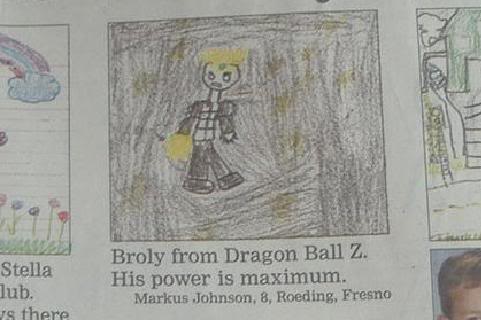
There’s an old and famous picture from a newspaper’s children’s section, where they asked kids, “If you could be a superhero, who would you be?” In response to this question, a boy named Markus answered, “Broly from Dragon Ball Z. His power is maximum.” But while people online have gotten lots of laughs from this innocent answer over the years, Markus’s words almost perfectly encapsulate the character of Broly, the Legendary Super Saiyan.

As an antagonist, Broly was always a one-dimensional character whose primary trait is being ridiculously and impressively powerful. To be fair, the way it’s portrayed in his appearances leaves a lasting impression, and has a clear, primal appeal to Dragon Ball Z fans. However, he’s ultimately a simplistic villain to be overcome by blasting him harder.

The character is also non-canon, appearing only in Dragon Ball Z anime films, which is why it’s rather significant that the creator of Dragon Ball himself, Toriyama Akira wrote the script for Dragon Ball Super: Broly. It not only means introducing Broly into the Dragon Ball universe proper, but also an opportunity to transform this flimsy rage machine into a fully fleshed character.

On a skeletal level, Super Broly is basically the same character: an instrument of revenge for his father, Paragus, against Vegeta  (the son of the man he hates most, King Vegeta), who goes berserk and must be stopped by Son Goku and his allies. There are a couple of crucial changes, however.

First, in the original Broly film, Broly is shown as having an inadvertent deep-seated trauma caused by Goku when they were fellow infants, which causes him to wantonly attack Goku. This no longer is a thing, and when he and Goku fight as adults, they’re meeting for the first time. Second, in the new film, Broly is shown as being ridiculously strong and terrifying but ultimately innocent inside—as if his personality isn’t inherently that of a fighter.

Both are smart choices that lay the groundwork for making Broly a properly three-dimensional character. The Goku grudge used to come across as largely a flimsy device to get Broly in direct conflict with the hero of the story, and it kind of punks out Vegeta in the process. Without it, his background focuses more on him being unfairly raised by his own father to be a tool for revenge, and the different ways in which Goku, Vegeta, and Broly have been shaped by their upbringings and experiences. An extensive background story in the first half of the film highlights these differences.

That being said, I don’t want to make this film sound like a deep look into character psyches, as it’s mostly one gigantic fight scene full of the fast and frenetic combat Dragon Ball is known for. However, those crucial differences between Goku, Vegeta, and Broly come out even as they’re pummeling each other. Goku’s Earth-bases martial arts background, Vegeta’s elite Saiyan training, and Broly’s mostly unrefined berserker rage are all conveyed in the action, which does a lot of showing instead of telling somewhat reminiscent of Mad Max: Fury Road.

A few bits of welcome comedy alongside some new characters help keep Dragon Ball Super: Broly from feeling too heavy—a clear indication of Toriyama’s hand in the process. Overall, it ends up being a really solid film, and one that manages to give depth and meaning to a pure power fantasy character like Broly without taking away the strength that made him popular in the first place.

 

Never Give Up: Hugtto! Precure

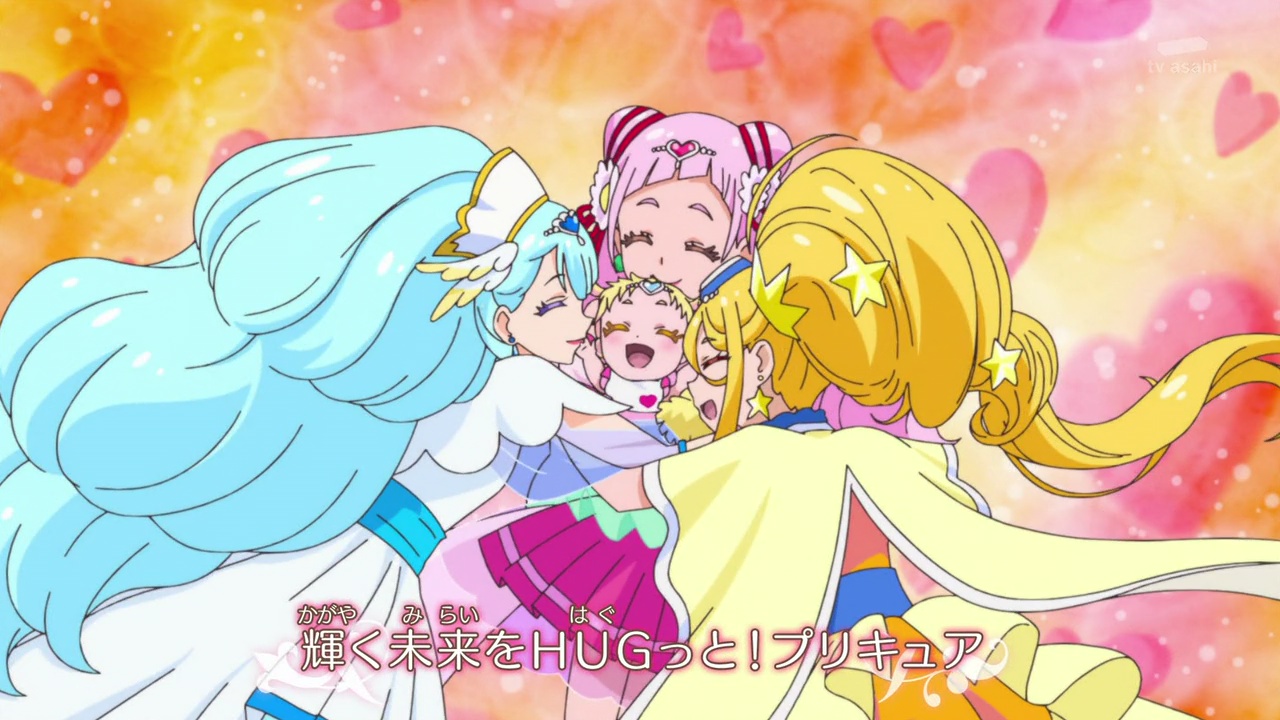
In the opening to Hugtto! Precure, the very first thing spoken by the heroine of the story, Nono Hana, is a motivational mantra: “You can do anything! You can be anything! Embrace your shining future! Hooray, hooray, everyone! Hooray, hooray, me! Here we go!”

At first, it feels a little hokey platitude you say to kids: “You can become president one day!” But over the course of 49 episodes, the words grow and grow in weight and significance. Hugtto! Precure knows it’s not easy to do what’s right, that failure can feel devastating, and that life can turn from joy to sorrow in a moment’s notice. Still, it tells its viewers, both young and old, something ever-important but especially in today’s world: “You define your own success, and who you want to be.”

The premise is standard magical girl stuff: Nono Hana is a 13-year-old girl who won’t let the world get her down, when a mysterious baby named Hugtan nd her talking hamster companion fall from the sky. Gaining magical powers to fight off the nefarious forces after the baby, Hana becomes Cure Yell, and over the course of the series makes new friends and allies who join in her fight. Hugtto! also celebrates the 15th anniversary of the Precure franchise, and it pulls out all the stops as a result. The animation and vibrant, impactful action scenes are frequently among the best in franchise history, and the Hugtto! makes numerous subtle and not-so-subtle references to past series.

But even before the first episode, one bit of news about the show stood out to me more than anything else: the fact that the director of Hugtto! is the famous Sato Junichi—in fact, it’s his first Precure! One of the best ever at making magical girl anime that are both poignant and respectful of the young audience watching them, the same attitude seen in works like Sailor Moon, Ojamajo Doremi, Princess Tutu, and Fushigiboshi no Futagohime is on full display in here. When the primary themes are dreams and motherhood, it can be all too easy to create something contrived, but Hugtto! leaps over that hurdle with grace and enthusiasm.

Major and minor characters alike are robust and fully realized, with their own strengths and weaknesses and unique circumstances, as if they all have their own lives and stories to lead. My favorite character is Aisaki Emiru, a rich girl whose overactive imagination leads her into being overly cautious. However, I think the character who encapsulates what makes Hugtto! so powerful is Nono Hana herself.

Hana’s Precure name, Cure Yell, comes from how “yell” (eeru) is used to mean “cheer” in Japanese. This explains not only her cheerleader-inspired outfit but also her general life philosophy: Everyone needs a supportive voice to lift them up sometimes, whether they’re ultra-talented naturals living their dreams or struggling to achieve anything, and that includes Hana herself. As the series points out numerous times, being that source of encouragement might seem easier or less important than what the superstars around her accomplish—Homare as a figure skater, Saaya as an actress, and more—but it’s just as challenging and valuable to inspire others to not give up. It doesn’t come totally naturally to Hana either; she actively works on it, essentially exuding a motherly and nurturing quality not just towards Hugtan but everyone else too.

People can fail and dreams can change, but “You can do anything! You can be anything!” is not meant to be taken literally. Rather, it encourages a mindset that doesn’t let any obstacle, no matter how big or small, trap people into doing nothing.

In terms of messaging, Hugtto! Precure is one of the best in franchise history. It’s very easy for any show of Precure’s kind—a massive merchandising machine—to play it safe and push toy sales, but Hugtto! actively emphasizes a plethora of important lessons that allow it to overcome that pitfall. For example, while Hugtto! has that excellent fighting action Precure is known for, it still foregrounds the idea that violence is ultimately not the answer, that it is the Precure’ s compassion that wins the day in the end. A key instance of this is when Cure Yell gains an elegant and powerful-looking sword, but rejects its violent appearance, claiming that it isn’t what they need in that moment to not just defeat a villain but save him as well.

Other notable stories highlight a progressive bent in Hugtto! Wakamiya Henri, is introduced as a figure-skating rival for Homare but becomes a key figure for challenging gender and sexuality norms. A stand-alone episode about childbirth becomes a lesson to viewers about the wrongful demonizing of Caesarean sections in Japan. The villains, each named after a different era of recent Japanese history, are all portrayed as having succumbed to cynicism and in need of the Precures to show them that they can still believe and dream. As a side note, it’s highly amusing to me that the villain who represents baby boomers, Daigan, loves to talk big about how he’d fix everything with ease, but ultimately proves ineffectual.

So where does Hugtto! Precure rank among its fellow Precure series? A part of me is still more fond of Heartcatch Precure! (which I consider the pinnacle of the franchise), but Hugtto! carries much of the same spirit and DNA that made Heartcatch great. In other words, it’s a top-tier show that’s at once familiar and daring, and perhaps casts a long shadow on what’s to follow. Best of luck to Star Twinkle Precure—it’s going to need some.

Hands-On Experience: Hashikko Ensemble, Chapter 12

Kurata Shion’s history with piano and some lewd humor make up Chapter 12 of Hashikko Ensemble.

Summary

The chapter begins with Mimi-sensei recalling her past. Growing up shy due to her large chest, she was inspired by a high school teacher to go into teaching herself. Unfortunately, her students treat her more like a friend than an authority figure, leaving her unconfident.

Shion tells the classroom about her own history. Encouraged to learn the piano from a young age by her mom, she eventually developed a form of tendonitis. When she suggested to her mom that she wanted to quit, her mother’s response was that Shion has no ability otherwise—if she stops playing, she’ll have nothing left.

Jin figures out that Shion was taught poor form—a byproduct of being coached by her inexperienced mom. This lines up with everything else we know about Shion: she uses too much force for everything, whether it’s sawing or playing piano. The conversation gets heated, especially because Shion discusses quitting the school due to her seeming inability to learn how to let up on her grip.

Oumi-sensei steps in to try and convey to Shion that there’s more to Hashimoto Tech than just learning trade skills, that it’s about having new human experiences. Mimi-sensei feels the spirit of her old teacher inspiring her, so she offers herself as an open ear. Shion immediately squanders this good faith by asking for a smartphone, to which Mimi responds, “Why don’t you ask your mom?”

Shion leaves, childishly frustrated at Mimi’s response, but accidentally trips and lands with her hands on Mimi’s chest. However, squeezing them and alternating her grip strength helps her figure out what it means to have a gentle touch. Excitedly, she runs to the woodshop classroom to demonstrate her suddenly improved sawing technique. Jin then asks her to try and play piano, and using that chesty eureka moment, Shion applies her new lighter touch to the ivory as well. The Chorus Club has their pianist now.

Poor Mimi-chan

I feel for Mimi, especially how she doesn’t seem to be treated seriously as an adult. Even her heartfelt recollection of how she became a teacher was a setup for a boob joke.However, I like how this chapter revealed that she actually has a tiny bit of an edge when Shion asks her about getting a smartphone. The way the page is framed, with each of them equally prominent in separate panels, makes Mimi’s response feel immediate and somewhat terse while still conveying her generally gentle demeanor.

The Road to Hell

Shion’s past is yet another instance of conflict between parent and child, but unlike Orihara’s situation of neglect, it involves a mom with good intentions. Shion’s case is when a general approach to life (work harder!) fails to take into account the particular needs or feelings of an individual. The fact that her mom actually suggests that Shion has nothing without piano is an all-too-real sentiment from a loving but perhaps overbearing parent, and on some level I can empathize with Shion’s situation more than any other character so far. It also makes me wonder if Kio Shimoku is laying a general criticism towards parents in Japan and the different ways they can negatively impact their children’s lives. As a father himself, perhaps he’s also warning himself—like a reminder to never forget what it was like to be that age.

Because Hashimoto Tech is a vocational school, it brings to the foreground the notion that these are kids on the cusp of becoming adults. For Shion, there’s also the question of what happens when one’s passion or hobby is tied to one’s career. At one point, she reveals that she always assumed a dislike of piano meant a dislike of music in general, and it’s a window into how all the different elements involved with her starting and giving up playing are jumbled together. Decoupling them is one of the outcomes of this chapter.

Talent vs. Hard Work

The question of whether hard work can compete with talent comes up while the class is discussing Shion’s situation. We know Shion’s opinion on this—that hard work can’t compete. Jin disagrees, but what’s especially curious is that Jin doesn’t see himself as talented. The question is if his incredible vocal skills is indeed a product of constant striving, or if he’s comparing himself to some kind of titan. The fact that Jin expresses empathy with Shion growing up with an overbearing mom might say it all.

Songs

Once again, “Kanade” by Sukima Switch. It’s the song Shion plays.

Final Thoughts

When Shion accidentally trips and is about to fall, Hasegawa (the judo girl) rushes to save her but then accidentally bumps into Akira. If you look closely, Hasegawa was behind the teacher’s lectern a moment before. Either this was a mistake, or she actually slid over the lectern to get there in time.

Also, she likes puns.

Basically, Hasegawa’s awesome.

They’re all awesome.

The Best Nonsense: “Himote House: A share house of super psychic girls”

The “semi-improv” anime genre began in 2009 with gdgd Fairies, and since then it’s been a source of both laugher and confusion. 2018’s Himote House: A share house of super psychic girls is the latest take on this formula, and it feels in certain ways a culmination of all the previous works. If gdgd Fairies is the pioneer, Tesagure! Bukatsumono the most consistently funny, and Naria Girls the strangest failure, then Himote House is simultaneously the most indicative of experience and the most successfully experimental.

Ostensibly, the series is about a group of girls with super powers who all have trouble getting boyfriends, but the premise (as always) is mostly a pretense to set up joke after joke. Like most of its predecessors, the show is built around varying degrees of scripted comedy and impromptu improv moments. More than any other show of its kind, however, Himote House is willing to break with its own established patterns. Trying to find ways to be attractive to guys gets plenty of laughs, but only because they highlight the absurdity of the characters themselves. An episode at a bathhouse has to be seen to be believed—at once spoofing the exploitative power of fanservice and leaning hard into an awkwardness like no other.

These types of shows live and die by their actors, and Himote House fortunately brings back multiple veterans from past series such as Straight Title Robot Anime and Tesagure! Bukatsumono. Himote House will even occasionally call back to previous series as a nod to the returning fans. The biggest thing of all, however, is that the three of the gdgd Fairies are here too, and that includes seiyuu mega-star and Okada Kazuchika girlfriend Mimori Suzuko. I’m particularly impressed by Mizuhara Kaoru, who plays a very different but equally amusing character compared to her role as shrshr in gdgd Fairies.

As with its predecessors, Himote House hits home if you’re into a kind of disorganized humor that thrives just as much on when jokes fall flat as when they succeed—it’s all about the actors sticking the landing. Existing somewhere in the range between Aqua Teen Hunger Force and Inferno Cop, Himote House is, if anything, memorable.

The World Wide Web of Human Pain: SSSS.Gridman

If you were to ask me what my favorite Power Rangers-type show was as a child, it would undoubtedly be Superhuman Samurai Syber-Squad. I distinctly recall running around the house yelling “SUPERHUMAN SAMURAI!!!!” mimicking both the theme song and the TV commercial jingle. So while I’ve never seen the original Gridman the Hyper Agent in Japanese that provided the source material, SSSS.Gridman was an instant must-watch—especially because it was being made by Studio Trigger (Little Witch AcademiaKill la Kill).

SSSS.Gridman is ostensibly about a boy named Yuuta who can merge with a computer entity called Gridman the Hyper Agent and use his abilities to fight off giant monsters attacking their city. However, it quickly feels more like a bizarre paranormal mystery that seems eager to deal out the truth piecemeal. Often times the show is seemingly less concerned with personal character development and more about pulling back the curtain. One of the biggest questions is how the monsters and even Gridman himself, who were previously confined to the computer realm, are manifesting in the real world.

The result of SSSS.Gridman‘s peculiar mixture of ingredients is that it can feel like a never-ending ocean of information to explore in both profound and frivolous ways. Somehow, it simultaneously presents itself as both a shallow case of “geek-info/reference overcharge” and an introspective look at the pain and suffering of human interaction.

The series is full of odd details that aren’t exactly vital but add to a certain meta-ness that can enhance enjoyment of SSSS.Gridman. Two side characters in the series actually come from a yuri short story by the series director. Most if not all of the characters in the anime are based on a Botcon convention-exclusive mirror-universe series called Transformers: Shattered Glass. it’s a strangely elaborate reference to make, almost purely for enjoyment’s sake (and to get the Transformers fans jumping out of their seats), or perhaps as a wink and nod to the fact that the company Takara had a hand in both Transformers and Dengeki Choujin Gridman. Even the title, SSSS.Gridman seems to be willing to play into its own American adaptation. After all, how else would a fan of Superhuman Samurai Syber-Squad interpret the series?

But then the anime also makes references so as to hint at the true natures of its characters, or to foreshadow what’s to come. It’s really deep-cut stuff that generally involves using monsters and motifs of past tokusatsu works (especially from Tsubaraya Productions, the studio behind Ultraman and Gridman), and far beyond my knowledge or experience to have picked up without outside reference (thanks to Mike Dent!) However, it’s not as if one needs to get every in-joke or obscure callback to understand SSSS.Gridman and where it’s going. The series is another showcase of one of Studio Trigger’s great strengths: the ability to put in all of that under-the-surface content for hardcore fans without alienating newcomers. The references aren’t a barrier to entry so much as a reward for the faithful, and it’s as much a sign of love as the very movements of the monsters themselves, who despite being animated in 3DCG are made to behave like people in rubber suits as a way of replicating the live-action feel of the original Gridman.

Right to the end, SSSS.Gridman seems to change and shift, and it can be difficult (though not impossible) to predict where it’s truly headed. Watching the series unfold is a quiet yet boisterous joy that captures simultaneously the anxieties and wonders of both childhood and adulthood.

Dreams Before Harems: Why I Like “We Never Learn”

We Never Learn is a popular harem manga currently running in Weekly Shonen Jump, and one I actually like a good deal. With the anime debuting next season, I’ve been thinking about why I’m fond of this particular series over other similar works, and I realized something. While We Never Learn is indeed a harem series, and thus shipping is ostensibly an important factor for enjoying the series, I find that I don’t actually care about pairings at all, and this makes the series better for me.

Because the anime is coming out this season, I’m going to make this post as spoiler-free as possible. Actually, I don’t even think I need spoilers to explain my point, so it works out.

The basic plot of We Never Learn has high school boy Yuiga Nariyuki tasked with tutoring two of the smartest girls in school. However, while Furuhashi Fumino is a genius of literature and the arts, and Ogata Rizu is a math and science wizard, their respective dreams are to go to college in their worst subjects instead. Along the way, other girls join the cast, and the close calls with Nariyuki never stop, in typical harem fashion.

One thing clear from the start is that each character has their own goals they want to reach. Sparks fly and fanservice abounds, but their attractiveness doesn’t define who they are as people. Moreover, they’re all supportive of one another, and this makes it a refreshing experience.

Nariyuki could end up with anyone, or no one. Any of the girls could end up with each other. Perhaps they might all marry random, unrelated characters. To me, none of it truly matters, because I want all of them to succeed in ways beyond relationship success. While the girls and their cuteness is a major part of We Never Learn, you want to see these girls achieve their dreams as they try to overcome genius with hard work in a Rock Lee-esque way. The fact that the geniuses they’re to beat are themselves makes it all the greater.

Tree Skills vs. Skill Trees: Hashikko Ensemble, Chapter 11

The path to a full Chorus Club is revealed, and the super-intense Kurata Shion gets center stage in this month’s chapter of Hashikko Ensemble.

Summary

Orihara is now a part of the Chorus Club, and Jin needs just one more member and a faculty advisor to get formal “Appreciation Society” status. If he can, he wants someone who plays piano.

Meanwhile, Kurata is getting advice from Oumi-sensei (the gray-haired one), who suggests that she join the woodworking club to improve her skills and to relax a little. However, the over-serious Kurata (who’s also revealed to be quite the spaz) refuses, seeing it as frivolous fun that gets in the way of Hashimoto Technical’s purpose as a vocational school. Both shy towards her fellow female classmates and frustrated at her lack of talent, she runs away, only to accidentally bump into Akira and the Chorus Club. Curiously, instead of making a typical startled noise, she lets out an F♯2 note.

In judo class (apparently a staple of Hashimoto Technical), Kurata is participating along with Hasegawa and her friend. Hasegawa, it turns out, is actually the daughter of a prominent judo family, and tosses around both one of the school’s judo club members and Orihara effortlessly (while also simultaneously ogling the latter). Kurata and Hasegawa’s friend are practicing against each other, but when a sudden pain in Kurata’s hand causes her to fall over, she reveals that her tendonitis is flaring up—as a result of her piano-playing!

Kurata’s Situation

Kurata doesn’t know how to crack eggs, and can’t seem to even run on a school racetrack without going off-course. If there’s any character she reminds me of, it’s Mio from Nichijou, who can’t seem to follow rules of any kind when it comes to sports or competition. I also love the way they reveal her music background, with her unusually melodic yelp.

I might be sounding like a broken record, but Kurata’s the latest in a long line of interesting characters in Hashikko Ensemble. First, there’s the fact that her antagonism towards the Chorus Club is kept mostly to herself—in fact, Jin and Akira don’t even really recognize her. Second, is that her dislike of the Chorus Club had seemed personal on some level, but the hints we get as to why this is the case make her and her story all the more intriguing.

It’s clear that Kurata has a musical background of some kind and that it’s limited by her tendonitis. Was a potential piano career derailed by health issues, leading her to lose faith in putting her future in something as fragile as musical performance? Is it perhaps pressure from parents? How much does she actually believe what she’s saying when she declares her preference for the pragmatic, and how much is she forcing herself to think this way? I’m really looking forward to finding out more.

As for what she’ll do as a potential Chorus Club member, one would think piano, but the fact that she has trouble playing might mean she’ll be another singer instead.

Hasegawa’s Unusual Friendship

Hasegawa and the other girl who’s always with her (whose name might not even have been mentioned yet) are so different from each other that you wouldn’t necessarily expect them to be close, but they say outright that it’s just a natural product of there being so few girls at the school. From what I can tell, while it likely began out of convenience, it transformed into a genuine friendship at some point. Now, they’re trying to get closer to Kurata too, but she’s as nervous and unsocial as they come.

I really enjoy how it doesn’t take much to portray Hasegawa and her friend as fleshed-out characters with an authentic-feeling history. This feeling of realism is one of Kio Shimoku’s greatest strengths.

As for Hasegawa’s judo background, I got a good chuckle out of how she actively eggs on the judo club. Also, i wonder if her love of beefy dudes is because of her family or not.

Songs

No music this chapter, aside from some basic voice lessons.

Final Thoughts

In a flashback, Kurata asks why the Japanese shorthand for “smartphone” is sumaho and not sumafo, as if it doesn’t make sense. I AGREE. IT’S ALWAYS BOTHERED ME.

Gattai Girls 10: “Mobile Police Patlabor” OVA 1 and Izumi Noa [Anime Secret Santa]

Introduction: For the second year in a row, I’m combining my Reverse Thieves’ Anime Secret Santa entry with my Gattai Girls review series—posts dedicated to looking at giant robot anime featuring prominent female characters due to their relative rarity within that genre.

Here, “prominent” is primarily defined by two traits. First, the female character has to be either a main character (as opposed to a sidekick or support character), or she has to be in a role which distinguishes her. Second, the female character has to actually pilot a giant robot, preferably the main giant robot of the series she’s in.

The year is 1988, and the long-standing image of giant robots in anime fluctuates between either fantastic heroes and gritty, expansive science fiction. In this environment, one multimedia franchise decides to ask a simple yet potential-laden question: how does a society police its citizens in a world where mecha are commonplace?

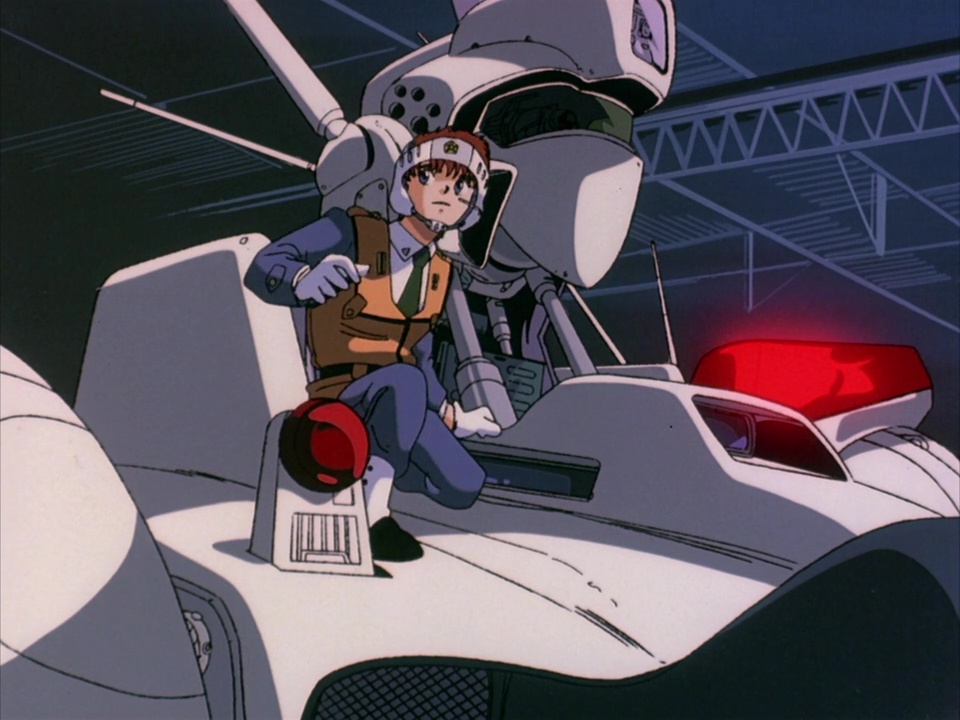
In the near future of Patlabor, humanoid robots are commonly used in various industries, the police have also decided to incorporate mecha known as Patrol Labors into their forces. Patlabor follows Special Vehicles Unit 2, a ragtag bunch of eccentrics who solve Labor-related crimes. While there are multiple iterations of Patlabor, including anime, TV series, OVAs, and films (all of which apparently have branching continuities), this review will be focused on the first OVA series, titled simply Mobile Police Patlabor, but also known as Patlabor: The Early Days.

At first, Patlabor presents itself as a fairly low-stakes works, with its eclectic cast of officers and mechanics trying to deal as much with each other as the crimes they’re supposed to prevent. However, it gradually reveals concerns that are deeper and broader than first expected—provided you peel back the curtain a little bit. Over the course of the seven episodes of the first OVA series, those “Labor crimes” (not sure if pun intended) often speak to underlying social issues in Japan such as the struggle between pacifism and militarism that has affected the nation since World War II.

Such themes are the wheelhouse of the OVA’s director, Oshii Mamoru, and he gets even more philosophical about the intersection between technology and society in his Patlabor films. Here in the first OVA, though, Oshii doesn’t go nearly as hard on his pet topics, and the result is a comparatively much more straightforward story. The OVA is much more willing to be a police drama with some underlying political messages, and thus more approachable for those who might feel the films to be too overbearing.

But it’s also impossible to shake the idea that Patlabor cares relatively little about what it presents on the surface, especially when it comes to the treatment of the ostensible protagonist, Izumi Noa. If one were to guess what Patlabor is about from just the opening alone, one would assume that Noa is the star of the show, as she relaxes with, takes care of, and fights in her beloved Patlabor, Alphonse. In fact, she’s the only character who appears in it at all! Yet, somehow, the clear poster child for Patlabor as a whole only ever has a semi-major part at best in any of the episodes.

It’s not as if Noa is portrayed as useless or incompetent or in need of big, strong man to rescue her, but her general character—tomboyish robot lover with a knack for piloting—seems to have the least connection to the series’s underlying focus on the intersection between politics and technology. In contrast, Shinohara Azuma is the son of the president of a Labor-manufacturing company, while Goto is the deceptively intelligent and wily chief whose past has him confront the militaristic elements of Japan. Even the other prominent female characters, Kanuka Clancy and Nagumo Shinobu, seem to get more screen time than Noa because they’re tied much more deeply with the police system. Ironically, the woman who was to be the heroine by virtue of her neutral and apolitical passion for mecha ends up feeling more like a side character.

Overall, Mobile Police Patlabor seems to embody much of the OVA spirit that permeated anime in the 80s and 90s by providing an opportunity for projects to go in unique and interesting directions. The result is a fascinating series, but also one that seems in conflict with itself at times.

Ahh Real Babies: Hosoda Mamoru’s Mirai

Director Hosoda Mamoru is nearly synonymous with family themes in anime films, but his newest work, Mirai (in Japanese: Mirai no Mirai) takes it to a whole new level. Whereas his past films such as Summer Wars, Wolf Children, and The Boy and the Beast explore the value and meaning of family, Mirai is more focused on the authentic feel of raising (and being) real flesh and blood children, and the challenges that come with having a family.

The story of Mirai centers around Kun, a bullet train-loving toddler who’s meeting his newborn little sister, Mirai, for the first time. As is typical of only children who suddenly have a sibling in their lives, he quickly grows jealous over all the attention given to the new baby. However, his tantrums lead him to discover that his backyard is the gateway to something magical, and that it lets Kun discover places and times he never could have otherwise. Through these voyages, which bring him to see his family members past and present in a new light, Kun is witness to the many small steps that lead him to being who he is.

At least, that’s the way the film presents Kun’s adventures. Mirai has almost a Calvin and Hobbes feel in that they never explain outright whether it’s all his imagination or if there really is time travel, and I think that ambiguity is a strength. While Mirai leans more toward the notion that Kun is actually accessing his family’s history given the amount of details he picks up, it doesn’t discount the possibility that Kun, like so many young children, is paying more attention than anyone realizes.

What makes the film truly memorable is the way it so realistically portrays the behavior and learning process of small children in Kun and Mirai. Speaking from my own experiences, I have plenty of friends and family at this point who have raised kids of their own, and many of the obstacles the parents face in dealing with Kun and Mirai actually perfectly mirror the experiences I’ve seen in those close to me. In particular, there’s a scene where Kun refuses to change out of his favorite pants—a stubbornness I’ve seen firsthand. It can feel almost too real, as if Mirai is trying to tell parents that it understands what they’re going through. Moreover, Kun’s mother and father also have to deal with delegating responsibility in their “working mother + work-from-home father” situation that’s quite unusual in Japanese society, which leads to even more examination of the “roles” of family in the modern age. To little surprise, in an interview shown at the screening, Director Hosoda discusses how having children of his own influenced the making of this film.

But it’s not just the parents that the film successfully empathizes with; the portrayal of the experience of being a young child is just as vivid and authentic. There’s one scene in particular toward the end of the film that successfully captures a child’s fear of being in a strange and unfamiliar place. While I’ve not been a baby in a long, long time, Kun’s reaction to his surroundings reminds me of the nightmares I had as a kid, as well as the times where I got lost in a mall or similarly large and eerie spaces.

Mirai feels more like a series of small episodes tied together into a single movie, but perhaps that’s the way childhood is. There’s no grand scheme or single obstacle to be overcome. It’s a learning process for the entire family.

For Hymn: Hashikko Ensemble, Chapter 10

In this chapter, the secrets of Orihara—his hearing and his traumatic past—are revealed in full.

Summary

Waking up inside the nurse’s office, Orihara explains that he suffers from a chronic high-pitched ringing in his ears. Jin figures out that Orihara suffers from a slight degree of hearing loss due to overexposure, specifically in the 3khz range—the same frequency as a baby crying or a woman screaming. Jin, however, believes Orihara’s brain is likely still picking up sounds at 3khz even if his ears aren’t, which is why Orihara can somehow “hear” things that he “can’t hear.”

During this talk, Orihara reveals two things about his past to the others. First, his little brother died. Second, the one time he was able to get rid of the ringing in his ears was in third grade, at a recital by a choir of old men, and a specific religious foreign song—hence, why he keeps listening to similar music. For this reason, Jin uses his connections to bring Orihara back to that choir from his childhood and have him repeat the same song. Hearing it again, Orihara is moved, but while Jin’s scientific explanation seems right, Akira has a simpler one: Orihara was healed by this music. Envisioning (?) a young voice from heaven speaking directly to him, Orihara smiles.

Later, at school, Jin comes barging in to get Shinji and Orihara (given name Kousei) for chorus club practice. Orihara is now an official member of the Chorus Club. The days pass, and coming up now is the MHK Concours—aka M-Con—an amateur chorus competition!

Music: When Science and Magic Collide

Orihara’s story, in my eyes, adds an interesting wrinkle to the ongoing theme of music as something that straddles the line between the known and the mysterious. Jin’s explanations make sense, yet I can’t help but wonder if Orihara’s deceased little brother might actually be trying to communicate with him. The manga itself never really says one way or the other, but regardless of the actual (meta-) physics, it’s notable that Orihara feels the song in his head and in his heart. There’s an important lesson here about how even as we might “understand” music on a theoretical level, there’s still an almost magical or spiritual quality to song that captivates the soul. As dominant as Jin is in this manga, his perspective isn’t the only one.

That being said, I doubt the manga is trying to push any sort of religious angle. It seems more an acknowledgement of the significance of the church in Western music.

Bouncing Back from Tragedy

Orihara’s story is the heaviest I’ve seen a Kio manga get, and that’s including Ogiue trying to commit suicide as a kid. Child abuse, and the degree to which Orihara’s anger is a product of his trauma, are incredibly tragic. Although not said outright, it’s extremely likely that the guy suffers from PTSD. The story basically implies that Orihara can’t hear the 30khz frequency because he was constantly being subjected to the anguished screams of his mom and his brother. And somehow, the series manages to swing around into silliness not long after.

It’s really not easy for a narrative to get so serious and then switch back into lighthearted humor, but I think Hashikko Ensemble does it well by actually making the awkwardness in that transition more prominent. In particular, when Orihara mentions his deceased brother, Jin seems to obliviously bring the topic back to music and science. But is Jin as ditzy as he acts? His ambiguously strained relationship with his dad, or indeed something else, might hint at this being a willful act of feigned ignorance.

Songs

The featured song this chapter is “Viderunt Omnes,” a Gregorian chant composed in the 11th century by Protein. Gregorian chants were traditionally used in Roman-Catholic churches.

Final Thoughts

Next chapter promises to focus on Kurata, whose intensity and dislike of the frivolous has me intrigued about her. However, given how quickly the manga jumped from “Orihara’s on board” to “Competition!”, I’m worried that Hashikko Ensemble is suffering from a lack of popularity and his rushing things forward. I genuinely think this is a very strong manga from Kio Shimoku, so I hope it has a long life ahead of it.