The Legacy of a Knight. Mazinger Z: Infinity

A mechanical titan emerges from a pool of water, piloted by an impetuous youth. With the power of Japanese science, this boy and his robot use lasers, mjssiles, and (of course) rocket punches to defend the Earth from the forces of evil. This simple concept became one of the foundations of anime and manga, helping to spawn the “super robot” genre as we know it, and made Mazinger Z a household title across Japan. The 2018 animated film, Mazinger Z: Infinity is the latest iteration, joining other recent Nagai Go revamps such as Devilman Crybaby and Cutie Honey Universe.

As one of the seminal works of an entire genre, Mazinger Z has been re-imagined and reworked time and time again. Whether it’s a mythological alternate world (God Mazinger), an ultra-macho 90s edition (Mazinkaiser), a mid-2000s meta epic (Shin Mazinger), or something else entirely, there’s always a desire to return to the father of super robots. Common to all of these works is a desire for action, tension, and spectacle, so it’s interesting to see how each film navigates the balance between new and nostalgic, as well as where on the Nagai spectrum of “goofy to gory” it falls.

Mazinger Z: Infinity takes place ten years after Kabuto Kouji, the hot-blooded hero of the original series, defeated his arch-nemesis, the mad scientist Dr. Hell. Now in his late 20s and a scientist, he researches photon energy (the power source of Mazinger Z) alongside his childhood love interest, Yumi Sayaka, spreading a clean energy source around the world. But when the forces of Dr. Hell reemerge with the goal of retrieving Mazinger Infinity—a mysterious robot/artifact that dwarfs even Mazinger Z in size—the people of Earth and Kabuto Kouji have to decide how to best protect their planet. Key to this conflict is a girl found inside Mazinger Infinity named Lisa.

The action scenes are amazing, as expected. The very first thing the audience sees is Great Mazinger in combat, piloted by Tsurugi Tetsuya, using nearly all his signature moves as if to make clear that this film revels in the thrill of combat. Later sequences are similarly impressive, especially in how they focus not on the classic one-on-one battles of the 70s but on large-scale clashes. The rest of the film, i.e. the non-action moments, tend to feel kind of safe and harmless at least in terms of presentation, like what one might typically expect from a Tezuka Production anime (Mazinger Z: Infinity is by Toei Animation). Visually speaking, Devilman Crybaby this is not. If Mazinger Z: Infinity was just about fighting, it probably would have been good enough. The film, however, is surprisingly ambitious.

This desire to do more can be seen in both the world-building and the messages conveyed, as blunt and hamfisted as they are in execution. Throughout the movie, there are numerous cases that show, “what if the technology of the Mazinger world has progressed?” Not only is photon energy ubiquitous, but it was even instrumental to helping the world rebuild from disaster—which is probably Dr. Hell-related but also draws parallels to the 3.11 Fukushima triple disaster. Robots of a global peacekeeping force are based off of the Mazinger series, and Kouji’s little brother Shirou is a pilot.

Yet while Mazinger Z being powered by a miraculous energy might have once been interpreted as a kinder look at nuclear power, Mazinger Z: Infinity takes a contemporary stance in light of 3.11. At one point, Sayaka expresses that although photon energy is an incredibly clean source of energy, it can still be exploited by humans for less than altruistic purposes. Mazinger is classically described as having the potential to be a “god or demon”—a notion that not so subtly reflects humanity’s relationship with technology. Messages about life and family further reflect a desire to communicate social morals, which is quite different from most of the previous sequels and re-imaginings.

While the movie is meant to take place a decade later, that 10-year difference feels massive and more like the 50 years that have passed since Mazinger Z debuted. Yes, Kouji is still in his prime, so his inevitable return to the cockpit can be less of a Rocky Balboa or The Last Jedi Luke Skywalker situation. But for everything else, that decade of time embodies various cultural and historical changes since Mazinger Z debuted, and includes idols, home computers, the internet, and more. Lisa, with her robotic personality, can even be seen as a Nagai version of Ayanami Rei from Neon Genesis Evangelion. On a similar note, Kouji is faced at one point with a very Shinji-esque situation, but approaches it as only the very first super robot pilot would.

One aspect of Kouji’s aging I enjoy is the fact that he became a scientist; it’s the future I always wanted for him. His grandfather and father were both scientists who built Mazingers, so I always thought it would only make sense. I just wish he would build his own robot finally, but perhaps him being more of a “peacetime” scientist is important.

Before Mazinger Z: Infinity, there were special interviews with the staff, and what’s notable is the utter lack of pretention. When asked what they key point of the film is, the response was “entertainment.” When asked what fans should look out for, the answer was essentially “cool robot fights.” It’s a largely straightforward film that wears all of its messages on its sleeve, speaking to kids and adults alike.

A final note about nostalgia: One original character for Mazinger Z: Infinity is the leader of the joint forces that defend against Dr. Hell’s mechanical beasts. That character is voiced by Ishimaru Hiroya—the original voice of Kabuto Kouji.

Join the Bakery: Kira Kira Precure a la Mode

According to anime, girls and sweets go hand-in-hand. That’s why it’s all the more surprising that the Precure franchise took this long to create a series specifically dedicated to a pastry and confectionery theme. But Kira Kira Precure a la Mode isn’t merely a baking-themed magical girl show—it’s also quite possibly the Precure most dedicated to its central motif.

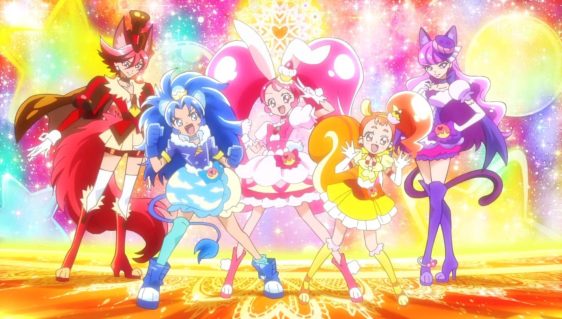
Kira Kira Precure a la Mode follows Usami Ichika, a middle school girl who enjoys baking. Learning of a nefarious force that creates havoc by stealing the very deliciousness of desserts—their kira kiraru (sparkles)—Ichika’s resistance is rewarded with the ability to become one of the warriors of legend known as Precure. As Cure Whip, she is joined by other friends and Cure allies to save the sweets, and by extension the world.

Aesthetic themes found in Precure are developed to varying degrees from one show to the next. While Go! Princess Precure directly asks what it means to be a princess and makes this a major narrative focus, Yes! Pretty Cure 5 is a bizarrely eclectic mix. There are butterflies? And dreams? And they fight an otherworldly corporation? But Precure a la Mode goes all-in. The heroes are all based on desserts. Their attacks include chocolate swords and whipped cream. The villains are trying to corrupt pastries and snacks. There’s even a recipe of the week most episodes, and the kids at home can learn how to make all of them! By the end, the show posits the notion that the love and kindness that comes with wanting to bake tasty treats for others can act as an antidote for malice and apathy. A generous claim, perhaps, yet the surest sign that this anime is wholly dedicated to its pro-baking message. It can be a bit ridiculous at times, but I prefer this over not developing the theme enough.

The core cast of Cures is pleasantly varied without falling too hard into generic five-man team syndrome, but their differences are not limited to just their standard color-coded contrasts. While all of them are involved in baking, each of them comes to it in unique ways resulting from what drives each of them. Ichika wants to make people happy through baking. Arisugawa Himari (Cure Custard) is a student of the science of baking, and wants others to appreciate the chemical magic that goes into cakes and cookies. Tategami Aoi (Cure Gelato) is more focused on her dream of being a rock star, but sees baking as a similar space for her passion. Kotozume Yukari (Cure Macaron) excels in nearly everything she does, but her inability to make perfect macarons becomes her opportunity to challenge herself. Kenjou Akira (Cure Chocolat) is the handsome and caring type, who bakes as an extension of her personality, as well as a way to treat her sickly little sister to something delicious. Later additions to the cast, especially a darkly snarky villain named Vibry (or Bibury, if you prefer) further add to the cornucopia of characters that highlight the series.

The Cures complement each other well overall, but special attention should be paid to Yukari and Akira. First, their personalities are rather rare in Precure. Yukari’s wry cleverness makes her almost an anti-trope character, frequently figuring out tricks and traps that the typical magical girl heroine would fall for in any other series. Akira is pretty much a Takarazuka Revue star transplanted into the world of Sunday morning children’s cartoons. Second, both are in high school as opposed to middle school, which is the typical age range of Precure girls. Third, though never stated 100% outright, it’s clear that there’s some shared romantic feelings between the two, with episodes dedicated to their trying to understand each other. While Precure is known for its significant yuri fanbase, these two bring it up a notch by combining multiple franchise-defying aspects together.

Overall, Kira Kira Precure a la Mode is a strong and solid entry into the Precure canon. It doesn’t quite hit the extraordinary highs of some of the franchise’s absolute best, but it’s definitely enjoyable from week to week, carries nice messages about how everyone’s unique, and even pushed that yuri envelope judge a smidge further than expected. It’s capable of appealing to the absolute newcomers as well as those with long-time experience, almost like a perfect chocolate chip cookie—simple, yet profoundly effective.

Love and Lust. Return to Genshiken: Volume 7

Volume 7 is the point where Genshiken starts focusing much more heavily on Ogiue’s story, for better or worse (guess which side I’m on!). As the only character at this point who has a powerfully emotional backstory (though I wouldn’t have minded learning about the others in their younger days), it makes sense, even if it pulls the manga away from its more laid-back origins.

What is Return to Genshiken?

Genshiken is an influential manga about otaku, as well as my favorite manga ever and the inspiration for this blog, but it’s been many years since I’ve read the series. I intend to re-read Genshiken with the benefit of hindsight and see how much, if at all, my thoughts on the manga have changed.

Note that, unlike my chapter reviews for the second series, Genshiken Nidaime, I’m going to be looking at this volume by volume, using both English and Japanese versions! I’ll also be spoiling the entirety of Genshiken, both the first series and the sequel, so be warned.

Volume 7 Summary

It’s the dawn of a new age for Genshiken, as Ohno now leads the club. However, an awkward scene with Kuchiki drives away all prospective members, aside from Sasahara’s sister Keiko (who doesn’t even attend the school). This means the balance of the club has shifted to actually have more women than men.

Ogiue’s troubles are only beginning, as she finds out she’s been accepted for Comic Festival. Given her outward hatred of fujoshi, the idea that she’ll be putting out a BL doujinshi frightens her. However, thanks to a pep talk by Ohno, she begins to move forward, though Ohno also uses this as an opportunity to get Ogiue into some mildly skimpy cosplay. Sasahara sees this, and later begins to fantasize about Ogiue, and the other girls in the club (including Keiko!) pick up on the small, yet smoldering sparks between the two.

Ohno and Kasukabe begin plotting to get the two closer, which ends up with her bringing her American friends, Angela Burton and Susanna “Sue” Hopkins, to ComiFes as a way to get Sasahara and Ogiue to be at the event together alone. The two actually begin to hit it off (to the point that it overwhelms Ogiue a little), but a chance encounter with two hometown women from Ogiue’s past—people she hesitantly calls “friends”—clearly induce emotional anguish in her. A confusing moment with Sue at first helps Ogiue calm down, only for her to flash the most hardcore page from Ogiue’s own doujinshi in front of Sasahara—the last person she wanted to show it to.

Sasahara, meanwhile, has his own non-romantic troubles, namely being unable to find work. He’s decided to pursue a career in manga editorial, but keeps getting rejected. Finally, he lands at a dedicated freelance editorial company and uses his experience with Kugayama and Ogiue to finally land a job.

The volume ends with Ohno and Kasukabe setting up a club trip to the resort town of Karuizawa, where they intend to finally get Sasahara and Ogiue together.

Is Kuchiki “Okay?”

Kuchiki’s character is being “that guy”: the one whom the other members barely tolerate because they don’t want to drive out because they either 1) don’t want to get too aggressive 2) have empathy for someone so socially awkward. It’s an understandable situation for anyone who’s had experience with a social circle full of dorks.

Given what’s happened with women and the rising tide against sexual harassment, however, Kuchiki’s character becomes increasingly hard to swallow. It’s not just that he’s got lascivious behavior, and it’s not just that he fails to respect personal space, but that he actively tries to creep on the girls, including attempting to peep on them bathing. Even Nidaime, with its female-centric cast, shows the ladies of Genshiken pretty much enduring Kuchiki’s existence and waiting for him to graduate.

I don’t fault Genshiken for this, simply because it does a good job of reflecting the reality of anime clubs in the 2000s and before. Not only is Kuchiki portrayed as being too spineless to actually threaten them, but it’s not like Genshiken rewards or praises the character. And yet, I have to wonder if a socially conscious series made in 2018 would even let him through the front door, so to speak.

Kuchiki’s not all bad, as he does try to defend Ohno’s cosplay from that one thief, but it’s arguably just an example of having a worse villain make a milder one look better. Sasahara sticking up for him and treating him like a human being does help Kuchiki grow a little bit, but is Sasahara’s kindness accidentally a form of complicity? It’s made more complex by the fact that it’s also one of Sasahara’s best qualities, and what helps him get his editor job. A later chapter in Nidaime has an in-love Ogiue praising this very quality of Sasahara, and even here in Volume 7 you can see her being somewhat smitten by that accepting demeanor. It’s perhaps the fate of the moderate force to sometimes not do enough.

Ogiue’s Right to Love

Volume 7 is where the layers of Ogiue begin to peel away, revealing not just a self-hating fujoshi, but one marred by trauma. The first time I read this volume, it wasn’t entirely clear where it would go, but re-reading while fully aware of Ogiue’s past actually makes it kind of heartbreaking. Her anxieties creep to the surface in many of her interactions, and as her feelings for Sasahara get stronger, it’s clear how much her experiences weigh on her mind.

One of the big moments comes when Ogiue is talking to Ohno about having to make a doujinshi for ComiFes. In it, she directly mentions that she’s drawn doujinshi before, and that she hates herself for being a fujoshi. Looking back, the idea that Ogiue has experience drawing more extreme material only makes sense, but I recall it being a bit of a revelation back when I first read it. This conversation is also the first true indication of Ogiue and Ohno having become friends. Before that, there was still a noticeable amount of animosity between them, and I believe here is where it begins to die down a bit.

Ogiue’s blushing profusely as Sasahara smiles at her is incredibly adorable but also complicated. You can feel the inner turmoil raging inside of her as she questions whether she should be happy. Also, I think her switch from a Haregan [i.e., not-Full Metal Alchemist] doujinshi to a Mugio x Chihiro Kujibiki Unbalance one is an early sign of her secret Sasahara x Madarame drawings.

The Society for the Study of Getting Turned On

There’s something very real and refreshing about the way Genshiken portrays sexual desire. The fact that it’s not limited to the male characters also means Genshiken goes a long way in showing women as beings with sexual desire. The approach isn’t like the hyper-eroticism of a fanservice series or a pornographic title and it doesn’t revel in the lasciviousness of its characters carnal wants, but it also doesn’t shy away from showing their libidos at work in public and private contexts.

Nothing shows this better than when Kasukabe drags Kohsaka off so that they can “do it ten times.” Immediately after, Keiko informs her brother that she’s not staying over that night, and Madarame decides it’s his cue to leave too. Keiko and Madarame, having the hots for Kohsaka and Kasukabe respectively, are clearly thinking similarly about how to “remedy” the situation in private. You can practically feel their hormones being barely contained.

Then the manga cuts to Sasahara playing an erogame while thinking about Ogiue in cosplay. It implies that he’s going the same route as his little sister and Madarame, but the fact that he’s thinking about Ogiue (and not Kasukabe) is significant. The Ogiue cosplay moment happens in the previous chapter, which means Sasahara had Ogiue on his mind the entire time. Let’s also not forget that the guys in the club were willing to use the other girls as masturbatory material, so this shows how much Ogiue’s been encroaching on Sasahara’s psyche. This obviously isn’t the first sign that Sasahara’s into Ogiue, but it certainly is one of the most vivid. Later, when they have a ComiFes planning meeting with Ohno, Sasahara’s brief glances at Ogiue show much his mind’s image of Ogiue still persists.

Angela and Sue
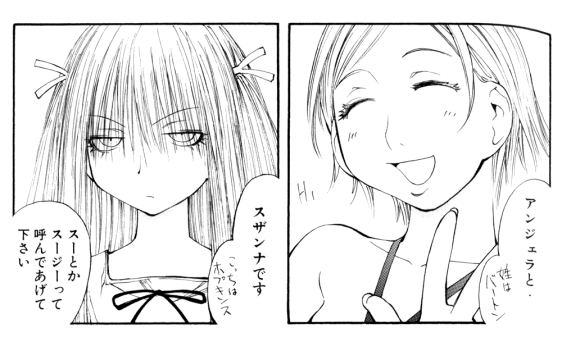
As we know from the end of Nidaime, Madarame eventually ends up with Sue. It’s kind of funny that he’s the first guy she meets in Genshiken, as if it was all a long play into the most classic of romance tropes.

I always found Angela and Sue to be fairly realistic, if exaggerated portrayals of American fangirls, but I think that it’s become even more the case as time has passed. Maybe it’s my greater exposure due to social media like Twitter, but Angela’s willingness to just announce her fetishes without hesitation seems not that unusual. Then again, Yoshitake from Nidaime is built from a similar cloth; the only difference is maybe level of sexual experience (Angela is clearly sexually active, while Yoshitake is very much not).

In Volume 7, Sue has a certain grumpiness about her, even as she becomes attached to Ogiue. However, Ogiue is pretty surly herself. I wonder if the softening up of Ogiue leads to Sue becoming less harsh as well.

It’s also funny to think about the fact that, at the time of Genshiken, Sue’s combination of Asuka reference (“Anta baka?”) and Ruri reference (“Baka bakka”) was like, anime nerd knowledge 101. Now, I think it wouldn’t be unusual for the typical fan, Japanese or otherwise, to not have it click immediately.

Final Random Thoughts

The between-chapter specials this volume include Sasahara and Madarame discussing preliminary Kujibiki Unbalance designs. Those drawings are clearly from a younger Kio Shimoku, as it’s the same style as the first chapter of Genshiken! Kio’s aesthetic changes are amusingly visible as a result.

As Sasahara is thinking dirty things about Ogiue, there’s a Gundam model kit box in the background. I think it’s a Sazabi.

In Sasahara’s job interview, he talks about how Kujibiki Unbalance has changed so much since the original cast graduated, to the point that it doesn’t even feel it’s the same series anymore. At the time, it feels like it might have been referencing the graduation of Madarame, Kugayama, and Tanaka, but now it seems to reflect Genshiken Nidaime even more—almost as if Kio doubled down on this idea for the sequel. We know he’s a guy who likes to get referential with his series, but I wonder if Nidaime is even more meta than any of us realized.

Down-Home Food Therapy: Atari no Kitchen

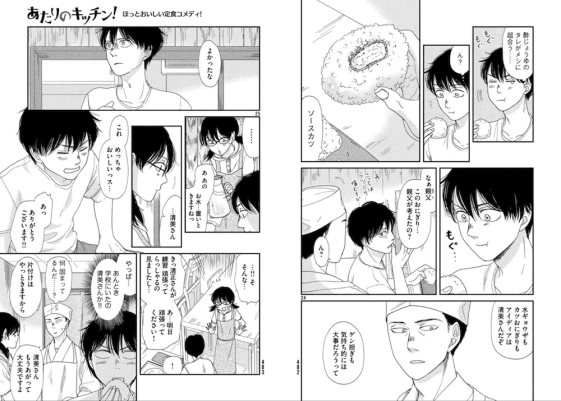
I enjoy food manga in all its forms. I was even quoted on the back of the English release of Sweetness & Lightning Volume 1! But within the Afternoon manga family is another food series I’m enjoying. Called Atari no Kitchen!, it follows a college-aged woman who starts working at a small, family-owned restaurant and helps to inspire dishes that are just right for each customer.

Atari no Kitchen! is very similar to manga such as Bartender and La Sommelière, where the food experts act almost like doctors prescribing particular spirits for each individual’s problems. Where I enjoy Atari no Kitchen! more is in its focus on food instead of alcohol. I have nothing against spirits, but their differences are much more subtle and alien to me, making their assumed effects much less relatable on a personal level. To put it succinctly, I’ve consumed far more food than alcohol in my life, and it makes this series easier to understand.

Because the setting for Atari no Kitchen! is a small restaurant (think of where Soma from Food Wars!: Shokugeki no Soma comes from), the dishes are not fancy foie gras or blowfish, but foods meant for working-class families to enjoy. For example, one chapter involves trying to find a better menu for the son of the restaurant owner, who’s set to participate in a sports event. Usually, he eats katsu, as a classic pun on the Japanese word for “win,” katsu (勝つ), but Kiyomi reads that katsu is pretty heavy and oily, and so doesn’t digest as efficiently as one might want for physical activity. So, she sets out to make a more balanced menu that still carries the flavor and spirit of pork cutlets. I think this is easy to understand and envision, even if someone’s never eaten a katsu in their life.

Kiyomi herself is also adorable, and I would be lying if I said she didn’t charm the socks off of me. The son, Kiyomasa, is also clearly smitten with her. It’s not exactly a romance series, but the fact that their names are so similar (they even start with the same kanji!) tells me that their feelings will grow as the series continues.

If you can read Japanese, you can find it on sale wherever Japanese books are sold. If not, it is a Kodansha title, so there’s always a chance it’ll get translated someday. Let’s hope!

Aikatsu Stars! Christmas 2017 Thoughts

I was asked to talk about the Aikatsu Stars! 2017 Christmas episode, so here I am!

Christmas isn’t the utter juggernaut of a holiday in Japan as it is in the United States, but it’s still celebrated in its own way: as a time for romance and appreciation. It’s not uncommon to see anime and manga feature Christmas stories, notably the many shoujo series where dates happen on and around December 25th. In some cases, series can be long enough Christmas episodes themselves become annual traditions, and this is the case with Aikatsu! Apparently, they even sing “We Wish You a Merry Christmas” every year:

As a Christmas-focused story, episode 87 of Aikatsu Stars! stands out to me for a few reasons. Generally, with these seasons-long children’s anime, the Christmas episodes are pretty self-contained. Maybe it’ll be about meeting Santa, or just having fun with friends. With Aikatsu Stars!, there’s a surprising amount of overall narrative progression. It’s not like they’re throwing revelations left and right, but the fact that M4 (the series’ premier male idol group) is branching off into their own solo careers is kind of a big deal. That there was some romantic development between perennial cat(-like) girl Saotome Ako and M4 member Kiri Kanata is also notable.

I only watch Aikatsu Stars! on and off, so I didn’t realize that Kizaki Rei is from New York City. As someone who just stopped by Rockefeller Center to see the giant tree right before Christmas, and as someone who kind of takes its presence for granted, I found the show’s presentation of it as this stand-out example of “Christmas around the world!” charming. If there’s one thing AIkatsu! has done right that many other series haven’t, it’s having more non-Japanese characters.

Aikatsu Stars! (and Aikatsu! in general) is that it really is in its own world when it comes to idol anime, or magical girl(ish) anime. Other series will be fun and wacky, or they might be a bit serious, but there’s rarely the almost Saved by the Bell-esque feel you find in Aikatsu! Even when the anime are literally about idols using their singing to defeat galactic empires, it lacks that particular brand of mild absurdity that permeates AIkatsu!. This is why Aikatsu Stars! is the sort of anime that could either go episodic forever or rapidly develop into an elaborate story at any moment, and both are equally welcome. Perhaps the Christmas episodes are indicative of that balance of story advancement and self-contained amusement.

This post was sponsored by Johnny Trovato. If you’re interested in submitting topics for the blog, or just like my writing and want to support Ogiue Maniax, check out my Patreon.

Gattai Girls 8: “Shingu: Secret of the Stellar Wars” and Moriyama Nayuta [Anime Secret Santa]

Introduction: The above title might seem like a confusing mess. The reason is that this post originally began as my annual review for the Reverse Thieves’ Anime Secret Santa, only for me to realize it also qualified for my ongoing Gattai Girls review series—posts dedicated to looking at giant robot anime featuring prominent female characters due to their relative rarity within that genre. So it’s a double special!

Here, “prominent” is primarily defined by two traits. First, the female character has to be either a main character (as opposed to a sidekick or support character), or she has to be in a role which distinguishes her. Second, the female character has to actually pilot a giant robot, preferably the main giant robot of the series she’s in.

 Overview

In the year 2070, middle school student and small-town resident Murata Hajime witnesses an extraterrestrial attack. To his surprise, Hajime’s neighbors in his town of Tenmo barely flinch, not even when a mysterious floating titan appears to stop the invader. It’s the beginning of a new life for Hajime, especially when he gets to know two of his classmates tied closely to the secrets of Tenmo: new transfer student Subaru Muryou and student vice-president Moriyama Nayuta.

2001’s Shingu: Secret of the Stellar Wars is an eclectic series. Also known as Gakuen Senki Muryou (“Record of School Wars Muryou”), Shingu combines science fiction mystery, small-town suspense, and everyday school life in a way that makes its continued enigmas consistently satisfying, even when it withholds answers. While the teasing of revelations and the subsequent disappointment of their reveals can often tank even the mightiest of works, Shingu always says just enough and encourages the use of imagination to fill in the blanks without feeling like a cop-out.

The deftness by which Shingu lays out it mysteries can be seen in one of the first scenes, when Muryou shows up for his first day of class in a school uniform. While this seems perfectly normal, it turns out that school uniforms haven’t been a thing for decades. Immediately, Muryou is shown to be unusual by placing him in an environment where what we perceive to be typical, i.e. school uniforms, simply isn’t. It’s an effect also used in the manga Coppelion to convey the uncanny quality of its main characters. The only explanation given is that Muryou got the uniform from his grandfather as a way to blend in, which puts Muryou potentially out of time, or at least sheltered from the world.

Moriyama Nayuta

It’s actually difficult to pin down a true “main character” for the series. Based on the English title, it sounds like Nayuta is the central protagonist, due to the fact that she can transform into the titular Shingu. However, the Japanese title centers on Muryou, who is a major catalyst in the narrative. And while Hajime can come across as a generic audience stand-in, his seeming blandness actually plays an important role in the series, as his ability to go with the flow and keep and open mind are key to humanity’s development. Because this is a Gattai Girls entry, I’m going to focus more on Nayuta and how her role as the Shingu works in the anime.

Nayuta feels cut from the same tsundere cloth as Evangelion‘s Asuka, especially when contrasting her with another female character, the taciturn Mineo. Nayuta has a not-so-secret crush on Hajime and sports the signature hairstyle of the tsundere, the twintails, but she’s not solely defined by those traits. Bullheaded, hardworking, and always eager to do the right thing, Nayuta’s closer in kindred spirit to Sonoda Umi from Love Live!, at least if Umi had the ability to transform into an alien behemoth.

Incidentally, Nayuta is not voiced by the tsundere master, Kugimiya Rie. Instead, Kugimiya plays a different character, Hajime’s adorable little sister Futaba, with Nayuta being played by Park Romi. Shingu is one of many series where Park and Kugimiya work together, perhaps most famously Full Metal Alchemist.

The fact that each of the trio fulfills a very different role, with Hajime and Muryou generally providing support for Nayuta, also means that she is rarely ever overshadowed in battle. As for the Shingu itself, it’s is an unusual design—a hollow vessel resembling paper that is then “filled out” by taking control of a nearby energy source or element such as water. It feels more reminiscent of the monsters found in series like Evangelion and RahXephon, with a dash of Ultraman thrown in. Aesthetically, the Shingu comes across as a combination of the alien other and beings from Japanese folklore, like a science fictional shikigami or tsukumogami.

Overall

Director Satou Tatsuo is more well-known for the series Martian Successor Nadesico, and much of the humor and interaction there can be found in Shingu. However, its mix of SF and the everyday also results in something that feels like the anti-Evangelion. Both Shingu and Eva focus on a trio of middle school students who have varying access to special abilities and must fend off unknown alien-like attackers. Both can arguably fall into the sekai-kei genre—stories where the personal struggles of the individual manifest into global consequences and where often the fate of the world is tied to the relationship between a boy and a girl. But Shingu is also more than just “boys and girls”; it’s about community and history, and the ability for humanity to learn and grow. Shingu: Secret of the Stellar Wars nonchalantly moves from one unexpected place to another, varying in scale from local to cosmic, and believing in people along the way.

Ogiue Maniax Discusses Anime NYC on the Speakeasy Podcast


In addition to my con report of Anime NYC, I also sat down with Kate and Al from the Reverse Thieves to discuss New York’s latest anime convention

Teikoku State of Mind: Anime NYC 2017

When a brand-new convention decides to call itself “Anime NYC,” it’s practically asking to have the deck stacked against it. Running a first-year convention is no small task, doubly so if it’s in the heart of Manhattan. And with no reputation to go by, potential attendees may feel reluctant to try things out. Small attendance numbers can mean a lack of overall interest and the inability to justify the high costs of NYC, while large numbers means a greater chance of disaster striking if mismanaged. As a longtime resident of New York City, I’ve seen cons come and go, but somehow, someway, Anime NYC went so swimmingly that I almost can’t believe it was real.

General Impressions and Exhibitor’s Hall

Those who attended New York Anime Festival and the first few New York Comic Cons might recall what it was like to go through the Jacob Javits Center without feeling like sardines. Walking through Anime NYC felt reminiscent of that environment, as the con was fairly heavily populated but with plenty of elbow room to spare. Panel rooms were right next to the Exhibitor’s Hall, making transitions between checking out the goods and listening in on industry and fan talks. Special events were held in a Main Event Hall that was a fair distance away, though nowhere near as disorienting as, say, the Baltimore Convention Center where Otakon used to take place.

Because it was so easy to navigate (without the space feeling overly empty), I came out of the three-day con feeling satisfied yet unstressed. Usually one comes with the other due to the hustle and bustle of trying to get everything done, or because there’s so little to do at the event itself that boredom and lethargy set in. Anime NYC struck a Goldilocks-type balance with a schedule that thrilled but did not overwhelm body and mind.

A major contrast between Anime NYC and NYCC is that the latter is focused on being a general comics pop culture event, with a film and television presence that all but overshadows the “comic” in comic con. Anime NYC, on the other hand, is first and foremost concerned with anime and manga. A few features branched out from that core, such as the presence of Overwatch voice actors who were there to meet the fans and sell autographs, but this was certainly no “anime ghetto,” as fans took to calling New York Anime Fest when it began to be dissolved into NYCC.  For those who love anime and love a big convention feel but think New York Comic Con’s a bit too much, Anime NYC has potential to be a gathering point for anime fans in the tri-state area.

Concerts

Anime NYC featured two concerts that shone in different ways. The first was Anime Diva Night, while the second was the Gundam Thunderbolt Concert.

At Anime Diva Night, three Japanese musical guests performed as part of the Anisong World Matsuri. Two of the singers, Ishida Yoko and TRUE, are amazing vocalists in their own right, but the third, Yonekura Chihiro, was the reason I wanted to attend. She’s the voice of so many amazing anime themes over the years that it almost doesn’t compare. Notably, she sang the opening and ending themes to Mobile Suit Gundam 08th MS Team.

While having Yonekura alone would’ve sufficed in my case, all three did a wonderful job. Some singers sound significantly better in the recording booth than they do onstage, but this was not the case for the Anime Diva trio, who sounded incredible even though the makeshift Main Events Hall did not have ideal acoustics.

The concert had a somewhat unusual format. Rather than move from one act to the next, each performer would do a few songs, perform a duet with another, and then the newer singer would take over before the next duet. There were two rotations in total, with all three singers performing together at the start and end of the show. All of the group performances were cover songs of popular anime themes—”Cruel Angel’s Thesis,” “Moonlight Densetsu,” “God Knows,” etc.—while the solo acts were their signature songs. Yonekura did indeed sing the Gundam 08th MS Team opening, but also an old favorite of mine in “Will” from the anime Hoshin Engi (aka Soul Hunter). Highlights from the other two singers included TRUE performing the first Sound!! Euphonium opening and Ishida doing arguably her most famous song, “Otome no Policy” from Sailor Moon R.

There were a couple of songs that didn’t make the concert that I was hoping for: Yonekura’s “Yakusoku no Basho e” from Kaleido Star and Ishida’s “White Destiny” from Pretear, but it was a small loss for an otherwise amazing concert.

The Gundam Thunderbolt Concert was highly unusual compared to what typically happens at an anime con performances. Generally, they’re closer to Anime Diva Night, sounding like the j-pop or j-rock one expects out of anime. To have the Gundam Thunderbolt composer Kikuchi Naruyoshi lead a jazz band himself on saxophone was a truly rare treat, and it’s one of the most unique experiences I’ve had at an anime con. The closest equivalent I could think of was Kanno Yoko’s concert at Otakon 2013.

I am no jazz aficionado, but thanks to the concert, I felt as if I began to understand the almost primal appeal that jazz holds for listeners. As I listened, an analogy popped into my head: jazz is like constructing a human being from music. They can be loud one moment and quiet the next. They can be a mess of contradictions, yet still function. I’m unsure if this will send me towards checking out more jazz in the future, but my curiosity is definitely piqued.

I’ve been more or less referring to the Gundam Thunderbolt Concert as a “jazz performance,” but that’s not entirely accurate. To everyone’s surprise, the concert also included performances by the singers of some of the 50s/60s-style pop songs from the Gundam Thunderbolt anime. In the context of the series, the two main characters, Io and Daryl, are two soldiers on opposite sides of a war who each listen to music as they battle. Io is an intense man who loves equally powerful jazz, while the handicapped Daryl prefers softer ballads.

At the Gundam Thunderbolt panel, Kikuchi mentioned that these are basically his two favorite genres of music, and he thought both fit the characters well. Interestingly, while the Gundam Thunderbolt manga included jazz already, Kikuchi composed entirely new songs that he felt fit Io’s character better.

One funny coincidence of sorts when it comes to Kikuchi’s choice to add a golden oldies aspect to the Gundam Thunderbolt score is that one of the biggest names in classic mid-20th-century American pop, Neil Sedaka, once composed the theme songs to Mobile Suit Z Gundam in the 1980s. I’d be curious to know what Kikuchi would think about this.

Artist Alley

More than Exhibitors’ Halls, Artist Alleys at cons can be affected heavily by the space they occupy. Regardless of the artists’ skills, or the amount of people in the alley, a bad space can make an attendee want to leave as quickly as possible, while a good space encourages more browsing and exploring.

Anime NYC’s is probably the best I’ve ever seen. Held on the top floor of the Jacob Javits Center, natural light shined down on the entire Artist Alley from an entirely windowed roof. At times, it almost felt like an outdoor European boutique, which made it just a pleasant place to peruse.

I purchased a few items at the Artist Alley, mainly from Japanese artists (something of a rarity even at anime cons). One booth was ran by the wife and assistant (pictured above) of manga artist Ohno Junji, creator behind the manga for obscure titles Mobile Suit Gundam: Missing Link and Mobile Suit Gundam The Origin MSD: Cucuruz Doan’s Island. Unfortunately, the artist couldn’t attend himself. They were selling art packages from Ohno himself and his assistant, Ally Suwabe:

Ohno Junji

Ally Suwabe

Axel Rex is Ohno’s original web comic he drew for Kodanasha/Yahoo!! Comics from 2008 to 2009.

The other Japanese artist attending was Tatsuyuki “Mikey” Maeda, who’s worked for the past 10 years as a manga assistant. In a way, while manga artists themselves only attend cons sparingly, their assistants are even rarer. Maeda was selling a short guide called “Secrets of Manga: Basics of the Tools & Trade.” In it, he gives various technical tips to aspiring manga creators, the kinds of things that often get glossed over in favor of “character design” and “how to draw mecha.” The guide talks about differences in pen nibs (such as what you should use if you have a light touch vs. a heavy hand), how to effectively use white-out, and more. I highly recommend it.

Panels

Gundam Thunderbolt Panel

Panels are an important part of the con experience for me, though due to my schedule I could not attend as many as I would have liked. Still, the Gundam Thunderbolt panel was highly informative, as were the Inifini-T Force and LeSean Thomas panels.

Infini-T Force is a current 3DCG anime series crossing over the classic heroes of Tatsunoko Production—Gatchaman, Casshan/Casshern, Hurricane Polymar, and Tekkaman. The fact that Tatsunoko, one of the most influential anime studios ever, had a con presence at all was the main reason I decided to attend their panel. Overall, it was a fairly basic introduction to Tatsunoko, but I like that they conveyed a bit of the studio’s historical significance. They’re one of the most influential studios ever, pushing the limits of animation in Japan since their inception in the 1960s. They were also willing to discuss a bit of the reception Infini-T Force has received in Japan, such as the fact that the primary female character is a little contentious to Japanese audiences. This is also somewhat unusual for Japanese companies, and was somewhat refreshing.

The LeSean Thomas panel was a general Q&A, but was one of the highlights of Anime NYC. It was inspiring to see attendee after attendee express how Thomas inspired them to keep working at their art, and how his success as a creator of color gave them the courage to never give up. I previously interviewed him at Otakon 2016, and he does make for an excellent role model.

Cosplay

In this case, I’ll let the pictures speak for themselves:

In Conclusion

Given how much I’ve praised Anime NYC, it might seem like I’m a paid shill, but I assure my readers that this is not the case. The con was actually executed so smoothly that there’s little I can complain about that would be the fault of the convention itself. While I attended for free as press, even the weekend ticket was affordable, especially compared to New York Comic Con ($60 vs. over $200 to buy four 1-day NYCC passes).

At approximately 20,000 attendees, Anime NYC has already become one of the larger anime cons in the US. The convention appears to have done a sound job of attracting locals, and I’m curious to see how much more it can grow. If the convention keeps up this level of quality, I’d be happy and proud to call Anime NYC “home.”


Return to Genshiken: Volume 6 – Eyes as Black as the Abyss

Volume 6 of Genshiken is probably my favorite volume of manga ever. I think I’ve re-read it more than any other, so coming back to it for “Return to Genshiken” is almost like visiting an old friend.

At this point, it feels almost unnecessary to call it a transitional volume because it feels like every volume brings a major shift or two. This time, I’d say there are two especially significant events: the graduation of the old guard, and the first full dive into Ogiue’s head.

What is Return to Genshiken?

Genshiken is an influential manga about otaku, as well as my favorite manga ever and the inspiration for this blog, but it’s been many years since I’ve read the series. I intend to re-read Genshiken with the benefit of hindsight and see how much, if at all, my thoughts on the manga have changed.

Note that, unlike my chapter reviews for the second series, Genshiken Nidaime, I’m going to be looking at this volume by volume, using both English and Japanese versions of Genshiken! I’ll also be spoiling the entirety of Genshiken, both the first series and the sequel, so be warned.

Volume 6 Summary

Ogiue decides to try her hand at drawing a doujinshi for Comic Festival, but only after a series of wacky/traumatic mishaps. From cosplay to drawings of Sasahara and Madarame to getting caught red-handed with a bag full of doujinshi at ComiFes itself, Ogiue’s grudging acknowledgement of her fujoshi side is the very definition of reluctant. What’s more, Kasukabe thinks Ogiue has a twinkle in her eye for Sasahara, and refuses to believe otherwise.

Meanwhile, Keiko tries to get into Shiiou University despite years of neglecting her own education, Madarame has a nervous non-date with Kasukabe, and the classic trio of dudes finally graduate from college. Ohno feels a twinge of sorrow, but that’s eventually wiped away when she becomes the new president of Genshiken, with the hope of bringing about a true Society for the Study of Cosplay.

End of an Era, Dawn of a New Age

Madarame, Tanaka, and Kugayama are all classic images of otaku. Out-of-shape, awkward, and filled with trivia, they’re firmly in the camp of nerds who can never pass as “cool.” All three stick around to varying degrees for the rest of the first series and even in the sequel, but the fact that these “big children” are entering into the adult world is important for the tone of Genshiken. While all have made strides in previous volumes in different areas—girls, artistic progress, life in general—their graduation in hindsight feels like the moment when “more” might just be possible. They, and especially the younger members, are poised to break through the boundaries of the otaku identity, if only a little.

The buildup to graduation is filled with emotion. For example, when Madarame runs into Kasukabe chatting with friends on campus, a combination of his powerful crush on her and his general social awkwardness causes him to snub her. It’s such a painfully relatable scene, especially with how Kasukabe’s friendly “hello” gesture throws Madarame completely off guard. How could Kasukabe actually be that friendly? When did she even get that way? While re-reading Genshiken has helped me to see this change more readily, I recall it feeling almost out-of-nowhere the first time around.

Another moment comes from Ohno, who has a cloud of melancholy hanging overhead prior to the guys’ graduation. The reason is that, because she came back from abroad, she has to do an extra year at the university, and thus will graduate a year after Sasahara, Kasukabe, and Kohsaka. It’s a heartfelt moment where Ohno and Kasukabe grow even closer, albeit with Kasukabe promising to fulfill a cosplay request that she’ll eventually regret. What makes this moment hilarious in hindsight is that, as saddened as Ohno is here, she ends up delaying her graduation multiple times throughout Nidaime because she just doesn’t want to face adult society. Like Kasukabe, Ohno changes quite a bit over the course of Genshiken, sometimes so gradually that it’s notice. That doesn’t apply here, though, as Volume 6 is also when Ohno agrees to become the new Genshiken president so that she can shape it in her own cosplay-loving image. Later in Volume 9, Ohno even makes a comment that her character appears to have changed at some point, referencing her transformation from meek token girl otaku to confident motherly type.

Ogius Maximus

This volume is chock full of premium Ogiue content. It’s a constant barrage of scowls, dreams created and destroyed, misunderstandings, and burgeoning romance. What’s especially telling about Ogiue’s prominence is that we’re privy to her inner thoughts to a degree only a few other prominent characters share, such as Sasahara and Madarame. She has a brief moment in Volume 5, but this time it’s entire extended internal monologues that lay bare the true Ogiue lurking within.

  We have Ogiue going to Comic Festival incognito, i.e. half a chapter devoted to showcasing Ogiue’s mix of anger towards others, anger at herself, and the sense that she just really want friends but is her own worst enemy. As she stomps through Tokyo Big Sight in her winter coat and high school-era glasses, a snarly pout adorning her face, you can see her giving into her basest desires, mirroring Sasahara’s first voyage to ComiFes (though this is certainly not Ogiue’s first rodeo). When Ogiue’s hovering around the rest of the club, the lonely look she gives as they laugh over in the distance is almost heartbreaking. The subsequent silliness of her bumping into Ohno and having her doujinshi spill out of her bag for all the world to see is dramady at its finest. In other words, Genshiken.

The breakdown of Ogiue’s defenses is a recurring theme in this volume, seen not only in her ComiFes disaster but also in her very first cosplay. Kasukabe, having noticed that Ogiue’s a little weak to pressure, uses this opportunity to try and get Ogiue to open up. Ogiue dressed as Renko from Kujibiki Unbalance is probably her most iconic moment. Not only has it been replicated on multiple occasions across various anime adaptations and decorative covers, but it’s the subject of Ogiue’s only full PVC figure (which I own, yes).

Sasa x Ogi Continues

In Volume 5, there’s a moment that I believe is the subtle beginning of Ogiue’s obsession with Sasahara x Madarame, and by extension the catalyst for her eventually falling for Sasahara. In Volume 6, Kasukabe’s actions nudge it towards greater prominence.

In one of the doujinshi planning scenes, Haraguchi reveals that he’s already made plans for Genshiken’s book (he wants to turn it into a big seller by bringing on a ton of high-profile guest artists). Sasahara keeps trying to politely refuse Haraguchi’s “kindness,” as his tendency as a non-confrontational person. However, as Haraguchi keeps pushing and pushing, eventually Sasahara’s expression grows stern (similar to how he reacts to his own sister). He puts his proverbial foot down, saying, “I will personally call all the guest artists you brought on board (without my consent) and turn them down.”

It’s potentially easy to miss, but immediately afterwards there’s a small panel with an Ogiue closeup, and she has the ever-so-slightest blush on her face. Without later context, it can just seem like she’s surprised or shocked at Sasahara’s change of behavior, but now it’s clear to me that this was the catalyst for her perception of Sasahara as a a “seme” character, and also her eventual attraction to him.

Back when I first read Genshiken, I was actually mildly skeptical towards the idea that Ogiue was interested in Sasahara just because Kasukabe said so. Both on a personal level and as a consumer of fiction, I’d groan at these situations. Just because someone looks at someone else once or twice didn’t mean romance is in the air!

Those situations still get overblown in my opinion, but as I’ve re-read Genshiken, it’s clear to me that the hints were there. It’s not that Ogiue is madly in love with Sasahara from the start, but that she begins to notice his finer qualities, and this grows into something more. This, I believe, is what Kasukabe truly notices, even if she misinterprets Ogiue’s drawing of Sasahara as aggressive top as a more typical from of affection.

Kasukabe really is the “matchmaker” of Genshiken, or maybe she just loves goading potential/existing couples. Whether it’s grilling Tanaka and Ohno, or it’s getting Madarame to quit waffling and pick a girl, her thrill at seeing her nerd friends get somewhere is actually one of Kasukabe’s most charming qualities.

The Ogiue Maniax Moment

The top image in this post is probably favorite Ogiue scene ever. It’s where my original banner came from, and I’ve used it in posts such as “Explaining Decompression in Comics.” As Ogiue thinks about the logistics of a Sasahara x Madarame relationship, her mind wanders down deeper and darker rabbit holes. She tries to pull herself away, but she can’t. In an entire volume where page after page of Ogiue’s piercing eyes is like manna from heaven, this is like the main course.

Keiko Shows Substance

Ogiue and Keiko meet for the first time in this volume, and it’s hilarious to see how antagonistic they were at the time. Keiko softens up to everyone over time, even her older brother, but there’s just a certain pleasure I derive from seeing Keiko eventually call Ogiue “onee-chan.” She’s marrying her brother and Ogiue in her head before everyone else. But I’m getting ahead of myself.

Volume 6 is probably almost as big a deal for Keiko fans as it is for Ogiue fans; it’s when Keiko really begins to turn a new leaf. Even if we learn in the next volume that her attempts to get into Shiiou University are fruitless, and that she quits college entirely by Nidaime, she’s genuinely trying to be more than just a dumb, shallow girl. I get the feeling a lot of Keiko lovers wouldn’t be so keen on her if she had never changed, but that’s the magic of Genshiken.

Mebaetame Amateur Figure Hour

Starting this volume of Genshiken, the between-chapters extras get creative. This time around, it’s Tanaka’s blog where he shows off his design and construction of a figure from Kujibiki Unbalance. The most amazing thing about this is that it’s made using real photographs of an actual constructed figure. This then later factors into the end-of-volume special, when Tanaka accidentally drops the figure and breaks it. Someone actually built it for real, and I don’t think we’ll ever know if it was Kio himself, an assistant, or an acquaintance. Did he actually break his own constructed figure for the sake of a gag, or was there a stunt double?

Final Random Thoughts

This is the last we see of Kitagawa, the Club Council vice president. She ends up marrying her senpai. I kind of wish we saw where she was in Nidaime, but she was always a pretty minor character. On a personal note, I knew a guy who really liked Kitagawa, but he passed away a few years ago. Rest in Peace, Cortana.

At graduation, someone is reading the end of Part 1 of the Kujibiki Unbalance manga. The pages shown are meant to be an indication of how far the story has gone, as characters portrayed as enemies earlier in the series are now getting married.

Kujibiki Unbalance in Volume 3

Kujibiki Unbalance in Volume 6

The end-of-volume special also features the crew hanging out post-graduation, and in one instance Sasahara and Madarame are checking the girls out. I like that there’s pretending that they don’t notice how attractive their clubmates are, though obviously they don’t say anything out loud. What sticks out to me here is Sasahara getting a little hot and bothered by Ogiue in a skirt. With Kasukabe, who’s dressed to kill in a short skirt and pantyhose, it feels like he’s seeing her as just “an attractive lady.” But with Ogiue, she’s wearing a pretty subdued outfit and a pretty long skirt. I’d like to think it’s that spice of beginning to actually have feelings for another, which turns even plain clothes into thrilling adventures in fantasy. In Volume 7, Sasahara really lets his imagination run wild, but that’s for next time.

The World is My Canvas, and Competition is my Art: Splatoon 2 Thoughts

The video game that has most occupied my attention lately is Splatoon 2. This comes as no personal surprise, seeing as I loved the hell out of the first one. The gameplay is mostly similar to its predecessor. The changes are mostly about quality of life. But even though both games are so similar, for some reason I find myself experimenting with the different weapons more in Splatoon 2.

My preferred weapon hasn’t changed since the first game: the N-Zap, modeled after the classic Zapper light gun from the NES. For me, t’s gone from a tool for Hunting Ducks to a jack-of-all trades tool whose relative lack of power can be made up for with smart movement and positioning. It’s also just accurate enough for me to effectively focus my fire, while still being forgiving enough to compensate for the fact that my aim is not that great. In Splatoon 2, the ability for it to quickly ink the ground synergizes well with the Ink Armor special, which temporarily lets the entire team take a few extra hits and survive. The N-Zap lets me support allies up close and from afar, and it fits like a glove. Finding the right weapon is just plain satisfying.

But much like characters in a good fighting game, the variety of weapons available, many quite different from each other, is part of the allure of Splatoon 2. Even if some weapons feel counterintuitive, there’s a certain thrill to trying to get into the right mindset for any given tool. When you’re using the Sloshing Machine, a bucket that launches spiraling volleys of ink, the focus is on using its overwhelming power and arching property to quickly kill, er, “splat” your opponent in unexpected places. Dualies are relatively short-range John Woo pistols that allow for unique evasive maneuvers. The Splat Brella is like a shotgun with as defensive shield, allowing players to pick off opponents while guarding allies.

Even weapons of the same class can be wildly different. The Dynamo Roller is the equivalent of trying to Falcon Punch everyone all the time, while the Carbon Roller focuses on mobility and turf coverage at the expense of battle strength. Sometimes using a different weapon means almost playing a different game, and every time I turn My Splatoon 2 on, I think, “Do I stick with the familiar, or try to transform my mind with another item?” Both ways are fun, doubly so when patches try to make everything worth using.

One of the major changes between Splatoon and Splatoon 2 is that the new special weapons–super moves, in other words–are significantly weaker. Where once they could flip a game upside down due to their sheer power, now they influence games in subtler, less pronounced ways. I think this might end up putting more emphasis on the main and sub weapons themselves, which contributes to weapon experimentation also being more fun.

In the end, gameplay is great, and all the modes are worth playing. My only complaints are shoddy Wi-Fi on the Switch (a common problem for the console), and the lack of the Squid Girl promotional outfit from the first Splatoon shirt.

No, really, give me my Ika Musume threads.